


 |
市場調查報告書
商品編碼
2122814
聚烯(PO)收縮膜:市場佔有率分析、產業趨勢與統計、成長預測(2026-2031)Polyolefin (PO) Shrink Films - Market Share Analysis, Industry Trends & Statistics, Growth Forecasts (2026 - 2031) |
||||||

※ 本網頁內容可能與最新版本有所差異。詳細情況請與我們聯繫。
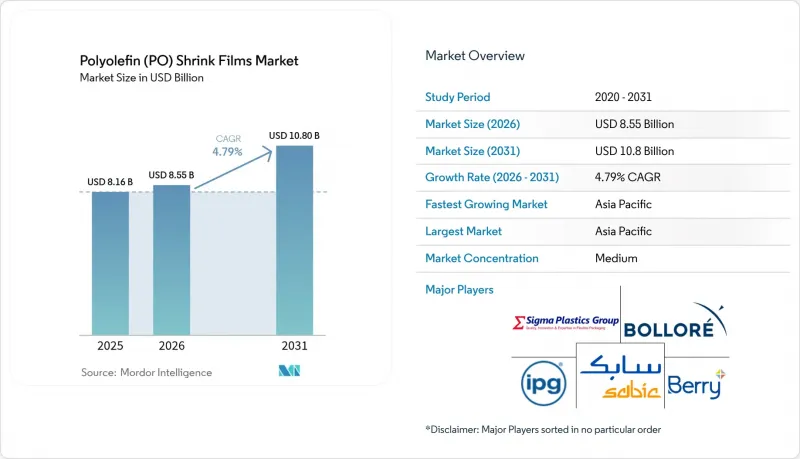
預計聚烯(PO)收縮膜市場將從2025年的81.6億美元成長到2026年的85.5億美元,到2031年將達到108億美元,2026年至2031年的複合年成長率為4.79%。
本報告按「類型」(普通收縮膜和交聯收縮膜)、「材料」(聚乙烯和聚丙烯)、「層級構造」(單層和多層)、「應用」(食品飲料、工業包裝等)和「地區」(亞太地區、北美地區、歐洲地區等)對產業進行分類。市場預測以美元計價。
全球聚烯(PO)收縮膜市場趨勢及洞察
北美電子商務對防篡改薄膜的需求
電子商務的蓬勃發展推動了對具有防篡改功能的聚烯(PO) 收縮膜的需求成長,以保護運輸途中的貨物。北美零售商正採用此類薄膜來保護產品並建立消費者信任,其中 78% 的線上購物者將視覺防篡改功能放在首位。 Intertape Polymer Group 的 ExlfilmPlus PCR 是一款含有 35% 回收材料的聚烯收縮膜,滿足了安全性和永續性的需求。薄膜兼具高透明度和源自廢棄產品的回收材料,有效解決了電子商務包裝中的難題。
歐洲食品接觸薄膜從PVC到POF的過渡
為了因應2024年4月生效的包裝相關法律(旨在2030年減少5%的廢棄物),歐洲食品製造商正轉向使用可回收的聚烯薄膜。同時,英國、西班牙和義大利也推出了塑膠稅,對再生材料含量低於30%的薄膜徵收罰款。 Kryser的「EV-HPG」薄膜已獲得「門市回收」認證,充分展現了加工商如何在食品安全、透明度和可回收性之間取得平衡。
PE和PP樹脂的價格波動
美國頁岩原料供應中斷進一步加劇了原料價格的波動,而原料成本佔成品薄膜成本的70%之多。經合組織警告稱,到2040年,塑膠產量可能達到7.36億噸,預計將加劇原料競爭。加工商正透過從多個供應商採購、縮短樹脂合約期限以及採用將消費後再生樹脂顆粒與原生樹脂混合的配方來規避風險。
細分市場分析
2025年,通用收縮膜憑藉其價格優勢和廣泛的加工條件,在聚烯收縮膜市場佔據了53.20%的最大市場佔有率。由於其透明性和易於印刷的特性,該細分市場已在超級市場中廣泛用於食品多件包裝和促銷組合。然而,加工商正擴大提案交聯等級的收縮膜,這些收縮膜具有抗穿刺性、耐磨性和更薄的壁厚,從而能夠提高生產線速度,同時避免包裝損壞。
受藥品泡殼包裝、盒裝化妝品和電子設備中熱敏內容物對低溫密封保護的需求推動,交聯產品的產量預計將在2026年至2031年間以6.55%的複合年成長率成長。亞洲和北美產能的擴張正在縮小價格差異,並加速聚烯收縮膜市場從傳統展示應用領域轉型為其他領域。
聚乙烯憑藉其透明度和成本優勢,在2025年仍將佔據聚烯(PO)收縮膜市場56.40%的主導佔有率。多層聚乙烯共混物已成為堆疊式飲料罐包裝和農產品托盤的標準材料,因為即使在較短的烘烤時間內,它們也能確保氣密性。加工商目前正在採用消費後回收(PCR)材料,以符合品牌的循環經濟計劃,同時又不影響產品的光學性能。
聚丙烯 (PP) 預計到 2031 年將以每年 6.92% 的速度成長,這主要得益於其高剛性、化學惰性和高耐熱變形溫度等特性,這些特性對於蒸餾食品和醫療用品至關重要。一種新型五層共擠出機將 PP 與彈性體連接件共混,在提高撕裂強度的同時保持了光澤度。這種優質配方使加工商能夠在聚烯(PO) 收縮膜市場中與同質化的聚乙烯 (PE) 產品區分開來。
區域分析
預計到2025年,亞太地區將佔全球銷售額的37.60%,成為聚烯收縮膜市場的主要驅動力,預計複合年成長率(CAGR)為6.82%,仍位居全球最快成長地區之列。在中國,成熟的擠出企業正與跨國日常消費品(FMCG)包裝製造商建立合作關係;而在印度,隨著都市區零售業的蓬勃發展,對硬質包裝的需求也隨之激增。區域加工商正積極配備內部無版數位印刷設備,以便快速進行自有品牌促銷宣傳活動,以充分利用國內電子商務市場的快速成長。
日本和韓國正致力於阻隔性多層薄膜技術,為出口型製藥業者提供專用的交聯捲膜。國內市場則主要需求是適合小型廠房空間且相容自動化生產的薄膜。產業協會正向節能型收縮烘箱的研發管道提供稅額扣抵,以促進其在聚烯收縮膜市場的應用。
北美市場成熟且創新主導,這得益於美國全通路零售生態系統的支持。加拿大和墨西哥接近性樹脂生產基地,並透過享有優惠關稅的貿易走廊補充了區域供應,使該地區更能抵禦價格波動。
歐洲在嚴格的法律規範和強大的購買力之間保持平衡。 《循環經濟指令》強制要求加工商獲得可回收性認證,向消費後再生塑膠(PCR)混合物的過渡正在推進,目標是在2027年完成。德國、義大利和英國是主要的需求中心,因為它們是飲料、糖果甜點和藥品的主要生產國。隨著零售連鎖店在歐盟範圍內統一包裝規格,南歐和東歐成員國正逐步迎頭趕上。
南美洲、中東和非洲雖然規模較小,但日益成為極具吸引力的新興市場。巴西憑藉其強大的石化產業基礎,向南方共同市場成員國供應產品。同時,沙烏地阿拉伯的「2030願景」正在推動對下游聚合物產業的投資,從而將聚烯(PO)收縮膜市場範圍擴大到波灣合作理事會(GCC)成員國。
其他好處:
- Excel格式的市場預測(ME)表
- 3個月的分析師支持
目錄
第1章:引言
- 研究假設和市場定義
- 調查範圍
第2章:調查方法
第3章執行摘要
第4章 市場狀況
- 市場概覽
- 市場促進因素
- 在北美,電子商務對防篡改包裝的需求不斷成長,加速了小體積包裝的使用。
- 在歐洲,食品接觸薄膜領域正逐漸從PVC轉向環保型POF。
- 對高品質印刷和品牌推廣的需求
- 與替代方案相比的成本效益
- 亞洲領先的高速生產線:自動化薄壁交聯薄膜
- 市場限制因素
- PE和PP樹脂價格的劇烈波動擾亂了美國頁岩原料的供應。
- 歐洲各地針對一次性塑膠製品徵收的稅金主要針對收縮包裝。
- 厚度減小和收縮力之間的權衡限制了大型工業包裝的廣泛應用。
- 價值鏈分析
- 波特五力模型
第5章 市場規模與成長預測
- 按類型
- 通用收縮膜
- 交聯收縮膜
- 材料類型
- 聚乙烯(PE)
- 聚丙烯(PP)
- 按層級構造
- 單層
- 多層
- 透過使用
- 食品/飲料
- 工業包裝
- 個人護理化妝品
- 製藥
- 印刷/文具
- 其他用途
- 按地區
- 亞太地區
- 中國
- 印度
- 日本
- 韓國
- 其他亞太國家
- 北美洲
- 美國
- 加拿大
- 墨西哥
- 歐洲
- 德國
- 英國
- 義大利
- 法國
- 其他歐洲國家
- 南美洲
- 巴西
- 阿根廷
- 其他南美國家
- 中東和非洲
- 沙烏地阿拉伯
- 南非
- 其他中東和非洲國家
- 亞太地區
第6章 競爭情勢
- 市場集中度
- 策略趨勢
- 市佔率分析
- 公司簡介
- Allen Plastic Industries Co., Ltd.
- Berry Global Inc.
- Bollore Group
- Bonset America Corporation
- Clysar, LLC
- Cosmo Films
- Coveris
- FlexiPack
- Innovia Films
- IPG
- Harwal Group of Companies
- Hubei HYF Packaging Co., Ltd.
- Kaneka Corporation
- Klockner Pentaplast
- Polyplex Corporation
- SABIC
- Sealed Air Corporation
- Sigma Plastics Group
- SYFAN USA
- Traco Packaging
- Winpak Ltd.
第7章 市場機會與未來展望
According to Mordor Intelligence, the polyolefin shrink films market size is expected to grow from USD 8.16 billion in 2025 to USD 8.55 billion in 2026 and is forecast to reach USD 10.8 billion by 2031 at 4.79% CAGR over 2026-2031.
This report Segments the Industry by Type (General Shrink Film and Cross-Linked Shrink Film), Material Type (Polyethylene and Polypropylene), Layer Structure (Monolayer and Multilayer), Application (Food and Beverage, Industrial Packaging, and More), and Geography (Asia-Pacific, North America, Europe, and More). The Market Forecasts are Provided in Terms of Value (USD).
Global Polyolefin (PO) Shrink Films Market Trends and Insights
E-commerce tamper-evidence demand in North America
E-commerce growth has driven demand for tamper-evident polyolefin shrink films to secure products during transit. North American retailers use these films to protect goods and build consumer trust, with 78% of online shoppers valuing visible tamper-evidence. Intertape Polymer Group's ExlfilmPlus PCR, a polyolefin shrink film with 35% recycled content, addresses security and sustainability needs. The film combines high clarity with post-consumer recycled content, meeting e-commerce packaging challenges.
PVC-to-POF switch in European food-contact films
European food manufacturers pivot towards recyclable polyolefin films after April 2024 packaging legislation targeting a 5% waste reduction by 2030 . Parallel plastic taxes in the UK, Spain and Italy penalize films with under 30% recycled content. Clysar's Store-Drop-Off-qualified EV-HPG illustrates how converters combine food safety, clarity and recyclability.
PE & PP resin price volatility
Shale-feedstock disruptions in the United States heighten raw-material swings that already represent up to 70% of finished film cost. The OECD warns that plastic production may hit 736 million tonnes by 2040, intensifying feedstock competition. Converters hedge risks via multi-sourcing, shorter resin contracts, and recipes that dilute virgin inputs with PCR pellets.
Other drivers and restraints analyzed in the detailed report include:
- High-definition printing & branding
- Cost advantage over alternatives
- Single-use-plastic levies on over-wrap
For complete list of drivers and restraints, kindly check the Table Of Contents.
Segment Analysis
General shrink film held the largest 53.20% polyolefin shrink film market share in 2025, underpinned by affordability and wide processing windows. The segment's clarity and ease of printing keeps it entrenched in food multipacks and promotional bundles across supermarkets. Yet converters increasingly upsell cross-linked grades where puncture resistance, scuff holdout and thinner profiles allow faster line speeds without wrap failure.
Cross-linked output is forecast to grow at a 6.55% CAGR from 2026 to 2031 as pharmaceutical blister bundles, boxed cosmetics and electronics seek lower sealing temperatures that protect heat-sensitive contents. Expanded capacity in Asia and North America narrows the price delta, encouraging switchovers that stretch the polyolefin shrink film market beyond traditional displays.
Polyethylene maintained a commanding 56.40% stake within the polyolefin shrink film market size in 2025, driven by transparency and cost competitiveness. Multi-layer PE blends permit tight seals even at low oven dwell times, making them a staple in beverage can dernests and produce trays. Processors now incorporate PCR streams to comply with brand circularity pledges without diluting optical properties.
Polypropylene is expected to rise 6.92% annually to 2031, buoyed by higher stiffness, chemical inertness and elevated heat-deflection points desirable for retorted foods and medical kits. New five-layer co-extruders co-blend PP with elastomer tie layers, retaining gloss while boosting tear resistance. This premium mix separates converters from commoditised PE offerings within the polyolefin shrink film market.
Complete Report Scope:
- By Type
- General Shrink Film
- Cross-Linked Shrink Film
- By Material Type
- Polyethylene (PE)
- Polypropylene (PP)
- By Layer Structure
- Monolayer
- Multilayer
- By Application
- Food & Beverage
- Industrial Packaging
- Personal Care & Cosmetics
- Pharmaceutical
- Printing & Stationery
- Other Applications
- By Geography
- Asia-Pacific
- China
- India
- Japan
- South Korea
- Rest of Asia-Pacific
- North America
- United States
- Canada
- Mexico
- Europe
- Germany
- United Kingdom
- Italy
- France
- Rest of Europe
- South America
- Brazil
- Argentina
- Rest of South America
- Middle East and Africa
- Saudi Arabia
- South Africa
- Rest of Middle East and Africa
- Asia-Pacific
Geography Analysis
Asia Pacific dominated the polyolefin shrink film market with 37.60% revenue contribution in 2025, and its projected 6.82% CAGR remains the fastest globally. China's entrenched extruder base partners with multinational FMCG packers, while India's rigid packaging boom responds to urban retail growth. Regional converters foster in-house plateless digital presses, enabling swift private-label promotion campaigns that capture domestic e-commerce surges.
Japan and South Korea focus on high-barrier multilayer technology, supplying niche cross-linked rolls for export pharmaceuticals; domestic demand leans on automation-ready thin gauges that fit compact factory footprints. Association grants channel R&D tax credits toward energy-efficient shrink ovens, reinforcing adoption inside the polyolefin shrink film market.
North America constitutes a mature yet innovation-led arena powered by the United States' omnichannel retail ecosystem. Canada and Mexico complement regional supply through proximity to resin production and tariff-favoured trade corridors, anchoring resilience against price swings.
Europe balances stringent regulatory oversight with high purchasing power. Circular economy directives push converters to certify recyclability and shift toward PCR blends by 2027. Germany, Italy and the United Kingdom represent core demand clusters owing to strong beverage, confectionery and pharmaceutical output. Southern and Eastern member states gradually catch up as retail chains harmonise packaging briefs across the bloc.
South America and the Middle East & Africa present smaller but increasingly attractive frontiers. Brazil leverages a robust petrochemical base to serve Mercosur neighbours, while Saudi Arabia's Vision 2030 encourages downstream polymer investments that extend the reach of the polyolefin shrink film market into Gulf Cooperation Council markets.
- Allen Plastic Industries Co., Ltd.
- Berry Global Inc.
- Bollore Group
- Bonset America Corporation
- Clysar, LLC
- Cosmo Films
- Coveris
- FlexiPack
- Innovia Films
- IPG
- Harwal Group of Companies
- Hubei HYF Packaging Co., Ltd.
- Kaneka Corporation
- Klockner Pentaplast
- Polyplex Corporation
- SABIC
- Sealed Air Corporation
- Sigma Plastics Group
- SYFAN USA
- Traco Packaging
- Winpak Ltd.
Additional Benefits:
- The market estimate (ME) sheet in Excel format
- 3 months of analyst support
TABLE OF CONTENTS
1 Introduction
- 1.1 Study Assumptions & Market Definition
- 1.2 Scope of the Study
2 Research Methodology
3 Executive Summary
4 Market Landscape
- 4.1 Market Overview
- 4.2 Market Drivers
- 4.2.1 E-commerce demand for tamper-evident wrap accelerating small-pack use in North America
- 4.2.2 Shift from PVC to eco-safer POF in European food-contact films
- 4.2.3 Demand for High-Quality Printing and Branding
- 4.2.4 Cost-Effectiveness Compared to Alternatives
- 4.2.5 Automation-ready thin-gauge cross-linked films driving high-speed lines in Asia
- 4.3 Market Restraints
- 4.3.1 Escalating PE & PP resin price volatility caused shale-feedstock disruptions in US
- 4.3.2 Single-use-plastics taxes across Europe targeting shrink over-wrap
- 4.3.3 Trade-off between downgauging & shrink force limiting adoption in heavy-duty industrial packs
- 4.4 Value Chain Analysis
- 4.5 Porter's Five Forces
- 4.5.1 Bargaining Power of Suppliers
- 4.5.2 Bargaining Power of Buyers
- 4.5.3 Threat of New Entrants
- 4.5.4 Threat of Substitutes
- 4.5.5 Degree of Competition
5 Market Size & Growth Forecasts (Value)
- 5.1 By Type
- 5.1.1 General Shrink Film
- 5.1.2 Cross-Linked Shrink Film
- 5.2 By Material Type
- 5.2.1 Polyethylene (PE)
- 5.2.2 Polypropylene (PP)
- 5.3 By Layer Structure
- 5.3.1 Monolayer
- 5.3.2 Multilayer
- 5.4 By Application
- 5.4.1 Food & Beverage
- 5.4.2 Industrial Packaging
- 5.4.3 Personal Care & Cosmetics
- 5.4.4 Pharmaceutical
- 5.4.5 Printing & Stationery
- 5.4.6 Other Applications
- 5.5 By Geography
- 5.5.1 Asia-Pacific
- 5.5.1.1 China
- 5.5.1.2 India
- 5.5.1.3 Japan
- 5.5.1.4 South Korea
- 5.5.1.5 Rest of Asia-Pacific
- 5.5.2 North America
- 5.5.2.1 United States
- 5.5.2.2 Canada
- 5.5.2.3 Mexico
- 5.5.3 Europe
- 5.5.3.1 Germany
- 5.5.3.2 United Kingdom
- 5.5.3.3 Italy
- 5.5.3.4 France
- 5.5.3.5 Rest of Europe
- 5.5.4 South America
- 5.5.4.1 Brazil
- 5.5.4.2 Argentina
- 5.5.4.3 Rest of South America
- 5.5.5 Middle East and Africa
- 5.5.5.1 Saudi Arabia
- 5.5.5.2 South Africa
- 5.5.5.3 Rest of Middle East and Africa
- 5.5.1 Asia-Pacific
6 Competitive Landscape
- 6.1 Market Concentration
- 6.2 Strategic Moves
- 6.3 Market Share Analysis
- 6.4 Company Profiles (includes Global level Overview, Market level overview, Core Segments, Financials as available, Strategic Information, Market Rank/Share for key companies, Products & Services, and Recent Developments)
- 6.4.1 Allen Plastic Industries Co., Ltd.
- 6.4.2 Berry Global Inc.
- 6.4.3 Bollore Group
- 6.4.4 Bonset America Corporation
- 6.4.5 Clysar, LLC
- 6.4.6 Cosmo Films
- 6.4.7 Coveris
- 6.4.8 FlexiPack
- 6.4.9 Innovia Films
- 6.4.10 IPG
- 6.4.11 Harwal Group of Companies
- 6.4.12 Hubei HYF Packaging Co., Ltd.
- 6.4.13 Kaneka Corporation
- 6.4.14 Klockner Pentaplast
- 6.4.15 Polyplex Corporation
- 6.4.16 SABIC
- 6.4.17 Sealed Air Corporation
- 6.4.18 Sigma Plastics Group
- 6.4.19 SYFAN USA
- 6.4.20 Traco Packaging
- 6.4.21 Winpak Ltd.
7 Market Opportunities & Future Outlook
- 7.1 White-space & Unmet-Need Assessment
- 7.2 Rising demand for eco-friendly and recyclable shrink films.

 RPETG收縮膜市場:全球市場預測,2026-2032年PE VCI收縮膜市場:全球市場預測,2026-2032年PET VCI收縮膜市場:全球市場預測,2026-2032年PP VCI收縮膜市場:全球市場預測,2026-2032年
 防霧聚烯收縮膜市場規模、佔有率和成長分析:按聚烯類型、薄膜結構、收縮類型、應用、終端用戶產業和地區分類-產業預測,2026-2033年收縮膜市場-2026-2032年全球市場預測
 2026年全球卷材收縮膜市場報告阻隔收縮膜市場:2026-2032年全球市場預測(依材料、包裝類型、產品、應用及最終用戶產業分類)
 聚烯收縮膜市場報告:按產品、終端用途產業和地區分類(2026-2034 年)
 全球收縮膜市場:市場規模、需求及預測(2034 年)