


 |
市場調查報告書
商品編碼
2122798
導電聚合物:市場佔有率分析、產業趨勢與統計、成長預測(2026-2031)Conductive Polymers - Market Share Analysis, Industry Trends & Statistics, Growth Forecasts (2026 - 2031) |
||||||

※ 本網頁內容可能與最新版本有所差異。詳細情況請與我們聯繫。
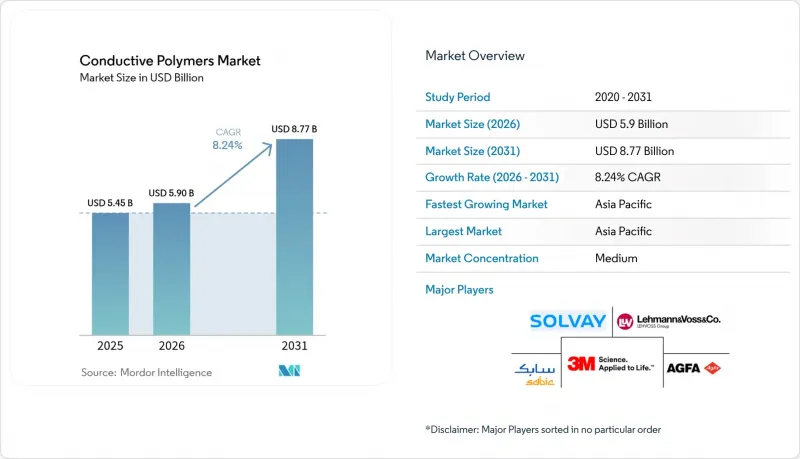
據 Mordor Intelligence 稱,導電聚合物市場預計到 2026 年價值 59 億美元,高於 2025 年的 54.5 億美元,預計到 2031 年將達到 87.7 億美元。
預計從 2026 年到 2031 年,其複合年成長率將達到 8.24%。
本報告按聚合物類型(本徵導電聚合物 (ICP)、本徵耗散聚合物 (IDP) 及其他)、類別(共軛導電聚合物、電荷轉移聚合物及其他)、應用(產品組件、防靜電包裝、物料輸送及其他)、終端用戶行業(電氣和電子設備、汽車和電動汽車及其他)以及地區(亞洲市場細分、北美及其他)細分地區(亞洲地區及其他)。市場預測以美元計價。
全球導電聚合物市場趨勢及洞察
電動車和家用電器對輕質電磁干擾屏蔽材料的需求激增。
電動車產生的電磁干擾比內燃機汽車更高。傳統的金屬屏蔽會增加重量並縮短續航里程,因此原始設備製造商 (OEM) 正在指定使用輕質導電聚合物。這使得組件品質最多可減少 28%,同時保持相同的屏蔽效果。在智慧型手機中,由於 5G 電路更靠近天線,製造商選擇使用聚合物屏蔽,這樣可以在不影響訊號品質的前提下,實現更薄的設備壁。亞太地區受益最大,因為該地區擁有全球大部分電動車電池和行動電話組裝。歐洲汽車製造商也正在採用類似的解決方案來滿足車輛排放氣體法規的要求。為消費性電子設備創建的設計庫現在正被應用於汽車平台,從而加速了跨產業的應用。
電子商務正在推動防靜電包裝的普及。
隨著每年數十億件電子設備從線上履約中心發出,對防靜電包裝的需求日益成長。物流業者報告稱,自從引入聚合物內襯信封後,靜電相關產品的退貨率下降了37%。北美地區的需求也不斷擴大,該地區的小包裹量持續成長。亞太地區的出口商也正在效仿這些舉措,以滿足買家的特定需求,進一步擴大了導電聚合物市場。
加工成本高,機械韌性有限
要使聚合物具有類似金屬的導電性,通常需要進行酸洗和溶劑交換等後處理流程,這會使生產成本比傳統塑膠增加高達23%。機械疲勞仍然是一個挑戰,因為高摻雜結構在反覆彎曲下容易開裂。汽車製造商通常會添加增強添加劑,但這會增加重量,抵消部分優勢。研究小組正在探索以彈性體基體包裹導電區域以平衡性能,但制定降低成本的藍圖是實現大規模應用的關鍵。
細分市場分析
截至2025年,導電塑膠佔導電聚合物市場的44.60%。這是因為擠出和射出成型成型設備已完成折舊,使得數千噸為規模的經濟型生產成為可能。這些聚合物符合筆記型電腦機殼和汽車感測器支架的電磁干擾(EMI)標準,從而支持其在成熟應用領域的擴張。預計到2031年,本徵導電聚合物將以8.42%的最高複合年成長率成長,這主要得益於穿戴式醫療設備和共形天線對更高單位克導電性的需求。諸如氣相聚合等加工技術的進步正在降低缺陷密度,並縮小與金屬的性能差異。
具有固有耗散特性的聚合物在工廠環境和半導體生產線中佔據著獨特的應用領域,它們透過快速靜電放電來防止微損傷。其他類型的聚合物包括奈米碳填料和熱塑性聚氨酯相結合的混合複合複合材料,這種材料可用於製造可拉伸電路。隨著技術的不斷進步,導電聚合物市場預計將逐步從一般塑膠轉向高價值的ICP配方,同時仍將保持廣泛的價格敏感應用。
共軛導電聚合物憑藉其可靠的合成方法和室溫穩定性,預計到 2025 年將佔據導電聚合物市場佔有率的 40.10%。這些聚合物可用作顯示器中的透明電極和用於照護現場診斷的有機電化學電晶體中的活性層。
儘管離子導電聚合物的市場規模較小,但由於其能夠同時承載電子和離子電荷,因此正以8.72%的複合年成長率快速成長。這項特性對於生物界面和固態電池至關重要。電荷轉移聚合物則用於需要特定氧化還原電位的感測器。導電填料聚合物在中等導電性的抗靜電托盤中仍保持成本競爭力。
區域分析
預計到2025年,亞太地區將佔據導電聚合物市場45.70%的佔有率,並在2031年之前以9.05%的複合年成長率成長,這主要得益於電子製造群的集中以及政府對電動車的補貼。中國在智慧型手機組裝和電動車電池組的大規模生產方面處於主導,而日本則在高純度聚合物的研發方面處於領先地位。
在北美,美國正透過聯邦稅收優惠政策加速國內電動車生產,提振對輕型屏蔽組件的需求。國防費用資助採用具有獨特導電性的聚合物的共形天線專案。在加拿大航太工業中,可拉伸電路正被應用於飛行安全系統,而墨西哥電動車組裝的出口正在推動區域需求。促進跨境材料流動的貿易協定正在支持市場整合。
在歐洲,受嚴格的車輛排放氣體法規鼓勵減重的推動,市場需求穩定成長。德國在高階電動車的聚合物基電磁干擾抑制解決方案的開發方面處於領先地位。法國航太部門正在尋求用於機載天線的高性能材料。北歐國家對循環經濟的承諾正在促進可回收導電塑膠的發展。歐盟的REACH法規鼓勵採用低揮發性有機化合物(VOC)聚合物製程。東歐的電子產品製造地正在採用防靜電地板材料以滿足全球客戶的審核要求,從而擴大了導電聚合物在歐洲大陸的市場範圍。
其他好處
- Excel格式的市場預測(ME)表
- 3個月的分析師支持
目錄
第1章:引言
- 研究假設和市場定義
- 調查範圍
第2章:調查方法
第3章執行摘要
第4章 市場狀況
- 市場概覽
- 市場促進因素
- 電動車和家用電器對輕質電磁干擾屏蔽材料的需求激增
- 電子商務推動了防靜電包裝的普及。
- 2025年後軟性熱電穿戴產品的廣泛應用
- 採用本徵導電聚合物(ICP)的軍用級共形天線
- 客製化提供了設計柔軟性和廣闊的創新及產品開發可能性。
- 市場限制因素
- 加工成本高,且機械強度有限
- 苯胺和特種單體的價格波動很大。
- 混合複合材料在處置時面臨的回收挑戰。
- 價值鏈分析
- 波特五力模型
第5章 市場規模與成長預測
- 按聚合物類型
- 本徵導電聚合物(ICP)
- 本徵耗散聚合物(IDP)
- 導電塑膠
- 其他
- 尺寸
- 共軛導電聚合物
- 電荷轉移聚合物
- 離子導電聚合物
- 導電填料聚合物
- 透過使用
- 產品組件(EMI外殼、感測器等)
- 防靜電包裝
- 物料輸送(托盤、週轉箱)
- 工作台和地板材料
- 其他
- 按最終用戶行業分類
- 電氣和電子設備
- 汽車和電動旅行
- 航太/國防
- 醫療保健穿戴式裝置
- 其他(工業包裝和物流)
- 按地區
- 亞太地區
- 中國
- 印度
- 日本
- 韓國
- ASEAN
- 其他亞太國家
- 北美洲
- 美國
- 加拿大
- 墨西哥
- 歐洲
- 德國
- 英國
- 法國
- 義大利
- 北歐國家
- 俄羅斯
- 其他歐洲國家
- 南美洲
- 巴西
- 阿根廷
- 其他南美國家
- 中東和非洲
- 沙烏地阿拉伯
- 阿拉伯聯合大公國
- 南非
- 其他中東和非洲國家
- 亞太地區
第6章 競爭情勢
- 市場集中度
- 策略趨勢
- 市佔率分析
- 公司簡介
- 3M
- Agfa-Gevaert Group
- Arkema
- Cabot Corporation
- Celanese Corporation
- Covestro AG
- Dupont
- Eeonyx
- Heraeus Holding
- Lehmann & Voss &Co.
- Parker Hannifin Corp
- PolyOne Corporation
- Premix Group
- RTP Company
- SABIC
- Solvay
- The Lubrizol Corporation
- The Lubrizol Corporation
- Westlake Plastics
第7章 市場機會與未來展望
According to Mordor Intelligence, conductive polymers market size in 2026 is estimated at USD 5.9 billion, growing from 2025 value of USD 5.45 billion with 2031 projections showing USD 8.77 billion, growing at 8.24% CAGR over 2026-2031.
This report is Segmented by Polymer Type (Inherently Conductive Polymers, Inherently Dissipative Polymers, and More), Class (Conjugated Conducting Polymers, Charge-Transfer Polymers, and More), Application (Product Components, Antistatic Packaging, Material Handling, and More), End-Use Industry (Electrical and Electronics, Automotive and E-Mobility, and More), and Geography (Asia-Pacific, North America, and More)
Global Conductive Polymers Market Trends and Insights
Lightweight EMI-Shielding Demand Surging in EV and Consumer Electronics
Electric vehicles emit higher electromagnetic interference than internal-combustion cars. Traditional metal shields add weight that curtails range, prompting OEMs to specify lightweight conductive polymers, which cut component mass by up to 28% while achieving comparable shielding effectiveness. In smartphones, 5G circuitry sits closer to antennas; thus, manufacturers select polymer shields that thin device walls without compromising signal quality. Asia Pacific benefits most because it hosts the bulk of global EV battery and handset assembly lines. European automakers are adopting similar solutions to meet fleet-emission targets. Design libraries created for consumer devices now transfer to automotive platforms, accelerating cross-sector adoption.
E-Commerce-Driven Uptake of Antistatic Packaging
Online fulfilment centres ship billions of electronics each year, heightening the need for static-safe packaging. Logistics providers report 37% fewer static-related product returns after adopting polymer-lined mailers, boosting demand in North America, where parcel volumes continue to rise. Asia Pacific exporters replicate these practices to satisfy buyer specifications, further expanding the conductive polymer market.
High Processing Cost and Limited Mechanical Robustness
Achieving metal-like conductivity in polymers typically requires post-treatment steps such as acid washing or solvent exchange, which lift production costs by as much as 23% relative to conventional plastics. Mechanical fatigue remains a challenge because highly doped structures can crack under repeated flexing. Automakers specify reinforcement additives, but these raise weight and erase some advantages. Research groups are exploring elastomeric matrices that encapsulate conductive domains to balance properties, yet mass-scale adoption hinges on cost-down roadmaps.
Other drivers and restraints analyzed in the detailed report include:
- Flexible Thermoelectric Wearables Adoption Post-2025
- Military-Grade Conformal Antennas Using Inherently Conductive Polymers
- Volatile Aniline and Specialty Monomer Prices
For complete list of drivers and restraints, kindly check the Table Of Contents.
Segment Analysis
Conductive plastics held 44.60% of the conductive polymer market size in 2025 because extrusion and injection-moulding assets are already amortised, allowing economic output at multi-kiloton scale. These polymers meet EMI standards for laptop housings and automotive sensor brackets, supporting expansion across mature applications. Inherently conductive polymers post the fastest 8.42% CAGR through 2031 as wearable healthcare devices and conformal antennas demand elevated conductivity per gram. Processing breakthroughs such as vapor-phase polymerisation lower defect density, narrowing the property gap with metals.
Inherently dissipative polymers maintain a niche in factory floors and semiconductor lines where rapid static bleed-off prevents micro-damage. Other polymer types include hybrid composites that marry nano-carbon fillers with thermoplastic polyurethane, enabling stretchable circuits. Continuous improvements suggest the conductive polymer market will gradually shift from commodity plastics toward higher-value ICP formulations while maintaining a broad base of price-sensitive applications.
Conjugated conducting polymers captured 40.10% of the conductive polymer market share in 2025 due to reliable synthesis protocols and stability under ambient conditions. They function as transparent electrodes in displays and as active layers in organic electrochemical transistors used for point-of-care diagnostics.
Despite their smaller base, ionically conducting polymers expand at a 8.72% CAGR because they carry both electronic and ionic charges, critical for biointerfaces and solid-state batteries. Charge-transfer polymers cater to sensors requiring specific redox potentials. Conductively filled polymers remain cost-competitive for antistatic trays where moderate conductivity suffices.
Complete Report Scope:
- By Polymer Type
- Inherently Conductive Polymers (ICPs)
- Inherently Dissipative Polymers (IDPs)
- Conductive Plastics
- Other Polymer Types
- By Class
- Conjugated Conducting Polymers
- Charge-Transfer Polymers
- Ionically Conducting Polymers
- Conductively Filled Polymers
- By Application
- Product Components (e.g., EMI housings, sensors)
- Antistatic Packaging
- Material Handling (trays, totes)
- Work-surface and Flooring
- Others
- By End-user Industry
- Electrical and Electronics
- Automotive and E-Mobility
- Aerospace and Defense
- Healthcare and Wearables
- Others (Industrial Packaging and Logistics)
- By Geography
- Asia-Pacific
- China
- India
- Japan
- South Korea
- ASEAN Countries
- Rest of Asia-Pacific
- North America
- United States
- Canada
- Mexico
- Europe
- Germany
- United Kingdom
- France
- Italy
- NORDIC
- Russia
- Rest of Europe
- South America
- Brazil
- Argentina
- Rest of South America
- Middle-East and Africa
- Saudi Arabia
- United Arab Emirates
- South Africa
- Rest of Middle-East and Africa
- Asia-Pacific
Geography Analysis
Asia Pacific held 45.70% share of the conductive polymer market in 2025 and is growing at a 9.05% CAGR through 2031, driven by its dense electronics manufacturing clusters and government subsidies for electric mobility. China commands bulk volume in smartphone assembly and EV battery packs, while Japan spearheads high-purity polymer research and development.
In North America the United States accelerates domestic EV production with federal tax incentives, creating upward demand for lightweight shield components. Defence spending channels funds into conformal antenna programmes that specify inherently conductive polymers. Canada's aerospace industry integrates stretchable circuits into cabin safety systems, while Mexico's EV assembly exports augment regional demand. Trade accords facilitating materials flow across borders support market coherence.
Europe exhibits steady uptake supported by stringent vehicle emission limits that reward weight reduction. Germany pioneers polymer-rich EMI solutions in premium EVs. France's aerospace sector demands high-performance grades for in-flight antennas. Nordic initiatives in circular economy favour recyclable conductive plastics. The EU's REACH framework incentivises low-VOC polymer processes. Eastern European electronics manufacturing hubs adopt antistatic flooring to meet global customer audits, expanding the conductive polymer market perimeter within the continent.
- 3M
- Agfa-Gevaert Group
- Arkema
- Cabot Corporation
- Celanese Corporation
- Covestro AG
- Dupont
- Eeonyx
- Heraeus Holding
- Lehmann&Voss&Co.
- Parker Hannifin Corp
- PolyOne Corporation
- Premix Group
- RTP Company
- SABIC
- Solvay
- The Lubrizol Corporation
- The Lubrizol Corporation
- Westlake Plastics
Additional Benefits:
- The market estimate (ME) sheet in Excel format
- 3 months of analyst support
TABLE OF CONTENTS
1 Introduction
- 1.1 Study Assumptions and Market Definition
- 1.2 Scope of the Study
2 Research Methodology
3 Executive Summary
4 Market Landscape
- 4.1 Market Overview
- 4.2 Market Drivers
- 4.2.1 Lightweight EMI-Shielding Demand Surging in EV And Consumer Electronics
- 4.2.2 E-Commerce-Driven Uptake of Antistatic Packaging
- 4.2.3 Flexible Thermoelectric Wearables Adoption Post-2025
- 4.2.4 Military-Grade Conformal Antennas Using Inherently Conductive Polymers (ICPs)
- 4.2.5 Design Flexibility and Huge Scope of Innovation and Product Development Through Customization
- 4.3 Market Restraints
- 4.3.1 High Processing Cost and Limited Mechanical Robustness
- 4.3.2 Volatile Aniline and Specialty Monomer Prices
- 4.3.3 End-Of-Life Recycling Challenges of Hybrid Composites
- 4.4 Value Chain Analysis
- 4.5 Porter's Five Forces
- 4.5.1 Bargaining Power of Suppliers
- 4.5.2 Bargaining Power of Buyers
- 4.5.3 Threat of New Entrants
- 4.5.4 Threat of Substitutes
- 4.5.5 Degree of Competition
5 Market Size and Growth Forecasts (Value)
- 5.1 By Polymer Type
- 5.1.1 Inherently Conductive Polymers (ICPs)
- 5.1.2 Inherently Dissipative Polymers (IDPs)
- 5.1.3 Conductive Plastics
- 5.1.4 Other Polymer Types
- 5.2 By Class
- 5.2.1 Conjugated Conducting Polymers
- 5.2.2 Charge-Transfer Polymers
- 5.2.3 Ionically Conducting Polymers
- 5.2.4 Conductively Filled Polymers
- 5.3 By Application
- 5.3.1 Product Components (e.g., EMI housings, sensors)
- 5.3.2 Antistatic Packaging
- 5.3.3 Material Handling (trays, totes)
- 5.3.4 Work-surface and Flooring
- 5.3.5 Others
- 5.4 By End-user Industry
- 5.4.1 Electrical and Electronics
- 5.4.2 Automotive and E-Mobility
- 5.4.3 Aerospace and Defense
- 5.4.4 Healthcare and Wearables
- 5.4.5 Others (Industrial Packaging and Logistics)
- 5.5 By Geography
- 5.5.1 Asia-Pacific
- 5.5.1.1 China
- 5.5.1.2 India
- 5.5.1.3 Japan
- 5.5.1.4 South Korea
- 5.5.1.5 ASEAN Countries
- 5.5.1.6 Rest of Asia-Pacific
- 5.5.2 North America
- 5.5.2.1 United States
- 5.5.2.2 Canada
- 5.5.2.3 Mexico
- 5.5.3 Europe
- 5.5.3.1 Germany
- 5.5.3.2 United Kingdom
- 5.5.3.3 France
- 5.5.3.4 Italy
- 5.5.3.5 NORDIC
- 5.5.3.6 Russia
- 5.5.3.7 Rest of Europe
- 5.5.4 South America
- 5.5.4.1 Brazil
- 5.5.4.2 Argentina
- 5.5.4.3 Rest of South America
- 5.5.5 Middle-East and Africa
- 5.5.5.1 Saudi Arabia
- 5.5.5.2 United Arab Emirates
- 5.5.5.3 South Africa
- 5.5.5.4 Rest of Middle-East and Africa
- 5.5.1 Asia-Pacific
6 Competitive Landscape
- 6.1 Market Concentration
- 6.2 Strategic Moves
- 6.3 Market Share Analysis
- 6.4 Company Profiles (includes Global Level Overview, Market Level Overview, Core Segments, Financials, Strategic Info, Market Rank/Share, Products and Services, Recent Developments)
- 6.4.1 3M
- 6.4.2 Agfa-Gevaert Group
- 6.4.3 Arkema
- 6.4.4 Cabot Corporation
- 6.4.5 Celanese Corporation
- 6.4.6 Covestro AG
- 6.4.7 Dupont
- 6.4.8 Eeonyx
- 6.4.9 Heraeus Holding
- 6.4.10 Lehmann&Voss&Co.
- 6.4.11 Parker Hannifin Corp
- 6.4.13 PolyOne Corporation
- 6.4.14 Premix Group
- 6.4.15 RTP Company
- 6.4.16 SABIC
- 6.4.17 Solvay
- 6.4.18 The Lubrizol Corporation
- 6.4.19 The Lubrizol Corporation
- 6.4.20 Westlake Plastics
7 Market Opportunities and Future Outlook
- 7.1 White-space and Unmet-need Assessment
- 7.2 Growth in smart textiles and IoT devices fuels need for flexible, conductive materials.

 Polythiophene市場規模、佔有率和成長分析:依產品類型、應用、最終用戶、形態、等級和地區分類-2026-2033年產業預測
 導電聚合物市場:按類型、導電材料、形態、等級、製造技術、應用和最終用途產業分類-2026-2032年全球市場預測
 導電聚合物市場預測——按類型、導電機制、形態、應用、最終用戶和地區分類的全球分析——2034年
 導電聚合物市場規模、佔有率和成長分析:按產品類型、形態、應用、最終用途產業、加工方法、導電類型和地區分類-2026-2033年產業預測導電聚合物市場預測至2034年-全球產品、類型、類別、導電電子、合成流程、技術、應用、最終使用者和地區分析
 導電聚合物市場報告:按產品、應用和地區分類(2026-2034 年)
 PEDOT市場:按聚合物類型、應用和地區分類
 軟性電子產品市場中的導電聚合物:市場機會、成長要素、產業趨勢分析及2026-2035年預測
 智慧塑膠市場規模、佔有率和趨勢分析報告:按產品、最終用途、地區和細分市場預測(2026-2033 年)
 全球導電聚合物市場規模、佔有率、趨勢和成長分析報告(2026-2034)