


 |
市場調查報告書
商品編碼
2122785
擠壓塗布:市場佔有率分析、行業趨勢和統計數據、成長預測(2026-2031)Extrusion Coatings - Market Share Analysis, Industry Trends & Statistics, Growth Forecasts (2026 - 2031) |
||||||

※ 本網頁內容可能與最新版本有所差異。詳細情況請與我們聯繫。
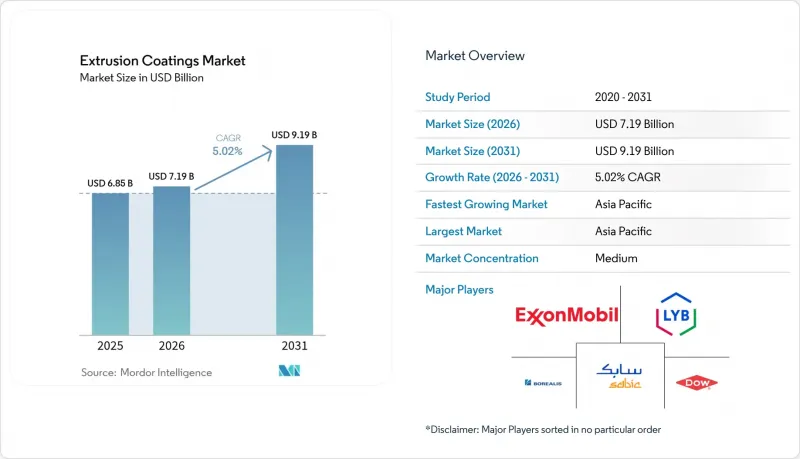
據 Mordor Intelligence 稱,2025 年擠壓塗布市值為 68.5 億美元,預計到 2031 年將達到 91.9 億美元,而 2026 年為 71.9 億美元,預測期(2026-2031 年)的複合年成長率為 5.02%。
本報告按材料(例如聚乙烯、乙烯-醋酸乙烯酯共聚物 (EVA))、基材(例如紙板、瓦楞紙板、聚合物薄膜)、應用(例如液體包裝、軟包裝)、終端用戶行業(例如食品飲料、醫療保健和製藥)以及地區(例如亞太地區、北美)對行業進行細分。市場預測以美元 (USD) 為單位。
全球擠壓塗布市場趨勢與洞察
對液體和軟包裝食品的需求不斷成長
2024年,流質食品紙盒和輕質包裝袋佔據擠壓塗布市場48.95%的佔有率,新興市場冷鏈基礎設施不完善以及品牌商偏好常溫保存型產品,進一步鞏固了這一佔有率。 2024年推出的新型生質能衍生低密度聚乙烯(LDPE)和乙烯-醋酸乙烯酯共聚物(EVA)在維持現有阻隔性能的同時,減少了20%的化石原料用量。包裝製造商正在使用這些樹脂來降低複合材料的厚度和運輸重量,同時又不影響熱封性能。加之植物來源乳製品替代品商店佔有率的不斷成長,預計亞洲和拉丁美洲的銷售量將穩步成長。
電子商務防護包裝處理量激增。
履約中心需要能夠承受自動化成型、高速密封和最後一公里運輸的塗層。採用茂金屬催化劑的聚乙烯(PE)塗層具備此工作流程所需的透明度、滑爽性和抗穿刺性,品牌商也擴大指定使用含有30-50%再生材料的薄膜,同時滿足ASTM運輸跌落測試標準。雖然目前尚缺乏該領域確切的全球銷售數據,但加工商的訂單數據顯示,從2023年起將實現兩位數成長,證實了電子商務是擠壓塗布市場參與企業強勁的需求支柱。
聚烯原料價格劇烈波動
2024年第一季至第四季度,中國乙烯平均合約價格波動超過每噸120美元,對加工商的利潤率帶來壓力,並促使他們轉向現貨採購。雖然一體化生產商正透過內部乙烯供應來緩解價格波動的影響,但中小塗料生產商卻面臨著營運資金緊張的困境,一些企業甚至推遲了對新生產線的投資。儘管期貨合約和策略性庫存在一定程度上緩解了這種不確定性,但原物料價格的不確定性在短期內仍將對擠出塗料市場構成壓力。
細分市場分析
預計到2025年,聚乙烯將佔據擠壓塗布市場42.12%的佔有率,並繼續作為大規模生產的液體和軟包裝的基礎材料。茂金屬觸媒技術的進步正在提升聚乙烯的韌性和光學性能,而化學回收利用有望提供大規模的循環原料供應。目前,一條商業化生產線已實現年產3萬噸,目標是到2026年達到年產50萬噸。乙烯-醋酸乙烯酯共聚物(EVA)正以5.67%的複合年成長率快速成長,憑藉其優異的黏合性和低溫柔柔軟性,在醫療和特種食品應用領域佔據了利基市場。將EVA與低密度聚乙烯(LDPE)混合,也可以製成適用於機械回收流程的單材料層壓結構。聚丙烯、聚對苯二甲酸乙二醇酯(PET)和特殊丙烯酸酯滿足了對耐久性、阻隔性或耐熱性的要求,但就產量而言,它們仍處於次要地位。樹脂的持續創新凸顯了擠壓塗布市場為何能在循環經濟法規日益嚴格的情況下仍保持多樣化的聚合物產品線。
第二波成長浪潮體現在工程共混物上,這些共混物能夠降低密封起始溫度、減少能耗,並與生物製藥產業中基於乙二醇的滅菌循環相容。這些功能改進提高了加工商的轉換成本,並鞏固了聚乙烯在更廣泛的擠壓塗布行業中作為主導樹脂的地位。相較之下,EVA產量的成長正推動亞太地區供應商進行後向整合,以確保VA含量的一致性和食品接觸相容性。
到2025年,紙板和瓦楞紙板將佔擠壓塗布市場52.10%的佔有率,這反映了它們在無菌紙盒和外帶食品容器領域的重要地位。 2025年推出的特殊生物聚合物添加劑將使薄膜厚度減少高達50%,同時保持耐油性,從而幫助品牌商實現其纖維回收目標。聚合物薄膜的複合年成長率(CAGR)為6.34%,受益於生產線速度的提高、薄膜厚度的減小以及在捆紮收縮膜和郵寄膜等領域應用範圍的擴大。流延丙烯酸聚合物(PP)的各種變體如今在透明度和製袋效率方面與BO-PP相當,同時成本降低高達15%,加速了其在乾貨和個人保健產品包裝領域的滲透。儘管面臨回收的挑戰,金屬箔仍然是藥品包裝中必不可少的材料,因為其對濕度控制至關重要。特種機織和不織布織物能夠滿足需要耐化學腐蝕的工業應用的需求,但其應用受到成本和製程複雜性的限制。
技術交流顯而易見。最初為薄膜生產線開發的無溶劑底漆的化學成分已針對紙板進行了重新配製,使加工商能夠在通用的基材平台上使用通用工具包。這種融合凸顯了基材柔軟性在擠壓塗布市場必須同時兼顧阻隔性能、可回收性和成本控制的時代中的戰略價值。
區域分析
預計到2025年,亞太地區將佔據擠壓塗布市場56.70%的佔有率,並在2031年之前以6.08%的複合年成長率成長,這主要得益於大規模樹脂生產擴張和可支配收入的提高。中國持續推動聚合物自給自足策略以及印度投資870億美元的石化工廠建設,為該地區提供了充足的原料;同時,快速的都市化也加速了包裝食品和電子商務的普及。沙烏地基礎工業公司(SABIC)在福建省的乙烯合資企業已於2024年動工建設,預計將於2027年左右進一步增強當地的樹脂供應。
在北美,陶氏化學憑藉著先進的回收試點計畫和嚴格的FDA包裝標準,維持其技術領先地位。 2024年底出售其非核心黏合劑資產將為擴大循環聚合物生產規模提供資金,以滿足未來的需求。歐洲透過回收和碳排放目標,維持其政策影響力,這些目標推動了產品的快速重組,同時也促使受監管的阻隔解決方案獲得溢價。例如,墨西哥產能的提升——阿克蘇諾貝爾投資360萬美元擠壓塗布線——表明北美市場正在重組,以適應區域加工商的需求。
南美洲和中東及非洲市場呈現穩定成長態勢,儘管基數較低。沙烏地阿拉伯耗資1.5兆美元的基礎設施項目正在推動對耐腐蝕塗層的需求,而海灣合作理事會(GCC)國家的油漆和塗料市場預計到2027年將達到45億美元。這些地區為尋求多元化經營、擺脫飽和西方市場的中型企業提供了策略性的待開發區機會。
其他好處:
- Excel格式的市場預測(ME)表
- 3個月的分析師支持
目錄
第1章:引言
- 研究假設和市場定義
- 調查範圍
第2章:調查方法
第3章執行摘要
第4章 市場狀況
- 市場概覽
- 市場促進因素
- 對液體和軟包裝食品的需求不斷成長
- 電子商務中防護包裝材料的處理量激增。
- 無菌藥品和藥品包裝的擴張
- 採用可回收的單一材料結構。
- 在建築應用的擴展
- 市場限制因素
- 聚烯原料價格波動很大。
- 加強碳足跡監管
- 過渡到水性阻隔材料
- 價值鏈分析
- 波特五力模型
第5章 市場規模及成長預測(美元)
- 材料
- 聚乙烯
- 低密度聚乙烯(LDPE)
- 高密度聚苯乙烯(HDPE)
- 其他聚乙烯(例如 LLDPE 和 m-LLDPE)
- 乙烯-乙烯基共聚物(EVA)
- 丙烯酸乙丁酯(EBA)
- 聚丙烯
- 聚對苯二甲酸乙二酯
- 其他材料
- 聚乙烯
- 按基礎材料
- 紙板和瓦楞紙板
- 聚合物薄膜
- 金屬箔
- 其他基礎材料(紡織品和不織布等)
- 透過使用
- 液體包裝
- 軟包裝
- 醫療包裝
- 個人護理和化妝品包裝
- 攝影膠卷
- 工業包裝和纏繞
- 其他用途(例如防腐蝕)
- 按最終用戶行業分類
- 食品/飲料
- 醫療和製藥
- 個人護理和化妝品
- 工業和化學
- 其他終端使用者產業(出版業、攝影業)
- 按地區
- 亞太地區
- 中國
- 印度
- 日本
- 韓國
- 其他亞太國家
- 北美洲
- 美國
- 加拿大
- 墨西哥
- 歐洲
- 德國
- 英國
- 法國
- 義大利
- 其他歐洲國家
- 南美洲
- 巴西
- 阿根廷
- 其他南美國家
- 中東和非洲
- 沙烏地阿拉伯
- 南非
- 其他中東和非洲國家
- 亞太地區
第6章 競爭情勢
- 市場集中度
- 策略趨勢
- 市佔率和排名分析
- 公司簡介
- Akzo Nobel NV
- Axalta Coating Systems, LLC
- Borealis AG
- Celanese Corporation
- Chevron Phillips Chemical Company LLC
- Davis-Standard
- Dow
- DuPont
- Eastman Chemical Company
- Exxon Mobil Corporation
- LyondellBasell Industries Holdings BV
- Optimum Plastics
- PPG Industries, Inc.
- Qenos Pty Ltd
- SABIC
- SCG Chemicals Public Company Limited
- The Lubrizol Corporation
- The Sherwin-Williams Company
- Transcendia
- Westlake Corporation
第7章 市場機會與未來展望
According to Mordor Intelligence, the extrusion coatings market size was valued at USD 6.85 billion in 2025 and estimated to grow from USD 7.19 billion in 2026 to reach USD 9.19 billion by 2031, at a CAGR of 5.02% during the forecast period (2026-2031).
This report Segments the Industry by Material (Polyethylene, Ethyl Vinyl Acetate (EVA), and More), Substrate (Paperboard and Cardboard, Polymer Films, and More), Application (Liquid Packaging, Flexible Packaging, and More), End-User Industry (Food and Beverage, Healthcare and Pharma, and More) and Geography (Asia-Pacific, North America, and More). The Market Forecasts are Provided in Terms of Value (USD).
Global Extrusion Coatings Market Trends and Insights
Growing Demand for Liquid & Flexible Food Packaging
Liquid food cartons and lightweight pouches capture 48.95% of the extrusion coatings market in 2024, a share reinforced by limited cold-chain infrastructure in emerging economies and brand owner preference for shelf-stable formats. New biomass-derived LDPE and EVA grades launched in 2024 match incumbent barrier performance yet cut fossil feedstock by 20%. Packaging converters are leveraging these resins to downgauge laminate thickness and reduce logistics weight without sacrificing heat-seal integrity. Combined with plant-based dairy alternatives gaining shelf space, the outlook affirms steady volume gains across Asia and Latin America.
Surge in E-commerce Protective Packaging Volumes
Fulfilment centers require coating layers that withstand automated forming, high-speed sealing and last-mile handling. Metallocene-catalyzed PE delivers the clarity, slip, and puncture resistance needed for this workflow, prompting brand owners to specify films with 30-50% recycled content that still meet ASTM shipping drop tests. Although the sector lacks definitive global volume data, converter order books reveal double-digit growth since 2023, confirming e-commerce as a resilient demand pillar for extrusion coatings market participants.
High Polyolefin Feedstock Price Volatility
Average PE contract prices in China swung by more than USD 120/ton between Q1 and Q4 2024, compressing converter margins and triggering procurement shifts toward spot purchases. Integrated producers buffer volatility through internal ethylene supply, yet small and midsized coaters face working-capital stress, occasionally delaying new line investments. While futures contracts and strategic stockpiling offer partial relief, raw-material uncertainty remains a near-term drag on the extrusion coatings market.
Other drivers and restraints analyzed in the detailed report include:
- Expansion of Sterile Medical & Pharma Packaging
- Recyclable Mono-material Structures Adoption
- Increasing Carbon-Footprint Regulations
For complete list of drivers and restraints, kindly check the Table Of Contents.
Segment Analysis
Polyethylene captured 42.12% of the extrusion coatings market share in 2025 and continues to anchor high-volume liquid and flexible packaging. Advancements in metallocene catalysis lift toughness and optics, while chemical-recycling initiatives promise circular feedstock at scale; one commercial line already delivers 30,000 t/y and targets 500,000 t/y by 2026. Ethyl vinyl acetate, expanding at 5.67% CAGR, secures medical and specialty food niches due to superior adhesion and low-temperature flexibility. Blending EVA with LDPE also enables mono-material laminate architectures that fit mechanical recycling streams. Polypropylene, PET, and specialty acrylates fill durability, high-barrier, or high-heat slots but remain secondary volume contributors. Continuous resin innovation underscores why the extrusion coatings market maintains a diversified polymer slate even as circular-economy mandates tighten.
A second wave of growth is evident in engineered blends that lower seal initiation temperature, cut energy use, and meet glycol-based sterilization cycles for biologics. These functional enhancements raise switching costs for converters, cementing polyethylene's role as the workhorse resin within the broader extrusion coatings industry. By contrast, EVA's rising volume encourages backward-integration moves among Asia-Pacific suppliers keen to ensure consistent VA content and food-contact compliance.
Paperboard and cardboard accounted for 52.10% of the extrusion coatings market size in 2025, reflecting their entrenched role in aseptic cartons and take-out foodservice. Specialty biopolymer additives launched in 2025 allow downgauging up to 50% while maintaining grease resistance, helping brand owners align with fibre-recycling goals. Polymer films, growing at 6.34% CAGR, benefit from high line speeds, downgauged thickness, and expanding applications in collation shrink and mailer films. Cast PP variants now match BO-PP clarity and bag-making efficiency yet cost up to 15% less, accelerating their penetration into dry food and personal-care wraps. Metal foils remain indispensable for moisture-critical pharma packs despite recyclability challenges. Specialty fabrics and non-wovens fill chemical-resistant industrial slots, but their adoption is tempered by cost and process complexity.
Technological cross-pollination is notable: solvent-less primer chemistries originally developed for film lines are being re-formulated for paperboard, giving converters a common toolkit across substrate platforms. This convergence emphasizes the strategic value substrate agility provides in an era where the extrusion coatings market must balance barrier performance, recyclability, and cost discipline simultaneously.
Complete Report Scope:
- By Material
- Polyethylene
- Low Density Polyethylene (LDPE)
- High Density Polyethylene (HDPE)
- Other Polyethylenes (LLDPE & m-LLDPE, etc.)
- Ethyl Vinyl Acetate (EVA)
- Ethyl Butyl Acrylate (EBA)
- Polypropylene
- Polyethylene Terephthalate
- Other Materials
- Polyethylene
- By Substrate
- Paperboard and Cardboard
- Polymer Films
- Metal Foils
- Other Substrates (Woven Fabrics and Non-wovens, etc.)
- By Application
- Liquid Packaging
- Flexible Packaging
- Medical Packaging
- Personal-Care and Cosmetics Packaging
- Photographic Film
- Industrial Packaging/Wrapping
- Other Applications (Corrosion Protection, etc.)
- By End-User Industry
- Food and Beverage
- Healthcare and Pharma
- Personal-Care and Cosmetics
- Industrial and Chemical
- Other End-User Industries (Publishing, Photographic)
- By Geography
- Asia-Pacific
- China
- India
- Japan
- South Korea
- Rest of Asia-Pacific
- North America
- United States
- Canada
- Mexico
- Europe
- Germany
- United Kingdom
- France
- Italy
- Rest of Europe
- South America
- Brazil
- Argentina
- Rest of South America
- Middle East and Africa
- Saudi Arabia
- South Africa
- Rest of Middle East and Africa
- Asia-Pacific
Geography Analysis
Asia-Pacific commanded 56.70% of the extrusion coatings market size in 2025 and is poised to compound at 6.08% CAGR through 2031 on the back of large-scale resin expansion and rising disposable incomes. China's sustained polymer self-sufficiency strategy and India's USD 87 billion petrochemical build-out furnish abundant raw materials, while rapid urbanization intensifies packaged-food and e-commerce penetration. SABIC's joint venture ethylene unit in Fujian, breaking ground in 2024, reinforces localized resin supply circa 2027.
North America leverages advanced recycling pilots and stringent FDA packaging norms to sustain technology leadership. Dow's divestment of non-core adhesive assets in late 2024 frees capital for circular-polymer scale-ups aimed at future demand. Europe maintains policy influence via recycling and carbon targets that compel rapid reformulation but also unleash premium pricing for compliant barrier solutions. Capacity additions in Mexico-such as AkzoNobel's USD 3.6 million extrusion-coatings line-signal North American realignment to serve regional converters.
South America, the Middle East, and Africa expand from a lower base yet post robust gains. Saudi Arabia's USD 1.5 trillion infrastructure pipeline lifts demand for corrosion-resistant wraps, while the GCC paints and coatings sector is projected to reach USD 4.5 billion by 2027. These regions offer strategic greenfield opportunities for mid-tier players aiming to diversify beyond saturated Western markets.
- Akzo Nobel N.V.
- Axalta Coating Systems, LLC
- Borealis AG
- Celanese Corporation
- Chevron Phillips Chemical Company LLC
- Davis-Standard
- Dow
- DuPont
- Eastman Chemical Company
- Exxon Mobil Corporation
- LyondellBasell Industries Holdings B.V.
- Optimum Plastics
- PPG Industries, Inc.
- Qenos Pty Ltd
- SABIC
- SCG Chemicals Public Company Limited
- The Lubrizol Corporation
- The Sherwin-Williams Company
- Transcendia
- Westlake Corporation
Additional Benefits:
- The market estimate (ME) sheet in Excel format
- 3 months of analyst support
TABLE OF CONTENTS
1 Introduction
- 1.1 Study Assumptions & Market Definition
- 1.2 Scope of the Study
2 Research Methodology
3 Executive Summary
4 Market Landscape
- 4.1 Market Overview
- 4.2 Market Drivers
- 4.2.1 Growing demand for liquid & flexible food packaging
- 4.2.2 Surge in e-commerce protective packaging volumes
- 4.2.3 Expansion of sterile medical & pharma packaging
- 4.2.4 Recyclable mono-material structures adoption
- 4.2.5 Increasing usage in construction applications
- 4.3 Market Restraints
- 4.3.1 High polyolefin feedstock price volatility
- 4.3.2 Increasing carbon-footprint regulations
- 4.3.3 Shift toward water-based barrier alternatives
- 4.4 Value Chain Analysis
- 4.5 Porter's Five Forces
- 4.5.1 Bargaining Power of Suppliers
- 4.5.2 Bargaining Power of Buyers
- 4.5.3 Threat of New Entrants
- 4.5.4 Threat of Substitutes
- 4.5.5 Degree of Competition
5 Market Size & Growth Forecasts (USD)
- 5.1 By Material
- 5.1.1 Polyethylene
- 5.1.1.1 Low Density Polyethylene (LDPE)
- 5.1.1.2 High Density Polyethylene (HDPE)
- 5.1.1.3 Other Polyethylenes (LLDPE & m-LLDPE, etc.)
- 5.1.2 Ethyl Vinyl Acetate (EVA)
- 5.1.3 Ethyl Butyl Acrylate (EBA)
- 5.1.4 Polypropylene
- 5.1.5 Polyethylene Terephthalate
- 5.1.6 Other Materials
- 5.1.1 Polyethylene
- 5.2 By Substrate
- 5.2.1 Paperboard and Cardboard
- 5.2.2 Polymer Films
- 5.2.3 Metal Foils
- 5.2.4 Other Substrates (Woven Fabrics and Non-wovens, etc.)
- 5.3 By Application
- 5.3.1 Liquid Packaging
- 5.3.2 Flexible Packaging
- 5.3.3 Medical Packaging
- 5.3.4 Personal-Care and Cosmetics Packaging
- 5.3.5 Photographic Film
- 5.3.6 Industrial Packaging/Wrapping
- 5.3.7 Other Applications (Corrosion Protection, etc.)
- 5.4 By End-User Industry
- 5.4.1 Food and Beverage
- 5.4.2 Healthcare and Pharma
- 5.4.3 Personal-Care and Cosmetics
- 5.4.4 Industrial and Chemical
- 5.4.5 Other End-User Industries (Publishing, Photographic)
- 5.5 By Geography
- 5.5.1 Asia-Pacific
- 5.5.1.1 China
- 5.5.1.2 India
- 5.5.1.3 Japan
- 5.5.1.4 South Korea
- 5.5.1.5 Rest of Asia-Pacific
- 5.5.2 North America
- 5.5.2.1 United States
- 5.5.2.2 Canada
- 5.5.2.3 Mexico
- 5.5.3 Europe
- 5.5.3.1 Germany
- 5.5.3.2 United Kingdom
- 5.5.3.3 France
- 5.5.3.4 Italy
- 5.5.3.5 Rest of Europe
- 5.5.4 South America
- 5.5.4.1 Brazil
- 5.5.4.2 Argentina
- 5.5.4.3 Rest of South America
- 5.5.5 Middle East and Africa
- 5.5.5.1 Saudi Arabia
- 5.5.5.2 South Africa
- 5.5.5.3 Rest of Middle East and Africa
- 5.5.1 Asia-Pacific
6 Competitive Landscape
- 6.1 Market Concentration
- 6.2 Strategic Moves
- 6.3 Market Share(%)/Ranking Analysis
- 6.4 Company Profiles (includes Global level Overview, Market level overview, Core Segments, Financials as available, Strategic Information, Market Rank/Share for key companies, Products & Services, and Recent Developments)
- 6.4.1 Akzo Nobel N.V.
- 6.4.2 Axalta Coating Systems, LLC
- 6.4.3 Borealis AG
- 6.4.4 Celanese Corporation
- 6.4.5 Chevron Phillips Chemical Company LLC
- 6.4.6 Davis-Standard
- 6.4.7 Dow
- 6.4.8 DuPont
- 6.4.9 Eastman Chemical Company
- 6.4.10 Exxon Mobil Corporation
- 6.4.11 LyondellBasell Industries Holdings B.V.
- 6.4.12 Optimum Plastics
- 6.4.13 PPG Industries, Inc.
- 6.4.14 Qenos Pty Ltd
- 6.4.15 SABIC
- 6.4.16 SCG Chemicals Public Company Limited
- 6.4.17 The Lubrizol Corporation
- 6.4.18 The Sherwin-Williams Company
- 6.4.19 Transcendia
- 6.4.20 Westlake Corporation
7 Market Opportunities & Future Outlook
- 7.1 White-space & Unmet-need Assessment
- 7.2 Development of Bio-based Polymers as Raw Material


