


 |
市場調查報告書
商品編碼
2122780
熱噴塗:市場佔有率分析、產業趨勢與統計、成長預測(2026-2031)Thermal Spray Coatings - Market Share Analysis, Industry Trends & Statistics, Growth Forecasts (2026 - 2031) |
||||||

※ 本網頁內容可能與最新版本有所差異。詳細情況請與我們聯繫。
據 Mordor Intelligence 稱,熱噴塗塗層市場預計到 2026 年價值 95.3 億美元,高於 2025 年的 91.5 億美元,預計到 2031 年將達到 116.5 億美元。
預計從 2026 年到 2031 年,其複合年成長率將達到 4.11%。
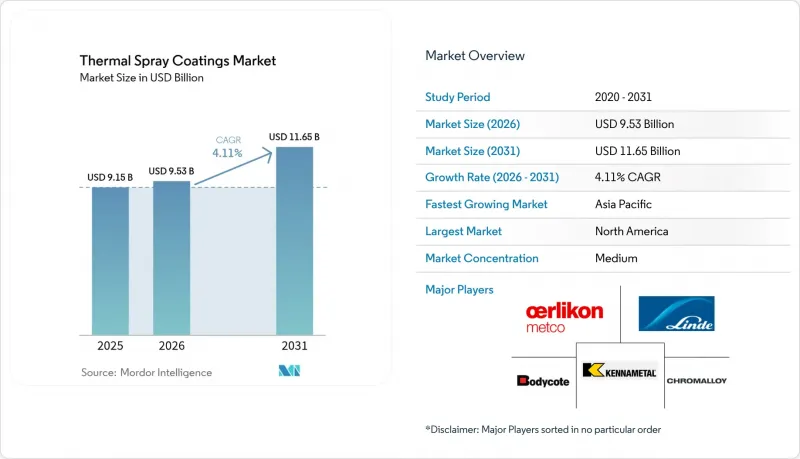
本報告按粉末塗料材料(陶瓷氧化物、碳化物、金屬、聚合物及其他材料)、製程(燃燒、電能)、終端用戶產業(航太、工業用燃氣渦輪機、汽車、電子、醫療設備及其他)和地區(亞太地區、北美、歐洲、南美及其他)進行細分。市場預測以美元計價。
全球熱噴塗市場趨勢與洞察
在醫療植入和義肢的應用日益廣泛
羥磷石灰塗層(透過醫用等離子噴塗技術)仍是目前唯一獲得FDA核准用於大規模生產的整形外科植入的塗層技術。近期使用B相鈦合金的研究已顯著降低了其與骨骼彈性模量的不匹配。高功率脈衝磁控濺鍍和高速火焰噴塗(HVOF)技術正被結合使用,以建構多層結構,從而在不影響骨整合的前提下實現抗菌表面。隨著3D列印晶格植入規模的擴大,噴塗生物陶瓷塗層使得針對患者最佳化的形態能夠更快地通過認證流程,儘管監管機構仍在完善測試方案。能夠保證表面粗糙度和相組成的可重複性的塗層供應商正在贏得新的多年期供應合約。
擴大航太渦輪機和機身部件的應用。
引擎製造商正在尋求能夠提高渦輪進氣溫度並滿足所有檢測樣品嚴格厚度公差的智慧工廠。由歐瑞康和MTU航空引擎公司聯合開發的數位化噴塗單元採用封閉回路型羽流診斷技術,可將返工率降低25%。冷噴塗已成為現場維修的第一線工具,能夠修復鋁製飛行控制殼體和鎂製齒輪箱蓋,且不會產生熱變形。採用耐氧化中階的多層陶瓷氧化物阻隔層可延長引擎大修週期,進而幫助航空公司延長窄體飛機的使用壽命。
與塗層品質的可靠性和可重複性相關的挑戰
目前,大型原始設備製造商 (OEM) 制定的統計製程窗口對於小規模代工製造商而言難以達到。顆粒尺寸變化、羽流行為以及基材預熱都會影響氧化物含量和孔隙率,進而影響運作過程中的磨損。自動化視覺檢測和線上聲學感測器有助於檢測超出規格的情況,但對於小批量生產應用而言,其實施成本仍然很高。缺乏全球通用的即時監測標準導致認證週期過長,尤其是在航太和醫療設備領域。
細分市場分析
預計到2025年,陶瓷氧化物將佔銷售額的29.78%,以4.91%的複合年成長率成為成長最快的材料。這一優勢源於其卓越的高溫穩定性和生物相容性,使其成為渦輪機、醫療和氫能基礎設施項目的標準材料。此外,碳化物混合物正被用於承受極端磨損的應用領域,例如石油和天然氣閥門以及採礦工具。鎳鉻鉬合金等金屬有助於防止海洋結構腐蝕,而聚合物基覆層則面向介電性能至關重要的電子領域。採用懸浮等離子噴塗法製造的奈米結構氧化物正在提高熱循環壽命,並為未來的推進系統結構開闢新的可能性。將稀土元素摻雜的氧化鋯與功能梯度黏合層結合的製造商,如今已能保證50,000小時的耐久性,這使得人們對熱噴塗塗層市場的認知從單純的「保護」轉變為「性能增強」。
此外,新型粉末霧化技術正在降低碳化鎢的供應風險。亞洲眾多工廠已開始將碳化鎢廢料回收利用,製成團聚WC-Co原料,從而減少了對中國原生鎢的依賴。同時,混合放電等離子燒結棒材的出現也拓展了原料的選擇範圍。這些變化有望透過緩解原料成本波動和促進本地粉末加工廠的建立,從而增強熱噴塗市場。
區域分析
北美擁有成熟的航太、國防和醫療設備生態系統,預計將引領市場,到2025年將佔33.86%的銷售額。美國聯邦航空管理局(FAA)認證的維修店目前正採用冷噴塗技術對鎂合金齒輪箱進行材料再沉積,以避免昂貴的零件更換;同時,美國能源部正在資助氫燃料相容渦輪機氧化物塗層的研究。儘管加州空氣品質調查增加了監管合規的不確定性,但憑藉其在北美智慧噴塗單元領域的領先地位,該公司預計將在整個預測期內保持主導地位。
亞太地區預計將成為成長最快的地區,複合年成長率將達到6.03%,這主要得益於汽車電氣化、消費性電子產品產能的提升以及燃氣渦輪機建設的蓬勃發展。中國粉末回收企業已開始向當地塗料公司供應碳化物原料,以規避美國地質調查局(USGS)指出的鎢相關風險。日本半導體工廠正在擴大等離子體耐受氧化鋁塗層在5奈米及以下蝕刻腔內的應用規模,而印度鐵路公司則指定在高速鐵路軌道部件中使用電弧噴塗鋼板。這些項目表明,熱噴塗塗層市場正在該地區製造業整體迅速滲透。
在歐洲,隨著更嚴格的揮發性有機化合物(VOC)法規迫使營運商過渡到閉合迴路離子噴塗室和水性黏合劑,相關領域正穩步推進。北海離岸風力發電電場現在指定在單樁內部使用鋁鋅(Al-Zn)熱噴塗犧牲陽極,從而將其使用壽命延長至25年以上。歐盟委員會的「Fit-for-55」包裝標準間接推動了對工業燃氣渦輪機高效阻隔塗層的需求。目前,中東和非洲仍是一個小眾市場,但隨著煉油廠維修和海水淡化廠對長效防腐蝕塗層的需求,預計該市場將得到更廣泛的應用。
其他好處
- Excel格式的市場預測(ME)表
- 3個月的分析師支持
目錄
第1章:引言
- 研究假設和市場定義
- 調查範圍
第2章:調查方法
第3章執行摘要
第4章 市場狀況
- 市場概覽
- 市場促進因素
- 在醫療植入和義肢的應用日益廣泛
- 在航太渦輪機和機身部件中的應用日益廣泛。
- 對陶瓷氧化物阻隔塗層的需求日益成長
- 用於電動車組件的冷噴塗式電磁干擾屏蔽
- 利用積層製造技術修復超合金零件
- 市場限制因素
- 與可靠性和塗層品質的可重複性相關的問題。
- 加強揮發性有機化合物和粉塵排放法規
- 重要粉末(碳化鎢、稀有碳化物)供應波動
- 價值鏈分析
- 波特五力模型
第5章 市場規模與成長預測
- 按類型分類的粉末塗料
- 陶瓷氧化物
- 碳化物
- 金屬
- 聚合物和其他材料
- 透過流程
- 燃燒
- 電能
- 按最終用戶行業分類
- 航太
- 工業用燃氣渦輪機
- 車
- 電子設備
- 醫療設備
- 能源和發電
- 石油和天然氣
- 其他(紙漿和造紙、採礦等)
- 按地區
- 亞太地區
- 中國
- 印度
- 日本
- 韓國
- 其他亞太國家
- 北美洲
- 美國
- 加拿大
- 墨西哥
- 歐洲
- 德國
- 英國
- 義大利
- 法國
- 其他歐洲國家
- 南美洲
- 巴西
- 阿根廷
- 其他南美國家
- 中東和非洲
- 沙烏地阿拉伯
- 南非
- 其他中東和非洲國家
- 亞太地區
第6章 競爭情勢
- 市場集中度
- 策略趨勢
- 市佔率分析
- 公司簡介
- Abakan Inc.
- APS Materials Inc.
- Bodycote
- Chromalloy Gas Turbine LLC
- Curtiss-Wright Corporation(FW Gartner)
- Fisher Barton
- Flame Spray Technologies BV
- Hannecard Roller Coatings, Inc-ASB Industries
- Kennametal Inc.
- Linde
- OC Oerlikon Management AG
- Steel Goode Products, LLC
- Sulzer Ltd
- Thermion
- Tocalo Co. Ltd.
- TST LLC
第7章 市場機會與未來展望
According to Mordor Intelligence, thermal spray coatings market size in 2026 is estimated at USD 9.53 billion, growing from 2025 value of USD 9.15 billion with 2031 projections showing USD 11.65 billion, growing at 4.11% CAGR over 2026-2031.
This report is Segmented by Powder Coating Materials (Ceramic Oxides, Carbides, Metals, Polymers & Other Materials), Process (Combustion, Electric Energy), End-User Industry (Aerospace, Industrial Gas Turbines, Automotive, Electronics, Medical Devices, and More), and Geography (Asia-Pacific, North America, Europe, South America, , and More). The Market Forecasts are Provided in Terms of Value (USD).
Global Thermal Spray Coatings Market Trends and Insights
Increased Usage in Medical Implants and Prosthetics
Medical-grade plasma-sprayed hydroxyapatite continues to be the only FDA-cleared coating technology for mass-produced orthopedic implants, and recent work with B-phase Ti alloys is reducing elastic-modulus mismatch to bone. High-power impulse magnetron sputtering and HVOF overlays are now being combined in layered constructs that supply antibacterial surfaces without compromising osseointegration. As 3-D printed lattice implants scale up, spray-applied bio-ceramic finishes allow patient-specific geometries to move through qualification more quickly, though regulators are still finalizing test protocols. Coating providers able to certify repeatable roughness and phase composition are winning new multi-year supply contracts.
Growing Adoption in Aerospace Turbine & Air-Frame Parts
Engine primes are raising turbine inlet temperatures and demanding smart factories that deliver tight thickness windows on every coupon. Digitalized spray cells developed by Oerlikon and MTU Aero Engines now employ closed-loop plume diagnostics that cut rework rates by 25%. Cold-spray has become a frontline depot-repair tool, allowing aluminum flight-control housings and magnesium gearbox covers to be rebuilt without heat-affected distortion. Multilayer ceramic-oxide barrier stacks with oxidation-resistant inter-layers are extending engine overhaul intervals, enabling airlines to keep narrow-body fleets in service longer.
Reliability & Coating-Quality Repeatability Issues
Large OEMs now specify statistical process windows that smaller job shops struggle to meet. Particle size variance, plume dynamics, and substrate pre-heat all influence oxide content and porosity, which in turn dictate in-service wear. Automated vision and inline acoustic sensors are helping detect off-nominal conditions, but integration costs remain high for low-volume applications. Without global standards on real-time monitoring, qualification cycles lengthen, especially in aerospace and medical device programs.
Other drivers and restraints analyzed in the detailed report include:
- Rising Preference for Ceramic-Oxide Barrier Coatings
- Cold-Spray EMI Shielding for E-Mobility Components
- Tightening VOC / Dust-Emission Regulations
For complete list of drivers and restraints, kindly check the Table Of Contents.
Segment Analysis
Ceramic oxides recorded 29.78% of 2025 revenue and will grow fastest at 4.91% CAGR. This dominance arises from outstanding high-temperature stability and bio-compatibility, making oxides the default for turbine, medical, and hydrogen infrastructure projects. Carbide blends follow for extreme wear tasks on oil-and-gas valves and mining tools. Metals such as Ni-Cr-Mo alloys serve corrosion defense of marine structures, while polymer-based overlays target electronics where dielectric properties matter. Nanostructured oxides fabricated via suspension plasma spray tighten thermal-cycling life and are unlocking future propulsion architectures. Manufacturers combining rare-earth-doped zirconia with functionally graded bond coats now market 50 000-hour durability guarantees, lifting the thermal spray coating market perception from protective to performance-enabling.
New powder atomization methods are also trimming tungsten carbide supply risk. Several Asian plants have begun recycling hard-metal scrap into agglomerated WC-Co feedstock, lessening exposure to Chinese primary tungsten. At the same time, hybrid spark-plasma-sintered rod stock is widening the choice of feed materials. These shifts will strengthen the thermal spray coating market by easing raw-material cost swings and opening the door to localized powder hubs.
Complete Report Scope:
- By Powder Coating Materials
- Ceramic Oxides
- Carbides
- Metals
- Polymers & Other Materials
- By Process
- Combustion
- Electric Energy
- By End-user Industry
- Aerospace
- Industrial Gas Turbines
- Automotive
- Electronics
- Medical Devices
- Energy and Power
- Oil and Gas
- Others (Pulp and Paper, Mining, etc.)
- By Geography
- Asia-Pacific
- China
- India
- Japan
- South Korea
- Rest of Asia-Pacific
- North America
- United States
- Canada
- Mexico
- Europe
- Germany
- United Kingdom
- Italy
- France
- Rest of Europe
- South America
- Brazil
- Argentina
- Rest of South America
- Middle East and Africa
- Saudi Arabia
- South Africa
- Rest of Middle East and Africa
- Asia-Pacific
Geography Analysis
North America led with 33.86% revenue in 2025 on the back of entrenched aerospace, defense, and medical device ecosystems. FAA-class repair shops now rely on cold-spray to redeposit material on magnesium gearboxes, avoiding costly part replacement, while the Department of Energy funds oxide-coating research for hydrogen-ready turbines. California's air-quality probes add compliance uncertainty, but the region's first-mover advantage in smart spray cells should preserve leadership during the forecast window.
Asia-Pacific is projected to grow fastest at 6.03% CAGR as automotive electrification, consumer-electronics capacity, and gas-turbine build-outs surge. Chinese powder recyclers already supply carbide feedstock to local coaters, hedging tungsten risks identified by USGS. Japanese semiconductor plants are scaling plasma-resistant alumina coatings for sub-5 nm etch chambers, while Indian railways specify arc-sprayed steel overlays on high-speed track components. These projects illustrate how the thermal spray coating market is embedding itself across the region's manufacturing spectrum.
Europe shows steady progress as tougher VOC caps push operators toward closed-loop plasma booths and water-borne binders. Offshore wind farms in the North Sea now specify Al-Zn thermally sprayed sacrificial anodes on monopile interiors, lengthening service life beyond 25 years. The European Commission's "Fit-for-55" package indirectly boosts demand for efficiency-raising barrier coatings on industrial gas turbines. Middle East and Africa remain niche today but will see higher uptake as refinery revamps and desalination plants pursue long-life corrosion shields.
- Abakan Inc.
- APS Materials Inc.
- Bodycote
- Chromalloy Gas Turbine LLC
- Curtiss-Wright Corporation (FW Gartner)
- Fisher Barton
- Flame Spray Technologies BV
- Hannecard Roller Coatings, Inc - ASB Industries
- Kennametal Inc.
- Linde
- OC Oerlikon Management AG
- Steel Goode Products, LLC
- Sulzer Ltd
- Thermion
- Tocalo Co. Ltd.
- TST LLC
Additional Benefits:
- The market estimate (ME) sheet in Excel format
- 3 months of analyst support
TABLE OF CONTENTS
1 Introduction
- 1.1 Study Assumptions & Market Definition
- 1.2 Scope of the Study
2 Research Methodology
3 Executive Summary
4 Market Landscape
- 4.1 Market Overview
- 4.2 Market Drivers
- 4.2.1 Increased usage in medical implants & prosthetics
- 4.2.2 Growing adoption in aerospace turbine & air-frame parts
- 4.2.3 Rising preference for ceramic-oxide barrier coatings
- 4.2.4 Cold-spray EMI shielding for e-mobility components
- 4.2.5 Additive-manufacturing repair of super-alloy parts
- 4.3 Market Restraints
- 4.3.1 Reliability & coating-quality repeatability issues
- 4.3.2 Tightening VOC / dust-emission regulations
- 4.3.3 Critical-powder supply volatility (WC, rare carbides)
- 4.4 Value Chain Analysis
- 4.5 Porter's Five Forces
- 4.5.1 Bargaining Power of Suppliers
- 4.5.2 Bargaining Power of Buyers
- 4.5.3 Threat of New Entrants
- 4.5.4 Threat of Substitutes
- 4.5.5 Degree of Competition
5 Market Size & Growth Forecasts (Value)
- 5.1 By Powder Coating Materials
- 5.1.1 Ceramic Oxides
- 5.1.2 Carbides
- 5.1.3 Metals
- 5.1.4 Polymers & Other Materials
- 5.2 By Process
- 5.2.1 Combustion
- 5.2.2 Electric Energy
- 5.3 By End-user Industry
- 5.3.1 Aerospace
- 5.3.2 Industrial Gas Turbines
- 5.3.3 Automotive
- 5.3.4 Electronics
- 5.3.5 Medical Devices
- 5.3.6 Energy and Power
- 5.3.7 Oil and Gas
- 5.3.8 Others (Pulp and Paper, Mining, etc.)
- 5.4 By Geography
- 5.4.1 Asia-Pacific
- 5.4.1.1 China
- 5.4.1.2 India
- 5.4.1.3 Japan
- 5.4.1.4 South Korea
- 5.4.1.5 Rest of Asia-Pacific
- 5.4.2 North America
- 5.4.2.1 United States
- 5.4.2.2 Canada
- 5.4.2.3 Mexico
- 5.4.3 Europe
- 5.4.3.1 Germany
- 5.4.3.2 United Kingdom
- 5.4.3.3 Italy
- 5.4.3.4 France
- 5.4.3.5 Rest of Europe
- 5.4.4 South America
- 5.4.4.1 Brazil
- 5.4.4.2 Argentina
- 5.4.4.3 Rest of South America
- 5.4.5 Middle East and Africa
- 5.4.5.1 Saudi Arabia
- 5.4.5.2 South Africa
- 5.4.5.3 Rest of Middle East and Africa
- 5.4.1 Asia-Pacific
6 Competitive Landscape
- 6.1 Market Concentration
- 6.2 Strategic Moves
- 6.3 Market Share Analysis
- 6.4 Company Profiles (includes Global level Overview, Market level overview, Core Segments, Financials as available, Strategic Information, Market Rank/Share, Products & Services, Recent Developments)
- 6.4.1 Abakan Inc.
- 6.4.2 APS Materials Inc.
- 6.4.3 Bodycote
- 6.4.4 Chromalloy Gas Turbine LLC
- 6.4.5 Curtiss-Wright Corporation (FW Gartner)
- 6.4.6 Fisher Barton
- 6.4.7 Flame Spray Technologies BV
- 6.4.8 Hannecard Roller Coatings, Inc - ASB Industries
- 6.4.9 Kennametal Inc.
- 6.4.10 Linde
- 6.4.11 OC Oerlikon Management AG
- 6.4.12 Steel Goode Products, LLC
- 6.4.13 Sulzer Ltd
- 6.4.14 Thermion
- 6.4.15 Tocalo Co. Ltd.
- 6.4.16 TST LLC
7 Market Opportunities & Future Outlook
- 7.1 White-space & Unmet-need Assessment

 熱噴塗市場:2026-2032年全球市場預測(依製程、塗佈材料、設備、塗層厚度及應用分類)
 熱噴塗塗層市場預測至2034年-全球塗層材料、製程、性能、應用、產業和區域分析
 熱噴塗粉末市場規模、佔有率和趨勢分析報告:按材料、應用、地區和細分市場預測(2026-2033 年)
 熱噴塗塗層市場規模、佔有率、趨勢和預測:按產品、技術、應用和地區分類,2026-2034年
 熱噴塗市場:按材料、工藝、應用和地區分類
 全球熱噴塗塗料市場規模、佔有率、趨勢和成長分析報告(2026-2034年)熱噴塗設備及服務市場:依產品、技術、製程及終端應用產業分類-2026-2032年全球預測熱噴塗粉末市場:依材料類型、塗覆製程、塗層功能及最終用途產業分類-2026-2032年全球預測日本熱噴塗塗料市場報告:按產品、技術、應用和地區分類(2026-2034年)熱噴塗塗層市場規模、佔有率和趨勢分析報告:按材料、技術、應用、地區和細分市場預測(2026-2033 年)