


 |
市場調查報告書
商品編碼
2122761
VoLTE:市場佔有率分析、產業趨勢與統計、成長預測(2026-2031 年)VoLTE - Market Share Analysis, Industry Trends & Statistics, Growth Forecasts (2026 - 2031) |
||||||

※ 本網頁內容可能與最新版本有所差異。詳細情況請與我們聯繫。
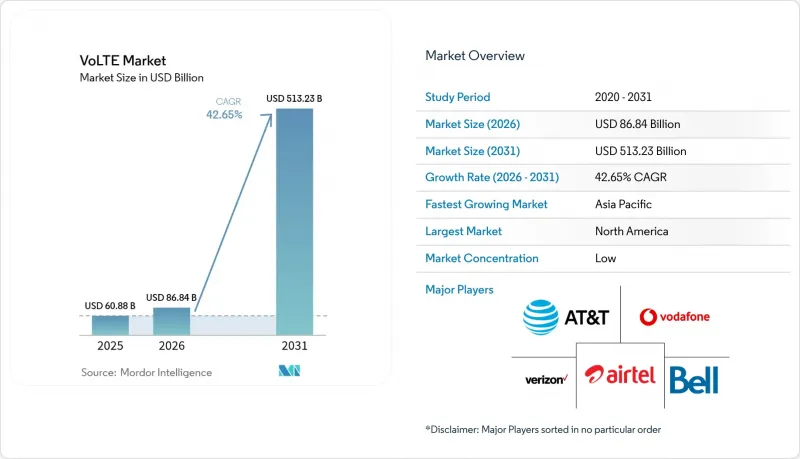
據 Mordor Intelligence 稱,2025 年 VoLTE 市值為 608.8 億美元,預計將從 2026 年的 868.4 億美元持續成長,到 2031 年達到 5132.3 億美元。
預測期(2026-2031 年)的複合年成長率預計為 42.65%。
本報告按最終用戶行業(企業、商業、政府)、設備類別(智慧型手機、其他)、技術(基於IMS的語音通話 (VoIMS)、其他)、通話類型(高清語音、其他)、運營商類型(行動通訊業者(MNO)、移動虛擬網路運營商 (MVNO)、其他)和地區進行細分。市場預測以美元 (USD) 為單位。
全球 VoLTE 市場趨勢與洞察
擴大LTE網路覆蓋範圍與智慧型手機普及率
目前,LTE網路已覆蓋已開發國家約95%的人口,並在新興市場持續擴展。到2024年,全球智慧型手機普及率將超過74%,屆時大多數5G裝置將支援VoLTE功能。營運商正將語音流量遷移至VoLTE,以回收3G頻段並降低營運成本。在印度和巴西,LTE網路正在遍遠地區擴展,這通常是透過政府聯合資助實現的,從而使VoLTE服務覆蓋到先前服務不足的地區。網路就緒度、設備效能和政策激勵措施的獎勵,使得VoLTE成為4G向5G過渡期間的預設語音通訊層。
3G網路退役的監管期限將加速VoLTE的過渡。
美國聯邦通訊委員會 (FCC) 強制規定的 3G 服務終止時間表以及歐洲 2025 年的終止建議,使得電路交換語音通訊不再作為備用方案,迫使營運商提供 VoLTE 服務。用於 5G 的快速頻率重新分配以及 E911 對定位精度的嚴格規定,使得 VoLTE 的部署至關重要。供應商正受益於 IMS 核心網的積極升級,而營運商則表示,由於能源成本降低和對舊有系統的維護負擔減輕,VoLTE 資本支出 (CAPEX) 的投資回收期縮短了。
低收入國家意識薄弱,普及速度慢
VoLTE的價值提案仍不明確,因為低收入地區的用戶更重視基本的網路連結。即使在LTE覆蓋區域,功能手機的普及和價格差異也阻礙了VoLTE的普及。營運商的宣傳活動需要強調VoLTE帶來的實際好處,例如更清晰的語音通話和同時使用語音及數據,並且應該與政府提升數位素養的舉措保持一致。
細分市場分析
儘管政府機構在2031年之前以43.9%的年複合成長率(CAGR)佔據了VoLTE市場的大部分佔有率,但商業領域在2025年仍保持著40.55%的最大市場佔有率。聯邦和地方政府正在部署VoLTE,以實現公共安全通訊的現代化、整合寬頻隨按即說並滿足嚴格的安全要求。美國緊急應變人員正在遷移到FirstNet的VoLTE寬頻網路,實現基於多媒體的情境察覺。
不斷擴展的智慧城市計畫正在採用 VoLTE 作為物聯網遙測和緊急警報的容錯備用方案。美國國防部正在透過專用網路部署加密的 VoLTE,以簡化語音通訊系統的採購和維護。私人企業正在利用現有的智慧型手機設備,將高清語音功能整合到整合通訊中,從而在無需大量硬體投資的情況下,支援混合辦公和客戶服務工作流程。
即使到了2025年,智慧型手機仍將佔據VoLTE市場佔有率的66.85%,而物聯網模組和穿戴式裝置將以45%的複合年成長率實現最高成長。資產追蹤設備將整合VoLTE模組,以便在發生入侵時發出語音警報,而智慧型手錶將具備自主通話功能。汽車製造商正在將VoLTE應用於自動事故通知和禮賓服務呼叫,從而為營運商和汽車製造商創造額外的業務收益。
具備 VoLTE 功能的低成本功能手機正在新興市場擴大其目標客戶群,因為在這些市場中,OTT 語音服務會導致數據消耗過大。在企業物聯網部署中,營運商級語音通訊對於將系統故障上報至控制中心至關重要,這使得設備能夠作為語音終端運行,從而促進了 VoLTE 市場的擴張。
區域分析
預計到2025年,北美將佔全球收入的39.45%,這主要得益於LTE的全面覆蓋、智慧型手機的早期普及以及美國聯邦通訊委員會(FCC)主導的3G服務關閉。包括Verizon和AT&T在內的營運商已完成全國範圍內的VoLTE部署,目前正在進行延遲最佳化,以支援低延遲語音應用。加拿大營運商正在利用農村地區的基礎設施共用計劃,將VoLTE覆蓋範圍擴展到人口密度較低的地區,而墨西哥則透過改革推動的頻段競標來加速LTE部署。
亞太地區預計將以45.8%的複合年成長率成長,這主要得益於中國擁有5億用戶的VoLTE網路以及印度「數位印度」計畫對4G設備的補貼。像Reliance Jio這樣的區域巨頭正引領潮流,推出免費通話的VoLTE套餐,展現了低成本語音服務如何加速普及。在日本和韓國,他們透過在都市區利用高密度光纖回程傳輸,並在標準VoLTE之上疊加RCS和超低延遲視訊技術,吸引高階用戶。
在歐洲,已製定了逐步淘汰3G的協調藍圖,並正在推廣跨境漫遊服務。這增強了旅行者對繼續使用VoLTE的信心。中東各國政府正在投資智慧城市項目,將VoLTE作為高層建築中物聯網遙測和緊急服務的備用方案。非洲和拉丁美洲在獲利能力方面仍然落後,但透過普及服務基金資助的LTE部署和終端降價計劃,正在湧現出尚未開發的機會。
其他好處
- Excel格式的市場預測(ME)表
- 3個月的分析師支持
目錄
第1章:引言
- 研究假設和市場定義
- 調查範圍
第2章:調查方法
第3章執行摘要
第4章 市場狀況
- 市場概覽
- 市場促進因素
- 對高速行動寬頻語音服務的需求不斷成長
- 擴大LTE網路覆蓋範圍與智慧型手機普及率
- 3G網路退役的監管期限將加速VoLTE的過渡。
- 用於關鍵任務語音通訊的企業專用 LTE 部署
- 以 eSIM 為中心的設備生態系統,可實現無縫的 IMS 配置。
- 引入 5G NSA 需要 VoLTE 來確保語音通訊的連續性,並透過回退機制實現。
- 市場限制因素
- 低收入國家意識薄弱,普及速度慢
- 營運商間漫遊和互通性的挑戰
- Vo5G 可能蠶食 VoLTE 基礎設施的風險正在抑制後期 VoLTE 基礎設施投資。
- 超高密度異構網路中的電池消耗和QoS挑戰
- 價值供應鏈分析
- 監理情勢
- 技術展望
- 波特五力分析
- 價格分析
- 政府推出VoLTE服務的現狀
- COVID-19 對 VoLTE 市場的影響
- 5G獨立組網部署對VoLTE經濟性的影響
- VoLTE連接及各國普及率細分
- 美國
- 加拿大
- 英國
- 德國
- 中國
- 日本
- 韓國
第5章 市場規模與成長預測
- 按最終用戶行業分類
- 公司
- 商業的
- 政府
- 按設備類別
- 智慧型手機
- 功能手機
- 物聯網模組和穿戴式設備
- 透過技術
- 基於IMS的語音通訊(VoIMS)
- 電路開關類型回退(CSFB)
- 單無線電語音通話連續性 (SRVCC)
- 透過 GAN(伏爾加)進行 LTE 語音通訊
- 雙頻無線電、語音和LTE同時通訊(SVLTE)
- 呼叫類型
- 高清語音
- 基於LTE的影像通訊
- 進階通訊服務(RCS)
- 按業務類型分類
- 行動通訊業者(MNO)
- 行動虛擬網路營運商(MVNO)
- 私人企業和企業的LTE網路
- 按地區
- 北美洲
- 美國
- 加拿大
- 墨西哥
- 南美洲
- 巴西
- 阿根廷
- 其他南美國家
- 歐洲
- 英國
- 德國
- 法國
- 義大利
- 俄羅斯
- 其他歐洲國家
- 亞太地區
- 中國
- 日本
- 韓國
- 印度
- 澳洲和紐西蘭
- ASEAN
- 其他亞太國家
- 中東和非洲
- 中東
- 沙烏地阿拉伯
- 阿拉伯聯合大公國
- 土耳其
- 以色列
- 其他中東國家
- 非洲
- 南非
- 奈及利亞
- 肯亞
- 其他非洲地區
- 中東
- 北美洲
第6章 競爭情勢
- 市場集中度
- 策略趨勢
- 市佔率分析
- 公司簡介
- AT&T Inc.
- Verizon Communications Inc.
- China Mobile Ltd.
- Reliance Jio Infocomm Ltd.
- Vodafone Group Plc
- Bharti Airtel Ltd.
- SK Telecom Co. Ltd.
- KT Corporation
- Orange SA
- Deutsche Telekom AG
- Telefonica SA
- Telstra Corporation Ltd.
- NTT Docomo Inc.
- China Unicom Ltd.
- China Telecom Corp.
- Bell Canada
- Rogers Communications Inc.
- Etisalat Group
- MTN Group
- Zain Group
- Telkomsel
第7章 市場機會與未來展望
According to Mordor Intelligence, the VoLTE market size was valued at USD 60.88 billion in 2025 and estimated to grow from USD 86.84 billion in 2026 to reach USD 513.23 billion by 2031, at a CAGR of 42.65% during the forecast period (2026-2031).
This report is Segmented by End-User Industry (Corporate, Commercial, Government), Device Category (Smartphones, and More), Technology (Voice Over IMS, and More), Call Type (HD Voice, and More), Operator Type (Mobile Network Operators, Mobile Virtual Network Operators, and More), and Geography. The Market Forecasts are Provided in Terms of Value (USD).
Global VoLTE Market Trends and Insights
Growing LTE Network Coverage & Smartphone Penetration
LTE now covers around 95% of populations in developed economies and continues to scale across emerging markets. Smartphone penetration surpassed 74% worldwide in 2024, and most 5G-capable devices ship with VoLTE enabled out-of-box. Operators migrate voice traffic to VoLTE to reclaim 3G spectrum and lower operating costs. Wider rural LTE footprints in India and Brazil, often co-funded by governments, extend VoLTE to previously underserved communities. The alignment of network readiness, device capability, and policy incentives positions VoLTE as the default voice layer during the 4G-to-5G transition.
Regulatory Sunset of 3G Networks Accelerating VoLTE Migration
The FCC's mandated 3G switch-off schedule and Europe's 2025 sunset recommendation eliminate fallback circuit-switched voice, compelling operators to provision. Rapid spectrum refarming for 5G and stringent E911 location-accuracy rules make VoLTE implementation non-negotiable. Equipment vendors gain from brisk IMS core upgrades, and operators report quicker pay-back on VoLTE CAPEX through lower energy costs and reduced legacy maintenance.
Lack of Awareness and Slow Adoption in Low-Income Nations
Subscribers in low-income regions prioritize basic connectivity, so VoLTE's value proposition remains unclear. Feature-phone prevalence and device affordability gaps stall migration even where LTE coverage exists. Operator campaigns must emphasize tangible benefits such as clearer audio and simultaneous voice-data functionality while aligning with government digital-literacy drives.
Other drivers and restraints analyzed in the detailed report include:
- Enterprise Private-LTE Adoption for Mission-Critical Voice
- 5G NSA Deployments Requiring VoLTE for Fallback Voice Continuity
- Roaming/Inter-Operator Interoperability Challenges
For complete list of drivers and restraints, kindly check the Table Of Contents.
Segment Analysis
Government agencies accounted for a 43.9% CAGR through 2031, though the Commercial segment retained the largest 40.55% share of VoLTE market size in 2025. Federal and municipal bodies adopt VoLTE to modernize public-safety communications, integrate broadband push-to-talk, and meet stringent security mandates. First responders in the United States migrate to FirstNet's VoLTE-enabled broadband, enabling multimedia situational awareness.
Expanding smart-city programs employ VoLTE as a resilient fallback for IoT telemetry and emergency alerts. Defense departments deploy encrypted VoLTE on private networks to simplify voice procurement and maintenance. Commercial enterprises leverage existing smartphone fleets to embed HD voice into unified communications, supporting hybrid work and customer-service workflows without heavy hardware investments.
Smartphones retained 66.85% of VoLTE market share in 2025, yet IoT Modules and Wearables log the strongest 45% CAGR. Asset trackers integrate VoLTE modules to relay voice alarms during intrusions, while smartwatches gain autonomous calling functions. Automakers embed VoLTE for automatic crash notification and concierge calling, adding incremental service revenue for operators and OEMs.
Lower-cost feature phones with VoLTE widen addressable bases in emerging markets where OTT voice alternatives consume excessive data. Enterprise IoT deployments require carrier-grade voice for control-room escalation during system faults, converting machines into voice end-points and enlarging the VoLTE market.
Complete Report Scope:
- By End-user Industry
- Corporate
- Commercial
- Government
- By Device Category
- Smartphones
- Feature Phones
- IoT Modules and Wearables
- By Technology
- Voice over IMS (VoIMS)
- Circuit-Switched Fallback (CSFB)
- Single-Radio Voice Call Continuity (SRVCC)
- Voice over LTE via GAN (VOLGA)
- Dual-Radio / Simultaneous Voice and LTE (SVLTE)
- By Call Type
- HD Voice
- Video over LTE
- Rich Communication Services (RCS)
- By Operator Type
- Mobile Network Operators (MNO)
- Mobile Virtual Network Operators (MVNO)
- Private / Enterprise LTE Networks
- By Geography
- North America
- United States
- Canada
- Mexico
- South America
- Brazil
- Argentina
- Rest of South America
- Europe
- United Kingdom
- Germany
- France
- Italy
- Russia
- Rest of Europe
- Asia-Pacific
- China
- Japan
- South Korea
- India
- Australia and New Zealand
- ASEAN
- Rest of Asia-Pacific
- Middle East and Africa
- Middle East
- Saudi Arabia
- UAE
- Turkey
- Israel
- Rest of Middle East
- Africa
- South Africa
- Nigeria
- Kenya
- Rest of Africa
- Middle East
- North America
Geography Analysis
North America commanded 39.45% of 2025 revenue on the back of complete LTE footprints, early smartphone saturation, and FCC-driven 3G sunsets. Operators, including Verizon and AT&T, finalized nationwide VoLTE rollouts and now target latency optimization to support low-latency voice applications. Canadian carriers leverage shared rural infrastructure programs to extend VoLTE coverage into sparsely populated regions, while Mexico's reform-driven spectrum auctions speed up LTE deployment.
Asia-Pacific is forecast to grow at 45.8% CAGR, buoyed by China's 500 million-subscriber VoLTE network and India's Digital India program that subsidizes 4G handsets. Regional giants like Reliance Jio lead with zero-charge VoLTE calling plans, illustrating how inexpensive voice can accelerate adoption. Japan and South Korea exploit dense urban fiber backhaul to layer RCS and ultra-low-latency video over standard VoLTE, attracting premium subscribers.
Europe's coordinated 3G sunset roadmap supports cross-border roaming efforts that bolster traveler confidence in VoLTE continuity. Middle East governments invest in smart-city blueprints, using VoLTE to back up IoT telemetry and emergency services in high-rise clusters. Africa and Latin America trail in revenue terms yet present untapped opportunities as universal service funds finance LTE rollouts and handset affordability programs.
- AT&T Inc.
- Verizon Communications Inc.
- China Mobile Ltd.
- Reliance Jio Infocomm Ltd.
- Vodafone Group Plc
- Bharti Airtel Ltd.
- SK Telecom Co. Ltd.
- KT Corporation
- Orange S.A.
- Deutsche Telekom AG
- Telefonica S.A.
- Telstra Corporation Ltd.
- NTT Docomo Inc.
- China Unicom Ltd.
- China Telecom Corp.
- Bell Canada
- Rogers Communications Inc.
- Etisalat Group
- MTN Group
- Zain Group
- Telkomsel
Additional Benefits:
- The market estimate (ME) sheet in Excel format
- 3 months of analyst support
TABLE OF CONTENTS
1 INTRODUCTION
- 1.1 Study Assumptions and Market Definition
- 1.2 Scope of the Study
2 RESEARCH METHODOLOGY
3 EXECUTIVE SUMMARY
4 MARKET LANDSCAPE
- 4.1 Market Overview
- 4.2 Market Drivers
- 4.2.1 Increasing demand for high-speed mobile broadband voice services
- 4.2.2 Growing LTE network coverage and smartphone penetration
- 4.2.3 Regulatory sunset of 3G networks accelerating VoLTE migration
- 4.2.4 Enterprise private-LTE adoption for mission-critical voice
- 4.2.5 eSIM-centric device ecosystem enabling seamless IMS provisioning
- 4.2.6 5G NSA deployments requiring VoLTE for fallback voice continuity
- 4.3 Market Restraints
- 4.3.1 Lack of awareness and slow adoption in low-income nations
- 4.3.2 Roaming/inter-operator interoperability challenges
- 4.3.3 Vo5G cannibalisation risk dampening late-stage VoLTE CAPEX
- 4.3.4 Battery-drain and QoS hurdles in ultra-dense heterogeneous networks
- 4.4 Value / Supply-Chain Analysis
- 4.5 Regulatory Landscape
- 4.6 Technological Outlook
- 4.7 Porter's Five Forces Analysis
- 4.7.1 Threat of New Entrants
- 4.7.2 Bargaining Power of Buyers/Consumers
- 4.7.3 Bargaining Power of Suppliers
- 4.7.4 Threat of Substitute Products
- 4.7.5 Intensity of Competitive Rivalry
- 4.8 Pricing Analysis
- 4.9 VoLTE Launches by Country
- 4.10 Impact of COVID-19 on the VoLTE Market
- 4.11 Impact of 5G Stand-Alone Roll-outs on VoLTE Economics
- 4.12 Breakdown of VoLTE Connection / Penetration by Country
- 4.12.1 United States
- 4.12.2 Canada
- 4.12.3 United Kingdom
- 4.12.4 Germany
- 4.12.5 China
- 4.12.6 Japan
- 4.12.7 South Korea
5 MARKET SIZE AND GROWTH FORECASTS (VALUE)
- 5.1 By End-user Industry
- 5.1.1 Corporate
- 5.1.2 Commercial
- 5.1.3 Government
- 5.2 By Device Category
- 5.2.1 Smartphones
- 5.2.2 Feature Phones
- 5.2.3 IoT Modules and Wearables
- 5.3 By Technology
- 5.3.1 Voice over IMS (VoIMS)
- 5.3.2 Circuit-Switched Fallback (CSFB)
- 5.3.3 Single-Radio Voice Call Continuity (SRVCC)
- 5.3.4 Voice over LTE via GAN (VOLGA)
- 5.3.5 Dual-Radio / Simultaneous Voice and LTE (SVLTE)
- 5.4 By Call Type
- 5.4.1 HD Voice
- 5.4.2 Video over LTE
- 5.4.3 Rich Communication Services (RCS)
- 5.5 By Operator Type
- 5.5.1 Mobile Network Operators (MNO)
- 5.5.2 Mobile Virtual Network Operators (MVNO)
- 5.5.3 Private / Enterprise LTE Networks
- 5.6 By Geography
- 5.6.1 North America
- 5.6.1.1 United States
- 5.6.1.2 Canada
- 5.6.1.3 Mexico
- 5.6.2 South America
- 5.6.2.1 Brazil
- 5.6.2.2 Argentina
- 5.6.2.3 Rest of South America
- 5.6.3 Europe
- 5.6.3.1 United Kingdom
- 5.6.3.2 Germany
- 5.6.3.3 France
- 5.6.3.4 Italy
- 5.6.3.5 Russia
- 5.6.3.6 Rest of Europe
- 5.6.4 Asia-Pacific
- 5.6.4.1 China
- 5.6.4.2 Japan
- 5.6.4.3 South Korea
- 5.6.4.4 India
- 5.6.4.5 Australia and New Zealand
- 5.6.4.6 ASEAN
- 5.6.4.7 Rest of Asia-Pacific
- 5.6.5 Middle East and Africa
- 5.6.5.1 Middle East
- 5.6.5.1.1 Saudi Arabia
- 5.6.5.1.2 UAE
- 5.6.5.1.3 Turkey
- 5.6.5.1.4 Israel
- 5.6.5.1.5 Rest of Middle East
- 5.6.5.2 Africa
- 5.6.5.2.1 South Africa
- 5.6.5.2.2 Nigeria
- 5.6.5.2.3 Kenya
- 5.6.5.2.4 Rest of Africa
- 5.6.5.1 Middle East
- 5.6.1 North America
6 COMPETITIVE LANDSCAPE
- 6.1 Market Concentration
- 6.2 Strategic Moves
- 6.3 Market Share Analysis
- 6.4 Company Profiles (includes Global level Overview, Market level overview, Core Segments, Financials as available, Strategic Information, Market Rank/Share, Products and Services, Recent Developments)
- 6.4.1 AT&T Inc.
- 6.4.2 Verizon Communications Inc.
- 6.4.3 China Mobile Ltd.
- 6.4.4 Reliance Jio Infocomm Ltd.
- 6.4.5 Vodafone Group Plc
- 6.4.6 Bharti Airtel Ltd.
- 6.4.7 SK Telecom Co. Ltd.
- 6.4.8 KT Corporation
- 6.4.9 Orange S.A.
- 6.4.10 Deutsche Telekom AG
- 6.4.11 Telefonica S.A.
- 6.4.12 Telstra Corporation Ltd.
- 6.4.13 NTT Docomo Inc.
- 6.4.14 China Unicom Ltd.
- 6.4.15 China Telecom Corp.
- 6.4.16 Bell Canada
- 6.4.17 Rogers Communications Inc.
- 6.4.18 Etisalat Group
- 6.4.19 MTN Group
- 6.4.20 Zain Group
- 6.4.21 Telkomsel


