


 |
市場調查報告書
商品編碼
2122759
測量軟體:市場佔有率分析、產業趨勢與統計、成長預測(2026-2031)Metrology Software - Market Share Analysis, Industry Trends & Statistics, Growth Forecasts (2026 - 2031) |
||||||

※ 本網頁內容可能與最新版本有所差異。詳細情況請與我們聯繫。
根據 Mordor Intelligence 估計,測量軟體市場在 2026 年的價值將達到 17.4 億美元,高於 2025 年的 15.8 億美元,預計到 2031 年將達到 28.6 億美元。
預計從 2026 年到 2031 年,其複合年成長率將達到 10.38%。
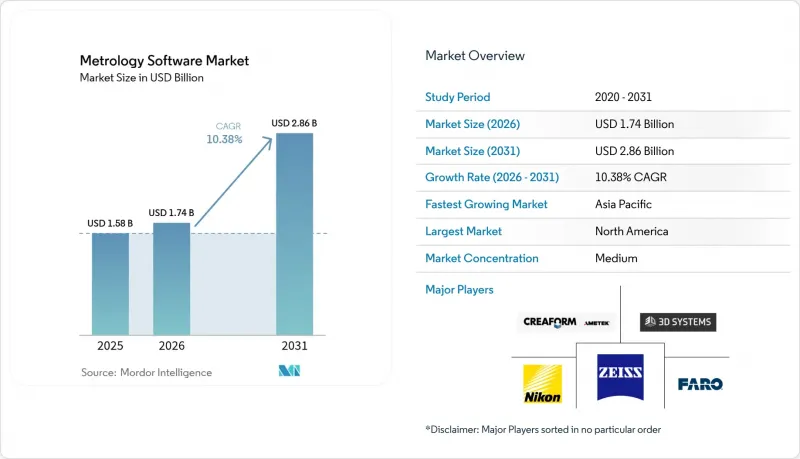
本報告按最終用戶產業(汽車、航太等)、部署模式(本地部署、雲端部署)、應用領域(逆向工程、模具製造等)、測量儀器類型(光學數位化儀和掃描器、可攜式機械手臂、雷射追蹤儀、結構光學掃描儀等)以及地區進行細分。市場預測以美元計價。
全球測量軟體市場趨勢與洞察
離散製造和流程製造自動化技術的進步
製造商正投資於整合可程式邏輯控制器 (PLC) 和測量軟體的自動化檢測單元,從而實現封閉回路型品管,並將汽車車身面板的缺陷率降低高達 25%。坐標測量機、光學掃描儀和工業機器人透過標準化協議進行通訊,從而實現全天候運作。電子組裝製造商正轉向無人值守生產,利用自動偏差警報在缺陷擴大之前糾正刀具偏差。半導體製造商正在將尺寸數據整合到先進的製程控制系統中,以驅動持續的參數調整。軟體供應商透過提供模組化應用程式介面 (API) 來滿足這些需求,從而簡化硬體整合並縮短部署時間。
對高品質、無缺陷產品的需求
醫療設備和航太產業的供應商正在將統計製程控制整合到其測量平台中,以便在零件進入最終組裝之前檢測微米等級的漂移,從而避免代價高昂的召回。電動車電池工廠正在追蹤每個電極的尺寸直到電池條碼,以確保符合功能安全法規,同時最大限度地降低返工成本。六標準差方法的應用已將測量資料分析從一項可選的附加功能提升為一項核心製造要求。汽車產業的一級供應商透過以軟體驅動的測試取代手動儀器測試,降低了品質保證成本。嚴格的供應商評估標準正在推動下游企業採用這些技術,測量軟體也正在擴展到沖壓、鑄造和模塑等子級環節。
初始成本高且整合複雜
當許可證、校準夾具和專案工程費用捆綁在一起時,中小型製造商的預算會迅速膨脹,儘管有可能提高生產效率,但這反而會成為一種阻礙。當傳統測量儀器需要客製化驅動程式時,整合專案往往會大幅超出最初的計劃。由於顧問會因標準化資料格式而收取額外的工時費,整體擁有成本 (TCO) 也會增加。本公司也要承擔推出期間操作員訓練的相關間接成本。當人工偵測已經能夠滿足客戶的公差目標時,評估投資報酬率 (ROI) 仍然十分困難,導致採購週期停滯不前。
細分市場分析
預計到2031年,醫療產業的複合年成長率將達到10.55%,而汽車產業即使到2025年仍將維持39.25%的測量軟體市場佔有率。嚴格的法律規範要求提供可驗證的檢驗追蹤,而這只有專業平台才能實現。隨著植入的不斷縮小,升級座標測量機以實現亞微米精度的趨勢日益明顯。在航太領域,安裝高容量雷射追蹤儀以原位繪製飛機關節圖仍然是主流做法。在能源專案中,測量軟體用於評估風力渦輪機葉片的空氣動力學特性,並採用邊緣分析來分析振動數據。
儘管道路車輛成長趨於穩定,但電池生產線需要新的分析方法來預測體積膨脹和電極錯位。電子組裝製造商正在將光學數位化儀整合到自動光學檢測 (AOI) 中,以大規模檢驗表面黏著技術元件的共面性。隨著品牌保護策略日益嚴格,消費品製造商開始從基於樣本的檢測轉向 100% 線上檢測。在整個預測期內,個人化植入領域的醫療創新預計將支撐對高級許可的需求,從而進一步加速向支持連續檢驗的軟體轉型。
雲端採用率正以11.35%的複合年成長率成長,削弱了本地部署解決方案的主導地位。預計到2025年,本地部署解決方案將佔儀器軟體市場規模的68.60%。跨國公司正在採用混合策略,將高度敏感的資料集保留在公司內部,同時將非敏感分析遷移到託管環境中。訂閱式定價模式對伺服器預算有限的中小型企業極具吸引力,因為它可以將資本投資轉化為營運成本。供應商營運的基礎設施減輕了修補程式管理的負擔,並縮短了漏洞存在的時間。儘管如此,國防和核能領域仍然偏好空氣間隙部署,這確保了本地部署銷售的利基需求。
邊緣節點目前在生產線旁執行時間受限的運算,僅將結果傳輸到雲端進行趨勢分析。這種架構在滿足延遲閾值的同時,又不犧牲中心可見度。在雲端訓練的機器學習模型會將最佳化的採樣模式發送回邊緣設備,從而無需硬體升級即可提高吞吐量。隨著網路安全認證的日趨成熟,審計人員也越來越認可分散式架構,從而推動了其在受監管行業的部署。
區域分析
預計到2025年,北美將在測量軟體市場佔據33.10%的市場。這主要得益於該地區成熟的航太、汽車和醫療製造叢集需要檢驗的測量工作流程。聯邦政府鼓勵國內生產的舉措正在推動對智慧品質系統的資本投資,而持續進行的人工智慧研究正在加速預測分析的普及應用。總部位於該地區的雲端服務供應商正在提供合規環境,從而促進多站點製造商的轉型。面向出口的供應商正在利用測量數據來支援全球客戶的審核,並維持軟體的更新週期。
亞太地區成長最快,複合年成長率達10.62%,這主要得益於中國向高附加價值生產轉型以及印度精密工程產品出口的不斷成長。台灣和中國當地的半導體晶圓廠正在10奈米以下製程中採用自動化光學測量技術,即時分析至關重要。日本先進的機器人產業正在將測量回饋融入組裝單元,以提高運作。韓國造船企業正在使用大型雷射追蹤儀來校準船體分段,從而提高組裝精度並減少乾船塢延誤。各地區政府都在為工業4.0試點計畫提供津貼,加速越南、泰國和馬來西亞等國中小製造業採用工業4.0技術。
在歐洲,受汽車電氣化和嚴格的環境標準(要求在整個生命週期內進行可追溯測量)的推動,市場持續穩定成長。德國工具機製造商正在將測量軟體整合到控制迴路中,並向全球出口承包精密生產線。在英國航太複合材料領域,對複雜曲面進行非接觸式檢測的需求正在推動掃描器技術的創新。資料保護條例正在影響雲端架構,供應商正轉向具有嚴格存取控制的歐洲資料中心。循環經濟的目標正在催生可重複使用零件認證的再製造檢測模組的二次需求。
其他好處:
- Excel格式的市場預測(ME)表
- 3個月的分析師支持
目錄
第1章:引言
- 研究假設和市場定義
- 調查範圍
第2章:調查方法
第3章執行摘要
第4章 市場狀況
- 市場概覽
- 市場促進因素
- 離散製造和流程製造自動化技術的進步
- 對高品質、無缺陷產品的需求
- 遷移到基於雲端的測量平台
- 與工業4.0的整合:數位孿生
- 積層製造品質保證簡介
- 自動駕駛車輛中雷射雷達和雷達的校準需求
- 市場限制因素
- 初始成本高且整合複雜
- 熟練的測量軟體專家短缺
- 與傳統測量儀器的互通性有其局限性
- 雲端採用的網路安全問題
- 產業價值鏈分析
- 監理情勢
- 技術展望
- 宏觀經濟因素的影響
- 評估新冠疫情對產業的影響
- 波特五力分析
第5章 市場規模與成長預測
- 按最終用戶行業分類
- 車
- 航太
- 電子設備製造
- 能源與電力
- 醫療器材
- 其他終端用戶產業
- 按部署模式
- 現場
- 基於雲端的
- 透過使用
- 品管和檢驗
- 逆向工程
- 模具製造
- 虛擬模擬與數位孿生
- 高容量測量
- 按測量儀器的類型
- 座標測量機(CMM)
- 光學數位化儀和掃描儀
- 可攜式手臂
- 雷射追蹤器
- 結構化光學掃描儀
- 其他類型的測量儀器
- 按地區
- 北美洲
- 美國
- 加拿大
- 墨西哥
- 歐洲
- 德國
- 英國
- 法國
- 俄羅斯
- 其他歐洲國家
- 亞太地區
- 中國
- 日本
- 印度
- 韓國
- 澳洲
- 其他亞太國家
- 中東和非洲
- 中東
- 沙烏地阿拉伯
- 阿拉伯聯合大公國
- 其他中東國家
- 非洲
- 南非
- 埃及
- 其他非洲國家
- 中東
- 南美洲
- 巴西
- 阿根廷
- 其他南美國家
- 北美洲
第6章 競爭情勢
- 市場集中度
- 策略趨勢
- 市佔率分析
- 公司簡介
- Nikon Metrology NV
- 3D Systems Corporation
- Creaform Inc.(AMETEK Inc.)
- FARO Technologies Inc.
- Carl Zeiss AG
- Hexagon AB
- LK Metrology Ltd.
- Renishaw plc
- Perceptron Inc.(Atlas Copco AB)
- InnovMetric Software Inc.
- Fluke Corporation
- Metrologic Group SA(Sandvik AB)
- Autodesk Inc.
- Dassault Systemes SE
- Verisurf Software Inc.
- Mapvision Ltd.
- GOM GmbH(Carl Zeiss AG)
- Capture 3D LLC
- Stratasys Ltd.(Control Software)
- Software Point Oy
第7章 市場機會與未來展望
According to Mordor Intelligence, the metrology software market size in 2026 is estimated at USD 1.74 billion, growing from 2025 value of USD 1.58 billion with 2031 projections showing USD 2.86 billion, growing at 10.38% CAGR over 2026-2031.
This report is Segmented by End-User Vertical (Automotive, Aerospace, and More), Deployment Model (On-Premise, and Cloud-Based), Application (Reverse Engineering, Tool and Die Manufacturing, and More), Measurement Device Type (Optical Digitizers and Scanners, Portable Arms, Laser Trackers, Structured Light Scanners, and More), and Geography. The Market Forecasts are Provided in Terms of Value (USD).
Global Metrology Software Market Trends and Insights
Rising Automation in Discrete and Process Manufacturing
Manufacturers invest in automated inspection cells that merge programmable logic controllers with metrology software, creating closed-loop quality control that cuts scrap by up to 25% in automotive body panels. Coordinate measuring machines, optical scanners, and industrial robots communicate through standardized protocols, enabling round-the-clock operations. Electronics assemblers transition to lights-out production, relying on automated deviation alerts to correct tool offsets before defects propagate. Semiconductor producers embed dimensional data into advanced process control, driving continuous parametric tuning. Software vendors respond with modular application programming interfaces that simplify hardware integration and shorten installation timelines.
Demand for High Quality and Zero-Defect Products
Medical device and aerospace suppliers embed statistical process control within metrology platforms to detect micrometer-level drift before components enter final assembly, averting costly recalls. Electric vehicle battery plants trace every electrode dimension back to the cell barcode, ensuring compliance with functional safety rules while minimizing rework budgets. The adoption of Six Sigma disciplines elevates measurement data analytics from an optional add-on to a core manufacturing requirement. Tier-one automotive suppliers report warranty cost reductions when software-driven inspections replace manual gauges. Strict supplier scorecards encourage downstream adoption, spreading metrology software into stamping, casting, and molding sub-tiers.
High Initial Cost and Integration Complexity
Bundling licenses, calibration fixtures, and project engineering quickly escalates budgets for small manufacturers, deterring adoption despite productivity gains. Integration projects often exceed original timelines when legacy gauges require custom drivers. Consultants bill additional hours to harmonize data formats, elevating the total cost of ownership. Companies also incur indirect costs associated with training operators during the ramp-up period. Return on investment assessments remain challenging when manual inspection already meets customer tolerance targets, leading to hesitant procurement cycles.
Other drivers and restraints analyzed in the detailed report include:
- Shift Toward Cloud-Based Metrology Platforms
- Integration With Industry 4.0 Digital Twins
- Shortage of Skilled Metrology Software Professionals
For complete list of drivers and restraints, kindly check the Table Of Contents.
Segment Analysis
The medical category is expected to account for a 10.55% CAGR through 2031, while the automotive domain is projected to retain a 39.25% market share of metrology software in 2025. Acute regulatory oversight requires validated audit trails, which only specialized platforms can deliver. Implant miniaturization drives upgrades to coordinate measuring machines for sub-micrometer accuracy. Aerospace continues to rely on large-volume laser tracker setups that map fuselage joins in situ. Energy projects utilize metrology software for wind blade aerodynamics, leveraging edge analytics to analyze vibration data.
Growth in road vehicles stabilizes, yet battery cell lines demand new analytics that predict volume expansion and electrode misalignment. Electronics assemblers integrate optical digitizers within automated optical inspection to verify surface-mount component coplanarity at scale. Consumer goods producers are starting to migrate from sample-based checks to 100% in-line inspection as brand protection strategies become increasingly stringent. Over the forecast horizon, medical innovation in personalized implants is expected to sustain premium licensing, reinforcing the shift toward software that supports continuous validation.
Cloud deployments reached an 11.35% CAGR, eroding on-premise dominance that represented 68.60% of the metrology software market size in 2025. Multinationals employ hybrid strategies that retain sensitive datasets on-site while moving non-classified analyses to managed environments. Subscription pricing converts capital expenditures into operating expenses, appealing to small enterprises that lack server budgets. Vendor-operated infrastructure offloads patch management, shortening vulnerability windows. Nevertheless, defense and nuclear segments still favor air-gapped installations, ensuring niche demand for on-premise sales.
Edge nodes now perform time-critical calculations adjacent to production lines, forwarding only the results to the cloud for trend analysis. This architecture satisfies latency thresholds without compromising central visibility. Machine learning models trained in the cloud return optimized sampling patterns to edge devices, boosting throughput without hardware upgrades. As cybersecurity certifications mature, audit departments become more comfortable with distributed architectures, bolstering expansion across regulated verticals.
Complete Report Scope:
- By End-User Vertical
- Automotive
- Aerospace
- Electronics Manufacturing
- Energy and Power
- Medical Devices
- Other End-User Verticals
- By Deployment Model
- On-Premise
- Cloud-Based
- By Application
- Quality Control and Inspection
- Reverse Engineering
- Tool and Die Manufacturing
- Virtual Simulation and Digital Twin
- Large-Volume Metrology
- By Measurement Device Type
- Coordinate Measuring Machines (CMM)
- Optical Digitizers and Scanners
- Portable Arms
- Laser Trackers
- Structured Light Scanners
- Other Measurement Device Types
- By Geography
- North America
- United States
- Canada
- Mexico
- Europe
- Germany
- United Kingdom
- France
- Russia
- Rest of Europe
- Asia-Pacific
- China
- Japan
- India
- South Korea
- Australia
- Rest of Asia-Pacific
- Middle East and Africa
- Middle East
- Saudi Arabia
- United Arab Emirates
- Rest of Middle East
- Africa
- South Africa
- Egypt
- Rest of Africa
- Middle East
- South America
- Brazil
- Argentina
- Rest of South America
- North America
Geography Analysis
North America held a 33.10% market share of the metrology software market in 2025, owing to its mature aerospace, automotive, and medical manufacturing clusters that demand validated measurement workflows. Federal initiatives encouraging reshoring promote capital investment in smart quality systems, while ongoing artificial intelligence research accelerates the adoption of predictive analytics. Cloud providers headquartered in the region offer compliance-ready environments, easing the migration process for multi-site manufacturers. Export-oriented suppliers leverage metrology data to support global customer audits, sustaining software update cycles.
Asia Pacific grew fastest at 10.62% CAGR, propelled by China's shift toward high-value production and India's escalating precision engineering exports. Semiconductor fabs across Taiwan and mainland China deploy automated optical metrology in sub-10 nm processes, mandating real-time analytics. Japan's advanced robotics sector embeds measurement feedback within assembly cells to enhance uptime. South Korean shipbuilders utilize large-volume laser trackers to align hull blocks, thereby improving fit accuracy and reducing dry-dock delays. Regional governments subsidize Industry 4.0 pilots, catalyzing the adoption of Industry 4.0 among small manufacturers in Vietnam, Thailand, and Malaysia.
Europe sustains steady growth, anchored by automotive electrification and stringent environmental standards that require lifecycle measurement traceability. German machine tool builders integrate metrology software inside control loops, exporting turnkey precision lines worldwide. The United Kingdom's aerospace composites sector demands non-contact inspection for complex curves, spurring scanner innovation. Data protection regulations influence cloud architecture, prompting vendors to shift toward European data centers with stringent access controls. Circular economy targets create secondary demand for remanufacturing inspection modules that certify reusable components.
- Nikon Metrology NV
- 3D Systems Corporation
- Creaform Inc. (AMETEK Inc.)
- FARO Technologies Inc.
- Carl Zeiss AG
- Hexagon AB
- LK Metrology Ltd.
- Renishaw plc
- Perceptron Inc. (Atlas Copco AB)
- InnovMetric Software Inc.
- Fluke Corporation
- Metrologic Group SA (Sandvik AB)
- Autodesk Inc.
- Dassault Systemes SE
- Verisurf Software Inc.
- Mapvision Ltd.
- GOM GmbH (Carl Zeiss AG)
- Capture 3D LLC
- Stratasys Ltd. (Control Software)
- Software Point Oy
Additional Benefits:
- The market estimate (ME) sheet in Excel format
- 3 months of analyst support
TABLE OF CONTENTS
1 INTRODUCTION
- 1.1 Study Assumptions and Market Definition
- 1.2 Scope of the Study
2 RESEARCH METHODOLOGY
3 EXECUTIVE SUMMARY
4 MARKET LANDSCAPE
- 4.1 Market Overview
- 4.2 Market Drivers
- 4.2.1 Rising Automation in Discrete and Process Manufacturing
- 4.2.2 Demand for High Quality and Zero-Defect Products
- 4.2.3 Shift Toward Cloud-Based Metrology Platforms
- 4.2.4 Integration With Industry 4.0 Digital Twins
- 4.2.5 Adoption in Additive Manufacturing Quality Assurance
- 4.2.6 LiDAR and Radar Calibration Needs in Autonomous Vehicles
- 4.3 Market Restraints
- 4.3.1 High Initial Cost and Integration Complexity
- 4.3.2 Shortage of Skilled Metrology Software Professionals
- 4.3.3 Limited Interoperability With Legacy Measurement Hardware
- 4.3.4 Cybersecurity Concerns in Cloud Deployments
- 4.4 Industry Value Chain Analysis
- 4.5 Regulatory Landscape
- 4.6 Technological Outlook
- 4.7 Impact of Macroeconomic Factors
- 4.8 Assessment of the Impact of COVID-19 on the Industry
- 4.9 Porter's Five Forces Analysis
- 4.9.1 Threat of New Entrants
- 4.9.2 Bargaining Power of Buyers
- 4.9.3 Bargaining Power of Suppliers
- 4.9.4 Threat of Substitute Products
- 4.9.5 Intensity of Competitive Rivalry
5 MARKET SIZE AND GROWTH FORECASTS (VALUE)
- 5.1 By End-User Vertical
- 5.1.1 Automotive
- 5.1.2 Aerospace
- 5.1.3 Electronics Manufacturing
- 5.1.4 Energy and Power
- 5.1.5 Medical Devices
- 5.1.6 Other End-User Verticals
- 5.2 By Deployment Model
- 5.2.1 On-Premise
- 5.2.2 Cloud-Based
- 5.3 By Application
- 5.3.1 Quality Control and Inspection
- 5.3.2 Reverse Engineering
- 5.3.3 Tool and Die Manufacturing
- 5.3.4 Virtual Simulation and Digital Twin
- 5.3.5 Large-Volume Metrology
- 5.4 By Measurement Device Type
- 5.4.1 Coordinate Measuring Machines (CMM)
- 5.4.2 Optical Digitizers and Scanners
- 5.4.3 Portable Arms
- 5.4.4 Laser Trackers
- 5.4.5 Structured Light Scanners
- 5.4.6 Other Measurement Device Types
- 5.5 By Geography
- 5.5.1 North America
- 5.5.1.1 United States
- 5.5.1.2 Canada
- 5.5.1.3 Mexico
- 5.5.2 Europe
- 5.5.2.1 Germany
- 5.5.2.2 United Kingdom
- 5.5.2.3 France
- 5.5.2.4 Russia
- 5.5.2.5 Rest of Europe
- 5.5.3 Asia-Pacific
- 5.5.3.1 China
- 5.5.3.2 Japan
- 5.5.3.3 India
- 5.5.3.4 South Korea
- 5.5.3.5 Australia
- 5.5.3.6 Rest of Asia-Pacific
- 5.5.4 Middle East and Africa
- 5.5.4.1 Middle East
- 5.5.4.1.1 Saudi Arabia
- 5.5.4.1.2 United Arab Emirates
- 5.5.4.1.3 Rest of Middle East
- 5.5.4.2 Africa
- 5.5.4.2.1 South Africa
- 5.5.4.2.2 Egypt
- 5.5.4.2.3 Rest of Africa
- 5.5.4.1 Middle East
- 5.5.5 South America
- 5.5.5.1 Brazil
- 5.5.5.2 Argentina
- 5.5.5.3 Rest of South America
- 5.5.1 North America
6 COMPETITIVE LANDSCAPE
- 6.1 Market Concentration
- 6.2 Strategic Moves
- 6.3 Market Share Analysis
- 6.4 Company Profiles (includes Global Level Overview, Market Level Overview, Core Segments, Financials as Available, Strategic Information, Market Rank/Share, Products and Services, and Recent Developments)
- 6.4.1 Nikon Metrology NV
- 6.4.2 3D Systems Corporation
- 6.4.3 Creaform Inc. (AMETEK Inc.)
- 6.4.4 FARO Technologies Inc.
- 6.4.5 Carl Zeiss AG
- 6.4.6 Hexagon AB
- 6.4.7 LK Metrology Ltd.
- 6.4.8 Renishaw plc
- 6.4.9 Perceptron Inc. (Atlas Copco AB)
- 6.4.10 InnovMetric Software Inc.
- 6.4.11 Fluke Corporation
- 6.4.12 Metrologic Group SA (Sandvik AB)
- 6.4.13 Autodesk Inc.
- 6.4.14 Dassault Systemes SE
- 6.4.15 Verisurf Software Inc.
- 6.4.16 Mapvision Ltd.
- 6.4.17 GOM GmbH (Carl Zeiss AG)
- 6.4.18 Capture 3D LLC
- 6.4.19 Stratasys Ltd. (Control Software)
- 6.4.20 Software Point Oy
7 MARKET OPPORTUNITIES AND FUTURE OUTLOOK
- 7.1 White-Space and Unmet-Need Assessment

 鐵路波紋磨損測量設備市場:全球市場預測,2026-2032年全自動線寬測量設備市場:全球市場預測,2026-2032年高速3D線雷射輪廓儀市場:全球市場預測,2026-2032年工業自動測量設備市場:全球市場預測(2026-2032年)觸覺感知測量設備市場:全球市場預測,2026-2032年測量軟體市場:全球市場預測,2026-2032年
 2026年尺寸測量市場十大成長機會
 測量儀器市場規模、佔有率和趨勢分析報告:按類型、應用、地區和細分市場分類(2026-2033 年)自動對焦電子自準直儀市場:按類型、解析度、通路、最終用戶和應用程式分類,全球預測,2026-2032年雕刻線厚度檢測器市場:按技術、材料類型、銷售管道、產業、應用和最終用戶分類,全球預測(2026-2032年)