


 |
市場調查報告書
商品編碼
2122753
線對板連接器:市場佔有率分析、行業趨勢和統計數據、成長預測(2026-2031 年)Wire-to-Board Connector - Market Share Analysis, Industry Trends & Statistics, Growth Forecasts (2026 - 2031) |
||||||

※ 本網頁內容可能與最新版本有所差異。詳細情況請與我們聯繫。
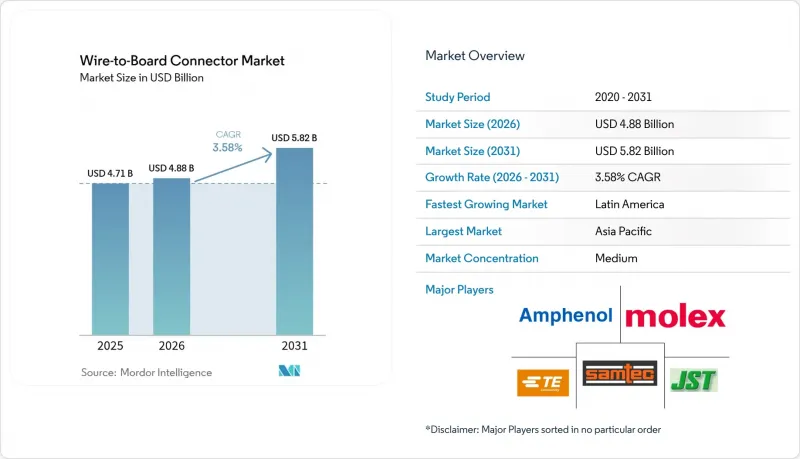
根據 Mordor Intelligence 預測,線對板連接器市場將從 2025 年的 47.1 億美元成長到 2026 年的 48.8 億美元,到 2031 年將達到 58.2 億美元,2026 年至 2031 年的複合年成長率為 3.58%。
本報告按引腳間距(2mm 或更小、2.1-4mm、大於 4mm)、安裝類型(表面黏著技術貼裝、通孔)、額定電流(1A 或更小、1.1A-3A、大於 3A)、方向(垂直、直角)、最終用戶行業(消費電子、IT 和電信、汽車、醫療設備、其他)以及地區進行醫療設備細分。市場預測以美元 (USD) 為單位。
全球線對板連接器市場趨勢及洞察
亞洲超小型穿戴裝置對2毫米或更小間距的需求正在成長
隨著健身追蹤器和智慧型手錶對尺寸的要求越來越小,間距小於2毫米的連接器目前佔據了出貨量的絕大部分。 Molex的0.175毫米間距產品線展示了交錯觸點如何克服焊接的局限性,同時保持0.35毫米的焊盤尺寸。金屬射出成型(MIM)技術能夠大規模生產符合嚴格公差要求的超小型外殼。亞太地區的製造商正在集中生產必要的模具,進一步鞏固其區域優勢。隨著外形規格的不斷縮小,跨學科團隊正在同步解決訊號完整性和電磁干擾(EMI)防護問題。
電動車電池管理系統 (BMS) 的快速普及推動了對大電流連接器的需求。
在電動車電池組的電池管理系統中,超過 6A 的連接器規格日益普及,使其成為線對板連接器市場中成長最快的電流等級。 TE Connectivity 的「HC-Stak」連接器可將端子尺寸縮小高達 30%,並支援鋁線,有助於實現車輛減重目標。諸如 PennEngineering 的「ECCB」等專用襯套,即使在鋁氧化的情況下也能保持低電阻。中國、歐洲和北美電動車銷量的成長正在形成需求集中,並影響供應商的佈局。
縮小PCB面積會限制焊盤的使用範圍。
小於 0.4 毫米的連接器焊盤尺寸會阻礙短期成長,因為它們會增加拾取放置精度並提高返工成本。更高的佈局密度會加劇串擾和熱熱點,迫使使用成本高昂的高 Tg 層壓板,從而削弱成本節約的優勢。良率的降低導致一些 OEM 廠商推遲推出下一代佈局,直到組裝升級完成。
細分市場分析
到2025年,尺寸小於2毫米的連接器將佔總銷售量的47.35%,推動線對板連接器市場的微型化趨勢。隨著智慧型手機、穿戴式耳機和植入式裝置的基板不斷縮小,到2031年,該細分市場將以3.59%的複合年成長率成長。 2.1-4毫米尺寸的連接器在汽車模組中仍然至關重要,因為在這些應用中,機械強度比尺寸更重要。尺寸大於4毫米的產品滿足特定的高電流需求,但其市佔率正在穩定下降。
間距為 80微米、電阻值低於 50 mΩ 的接點研究原型預示著未來可能模式轉移。亞太地區的製造地擁有大多數間距為 2 毫米或更小的模具,鞏固了該地區的領先地位。隨著間距的縮小,設計人員必須同時最佳化訊號完整性、散熱和插入力,這使得線對板連接器市場的這一細分領域成為跨領域合作的關鍵領域。
預計到2025年,表面黏著技術連接器將佔總銷售額的56.85%,這反映了整個消費和工業產品線自動化技術的進步。自動化貼片製程降低了每個接頭的成本,並最大限度地減少了PCB鑽孔,從而支撐了3.5%的複合年成長率。通孔在電力電子領域仍然非常重要,因為更大的焊錫槽有助於散熱和提高抗衝擊性。
高密度表面黏著技術基板的返工成本很高,因為相鄰元件可能會阻礙製程。雖然IPC/WHMA-A-620標準要求更嚴格的工藝窗口,但許多老舊的生產線難以滿足這項要求。亞太地區仍然擁有最完善的表面黏著技術基礎設施,儘管北美的一些工廠在生產線對板連接器等高可靠性組件時仍然傾向於採用通孔設計。
區域分析
亞太地區由於其PCB和最終組裝產能集中在中國、日本和韓國,預計到2025年將佔全球銷售額的46.25%。激勵措施正在吸引更多生產基地落腳印度,從而擴大該地區的市場佔有率。東南亞國家在半導體封裝市場處於主導,並將高密度連接器整合到其本地供應鏈中。這些潛在因素表明,在整個預測期內,線對板連接器市場預計將在該地區穩步發展。
在北美,市場由墨西哥的汽車組裝、美國的先進航太產業以及全部區域的醫療設備出口共同構成。儘管由於生產回流和關稅的影響,一些連接器產品線正從亞洲撤回,但成本差異仍然存在。加拿大礦業機械產業正在線對板連接器市場中創造對耐環境產品的局部需求。
在歐洲,連接器創新與電動車動力系統的引入以及向工業4.0的升級密切相關。德國在汽車應用高電流連接器的研發方面處於主導,而北歐電力公司則將連接器整合到風力發電和電網儲能設施中。嚴格的RoHS和REACH法規迫使全球供應商採用管制化學品。拉丁美洲的複合年成長率(CAGR)高達4.99%,位居全球之首,這主要得益於巴西汽車行業的成長以及原始設備製造商(OEM)為規避外匯風險而提高在地採購比例。非洲和中東規模雖小但成長迅速的太陽能微電網計畫也為全球發展提供了補充。
其他好處
- Excel格式的市場預測(ME)表
- 3個月的分析師支持
目錄
第1章:引言
- 研究假設和市場定義
- 調查範圍
第2章:調查方法
第3章執行摘要
第4章 市場狀況
- 市場概覽
- 市場促進因素
- 亞洲超小型穿戴裝置對2毫米或更小間距的需求正在成長
- 電動車電池管理系統 (BMS) 的快速普及推動了對大電流連接器的需求。
- 透過對現有工廠進行自動化維修來升級感測器連接器
- 由於低地球衛星星系的部署,對抗振動連接器的需求增加。
- 向更快的夾層 WTB 配置過渡到開放式運算伺服器設計。
- 利用醫用一次性產品(一次性內視鏡)擴大低成本微型 WTB 的生產規模。
- 市場限制因素
- 由於PCB面積減少(0.4毫米或更少),著陸墊的尺寸也相應減少。
- 對引擎室環境溫度超過 125 度C。
- 貿易戰關稅導致美國進口商的物料清單(BOM)價格上漲。
- 高密度連接器供應鏈中的仿冒風險
- 工業生態系分析
- 監管和技術展望
- 材料RoHS/REACH合規性趨勢
- 技術概覽 - 112Gbps PAM4 和 0.175mm 間距藍圖
- 波特五力分析
第5章 市場規模與成長預測
- 按間距大小
- 2毫米或更小
- 2.1~4mm
- 大於4毫米
- 按安裝類型
- 表面黏著技術型
- 通孔
- 按類型分類的額定電流
- 1A 或更低
- 1.1A~3A
- 3.1A~6A
- 6A級以上
- 方向
- 垂直的
- 直角
- 按最終用戶行業分類
- 家用電子產品
- 資訊科技/通訊
- 車
- 工業自動化
- 航太/國防
- 醫療設備
- 其他(能源、照明)
- 按地區
- 北美洲
- 美國
- 加拿大
- 墨西哥
- 歐洲
- 德國
- 英國
- 法國
- 北歐的
- 其他歐洲國家
- 南美洲
- 巴西
- 其他南美國家
- 亞太地區
- 中國
- 日本
- 印度
- 東南亞
- 其他亞太國家
- 中東和非洲
- 中東
- 波灣合作理事會(GCC)成員國
- 土耳其
- 其他中東國家
- 非洲
- 南非
- 其他非洲地區
- 中東
- 北美洲
第6章 競爭情勢
- 市場集中度
- 策略趨勢
- 市佔率分析
- 公司簡介
- TE Connectivity Ltd.
- Molex LLC
- Amphenol ICC(Amphenol Corp.)
- JST Mfg. Co. Ltd.
- Samtec Inc.
- Hirose Electric Co. Ltd.
- Harting Technology Group
- Phoenix Contact GmbH and Co. KG
- Wago Kontakttechnik GmbH and Co. KG
- ERNI Deutschland GmbH
- Kyocera-AVX Components
- Wurth Elektronik GmbH and Co. KG
- Yazaki Corp.
- Luxshare Precision
- Foxconn Interconnect Technology
- JAE Electronics Inc.
- LEMO SA
- Harwin Plc
- Global Connector Technology(GCT)
- Omron Electronic Components
- Shenzhen Deren Electronics
第7章 市場機會與未來展望
According to Mordor Intelligence, the wire-to-board connector market size is expected to grow from USD 4.71 billion in 2025 to USD 4.88 billion in 2026 and is forecast to reach USD 5.82 billion by 2031 at 3.58% CAGR over 2026-2031.
This report is Segmented by Pitch Size (Up To 2 Mm, 2. 1 To 4 Mm, Above 4 Mm), Mounting Type (Surface-Mount, and Through-Hole), Current Rating (Up To 1 A, 1. 1 A To 3 A, and More), Orientation (Vertical, and Right-Angle), End-User Vertical (Consumer Electronics, IT and Telecommunication, Automotive, Medical Devices, and More), and Geography. The Market Forecasts are Provided in Terms of Value (USD).
Global Wire-to-Board Connector Market Trends and Insights
Ultra-compact Wearables Driving Sub-2 mm Pitch Demand in Asia
Sub-2 mm connectors now dominate shipments because fitness trackers and smartwatches require ever-smaller footprints. Molex's 0.175 mm pitch range illustrates how staggered contacts overcome soldering limits while keeping 0.35 mm pads. Metal Injection Molding supports mass production of microminiature housings with tight tolerances. Asia-Pacific manufacturers concentrate the necessary tooling, reinforcing the region's lead. As form factors shrink, cross-disciplinary teams address signal integrity and electromagnetic interference concurrently.
Rapid EV-Battery BMS Adoption Boosting High-Current Connectors
Battery management systems in EV packs increasingly specify connectors above 6 A, the fastest-growing current class of the wire-to-board connector market. TE Connectivity's HC-Stak cuts terminal size by up to 30% and supports aluminum cabling, easing vehicle mass targets. Specialized bushings such as PennEngineering's ECCB maintain low resistance despite aluminum oxidation. Rising EV volumes in China, Europe, and North America create demand clusters that influence supplier footprints.
PCB Real-Estate Shrink Limiting Landing Pads
Connector pads under 0.4 mm challenge pick-and-place accuracy and raise rework costs, depressing short-term growth. Denser layouts heighten crosstalk and thermal hotspots, forcing expensive high-Tg laminates that erode savings. Yield drops prompt some OEMs to delay next-gen layouts until assembly lines upgrade.
Other drivers and restraints analyzed in the detailed report include:
- Automation Retrofits in Brownfield Factories Raising Sensor Refresh
- LEO-Satellite Constellations Requiring Vibration-Resistant Connectors
- Solder-Joint Reliability at >125 °C Under-Hood
For complete list of drivers and restraints, kindly check the Table Of Contents.
Segment Analysis
Sub-2 mm connectors captured 47.35% of 2025 revenue and anchor the wire-to-board connector market's miniaturization wave. The segment expands at a 3.59% CAGR to 2031 as smartphones, hearables, and implantables shrink boards further. The 2.1-4 mm class remains essential in automotive modules where mechanical robustness trumps size. Above-4 mm products cater to specialized high-current needs but steadily lose share.
Research prototyping 80 µm pitch contacts with <50 mΩ resistance hints at future disruption. Asia-Pacific fabs house most sub-2 mm tooling, reinforcing regional dominance. Designers must co-optimize signal integrity, thermal spread, and insertion force as pitches fall, making this slice of the wire-to-board connector market a nexus for cross-discipline collaboration.
Surface-mount connectors owned 56.85% of 2025 sales, reflecting automation's pull across consumer and industrial lines. Automated pick-and-place lowers cost per joint and limits PCB drilling, supporting a 3.5% CAGR. Through-hole remains critical for power electronics, where larger solder barrels aid heat dissipation and shock resistance.
Rework on dense surface-mount boards is costly because neighboring components block access. IPC/WHMA-A-620 calls for tighter process windows that many legacy lines struggle to meet. Asia-Pacific maintains the strongest surface-mount infrastructure, whereas some North American facilities still favor through-hole for rugged assemblies in the wire-to-board connector market.
Complete Report Scope:
- By Pitch Size
- Upto 2 mm
- 2.1 - 4 mm
- Above 4 mm
- By Mounting Type
- Surface-Mount
- Through-Hole
- By Current Rating
- Up to 1 A
- 1.1 A - 3 A
- 3.1 A - 6 A
- Above 6 A
- By Orientation
- Vertical
- Right-angle
- By End-User Vertical
- Consumer Electronics
- IT and Telecommunication
- Automotive
- Industrial Automation
- Aerospace and Defense
- Medical Devices
- Others (Energy, Lighting)
- By Geography
- North America
- United States
- Canada
- Mexico
- Europe
- Germany
- United Kingdom
- France
- Nordics
- Rest of Europe
- South America
- Brazil
- Rest of South America
- Asia-Pacific
- China
- Japan
- India
- South-East Asia
- Rest of Asia-Pacific
- Middle East and Africa
- Middle East
- Gulf Cooperation Council Countries
- Turkey
- Rest of Middle East
- Africa
- South Africa
- Rest of Africa
- Middle East
- North America
Geography Analysis
Asia-Pacific generated 46.25% of 2025 turnover owing to clustered PCB and final-assembly capacity in China, Japan, and South Korea. Incentives draw supplementary builds to India, widening the regional base. Southeast Asian nations lead semiconductor packaging, pulling high-density connectors into local supply chains. These fundamentals keep the wire-to-board connector market firmly anchored in the region for the forecast horizon.
North America combines automotive assembly in Mexico, advanced aerospace in the United States, and medical device exports across the zone. Reshoring initiatives and tariff exposure are nudging selected connector lines back from Asia, yet cost gaps persist. Canada's mining equipment sector adds pockets of demand for ruggedized variants of the wire-to-board connector market.
Europe aligns connector innovation with EV drivetrain rollouts and Industrie 4.0 upgrades. Germany spearheads high-current development for vehicles, while Nordic utilities integrate connectors into wind and grid-storage assets. Strict RoHS and REACH mandates drive global suppliers to adopt compliant chemistries. Latin America, led by Brazil's automotive growth, posts the fastest 4.99% CAGR as OEMs deepen local content to buffer currency risk. Small but rising African and Middle-Eastern projects in solar micro-grids round out global exposure.
- TE Connectivity Ltd.
- Molex LLC
- Amphenol ICC (Amphenol Corp.)
- J.S.T. Mfg. Co. Ltd.
- Samtec Inc.
- Hirose Electric Co. Ltd.
- Harting Technology Group
- Phoenix Contact GmbH and Co. KG
- Wago Kontakttechnik GmbH and Co. KG
- ERNI Deutschland GmbH
- Kyocera-AVX Components
- Wurth Elektronik GmbH and Co. KG
- Yazaki Corp.
- Luxshare Precision
- Foxconn Interconnect Technology
- JAE Electronics Inc.
- LEMO SA
- Harwin Plc
- Global Connector Technology (GCT)
- Omron Electronic Components
- Shenzhen Deren Electronics
Additional Benefits:
- The market estimate (ME) sheet in Excel format
- 3 months of analyst support
TABLE OF CONTENTS
1 INTRODUCTION
- 1.1 Study Assumptions and Market Definition
- 1.2 Scope of the Study
2 RESEARCH METHODOLOGY
3 EXECUTIVE SUMMARY
4 MARKET LANDSCAPE
- 4.1 Market Overview
- 4.2 Market Drivers
- 4.2.1 Ultra-compact wearables driving sub-2 mm pitch demand in Asia
- 4.2.2 Rapid EV-battery BMS adoption boosting high-current WTB connectors
- 4.2.3 Automation retrofits in brownfield factories raising sensor-connector refresh
- 4.2.4 LEO-satellite constellation build-outs requiring vibration-resistant connectors
- 4.2.5 Open-compute server designs shifting to higher-speed mezzanine WTB formats
- 4.2.6 Medical disposables (single-use endoscopes) scaling volumes of low-cost micro-WTB
- 4.3 Market Restraints
- 4.3.1 PCB real-estate shrink limiting connector landing padsLess than 0.4 mm
- 4.3.2 Solder-joint reliability concerns at Above 125 °C under-hood environments
- 4.3.3 Trade-war tariffs inflating BOM pricing for U S importers
- 4.3.4 Supply-chain counterfeit risk for high-density connectors
- 4.4 Industry Ecosystem Analysis
- 4.5 Regulatory and Technological Outlook
- 4.5.1 Materials RoHS/REACH compliance trends
- 4.5.2 Technology Snapshot - 112 Gbps PAM4 and 0.175 mm pitch road-maps
- 4.6 Porter's Five Forces Analysis
- 4.6.1 Bargaining Power of Buyers
- 4.6.2 Bargaining Power of Suppliers
- 4.6.3 Threat of New Entrants
- 4.6.4 Threat of Substitute Products
- 4.6.5 Intensity of Competitive Rivalry
5 MARKET SIZE AND GROWTH FORECASTS (VALUES)
- 5.1 By Pitch Size
- 5.1.1 Upto 2 mm
- 5.1.2 2.1 - 4 mm
- 5.1.3 Above 4 mm
- 5.2 By Mounting Type
- 5.2.1 Surface-Mount
- 5.2.2 Through-Hole
- 5.3 By Current Rating
- 5.3.1 Up to 1 A
- 5.3.2 1.1 A - 3 A
- 5.3.3 3.1 A - 6 A
- 5.3.4 Above 6 A
- 5.4 By Orientation
- 5.4.1 Vertical
- 5.4.2 Right-angle
- 5.5 By End-User Vertical
- 5.5.1 Consumer Electronics
- 5.5.2 IT and Telecommunication
- 5.5.3 Automotive
- 5.5.4 Industrial Automation
- 5.5.5 Aerospace and Defense
- 5.5.6 Medical Devices
- 5.5.7 Others (Energy, Lighting)
- 5.6 By Geography
- 5.6.1 North America
- 5.6.1.1 United States
- 5.6.1.2 Canada
- 5.6.1.3 Mexico
- 5.6.2 Europe
- 5.6.2.1 Germany
- 5.6.2.2 United Kingdom
- 5.6.2.3 France
- 5.6.2.4 Nordics
- 5.6.2.5 Rest of Europe
- 5.6.3 South America
- 5.6.3.1 Brazil
- 5.6.3.2 Rest of South America
- 5.6.4 Asia-Pacific
- 5.6.4.1 China
- 5.6.4.2 Japan
- 5.6.4.3 India
- 5.6.4.4 South-East Asia
- 5.6.4.5 Rest of Asia-Pacific
- 5.6.5 Middle East and Africa
- 5.6.5.1 Middle East
- 5.6.5.1.1 Gulf Cooperation Council Countries
- 5.6.5.1.2 Turkey
- 5.6.5.1.3 Rest of Middle East
- 5.6.5.2 Africa
- 5.6.5.2.1 South Africa
- 5.6.5.2.2 Rest of Africa
- 5.6.5.1 Middle East
- 5.6.1 North America
6 COMPETITIVE LANDSCAPE
- 6.1 Market Concentration
- 6.2 Strategic Moves
- 6.3 Market Share Analysis
- 6.4 Company Profiles (includes Global level Overview, Market level overview, Core Segments, Financials as available, Strategic Information, Market Rank/Share for key companies, Products and Services, and Recent Developments)
- 6.4.1 TE Connectivity Ltd.
- 6.4.2 Molex LLC
- 6.4.3 Amphenol ICC (Amphenol Corp.)
- 6.4.4 J.S.T. Mfg. Co. Ltd.
- 6.4.5 Samtec Inc.
- 6.4.6 Hirose Electric Co. Ltd.
- 6.4.7 Harting Technology Group
- 6.4.8 Phoenix Contact GmbH and Co. KG
- 6.4.9 Wago Kontakttechnik GmbH and Co. KG
- 6.4.10 ERNI Deutschland GmbH
- 6.4.11 Kyocera-AVX Components
- 6.4.12 Wurth Elektronik GmbH and Co. KG
- 6.4.13 Yazaki Corp.
- 6.4.14 Luxshare Precision
- 6.4.15 Foxconn Interconnect Technology
- 6.4.16 JAE Electronics Inc.
- 6.4.17 LEMO SA
- 6.4.18 Harwin Plc
- 6.4.19 Global Connector Technology (GCT)
- 6.4.20 Omron Electronic Components
- 6.4.21 Shenzhen Deren Electronics
7 MARKET OPPORTUNITIES AND FUTURE OUTLOOK
- 7.1 White-space and Unmet-Need Assessment

 線對板連接器市場:按連接器類型、觸點類型、引腳數、外殼材質、額定電流、安裝方式、絕緣材料、最終用戶分類,全球預測,2026-2032年
 基板對板連接器市場分析及至2035年預測:按類型、產品、技術、應用、材料類型、組件、最終用戶、部署方式、安裝類型和功能分類
 2026年全球線對板連接器市場報告印刷基板對板連接器市場按連接器類型、間距、位數、線規和最終用戶行業分類 - 全球預測(2026-2032 年)基板安裝連接器市場按產品類型、安裝技術、材質、額定電流、動作溫度、端接方式和最終用途產業分類-2026-2032年全球預測
 線對板連接器市場,按產品類型、按連接類型、按額定電流、按應用、按國家和地區 - 2025 年至 2032 年全球行業分析、市場規模、市場佔有率及預測
 線對基板連接器市場規模、佔有率、成長分析(按連接器類型、按額定電流、按連接器樣式、按間距大小、按應用、按地區)- 行業預測 2025-2032