


 |
市場調查報告書
商品編碼
2122743
自動化即服務:市場佔有率分析、產業趨勢與統計資料、成長預測(2026-2031 年)Automation-as-a-Service - Market Share Analysis, Industry Trends & Statistics, Growth Forecasts (2026 - 2031) |
||||||

※ 本網頁內容可能與最新版本有所差異。詳細情況請與我們聯繫。
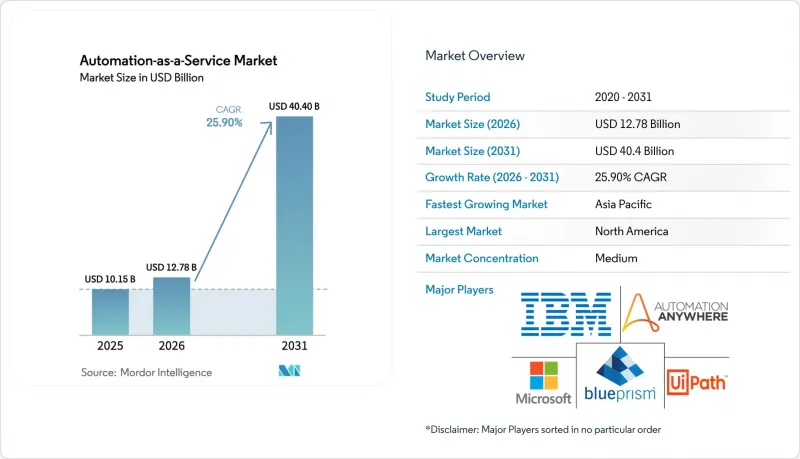
根據 Mordor Intelligence 預測,自動化即服務 (AaaS) 市場規模將從 2025 年的 101.5 億美元成長到 2026 年的 127.8 億美元,然後在 2031 年達到 404 億美元,2026 年至 2031 年的複合成長率為 25.9%。
本報告按部署類型(本地部署和雲端部署)、組件(解決方案和服務)、業務功能(資訊科技、財務和會計等)、企業規模(大型企業和中小企業)、最終用戶行業(銀行、金融服務和保險、電信和 IT、零售和消費品等)以及地區進行分類。
全球自動化即服務 (AaaS) 市場趨勢與洞察
業務流程自動化的需求日益成長
目前,44% 的新增自動化工作流程由各個業務部門生成,這表明公民開發人員正在有效地補充中央 IT 團隊的工作。與營收和營運相關的專案佔運作中自動化流程的近一半,且客戶用例的使用趨勢顯著增強。隨著跨職能團隊重新設計交接流程,對能夠實現細粒度存取控制並支援低程式碼配置的平台的需求日益成長。複雜性也在不斷增加。 61% 的已投入運作中機器人執行的是多階段邏輯,而非單一任務巨集。客戶支援流程正經歷三位數的成長,這顯示在成本受限的經濟週期中,自動化與客戶維繫策略密切相關。
雲端優先的IT策略正在加速AaaS的普及。
多租用戶架構使服務提供者能夠在不安排計劃停機的情況下向所有客戶端執行個體部署新功能,從而加速創新週期。基礎設施即程式碼 (IaC) 範本透過標準化測試、預發布和生產環境的配置,進一步減少了摩擦。對於中小企業而言,付費使用制將自動化相關支出納入營運預算,從而消除伺服器維護開銷。擁有混合環境的公司透過將對延遲敏感的工作負載部署在邊緣,同時在雲端集中管理策略,從而在資料主權法規和彈性可擴展性之間取得平衡。因此,以雲端為中心的採用速度超過了自動化即服務 (Automation-as-a-Service) 市場的整體成長速度。
多租戶雲端中的資料安全和隱私問題
在共用基礎設施模型中,如果隔離控制失效,橫向機芯的風險就會增加。這對於金融服務和醫療保健行業的買家來說是一個主要擔憂。當人工智慧助理繼承了廣泛的 OAuth 權限範圍時,這個問題會更加嚴重,可能導致敏感內容透過即時注入洩漏。歐洲監管機構正在強制執行嚴格的資料居住要求和自動決策揭露規則,要求提供者驗證加密標準並隔離日誌。供應商正在透過實施客戶管理的金鑰、特定區域的資料儲存和持續的合規性儀表板來應對這些要求。雖然採用率依然很高,但高度監管產業的買家選擇分階段部署,先從風險較低的流程著手。
細分市場分析
到2025年,本地部署仍將佔據自動化即服務 (AaaS) 市場67.62%的佔有率。這反映了金融和公共部門嚴格的主權要求,以及已投入的硬體資源。儘管如此,隨著企業將非關鍵工作流程和開發沙箱遷移到雲端以減少基礎設施維護,基於雲端的解決方案正以27.3%的複合年成長率快速成長。供應商現在提供單一租戶虛擬私有雲 (VPC) 選項,這些選項在滿足審計要求的同時,也能保持彈性可擴充性和自動修補程式功能。邊緣部署正在建構混合拓撲結構,透過在本地處理對延遲敏感的任務數據,然後再將增強後的有效負載傳輸到中央分析系統,從而平衡效能和管治。合約擴大將兩種運行模式捆綁在一個統一的控制面板下,使管理員能夠根據成本和合規性觸發條件動態調整工作負載。這種柔軟性已使雲端模式成為自動化即服務 (AaaS) 市場的長期成長引擎,這一趨勢在從未擁有資料中心資產的新興數位企業中尤為明顯。
到2025年,解決方案將佔銷售額的66.05%,其中平台許可和機器人創建工作室是大多數買家的入門選擇。然而,隨著企業尋求設計思維、變革管理和持續改進方面的專業知識,預計到2031年,服務領域的複合年成長率將達到27.2%,超過軟體銷售。託管服務供應商透過建立運作手冊、監控機器人健康狀況和應用安全補丁,使客戶能夠專注於核心創新。供應商生態系統中的顧問公司提供將流程挖掘診斷與超自動化藍圖結合的軟體包,無需增加人員即可加快價值實現速度。隨著複雜性的增加,服務品質成為關鍵的差異化因素,從而增強生態系統鎖定,並推動整個自動化即服務市場的合約生命週期價值。
區域分析
預計北美將繼續保持主導地位,到2025年將佔全球收入的38.15%,這得益於成熟的超大規模資料中心、密集的合作夥伴網路以及金融、醫療保健和公共服務等領域平台的早期應用。美國企業正在部署認知機器人,以匹配ERP、CRM和產業專用的雲端平台上的數據,推動平台利用率高於全球平均。在加拿大,公共部門的採用速度正在加快;而在墨西哥,自動化正被用於提升製造業近岸外包的競爭力。
預計亞太地區將實現最快成長,到2031年複合年成長率將達到26.4%。 《東協數位發展總體規劃2025》透過推動跨國數位服務標準的建立和提升公共部門的自動化水平,正促使私人企業快速採用相關技術。中國正在擴大工廠機器人和城市管理機器人的應用;印度正在推進IT服務工作流程的現代化;日本則透過引入互動式智慧體來應對老年護理領域的人手不足。韓國正在試行利用5G技術進行邊緣自動化,而澳洲則專注於提升採礦業的流程效率。
歐洲採取謹慎的態度,力求在創新與嚴格的資料保護監管之間取得平衡。 GDPR 和提案的人工智慧管治立法正在推動對可解釋工作流程和嵌入式審計日誌的需求。瑞士、瑞典和德國的採用率最高,銀行和製造商已將人工智慧輔助駕駛系統整合到關鍵營運中。南歐國家依靠歐盟的數位化資金,這催生了對平台即服務 (PaaS) 合約的新競標。儘管宏觀經濟情勢各異,但這些趨勢仍使自動化即服務 (AaaS) 市場保持強勁成長。
其他好處:
- Excel格式的市場預測(ME)表
- 3個月的分析師支持
目錄
第1章:引言
- 研究假設和市場定義
- 調查範圍
第2章:調查方法
第3章執行摘要
第4章 市場狀況
- 市場概覽
- 市場促進因素
- 業務流程自動化的需求日益成長
- 「雲端優先」的IT策略正在加速AaaS的普及。
- RPA與通用AI融合實現超自動化
- 訂閱和按使用收費系統正在降低中小企業的進入門檻。
- 專注於特定領域的機器人交易平台的出現。
- 整合流程挖掘洞察,推動端到端自動化。
- 市場限制因素
- 多租戶雲端中的資料安全和隱私問題
- 與舊有系統/本地系統整合的複雜性
- 對演算法透明度和倫理的監管
- 低程式碼自動化管治人員短缺
- 價值鏈分析
- 監理情勢
- 技術展望
- 波特五力分析
- 評估宏觀經濟趨勢對市場的影響
第5章 市場規模與成長預測
- 依部署類型
- 現場
- 雲
- 按組件
- 解決方案
- 服務
- 業務職能
- 資訊科技
- 財會
- 人力資源
- 銷售與行銷
- 營運/供應鏈
- 按公司規模
- 大公司
- 中小企業
- 按最終用戶行業分類
- BFSI
- 通訊/IT
- 零售和消費品
- 醫療保健和生命科學
- 製造業
- 政府/公共部門
- 其他終端用戶產業
- 地區
- 北美洲
- 美國
- 加拿大
- 墨西哥
- 歐洲
- 德國
- 英國
- 法國
- 義大利
- 西班牙
- 其他歐洲國家
- 亞太地區
- 中國
- 日本
- 印度
- 韓國
- 澳洲和紐西蘭
- 其他亞太國家
- 南美洲
- 巴西
- 阿根廷
- 其他南美國家
- 中東和非洲
- 中東
- 沙烏地阿拉伯
- 阿拉伯聯合大公國
- 土耳其
- 其他中東國家
- 非洲
- 南非
- 埃及
- 奈及利亞
- 其他非洲國家
- 中東
- 北美洲
第6章 競爭情勢
- 市場集中度
- 策略趨勢
- 市佔率分析
- 公司簡介
- Automation Anywhere
- UiPath
- Blue Prism
- IBM
- Microsoft
- HCLTech
- Hewlett Packard Enterprise
- Kofax
- NICE
- Pegasystems
- ServiceNow
- Appian
- SAP
- Oracle
- Salesforce(MuleSoft/RPA)
- WorkFusion
- Celonis
- Nintex
- Workato
- AutomationEdge
第7章 市場機會與未來展望
According to Mordor Intelligence, the automation-as-a-Service market size is expected to grow from USD 10.15 billion in 2025 to USD 12.78 billion in 2026 and is forecast to reach USD 40.4 billion by 2031 at 25.9% CAGR over 2026-2031.
This report is Segmented by Deployment Type (On-Premise and Cloud), Component (Solution and Services), Business Function (Information Technology, Finance and Accounting, and More), Enterprise Size (Large Enterprises and Small and Medium Enterprises (SMEs)), End-User Vertical (BFSI, Telecom and IT, Retail and Consumer Goods, and More), and Geography.
Global Automation-as-a-Service Market Trends and Insights
Rising Demand for Business-Process Automation
Business units now originate 44% of all newly automated workflows, signalling that citizen developers are complementing central IT teams. Revenue-operations projects account for nearly half of live automations, underscoring a pivot toward customer-facing use cases. As cross-functional teams re-engineer hand-offs, demand rises for platforms that can manage granular permissions while enabling low-code composition. Complexity is also increasing: 61% of active bots execute multistep logic rather than single-task macros. Customer support processes experienced triple-digit growth, showing that automation is firmly linked to retention strategies during cost-constrained economic cycles.
Cloud-First IT Strategies Accelerating AaaS Adoption
Multi-tenant architectures let providers roll out new capabilities to every client instance without scheduled downtime, shortening innovation cycles. Infrastructure-as-Code templates further reduce friction by standardising environment provisioning across testing, staging and production tiers. For SMEs, pay-as-you-go consumption shifts automation spending to operating budgets and removes server maintenance overhead. Enterprises with hybrid footprints place latency-sensitive workloads at the edge while orchestrating policies centrally in the cloud, balancing sovereignty rules with elastic scale. As a result, cloud-centric deployments are outpacing overall Automation-as-a-Service market growth.
Data-Security and Privacy Concerns in Multi-Tenant Clouds
Shared-infrastructure models increase lateral-movement risk if isolation controls fail, a top worry for financial-services and healthcare buyers. The issue is amplified when AI copilots inherit broad OAuth scopes, potentially exposing confidential content through prompt injections. European regulators enforce strict residency and automated-decision disclosure rules, forcing providers to certify encryption standards and segregate logs. Vendors respond with customer-managed keys, regionally pinned data stores and continuous compliance dashboards. Adoption momentum remains solid but buyers in highly regulated sectors proceed with staged rollouts that start with low-risk processes.
Other drivers and restraints analyzed in the detailed report include:
- Convergence of RPA with Generative AI for Hyper-Automation
- Subscription and Usage-Based Pricing Lowering SME Entry Barriers
- Integration Complexity with Legacy/On-Prem Systems
For complete list of drivers and restraints, kindly check the Table Of Contents.
Segment Analysis
On-premise installations retained 67.62% share of the Automation-as-a-Service market in 2025, reflecting strict sovereignty mandates and sunk hardware investments within finance and public-sector domains. Nevertheless, cloud variants are expanding at a 27.3% CAGR as organisations migrate non-critical workflows and development sandboxes to reduce infrastructure upkeep. Vendors now provide single-tenant VPC options that satisfy audit requirements while preserving elastic scale and automated patching. Edge deployments process data locally for latency-sensitive tasks before routing enriched payloads to central analytics, creating a hybrid topology that balances performance with governance. Contracts increasingly bundle both operating modes under unified dashboards, enabling administrators to shift workloads dynamically based on cost or compliance triggers. This flexibility positions cloud models as the long-run growth engine of the Automation-as-a-Service market, particularly for green-field digital businesses that never owned data-centre assets.
Solutions accounted for 66.05% revenue in 2025 as platform licences and bot-authoring studios formed the entry point for most buyers. The services segment, however, is forecast to outpace software sales at 27.2% CAGR through 2031 as enterprises seek design thinking, change management and continuous-improvement expertise. Managed-service providers curate runbooks, monitor bot health and apply security patches, letting customers focus on core innovation. Advisory firms within the vendor ecosystem package process-mining diagnostics with hyper-automation blueprints, accelerating time to value without ballooning headcount. As complexity rises, service quality becomes a key differentiator, reinforcing ecosystem lock-in and boosting lifetime contract values across the Automation-as-a-Service market.
Complete Report Scope:
- By Deployment Type
- On-premise
- Cloud
- By Component
- Solution
- Services
- By Business Function
- Information Technology
- Finance and Accounting
- Human Resources
- Sales and Marketing
- Operations / Supply-Chain
- By Enterprise Size
- Large Enterprises
- Small and Medium Enterprises (SMEs)
- By End-user Vertical
- BFSI
- Telecom and IT
- Retail and Consumer Goods
- Healthcare and Life Sciences
- Manufacturing
- Government and Public Sector
- Other End-user Verticals
- Geography
- North America
- United States
- Canada
- Mexico
- Europe
- Germany
- United Kingdom
- France
- Italy
- Spain
- Rest of Europe
- Asia-Pacific
- China
- Japan
- India
- South Korea
- Australia and New Zealand
- Rest of Asia-Pacific
- South America
- Brazil
- Argentina
- Rest of South America
- Middle East and Africa
- Middle East
- Saudi Arabia
- United Arab Emirates
- Turkey
- Rest of Middle East
- Africa
- South Africa
- Egypt
- Nigeria
- Rest of Africa
- Middle East
- North America
Geography Analysis
North America holds leadership with 38.15% revenue in 2025, supported by mature hyperscale data centres, a dense partner network and early platform adoption that spans finance, healthcare and public services. United States corporations deploy cognitive bots that reconcile data across ERP, CRM and vertical clouds, pushing platform utilisation rates above global averages. Canada accelerates public-sector use, while Mexico leverages automation to enhance near-shoring competitiveness in manufacturing.
Asia-Pacific registers the fastest growth at 26.4% CAGR through 2031. The ASEAN Digital Masterplan 2025 catalyses cross-border digital-service standards, spurring public-sector automation that quickly permeates private enterprises. China scales factory-floor robotics and city-administration bots, India modernises IT-service workflows, and Japan addresses labour shortages with conversational agents for elder-care. South Korea pilots 5G-enabled edge automations, while Australia focuses on mining-sector process efficiency.
Europe adopts a measured stance that balances innovation with rigorous data-protection oversight. GDPR and proposed AI-governance acts prompt demand for explainable workflows and built-in audit logs. Switzerland, Sweden and Germany exhibit the highest penetration rates, with banks and manufacturers integrating AI copilots into critical operations. Southern-European economies rely on EU funding for digitalisation, creating fresh bids for platform-as-a-service contracts. These dynamics keep the Automation-as-a-Service market resilient across varying macro-economic backdrops.
- Automation Anywhere
- UiPath
- Blue Prism
- IBM
- Microsoft
- HCLTech
- Hewlett Packard Enterprise
- Kofax
- NICE
- Pegasystems
- ServiceNow
- Appian
- SAP
- Oracle
- Salesforce (MuleSoft/RPA)
- WorkFusion
- Celonis
- Nintex
- Workato
- AutomationEdge
Additional Benefits:
- The market estimate (ME) sheet in Excel format
- 3 months of analyst support
TABLE OF CONTENTS
1 INTRODUCTION
- 1.1 Study Assumptions and Market Definition
- 1.2 Scope of the Study
2 RESEARCH METHODOLOGY
3 EXECUTIVE SUMMARY
4 MARKET LANDSCAPE
- 4.1 Market Overview
- 4.2 Market Drivers
- 4.2.1 Rising demand for business-process automation
- 4.2.2 Cloud-first IT strategies accelerating AaaS adoption
- 4.2.3 Convergence of RPA with Gen-AI for hyper-automation
- 4.2.4 Subscription and usage-based pricing lowering SME entry barriers
- 4.2.5 Emergence of domain-specific bot marketplaces
- 4.2.6 Integration of process-mining insights to drive end-to-end automation
- 4.3 Market Restraints
- 4.3.1 Data-security and privacy concerns in multi-tenant clouds
- 4.3.2 Integration complexity with legacy/on-prem systems
- 4.3.3 Regulatory scrutiny over algorithmic transparency and ethics
- 4.3.4 Scarcity of low-code automation governance talent
- 4.4 Value Chain Analysis
- 4.5 Regulatory Landscape
- 4.6 Technological Outlook
- 4.7 Porter's Five Forces Analysis
- 4.7.1 Bargaining Power of Suppliers
- 4.7.2 Bargaining Power of Consumers
- 4.7.3 Threat of New Entrants
- 4.7.4 Threat of Substitute Products
- 4.7.5 Intensity of Competitive Rivalry
- 4.8 Assessment of the Impact of Macroeconomic Trends on the Market
5 MARKET SIZE AND GROWTH FORECASTS (VALUE)
- 5.1 By Deployment Type
- 5.1.1 On-premise
- 5.1.2 Cloud
- 5.2 By Component
- 5.2.1 Solution
- 5.2.2 Services
- 5.3 By Business Function
- 5.3.1 Information Technology
- 5.3.2 Finance and Accounting
- 5.3.3 Human Resources
- 5.3.4 Sales and Marketing
- 5.3.5 Operations / Supply-Chain
- 5.4 By Enterprise Size
- 5.4.1 Large Enterprises
- 5.4.2 Small and Medium Enterprises (SMEs)
- 5.5 By End-user Vertical
- 5.5.1 BFSI
- 5.5.2 Telecom and IT
- 5.5.3 Retail and Consumer Goods
- 5.5.4 Healthcare and Life Sciences
- 5.5.5 Manufacturing
- 5.5.6 Government and Public Sector
- 5.5.7 Other End-user Verticals
- 5.6 Geography
- 5.6.1 North America
- 5.6.1.1 United States
- 5.6.1.2 Canada
- 5.6.1.3 Mexico
- 5.6.2 Europe
- 5.6.2.1 Germany
- 5.6.2.2 United Kingdom
- 5.6.2.3 France
- 5.6.2.4 Italy
- 5.6.2.5 Spain
- 5.6.2.6 Rest of Europe
- 5.6.3 Asia-Pacific
- 5.6.3.1 China
- 5.6.3.2 Japan
- 5.6.3.3 India
- 5.6.3.4 South Korea
- 5.6.3.5 Australia and New Zealand
- 5.6.3.6 Rest of Asia-Pacific
- 5.6.4 South America
- 5.6.4.1 Brazil
- 5.6.4.2 Argentina
- 5.6.4.3 Rest of South America
- 5.6.5 Middle East and Africa
- 5.6.5.1 Middle East
- 5.6.5.1.1 Saudi Arabia
- 5.6.5.1.2 United Arab Emirates
- 5.6.5.1.3 Turkey
- 5.6.5.1.4 Rest of Middle East
- 5.6.5.2 Africa
- 5.6.5.2.1 South Africa
- 5.6.5.2.2 Egypt
- 5.6.5.2.3 Nigeria
- 5.6.5.2.4 Rest of Africa
- 5.6.5.1 Middle East
- 5.6.1 North America
6 COMPETITIVE LANDSCAPE
- 6.1 Market Concentration
- 6.2 Strategic Moves
- 6.3 Market Share Analysis
- 6.4 Company Profiles (includes Global-level Overview, Market-level Overview, Core Segments, Financials as available, Strategic Information, Market Rank/Share, Products and Services, and Recent Developments)
- 6.4.1 Automation Anywhere
- 6.4.2 UiPath
- 6.4.3 Blue Prism
- 6.4.4 IBM
- 6.4.5 Microsoft
- 6.4.6 HCLTech
- 6.4.7 Hewlett Packard Enterprise
- 6.4.8 Kofax
- 6.4.9 NICE
- 6.4.10 Pegasystems
- 6.4.11 ServiceNow
- 6.4.12 Appian
- 6.4.13 SAP
- 6.4.14 Oracle
- 6.4.15 Salesforce (MuleSoft/RPA)
- 6.4.16 WorkFusion
- 6.4.17 Celonis
- 6.4.18 Nintex
- 6.4.19 Workato
- 6.4.20 AutomationEdge
7 MARKET OPPORTUNITIES AND FUTURE OUTLOOK
- 7.1 White-space and Unmet-Need Assessment

 自動化即服務 (AaaS) 市場:按組件、定價模式、技術、應用、企業規模和產業分類-2026-2032 年全球市場預測
 客戶服務自動化市場預測至2034年:按組件、通訊管道、部署模式、應用、最終用戶和地區分類的全球分析
 自動化即服務 (AaaS) 市場規模、佔有率、趨勢和預測:按組件、業務功能、企業規模、行業和地區分類,2026-2034 年
 2026年全球客戶服務自動化市場報告2026年全球自動化即服務市場報告日本自動化服務市場規模、佔有率、趨勢和預測:按組件、業務功能、公司規模、行業和地區分類,2026-2034年
 自動化服務市場 - 全球產業規模、佔有率、趨勢、機會及預測(按部署類型、業務功能、公司規模、最終用戶供應商、地區和競爭格局分類,2021-2031 年)
 自動化即服務 (AaaS) 市場規模、佔有率和成長分析(按組件、部署類型、業務功能、組織規模、類型、最終用戶行業和地區分類)—2026-2033 年行業預測數位客戶體驗和服務自動化市場-全球產業規模、佔有率、趨勢、機會和預測,按分析工具、部署方式、應用領域、地區和競爭格局分類,2020-2030 年預測
 自動化即服務市場,按組件、按部署、按業務功能、按組織規模、按最終用戶垂直、按國家/地區 - 2025 年至 2032 年全球行業分析、市場規模、市場佔有率和預測