


 |
市場調查報告書
商品編碼
2122732
追蹤溯源解決方案:市場佔有率分析、產業趨勢與統計、成長預測(2026-2031 年)Track And Trace Solutions - Market Share Analysis, Industry Trends & Statistics, Growth Forecasts (2026 - 2031) |
||||||

※ 本網頁內容可能與最新版本有所差異。詳細情況請與我們聯繫。
根據 Mordor Intelligence 預測,追蹤溯源解決方案市場規模預計將在 2025 年達到 35.1 億美元,2026 年達到 38.3 億美元,到 2031 年達到 59.3 億美元,2026 年至 2031 年的複合年成長率為 9.14%。
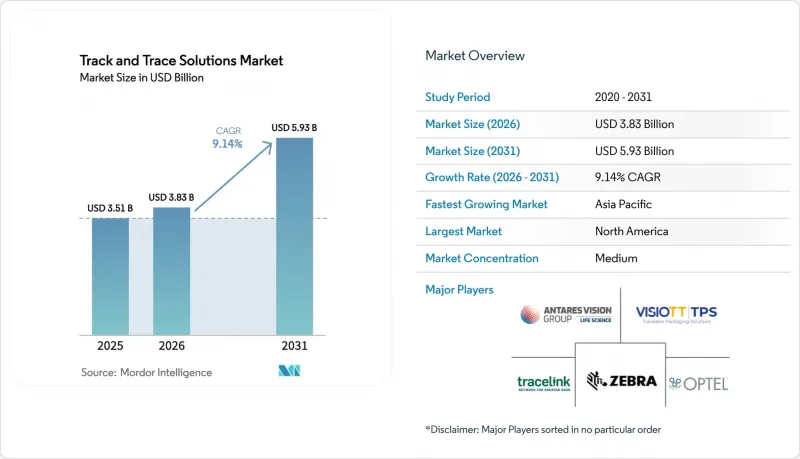
本報告按組件(硬體系統(列印和標記設備等)、軟體解決方案、其他)、技術(條碼、2D資料矩陣、其他)、應用(序列化解決方案、聚合解決方案)、最終用戶(製藥公司、其他)和地區(北美、歐洲、其他)進行細分。市場預測以美元計價。
全球追蹤溯源解決方案市場趨勢及洞察
全球藥品溯源法規的協調統一
監管協調正在加速實施進程。中國將於2026年1月生效的新版GMP附錄強制要求原料藥(原料藥)出貨進行電子批記錄;而印度將於2025年2月生效的出口法規正在加速QR碼的普及應用。 ISO 12931概述了通用的認證框架,旨在減少貿易夥伴之間的整合延遲。跨國公司正朝著標準化其企業級架構的方向發展,而不是維護孤立的、基於區域的系統。認證差距(截至2025年,南亞只有十分之三的學名藥公司符合ISO 12931標準)使得符合標準的供應商能夠贏得更有利的合約。
假藥威脅日益嚴重,因此確保病人安全顯得尤為重要。
國際刑警組織2023年的「盤古行動」查獲了價值5,300萬美元的非法毒品,但世界衛生組織的記錄顯示,2024年假藥案件數量高達1,500起。 [1] 美國醫院集團採購組織目前拒收缺乏序列化可追溯資料的貨物。隨著遠距遠端醫療的普及,患者繞過實體藥局就醫,這帶來了新的安全隱患,促使美國食品藥物管理局(FDA)在2024年向15家線上經銷商發出警告信。在此背景下,序列化被視為第一線防禦措施。
由於各國實施進度安排不同,投資不確定性。
巴西已將小規模製造商的全面序列化計畫推遲至2027年,導致資金流向那些截止日期更為明確的市場。沙烏地阿拉伯於2024年完成了分階段實施,但其鄰國仍保留著各自獨特的申報系統。在土耳其,外國當地企業,導致合規壓力不均。製造商被迫在這種分散的環境中分配資源,導致決策週期延長。
細分市場分析
到2025年,軟體解決方案將佔總收入的52.64%,凸顯了其作為連接生產線級控制器和企業資源計劃(ERP)系統的整合層的重要作用。跨國公司對追蹤溯源解決方案的需求推動了該市場的發展,這些公司需要一個統一的全球平台來管理批次級事件,並將匯總資料上傳至歐盟以符合資料安全合規性要求(DSCSA)。託管服務專家正在執行檢驗、審計和升級工作,隨著缺乏序列化專業知識的中型企業將合規營運外包,該市場正以10.49%的複合年成長率成長。
硬體系統仍然至關重要,但買家正在避免被供應商鎖定。 Videojet 的模組化資料矩陣印表機可以快速安裝,並透過與第三方相機整合來縮短切換時間。人工智慧視覺系統可即時偵測條碼缺陷和標籤錯誤,從而減少 30% 的重工。防篡改標籤在一些中東和非洲市場是強制性的,並且正在不斷發展壯大,但軟體主導的互通性才是決定合約成敗的關鍵。隨著監管審計日益嚴格,追蹤和追溯解決方案市場的預算重點正從設備轉向生命週期服務。
由於條碼和2D資料矩陣符號幾乎相容於所有掃描器且單位成本極低,預計到2025年,它們將佔市場支出的55.76%。這一佔有率表明,基於標準的條碼在追蹤溯源解決方案市場佔據主導地位,並成為滿足美國、歐洲、中國和印度監管要求的基準。 GS1資料矩陣透過在狹小空間內編碼GTIN、序號、批號和有效期,實現了在泡殼包裝卡和瓶子上的高速列印。
生技藥品和疫苗等需要持續溫度控制的應用推動,RFID 和 NFC 正在以 8.85% 的複合年成長率成長。
區域分析
2025年,北美地區的銷售額佔比達到42.24%。美國在DCSSA穩定期於2024年11月結束後,將有限的豁免期延長至2025年。此舉促進了分階段升級,有利於那些能夠同時支援EPCIS和傳統平面文件流的平台。在加拿大,序列化規則在2025年之前逐步實施,但執法力度相對寬鬆。同時,墨西哥的提案缺乏明確的時間表,供應商則優先考慮遵守美國的規定。隨著企業逐步完成DCSSA的最後階段,這些因素導致支出居高不下。
亞太地區正以10.29%的複合年成長率引領成長。中國2027年供應鏈可追溯性目標和印度強制出口QR碼的要求推動了生產線的快速維修。中國將於2026年生效的GMP附錄強制要求輔料和原料藥(API)進行序列化批次記錄,這將增加國內需求。印度針對“300強品牌”的QR碼法規正在形成一個“兩極分化的市場”,有利於那些有財力進行升級的品牌。雖然日本鼓勵自願採用,但競爭壓力正促使先行企業對高附加價值療法進行序列化。這些因素共同推動了亞太地區追蹤溯源解決方案市場佔有率的擴大。
在歐洲,儘管「假藥指令」下已建立了一個成熟的部署環境,但檢驗系統的演進速度因國家而異。在南歐部分地區,藥局仍在使用人工掃描,導致合規速度較慢。在英國,脫歐後的獨立資料庫為在雙重市場運作的製造商帶來了複雜性和額外成本。儘管追蹤溯源解決方案市場已趨於成熟,但持續的改善仍在推動歐洲市場維持中位數個位數的成長。
中東和非洲的進展並不均衡。儘管海灣合作理事會波灣合作理事會已強制要求在港口實施條碼和數據聚合,但撒哈拉以南非洲國家仍依賴捐助者資助的試點項目,且往往在大規模部署階段停滯不前。沙烏地阿拉伯已於2024年完成分階段實施,但鄰近市場的資料格式仍不一致。南非的法規草案仍未最終確定。這些差異正在減緩成長,但如果協調工作能夠取得進展,則有長期發展的空間。
在南美洲,市場依然分散。在巴西,由於實施工作屢次延誤,本地系統更新被推遲至2027年,阻礙了投資。在阿根廷,精神藥物和管制藥品的序列化是強制性的,但缺乏統一的檢驗系統,限制了其效益。智利和哥倫比亞僅發布了不強制要求序列化的指南,導致序列化實施主要依據跨國公司的政策而非國內法律。在推出更明確的實施指南之前,這種不確定性將限制該地區追蹤溯源解決方案市場的規模。
其他好處
- Excel格式的市場預測(ME)表
- 3個月的分析師支持
目錄
第1章:引言
- 研究假設和市場定義
- 調查範圍
第2章:調查方法
第3章執行摘要
第4章 市場狀況
- 市場概覽
- 市場促進因素
- 全球藥品溯源法規的協調統一
- 假藥威脅日益嚴重,因此確保病人安全顯得尤為重要。
- 直接面向患者的銷售和電子商務管道的激增,推動了對端到端可視性的需求。
- 醫藥供應鏈數位化及雲端原生SaaS的採用
- 由於轉向個人化和小批量治療,需要靈活的序列化。
- 透過避免品牌聲譽和召回成本,推動追蹤和追溯分析的投資。
- 市場限制因素
- 由於各國實施進度安排不同,投資不確定性。
- 傳統MES/ERP和包裝生產線相關的高額資本投資和整合成本。
- 網路化溯源平台的資料隱私與網路安全風險
- 低利潤學名藥生產商單位投資報酬率的局限性
- 技術展望
- 波特五力模型
第5章 市場規模與成長預測
- 按組件
- 硬體系統
- 印刷和標記設備
- 監測與檢驗系統
- 標籤和防篡改解決方案
- 其他
- 軟體解決方案
- 工廠級管理套件
- 生產線控制器軟體
- 捆綁托盤追蹤軟體
- 企業雲端平台
- 專業服務/託管服務
- 硬體系統
- 透過技術
- 條碼/2D資料矩陣
- RFID/NFC
- 先進的物聯網感測器和藍牙低功耗信標
- 透過使用
- 序列化解決方案
- 瓶子序列化
- 泡殼包裝條的序列化
- 紙箱序列化
- 資料矩陣 QR 序列化
- 整合解決方案
- 捆綁聚合
- 病例聚集
- 托盤整合
- 序列化解決方案
- 最終用戶
- 製藥公司
- 契約製造和包裝操作員(CMO/CPO)
- 醫療設備製造商
- 醫療用品經銷商和批發商
- 其他生命科學相關人員(非處方藥、膳食補充劑、化妝品、合法大麻)
- 按地區
- 北美洲
- 美國
- 加拿大
- 墨西哥
- 歐洲
- 德國
- 英國
- 法國
- 義大利
- 西班牙
- 其他歐洲國家
- 亞太地區
- 中國
- 日本
- 印度
- 韓國
- 澳洲
- 其他亞太國家
- 中東和非洲
- GCC
- 南非
- 其他中東和非洲國家
- 南美洲
- 巴西
- 阿根廷
- 南美洲其他地區
- 北美洲
第6章 競爭情勢
- 市場集中度
- 市佔率分析
- 公司簡介
- OPTEL Group
- TraceLink Inc.
- Antares Vision SpA
- SEA Vision SRL
- Syntegon Technology GmbH
- Zebra Technologies Corp.
- Mettler-Toledo International Inc.
- Korber Medipak Systems GmbH
- ACG Worldwide
- VISIOTT
- Uhlmann
- Sato Holdings Corporation
- Siemens Digital Industries
- Brother Industries, Ltd.(Domino Printing Sciences plc)
- Dover Corporation(Markem-Imaje)
- Wipotec-OCS GmbH
- Veralto Corporation(Videojet Technologies Inc.)
- Coesia SpA
第7章 市場機會與未來展望
According to Mordor Intelligence, the track and trace solutions market size is projected to be USD 3.51 billion in 2025, USD 3.83 billion in 2026, and reach USD 5.93 billion by 2031, growing at a CAGR of 9.14% from 2026 to 2031.
This report is Segmented by Component (Hardware Systems [Printing & Marking Equipment, and More], Software Solutions, and More), Technology (Barcode / 2-D DataMatrix, and More), Application (Serialization Solutions and Aggregation Solutions), End User (Pharmaceutical Manufacturers, and More), and Geography (North America, Europe, and More). The Market Forecasts are Provided in Terms of Value (USD).
Global Track And Trace Solutions Market Trends and Insights
Convergence of Global Pharmaceutical Traceability Mandates
Regulatory alignment is compressing deployment schedules. China's new GMP appendices effective January 2026 enforce electronic batch records for API shipments, while India's February 2025 export rule accelerates QR-code rollouts. ISO 12931 offers a shared authentication blueprint that trims integration delays across trading partners. Multinationals are standardizing enterprise-wide architectures instead of maintaining isolated regional stacks. The certification gap-only three in ten South Asian generic firms met ISO 12931 by 2025-lets compliant suppliers command premium contracts.
Escalating Counterfeit Drug Threat Elevating Patient-Safety Imperatives
Interpol's 2023 Operation Pangea seized illicit drugs valued at USD 53 million, yet WHO recorded 1,500 falsified-medicine incidents in 2024[1]. Hospital group-purchasing organizations in the United States now reject shipments lacking serialized pedigree data. Telemedicine growth opens fresh vulnerabilities as patients bypass brick-and-mortar pharmacies; the FDA sent 15 warning letters to online outlets in 2024. This environment propels serialization as a frontline defense.
Fragmented Country-Level Timelines Generating Investment Uncertainty
Brazil deferred full serialization for smaller producers to 2027, diverting capital to markets with firmer deadlines. Saudi Arabia completed phased rollouts in 2024, yet neighboring states retain unique file formats. Turkey fines foreign firms more often than local peers, creating uneven compliance pressure. Manufacturers juggle resources across this patchwork, extending decision cycles.
Other drivers and restraints analyzed in the detailed report include:
- Surge in Direct-to-Patient and E-commerce Channels Requiring End-to-End Visibility
- Digitalization of Pharma Supply Chains and Cloud-Native SaaS Adoption
- High Capital and Integration Costs with Legacy Systems
For complete list of drivers and restraints, kindly check the Table Of Contents.
Segment Analysis
Software Solutions anchored 52.64% of 2025 revenue, underscoring their role as the unifying layer that links line-level controllers with enterprise resource planning. The Track and Trace Solutions market benefits from multinationals that mandate single global platforms to manage DSCSA lot-level events alongside EU aggregation uploads. Managed-service specialists execute validation, audits, and upgrades, growing at 10.49% CAGR as mid-sized firms lacking serialization talent outsource compliance.
Hardware Systems remain essential, yet buyers avoid vendor lock-in. Modular DataMatrix printers from Videojet install quickly and pair with third-party cameras, cutting changeover time. AI-equipped vision systems identify barcode defects and misapplied labels in real time, trimming rework by 30%. Tamper-evident labeling is compulsory in select MEA markets and continues to carve a niche, but software-driven interoperability decides contract awards. The Track and Trace Solutions market continues to shift budget weight from equipment to lifecycle services as regulatory audits intensify.
Barcodes and 2-D DataMatrix symbols delivered 55.76% of 2025 spending because of universal scanner compatibility and negligible per-unit cost. This share underscores the Track and Trace Solutions market dominance of standards-based barcoding, a baseline that satisfies regulators across the United States, Europe, China, and India. GS1 DataMatrix encodes GTIN, serial, lot, and expiration within a small footprint, enabling high-speed printing on blister cards and bottles.
RFID & NFC are advancing at 8.85% CAGR, driven by biologics and vaccines that need continuous temperature assurance.
Complete Report Scope:
- By Component
- Hardware Systems
- Printing & Marking Equipment
- Monitoring & Verification Systems
- Labeling & Tamper-evident Solutions
- Other Hardware
- Software Solutions
- Plant-level Management Suites
- Line Controller Software
- Bundle / Pallet Tracking Software
- Enterprise & Cloud Platforms
- Professional & Managed Services
- Hardware Systems
- By Technology
- Barcode / 2-D DataMatrix
- RFID & NFC
- Advanced IoT Sensors & BLE Beacons
- By Application
- Serialization Solutions
- Bottle Serialization
- Blister & Strip Serialization
- Carton & Case Serialization
- Data-Matrix / QR Serialization
- Aggregation Solutions
- Bundle Aggregation
- Case Aggregation
- Pallet Aggregation
- Serialization Solutions
- By End User
- Pharmaceutical Manufacturers
- Contract Manufacturing & Packaging Organizations (CMOs/CPOs)
- Medical Device Manufacturers
- Healthcare Distributors & Wholesalers
- Other Life-science Stakeholders (OTC, Nutraceuticals, Cosmetics, Legal Cannabis)
- By Geography
- North America
- United States
- Canada
- Mexico
- Europe
- Germany
- United Kingdom
- France
- Italy
- Spain
- Rest of Europe
- Asia-Pacific
- China
- Japan
- India
- South Korea
- Australia
- Rest of Asia-Pacific
- Middle East and Africa
- GCC
- South Africa
- Rest of Middle East and Africa
- South America
- Brazil
- Argentina
- Rest of South America
- North America
Geography Analysis
North America delivered 42.24% of 2025 revenue. The United States closed its DSCSA stabilization period in November 2024, then extended limited exemptions through 2025, prompting staggered upgrades that favored platforms able to support EPCIS and legacy flat-file flows simultaneously. Canada phased in serialization rules through 2025, though enforcement remained lighter, while Mexico's proposal lacks firm dates, leading suppliers to prioritize U.S. readiness. These dynamics keep spending elevated as firms complete final DSCSA milestones.
Asia-Pacific leads growth at 10.29% CAGR. China's 2027 full-chain traceability goal and India's export QR-code mandate force rapid line retrofits. Chinese GMP appendices effective 2026 impose serialized batch records for excipients and APIs, increasing domestic demand. India's top-300-brand QR rule creates a two-speed market favoring branded players with capital for upgrades. Japan recommends voluntary adoption, yet competitive pressure nudges early movers to serialize high-value therapies. Collectively, these forces enlarge the Track and Trace Solutions market share for Asia-Pacific.
Europe maintains mature adoption under the Falsified Medicines Directive, but national verification systems evolve at varied speeds. Pharmacy compliance lags in parts of Southern Europe where manual scans persist. The United Kingdom's separate repository post-Brexit adds complexity and incremental cost for dual-market manufacturers. Despite maturity, continuing enhancements sustain mid-single-digit growth in the Track and Trace Solutions market across Europe.
Middle East and Africa show uneven progress. Gulf Cooperation Council states enforce barcodes and aggregation at ports, yet sub-Saharan nations rely on donor-funded pilots that often stall at scale. Saudi Arabia finished phased implementation in 2024 but adjacent markets still diverge on data formats. South Africa's draft rules remain pending. Such disparity tempers growth but leaves headroom for long-run expansion once harmonization improves.
South America remains fragmented. Brazil's repeated postponements push local upgrades to 2027, stalling investments. Argentina requires serialization for psychotropics and controlled drugs yet lacks centralized verification, limiting benefits. Chile and Colombia publish guidance without mandates, resulting in optional adoption guided by multinational policy rather than national law. This uncertainty curbs the Track and Trace Solutions market size in the region until clearer enforcement emerges.
- OPTEL Group
- TraceLink
- Antares Vision SpA
- SEA Vision SRL
- Syntegon Technology
- Zebra Technologies
- Mettler Toledo
- Korber
- ACG Worldwide
- VISIOTT
- Uhlmann
- Sato Holdings Corporation
- Siemens Digital Industries
- Brother Industries, Ltd. (Domino Printing Sciences plc)
- Dover Corporation (Markem-Imaje)
- Wipotec-OCS GmbH
- Veralto Corporation (Videojet Technologies Inc.)
- Coesia S.p.A.
Additional Benefits:
- The market estimate (ME) sheet in Excel format
- 3 months of analyst support
TABLE OF CONTENTS
1 Introduction
- 1.1 Study Assumptions & Market Definition
- 1.2 Scope of the Study
2 Research Methodology
3 Executive Summary
4 Market Landscape
- 4.1 Market Overview
- 4.2 Market Drivers
- 4.2.1 Convergence of Global Pharmaceutical Traceability Mandates (WHO, ISO)
- 4.2.2 Escalating Counterfeit Drug Threat Elevating Patient?Safety Imperatives
- 4.2.3 Surge in Direct-to-Patient & E-commerce Channels Requiring End-to-End Visibility
- 4.2.4 Digitalization of Pharma Supply Chains and Cloud-native SaaS Adoption
- 4.2.5 Transition to Personalized & Small-Batch Therapies Necessitating Flexible Serialization
- 4.2.6 Brand Reputation & Recall Cost Avoidance Driving Investment in Track & Trace Analytics
- 4.3 Market Restraints
- 4.3.1 Divergent Country-level Timelines Generating Investment Uncertainty
- 4.3.2 High Capital & Integration Costs with Legacy MES/ERP and Packaging Lines
- 4.3.3 Data Privacy & Cyber-security Risks in Networked Traceability Platforms
- 4.3.4 Limited Per-unit ROI for Low-margin Generic Manufacturers
- 4.4 Technological Outlook
- 4.5 Porter's Five Forces
- 4.5.1 Threat of New Entrants
- 4.5.2 Bargaining Power of Buyers
- 4.5.3 Bargaining Power of Suppliers
- 4.5.4 Threat of Substitutes
- 4.5.5 Intensity of Competitive Rivalry
5 Market Size & Growth Forecasts (Value, USD)
- 5.1 By Component
- 5.1.1 Hardware Systems
- 5.1.1.1 Printing & Marking Equipment
- 5.1.1.2 Monitoring & Verification Systems
- 5.1.1.3 Labeling & Tamper-evident Solutions
- 5.1.1.4 Other Hardware
- 5.1.2 Software Solutions
- 5.1.2.1 Plant-level Management Suites
- 5.1.2.2 Line Controller Software
- 5.1.2.3 Bundle / Pallet Tracking Software
- 5.1.2.4 Enterprise & Cloud Platforms
- 5.1.3 Professional & Managed Services
- 5.1.1 Hardware Systems
- 5.2 By Technology
- 5.2.1 Barcode / 2-D DataMatrix
- 5.2.2 RFID & NFC
- 5.2.3 Advanced IoT Sensors & BLE Beacons
- 5.3 By Application
- 5.3.1 Serialization Solutions
- 5.3.1.1 Bottle Serialization
- 5.3.1.2 Blister & Strip Serialization
- 5.3.1.3 Carton & Case Serialization
- 5.3.1.4 Data-Matrix / QR Serialization
- 5.3.2 Aggregation Solutions
- 5.3.2.1 Bundle Aggregation
- 5.3.2.2 Case Aggregation
- 5.3.2.3 Pallet Aggregation
- 5.3.1 Serialization Solutions
- 5.4 By End User
- 5.4.1 Pharmaceutical Manufacturers
- 5.4.2 Contract Manufacturing & Packaging Organizations (CMOs/CPOs)
- 5.4.3 Medical Device Manufacturers
- 5.4.4 Healthcare Distributors & Wholesalers
- 5.4.5 Other Life-science Stakeholders (OTC, Nutraceuticals, Cosmetics, Legal Cannabis)
- 5.5 By Geography
- 5.5.1 North America
- 5.5.1.1 United States
- 5.5.1.2 Canada
- 5.5.1.3 Mexico
- 5.5.2 Europe
- 5.5.2.1 Germany
- 5.5.2.2 United Kingdom
- 5.5.2.3 France
- 5.5.2.4 Italy
- 5.5.2.5 Spain
- 5.5.2.6 Rest of Europe
- 5.5.3 Asia-Pacific
- 5.5.3.1 China
- 5.5.3.2 Japan
- 5.5.3.3 India
- 5.5.3.4 South Korea
- 5.5.3.5 Australia
- 5.5.3.6 Rest of Asia-Pacific
- 5.5.4 Middle East and Africa
- 5.5.4.1 GCC
- 5.5.4.2 South Africa
- 5.5.4.3 Rest of Middle East and Africa
- 5.5.5 South America
- 5.5.5.1 Brazil
- 5.5.5.2 Argentina
- 5.5.5.3 Rest of South America
- 5.5.1 North America
6 Competitive Landscape
- 6.1 Market Concentration
- 6.2 Market Share Analysis
- 6.3 Company Profiles (includes Global level Overview, Market level overview, Core Business Segments, Financials, Headcount, Key Information, Market Rank, Market Share, Products and Services, and analysis of Recent Developments)
- 6.3.1 OPTEL Group
- 6.3.2 TraceLink Inc.
- 6.3.3 Antares Vision SpA
- 6.3.4 SEA Vision SRL
- 6.3.5 Syntegon Technology GmbH
- 6.3.6 Zebra Technologies Corp.
- 6.3.7 Mettler-Toledo International Inc.
- 6.3.8 Korber Medipak Systems GmbH
- 6.3.9 ACG Worldwide
- 6.3.10 VISIOTT
- 6.3.11 Uhlmann
- 6.3.12 Sato Holdings Corporation
- 6.3.13 Siemens Digital Industries
- 6.3.14 Brother Industries, Ltd. (Domino Printing Sciences plc)
- 6.3.15 Dover Corporation (Markem-Imaje)
- 6.3.16 Wipotec-OCS GmbH
- 6.3.17 Veralto Corporation (Videojet Technologies Inc.)
- 6.3.18 Coesia S.p.A.
7 Market Opportunities & Future Outlook
- 7.1 White-space & Unmet-need Assessment

 2026年全球RFID追蹤追溯解決方案市場報告
 溯源解決方案市場:按組件、技術、應用、最終用戶產業、企業規模和部署類型分類-2026-2032年全球市場預測
 全球追蹤溯源解決方案市場:按應用程式、元件、部署模式、最終用戶、技術和地區分類-預測至2031年
 追蹤解決方案市場規模、佔有率、趨勢和預測:按產品、技術、應用、最終用戶產業和地區分類,2026-2034 年
 追蹤及追蹤解決方案市場:按產品類型、技術、應用、最終用戶和地區分類
 全球追蹤及追蹤解決方案市場規模、佔有率、趨勢及成長分析報告(2026-2034)2026年全球追蹤溯源解決方案市場報告追蹤解決方案市場規模、佔有率、成長及全球產業分析:依類型、應用和地區劃分的洞察與預測(2026-2034年)日本追蹤溯源解決方案市場報告:按產品、技術、應用、最終用戶產業和地區分類,2026-2034年
 追蹤溯源解決方案市場規模、佔有率及成長分析(依產品、解決方案、應用、最終用戶、通路及地區分類)-2026-2033年產業預測