


 |
市場調查報告書
商品編碼
2122704
防塗鴉塗料:市場佔有率分析、產業趨勢和統計數據以及成長預測(2026-2031 年)Anti-Graffiti Coatings - Market Share Analysis, Industry Trends & Statistics, Growth Forecasts (2026 - 2031) |
||||||

※ 本網頁內容可能與最新版本有所差異。詳細情況請與我們聯繫。
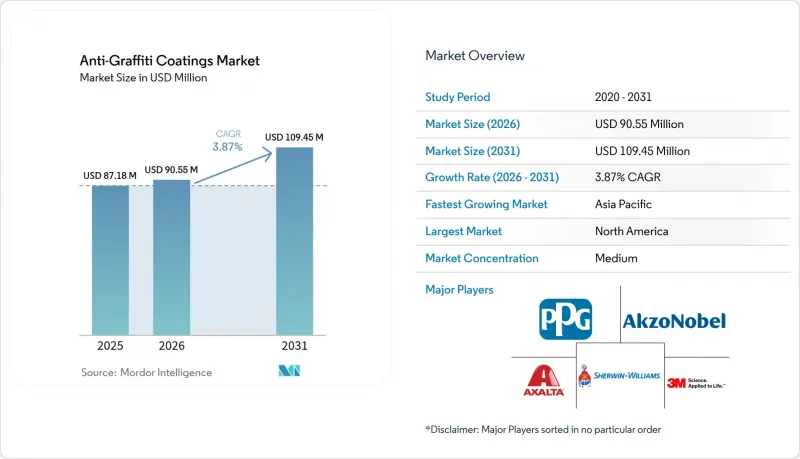
據 Mordor Intelligence 稱,防塗鴉塗料市場預計將從 2025 年的 8,718 萬美元成長到 2026 年的 9,055 萬美元,並將從 2026 年到 2031 年以 3.87% 的複合年成長率成長,到 2031 年達到 1.0945 億美元。
本報告按類型(犧牲陽極型、半犧牲陽極型、非犧牲陽極型)、技術(水性塗料、溶劑型塗料、粉末塗料)、終端用戶行業(汽車和交通運輸、建築及其他終端用戶行業)和地區(亞太地區、北美地區、歐洲地區、南美地區以及中東和非洲地區)進行細分。市場預測以美元計價。
全球防塗鴉塗料市場趨勢及洞察
地方政府增加塗鴉清除支出
為了遏制日益猖獗的塗鴉破壞行為帶來的損失(這些損失已超出其常規維護預算),各城市正在加快預算撥款。波特蘭市累計了第1099-2024號緊急法令,以應對2020年至2022年間塗鴉申訴激增586%的情況。同時,惠靈頓市議會已獲得757萬美元的資金,用於一項持續到2025年的保護計畫。德國鐵路公司每年花費800萬歐元清潔,該公司正逐步採用聚矽氮烷基阻隔塗層,這種塗層能夠承受反覆的無溶劑清潔。由於預防措施已被證明比反覆清除更具成本效益,市政採購越來越優先考慮能夠維護城市景觀並最大限度降低生命週期成本的永久性低VOC塗層。這種轉變支撐了公共基礎設施和交通資產對防塗鴉塗層的穩定需求,並鞏固了供應商的中期收入前景。
公共基礎建設快速擴張
亞太地區的建築熱潮正推動著對錶面防護解決方案的根本需求。中國國家發展和改革委員會的《2024年藍圖》強調「高品質基礎設施」是國內需求的驅動力,加速了鐵路、橋樑和智慧城市計畫採用防塗鴉規範。在印度和印尼,永久性塗層正被納入智慧運輸走廊的採購標準,以控制未來的維護成本。同樣,美國聯邦政府的「清潔採購」舉措已投入超過20億美元用於低碳建築材料,其中水性、符合揮發性有機化合物(VOC)標準的產品的使用率不斷上升。新興的區域建築商通常缺乏完善的清潔系統,他們將耐用塗層視為降低生命週期成本的早期防護措施,這正在推動防塗鴉塗層市場長期應用。
矽氧烷和氟聚合物的原料成本波動很大。
矽氧烷和氟聚合物的價格波動對生產商的利潤率帶來壓力,而終端用戶對價格仍然十分敏感。歐洲化學品管理局 (ECHA)提案,提高了供應鏈的監管力度,並增加了合規相關支出。生產商正在嘗試使用混合化學配方,以減少矽氧烷的使用量並保持耐久性,但由於重新設計方面的挑戰和更長的認證週期,產品推出速度正在放緩。依賴現貨採購的中小型混配商面臨更高的成本上漲風險,這抑制了防塗鴉塗料市場的短期生產。
細分市場分析
至2025年,非犧牲型系統將佔防塗鴉塗料市場51.63%的佔有率,預計到2031年將以4.42%的複合年成長率成長。客戶青睞其單次塗裝即可降低的生命週期成本以及耐水反覆清洗的特性。半犧牲型方法適用於預算適中且重塗週期適中的項目,而犧牲型薄膜則適用於歷史建築和不宜使用耐用聚合物的易損基材。
雖然非犧牲塗層的初始投資較高,但由於減少了因重新粉刷而關閉交通樞紐和公共建築的頻率,這部分成本得以抵消。聚氨酯粉末屏障的案例研究表明,其耐洗性極佳,即使經過 1000 次以上的清洗循環,光澤度也不會下降。這些經濟優勢鞏固了高階細分市場,並促進了防塗鴉塗料市場的價值集中化。
區域分析
2025年,北美在防塗鴉塗料市場維持了38.90%的市佔率。波特蘭市的1099-2024號緊急法令及類似的城市法令已將防護塗料納入年度維護預算,從而帶來了可預測的穩定訂單。該地區的「清潔採購」條款已將聯邦資金分配給低碳水性塗料,符合規定的供應商也因此獲得了優先供貨權。加州空氣品質管理區(AQMD)對非犧牲性塗料揮發性有機化合物(VOC)含量設定的100克/公升的限值,持續推動研發工作,並對全球出貨的產品線產生影響。
亞太地區是成長最快的地區,預計到2031年將以4.14%的複合年成長率成長,這主要得益於中國基礎設施建設的加速發展和印度的「百座智慧城市」計畫。市政當局正在強制要求在地鐵橋墩和人行天橋上使用預防性塗層,以避免未來清潔工作量激增。在日本和韓國等成熟市場,為了應對日益嚴格的環保法規,對現有鐵路和公路設施進行低VOC塗層維修,從而維持了市場需求。
在歐洲,在日益嚴格的環境法規的壓力下,市場呈現穩定成長態勢。法國禁止使用全氟烷基和多氟烷基物質(PFAS),以及歐盟正在考慮的廣泛法規,促使人們重新評估樹脂的選擇,加速對矽酮和生物聚合物的研究。在德國,塗鴉造成的損失每年超過2億歐元,永久性防污措施的經濟合理性日益凸顯,地方政府聯盟正積極簽訂包含防塗鴉條款的長期維護合約。在南美洲、中東和非洲,儘管目前市場規模較小,但聖保羅和利雅德地鐵的快速現代化改造正在擴大市場佔有率,防塗鴉塗料市場也呈現出向多個地區擴張的跡象。
其他好處
- Excel格式的市場預測(ME)表
- 3個月的分析師支持
目錄
第1章:引言
- 研究假設和市場定義
- 調查範圍
第2章:調查方法
第3章執行摘要
第4章 市場狀況
- 市場概覽
- 市場促進因素
- 地方政府增加塗鴉清除支出
- 公共基礎建設快速擴張
- 加強對揮發性有機化合物(VOCs)的監管將加速水性組合藥物。
- 在智慧城市中,街道設備採用防塗鴉塗鴉粉末塗層。
- 將防塗鴉和抗菌功能融入公共運輸設施
- 市場限制因素
- 矽氧烷和氟聚合物的原料成本波動很大。
- 對新引入的、影響含氟塗料的全氟烷基和多氟烷基物質(PFAS)進行監管。
- 多孔3D列印混凝土外牆的黏合挑戰
- 價值鏈分析
- 波特五力模型
第5章 市場規模與成長預測
- 按類型
- 祭祀類型
- 半祭祀型
- 非祭祀型
- 透過技術
- 水溶液
- 溶劑型
- 粉末塗裝
- 按最終用戶行業分類
- 汽車和運輸業
- 建造
- 其他終端使用者產業(工業設備、公共產業)
- 按地區
- 亞太地區
- 中國
- 日本
- 印度
- 韓國
- ASEAN
- 其他亞太國家
- 北美洲
- 美國
- 加拿大
- 墨西哥
- 歐洲
- 德國
- 英國
- 法國
- 義大利
- 西班牙
- 俄羅斯
- 北歐國家
- 其他歐洲國家
- 南美洲
- 巴西
- 阿根廷
- 其他南美國家
- 中東和非洲
- 沙烏地阿拉伯
- 南非
- 其他中東和非洲國家
- 亞太地區
第6章 競爭情勢
- 市場集中度
- 策略趨勢
- 市佔率和排名分析
- 公司簡介
- 3M
- AkzoNobel NV
- Axalta Coating Systems LLC
- BASF
- CSL Silicones Inc.
- Dulux
- Hempel A/S
- Hydron Protective Coatings Ltd
- IFS Coatings
- IGP Pulvertechnik AG
- Nano-Care Deutschland AG
- Nukote Coating Systems International
- PPG Industries Inc.
- Saint-Gobain
- Teknos Group
- The Sherwin-Williams Company
- Urban Hygiene Ltd
- WRMeadows, Inc.
- Wacker Chemie AG
第7章 市場機會與未來展望
According to Mordor Intelligence, the anti-Graffiti coatings market size is expected to grow from USD 87.18 Million in 2025 to USD 90.55 Million in 2026 and is forecast to reach USD 109.45 Million by 2031 at 3.87% CAGR over 2026-2031.
This report is Segmented by Type (Sacrificial, Semi-Sacrificial, and Non-Sacrificial), Technology (Water-Based, Solvent-Based, and Powder Coating), End-User Industry (Automotive and Transportation, Construction, and Other End-User Industries), and Geography (Asia-Pacific, North America, Europe, South America, and Middle East and Africa). The Market Forecasts are Provided in Terms of Value (USD).
Global Anti-Graffiti Coatings Market Trends and Insights
Escalating Municipality Spending on Graffiti Removal
Cities are front-loading budgets to curb soaring vandalism costs that outpace routine maintenance allocations. Portland's Emergency Ordinance 1099-2024 follows a 586% jump in graffiti complaints between 2020 and 2022, while Wellington City Council ring-fenced USD 7.57 Million for protective programmes through 2025 . Deutsche Bahn's EUR 8 Million annual outlay on cleanup has pushed the rail operator toward polysilazane barriers that tolerate repeated solvent-free wash cycles. As prevention proves cheaper than serial removal, municipal procurement increasingly favours permanent, low-VOC (Volatile Organic Compound) coatings that preserve urban aesthetics and minimise life-cycle costs. This shift anchors steady volume off-take for the anti-graffiti coatings market in public infrastructure and transit assets, underpinning suppliers' medium-term revenue visibility.
Rapid Expansion of Public Infrastructure Construction
Asia-Pacific construction booms are boosting baseline demand for surface-protection solutions. China's 2024 National Development and Reform Commission roadmap highlights "high-quality infrastructure" as a domestic-demand catalyst, accelerating anti-graffiti specification in rail, bridge, and smart-city projects. Parallel smart-mobility corridors in India and Indonesia are embedding permanent coatings into procurement standards to curb future maintenance outlays. Similar funding flows from the United States' Federal Buy Clean initiative channel more than USD 2 Billion toward low-carbon building materials, tilting preferences to water-based, Volatile Organic Compound (VOC)-compliant offerings. Contractors in emerging hubs, often operating without established cleaning fleets, view durable coatings as an upfront safeguard that lowers whole-life costs, reinforcing long-run uptake across the anti-graffiti coatings market.
Volatile Siloxane and Fluoropolymer Raw-Material Costs
Siloxane and fluoropolymer pricing swings are squeezing producer margins at a time when end-users remain price sensitive. European Chemicals Agency proposals to tighten rules on certain silicon compounds, including Silicon Dioxide (SiO2), have heightened supply-chain caution and inflated compliance expenditures. Producers are experimenting with hybrid chemistries that trim siloxane loads while safeguarding durability, yet re-engineering hurdles and certification timelines slow roll-outs. Smaller formulators reliant on spot purchases face pronounced cost pass-through risks, restraining near-term output in the anti-graffiti coatings market.
Other drivers and restraints analyzed in the detailed report include:
- Stricter Volatile Organic Compound (VOC) Norms Accelerating Water-borne Formulations
- Adoption of Anti-graffiti Powder Coatings for Smart-city Street Furniture
- Emerging Per- and polyfluoroalkyl substances (PFAS) Restrictions Affecting Fluorinated Coatings
For complete list of drivers and restraints, kindly check the Table Of Contents.
Segment Analysis
Non-sacrificial systems held 51.63% of anti-graffiti coatings market share in 2025 and are expanding at a 4.42% CAGR to 2031. Customers favour their one-time application and rinse-repeat cleaning tolerance that shrink life-cycle spend. Semi-sacrificial formats satisfy mid-tier budgets with moderate recoat intervals, while sacrificial films cater to historic preservation or sensitive substrates that cannot host durable polymers.
Higher upfront expenditure on non-sacrificial layers is offset by fewer closures of transit stations or public buildings for re-painting. Case studies on polyurethane-powder barriers show wash-off resilience beyond 1,000 cleaning cycles without gloss loss. These economics reinforce the premium niche, anchoring value concentration within the anti-graffiti coatings market.
Complete Report Scope:
- By Type
- Sacrificial
- Semi-Sacrificial
- Non-Sacrificial
- By Technology
- Water-Based
- Solvent-Based
- Powder Coating
- By End-User Industry
- Automotive and Transportation
- Construction
- Other End-User Industries (Industrial Equipment, Utilities)
- By Geography
- Asia-Pacific
- China
- Japan
- India
- South Korea
- ASEAN Countries
- Rest of Asia-Pacific
- North America
- United States
- Canada
- Mexico
- Europe
- Germany
- United Kingdom
- France
- Italy
- Spain
- Russia
- NORDIC Countries
- Rest of Europe
- South America
- Brazil
- Argentina
- Rest of South America
- Middle East and Africa
- Saudi Arabia
- South Africa
- Rest of Middle East and Africa
- Asia-Pacific
Geography Analysis
North America retained 38.90% of the Anti-Graffiti Coatings market share in 2025. Portland's Emergency Ordinance 1099-2024 and similar city mandates integrate protective coatings into annual maintenance budgets, translating to predictable recurrent orders. The region's Buy Clean clauses funnel federal funds toward low-carbon, water-based layers, pushing compliant suppliers up the preferred-vendor ladder. California's Air Quality Management District (AQMD) caps of 100 g/L Volatile Organic Compound (VOC) on non-sacrificial coatings continue to spur research and development (R&D) output, influencing product lines shipped worldwide.
Asia-Pacific is the fastest-expanding territory at 4.14% CAGR through 2031, propelled by China's infrastructure acceleration and India's 100-smart-city rollout. Urban councils specifying preventive coatings for metro pillars and pedestrian bridges aim to avoid future cleaning labour spikes. Mature markets such as Japan and South Korea sustain flow by retrofitting existing rail and highway assets with low-VOC layers in line with tightened environmental policies.
Europe grows steadily under the weight of progressive environmental regulation. France's Per- and polyfluoroalkyl substances (PFAS) embargo and the European Union (EU)'s pending wide-spectrum restriction are reshuffling resin choices and fast-tracking silicone and bio-polymer research. Germany's graffiti damage exceeding EUR 200 Million each year sharpens the financial case for permanent barriers, encouraging municipal consortiums to award long-term maintenance contracts featuring anti-graffiti clauses. South America and the Middle East & Africa, while smaller today, are carving space through rapid metro upgrades in Sao Paulo and Riyadh, positioning the anti-graffiti coatings market for multi-regional breadth.
- 3M
- AkzoNobel N.V.
- Axalta Coating Systems LLC
- BASF
- CSL Silicones Inc.
- Dulux
- Hempel A/S
- Hydron Protective Coatings Ltd
- IFS Coatings
- IGP Pulvertechnik AG
- Nano-Care Deutschland AG
- Nukote Coating Systems International
- PPG Industries Inc.
- Saint-Gobain
- Teknos Group
- The Sherwin-Williams Company
- Urban Hygiene Ltd
- W.R.Meadows, Inc.
- Wacker Chemie AG
Additional Benefits:
- The market estimate (ME) sheet in Excel format
- 3 months of analyst support
TABLE OF CONTENTS
1 Introduction
- 1.1 Study Assumptions & Market Definition
- 1.2 Scope of the Study
2 Research Methodology
3 Executive Summary
4 Market Landscape
- 4.1 Market Overview
- 4.2 Market Drivers
- 4.2.1 Escalating Municipality Spending on Graffiti Removal
- 4.2.2 Rapid Expansion of Public-infrastructure Construction
- 4.2.3 Stricter Volatile Organic Compound (VOC) Norms Accelerating Water-borne Formulations
- 4.2.4 Adoption of Anti-graffiti Powder Coatings for Smart-city Street Furniture
- 4.2.5 Convergence of Anti-graffiti & Antimicrobial Surfaces in Transit Assets
- 4.3 Market Restraints
- 4.3.1 Volatile Siloxane & Fluoropolymer Raw-material Costs
- 4.3.2 Emerging Per- and polyfluoroalkyl substances (PFAS) Restrictions Affecting Fluorinated Coatings
- 4.3.3 Adhesion Challenges on Highly Porous 3D-Printed Concrete Facades
- 4.4 Value Chain Analysis
- 4.5 Porter's Five Forces
- 4.5.1 Bargaining Power of Suppliers
- 4.5.2 Bargaining Power of Buyers
- 4.5.3 Threat of New Entrants
- 4.5.4 Threat of Substitutes
- 4.5.5 Degree of Competition
5 Market Size & Growth Forecasts (Value)
- 5.1 By Type
- 5.1.1 Sacrificial
- 5.1.2 Semi-Sacrificial
- 5.1.3 Non-Sacrificial
- 5.2 By Technology
- 5.2.1 Water-Based
- 5.2.2 Solvent-Based
- 5.2.3 Powder Coating
- 5.3 By End-User Industry
- 5.3.1 Automotive and Transportation
- 5.3.2 Construction
- 5.3.3 Other End-User Industries (Industrial Equipment, Utilities)
- 5.4 By Geography
- 5.4.1 Asia-Pacific
- 5.4.1.1 China
- 5.4.1.2 Japan
- 5.4.1.3 India
- 5.4.1.4 South Korea
- 5.4.1.5 ASEAN Countries
- 5.4.1.6 Rest of Asia-Pacific
- 5.4.2 North America
- 5.4.2.1 United States
- 5.4.2.2 Canada
- 5.4.2.3 Mexico
- 5.4.3 Europe
- 5.4.3.1 Germany
- 5.4.3.2 United Kingdom
- 5.4.3.3 France
- 5.4.3.4 Italy
- 5.4.3.5 Spain
- 5.4.3.6 Russia
- 5.4.3.7 NORDIC Countries
- 5.4.3.8 Rest of Europe
- 5.4.4 South America
- 5.4.4.1 Brazil
- 5.4.4.2 Argentina
- 5.4.4.3 Rest of South America
- 5.4.5 Middle East and Africa
- 5.4.5.1 Saudi Arabia
- 5.4.5.2 South Africa
- 5.4.5.3 Rest of Middle East and Africa
- 5.4.1 Asia-Pacific
6 Competitive Landscape
- 6.1 Market Concentration
- 6.2 Strategic Moves
- 6.3 Market Share(%)/Ranking Analysis
- 6.4 Company Profiles (includes Global level Overview, Market level overview, Core Segments, Financials as available, Strategic Information, Market Rank/Share for key companies, Products & Services, and Recent Developments)
- 6.4.1 3M
- 6.4.2 AkzoNobel N.V.
- 6.4.3 Axalta Coating Systems LLC
- 6.4.4 BASF
- 6.4.5 CSL Silicones Inc.
- 6.4.6 Dulux
- 6.4.7 Hempel A/S
- 6.4.8 Hydron Protective Coatings Ltd
- 6.4.9 IFS Coatings
- 6.4.10 IGP Pulvertechnik AG
- 6.4.11 Nano-Care Deutschland AG
- 6.4.12 Nukote Coating Systems International
- 6.4.13 PPG Industries Inc.
- 6.4.14 Saint-Gobain
- 6.4.15 Teknos Group
- 6.4.16 The Sherwin-Williams Company
- 6.4.17 Urban Hygiene Ltd
- 6.4.18 W.R.Meadows, Inc.
- 6.4.19 Wacker Chemie AG
7 Market Opportunities & Future Outlook
- 7.1 White-space & Unmet-Need Assessment
- 7.2 Introduction of Bio-based Technology Coatings

 2026-2030年全球防塗鴉塗料市場
 防塗鴉塗料市場:2026-2032年全球市場預測(依產品類型、化學成分、配方、最終用途產業及通路分類)
 全球防塗鴉塗料市場規模、佔有率、趨勢和成長分析報告(2026-2034)塗鴉清除市場:全球預測,按服務提供者、塗鴉類型、服務類型、技術、表面應用和最終用戶分類,2026-2032 年
 防塗鴉塗料市場-全球產業規模、佔有率、趨勢、機會及預測(按類型、最終用途產業、地區及競爭格局分類,2021-2031年)
 防塗鴉塗料市場規模、佔有率及成長分析(按類型、基材、塗料類型、最終用戶和地區分類)-產業預測(2026-2033 年)
 防塗鴉和自清潔塗料市場機會、成長動力、產業趨勢分析及 2025 - 2034 年預測全球防塗鴉塗料市場 - 全球產業分析、規模、佔有率、成長、趨勢、預測 (2031)