


 |
市場調查報告書
商品編碼
2122673
汽車方向盤:市場佔有率分析、產業趨勢與統計、成長預測(2026-2031)Automotive Steering Wheel - Market Share Analysis, Industry Trends & Statistics, Growth Forecasts (2026 - 2031) |
||||||

※ 本網頁內容可能與最新版本有所差異。詳細情況請與我們聯繫。
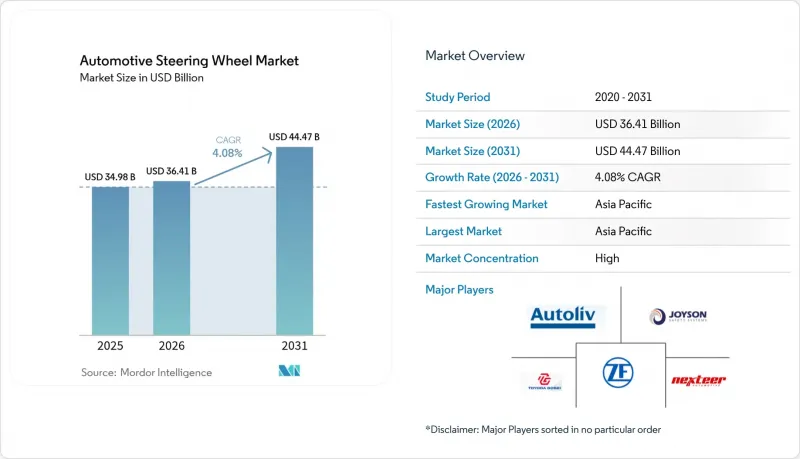
根據 Mordor Intelligence 預測,汽車方向盤市場規模將從 2025 年的 349.8 億美元成長到 2026 年的 364.1 億美元,然後在 2031 年達到 444.7 億美元,2026 年至 2031 年的複合年成長率為 4.0%。
本報告按技術(傳統柱式轉向系統及其他)、材料類型(鋁合金輪圈、鎂合金輪圈及其他)、車輛類型(乘用車、輕型商用車及其他)、分銷管道(原廠配套零件、售後替換零件)、動力類型(內燃機及其他)和地區進行分類。市場預測以美元計價。
全球汽車方向盤市場趨勢及洞察
線控(SbW)平台的快速普及
繼蔚來汽車於2025年推出採用採埃孚(ZF)無柱式架構的ET9之後,梅賽德斯-奔馳計劃於2026年在EQS車型上全面引入SBW(軟體驅動車輪)技術。這項技術取消了機械連桿,實現了可變齒比和基於軟體的反饋調整,從而提升了城市環境下的操控性和高速行駛時的穩定性。採埃孚已與多家汽車製造商簽訂契約,預計到2030年,SBW硬體的複合年成長率將達到7.90%。這項轉變將實現軟體定義的底盤控制,同時也要求傳統供應商提升其在電子和網路安全方面的能力。該技術在中國的早期成功已促使監管機構表示有意對其進行型式認證,從而加速其在全球的普及應用。
強制要求將前座安全氣囊整合到方向盤中。
將於2024年7月生效的歐盟第二版通用安全法規(General Safety Regulation II)強制要求增強緊急煞車和駕駛員疲勞預警功能,這將需要重新設計轉向系統。在美國,國家公路交通安全管理局(NHTSA)正在其駕駛員注意力不足過動症安全系統(DADSS)計畫下進行研究,利用嵌入輪圈的觸覺感測器來檢測駕駛員的疲勞狀態。採埃孚LIFETEC公司開發了一種頂部展開式安全氣囊,在滿足更嚴格的包裝限制的同時,兼顧了美觀和碰撞性能。雖然監管整合會增加系統複雜性和整合成本,但全球要求的標準化將透過大規模生產為一級供應商創造規模經濟效益。
鋁和鎂價格波動
預計2024年至2025年間,鋁和鎂的現貨價格波動幅度將超過20%,將對輕量化輪圈和輻條的利潤率構成壓力。供應商正透過長期供應合約和合金替代來規避風險,但成本飆升阻礙了對成本敏感的細分市場採用這些產品。儘管整車製造商正在探索使用回收材料來抵消價格波動的影響,但二級鑄造廠仍然容易受到原料風險的影響。
細分市場分析
到2025年,電動方向盤(EPS)將佔據汽車方向盤市場37.86%的佔有率。這主要歸功於汽車製造商(OEM)為了提高效率並支援高級駕駛輔助系統(ADAS),將液壓系統升級為電動輔助系統。在優先考慮低成本和機械結構簡單的市場中,傳統的柱式轉向系統仍然佔據主導地位。線控轉向系統目前仍是一個小眾市場,但預計到2031年,在高階電動車的推出和自動駕駛技術進步的推動下,其複合年成長率將達到7.66%。
EPS(電動輔助轉向)佔據了汽車方向盤市場的大部分佔有率,為當前的電氣化轉型提供了支持;而SbW(線控轉向)則為L3級及以上級別的自動駕駛模式奠定了基礎。 ZF的ET9合約證明了商業性可行性,無需使用液壓油即可實現可變轉向比和軟體定義的轉向手感。在商用卡車領域,EPS單元可提供高達8000牛頓米的扭矩,同時與液壓泵相比,能耗更低,凸顯了其效率優勢。
次要因素正在影響供應商的市場定位。 EPS單元依賴整合扭力感測器,這些感測器提供車道維持和自動泊車功能所需的信息,這提高了低成本參與企業的准入門檻。 SbW架構為伸縮式轉向柱創造了新的空間,從而實現了類似客廳的座艙設計理念。高頻寬CAN-FD和以乙太網路為基礎的網域控制器的整合進一步模糊了底盤和資訊娛樂系統之間的界限,為軟體整合商而非傳統的轉向柱專家創造了新的商機。
預計到2025年,鋁製方向盤仍將維持主導地位,市佔率達37.12%,這得益於其重量減輕40%以及可無限循環利用的特性。在大型車隊中,耐用性比重量更為重要,因此鋼材仍佔主導地位。鎂合金輪圈面向高性能細分市場,但面臨加工和腐蝕相關的成本挑戰。受汽車製造商「從搖籃到大門」二氧化碳減排目標的推動,天然纖維複合材料,尤其是大麻和亞麻,預計到2031年將以7.42%的複合年成長率成長。 Cupra的「ampliTex」座椅背與碳纖維相比,二氧化碳排放量減少了49%,展現了其在內裝零件領域可擴展應用的潛力。
在汽車方向盤市場,將鋁合金框架與生物複合材料表面結合,既能實現結構強度,也能帶來體現永續性的觸感。然而,挑戰依然存在。解決吸濕性問題需要先進的樹脂體系,而生物纖維零件無法承受電動車噴漆生產線中常見的200 度C高溫烘烤循環。一項歐盟指令要求自2028年起,汽車內裝零件中必須使用25%的回收或生物基材料,這將進一步增加對天然纖維的需求。
區域分析
預計到2025年,亞太地區將以48.21%的市佔率引領汽車方向盤市場,年複合成長率(CAGR)為6.56%,主要得益於中國電動車的蓬勃發展以及政策支持下本土半導體生產能力的提升。北京的目標是到2025年達到25%的在地採購率,進而建立方向盤感測器和ECU的供應基地。大規模生產和成本效益的提升正推動中階車型快速採用觸覺回饋等高階功能。然而,稀土元素磁鐵的出口限制正在擾亂OEM廠商的生產計劃,鈴木和福特工廠的暫時停產便是例證。
北美地區與其說是成本領先地區,不如說是技術採納地區。美國基礎設施立法強制要求安裝駕駛員疲勞檢測系統,這推動了對配備眾多感測器的車輪的需求。同時,加拿大和墨西哥的工廠正在擴大電動輔助轉向系統(EPS)的生產,以滿足底特律三大汽車公司電動車計畫的需求。 Nextear在墨西哥的新技術中心預計到2026年將創造350個就業機會,利用近岸外包趨勢加強對柱式EPS和電控轉向系統的檢驗。儘管運費上漲,但圍繞美國可能對墨西哥組裝產品加徵關稅的貿易政策不確定性,可能會導致生產轉移回亞洲。
在歐洲,優質化與嚴格的安全法規之間存在著平衡。歐盟的GSR II和Euro NCAP 2026對實體按鍵的要求,推動了對整合式方向盤控制和握把感測器的需求。博世位於匈牙利的工廠目前正在為區域內的汽車製造商生產EPS齒輪箱,這表明其產能正在提升,以便更貼近高階客戶。在供應方面,德國一級供應商正積極推動通過TUV和KBA等權威機構的SbW檢驗,而這些性能標準也正在全球推廣到型式認證中。
在南美、中東和非洲等新興地區,儘管基數較低,但銷量仍實現了兩位數的成長。印度零件製造商已設定了1000億美元的出口目標,其中方向盤總成被視為關稅優惠的大宗商品。採埃孚雷恩收購TRW Sun Steering Wheels後,在古爾格拉姆和普納新增了工廠,從而改善了本地生產的安全氣囊和感測器的國內採購。海灣國家正在加速推廣電動車以實現車輛脫碳,但基礎設施的匱乏阻礙了方向盤的大規模應用。
其他好處
- Excel格式的市場預測(ME)表
- 3個月的分析師支持
目錄
第1章:引言
- 研究假設和市場定義
- 調查範圍
第2章:調查方法
第3章執行摘要
第4章 市場狀況
- 市場概覽
- 市場促進因素
- 線控(SbW)平台的快速普及
- 強制要求將前座安全氣囊整合到方向盤中。
- 電動車製造商為減輕重量所做的努力
- 優質化和改善的機上使用者體驗
- 法規發展動態-利用車輪感測器進行異常檢測
- L3+級車輛對可伸縮、無柱式駕駛座的需求
- 市場限制因素
- 鋁和鎂價格波動
- SbW的全球型式認證和網路安全合規性延誤
- 觸覺驅動感測模組晶片級供不應求
- 由於操縱桿和語音人機介面,無人駕駛計程車有輪班風險。
- 價值供應鏈分析
- 監理情勢
- 技術展望
- 波特五力模型
第5章 市場規模與成長預測
- 透過技術
- 傳統柱式轉向
- 電動方向盤(EPS)
- 線控轉向(SbW)
- 依材料類型
- 鋁合金輪圈
- 鎂合金輪圈
- 鋼圈
- 天然纖維複合材料輪輞
- 按車輛類型
- 搭乘用車
- 輕型商用車
- 大型商用車輛
- 巴士
- 透過分銷管道
- 原廠正品零件
- 售後替換零件
- 依推進類型
- 內燃機
- 電池式電動車
- 油電混合車
- 插電式混合動力電動車
- 燃料電池電動車
- 替代燃料
- 按地區
- 北美洲
- 美國
- 加拿大
- 其他北美國家
- 南美洲
- 巴西
- 阿根廷
- 其他南美國家
- 歐洲
- 德國
- 英國
- 法國
- 義大利
- 西班牙
- 俄羅斯
- 其他歐洲國家
- 亞太地區
- 中國
- 日本
- 印度
- 韓國
- 菲律賓
- 印尼
- 越南
- 澳洲
- 紐西蘭
- 其他亞太國家
- 中東和非洲
- 阿拉伯聯合大公國
- 沙烏地阿拉伯
- 土耳其
- 南非
- 埃及
- 其他中東和非洲國家
- 北美洲
第6章 競爭情勢
- 市場集中度
- 策略舉措和夥伴關係
- 市佔率分析
- 公司簡介
- Autoliv Inc.
- ZF Friedrichshafen AG
- Joyson Safety Systems
- Toyoda Gosei Co., Ltd.
- Valeo SA
- Nexteer Automotive Group
- Tokai Rika Co., Ltd.
- Hyundai Mobis Co., Ltd.
- JTEKT Corporation
- NSK Ltd.
- Mando Corporation
- Robert Bosch GmbH
- Denso Corporation
- Continental AG
- Thyssenkrupp AG
第7章 市場機會與未來展望
According to Mordor Intelligence, the automotive steering wheel market size is expected to grow from USD 34.98 billion in 2025 to USD 36.41 billion in 2026 and is forecast to reach USD 44.47 billion by 2031 at 4.08% CAGR over 2026-2031.
This report is Segmented by Technology (Conventional Column-Steer, and More), Material Type (Aluminum Rim, Magnesium Rim, and More), Vehicle Type (Passenger Cars, Light Commercial Vehicles, and More), Sales Channel (Original-Fitted and Aftermarket Replacement), Propulsion Type (Internal Combustion Engine, and More), and Geography. The Market Forecasts are Provided in Terms of Value (USD).
Global Automotive Steering Wheel Market Trends and Insights
Surging Adoption of Steer-By-Wire (SBW) Platforms
Mercedes-Benz will roll out full SbW on the 2026 EQS, following NIO's 2025 launch of the ET9 that features ZF's column-less architecture. The technology removes mechanical links, enabling variable ratios and software-tuned feedback for urban manoeuvrability and high-speed stability. ZF has secured multi-OEM contracts that underpin a 7.90% CAGR for SbW hardware through 2030. The shift allows software-defined chassis control while challenging traditional suppliers to build electronic and cybersecurity competencies. Early wins in China illustrate regulators' willingness to homologate the architecture, accelerating global uptake.
Mandatory Frontal-Airbag Integration in Steering Wheels
EU General Safety Regulation II, effective July 2024, compels enhanced emergency braking and drowsiness-warning functions that re-shape steering design. In the United States, NHTSA research into driver-impairment detection uses tactile sensors embedded in the rim under the DADSS program. ZF LIFETEC has engineered top-deployment airbags that blend aesthetics with crash performance, meeting stricter packaging limits. Convergence of mandates raises system complexity and integration cost but standardises global requirements, creating volume leverage for tier-ones.
Volatile Aluminum and Magnesium Prices
Spot prices for aluminium and magnesium have swung more than 20% in 2024-2025, squeezing margins on lightweight rims and spokes. Suppliers hedge through long-term supply contracts and alloy substitution, yet cost spikes deter adoption in cost-sensitive segments. OEMs explore recycled feedstock to offset volatility, but tier-two casting shops remain exposed to raw-material risk.
Other drivers and restraints analyzed in the detailed report include:
- Light-Weighting Push From EV OEMs
- Legislative Drive-Impairment Monitoring Via Wheel Sensors
- Global SbW Homologation and Cyber-Security Compliance Lag
For complete list of drivers and restraints, kindly check the Table Of Contents.
Segment Analysis
EPS controlled 37.86% of the automotive steering wheel market in 2025 as OEMs upgraded hydraulic systems to electric assist for efficiency and ADAS readiness. Conventional column-steer persists in markets prioritising low cost and mechanical simplicity. Steer-by-wire remains niche but is forecast at 7.66% CAGR to 2031 thanks to premium EV launches and autonomous drive programs.
The EPS-heavy portion of the steering wheel market size supports today's electrification, while SbW prepares the ground for Level 3+ hands-free modes. ZF's ET9 contract showcases commercial viability, delivering a variable ratio and software-defined feel without hydraulic fluid. In commercial trucks, EPS units provide up to 8,000 Nm torque yet trim energy draw compared with hydraulic pumps, underlining the efficiency case.
Second-order effects shape supplier positioning. EPS units rely on integrated torque sensors that feed lane-keep and auto-park functions, raising entry barriers for low-cost players. SbW architectures create fresh real estate for retractable columns, enabling living-room cabin concepts. Integration of high-bandwidth CAN-FD or Ethernet-based domain controllers further blurs lines between chassis and infotainment domains, offering white-space for software integrators rather than classic column specialists.
Aluminium remained the leader with 37.12% of the automotive steering wheel market share in 2025, credited to 40% mass savings and endless recyclability. Steel endures for heavy-duty fleets where durability trumps weight. Magnesium rims serve high-performance niches but face processing and corrosion cost hurdles. Natural-fibre composites, notably hemp and flax, are set to grow 7.42% CAGR through 2031, propelled by automakers' cradle-to-gate CO2 targets. Cupra's ampliTex seatbacks cut 49% CO2 versus carbon fibre, signalling scalability for interior parts.
The steering wheel market benefits from bio-composite skins over aluminium skeletons, marrying structural integrity with tactile sustainability cues. Challenges persist: moisture absorption demands advanced resin systems, and bio-fibre parts cannot exceed 200 °C bake cycles common in EV paint lines. Nevertheless, European directives urging 25% recycled or bio-based content in interiors post-2028 strengthen the pull for natural fibres.
Complete Report Scope:
- By Technology
- Conventional Column-Steer
- Electric Power-Assist (EPS)
- Steer-by-Wire (SbW)
- By Material Type
- Aluminium Rim
- Magnesium Rim
- Steel Rim
- Natural-fibre Composite Rim
- By Vehicle Type
- Passenger Cars
- Light Commercial Vehicles
- Heavy Commercial Vehicles
- Bus and Coahes
- By Sales Channel
- OEM Fitted
- Aftermarket Replacement
- By Propulsion Type
- Internal-Combustion Engine
- Battery-Electric Vehicle
- Hybrid Electric Vehicle
- Plug-In Hybrid Electric Vehicles
- Fuel Cell Electric Vehicles
- Alternative Fuels
- By Geography
- North America
- United States
- Canada
- Rest of North America
- South America
- Brazil
- Argentina
- Rest of South America
- Europe
- Germany
- United Kingdom
- France
- Italy
- Spain
- Russia
- Rest of Europe
- Asia-Pacific
- China
- Japan
- India
- South Korea
- Philippines
- Indonesia
- Vietnam
- Australia
- New Zealand
- Rest of Asia-Pacific
- Middle East and Africa
- United Arab Emirates
- Saudi Arabia
- Turkey
- South Africa
- Egypt
- Rest of Middle East and Africa
- North America
Geography Analysis
Asia-Pacific led the automotive steering wheel market with 48.21% share in 2025 and is growing at 6.56% CAGR on the strength of China's EV surge and policy-backed chip localisation. Beijing targets 25% local semiconductor content by 2025, anchoring supply for wheel-integrated sensors and ECUs. Large-scale production and cost efficiencies permit rapidly migrating premium features such as haptic feedback into mid-segment vehicles. However, export restrictions on rare-earth magnets have disrupted OEM production schedules, as seen in temporary shutdowns at Suzuki and Ford plants.
North America remains a technology adopter rather than a cost leader. US infrastructure legislation mandates driver-impairment detection, spurring demand for sensor-rich wheels, while Canadian and Mexican plants scale EPS output to serve Detroit Three EV programs. Nexteer's new technical centre in Mexico adds 350 roles by 2026 to hone column-type EPS and SbW validation, exploiting near-shoring trends. Trade-policy uncertainty around potential US tariffs on Mexican assemblies could shift sourcing back to Asia despite freight premiums.
Europe balances premiumisation with strict safety mandates. EU GSR II and Euro NCAP 2026 physical-button requirements anchor demand for integrated wheel controls and grip sensors. Bosch's Hungarian plant now produces EPS racks for regional OEMs, evidencing capacity expansion nearer to premium customers. On the supply side, German tier-ones push SbW validation through TUV and KBA authorities, setting performance benchmarks that ripple through global homologation.
Emerging regions - South America, the Middle East, and Africa - show double-digit unit growth off low bases. India's component makers pursue a USD 100 billion export ambition, with steering wheel assemblies viewed as tariff-friendly volume cargo. ZF Rane's acquisition of TRW Sun Steering Wheels adds Gurugram and Pune plants, enhancing domestic content for localised airbags and sensors. Gulf states accelerate EV adoption for fleet decarbonisation, yet infrastructure gaps delay large-scale SbW rollout.
- Autoliv Inc.
- ZF Friedrichshafen AG
- Joyson Safety Systems
- Toyoda Gosei Co., Ltd.
- Valeo SA
- Nexteer Automotive Group
- Tokai Rika Co., Ltd.
- Hyundai Mobis Co., Ltd.
- JTEKT Corporation
- NSK Ltd.
- Mando Corporation
- Robert Bosch GmbH
- Denso Corporation
- Continental AG
- Thyssenkrupp AG
Additional Benefits:
- The market estimate (ME) sheet in Excel format
- 3 months of analyst support
TABLE OF CONTENTS
1 Introduction
- 1.1 Study Assumptions & Market Definition
- 1.2 Scope of the Study
2 Research Methodology
3 Executive Summary
4 Market Landscape
- 4.1 Market Overview
- 4.2 Market Drivers
- 4.2.1 Surging Adoption of Steer-By-Wire (SBW) Platforms
- 4.2.2 Mandatory Frontal-Airbag Integration In Steering Wheels
- 4.2.3 Light-Weighting Push From EV OEMs
- 4.2.4 Premiumisation and In-Cabin UX Upgrades
- 4.2.5 Legislative Drive-Impairment Monitoring Via Wheel Sensors
- 4.2.6 Demand For Stowable/Column-Less Cockpits In L3+ Vehicles
- 4.3 Market Restraints
- 4.3.1 Volatile Aluminium and Magnesium Prices
- 4.3.2 Global Sbw Homologation and Cybersecurity Compliance Lag
- 4.3.3 Chip-Level Shortages For Haptic/Driver-Sense Modules
- 4.3.4 Share-Shift Risk From Joystick/Voice HMI In Robo-Taxis
- 4.3.5 Chip-Level Shortages For Haptic/Driver-Sense Modules
- 4.4 Value / Supply-Chain Analysis
- 4.5 Regulatory Landscape
- 4.6 Technological Outlook
- 4.7 Porter's Five Forces
- 4.7.1 Threat of New Entrants
- 4.7.2 Bargaining Power of Buyers
- 4.7.3 Bargaining Power of Suppliers
- 4.7.4 Threat of Substitute Products
- 4.7.5 Intensity of Competitive Rivalry
5 Market Size & Growth Forecasts (Value (USD))
- 5.1 By Technology
- 5.1.1 Conventional Column-Steer
- 5.1.2 Electric Power-Assist (EPS)
- 5.1.3 Steer-by-Wire (SbW)
- 5.2 By Material Type
- 5.2.1 Aluminium Rim
- 5.2.2 Magnesium Rim
- 5.2.3 Steel Rim
- 5.2.4 Natural-fibre Composite Rim
- 5.3 By Vehicle Type
- 5.3.1 Passenger Cars
- 5.3.2 Light Commercial Vehicles
- 5.3.3 Heavy Commercial Vehicles
- 5.3.4 Bus and Coahes
- 5.4 By Sales Channel
- 5.4.1 OEM Fitted
- 5.4.2 Aftermarket Replacement
- 5.5 By Propulsion Type
- 5.5.1 Internal-Combustion Engine
- 5.5.2 Battery-Electric Vehicle
- 5.5.3 Hybrid Electric Vehicle
- 5.5.4 Plug-In Hybrid Electric Vehicles
- 5.5.5 Fuel Cell Electric Vehicles
- 5.5.6 Alternative Fuels
- 5.6 By Geography
- 5.6.1 North America
- 5.6.1.1 United States
- 5.6.1.2 Canada
- 5.6.1.3 Rest of North America
- 5.6.2 South America
- 5.6.2.1 Brazil
- 5.6.2.2 Argentina
- 5.6.2.3 Rest of South America
- 5.6.3 Europe
- 5.6.3.1 Germany
- 5.6.3.2 United Kingdom
- 5.6.3.3 France
- 5.6.3.4 Italy
- 5.6.3.5 Spain
- 5.6.3.6 Russia
- 5.6.3.7 Rest of Europe
- 5.6.4 Asia-Pacific
- 5.6.4.1 China
- 5.6.4.2 Japan
- 5.6.4.3 India
- 5.6.4.4 South Korea
- 5.6.4.5 Philippines
- 5.6.4.6 Indonesia
- 5.6.4.7 Vietnam
- 5.6.4.8 Australia
- 5.6.4.9 New Zealand
- 5.6.4.10 Rest of Asia-Pacific
- 5.6.5 Middle East and Africa
- 5.6.5.1 United Arab Emirates
- 5.6.5.2 Saudi Arabia
- 5.6.5.3 Turkey
- 5.6.5.4 South Africa
- 5.6.5.5 Egypt
- 5.6.5.6 Rest of Middle East and Africa
- 5.6.1 North America
6 Competitive Landscape
- 6.1 Market Concentration
- 6.2 Strategic Moves & Partnerships
- 6.3 Market Share Analysis
- 6.4 Company Profiles (includes Global level Overview, Market level overview, Core Segments, Financials as available, Strategic Information, Market Rank/Share for key companies, Products & Services, and Recent Developments)
- 6.4.1 Autoliv Inc.
- 6.4.2 ZF Friedrichshafen AG
- 6.4.3 Joyson Safety Systems
- 6.4.4 Toyoda Gosei Co., Ltd.
- 6.4.5 Valeo SA
- 6.4.6 Nexteer Automotive Group
- 6.4.7 Tokai Rika Co., Ltd.
- 6.4.8 Hyundai Mobis Co., Ltd.
- 6.4.9 JTEKT Corporation
- 6.4.10 NSK Ltd.
- 6.4.11 Mando Corporation
- 6.4.12 Robert Bosch GmbH
- 6.4.13 Denso Corporation
- 6.4.14 Continental AG
- 6.4.15 Thyssenkrupp AG
7 Market Opportunities & Future Outlook

 汽車方向盤市場-2026-2032年全球市場預測
 方向盤市場分析及預測(至2035年):類型、技術、組件、應用、材質、製程、最終用戶、功能、安裝類型、解決方案
 汽車加熱方向盤市場規模、佔有率和成長分析:按產品類型、技術、車輛類型、銷售管道、分銷管道、最終用戶和地區分類-2026-2033年產業預測汽車加熱方向盤市場:依技術、材料、整合度、感測器技術、控制系統、設計、車輛類型、銷售管道和應用分類-2026-2032年全球市場預測
 2026年全球方向盤電樞市場報告
 方向盤開關市場,按產品、按車輛、按銷售管道、按應用、按國家和地區 - 2025 年至 2032 年全球行業分析、市場規模、市場佔有率和預測
 汽車方向盤市場規模、佔有率、成長分析,按材料類型、按產品類型、按技術、按方向盤類型、按最終用途車輛類型、按地區 - 行業預測,2025 年至 2032 年
 方向盤開關市場機會、成長動力、產業趨勢分析與 2025 - 2034 年預測
 全球汽車方向盤市場 2025-2029汽車加熱方向盤市場機會、成長動力、產業趨勢分析及 2025 年至 2034 年預測