


 |
市場調查報告書
商品編碼
2122667
電容式感測器:市場佔有率分析、產業趨勢與統計、成長預測(2026-2031)Capacitive Sensors - Market Share Analysis, Industry Trends & Statistics, Growth Forecasts (2026 - 2031) |
||||||

※ 本網頁內容可能與最新版本有所差異。詳細情況請與我們聯繫。
據 Mordor Intelligence 稱,2025 年電容式感測器市值為 328.7 億美元,預計到 2031 年將達到 434.1 億美元,而 2026 年為 344.3 億美元,預測期(2026-2031 年)的複合年成長率為 4.74%。
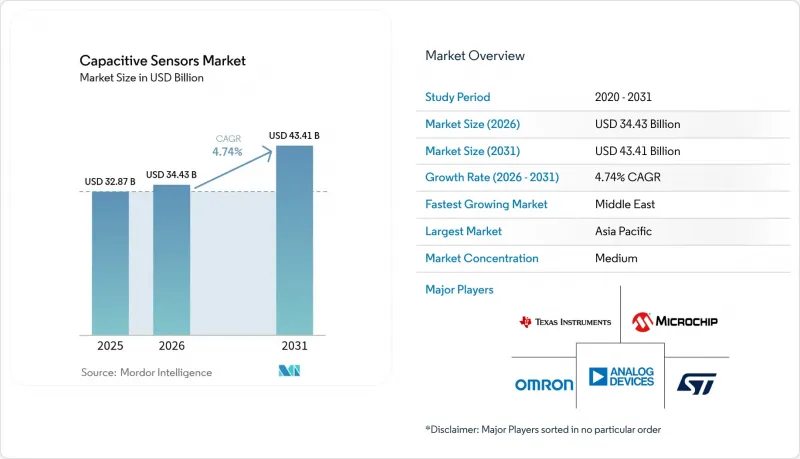
本報告按類型(觸控感測器、運動感測器及其他)、終端用戶產業(消費性電子、汽車及其他)、感測原理(自電容式、互電容式、表面電容式及其他)、外形規格(表面黏著技術貼裝感測器、通孔感測器、軟/薄膜感測器及其他)和地區進行細分。市場預測以美元計價。
全球電容式感測器市場趨勢與洞察
家用電器中電容式觸控螢幕應用範圍的擴大
智慧型手機、平板電腦和穿戴式裝置製造商正持續推動從電阻式技術轉型為先進的互電容式和投射式電容式。三星的軟性OLED生產線將於2024年運作,生產線採用投射式電容式,可實現折疊式顯示器在整個彎曲半徑範圍內保持均勻的靈敏度。汽車製造商也在資訊娛樂系統、方向盤控制和擴增實境(AR)抬頭顯示器中採用類似的架構。這些設計選擇增加了每輛車電容式感測器的平均數量,從而促進了規模經濟,並將這種經濟效益擴展到工業機械和家用電器領域。同時,嵌入玻璃下方的觸覺驅動器可在平面上實現觸覺確認,從而減少錯誤並提高視障用戶的使用體驗。因此,供應商正優先提供韌體工具包,使OEM廠商能夠在無需修改硬體的情況下微調延遲、設定閾值並實現多指手勢。
汽車人機介面中電容式感測器整合技術的進步
歐洲新車安全評鑑協會 (Euro NCAP) 的安全協議將於 2024 年更新,該協議評估透過電容通道追蹤駕駛員注意力的方向盤握力感測器,並要求一級供應商確保汽車控制器符合 AEC-Q100 標準。特斯拉和寶馬已證明,即使駕駛員佩戴手套,電容式感測器陣列也能可靠地檢測「雙手放在方向盤上」的狀態,這對於 L2 級及以上自動駕駛至關重要。電容式表面也開始應用於外部充電埠蓋和車內間接照明滑塊,以取代易受灰塵影響的機械開關。隨著電動動力傳動系統的日益普及,車輛中的電磁干擾 (EMI) 水平也在上升,供應商目前正將差分感測和頻譜調製相結合以保持抗干擾能力。該領域較長的產品生命週期確保了認證感測器 IC 擁有長達數年的收入來源,而整合到汽車領域對電容式感測器市場具有重要的戰略意義。
氧化銦錫(ITO)供不應求和價格波動
2024年,由於地緣政治緊張局勢引發的供應鏈問題,銦的價格波動超過40%,這些問題擾亂了中國和韓國的採礦作業。多家顯示器製造商對同一種金屬的競爭進一步加劇了供不應求,迫使感測器供應商延長前置作業時間並增加庫存。聚合物導體和銀奈米線可能是潛在的解決方案,但它們在大規模生產的觸控螢幕面板中的應用成本仍然很高。一些原始設備製造商(OEM)重新設計了使用者介面以減少透明導體的面積,但這種妥協限制了手勢控制和品牌差異化的功能。因此,在替代材料成熟之前,策略性儲備和與多家供應商簽訂合約仍然是權宜之計。
細分市場分析
到2025年,在智慧型手機和平板電腦的強勁需求以及桌上型消費性電子產品日益普及的推動下,觸控感測器細分市場在電容式感測器市場中保持了44.02%的銷售佔有率。這一主導地位確保了穩定的銷量,並推動了晶圓級成本的降低。因此,觸控積體電路正進入對價格敏感的市場,例如教育平板電腦和入門級汽車。觸控感測器在必須承受化學消毒的監護儀領域也越來越受歡迎,玻璃或聚合物覆蓋層可在不影響精確度的前提下保護電極。同時,開發人員正在韌體中實現防誤觸邏輯,以最大限度地減少會議系統中使用的大型面板上的誤觸現象。
隨著非接觸式電梯面板和病房控制設備的普及,接近感測器正經歷最快的成長,預計到2031年將以5.03%的複合年成長率成長。此細分市場利用電容場透過非導電層檢測物體,從而實現對藥品容器中液位的監測,而光學探頭在這些容器中會變得渾濁且失效。新興的包裝生產線正在灌裝機周圍整合接近感測器陣列,以便在操作員的手臂進入安全區域時停止操作,從而提高對ISO 13849標準的符合性。運動和位置感測器雖然體積小巧,但在虛擬實境(VR)控制器和精密機器人等盈利的細分市場中卻找到了應用,在需要5微米或更低雙向解析度的領域,利潤率超過30%。
預計到2025年,消費性電子產品將佔據電容式感測器市場40.35%的佔有率。這主要得益於行動電話的強勁成長,手機最多可配備五個獨立的電容式感應器,分別用於顯示輸入、側鍵替代和相機自動對焦模組。在市場飽和的領域,成長已趨於平緩,但折疊式和可捲曲手機等新型產品形態正在重新激活更換。在遊戲主機領域,大面積電容式面板被用於運動追蹤,保持中等個位數的成長。
醫療保健領域正以4.82%的複合年成長率維持最高成長動能。為因應新冠疫情而製定的法律規範要求人工呼吸器、患者終端和檢測設備採用非接觸式或可擦拭的使用者介面。封裝在PET薄膜下的電容式按鈕符合IP67標準,可在徹底消毒後仍保持機械劣化。醫院還在加護病房室外部署電容式手勢面板,以防止病原體傳播。汽車領域保持其傳統重要性,電動車正透過配備電容式充電埠蓋和座椅佔用偵測功能來提升性能。同時,航太領域對用於駕駛座現代化改造專案的耐輻射組件的需求也在不斷成長。
區域分析
亞太地區在中國垂直整合的顯示器和智慧型手機供應鏈的支持下,預計到2025年將佔全球銷售額的39.05%。韓國面板製造商正在擴大折疊式OLED的生產,推動該地區對電容式控制器的需求。同時,台灣EMS供應商正在爭取策略性晶圓配額,以支援筆記型電腦市場的復甦。印度對半導體封裝的優惠政策使得跨國IDM公司能夠建立凸塊加工和測試設施,為本土消費電子品牌採用本地生產的感測器IC鋪平了道路。日本機器人產業仍然是高精度位置感測器的主要買家,尤其是在需要亞微米級控制的半導體光刻階段。
在北美,汽車、航太和醫療用電子設備領域正穩步推進這項技術的應用。美國電動車製造商正在指定使用能夠抵抗800V快速充電過程中產生的電磁干擾(EMI)脈衝的方向盤觸控感測器,這促進了底特律一級汽車製造商與矽谷新創公司之間的合作。加拿大醫療設備製造商正在採用投射式電容式,以符合牙科設備「無縫」清潔規範的要求。歐洲在技術成熟度方面與北美不相上下,但受循環經濟等永續性法規的推動,可修復電容面板的需求正在成長,而對黏合式電阻觸摸膜的需求則有所下降。
預計到2031年,中東地區的複合年成長率將達到4.98%,位居全球之首。在阿拉伯聯合大公國的智慧城市計畫中,電容式人體感應器被整合到照明燈桿中,以便在用電低谷時段調節能耗。沙烏地阿拉伯的「2030願景」工業園區正在為包裝和填充生產線部署衛生、非接觸式控制系統。在南美洲,隨著巴西一家汽車工廠將充電埠蓋升級為電容式,為該國即將推出的電動車做準備,市場正穩定成長。非洲仍在發展中,但奈及利亞的金融科技自助服務終端已經出現了對能夠防塵、耐高濕的耐用觸控表面的早期需求。
其他好處
- Excel格式的市場預測(ME)表
- 3個月的分析師支持
目錄
第1章:引言
- 研究假設和市場定義
- 調查範圍
第2章:調查方法
第3章執行摘要
第4章 市場狀況
- 市場概覽
- 市場促進因素
- 家用電器中電容式觸控螢幕應用範圍的擴大
- 汽車人機介面中電容式感測器整合技術的進步
- 工業自動化機器人需求不斷成長
- 穿戴式裝置和物聯網裝置的成長需要低功耗電容式感測技術。
- 透明導電聚合物的出現,為氧化銦錫提供了替代材料。
- 監管機構正在食品加工和醫療領域推廣衛生非接觸式介面。
- 市場限制因素
- 氧化銦錫(ITO)供不應求和價格波動
- 工業環境中的電磁干擾敏感性
- 由於與多點觸控演算法相關的專利高度集中,導致授權成本不斷上升。
- 在惡劣環境下戴上手套偵測接觸的局限性
- 產業價值鏈分析
- 宏觀經濟因素的影響
- 技術展望
- 波特五力分析
- 監理情勢
第5章 市場規模與成長預測
- 按類型
- 觸摸感應器
- 運動感應器
- 位置感測器
- 接近感測器
- 其他
- 按最終用戶行業分類
- 家用電器
- 車
- 航太/國防
- 衛生保健
- 飲食
- 石油和天然氣
- 工業機械
- 其他
- 檢測原理
- 自電容型
- 互電容
- 表面電容
- 投射式電容
- 按外形規格
- 表面黏著技術貼裝感測器
- 通孔式感測器
- 軟性/薄膜型感測器
- 嵌入式積體電路感測器
- 按地區
- 北美洲
- 美國
- 加拿大
- 墨西哥
- 歐洲
- 德國
- 英國
- 法國
- 俄羅斯
- 其他歐洲國家
- 亞太地區
- 中國
- 日本
- 印度
- 韓國
- 澳洲
- 其他亞太國家
- 中東和非洲
- 中東
- 沙烏地阿拉伯
- 阿拉伯聯合大公國
- 其他中東國家
- 非洲
- 南非
- 埃及
- 其他非洲地區
- 中東
- 南美洲
- 巴西
- 阿根廷
- 南美洲其他地區
- 北美洲
第6章 競爭情勢
- 市場集中度
- 策略趨勢
- 市佔率分析
- 公司簡介
- Texas Instruments Incorporated
- STMicroelectronics NV
- Analog Devices Inc.
- Microchip Technology Inc.
- Omron Corporation
- Infineon Technologies AG
- NXP Semiconductors NV
- Fujitsu Limited
- 3M Company
- Siemens AG
- Sony Group Corporation
- TDK Corporation
- ROHM Co., Ltd.
- Synaptics Incorporated
- Cypress Semiconductor Corporation(Infineon)
第7章 市場機會與未來展望
According to Mordor Intelligence, the capacitive sensor market size was valued at USD 32.87 billion in 2025 and estimated to grow from USD 34.43 billion in 2026 to reach USD 43.41 billion by 2031, at a CAGR of 4.74% during the forecast period (2026-2031).
This report is Segmented by Type (Touch Sensor, Motion Sensor, and More), End-User Industry (Consumer Electronics, Automotive, and More), Sensing Principle (Self-Capacitance, Mutual Capacitance, Surface Capacitance, and More), Form Factor (Surface-Mount Sensors, Through-Hole Sensors, Flexible/Thin-Film Sensors, and More), and Geography. The Market Forecasts are Provided in Terms of Value (USD).
Global Capacitive Sensors Market Trends and Insights
Growing Adoption of Capacitive Touch Screens in Consumer Electronics
Smartphone, tablet, and wearable device makers continue to replace resistive technologies with advanced mutual and projected capacitance. Flexible OLED production lines commissioned by Samsung in 2024 integrate projected capacitance to enable foldable displays that maintain uniform sensitivity across bending radii. Automakers embrace the same architectures for infotainment units, steering-wheel controls, and augmented-reality head-up displays. These design choices enhance the average capacitive sensor content per vehicle, fostering volume economies that extend to industrial machinery and white goods. Meanwhile, haptic drivers embedded beneath glass enable tactile confirmation on flat surfaces, reducing accidental activations and improving accessibility for visually impaired users. Vendors are therefore prioritizing firmware toolkits that allow OEMs to fine-tune latency, set thresholds, and implement multi-finger gestures without requiring new hardware spins.
Increasing Integration of Capacitive Sensors in Automotive Human-Machine Interfaces
Euro NCAP safety protocols, updated in 2024, evaluate steering-wheel grip sensors that track driver attention through capacitive channels, driving tier-one suppliers to certify automotive-grade controllers to AEC-Q100 standards. Tesla and BMW have demonstrated that capacitive sensor arrays can reliably detect hands-on-wheel conditions, even when operators wear gloves a critical feature for Level 2+ autonomy. Capacitive surfaces are also appearing on exterior charge-port doors and interior ambient-lighting sliders, replacing mechanical switches that are susceptible to dust ingress. Because automotive EMI levels rise with electrified powertrains, suppliers now bundle differential sensing and spread-spectrum modulation to maintain immunity. Long product life cycles in the sector lock in multiyear revenue streams for qualified sensor ICs, giving automotive integrations an outsized strategic impact on the capacitive sensor market.
Supply Shortage and Price Volatility of Indium Tin Oxide
Indium prices fluctuated by more than 40% in 2024 as mining operations in China and South Korea were disrupted by supply chain issues amid geopolitical tensions. Display manufacturers competing for the same metal exacerbated scarcity, forcing sensor vendors to lengthen lead times and carry higher inventories. Polymer conductors and silver nanowires offer potential relief but remain expensive to scale for high-volume touchscreen overlays. Some OEMs redesigned user interfaces to reduce transparent conductor area, but such compromises limit gesture zones and brand differentiation. Strategic stockpiling and multi-sourcing contracts are, therefore, temporary stopgaps until alternative materials mature.
Other drivers and restraints analyzed in the detailed report include:
- Rising Demand for Industrial Automation and Robotics
- Growth of Wearable and IoT Devices Requiring Low Power Capacitive Sensing
- Sensitivity to Electromagnetic Interference in Industrial Environments
For complete list of drivers and restraints, kindly check the Table Of Contents.
Segment Analysis
The touch-sensor subsegment retained a 44.02% revenue share within the capacitive sensor market in 2025, thanks to entrenched demand for smartphones and tablets, combined with rising installations in countertop appliances. This dominance provides stable volumes that drive wafer-level cost declines, permitting touch ICs to enter price-sensitive markets such as education tablets and entry-level cars. Touch sensors also proliferate in medical-grade monitors that must withstand chemical sterilization, where glass or polymer overlays protect electrodes without compromising accuracy. Meanwhile, developers enrich firmware with palm-rejection logic to minimize ghost touches on large panels used in conference systems.
Proximity sensors exhibit the swiftest momentum, expanding at a 5.03% CAGR to 2031 as contactless elevator panels and hospital room controls become standard. The subsegment leverages capacitive fields to detect objects through non-conductive layers, enabling liquid-level monitoring in pharmaceutical vessels where optical probes cloud over. Emerging packaging lines integrate proximity arrays around fillers to halt operation if an operator's arm breaches safety envelopes, improving compliance with ISO 13849. Motion and position sensors, although smaller in unit volume, find profitable niches in virtual-reality controllers and precision robotics, where bidirectional resolution of under 5 µm commands margins exceed 30%.
Consumer electronics accounted for 40.35% of the capacitive sensor market in 2025, anchored by mobile phones that package up to five separate capacitive solutions for display input, side-key replacement, and camera AF modules. Growth is plateauing in saturated geographies, but new form factors, such as foldables and rollables, refresh replacement cycles. Gaming consoles utilize large surface capacitive panels for motion tracking, sustaining mid-single-digit growth.
Healthcare registers the highest forward trajectory at 4.82% CAGR. Regulatory frameworks that emerged in response to the COVID-19 crisis mandate touchless or wipe-friendly user interfaces for ventilators, patient terminals, and laboratory equipment. Capacitive buttons sealed under PET films meet IP67 standards, allowing for aggressive disinfection without mechanical degradation. Hospitals also deploy capacitive hand-gesture panels outside intensive-care rooms to reduce pathogen transfer. Automotive retains its historical importance, with electric cars adding capacitive charge-port lids and seat-occupancy detection, while aerospace seeks radiation-hardened parts for cockpit modernization programs.
Complete Report Scope:
- By Type
- Touch Sensor
- Motion Sensor
- Position Sensor
- Proximity Sensor
- Other Types
- By End-User Industry
- Consumer Electronics
- Automotive
- Aerospace and Defense
- Healthcare
- Food and Beverages
- Oil and Gas
- Industrial Machinery
- Other End-User Industry
- By Sensing Principle
- Self-Capacitance
- Mutual Capacitance
- Surface Capacitance
- Projected Capacitance
- By Form Factor
- Surface-Mount Sensors
- Through-Hole Sensors
- Flexible/Thin-Film Sensors
- Embedded IC Sensors
- By Geography
- North America
- United States
- Canada
- Mexico
- Europe
- Germany
- United Kingdom
- France
- Russia
- Rest of Europe
- Asia-Pacific
- China
- Japan
- India
- South Korea
- Australia
- Rest of Asia-Pacific
- Middle East and Africa
- Middle East
- Saudi Arabia
- United Arab Emirates
- Rest of Middle East
- Africa
- South Africa
- Egypt
- Rest of Africa
- Middle East
- South America
- Brazil
- Argentina
- Rest of South America
- North America
Geography Analysis
Asia-Pacific retained 39.05% of global revenue in 2025, anchored by China's vertically integrated display and smartphone supply chains. South Korea's panel makers scale up foldable OLED production, driving localized demand for projected-capacitance controllers, while Taiwan's EMS providers secure strategic wafer allocations to support the notebook rebound. India's incentives for semiconductor packaging have attracted multinational IDMs to establish bumping and test capacity, opening pathways for domestic appliance brands to adopt local sensor ICs. Japan's robotics sector remains a premium buyer of high-accuracy position sensors, especially for semiconductor lithography stages where sub-micron control is compulsory.
North America demonstrates steady adoption across the automotive, aerospace, and medical electronics sectors. U.S. electric-vehicle makers specify steering-wheel touch sensors that resist EMI bursts generated during 800-V fast charging, fostering collaboration between Detroit's tier-one automakers and Silicon Valley startups. Canadian medical device firms are embracing projected capacitance to meet no-gap cleaning regulations for dental equipment. Europe parallels North America in maturity but channels sustainability mandates-such as circular-economy rules-into a demand for reparable capacitive panels rather than glued-in resistive touch films.
The Middle East is expected to record the fastest 4.98% CAGR through 2031. Smart-city programs in the United Arab Emirates integrate capacitive occupancy sensors within lighting poles to modulate energy consumption during periods of low traffic. Saudi Arabia's Vision 2030 industrial zones are outfitting packaging and bottling lines with hygienic, touchless controls. South America grows moderately as Brazilian automotive plants upgrade to capacitive charge-port lids for domestic electric vehicle launches. Africa remains nascent, but fintech kiosks in Nigeria demonstrate early demand for robust touch surfaces that can withstand dust and high humidity.
- Texas Instruments Incorporated
- STMicroelectronics N.V.
- Analog Devices Inc.
- Microchip Technology Inc.
- Omron Corporation
- Infineon Technologies AG
- NXP Semiconductors N.V.
- Fujitsu Limited
- 3M Company
- Siemens AG
- Sony Group Corporation
- TDK Corporation
- ROHM Co., Ltd.
- Synaptics Incorporated
- Cypress Semiconductor Corporation (Infineon)
Additional Benefits:
- The market estimate (ME) sheet in Excel format
- 3 months of analyst support
TABLE OF CONTENTS
1 INTRODUCTION
- 1.1 Study Assumptions and Market Definition
- 1.2 Scope of the Study
2 RESEARCH METHODOLOGY
3 EXECUTIVE SUMMARY
4 MARKET LANDSCAPE
- 4.1 Market Overview
- 4.2 Market Drivers
- 4.2.1 Growing Adoption of Capacitive Touch Screens in Consumer Electronics
- 4.2.2 Increasing Integration of Capacitive Sensors in Automotive Human Machine Interfaces
- 4.2.3 Rising Demand for Industrial Automation and Robotics
- 4.2.4 Growth of Wearable and IoT Devices Requiring Low Power Capacitive Sensing
- 4.2.5 Emergence of Transparent Conductive Polymers as Alternative to Indium Tin Oxide
- 4.2.6 Regulatory Push for Hygienic Contactless Interfaces in Food Processing and Healthcare
- 4.3 Market Restraints
- 4.3.1 Supply Shortage and Price Volatility of Indium Tin Oxide
- 4.3.2 Sensitivity to Electromagnetic Interference in Industrial Environments
- 4.3.3 Patent Thickets Around Multi-Touch Algorithms Increasing Licensing Costs
- 4.3.4 Limitations in Detecting Gloved Touches in Harsh Environments
- 4.4 Industry Value Chain Analysis
- 4.5 Impact of Macroeconomic Factors
- 4.6 Technological Outlook
- 4.7 Porter's Five Forces Analysis
- 4.7.1 Threat of New Entrants
- 4.7.2 Bargaining Power of Buyers
- 4.7.3 Bargaining Power of Suppliers
- 4.7.4 Threat of Substitute Products
- 4.7.5 Intensity of Competitive Rivalry
- 4.8 Regulatory Landscape
5 MARKET SIZE AND GROWTH FORECASTS (VALUE)
- 5.1 By Type
- 5.1.1 Touch Sensor
- 5.1.2 Motion Sensor
- 5.1.3 Position Sensor
- 5.1.4 Proximity Sensor
- 5.1.5 Other Types
- 5.2 By End-User Industry
- 5.2.1 Consumer Electronics
- 5.2.2 Automotive
- 5.2.3 Aerospace and Defense
- 5.2.4 Healthcare
- 5.2.5 Food and Beverages
- 5.2.6 Oil and Gas
- 5.2.7 Industrial Machinery
- 5.2.8 Other End-User Industry
- 5.3 By Sensing Principle
- 5.3.1 Self-Capacitance
- 5.3.2 Mutual Capacitance
- 5.3.3 Surface Capacitance
- 5.3.4 Projected Capacitance
- 5.4 By Form Factor
- 5.4.1 Surface-Mount Sensors
- 5.4.2 Through-Hole Sensors
- 5.4.3 Flexible/Thin-Film Sensors
- 5.4.4 Embedded IC Sensors
- 5.5 By Geography
- 5.5.1 North America
- 5.5.1.1 United States
- 5.5.1.2 Canada
- 5.5.1.3 Mexico
- 5.5.2 Europe
- 5.5.2.1 Germany
- 5.5.2.2 United Kingdom
- 5.5.2.3 France
- 5.5.2.4 Russia
- 5.5.2.5 Rest of Europe
- 5.5.3 Asia-Pacific
- 5.5.3.1 China
- 5.5.3.2 Japan
- 5.5.3.3 India
- 5.5.3.4 South Korea
- 5.5.3.5 Australia
- 5.5.3.6 Rest of Asia-Pacific
- 5.5.4 Middle East and Africa
- 5.5.4.1 Middle East
- 5.5.4.1.1 Saudi Arabia
- 5.5.4.1.2 United Arab Emirates
- 5.5.4.1.3 Rest of Middle East
- 5.5.4.2 Africa
- 5.5.4.2.1 South Africa
- 5.5.4.2.2 Egypt
- 5.5.4.2.3 Rest of Africa
- 5.5.4.1 Middle East
- 5.5.5 South America
- 5.5.5.1 Brazil
- 5.5.5.2 Argentina
- 5.5.5.3 Rest of South America
- 5.5.1 North America
6 COMPETITIVE LANDSCAPE
- 6.1 Market Concentration
- 6.2 Strategic Moves
- 6.3 Market Share Analysis
- 6.4 Company Profiles (includes Global level Overview, Market level overview, Core Segments, Financials as available, Strategic Information, Market Rank/Share for key companies, Products and Services, and Recent Developments)
- 6.4.1 Texas Instruments Incorporated
- 6.4.2 STMicroelectronics N.V.
- 6.4.3 Analog Devices Inc.
- 6.4.4 Microchip Technology Inc.
- 6.4.5 Omron Corporation
- 6.4.6 Infineon Technologies AG
- 6.4.7 NXP Semiconductors N.V.
- 6.4.8 Fujitsu Limited
- 6.4.9 3M Company
- 6.4.10 Siemens AG
- 6.4.11 Sony Group Corporation
- 6.4.12 TDK Corporation
- 6.4.13 ROHM Co., Ltd.
- 6.4.14 Synaptics Incorporated
- 6.4.15 Cypress Semiconductor Corporation (Infineon)
7 MARKET OPPORTUNITIES AND FUTURE OUTLOOK
- 7.1 White-Space and Unmet-Need Assessment

 2026年全球電容式氣隙(GAP)感測器市場報告
 空氣間隙感測器市場規模、佔有率和成長分析:按感測器類型、輸出類型、應用、最終用戶、分銷管道和地區分類-2026-2033年產業預測
 電容式感測器市場:2026-2032年全球市場預測(依感測器類型、材料、檢測技術、安裝方式和應用分類)
 電容式感測器市場:按類型、產業和地區分類
 電容式感測器市場規模、佔有率、趨勢和預測:按類型、最終用途產業和地區分類,2026-2034年
 全球電容式感測器市場規模、佔有率、趨勢和成長分析報告(2026-2034年)
 電容式感測器市場-全球產業規模、佔有率、趨勢、機會、預測:按類型、最終用戶、地區和競爭對手分類,2021-2031年電容式燃油液位感知器市場按產品類型、車輛類型、燃油類型、最終用途和應用分類-全球預測,2026-2032年非接觸式電容感測器市場:按技術、安裝方式、材料、應用和最終用途產業分類,全球預測(2026-2032年)非接觸式電容空氣間隙感測器市場:按類型、輸出、頻率範圍、安裝方式、材料、價格範圍和應用分類,全球預測(2026-2032年)