


 |
市場調查報告書
商品編碼
2122659
零售包裝:市場佔有率分析、產業趨勢與統計、成長預測(2026-2031)Retail Ready Packaging - Market Share Analysis, Industry Trends & Statistics, Growth Forecasts (2026 - 2031) |
||||||

※ 本網頁內容可能與最新版本有所差異。詳細情況請與我們聯繫。
根據 Mordor Intelligence 估計,零售包裝市場在 2026 年的價值將達到 797.2 億美元,高於 2025 年的 753.5 億美元,預計到 2031 年將達到 1,056.8 億美元。
預計從 2026 年到 2031 年,其複合年成長率將達到 5.8%。
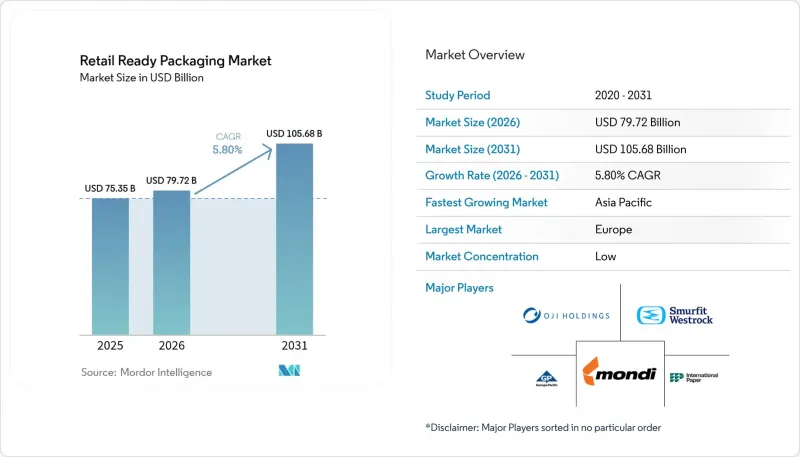
本報告按材料類型(紙/紙板、塑膠、混合材料及其他)、包裝類型(模切展示盒、瓦楞紙箱、收縮包裝托盤等)、最終用戶應用(食品、飲料、家居用品/家庭護理產品、個人護理/化妝品等)和地區進行細分。市場預測以美元計價。
全球零售包裝市場的趨勢與洞察
有關循環經濟的法規正在加速採用單一材料纖維SRP。
歐盟的《包裝和包裝廢棄物法規》(PPWR)將於2025年1月生效,該法規引入了可回收性標準,使得多層複合材料在經濟上失去了吸引力。由於符合法規要求的組合包裝的遵循成本高達每噸739美元,零售商和品牌所有者被迫轉向能夠無縫整合到現有廢棄物收集計劃中的單纖維結構。全球消費品公司正在跨區域推廣這些標準化的包裝形式,以避免重複的規格管理,使受監管的加工商獲得先發優勢。類似的趨勢在美國也日益明顯,加州的SB 343法案將回收標誌的使用限制在具有大規模的基材上。隨著加拿大、日本和拉丁美洲主要市場推出類似的法規,單一材料設計正從區域性偏好轉變為全球競標的基本要求。
電子商務的快速發展帶動了對商店展示合規性要求的日益成長。
隨著線上訂單激增履約中心帶來巨大壓力,各大零售商紛紛實施了嚴格的「貨架就緒」要求,如果供應商出貨的包裝不符合標準,將處以最高可達發票金額3%的扣回爭議帳款罰款。符合GS1「Sunrise 2027」藍圖的序列化2D條碼,以及不斷擴展的RFID強制應用,正將庫存準確性直接整合到包裝盒中,從而實現自動分揀和即時庫存檢查。包裝如今已成為資料載體,透過減少成本高昂的人工掃描,使得採用價格更高的智慧包裝成為可能。此外,整合的NFC標籤為參與企業創造了新的應用場景,使品牌能夠在產品開箱時檢驗其真偽並投放基於應用程式的促銷活動。
瓦楞紙板基紙價格波動
箱板紙價格每年波動15%至25%,一家北美大型造紙公司於2025年1月宣布每噸漲價70美元,這一漲幅將在幾週內反映在加工商的帳單上。加上後表面處理工程20%至30%的利潤,品牌商面臨著箱裝價格的劇烈波動,使得促銷預算規劃更加複雜。大型垂直整合型公司透過擁有造紙廠來降低風險,而小規模的獨立公司則面臨利潤率壓力,或被迫轉嫁額外費用,從而削弱了其在競標中的競爭力。如果亞太地區新增產能投入運作,價格波動可能會緩解,但由於歐洲能源成本持續高企,原料前景仍不明朗。
細分市場分析
到2025年,紙和紙板將佔零售包裝市場佔有率的54.86%,繼續作為大規模生產的日常消費品(FMCG)的標準基礎材料。瓦楞紙板提供耐用的運輸保護,同時其可印刷的牛皮紙表面符合品牌宣傳和可回收性要求。折疊式紙盒在需要高品質圖像和高剛性的領域,尤其是在糖果甜點禮品包裝方面,市場佔有率正在不斷成長。經硫酸漂白的固態紙漿可保護需要耐油性和亮白色表面的冷藏乳製品。白色背襯塑合板適用於價格實惠的穀物和家居用品,這些產品需要經濟實惠且外觀美觀。
隨著加工商將生物聚合物、阻隔塗層和感測器層融合到單一結構中,混合材料和其他材料的年複合成長率預計到2031年將達到7.05%。 PLA和PHA的混合物為農產品開闢了可堆肥的選擇,早期商業化生產已證明其在潮濕供應鏈中的展示性能。採用導電油墨的智慧標籤可無縫整合到PET視窗中,將二級包裝轉變為可掃描的商業中心。雖然塑膠在需要防潮和防穿刺性能的領域仍佔有一席之地,但水性分散塗層的進步使得纖維基材即使在冷藏環境下也能達到與現有多層薄膜相當的性能。隨著全球品牌採用這些混合材料來滿足不同地區的減廢棄物目標,同時又不影響功能性,零售包裝市場正從中受益。
區域分析
預計到2031年,亞太地區將以8.75%的複合年成長率實現最高成長。隨著自動化履約設施的引入,中國、印度和東南亞的供應鏈正在現代化。為滿足高階消費性電子產品的上市需求,當地瓦楞紙板生產商正在升級多色柔版印刷機;與此同時,區域內主要的紙漿和造紙企業正在解決箱板紙廠的瓶頸問題,以滿足電商包裝箱的激增需求。澳洲和紐西蘭政府禁止使用某些一次性塑膠的政策,正在加速乳製品和農產品出口商採用紡織基可重複使用包裝材料(SRP)。跨國加工企業透過在新加坡和上海擴大設計中心,並根據區域文化差異調整全球品牌形象,從而支持零售包裝市場的成長。
至2025年,歐洲將維持35.12%的市場佔有率,成為最大的單一區域集團。塑膠包裝回收指令(PPWR)中嚴格的回收目標將於2025年生效,這將促進德國、法國和北歐國家採用標準化的單纖維包裝形式。零售業的合作項目,例如英國的“考陶爾德承諾”,正在提高再生材料的使用目標,並刺激對閉合迴路箱板紙工廠的投資。在義大利,傳統圖案被用於推廣高價值葡萄酒和糖果甜點的出口,裝飾性壓紋也被應用於可切割的自包裝零售包裝(SRP)。在西班牙的溫室農業領域,透氣模切技術被用於最佳化從安達盧西亞包裝設施到北歐國家配送中心的空氣流通。
在北美,隨著全通路零售將店內自取與直接送貨上門結合,市場需求依然成熟且強勁。美國量販店正在擴大RFID技術在一般商品領域的應用,將序列化標籤嵌入二級包裝中以降低缺貨率。加拿大雜貨店正在試驗使用水性塗層複合纖維肉類托盤,以符合即將訂定的聯邦塑膠減量法規。墨西哥的加工廠(出口加工企業)受惠於近岸外包,刺激了對用於跨境運往美國的瓦楞紙箱的訂單。總體而言,在勞動力市場緊張的情況下,對自動化的投資仍然是維持服務水準的關鍵手段,從而支撐了零售包裝市場的強勁出貨量成長。
其他好處:
- Excel格式的市場預測(ME)表
- 3個月的分析師支持
目錄
第1章:引言
- 研究假設和市場定義
- 調查範圍
第2章:調查方法
第3章執行摘要
第4章 市場狀況
- 市場概覽
- 市場促進因素
- 有關循環經濟的法規正在加速採用單一材料纖維SRP。
- 電子商務的快速發展推動了對商店包裝標準(SRP)合規性的日益成長的需求。
- 零售業人手不足-透過建議零售價將門市工作時間減少了40%。
- 利用人工智慧實現包裝線自動化,提高了設定變更的速度。
- 品牌製造商正在利用建議零售價來提高商店購買率。
- 數位印刷的成本效益使得在供應鏈複製(SRP)中小批量生產促銷成為可能。
- 市場限制因素
- 瓦楞紙板基紙價格波動
- 供應鏈原則(SRP)缺乏全球標準化,導致供應鏈成本上升。
- SRP格式中RFID/智慧標籤的整合成本
- 超級市場法規的罰款和扣回爭議帳款
- 供應鏈分析
- 監理情勢
- 技術展望
- 波特五力模型
第5章 市場規模與成長預測
- 材料類型
- 紙張和紙板
- 瓦楞紙板基紙
- 折疊紙盒用紙板(FBB)
- 固體漂白硫酸漿(SBS)
- 白色線條塑合板(WLC)
- 塑膠
- PET
- HDPE
- PP
- 生質塑膠(PLA、PHA)
- 混合材料和其他材料
- 紙張和紙板
- 按包裝類型
- 模切展示容器
- 標準RSC模切
- 高品質預印模切產品
- 瓦楞紙箱
- 用於商店展示的RSC
- 手把一體成型SRP
- 收縮包裝托盤
- PE收縮
- 可堆肥收縮包裝
- 修改案例
- 高牆箱
- 零售展示櫃
- 塑膠容器
- 嵌套式貨箱
- 硬質塑膠托盤
- 其他物品(立式袋、可重複使用的托特包)
- 模切展示容器
- 透過最終用戶應用程式
- 食物
- 即食餐
- 生鮮食品
- 肉類/家禽
- 麵包糖果甜點
- 飲料
- 軟性飲料
- 酒精飲料
- 乳類飲料
- 居家及居家護理產品
- 個人護理化妝品
- 家用電子電器和家用電器
- 其他(DIY/園藝、寵物食品)
- 食物
- 按地區
- 北美洲
- 美國
- 加拿大
- 墨西哥
- 歐洲
- 德國
- 英國
- 法國
- 義大利
- 西班牙
- 俄羅斯
- 其他歐洲國家
- 亞太地區
- 中國
- 印度
- 日本
- 韓國
- 澳洲和紐西蘭
- 其他亞太國家
- 中東和非洲
- 中東
- 阿拉伯聯合大公國
- 沙烏地阿拉伯
- 土耳其
- 其他中東國家
- 非洲
- 南非
- 奈及利亞
- 埃及
- 其他非洲國家
- 中東
- 南美洲
- 巴西
- 阿根廷
- 其他南美國家
- 北美洲
第6章 競爭情勢
- 市場集中度
- 策略趨勢
- 市佔率分析
- 公司簡介
- Mondi Group
- Smurfit Westrock
- International Paper Company
- Georgia-Pacific LLC
- Oji Holdings Corporation
- Rengo Co., Ltd.
- Klabin SA
- Pratt Industries
- Graphic Packaging International
- STI Group
- Cardboard Box Company
- Weedon Group
- Caps Cases Limited
- Vanguard Packaging Inc.
- TricorBraun
- Huhtamaki Oyj
- Orora Limited
- Sealed Air Corporation
- Amcor PLC
- Sonoco Products Company
- Visy Industries
- Packaging Corporation of America
第7章 市場機會與未來展望
According to Mordor Intelligence, retail ready packaging market size in 2026 is estimated at USD 79.72 billion, growing from 2025 value of USD 75.35 billion with 2031 projections showing USD 105.68 billion, growing at 5.8% CAGR over 2026-2031.
This report is Segmented by Material Type (Paper and Paperboard, Plastics, Hybrid and Other Materials), Package Type (Die-Cut Display Containers, Corrugated Cardboard Boxes, Shrink-Wrapped Trays, and More), End-User Application (Food, Beverage, Household and Home-Care Products, Personal Care and Cosmetics, and More), and by Geography. The Market Forecasts are Provided in Terms of Value (USD).
Global Retail Ready Packaging Market Trends and Insights
Circular-economy regulations accelerating single-material fiber SRP adoption
The European Union's Packaging and Packaging Waste Regulation (PPWR) effective January 2025 introduces recyclability thresholds that make multi-layer laminates financially unattractive. Compliance fees on restricted combinations run as high as USD 739 per tonne, encouraging retailers and brand owners to converge on mono-fiber structures that slide seamlessly into existing curbside programs. Global consumer-goods companies standardize these formats across regions to avoid managing duplicate specifications, giving compliant converters first-mover advantage. Similar momentum builds in the United States where California's SB 343 limits the use of recycling symbols to substrates proven recyclable at scale.As comparable rules emerge in Canada, Japan and key Latin American markets, single-material designs transition from regional preference to baseline requirement for global tenders.
E-commerce hyper-growth raising shelf-ready packaging compliance demand
Online order volumes strain fulfillment centers, so large retailers institute strict shelf-ready requirements and apply charge-back penalties that can exceed 3% of invoice value when suppliers ship non-compliant cases. Serialized 2D barcodes aligned with the GS1 Sunrise 2027 roadmap and expanding RFID mandates embed inventory accuracy directly into the case, allowing automated sortation and real-time stock checks. Packaging now acts as a data carrier that lowers costly manual scans, justifying higher-priced smart formats. Integrated NFC tags additionally let brands validate product authenticity and launch app-based promotions at the point of unboxing, creating an incremental marketing use-case for retail ready packaging market participants.
Corrugated containerboard price volatility
Linerboard prices moved 15-25% within a single year, and a USD 70 per-ton increase announced for January 2025 by a leading North American mill flows through converter invoices within weeks. Because finishing adds a further 20-30% mark-up, brand owners see case costs swing sharply, complicating promotion budgets.Vertically integrated majors smooth exposure by owning mills, yet small independents face margin compression or must pass on surcharges that hurt competitiveness in tenders. Volatility may ease once additional capacity comes online in Asia-Pacific, but elevated energy costs in Europe keep the input outlook uncertain.
Other drivers and restraints analyzed in the detailed report include:
- Retailer labor shortages driving SRP adoption for 40% man-hour reduction
- AI-enabled packaging line automation boosting changeover speed
- Lack of global SRP standardization inflating supply-chain costs
For complete list of drivers and restraints, kindly check the Table Of Contents.
Segment Analysis
Paper and paperboard controlled 54.86% of retail ready packaging market share in 2025 and remains the default substrate for high-volume FMCG goods. Corrugated containerboard supplies durable transit protection while presenting printable kraft surfaces that align with branding and recyclability claims. Folding boxboard gains ground where premium graphics and rigidity coexist, notably in confectionery gift packs. Solid bleached sulfate safeguards chilled dairy launches that need grease resistance and bright whiteness. White-lined chipboard supports value-tier cereals and household staples that seek cost efficiency with acceptable shelf finish.
Hybrid and other materials expand at a 7.05% CAGR through 2031 as converters fuse bio-polymers, barrier coatings and sensor layers into single structures. PLA and PHA blends open compostable options for produce, and early commercial runs demonstrate shelf performance in humid supply chains. Smart labels relying on conductive inks integrate seamlessly onto PET windows, turning secondary packs into scan-ready commerce nodes. Although plastics retain niche roles demanding moisture or puncture protection, advances in aqueous dispersion coatings allow fiber substrates to challenge incumbent multilayer films even in freezer environments. The retail ready packaging market benefits as global brands adopt these hybrids to meet diverging regional waste-reduction targets without sacrificing functionality.
Complete Report Scope:
- By Material Type
- Paper and Paperboard
- Corrugated Containerboard
- Folding Boxboard (FBB)
- Solid Bleached Sulfate (SBS)
- White-lined Chipboard (WLC)
- Plastics
- PET
- HDPE
- PP
- Bio-plastics (PLA, PHA)
- Hybrid and Other Materials
- Paper and Paperboard
- By Package Type
- Die-cut Display Containers
- Standard RSC Die-cuts
- High-graphic Pre-print Die-cuts
- Corrugated Cardboard Boxes
- Shelf-ready RSC
- Handle-integrated SRP
- Shrink-wrapped Trays
- PE Shrink
- Compostable Shrink
- Modified Cases
- High Wall Cases
- Retail-display Cases
- Plastic Containers
- Nestable Crates
- Rigid Plastic Trays
- Others (Stand-up Pouches, Re-usable Totes)
- Die-cut Display Containers
- By End-User Application
- Food
- Ready-to-eat Meals
- Fresh Produce
- Meat and Poultry
- Bakery and Confectionery
- Beverage
- Soft Drinks
- Alcoholic Beverages
- Dairy Drinks
- Household and Home-care Products
- Personal Care and Cosmetics
- Consumer Electronics and Appliances
- Others (DIY and Garden, Pet Food)
- Food
- By Geography
- North America
- United States
- Canada
- Mexico
- Europe
- Germany
- United Kingdom
- France
- Italy
- Spain
- Russia
- Rest of Europe
- Asia-Pacific
- China
- India
- Japan
- South Korea
- Australia and New Zealand
- Rest of Asia-Pacific
- Middle East and Africa
- Middle East
- United Arab Emirates
- Saudi Arabia
- Turkey
- Rest of Middle East
- Africa
- South Africa
- Nigeria
- Egypt
- Rest of Africa
- Middle East
- South America
- Brazil
- Argentina
- Rest of South America
- North America
Geography Analysis
Asia-Pacific delivers the highest 8.75% CAGR through 2031 with China, India and Southeast Asia modernizing supply chains and installing automated fulfillment facilities. Local corrugators upgrade to multi-color flexo machines to target premium consumer electronics launches, while regional pulp-and-paper majors debottleneck containerboard mills to satisfy surging e-commerce case demand. Government policies in Australia and New Zealand banning certain single-use plastics accelerate fiber SRP adoption across dairy and produce exporters. Multinational converters expand design centers in Singapore and Shanghai to localize global brand imagery for regional cultural nuances, underpinning volume growth for the retail ready packaging market.
Europe retains 35.12% 2025 share, the largest single regional block. Strict recycling targets under PPWR take effect in 2025, driving standardized mono-fiber formats in Germany, France and the Nordics. Retail alliances such as the United Kingdom's Courtauld Commitment elevate post-consumer content goals, spurring investment in closed-loop containerboard mills. Italy leverages heritage graphics to position high-value wine and confectionery exports, integrating embellished embossing into tear-open SRP. Spain's greenhouse produce sector adopts vented die-cuts that optimize airflow from Andalusia packing sites to Northern European distribution hubs.
North America exhibits mature but resilient demand as omnichannel retailing blends store pick-up and direct-to-consumer flows. US mass merchants broaden RFID rollouts to general merchandise, embedding serialized tags in secondary packs to cut out-of-stock rates. Canadian grocers pilot fiber-based meat trays laminated with aqueous coatings to comply with upcoming federal plastic reduction rules. Mexican maquiladoras benefit from nearshoring, stimulating corrugated case orders for cross-border shipments into the United States. Overall, automation investment remains the key lever for maintaining service levels in a tight labor market, sustaining healthy unit expansion for the retail ready packaging market.
- Mondi Group
- Smurfit Westrock
- International Paper Company
- Georgia-Pacific LLC
- Oji Holdings Corporation
- Rengo Co., Ltd.
- Klabin S.A.
- Pratt Industries
- Graphic Packaging International
- STI Group
- Cardboard Box Company
- Weedon Group
- Caps Cases Limited
- Vanguard Packaging Inc.
- TricorBraun
- Huhtamaki Oyj
- Orora Limited
- Sealed Air Corporation
- Amcor PLC
- Sonoco Products Company
- Visy Industries
- Packaging Corporation of America
Additional Benefits:
- The market estimate (ME) sheet in Excel format
- 3 months of analyst support
TABLE OF CONTENTS
1 INTRODUCTION
- 1.1 Study Assumptions and Market Definition
- 1.2 Scope of the Study
2 RESEARCH METHODOLOGY
3 EXECUTIVE SUMMARY
4 MARKET LANDSCAPE
- 4.1 Market Overview
- 4.2 Market Drivers
- 4.2.1 Circular-economy regulations accelerating single-material fibre SRP adoption
- 4.2.2 E-commerce hyper-growth raising shelf-ready packaging (SRP) compliance demand
- 4.2.3 Retailer labour shortages - SRP cuts in-store man-hours by 40 %
- 4.2.4 AI-enabled packaging line automation boosting change-over speed
- 4.2.5 Branded manufacturers using SRP to lift on-shelf conversion rates
- 4.2.6 Digital-printing economics enabling micro-batch promotions in SRP
- 4.3 Market Restraints
- 4.3.1 Corrugated containerboard price volatility
- 4.3.2 Lack of global SRP standardisation inflating supply-chain cost
- 4.3.3 RFID / smart-label integration costs in SRP formats
- 4.3.4 Supermarket non-compliance fines and charge-backs
- 4.4 Supply-Chain Analysis
- 4.5 Regulatory Landscape
- 4.6 Technological Outlook
- 4.7 Porter's Five Forces
- 4.7.1 Bargaining Power of Suppliers
- 4.7.2 Bargaining Power of Buyers
- 4.7.3 Threat of New Entrants
- 4.7.4 Threat of Substitutes
- 4.7.5 Intensity of Competitive Rivalry
5 MARKET SIZE AND GROWTH FORECASTS (VALUE)
- 5.1 By Material Type
- 5.1.1 Paper and Paperboard
- 5.1.1.1 Corrugated Containerboard
- 5.1.1.2 Folding Boxboard (FBB)
- 5.1.1.3 Solid Bleached Sulfate (SBS)
- 5.1.1.4 White-lined Chipboard (WLC)
- 5.1.2 Plastics
- 5.1.2.1 PET
- 5.1.2.2 HDPE
- 5.1.2.3 PP
- 5.1.2.4 Bio-plastics (PLA, PHA)
- 5.1.3 Hybrid and Other Materials
- 5.1.1 Paper and Paperboard
- 5.2 By Package Type
- 5.2.1 Die-cut Display Containers
- 5.2.1.1 Standard RSC Die-cuts
- 5.2.1.2 High-graphic Pre-print Die-cuts
- 5.2.2 Corrugated Cardboard Boxes
- 5.2.2.1 Shelf-ready RSC
- 5.2.2.2 Handle-integrated SRP
- 5.2.3 Shrink-wrapped Trays
- 5.2.3.1 PE Shrink
- 5.2.3.2 Compostable Shrink
- 5.2.4 Modified Cases
- 5.2.4.1 High Wall Cases
- 5.2.4.2 Retail-display Cases
- 5.2.5 Plastic Containers
- 5.2.5.1 Nestable Crates
- 5.2.5.2 Rigid Plastic Trays
- 5.2.6 Others (Stand-up Pouches, Re-usable Totes)
- 5.2.1 Die-cut Display Containers
- 5.3 By End-User Application
- 5.3.1 Food
- 5.3.1.1 Ready-to-eat Meals
- 5.3.1.2 Fresh Produce
- 5.3.1.3 Meat and Poultry
- 5.3.1.4 Bakery and Confectionery
- 5.3.2 Beverage
- 5.3.2.1 Soft Drinks
- 5.3.2.2 Alcoholic Beverages
- 5.3.2.3 Dairy Drinks
- 5.3.3 Household and Home-care Products
- 5.3.4 Personal Care and Cosmetics
- 5.3.5 Consumer Electronics and Appliances
- 5.3.6 Others (DIY and Garden, Pet Food)
- 5.3.1 Food
- 5.4 By Geography
- 5.4.1 North America
- 5.4.1.1 United States
- 5.4.1.2 Canada
- 5.4.1.3 Mexico
- 5.4.2 Europe
- 5.4.2.1 Germany
- 5.4.2.2 United Kingdom
- 5.4.2.3 France
- 5.4.2.4 Italy
- 5.4.2.5 Spain
- 5.4.2.6 Russia
- 5.4.2.7 Rest of Europe
- 5.4.3 Asia-Pacific
- 5.4.3.1 China
- 5.4.3.2 India
- 5.4.3.3 Japan
- 5.4.3.4 South Korea
- 5.4.3.5 Australia and New Zealand
- 5.4.3.6 Rest of Asia-Pacific
- 5.4.4 Middle East and Africa
- 5.4.4.1 Middle East
- 5.4.4.1.1 United Arab Emirates
- 5.4.4.1.2 Saudi Arabia
- 5.4.4.1.3 Turkey
- 5.4.4.1.4 Rest of Middle East
- 5.4.4.2 Africa
- 5.4.4.2.1 South Africa
- 5.4.4.2.2 Nigeria
- 5.4.4.2.3 Egypt
- 5.4.4.2.4 Rest of Africa
- 5.4.4.1 Middle East
- 5.4.5 South America
- 5.4.5.1 Brazil
- 5.4.5.2 Argentina
- 5.4.5.3 Rest of South America
- 5.4.1 North America
6 COMPETITIVE LANDSCAPE
- 6.1 Market Concentration
- 6.2 Strategic Moves
- 6.3 Market Share Analysis
- 6.4 Company Profiles (includes Global level Overview, Market level overview, Core Segments, Financials as available, Strategic Information, Market Rank/Share for key companies, Products and Services, and Recent Developments)
- 6.4.1 Mondi Group
- 6.4.2 Smurfit Westrock
- 6.4.3 International Paper Company
- 6.4.4 Georgia-Pacific LLC
- 6.4.5 Oji Holdings Corporation
- 6.4.6 Rengo Co., Ltd.
- 6.4.7 Klabin S.A.
- 6.4.8 Pratt Industries
- 6.4.9 Graphic Packaging International
- 6.4.10 STI Group
- 6.4.11 Cardboard Box Company
- 6.4.12 Weedon Group
- 6.4.13 Caps Cases Limited
- 6.4.14 Vanguard Packaging Inc.
- 6.4.15 TricorBraun
- 6.4.16 Huhtamaki Oyj
- 6.4.17 Orora Limited
- 6.4.18 Sealed Air Corporation
- 6.4.19 Amcor PLC
- 6.4.20 Sonoco Products Company
- 6.4.21 Visy Industries
- 6.4.22 Packaging Corporation of America
7 MARKET OPPORTUNITIES AND FUTURE OUTLOOK
- 7.1 White-space and Unmet-need Assessment

 零售包裝市場:2026-2032年全球市場預測(依包裝類型、材料、最終用途產業及銷售管道)
 零售包裝市場報告:按產品類型、材料、最終用戶和地區分類(2026-2034 年)
 零售包裝市場規模、佔有率、成長率及全球產業分析:按類型、應用和地區分類,預測2026-2034年
 2026年全球零售即用包裝市場報告
 零售包裝市場:按產品、材料、應用和地區分類
 零售包裝市場規模、佔有率和成長分析(按材料類型、包裝形式、最終用戶和地區分類)—產業預測(2026-2033 年)全球零售包裝市場-2025-2030年預測
 全球零售包裝市場
 零售包裝市場規模、佔有率、趨勢分析報告:按產品、材料、應用、地區、細分市場、預測,2025 年至 2030 年
 零售包裝市場機會、成長動力、產業趨勢分析與預測 2025-2034