


 |
市場調查報告書
商品編碼
2122650
自動駕駛卡車:市場佔有率分析、產業趨勢與統計及成長預測(2026-2031 年)Autonomous Truck - Market Share Analysis, Industry Trends & Statistics, Growth Forecasts (2026 - 2031) |
||||||

※ 本網頁內容可能與最新版本有所差異。詳細情況請與我們聯繫。
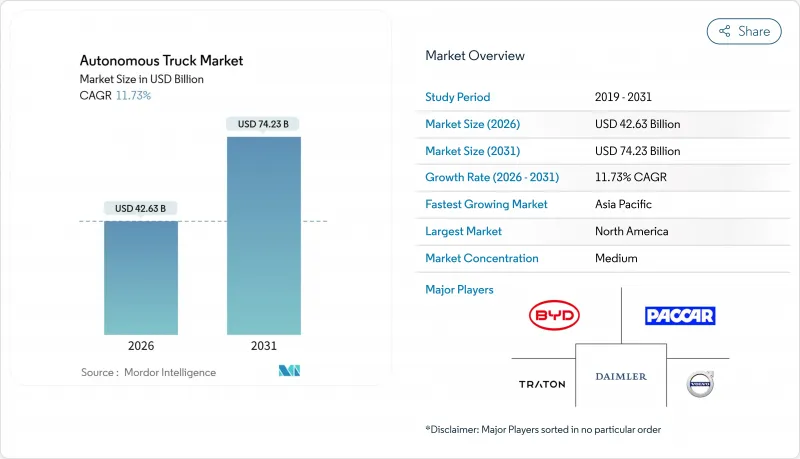
根據 Mordor Intelligence 預測,到 2026 年,自動駕駛卡車市場規模將達到 426.3 億美元,到 2031 年將達到 742.3 億美元,複合年成長率為 11.73%。
本報告按卡車類型(例如,輕型卡車)、自動駕駛等級(例如,SAE 1-2級(駕駛輔助))、ADAS功能(例如,主動式車距維持定速系統、車道偏離預警)、組件(例如,雷射雷達、雷達、攝影機)、動力系統(內燃機、電池式電動車及其他)和地區進行細分。市場預測以貨幣價值(美元)和銷售(輛)兩種形式呈現。
全球自動駕駛卡車市場趨勢及洞察
長途運輸司機短缺和人事費用上升。
長期存在的司機短缺和不斷上漲的人事費用正在重塑貨運經濟格局,使自動化長途運輸模式更具優勢。美國聯邦機動車輛運輸安全管理局 (FMCSA) 規定,人工駕駛員在 14 小時內的駕駛時間不得超過 11 小時,這意味著車輛的使用率僅為半天左右。在已規劃的州際公路上行駛的自動駕駛卡車可以長時間運作,其主要限制因素是加油、充電、檢查和維護。據美國卡車運輸協會 (ATA) 稱,重型卡車 (FTL) 司機的離職率有時高達 90% 甚至更高,這促使企業更有獎勵在可預測的路線上部署 L4 級自動駕駛卡車。歐洲和日本的運輸公司也面臨類似的勞動力壓力,因為年輕員工往往不願意從事長途運輸工作。因此,連接樞紐的自動駕駛接駁車使運輸公司能夠將數量有限的司機重新部署到受監管的「首公里」和「末公里」路線上。
對全天候樞紐間物流的需求
電子商務和即時生產的成長催生了對不間斷貨運的需求,而人工駕駛無法在規定的駕駛時間限制下滿足這一需求。在固定貨運站之間運行的自動駕駛卡車可以提供24小時服務,且不違反休息時間規定。貨運代理商已在進行夜間試點路線(例如達拉斯至休士頓),旨在顯著提高牽引車的使用率。中國的國家現代化計畫指定了重點製造業走廊用於自動駕駛貨運,目標是大幅縮短平均運輸時間。零售商和第三方物流(3PL) 服務商將持續的自動駕駛營運視為應對駕駛員不安全感的有效手段,尤其是在季節性需求高峰期,此時現貨價格可能翻三倍。
國際法規碎片化與跨國責任
法律差異導致自動駕駛卡車市場因地區而異。在德國,已建立起特定營運區域內L4級自動駕駛的法律體制,但需經核准和監管。然而,法國和西班牙仍要求車上配備安全駕駛人,這種不連續性阻礙了跨境物流。在美國,自動駕駛法規主要由各州自行製定,導致保險和資料共用的義務分散不一。原始設備製造商(OEM)、軟體供應商和車隊營運商之間的過失責任分配問題仍未解決。這種不確定性推高了保險費,也阻礙了中小運輸公司在相關判例穩定之前進行投資。儘管監管協調工作仍在進行中,但進度已超出目前的預期,導致市場成長受到抑制。
細分市場分析
2025年,大型牽引車佔總銷售量的46.57%,在長途運輸領域佔據主導地位。該領域透過降低人事費用和提高行駛里程,實現了投資回報最大化。同時,小型卡車仍屬於小眾市場,因為其較低的負載容量限制了昂貴感測器陣列的經濟效益。中型平台市場雖然規模較小,但預計在2026年至2031年間將以13.34%的複合年成長率成長,這主要得益於本地運輸以及在交通模式可預測的地理圍欄區域內的最後一公里配送。自動駕駛卡車市場正受惠於零售商使用配備L4級系統的專用6級廂型車連接微型倉配中心。
中型卡車向自動駕駛的過渡與都市地區電子商務的日益普及不謀而合。頻繁的啟停駕駛循環非常適合電氣化,而電動驅動系統也能與自動駕駛控制邏輯高效整合。雖然重型牽引車仍在跨州運輸路線上進行測試,但監管風險使得投資集中在法規明確允許無人駕駛的地區。輕型卡車的試點營運主要集中在限速的校園環境中,這意味著只有當負載容量和自動駕駛的經濟性同時提升時,才會出現大規模的部署。總體而言,這些趨勢證實,中型卡車是自動駕駛卡車市場中成長最快的細分市場。
到2025年,SAE 1-2級駕駛輔助系統將佔據自動駕駛卡車市場71.87%的佔有率,這反映出配備主動式車距維持定速系統和車道維持輔助系統的車輛數量眾多。然而,隨著德克薩斯州、亞利桑那州和巴伐利亞州在州政府批准的測試區域內允許在已繪製地圖的高速公路上進行完全自動駕駛,預計到2031年,4級平台將以15.21%的複合年成長率成長。 3級自動駕駛卡車系統的市場規模仍然小規模,因為駕駛員交接的要求會帶來法律責任風險,許多卡車公司都在規避這些風險。由於感測器和運算能力的限制,在目前的預測期內不太可能實現5級完全自動駕駛。
商業試點計畫表明,即使無需完全覆蓋所有地理區域,4級高速公路試點路線也能獲得大部分經濟效益。遠端監控中心對多輛牽引車進行監控,提高了勞動生產力。安全監管機構關注的是特定運行區域內的效能,而非理論上的完美,這加快了特定路線部署的認證進程。 1級和2級功能仍將是必不可少的安全標準,但它們對市場總規模(TAM)的貢獻將隨時間推移而下降。因此,4級系統將成為自動駕駛卡車市場的主要收入來源。
區域分析
預計到2025年,北美將佔全球收入的37.46%,並將在2031年之前保持9.52%的複合年成長率。隨著多個州授權在公共道路上進行自動駕駛汽車測試,該地區已成為最大的商業測試基地。美國運輸部指定的十個自動駕駛汽車測試點為測試和檢驗提供支持,隨著監管協調的推進,通往墨西哥和加拿大的跨境運輸路線預計將從中受益。密集的州際貨運網路和對清潔運輸的慷慨補貼支撐了長途運輸、冷藏運輸和小包裹運輸領域的持續需求。
預計到2031年,歐洲市場將以9.43%的複合年成長率成長。歐盟針對新型重型車輛制定的二氧化碳排放標準旨在到2030年減排約45%,到2035年減排65%,到2040年減排90%(與基準值相比),針對各類車輛的具體法規正在刺激對電動車和自動駕駛技術相結合的投資。德國透過建設專用高速公路走廊發揮主導作用,而法國和西班牙則因安全駕駛法規的實施而穩步推進。東歐仍處於起步階段,基礎設施和資金籌措正逐步成熟。西亞地區正呈現兩位數成長,主權運作基金正透過全天候自動駕駛貨櫃穿梭運輸實現港口物流現代化。
亞太地區預計將以13.33%的複合年成長率實現最快成長,這主要得益於中國國家級試點區域以及日本和韓國政府支持的卡車平台化項目。製造業集群的高度集中和勞動力老化正在加速自動駕駛技術的應用。在中國粵港澳大灣區,全球最大的自動駕駛卡車車隊在連接工廠和港口碼頭的專用車道上運行。韓國正大力投資興建5G高速公路,專門用於實現互聯自動駕駛。東南亞國家則採取觀望態度,等待感測器成本下降和資金籌措機制適應當地情況。總體而言,貨運量的成長和扶持政策正在鞏固該地區在自動駕駛卡車市場的主導地位。
其他好處:
- Excel格式的市場預測(ME)表
- 3個月的分析師支持
目錄
第1章:引言
- 研究假設和市場定義
- 調查範圍
第2章:調查方法
第3章執行摘要
第4章 市場狀況
- 市場概覽
- 市場促進因素
- 幹線運輸司機短缺和人事費用上升。
- 對全天候樞紐間物流的需求
- 自動駕駛與零排放動力系統的融合
- 邊緣人工智慧平台模式縮短了檢驗週期
- 綠色走廊稅優惠(IRA,適合55歲以上)
- 加強安全法規
- 市場限制因素
- 各國法規差異及跨境法律責任
- LiDAR和感測器套件高成本
- 網路安全與OTA更新風險
- 不透明的變壓器模型阻礙了符合 ISO 26262 標準。
- 價值供應鏈分析
- 監理情勢
- 技術展望
- 波特五力模型
第5章 市場規模與成長預測
- 按卡車類型
- 小型卡車
- 中型卡車
- 大型卡車
- 依自主程度
- SAE 1-2級(駕駛輔助)
- SAE 3級(有條件)
- SAE 4級(進階)
- SAE 5級(完全自動駕駛)
- ADAS功能類別
- 主動式車距維持定速系統
- 車道偏離警示
- 交通堵塞援助
- 高速公路領航員
- 自動緊急制動
- 盲點偵測
- 車道維持輔助
- 按組件
- LiDAR
- 雷達
- 相機
- 超音波感測器和其他感測器
- 人工智慧運算模組
- 透過驅動系統
- 內燃機
- 電池式電動車
- 混合
- 氫燃料電池
- 按地區
- 北美洲
- 美國
- 加拿大
- 其他北美國家
- 南美洲
- 巴西
- 阿根廷
- 其他南美國家
- 歐洲
- 德國
- 英國
- 法國
- 西班牙
- 俄羅斯
- 其他歐洲國家
- 亞太地區
- 印度
- 中國
- 日本
- 韓國
- 其他亞太國家
- 中東和非洲
- 阿拉伯聯合大公國
- 沙烏地阿拉伯
- 土耳其
- 埃及
- 南非
- 其他中東和非洲國家
- 北美洲
第6章 競爭情勢
- 市場集中度
- 策略趨勢
- 市佔率分析
- 公司簡介
- AB Volvo
- Daimler Truck AG
- Traton SE
- PACCAR Inc.
- BYD Co. Ltd.
- Tesla Inc.
- TuSimple
- Aurora Innovation
- Waymo Via
- Plus.ai
- Torc Robotics
- Kodiak Robotics
- Nikola Corp.
- Einride
- Embark Technology
- Hyzon Motors
- Gatik AI
- Volvo-Uber ATG JV
- Scania AB
- Navistar
第7章 市場機會與未來展望
According to Mordor Intelligence, the autonomous truck market size reached USD 42.63 billion in 2026 and is projected to attain USD 74.23 billion by 2031, representing an 11.73% CAGR.
This report is Segmented by Truck Type (Light-Duty Trucks, and More), Level of Autonomy (SAE Level 1-2 (Driver Assist), and More), ADAS Features (Adaptive Cruise Control, Lane Departure Warning, and More), Component (LIDAR, RADAR, Cameras, and More), Drive Type (IC Engine, Battery-Electric, Hybrid, and More), and Geography. The Market Forecasts are Provided in Terms of Value (USD) and Volume (Units).
Global Autonomous Truck Market Trends and Insights
Driver Shortage and Rising Line-Haul Labor Cost
Chronic gaps in driver availability and escalating wages redefine freight economics in favor of automated line-haul operations. The Federal Motor Carrier Safety Administration limits human operators to 11 driving hours within a 14-hour window, a regulation that caps asset utilization at roughly half of every day. Autonomous tractors running mapped interstate corridors can operate for extended hours, limited mainly by fueling/charging, inspections, and maintenance. ATA-reported large-truckload driver turnover has been around/above 90% in some periods, intensifying the incentive to deploy Level 4 trucks on predictable lanes. European and Japanese fleets face similar demographic pressure as younger workers avoid long-haul careers. Autonomous hub-to-hub shuttles, therefore, enable carriers to redeploy scarce human drivers to first-mile and last-mile routes that remain regulation-bound.
Demand for 24/7 Hub-to-Hub Logistics
E-commerce growth and just-in-time manufacturing create demand for nonstop freight flows that manual operations cannot sustain under hours-of-service rules. Autonomous trucks on fixed terminals can deliver round-the-clock service without contravening rest mandates. Freight integrators have already demonstrated overnight pilot lanes (e.g., Dallas-Houston) aimed at materially improving tractor utilization. China's national modernization plan designates key manufacturing corridors for autonomous freight, targeting significant reductions in average transit time. Retailers and third-party logistics providers see continuous autonomy as a hedge against driver-availability volatility, especially during seasonal spikes when spot rates often triple.
Patchwork Global Regulation and Cross-Border Liability
Divergent legal frameworks divide the autonomous truck market across regions. Germany has established a legal framework for Level 4 autonomous driving in defined operating areas, subject to approval and oversight; however, it still requires safety drivers in France and Spain, creating a discontinuity that disrupts cross-border logistics. The United States governs autonomy largely at the state level, resulting in a mosaic of insurance and data-sharing mandates. Liability allocation remains unresolved regarding the distribution of fault among the OEM, software provider, and fleet operator. Such uncertainty elevates insurance premiums and deters small and mid-size carriers from investing until precedents stabilize. Harmonization efforts continue, but the timeline spans beyond the current forecast horizon, thereby tempering growth.
Other drivers and restraints analyzed in the detailed report include:
- Collaboration of Autonomy with Zero-Emission Powertrains
- Edge-AI Foundation Models Cut Validation Cycles
- High LiDAR/Sensor-Suite Costs
For complete list of drivers and restraints, kindly check the Table Of Contents.
Segment Analysis
Heavy-duty tractors retained 46.57% of 2025 revenue due to their dominance in long-haul applications where labor savings and high mileage maximize payback. Light-duty trucks remain niche because lower payload limits dilute the economic advantage of costly sensor suites. Medium-duty platforms account for a smaller base yet will advance at a 13.34% CAGR from 2026 to 2031, driven by regional-haul and last-mile routes within geofenced areas that experience predictable traffic patterns. The autonomous truck market benefits from retailers linking micro-fulfillment centers via dedicated Class 6 box trucks outfitted with Level 4 stacks.
The shift toward medium-duty autonomy aligns with rising e-commerce density inside metropolitan regions. High stop-start duty cycles favor electrification, and electric drivetrains integrate efficiently with autonomous control logic. Heavy-duty tractors continue to test multi-state corridors, yet regulatory risk concentrates investment in locations where statutes explicitly permit driverless operation. Light-duty experimentation centers on campus environments where speed is limited, suggesting that broader scale will follow only when combined payload and autonomy economics improve. Overall, these dynamics reinforce medium-duty trucks as the fastest growing slice of the autonomous truck market.
SAE Level 1-2 driver-assist systems captured 71.87% of the 2025 autonomous truck market, reflecting a large installed base of adaptive cruise control and lane-keeping features. However, Level 4 platforms are projected to scale at a 15.21% CAGR through 2031 as state-approved sandboxes in Texas, Arizona, and Bavaria allow fully driverless operation on mapped highways. The autonomous truck market size for Level 3 systems remains modest because handoff requirements create liability risk that many fleets avoid. Level 5 universal autonomy remains beyond the current forecast window due to sensor and compute constraints.
Commercial pilots show that Level 4 highway-pilot routes capture most of the economic benefit without requiring complete geographic coverage. Remote supervision centers monitor multiple tractors, amplifying labor productivity. Safety regulators focus on performance within defined operating domains rather than theoretical perfection everywhere, which accelerates certification for corridor-specific deployments. Level 1-2 features will continue as mandatory safety baselines, yet their contribution to total addressable value diminishes over time. Consequently, Level 4 systems become the primary revenue engine of the autonomous truck market.
Complete Report Scope:
- By Truck Type
- Light-Duty Trucks
- Medium-Duty Trucks
- Heavy-Duty Trucks
- By Level of Autonomy
- SAE Level 1- 2 (Driver Assist)
- SAE Level 3 (Conditional)
- SAE Level 4 (High)
- SAE Level 5 (Full)
- By ADAS Feature
- Adaptive Cruise Control
- Lane Departure Warning
- Traffic Jam Assist
- Highway Pilot
- Automatic Emergency Braking
- Blind-Spot Detection
- Lane-Keeping Assist
- By Component
- LiDAR
- RADAR
- Cameras
- Ultrasonic and Other Sensors
- AI Compute Modules
- By Drive Type
- Internal-Combustion
- Battery-Electric
- Hybrid
- Hydrogen Fuel-Cell
- By Geography
- North America
- United States
- Canada
- Rest of North America
- South America
- Brazil
- Argentina
- Rest of South America
- Europe
- Germany
- United Kingdom
- France
- Spain
- Russia
- Rest of Europe
- Asia-Pacific
- India
- China
- Japan
- South Korea
- Rest of Asia-Pacific
- Middle East and Africa
- United Arab Emirates
- Saudi Arabia
- Turkey
- Egypt
- South Africa
- Rest of Middle-East and Africa
- North America
Geography Analysis
North America accounted for 37.46% of 2025 revenue and is projected to register a 9.52% CAGR through 2031. Multiple states authorize driverless testing on public highways, making the region the largest commercial sandbox. Ten U.S. DOT-designated Automated Vehicle Proving Grounds support testing and validation, and cross-border lanes into Mexico and Canada stand to benefit once legal harmonization advances. Dense interstate freight networks and generous clean-transport subsidies underpin sustained demand across long-haul, refrigerated, and parcel segments.
Europe is forecasted to expand at a 9.43% CAGR to 2031. EU CO2 standards for new heavy-duty vehicles aim for a reduction of ~45% by 2030, 65% by 2035, and 90% by 2040 (compared to the baseline), with specific rules in place for each vehicle category, catalyzing investment in combined electric and autonomous technologies. Germany leads with dedicated autobahn corridors, while France and Spain progress at a measured pace due to safety driver stipulations. Eastern Europe remains early-stage as infrastructure and financing mature. Western Asia shows double-digit growth as sovereign wealth funds modernize port logistics through 24-hour autonomous container shuttles.
Asia-Pacific will grow fastest at a 13.33% CAGR, reflecting national pilot zones in China and government-backed truck platooning programs in Japan and South Korea. Dense manufacturing clusters and aging workforces accelerate adoption. China's Greater Bay Area supports the world's largest fleet of driverless trucks on dedicated lanes linking factories to port terminals. South Korea invests heavily in 5G-enabled highways tailored for connected autonomy. Southeast Asian nations adopt a wait-and-see approach until sensor costs fall and financing mechanisms adapt to local conditions. Collectively, rising freight volumes and supportive policy drive regional leadership in the autonomous truck market.
- AB Volvo
- Daimler Truck AG
- Traton SE
- PACCAR Inc.
- BYD Co. Ltd.
- Tesla Inc.
- TuSimple
- Aurora Innovation
- Waymo Via
- Plus.ai
- Torc Robotics
- Kodiak Robotics
- Nikola Corp.
- Einride
- Embark Technology
- Hyzon Motors
- Gatik AI
- Volvo - Uber ATG JV
- Scania AB
- Navistar
Additional Benefits:
- The market estimate (ME) sheet in Excel format
- 3 months of analyst support
TABLE OF CONTENTS
1 Introduction
- 1.1 Study Assumptions and Market Definition
- 1.2 Scope of the Study
2 Research Methodology
3 Executive Summary
4 Market Landscape
- 4.1 Market Overview
- 4.2 Market Drivers
- 4.2.1 Driver Shortage and Rising Line-Haul Labor Cost
- 4.2.2 Demand for 24/7 Hub-to-Hub Logistics
- 4.2.3 Collaboration of Autonomy with Zero-Emission Powertrains
- 4.2.4 Edge-AI Foundation Models Cut Validation Cycles
- 4.2.5 Green-Corridor Tax Incentives (IRA, Fit-For-55)
- 4.2.6 Tightening Safety Regulations
- 4.3 Market Restraints
- 4.3.1 Patchwork Global Regulation and Cross-Border Liability
- 4.3.2 High Lidar/Sensor-Suite Costs
- 4.3.3 Cyber-Security and OTA Update Risks
- 4.3.4 Opaque Transformer Models Hinder ISO-26262 Compliance
- 4.4 Value / Supply-Chain Analysis
- 4.5 Regulatory Landscape
- 4.6 Technological Outlook
- 4.7 Porter's Five Forces
- 4.7.1 Threat of New Entrants
- 4.7.2 Bargaining Power of Buyers
- 4.7.3 Bargaining Power of Suppliers
- 4.7.4 Threat of Substitutes
- 4.7.5 Competitive Rivalry
5 Market Size and Growth Forecasts (Value (USD) and Volume (Units))
- 5.1 By Truck Type
- 5.1.1 Light-Duty Trucks
- 5.1.2 Medium-Duty Trucks
- 5.1.3 Heavy-Duty Trucks
- 5.2 By Level of Autonomy
- 5.2.1 SAE Level 1- 2 (Driver Assist)
- 5.2.2 SAE Level 3 (Conditional)
- 5.2.3 SAE Level 4 (High)
- 5.2.4 SAE Level 5 (Full)
- 5.3 By ADAS Feature
- 5.3.1 Adaptive Cruise Control
- 5.3.2 Lane Departure Warning
- 5.3.3 Traffic Jam Assist
- 5.3.4 Highway Pilot
- 5.3.5 Automatic Emergency Braking
- 5.3.6 Blind-Spot Detection
- 5.3.7 Lane-Keeping Assist
- 5.4 By Component
- 5.4.1 LiDAR
- 5.4.2 RADAR
- 5.4.3 Cameras
- 5.4.4 Ultrasonic and Other Sensors
- 5.4.5 AI Compute Modules
- 5.5 By Drive Type
- 5.5.1 Internal-Combustion
- 5.5.2 Battery-Electric
- 5.5.3 Hybrid
- 5.5.4 Hydrogen Fuel-Cell
- 5.6 By Geography
- 5.6.1 North America
- 5.6.1.1 United States
- 5.6.1.2 Canada
- 5.6.1.3 Rest of North America
- 5.6.2 South America
- 5.6.2.1 Brazil
- 5.6.2.2 Argentina
- 5.6.2.3 Rest of South America
- 5.6.3 Europe
- 5.6.3.1 Germany
- 5.6.3.2 United Kingdom
- 5.6.3.3 France
- 5.6.3.4 Spain
- 5.6.3.5 Russia
- 5.6.3.6 Rest of Europe
- 5.6.4 Asia-Pacific
- 5.6.4.1 India
- 5.6.4.2 China
- 5.6.4.3 Japan
- 5.6.4.4 South Korea
- 5.6.4.5 Rest of Asia-Pacific
- 5.6.5 Middle East and Africa
- 5.6.5.1 United Arab Emirates
- 5.6.5.2 Saudi Arabia
- 5.6.5.3 Turkey
- 5.6.5.4 Egypt
- 5.6.5.5 South Africa
- 5.6.5.6 Rest of Middle-East and Africa
- 5.6.1 North America
6 Competitive Landscape
- 6.1 Market Concentration
- 6.2 Strategic Moves
- 6.3 Market Share Analysis
- 6.4 Company Profiles (Includes Global level Overview, Market level overview, Core Segments, Financials as available, Strategic Information, Market Rank/Share for key companies, Products and Services, and Recent Developments)
- 6.4.1 AB Volvo
- 6.4.2 Daimler Truck AG
- 6.4.3 Traton SE
- 6.4.4 PACCAR Inc.
- 6.4.5 BYD Co. Ltd.
- 6.4.6 Tesla Inc.
- 6.4.7 TuSimple
- 6.4.8 Aurora Innovation
- 6.4.9 Waymo Via
- 6.4.10 Plus.ai
- 6.4.11 Torc Robotics
- 6.4.12 Kodiak Robotics
- 6.4.13 Nikola Corp.
- 6.4.14 Einride
- 6.4.15 Embark Technology
- 6.4.16 Hyzon Motors
- 6.4.17 Gatik AI
- 6.4.18 Volvo - Uber ATG JV
- 6.4.19 Scania AB
- 6.4.20 Navistar
7 Market Opportunities and Future Outlook
- 7.1 White-space and Unmet-Need Assessment

 自動駕駛卡車市場:2026-2032年全球市場預測(按自動駕駛等級、卡車類型、動力傳動系統類型、技術、車輛配置、應用和最終用戶分類)
 全球自動駕駛卡車市場:按應用、ADAS特性、自動駕駛等級、驅動系統、感測器類型、車輛類別、車輛類型和地區分類-預測至2035年
 自動駕駛卡車市場:商業機會、成長要素、產業趨勢分析及2026-2035年預測
 自動駕駛卡車市場規模、佔有率和成長分析:按卡車類型、自動駕駛等級、ADAS功能、組件、動力系統、應用和地區分類-2026-2033年產業預測
 互聯車隊管理市場預測至2034年-按組件、部署模式、車隊類型、連接技術、應用、最終用戶和地區分類的全球分析自動駕駛卡車市場:未來預測(至2034年)-按自動駕駛等級、卡車類型、組件、動力系統、應用、最終用戶和地區分類的全球分析
 2026-2030年全球自主堆場管理市場B2B車隊服務市場預測至2034年-按服務類型、車隊類型、最終用戶和地區分類的全球分析
 自動駕駛卡車市場規模、佔有率和趨勢分析報告:按推進系統、車輛類型、自動駕駛等級、感測器類型、應用、ADAS功能、地區和細分市場進行預測(2026-2033年)
 互聯車隊管理市場:策略洞察與預測(2026-2031 年)