


 |
市場調查報告書
商品編碼
2122644
行動衛星服務:市場佔有率分析、產業趨勢與統計、成長預測(2026-2031)Mobile Satellite Services - Market Share Analysis, Industry Trends & Statistics, Growth Forecasts (2026 - 2031) |
||||||

※ 本網頁內容可能與最新版本有所差異。詳細情況請與我們聯繫。
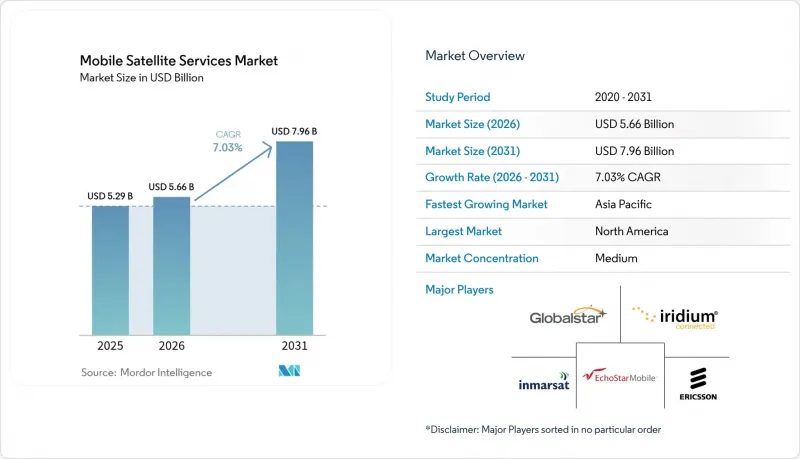
根據 Mordor Intelligence 估計,行動衛星服務市場在 2026 年的價值將達到 56.6 億美元,高於 2025 年的 52.9 億美元,預計到 2031 年將達到 79.6 億美元。
預計從 2026 年到 2031 年,其複合年成長率將達到 7.03%。
本報告按服務(語音、數據、寬頻等)、頻段(L波段、S 波段等)和最終用戶行業(航運、航空、政府/國防等)進行分類。
全球行動衛星服務市場趨勢與洞察
衛星和地面行動通訊網路融合進展
主要亮點
- 2024年,美國聯邦通訊委員會(FCC)採納了「來自太空的補充覆蓋」框架,允許在地面行動通訊頻段內開展輔助衛星業務,使天基網路和地面網路之間的無縫切換從概念走向早期商業性現實。行動通訊業者現在正將衛星容量作為自動回退層,以確保即使光纖回程傳輸、微波或蜂巢無線電出現故障,用戶也能繼續使用相同的裝置。 AT&T和Verizon已率先進行全國漫遊試驗,利用AST SpaceMobile的L波段和S波段有效載荷在基地台故障時發送文字訊息。衛星營運商可以獲得更高的批發收入,而營運商無需資本投資即可擴展其覆蓋範圍。這將形成一個良性循環,模糊地面網路和非地面網路之間的傳統界限,並擴大行動衛星服務市場。
政府和國防部門對安全通訊線路的需求日益成長。
一系列地緣政治緊張局勢暴露了對外國運營商的依賴,導致國家層面的互聯互通需求激增。歐盟委員會批准了106億歐元(約113億美元)的多軌道IRIS2計畫預算,該計畫將為政府機構、緊急應變人員和關鍵基礎設施提供加密寬頻服務。美國、日本和印度的類似採購計劃也明確規定了透過多軌道實現抗量子加密和冗餘。 2025年初,SES以31億美元完成了對國際通訊衛星組織(Intelsat)的收購,旨在加強其政府業務,並透過單一窗口合約提供多層地球-中地球-低地球通訊能力。因此,高利潤的政府合約正在支持衛星星座升級,並擴大行動衛星服務市場的潛在收入來源。
傳統MSS系統之間缺乏互通性
由於L波段、S波段和Ku波段閘道無法互通,營運跨洲機隊的公司仍被迫使用多個終端。儘管行動衛星服務協會(MSSA)於2024年成立,旨在推廣漫遊標準,但晶片組碎片化問題仍然存在,這增加了跨多個服務區域運營的貨運公司和航空公司的總體擁有成本(TCO)。在實現無縫漫遊之前,行動衛星服務市場的感知價值將低於地面行動電話服務,後者只需一張SIM卡即可提供全球接入。雖然多模終端正在湧現,但由於認證程序、天線設計上的妥協以及生產規模的限制,其普及速度緩慢。
細分市場分析
到2025年,資料通訊將佔總收入的62.85%,凸顯了寬頻和串流媒體如今已成為行動衛星服務市場客戶預算的支柱。企業正在簽訂高吞吐量線路契約,用於視訊監控、船員福利以及遠端軟體更新的回程傳輸,而這些更新在其他情況下是無法實現的。語音通訊在海上遇險和駕駛座安全領域仍佔據著一定的市場佔有率,但基於頻寬的合約正在超越按分鐘收費。物聯網/機器對機器(IoT/M2M)合約的成長速度最快,預計到2031年將維持12.05%的複合年成長率,因為農業、採礦和公共產業正在擴大遠端感測器的部署。從利潤率提升的角度來看,這一領域具有重要的戰略意義,因為每增加一個新的感測器模組,收入就會增加,而衛星營運成本卻可以忽略不計。因此,儘管單價收入較低,但物聯網終端的行動衛星服務市場規模預計將顯著成長。
影片和資料量的成長迫使營運商採用可重播的有效載荷,以便在衛星上處理流量,從而緩解地面瓶頸。中國發射的12顆搭載人工智慧的低地球軌道衛星,總吞吐量達744 TOPS,便是軌道邊緣運算的典範。這項技術透過頻譜效率,在不分配額外頻寬的情況下,確保了額外的可銷售吞吐量。靈活的軟體定義樞紐可在數分鐘內完成容量重新部署,從季節性航線到颶風災區,均可適用,從而提高資源利用率。此外,向「容量即服務 (CaaS)」合約的轉變促使營運商提供效能保證,而非雲端運算引入的「盡力而為」通訊鏈路模式。所有這些變化共同凸顯了數據的重要性,也印證了到2031年數據將繼續佔據行動衛星服務市場60%以上的佔有率的預測。
區域分析
2025年,北美地區在行動衛星服務市場維持了37.65%的佔有率,這得益於國防部的大規模合約、完善的法律規範以及早期「直接到設備」的試點計畫。美國佔了該地區收入的大部分,這主要得益於能源管道和緊急應變網路中的衛星廣播服務。加拿大透過在其北部地區履行普遍服務義務擴大了需求,而墨西哥則利用共用衛星容量連接了山區社區。該地區C頻段的重新分配確保了額外的下行頻寬,使營運商能夠在不發射新衛星的情況下擴大消費者寬頻服務的覆蓋範圍。
亞太地區預計將以9.95%的複合年成長率成為所有地區中成長最快的地區,這主要得益於各國政府追求數位主權以及私人企業集團推進物流鏈數位化。衛星發射速度依然強勁,例如KDDI等區域營運商正在將「au Starlink Direct」商業化,為日本山區普遍使用的智慧型手機提供通訊服務。中國透過增設高通量Ka波段衛星,為「一帶一路」航運路線提供服務,提升了國內通訊能力。同時,在印度,Bharti Airtel和SpaceX達成協議,將擴大農村地區的寬頻覆蓋範圍。東南亞島國簽署了一項採購框架協議,旨在將災害救援、漁業監測和學校網路存取等通訊能力整合到一個國家合約中。在歐洲,以IRIS2安全計畫為核心的機構需求強勁。歐洲全球導航衛星系統局迅速批准了抗量子上行鏈路研究的津貼,SpaceRISE聯盟也已開始建立一個結合地球同步軌道(GEO)、中地球軌道(MEO)和低地球軌道(LEO)的多軌道網路。中東電信業者與歐洲船隊所有者合作,為紅海新航線提供海上通訊覆蓋。非洲電信業者也向歐洲供應商採購Ka波段容量,以彌補國內光纖網路的不足。在拉丁美洲,颶風易發地區開發了抗災衛星覆蓋網路;安第斯山脈國家引入了L波段攜帶式衛星電話,用於微波鏈路無法覆蓋地區的緊急應變。
其他好處:
- Excel格式的市場預測(ME)表
- 3個月的分析師支持
目錄
第1章:引言
- 研究假設和市場定義
- 調查範圍
第2章:調查方法
第3章執行摘要
第4章 市場狀況
- 市場概覽
- 市場促進因素
- 衛星和地面電波移動網路的融合正在推進。
- 政府和國防部門對安全通訊線路的需求日益成長。
- 遠端位置物聯網/機器對機器 (M2M) 資產日益成長的連線需求
- 災害應對型通訊項目激增
- 3GPP-NTN 標準(MSS)支援與設備直接連接。
- 低地球窄頻衛星星系可降低延遲和成本。
- 市場限制因素
- 傳統MSS系統之間缺乏互通性
- 加強對頻段和軌道槽位的監管
- 相位陣列天線導致終端成本高昂
- 由於太空碎片預防法規的訂定,發射保險費正在上漲。
- 價值鏈分析
- 監理情勢
- 技術展望
- 波特五力分析
第5章 市場規模與成長預測
- 按服務
- 聲音的
- 數據
- 寬頻
- IoT/M2M
- 按頻段
- L波段
- S波段
- Ku波段
- Ka波段
- 按最終用戶行業分類
- 海上
- 航空
- 政府/國防
- 企業與能源
- 陸地行動通訊
- 按地區
- 北美洲
- 美國
- 加拿大
- 墨西哥
- 南美洲
- 巴西
- 阿根廷
- 其他南美國家
- 歐洲
- 德國
- 英國
- 法國
- 俄羅斯
- 其他歐洲國家
- 亞太地區
- 中國
- 印度
- 日本
- 韓國
- ASEAN
- 其他亞太國家
- 中東
- 沙烏地阿拉伯
- 阿拉伯聯合大公國
- 土耳其
- 其他中東國家
- 非洲
- 南非
- 奈及利亞
- 其他非洲國家
- 北美洲
第6章 競爭情勢
- 市場集中度
- 策略趨勢
- 市佔率分析
- 公司簡介
- Inmarsat plc
- Iridium Communications Inc.
- Globalstar Inc.
- EchoStar Mobile Ltd
- Thuraya Telecommunications Co.
- Intelsat SA
- ORBCOMM Inc.
- ViaSat Inc.(Incl. ViaSat UK)
- Ericsson(Satellite IoT)
- SES SA
- Eutelsat Group
- Hughes Network Systems
- OneWeb
- AST SpaceMobile
- Ligado Networks
- Telesat Lightspeed
- Skylo Technologies
- Qualcomm Inc.(Snapdragon Satellite)
- SpaceX-Starlink Direct-to-Cell
- Thales Alenia Space
第7章 市場機會與未來展望
According to Mordor Intelligence, the mobile satellite services market size in 2026 is estimated at USD 5.66 billion, growing from 2025 value of USD 5.29 billion with 2031 projections showing USD 7.96 billion, growing at 7.03% CAGR over 2026-2031.
This report is Segmented by Service (Voice, Data, Broadband, and More), Frequency (L-Band, S-Band, and More), End-User Industry (Maritime, Aviation, Government and Defense, and More),
Global Mobile Satellite Services Market Trends and Insights
Rising Integration of Satellite-Terrestrial Mobile Networks
Key Highlights
- Seamless handover between space-based and ground networks moved from concept to early commercial reality after the Federal Communications Commission adopted its Supplemental Coverage from Space framework in 2024, allowing secondary satellite operations within terrestrial mobile spectrum.Mobile operators now embed satellite capacity as an automated fallback layer so subscribers retain service on the same handset when fibre backhaul, microwave, or cellular radios fail. AT&T and Verizon opened the door to nationwide roaming trials that use AST SpaceMobile's L- and S-Band payloads to provide texting when towers are down. Satellite operators gain incremental wholesale revenue, while telcos strengthen coverage maps without capital outlay. The result is a virtuous cycle that enlarges the mobile satellite services market by blurring the historical boundary between terrestrial and non-terrestrial networks.
Escalating Government and Defense Demand for Secure Links
Sovereign connectivity requirements surged after several geopolitical flashpoints exposed reliance on foreign operators. The European Commission approved EUR 10.6 billion (USD 11.3 billion) for the multi-orbit IRIS2 programme that will furnish encrypted broadband to institutions, first responders, and critical infrastructure.Similar procurement tracks in the United States, Japan, and India specify quantum-resistant encryption and multi-orbit redundancy. SES completed its USD 3.1 billion acquisition of Intelsat in early 2025 to strengthen its government portfolio and offer layered GEO-MEO-LEO capacity under single-throat contracts. High-margin government deals therefore underpin fleet upgrades and expand the reachable revenue pool for the mobile satellite services market.
Lack of Interoperability Among Legacy MSS Systems
Enterprises with transcontinental fleets still juggle multiple terminals because L-Band, S-Band, and Ku-Band gateways do not interoperate. The Mobile Satellite Services Association formed in 2024 to champion roaming standards, yet chipset fragmentation persists and drives higher total cost of ownership for shippers and airlines that traverse many footprints. Without seamless roaming, the perceived value of the mobile satellite services market remains lower than terrestrial cellular, where a single SIM offers worldwide access. Multimode terminals are emerging, but certification, antenna design compromises, and limited production scale have slowed adoption.
Other drivers and restraints analyzed in the detailed report include:
- Growing Connectivity Needs for Remote IoT/M2M Assets
- Surge in Disaster-Resilient Communications Programmes
- High User-Terminal Cost Due to Phased-Array Antennas
For complete list of drivers and restraints, kindly check the Table Of Contents.
Segment Analysis
Data connectivity accounted for 62.85% of 2025 revenue, underscoring how broadband and streaming now anchor customer budgets in the mobile satellite services market. Enterprises book high-throughput circuits to backhaul video surveillance, crew welfare access, and remote software updates that would otherwise be impossible. Voice retains a niche in maritime distress and cockpit safety, yet bandwidth-driven contracts are eclipsing per-minute billing. IoT/M2M subscriptions grew fastest and are forecast to post 12.05% CAGR to 2031 as agriculture, mining, and utilities scale remote sensor fleets. Each new sensor module adds incremental revenue at negligible satellite operating cost, making the segment strategically significant for margin expansion. The mobile satellite services market size for IoT endpoints is therefore poised to rise meaningfully despite lower average revenue per device.
Video and data growth pushes operators to adopt regenerative payloads so traffic can be processed onboard, reducing ground bottlenecks. China's launch of 12 AI-enhanced LEO satellites that execute 744 TOPS showcases orbital edge computing, where spectral efficiency gains free additional throughput for sale without extra spectrum allocation. Flexible software-defined hubs let capacity be redeployed from seasonal maritime lanes to hurricane recovery zones within minutes, improving utilisation. The transition to capacity-as-a-service contracts also incentivises operators to provide performance guarantees rather than best-effort links, a model imported from cloud computing. These shifts collectively reinforce data's primacy and validate the expectation that data will still exceed 60% of the mobile satellite services market by 2031.
Complete Report Scope:
- By Service
- Voice
- Data
- Broadband
- IoT / M2M
- By Frequency Band
- L-Band
- S-Band
- Ku-Band
- Ka-Band
- By End-User Industry
- Maritime
- Aviation
- Government and Defense
- Enterprise and Energy
- Land Mobile
- By Geography
- North America
- United States
- Canada
- Mexico
- South America
- Brazil
- Argentina
- Rest of South America
- Europe
- Germany
- United Kingdom
- France
- Russia
- Rest of Europe
- Asia Pacific
- China
- India
- Japan
- South Korea
- ASEAN
- Rest of Asia Pacific
- Middle East
- Saudi Arabia
- United Arab Emirates
- Turkey
- Rest of Middle East
- Africa
- South Africa
- Nigeria
- Rest of Africa
- North America
Geography Analysis
North America retained 37.65% share of the mobile satellite services market in 2025 because of large Department of Defense contracts, well-established regulatory pathways, and early direct-to-device pilots. The United States accounted for most regional revenue, buoyed by fleet broadcasts across energy pipelines and first-responder networks. Canada increased demand through universal service mandates in its northern territories, and Mexico leveraged shared satellite capacity to connect mountainous communities. Regional C-band refarming provided additional downlink bandwidth, allowing operators to widen consumer broadband offers without launching new spacecraft.
Asia Pacific is set to post a 9.95% CAGR, the fastest among all regions, as governments pursue digital sovereignty and private conglomerates digitise logistics chains. Launch rates remain brisk, and regional players such as KDDI commercialised "au Starlink Direct" to bring messaging to standard smartphones across Japan's mountainous topography. China expanded national capacity by adding high-throughput Ka-Band satellites that will serve Belt and Road shipping routes, while India welcomed agreements between Bharti Airtel and SpaceX to widen rural broadband. Southeast Asian archipelagos signed procurement frameworks that bundle capacity for disaster-relief, fisheries monitoring, and school connectivity into a single sovereign contract. Europe experienced robust institutional demand anchored by the IRIS2 security programme. The European GNSS Agency fast-tracked grants for quantum-safe uplink research, and the SpaceRISE consortium began constructing a multi-orbit network with combined GEO, MEO, and LEO segments. Middle East operators collaborated with European fleet owners to provide maritime coverage along new Red Sea shipping lanes, and African telcos sourced Ka-Band capacity from European providers to bridge national fibre gaps. Latin America pursued disaster-resilient satellite overlays in hurricane zones, and Andean nations adopted L-Band handheld satellite phones for emergency response in terrain where microwave links are infeasible.
- Inmarsat plc
- Iridium Communications Inc.
- Globalstar Inc.
- EchoStar Mobile Ltd
- Thuraya Telecommunications Co.
- Intelsat S.A.
- ORBCOMM Inc.
- ViaSat Inc. (Incl. ViaSat U.K.)
- Ericsson (Satellite IoT)
- SES S.A.
- Eutelsat Group
- Hughes Network Systems
- OneWeb
- AST SpaceMobile
- Ligado Networks
- Telesat Lightspeed
- Skylo Technologies
- Qualcomm Inc. (Snapdragon Satellite)
- SpaceX - Starlink Direct-to-Cell
- Thales Alenia Space
Additional Benefits:
- The market estimate (ME) sheet in Excel format
- 3 months of analyst support
TABLE OF CONTENTS
1 INTRODUCTION
- 1.1 Study Assumptions and Market Definition
- 1.2 Scope of the Study
2 RESEARCH METHODOLOGY
3 EXECUTIVE SUMMARY
4 MARKET LANDSCAPE
- 4.1 Market Overview
- 4.2 Market Drivers
- 4.2.1 Rising integration of satellite-terrestrial mobile networks
- 4.2.2 Escalating government and defense demand for secure links
- 4.2.3 Growing connectivity needs for remote IoT/M2M assets
- 4.2.4 Surge in disaster-resilient communications programs
- 4.2.5 3GPP-NTN standard enabling direct-to-device MSS
- 4.2.6 LEO narrow-band constellations lowering latency and cost
- 4.3 Market Restraints
- 4.3.1 Lack of interoperability among legacy MSS systems
- 4.3.2 Tightening spectrum and orbital slot regulations
- 4.3.3 High user-terminal cost due to phased-array antennas
- 4.3.4 Space-debris mitigation rules raising launch insurance
- 4.4 Value Chain Analysis
- 4.5 Regulatory Landscape
- 4.6 Technological Outlook
- 4.7 Porter's Five Forces Analysis
- 4.7.1 Bargaining Power of Buyers
- 4.7.2 Bargaining Power of Suppliers
- 4.7.3 Threat of New Entrants
- 4.7.4 Threat of Substitutes
- 4.7.5 Competitive Rivalry
5 MARKET SIZE AND GROWTH FORECASTS (VALUE)
- 5.1 By Service
- 5.1.1 Voice
- 5.1.2 Data
- 5.1.3 Broadband
- 5.1.4 IoT / M2M
- 5.2 By Frequency Band
- 5.2.1 L-Band
- 5.2.2 S-Band
- 5.2.3 Ku-Band
- 5.2.4 Ka-Band
- 5.3 By End-User Industry
- 5.3.1 Maritime
- 5.3.2 Aviation
- 5.3.3 Government and Defense
- 5.3.4 Enterprise and Energy
- 5.3.5 Land Mobile
- 5.4 By Geography
- 5.4.1 North America
- 5.4.1.1 United States
- 5.4.1.2 Canada
- 5.4.1.3 Mexico
- 5.4.2 South America
- 5.4.2.1 Brazil
- 5.4.2.2 Argentina
- 5.4.2.3 Rest of South America
- 5.4.3 Europe
- 5.4.3.1 Germany
- 5.4.3.2 United Kingdom
- 5.4.3.3 France
- 5.4.3.4 Russia
- 5.4.3.5 Rest of Europe
- 5.4.4 Asia Pacific
- 5.4.4.1 China
- 5.4.4.2 India
- 5.4.4.3 Japan
- 5.4.4.4 South Korea
- 5.4.4.5 ASEAN
- 5.4.4.6 Rest of Asia Pacific
- 5.4.5 Middle East
- 5.4.5.1 Saudi Arabia
- 5.4.5.2 United Arab Emirates
- 5.4.5.3 Turkey
- 5.4.5.4 Rest of Middle East
- 5.4.6 Africa
- 5.4.6.1 South Africa
- 5.4.6.2 Nigeria
- 5.4.6.3 Rest of Africa
- 5.4.1 North America
6 COMPETITIVE LANDSCAPE
- 6.1 Market Concentration
- 6.2 Strategic Moves
- 6.3 Market Share Analysis
- 6.4 Company Profiles (includes Global level Overview, Market level overview, Core Segments, Financials as available, Strategic Information, Market Rank/Share for key companies, Products and Services, and Recent Developments)
- 6.4.1 Inmarsat plc
- 6.4.2 Iridium Communications Inc.
- 6.4.3 Globalstar Inc.
- 6.4.4 EchoStar Mobile Ltd
- 6.4.5 Thuraya Telecommunications Co.
- 6.4.6 Intelsat S.A.
- 6.4.7 ORBCOMM Inc.
- 6.4.8 ViaSat Inc. (Incl. ViaSat U.K.)
- 6.4.9 Ericsson (Satellite IoT)
- 6.4.10 SES S.A.
- 6.4.11 Eutelsat Group
- 6.4.12 Hughes Network Systems
- 6.4.13 OneWeb
- 6.4.14 AST SpaceMobile
- 6.4.15 Ligado Networks
- 6.4.16 Telesat Lightspeed
- 6.4.17 Skylo Technologies
- 6.4.18 Qualcomm Inc. (Snapdragon Satellite)
- 6.4.19 SpaceX - Starlink Direct-to-Cell
- 6.4.20 Thales Alenia Space
7 MARKET OPPORTUNITIES AND FUTURE OUTLOOK
- 7.1 White-space and Unmet-need Assessment

 行動衛星服務市場:按服務、衛星軌道、頻段、應用和最終用戶分類-2026-2032年全球市場預測
 行動衛星服務市場報告:按服務類型、應用類型、產業和地區分類,2026-2034年
 2026年全球行動衛星服務市場報告
 行動衛星服務市場 - 全球產業規模、佔有率、趨勢、機會、預測(按類型、銷售管道、應用、地區和競爭格局分類,2021-2031年)
 拉丁美洲行動衛星服務市場(2023-2030 年)
 行動衛星服務 (MSS) 市場規模、佔有率和成長分析(按服務、頻率、應用、最終用戶和地區分類)—2026-2033 年產業預測
 北美行動衛星服務:市場佔有率分析、產業趨勢和成長預測(2025-2030 年)
 2030 年行動衛星服務市場預測:按服務類型、頻寬、技術、應用和地區分類的全球分析