


 |
市場調查報告書
商品編碼
2122636
全球導航衛星系統(GNSS)晶片:市場佔有率分析、產業趨勢與統計、成長預測(2026-2031)GNSS Chip - Market Share Analysis, Industry Trends & Statistics, Growth Forecasts (2026 - 2031) |
||||||

※ 本網頁內容可能與最新版本有所差異。詳細情況請與我們聯繫。
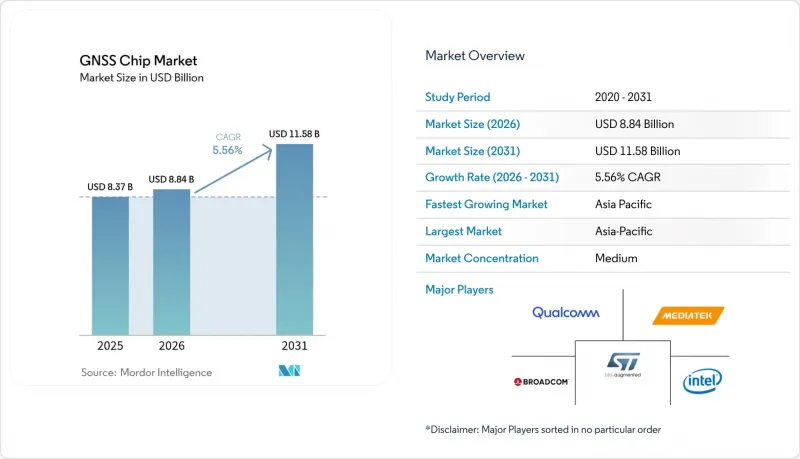
據 Mordor Intelligence 稱,2025 年 GNSS 晶片市值為 83.7 億美元,預計到 2031 年將達到 115.8 億美元,而 2026 年為 88.4 億美元,預測期(2026-2031 年)的複合年成長率為 5.56%。
本報告按設備類型(智慧型手機、平板電腦、穿戴式裝置等)、頻段(單頻L1等)、終端用戶產業(汽車、農業等)、應用程式(導航、定位和地圖繪製等)以及地區(北美、南美、歐洲等)進行細分。市場預測以美元計價。
全球GNSS晶片市場趨勢與洞察
配備多頻GNSS的智慧型手機出貨量激增。
目前,高階設備配備了雙頻(L1/L5)或三頻接收器,定位精度從米級提升至分米級,即使在人口密集的都市區也能實現可靠的擴增實境(AR)導航。中國、韓國和美國旗艦機型的發布加速了產品更新換代,因為老舊的單頻設計已無法滿足室內外無縫覆蓋的新需求。開發者正利用這種更高的定位精度來增強遊戲、社交媒體標記和定位服務,從而導致全球導航衛星系統(GNSS)晶片市場對先進晶片組的持續高需求。
ADAS和自動駕駛對精準度的要求越來越高
L3級及以上自動駕駛需要持續的車道級定位,這促使汽車製造商將多頻GNSS與IMU和V2X無線電技術結合。測量級感測器的高精度提升使得每輛車增加半導體負載成為可能,而透過無線電傳輸軟體功能則顯著提高了提供韌體可升級導航協定堆疊的晶片供應商的持續獲利潛力。
全球導航衛星系統易受干擾和欺騙
2024年,歐洲航空當局報告了超過1000起干擾事件,導致航線變更和飛行中系統重置。目前,私營機構被要求實施多衛星群接收、干擾偵測和加密服務,這增加了硬體成本,並使GNSS晶片市場供應商的認證進度更加複雜。
細分市場分析
報告指出,受消費性電子設備中定位服務的普及推動,智慧型手機將在2025年佔據全球導航衛星系統(GNSS)晶片市場54.62%的佔有率。雖然出貨量成長已進入成熟階段,但雙頻功能的升級維持了每台設備的半導體價值,使供應商能夠維持利潤率。平板電腦、穿戴式裝置和個人追蹤器市場表現強勁,但平均售價較低。隨著汽車製造商將導航冗餘技術應用於進階駕駛輔助系統(ADAS),汽車系統正呈現約5%的成長率。
目前,無人機市場規模小規模,但預計將以7.55%的複合年成長率成長,並有望成為該設備類別中收入成長最快的領域。商業巡檢、配送和農業精準噴灑等應用需要在嚴格的重量和功耗限制下達到厘米級精度,這推動了對緊湊型多頻接收器的需求。低功耗資產追蹤設備和專用工業設備滿足了對穩健性的特定需求,從而豐富了GNSS晶片市場的設計多樣性。
注重成本的家用電子電器預計仍將採用單頻L1解決方案,到2025年,單頻L1解決方案仍將佔據GNSS晶片市場66.45%的佔有率,鞏固其入門級產品的地位。然而,都市區峽谷效應和電離層誤差導致的多路徑干擾限制了L1的性能,促使汽車、測繪和無人機產業的客戶採用雙頻或三頻架構。
受濾波器價格下降和新型四頻單晶片產品湧現(這些產品簡化了基板設計)的推動,多頻產品的出貨量正以7.86%的複合年成長率成長。雙頻L1/L5現已成為許多一級汽車平台的強制性要求,而航空監管機構也正逐步強制要求在安全關鍵型導航系統中採用L5。
區域分析
預計到2025年,亞太地區將佔據全球GNSS晶片市場規模的42.10%,主要得益於中國北斗系統的開發、智慧型手機的大規模生產以及當地對精密農業設備的強勁需求。政府對國內半導體企業的支持,以及印度NavIC和日本QZSS相關生態系統的擴展,進一步加速了該地區GNSS晶片的普及應用。獲得北斗和NavIC全面認證的供應商正獲得優先供應商地位,並確保其設計被行動電話和農業機械等行業的原始設備製造商(OEM)採用。
北美憑藉汽車ADAS系統、國防合約和大規模5G定時部署,保持穩定的市場佔有率。聯邦採購強調容錯性和加密M碼功能,迫使供應商採用無干擾前端和SAASM相容性。該地區活躍的無人機配送試點計畫和矽谷穿戴裝置品牌維持著技術領先的良性循環,儘管出貨量下降,但平均售價(ASP)仍然居高不下。
在歐洲,伽利略雙頻系統的應用正被列入航空和道路運輸法規的優先事項。 2024年東歐地區欺騙事件的激增加速了航空公司對飛機維修,以適應多衛星群接收器。同時,在南美洲、中東和非洲,全球導航衛星系統(GNSS)正被部署用於促進智慧城市建設、採礦自動化和氣候適應農業。巴西正利用精準大豆種植技術來維持出口競爭力,海灣國家則將GNSS整合到大型基礎設施項目中。此外,非洲各地的行動營運商正在投資5G授時技術以繞過固定網路,所有這些都推動了GNSS晶片市場的累積成長。
其他好處:
- Excel格式的市場預測(ME)表
- 3個月的分析師支持
目錄
第1章:引言
- 研究假設和市場定義
- 調查範圍
第2章:調查方法
第3章執行摘要
第4章 市場狀況
- 市場概覽
- 市場促進因素
- 配備多頻GNSS的智慧型手機出貨量正在快速成長。
- ADAS和自動駕駛對更高精度的需求日益成長。
- 精密農業和物流追蹤的擴展
- 實現最後一公里無人機配送的公分級定位
- 用於醫療穿戴裝置的小型雙頻晶片
- 對主權衛星群的投資正在刺激當地需求。
- 市場限制因素
- 全球導航衛星系統易受干擾和欺騙
- 多衛星群晶片組的高功耗
- 先進射頻前端節點的供應受限
- L波段頻率重新分配的監理延誤
- 產業價值鏈分析
- 監理情勢
- 技術展望
- 波特五力分析
- 宏觀經濟和地緣政治衝擊的影響
第5章 市場規模與成長預測
- 依設備類型
- 智慧型手機
- 平板電腦和穿戴式裝置
- 個人追蹤設備
- 低功耗資產追蹤設備
- 車載系統
- 無人機
- 其他設備類型
- 按頻段
- 單頻L1
- 雙頻 L1/L5
- 雙頻 L1/L2
- 多頻(三頻或更高)
- 按最終用戶行業分類
- 車
- 家用電子產品
- 航空
- 農業
- 建築和採礦
- 國防/公共安全
- 其他最終用戶
- 透過使用
- 導航
- 定位與測繪
- 定時和同步
- 遙感探測
- 按地區
- 北美洲
- 美國
- 加拿大
- 墨西哥
- 南美洲
- 巴西
- 阿根廷
- 其他南美國家
- 歐洲
- 德國
- 英國
- 法國
- 義大利
- 其他歐洲國家
- 亞太地區
- 中國
- 日本
- 韓國
- 印度
- 其他亞太國家
- 中東
- 沙烏地阿拉伯
- 阿拉伯聯合大公國
- 其他中東國家
- 非洲
- 南非
- 其他非洲國家
- 北美洲
第6章 競爭情勢
- 市場集中度
- 策略趨勢
- 市佔率分析
- 公司簡介
- Qualcomm Technologies, Inc.
- Broadcom Inc.
- MediaTek Inc.
- STMicroelectronics NV
- u-blox Holding AG
- Samsung Electronics Co., Ltd.(System LSI)
- Skyworks Solutions, Inc.
- Quectel Wireless Solutions Co., Ltd.
- Sony Semiconductor Solutions Corporation
- Intel Corporation
- Thales Group
- Trimble Inc.
- Hemisphere GNSS, Inc.
- Septentrio NV
- Furuno Electric Co., Ltd.
- Allystar Technology Co., Ltd.
- Hexagon AB(NovAtel Inc.)
- Orolia(Safran Electronics & Defense)
- HiSilicon(Shanghai)Technologies Co., Ltd.
- Topcon Positioning Systems, Inc.
第7章 市場機會與未來展望
According to Mordor Intelligence, the GNSS chip market size was valued at USD 8.37 billion in 2025 and estimated to grow from USD 8.84 billion in 2026 to reach USD 11.58 billion by 2031, at a CAGR of 5.56% during the forecast period (2026-2031).
This report is Segmented by Device Type (Smartphones, Tablets and Wearables, and More), Frequency Band (Single-Frequency L1, and More), End-User Industry (Automotive, Agriculture, and More), Application (Navigation, Positioning and Mapping, and More), and Geography (North America, South America, Europe, and More). The Market Forecasts are Provided in Terms of Value (USD).
Global GNSS Chip Market Trends and Insights
Surge in Multi-frequency GNSS Smartphone Shipments
Premium handsets now integrate dual-band L1/L5 and even tri-band receivers, which enhance location accuracy from meters to decimeters, enabling reliable augmented-reality navigation in dense urban cores. Flagship launches across China, South Korea, and the United States accelerate the refresh cycle because older single-frequency designs cannot support emerging indoor-outdoor continuity. Developers leverage the improved accuracy to enrich gaming, social-media tagging, and emergency-caller location services, which in turn sustains a high-volume pull for advanced chipsets inside the GNSS chip market.
Rising ADAS and Autonomous-Driving Precision Needs
Level 3 and higher autonomy demands consistent lane-level positioning, prompting automakers to pair multi-frequency GNSS with IMUs and vehicle-to-everything radios. Survey-grade accuracy elevates silicon content per vehicle and justifies premium ASPs, while over-the-air software functions multiply recurring revenue potential for chip suppliers that offer firmware-upgradable navigation stacks.
GNSS Vulnerability to Jamming and Spoofing
More than 1,000 interference incidents were reported by European aviation authorities in 2024, resulting in rerouting and in-flight system resets. Civil agencies now mandate multi-constellation reception, interference detection, and encrypted services, which inflate hardware costs and complicate certification timelines for GNSS chip market vendors.
Other drivers and restraints analyzed in the detailed report include:
- Expansion of Precision Agriculture and Logistics Tracking
- Centimeter-Level Positioning for Drone Last-mile Delivery
- High Power Draw of Multi-constellation Chipsets
For complete list of drivers and restraints, kindly check the Table Of Contents.
Segment Analysis
Smartphones accounted for 54.62% of the GNSS chip market size in 2025, driven by the widespread adoption of location-based services in consumer devices, according to. Although shipment growth is maturing, dual-band upgrades sustain silicon value per handset, enabling suppliers to maintain their margins. Tablets, wearables, and personal trackers represent steady but lower-ASP outlets. In-vehicle systems post mid-single-digit growth as automakers embed navigation redundancy for ADAS.
Drones, with a modest base today, are forecasted to grow at a 7.55% CAGR and thus provide the fastest incremental revenue among device classes. Commercial inspection, delivery, and precision-spray agriculture collectively demand centimeter accuracy under strict weight and power budgets, creating a premium for compact multi-frequency receivers. Low-power asset trackers and specialty industrial devices round out niche demand with ruggedized requirements, reinforcing design diversity in the GNSS chip market.
Cost-sensitive consumer electronics are expected to maintain a single-frequency L1 solution at 66.45% of the GNSS chip market share in 2025, solidifying their role as the entry-level option. However, urban-canyon multipath and ionospheric errors limit L1 performance, prompting automotive, surveying, and drone clients to adopt dual- or tri-band architectures.
Multi-frequency shipments are rising at an 7.86% CAGR, helped by falling filter prices and new quad-band single-die offerings that streamline board design. For many tier-one automotive platforms, dual-band L1/L5 is now a hard requirement, while aviation regulators move toward mandatory L5 for safety-critical navigation.
Complete Report Scope:
- By Device Type
- Smartphones
- Tablets and Wearables
- Personal Tracking Devices
- Low-power Asset Trackers
- In-vehicle Systems
- Drones
- Other Device Types
- By Frequency Band
- Single-frequency L1
- Dual-frequency L1/L5
- Dual-frequency L1/L2
- Multi-frequency (Tri-band and above)
- By End-user Industry
- Automotive
- Consumer Electronics
- Aviation
- Agriculture
- Construction and Mining
- Defense and Public Safety
- Other End-users
- By Application
- Navigation
- Positioning and Mapping
- Timing and Synchronization
- Remote Sensing
- By Geography
- North America
- United States
- Canada
- Mexico
- South America
- Brazil
- Argentina
- Rest of South America
- Europe
- Germany
- United Kingdom
- France
- Italy
- Rest of Europe
- Asia-Pacific
- China
- Japan
- South Korea
- India
- Rest of Asia-Pacific
- Middle East
- Saudi Arabia
- United Arab Emirates
- Rest of Middle East
- Africa
- South Africa
- Rest of Africa
- North America
Geography Analysis
Asia-Pacific held 42.10% of the GNSS chip market size in 2025, supported by China's BeiDou build-out, high-volume smartphone assembly, and strong local demand for precision agriculture equipment. Government incentives for indigenous silicon, combined with the growing ecosystem around India's NavIC and Japan's QZSS, further accelerate regional uptake. Suppliers that certify full BeiDou and NavIC compliance gain preferred-vendor status, locking in design wins with OEMs across handsets and farm machinery.
North America contributes a stable share anchored in automotive ADAS, defense contracts, and large-scale 5G timing deployments. Federal procurement emphasizes resilience and encrypted M-code capability, prompting vendors to adopt anti-jam front-ends and SAASM compatibility. The region's thriving drone-delivery pilots and Silicon Valley wearable brands maintain a technology leadership loop that keeps ASPs elevated despite lower unit volumes.
Europe prioritizes the adoption of Galileo dual-frequency in both aviation and road transport regulations. The 2024 spike in spoofing incidents over Eastern Europe accelerated airline retrofits with multi-constellation receivers. Meanwhile, South America, the Middle East and Africa adopt GNSS to bolster smart-city builds, mining automation and climate-smart farming. Brazil leverages precision soybean planting to defend its export competitiveness; Gulf countries embed GNSS into mega infrastructure projects; and pan-African mobile operators invest in 5G timing to leapfrog fixed networks, cumulatively enlarging the GNSS chip market.
- Qualcomm Technologies, Inc.
- Broadcom Inc.
- MediaTek Inc.
- STMicroelectronics N.V.
- u-blox Holding AG
- Samsung Electronics Co., Ltd. (System LSI)
- Skyworks Solutions, Inc.
- Quectel Wireless Solutions Co., Ltd.
- Sony Semiconductor Solutions Corporation
- Intel Corporation
- Thales Group
- Trimble Inc.
- Hemisphere GNSS, Inc.
- Septentrio N.V.
- Furuno Electric Co., Ltd.
- Allystar Technology Co., Ltd.
- Hexagon AB (NovAtel Inc.)
- Orolia (Safran Electronics & Defense)
- HiSilicon (Shanghai) Technologies Co., Ltd.
- Topcon Positioning Systems, Inc.
Additional Benefits:
- The market estimate (ME) sheet in Excel format
- 3 months of analyst support
TABLE OF CONTENTS
1 INTRODUCTION
- 1.1 Study Assumptions and Market Definition
- 1.2 Scope of the Study
2 RESEARCH METHODOLOGY
3 EXECUTIVE SUMMARY
4 MARKET LANDSCAPE
- 4.1 Market Overview
- 4.2 Market Drivers
- 4.2.1 Surge in multi-frequency GNSS smartphone shipments
- 4.2.2 Rising ADAS and autonomous-driving precision needs
- 4.2.3 Expansion of precision agriculture and logistics tracking
- 4.2.4 Centimeter-level positioning for drone last-mile delivery
- 4.2.5 Miniaturized dual-band chips for medical wearables
- 4.2.6 Sovereign constellation investments spurring local demand
- 4.3 Market Restraints
- 4.3.1 GNSS vulnerability to jamming and spoofing
- 4.3.2 High power draw of multi-constellation chipsets
- 4.3.3 Advanced RF-front-end node supply constraints
- 4.3.4 Regulatory delays in L-band spectrum re-allocation
- 4.4 Industry Value Chain Analysis
- 4.5 Regulatory Landscape
- 4.6 Technological Outlook
- 4.7 Porter's Five Forces Analysis
- 4.7.1 Bargaining Power of Suppliers
- 4.7.2 Bargaining Power of Consumers
- 4.7.3 Threat of New Entrants
- 4.7.4 Threat of Substitute Products
- 4.7.5 Intensity of Competitive Rivalry
- 4.8 Impact of Macroeconomic and Geopolitical Shocks
5 MARKET SIZE AND GROWTH FORECASTS (VALUE)
- 5.1 By Device Type
- 5.1.1 Smartphones
- 5.1.2 Tablets and Wearables
- 5.1.3 Personal Tracking Devices
- 5.1.4 Low-power Asset Trackers
- 5.1.5 In-vehicle Systems
- 5.1.6 Drones
- 5.1.7 Other Device Types
- 5.2 By Frequency Band
- 5.2.1 Single-frequency L1
- 5.2.2 Dual-frequency L1/L5
- 5.2.3 Dual-frequency L1/L2
- 5.2.4 Multi-frequency (Tri-band and above)
- 5.3 By End-user Industry
- 5.3.1 Automotive
- 5.3.2 Consumer Electronics
- 5.3.3 Aviation
- 5.3.4 Agriculture
- 5.3.5 Construction and Mining
- 5.3.6 Defense and Public Safety
- 5.3.7 Other End-users
- 5.4 By Application
- 5.4.1 Navigation
- 5.4.2 Positioning and Mapping
- 5.4.3 Timing and Synchronization
- 5.4.4 Remote Sensing
- 5.5 By Geography
- 5.5.1 North America
- 5.5.1.1 United States
- 5.5.1.2 Canada
- 5.5.1.3 Mexico
- 5.5.2 South America
- 5.5.2.1 Brazil
- 5.5.2.2 Argentina
- 5.5.2.3 Rest of South America
- 5.5.3 Europe
- 5.5.3.1 Germany
- 5.5.3.2 United Kingdom
- 5.5.3.3 France
- 5.5.3.4 Italy
- 5.5.3.5 Rest of Europe
- 5.5.4 Asia-Pacific
- 5.5.4.1 China
- 5.5.4.2 Japan
- 5.5.4.3 South Korea
- 5.5.4.4 India
- 5.5.4.5 Rest of Asia-Pacific
- 5.5.5 Middle East
- 5.5.5.1 Saudi Arabia
- 5.5.5.2 United Arab Emirates
- 5.5.5.3 Rest of Middle East
- 5.5.6 Africa
- 5.5.6.1 South Africa
- 5.5.6.2 Rest of Africa
- 5.5.1 North America
6 COMPETITIVE LANDSCAPE
- 6.1 Market Concentration
- 6.2 Strategic Moves
- 6.3 Market Share Analysis
- 6.4 Company Profiles (includes Global level Overview, Market level overview, Core Segments, Financials as available, Strategic Information, Market Rank/Share for key companies, Products and Services, and Recent Developments)
- 6.4.1 Qualcomm Technologies, Inc.
- 6.4.2 Broadcom Inc.
- 6.4.3 MediaTek Inc.
- 6.4.4 STMicroelectronics N.V.
- 6.4.5 u-blox Holding AG
- 6.4.6 Samsung Electronics Co., Ltd. (System LSI)
- 6.4.7 Skyworks Solutions, Inc.
- 6.4.8 Quectel Wireless Solutions Co., Ltd.
- 6.4.9 Sony Semiconductor Solutions Corporation
- 6.4.10 Intel Corporation
- 6.4.11 Thales Group
- 6.4.12 Trimble Inc.
- 6.4.13 Hemisphere GNSS, Inc.
- 6.4.14 Septentrio N.V.
- 6.4.15 Furuno Electric Co., Ltd.
- 6.4.16 Allystar Technology Co., Ltd.
- 6.4.17 Hexagon AB (NovAtel Inc.)
- 6.4.18 Orolia (Safran Electronics & Defense)
- 6.4.19 HiSilicon (Shanghai) Technologies Co., Ltd.
- 6.4.20 Topcon Positioning Systems, Inc.
7 MARKET OPPORTUNITIES AND FUTURE OUTLOOK
- 7.1 White-space and Unmet-need Assessment

 2026-2030年全球GNSS晶片市場
 用於時間同步的GNSS晶片市場(截至2034年)
 2026年全球工業精密時間同步協定(PTP)市場報告
 全球GNSS晶片市場規模、佔有率、趨勢和成長分析報告(2026-2034年)
 GNSS晶片市場分析及預測(至2035年):依類型、產品類型、服務、技術、組件、應用、設備、最終用戶、功能、安裝類型分類
 全球GNSS授時模組市場(按組件類型、外形規格、介面、頻率範圍和應用分類)預測(2026-2032年)按部署類型、技術、封裝、通訊協定和應用分類的時間同步化晶片市場—2026-2032年全球預測
 GNSS 晶片市場規模及預測 2021 - 2031、全球及地區佔有率、趨勢及成長機會分析報告涵蓋範圍:依設備、應用、垂直及地理分類