


 |
市場調查報告書
商品編碼
2122627
行動生物識別:市場佔有率分析、產業趨勢與統計及成長預測(2026-2031)Mobile Biometrics - Market Share Analysis, Industry Trends & Statistics, Growth Forecasts (2026 - 2031) |
||||||

※ 本網頁內容可能與最新版本有所差異。詳細情況請與我們聯繫。
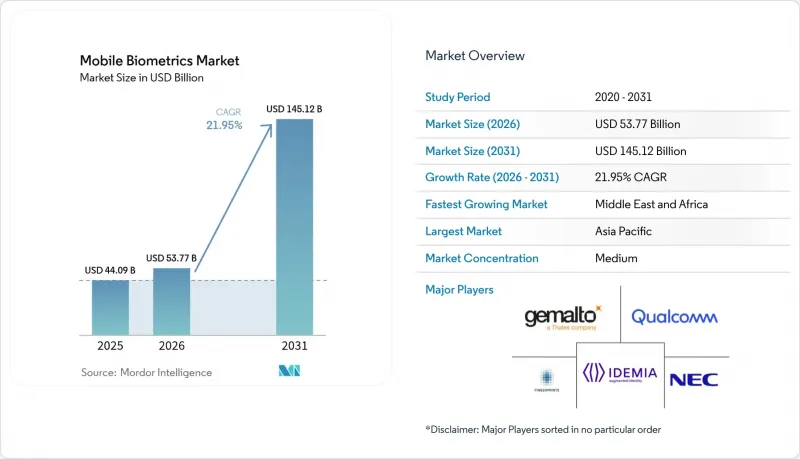
據 Mordor Intelligence 稱,2025 年行動生物識別市場價值為 440.9 億美元,預計將從 2026 年的 537.7 億美元成長到 2031 年的 1451.2 億美元。
預測期(2026-2031 年)的複合年成長率預計為 21.95%。
本報告按組件(硬體、軟體平台、服務)、認證模式(單因素認證等)、技術/模式(指紋識別、臉部認證等)、設備類型(智慧型手機、平板電腦等)、產業領域(銀行、金融服務和保險業、政府/公共部門等)以及地區進行細分。市場預測以美元計價。
全球行動生物識別市場趨勢與洞察
印度 UPI 生態系內雙模認證數量激增。
印度的統一支付介面(UPI)採用指紋和臉部認證取代PIN碼,從而減少詐欺並加快小額交易。這種模式已經對東南亞的銀行帳戶提供者產生了影響,並有望推動失業消費者群體中行動生物識別市場的發展。雖然銀行受益於扣回爭議帳款成本的降低,但隱私監管機構仍在結合Aadhaar(印度居民識別系統)繼續審查資料儲存做法。
中國OEM智慧型手機利用支援5G的裝置端AI提升欺騙偵測能力。
中國行動電話製造商正將人工智慧模型整合到其設備中,以檢測深度造假攻擊。此舉是對預計2024年生物識別詐騙將激增40%的及時回應。這種軟硬體一體化的解決方案提高了全球競爭對手的標準,同時保持了電池續航力,並鞏固了其高階產品定位。
低價安卓設備遭受高發的呈現攻擊
低價智慧型手機通常缺乏強大的生物識別認證功能,導致深度造假語音和麵具在六次試驗中99%都能繞過感應器。這種漏洞損害了用戶信任,迫使非洲銀行增加實體身份驗證,並阻礙了價格敏感型用戶群對智慧型手機的接受度。
細分市場分析
預計到2025年,行動生物識別市場的硬體市場規模將達到263.5億美元,佔總營收的59.74%。隨著產品日益同質化,感測器製造商正加大對整合顯示器的超音波模組的投資,以維持利潤率。人工智慧最佳化晶片可降低延遲,即使在低光源環境或手指潮濕的情況下也能確保可靠運作。服務領域雖然規模較小,但正以22.8%的複合年成長率成長,這主要得益於銀行和醫院購買的身份即服務(IaaS)訂閱。服務提供者正在將編配儀表板、詐欺風險分析和合規性報告功能捆綁在一起,將資本支出轉化為營運費用。
醫療保健產業對託管服務的需求最為顯著,醫院紛紛將病患生物識別註冊外包,以避免資料中心營運負擔。主要的基礎設施即服務 (IaaS) 供應商共同行銷生物識別API,以擴大其業務覆蓋範圍。同時,整合指紋、語音和行為訊號的軟體平台正在確立其在多重雲端部署中作為關鍵整合商的策略地位。這些因素共同作用,正在強化服務良性循環,從而推動整個行動生物識別市場實現更穩定的年度經常性收入 (ARR)。
預計到2025年,單因素身份驗證技術市場規模將達到312.3億美元,凸顯了用戶對iOS和Android原生整合的一鍵解鎖流程的偏好。然而,監管機構和保險公司目前正敦促銀行減少剩餘的詐欺行為,並正在撥出新的預算用於實施多因素身份驗證,生物識別和基於設備的加密金鑰。
Android 15 中整合密碼驗證功能至關重要。谷歌透過將 FIDO 憑證快取在硬體隔離區中,使臉部認證和指紋認證能夠作為使用者不可見的第二重身份驗證因素。這使得企業能夠在不影響行動支付流程的前提下實現多層安全防護。預計董事會層級的風險委員會將優先考慮此類多層控制措施,以抵禦利用生成式人工智慧的網路釣魚攻擊。
區域分析
預計到2025年,亞太地區市場規模將達到195.5億美元,佔全球整體營收的44.35%。智慧型手機的快速普及、金融科技應用的激增以及政府主導的數位身分識別項目正在推動該地區的成長。中國原始設備製造商(OEM)採用超音波屏下感測器正在帶動整個供應鏈的發展,為降低物料清單成本和實現大規模應用奠定了基礎。在印度,與Aadhaar合作的基礎設施改善工作正在持續進行,雙模式UPI交易正在將商家的使用範圍擴展到大都會圈。中東是成長最快的市場,預計到2025年將達到30.6億美元,複合年成長率(CAGR)為23.6%。阿拉伯聯合大公國以行動身分驗證憑證取代實體阿拉伯聯合大公國身分證,是自上而下政策加速全國互通性的典型例子。科威特的「2035願景」將生物識別註冊與電子政府服務結合,推動了對多模態套件的需求。在杜拜,包括大型企劃在內的基礎設施建設熱潮,正迫使承包商實施生物識別門禁系統,進一步促進了區域支出。
在北美,隨著企業對其身分和存取管理 (IAM) 系統進行現代化改造,以及消費者銀行服務向無密碼登入模式轉型,成長雖然穩定但成長放緩。摩根大通的生物識別結帳試點計畫表明,無卡零售支付即將迎來轉折點。歐洲在結構上仍然具有吸引力,但需要遵守嚴格的 GDPR 和人工智慧法律法規。歐盟數位身分錢包統一了 10 個國家的標準,並簡化了供應商身分驗證流程。撒哈拉以南非洲地區雖然以金額為準較小,但其行動選民登記套件的銷售成長強勁,凸顯了攜帶式登記硬體的巨大潛在需求。
其他好處:
- Excel格式的市場預測(ME)表
- 3個月的分析師支持
目錄
第1章:引言
- 研究假設和市場定義
- 調查範圍
第2章:調查方法
第3章執行摘要
第4章 市場狀況
- 市場概覽
- 市場促進因素
- 英國統一支付介面 (UPI) 生態系統中雙重身分驗證方式的激增。
- 在中國OEM智慧型手機中,支援5G的終端AI正在提高欺騙偵測的準確性。
- 奈及利亞、巴西和印尼強制要求行動銀行使用電子身份驗證 (e-KYC)。
- 在撒哈拉以南非洲地區部署行動生物識別選民登記工具包
- 歐洲關於數位身分錢包的法規正在加速智慧型手機上生物識別護照的使用。
- 高階市場中原始設備製造商 (OEM) 向超音波感測器的轉變
- 市場限制因素
- 低成本安卓設備遭受高頻率的呈現攻擊
- 歐盟資料主權法限制了基於雲端的語音生物識別。
- 持續行為認證期間電池電量消耗問題
- 行動生物識別性能缺乏通用基準
- 價值供應鏈分析
- 監理展望
- 波特五力模型
第5章 市場規模與成長預測
- 按組件
- 硬體
- 軟體平台
- 服務
- 身份驗證模式
- 單因素身份驗證
- 多因素身份驗證
- 按技術/模式
- 指紋認證
- 臉部辨識
- 語音辨識
- 虹膜辨識
- 靜脈和血管模式識別
- 行為生物特徵(行走、擊鍵)
- 其他方式
- 依設備類型
- 智慧型手機
- 藥片
- 智慧型穿戴裝置
- 物聯網/邊緣設備
- 堅固耐用的手持終端機和掃描儀
- 按行業分類
- BFSI
- 政府/公共部門
- 衛生保健
- 零售與電子商務
- 資訊科技/通訊
- 國防與安全
- 教育
- 其他行業
- 按地區
- 北美洲
- 美國
- 加拿大
- 墨西哥
- 南美洲
- 巴西
- 阿根廷
- 其他南美國家
- 歐洲
- 英國
- 德國
- 法國
- 義大利
- 西班牙
- 北歐的
- 其他歐洲國家
- 亞太地區
- 中國
- 日本
- 韓國
- 印度
- 澳洲
- 紐西蘭
- 其他亞太國家
- 中東和非洲
- 中東
- GCC
- 土耳其
- 其他中東國家
- 非洲
- 南非
- 奈及利亞
- 肯亞
- 其他非洲國家
- 中東
- 北美洲
第6章 競爭情勢
- 市場集中度
- 策略趨勢
- 市佔率分析
- 公司簡介
- Apple Inc.
- Samsung Electronics Co. Ltd.
- Qualcomm Technologies Inc.
- IDEMIA(Safran Identity and Security)
- NEC Corporation
- Thales Group(Gemalto)
- Fingerprint Cards AB
- Goodix Technology Co. Ltd.
- Synaptics Incorporated
- Precise Biometrics AB
- Nuance Communications Inc.
- Aware Inc.
- Daon Inc.
- M2SYS Technology
- Veridium Ltd.
- FaceTec Inc.
- Mobbeel Solutions SLL
- VoiceVault Inc.
- ValidSoft Ltd.
- Tech5 SA
- HYPR Corp.
- Suprema Inc.
- ID RandD Inc.
- ImageWare Systems Inc.
第7章 市場機會與未來展望
According to Mordor Intelligence, the mobile biometric market size was valued at USD 44.09 billion in 2025 and estimated to grow from USD 53.77 billion in 2026 to reach USD 145.12 billion by 2031, at a CAGR of 21.95% during the forecast period (2026-2031).
This report is Segmented by Component (Hardware, Software Platforms, Services), Authentication Mode (Single-Factor Authentication, and More), Technology/Modality (Fingerprint Recognition, Facial Recognition, and More), Device Type (Smartphones, Tablets, and More), Industry Vertical (BFSI, Government and Public Sector, and More), and by Geography. The Market Forecasts are Provided in Terms of Value (USD).
Global Mobile Biometrics Market Trends and Insights
Bi-modal authentication surge in India's UPI ecosystem
India's Unified Payments Interface is enabling fingerprint or facial recognition in lieu of PINs, cutting fraud and speeding micro-transactions. The model is already influencing wallet providers across Southeast Asia and could lift mobile biometric market adoption among unbanked consumers. Banks benefit from reduced chargeback costs, yet privacy regulators continue to scrutinize Aadhaar-linked storage practices.
5G-enabled on-device AI improving spoof detection in Chinese OEM smartphones
Chinese handset makers have embedded AI models that detect deep-fake attempts locally, a timely response after a 40% jump in biometric fraud in 2024. The hardware-software bundle raises the bar for global competitors and underpins premium positioning while preserving battery life.
High presentation-attack rates on low-cost Android devices
Budget phones often lack robust liveness checks, allowing deep-fake audio or masks to bypass sensors 99% of the time in six attempts. The gap erodes user trust and forces banks in Africa to add physical ID reviews, dampening scale in price-sensitive segments.
Other drivers and restraints analyzed in the detailed report include:
- e-KYC mandates for mobile banking in Nigeria and Brazil
- European Digital Identity Wallet regulation accelerating biometric passports on phones
- Restrictive data-sovereignty laws limiting cloud voice biometrics in the EU
For complete list of drivers and restraints, kindly check the Table Of Contents.
Segment Analysis
The mobile biometric market size for hardware stood at USD 26.35 billion in 2025, equal to 59.74% revenue share. Sensor makers invested in under-display ultrasonic modules to defend margins as commoditization sets. AI-optimized chips compress latency, ensuring usability in low-light and wet-finger scenarios. Services, though smaller, are compounding at 22.8% CAGR on the back of identity-as-a-service subscriptions purchased by banks and hospitals. Providers bundle orchestration dashboards, fraud-risk analytics, and compliance reporting, shifting capital expense to operating outlays.
Demand for managed services is most pronounced in healthcare, where hospitals outsource biometric patient enrollment to avoid running data centers. Leading IaaS players co-market biometric APIs, broadening reach. Meanwhile, software platforms that unify fingerprint, voice, and behavioral signals hold strategic ground as integrators of record for multicloud deployments. Collectively, these forces reinforce a services flywheel that drives stickier annual recurring revenue across the mobile biometric market.
Single-factor techniques generated USD 31.23 billion in 2025, underscoring user preference for one-touch unlock flows embedded natively in iOS and Android. However, regulators and insurers now pressure banks to shrink residual fraud, steering new budget line items toward multi-factor deployments that mix biometrics with device-based cryptographic keys.
Android 15's passkey integration proves critical; by caching FIDO credentials in the hardware enclave, Google enables face or fingerprint to act as a second factor invisibly to users. Enterprises gain defense-in-depth without abandonment mobile checkout flows. Expect board-level risk committees to prioritize such layered controls as phishing kits that weaponize generative AI.
Complete Report Scope:
- By Component
- Hardware
- Software Platforms
- Services
- By Authentication Mode
- Single-Factor Authentication
- Multi-Factor Authentication
- By Technology / Modality
- Fingerprint Recognition
- Facial Recognition
- Voice Recognition
- Iris Recognition
- Vein and Vascular Pattern Recognition
- Behavioral Biometrics (Gait, Keystroke)
- Other Modalities
- By Device Type
- Smartphones
- Tablets
- Smart Wearables
- IoT / Edge Devices
- Rugged Handhelds and Scanners
- By Industry Vertical
- BFSI
- Government and Public Sector
- Healthcare
- Retail and E-commerce
- IT and Telecom
- Defense and Security
- Education
- Other Verticals
- By Geography
- North America
- United States
- Canada
- Mexico
- South America
- Brazil
- Argentina
- Rest of South America
- Europe
- United Kingdom
- Germany
- France
- Italy
- Spain
- Nordics
- Rest of Europe
- Asia Pacific
- China
- Japan
- South Korea
- India
- Australia
- New Zealand
- Rest of Asia Pacific
- Middle East and Africa
- Middle East
- GCC
- Turkey
- Rest of Middle East
- Africa
- South Africa
- Nigeria
- Kenya
- Rest of Africa
- Middle East
- North America
Geography Analysis
Asia-Pacific generated USD 19.55 billion in 2025, equating to 44.35% of global revenue. Rapid smartphone penetration, proliferating fintech apps, and government-backed digital ID programs sustain region-leading scale. Chinese OEMs' embrace of ultrasonic in-display sensors has rippled across supply chains, lowering BOM costs and seeding mass adoption. India continues to iterate on Aadhaar-linked rails, with bi-modal UPI transactions expanding merchant acceptance beyond metro centers. The Middle East, at USD 3.06 billion in 2025, is the fastest-growing pocket with a 23.6% CAGR. UAE's replacement of physical Emirates IDs with mobile credentials exemplifies a top-down policy play that accelerates nationwide interoperability. Kuwait's Vision 2035 ties biometric enrollment to e-government service access, lifting demand for multimodal kits. Dubai's infrastructure boom, including transit megaprojects, compels contractors to adopt biometric access control, further lifting regional outlays.
North America maintains steady but slower growth as enterprises modernize IAM stacks and consumer banking shifts toward password-free sign-in. JPMorgan Chase's biometric checkout pilots hint at a coming inflection in card-less retail payments. Europe remains structurally attractive but navigates stringent GDPR and AI Act requirements. The EU Digital Identity Wallet harmonizes standards across 10 nations, catalyzing vendor certification pipelines. Sub-Saharan Africa, while smaller in dollar terms, drives volume in mobile voter-registration kits, underscoring latent demand for portable enrollment hardware.
- Apple Inc.
- Samsung Electronics Co. Ltd.
- Qualcomm Technologies Inc.
- IDEMIA (Safran Identity and Security)
- NEC Corporation
- Thales Group (Gemalto)
- Fingerprint Cards AB
- Goodix Technology Co. Ltd.
- Synaptics Incorporated
- Precise Biometrics AB
- Nuance Communications Inc.
- Aware Inc.
- Daon Inc.
- M2SYS Technology
- Veridium Ltd.
- FaceTec Inc.
- Mobbeel Solutions SLL
- VoiceVault Inc.
- ValidSoft Ltd.
- Tech5 SA
- HYPR Corp.
- Suprema Inc.
- ID RandD Inc.
- ImageWare Systems Inc.
Additional Benefits:
- The market estimate (ME) sheet in Excel format
- 3 months of analyst support
TABLE OF CONTENTS
1 INTRODUCTION
- 1.1 Study Assumptions and Market Definition
- 1.2 Scope of the Study
2 RESEARCH METHODOLOGY
3 EXECUTIVE SUMMARY
4 MARKET LANDSCAPE
- 4.1 Market Overview
- 4.2 Market Drivers
- 4.2.1 Bi-modal authentication surge in India's Unified Payments Interface (UPI) ecosystem
- 4.2.2 5G-enabled on-device AI improving spoof detection in Chinese OEM smartphones
- 4.2.3 e-KYC mandates for mobile banking in Nigeria, Brazil and Indonesia
- 4.2.4 Deployment of mobile biometric voter enrolment kits across Sub-Saharan Africa
- 4.2.5 European Digital Identity Wallet regulation accelerating biometric passport use on phones
- 4.2.6 OEM shift toward under-display ultrasonic sensors in premium segment
- 4.3 Market Restraints
- 4.3.1 High presentation-attack rates on low-cost Android devices
- 4.3.2 Restrictive data-sovereignty laws limiting cloud-based voice biometrics in EU
- 4.3.3 Battery-drain concerns for continuous behavioral authentication
- 4.3.4 Absence of universal mobile biometric performance benchmarks
- 4.4 Value / Supply-Chain Analysis
- 4.5 Regulatory Outlook
- 4.6 Porter's Five Forces
- 4.6.1 Threat of New Entrants
- 4.6.2 Bargaining Power of Buyers
- 4.6.3 Bargaining Power of Suppliers
- 4.6.4 Threat of Substitutes
- 4.6.5 Intensity of Competitive Rivalry
5 MARKET SIZE AND GROWTH FORECASTS (VALUE)
- 5.1 By Component
- 5.1.1 Hardware
- 5.1.2 Software Platforms
- 5.1.3 Services
- 5.2 By Authentication Mode
- 5.2.1 Single-Factor Authentication
- 5.2.2 Multi-Factor Authentication
- 5.3 By Technology / Modality
- 5.3.1 Fingerprint Recognition
- 5.3.2 Facial Recognition
- 5.3.3 Voice Recognition
- 5.3.4 Iris Recognition
- 5.3.5 Vein and Vascular Pattern Recognition
- 5.3.6 Behavioral Biometrics (Gait, Keystroke)
- 5.3.7 Other Modalities
- 5.4 By Device Type
- 5.4.1 Smartphones
- 5.4.2 Tablets
- 5.4.3 Smart Wearables
- 5.4.4 IoT / Edge Devices
- 5.4.5 Rugged Handhelds and Scanners
- 5.5 By Industry Vertical
- 5.5.1 BFSI
- 5.5.2 Government and Public Sector
- 5.5.3 Healthcare
- 5.5.4 Retail and E-commerce
- 5.5.5 IT and Telecom
- 5.5.6 Defense and Security
- 5.5.7 Education
- 5.5.8 Other Verticals
- 5.6 By Geography
- 5.6.1 North America
- 5.6.1.1 United States
- 5.6.1.2 Canada
- 5.6.1.3 Mexico
- 5.6.2 South America
- 5.6.2.1 Brazil
- 5.6.2.2 Argentina
- 5.6.2.3 Rest of South America
- 5.6.3 Europe
- 5.6.3.1 United Kingdom
- 5.6.3.2 Germany
- 5.6.3.3 France
- 5.6.3.4 Italy
- 5.6.3.5 Spain
- 5.6.3.6 Nordics
- 5.6.3.7 Rest of Europe
- 5.6.4 Asia Pacific
- 5.6.4.1 China
- 5.6.4.2 Japan
- 5.6.4.3 South Korea
- 5.6.4.4 India
- 5.6.4.5 Australia
- 5.6.4.6 New Zealand
- 5.6.4.7 Rest of Asia Pacific
- 5.6.5 Middle East and Africa
- 5.6.5.1 Middle East
- 5.6.5.1.1 GCC
- 5.6.5.1.2 Turkey
- 5.6.5.1.3 Rest of Middle East
- 5.6.5.2 Africa
- 5.6.5.2.1 South Africa
- 5.6.5.2.2 Nigeria
- 5.6.5.2.3 Kenya
- 5.6.5.2.4 Rest of Africa
- 5.6.5.1 Middle East
- 5.6.1 North America
6 COMPETITIVE LANDSCAPE
- 6.1 Market Concentration
- 6.2 Strategic Moves
- 6.3 Market Share Analysis
- 6.4 Company Profiles {(includes Global level Overview, Market level overview, Core Segments, Financials as available, Strategic Information, Market Rank/Share for key companies, Products and Services, and Recent Developments)}
- 6.4.1 Apple Inc.
- 6.4.2 Samsung Electronics Co. Ltd.
- 6.4.3 Qualcomm Technologies Inc.
- 6.4.4 IDEMIA (Safran Identity and Security)
- 6.4.5 NEC Corporation
- 6.4.6 Thales Group (Gemalto)
- 6.4.7 Fingerprint Cards AB
- 6.4.8 Goodix Technology Co. Ltd.
- 6.4.9 Synaptics Incorporated
- 6.4.10 Precise Biometrics AB
- 6.4.11 Nuance Communications Inc.
- 6.4.12 Aware Inc.
- 6.4.13 Daon Inc.
- 6.4.14 M2SYS Technology
- 6.4.15 Veridium Ltd.
- 6.4.16 FaceTec Inc.
- 6.4.17 Mobbeel Solutions SLL
- 6.4.18 VoiceVault Inc.
- 6.4.19 ValidSoft Ltd.
- 6.4.20 Tech5 SA
- 6.4.21 HYPR Corp.
- 6.4.22 Suprema Inc.
- 6.4.23 ID RandD Inc.
- 6.4.24 ImageWare Systems Inc.
7 MARKET OPPORTUNITIES AND FUTURE OUTLOOK
- 7.1 White-space and Unmet-Need Assessment


