


 |
市場調查報告書
商品編碼
2122623
指紋模組:市場佔有率分析、產業趨勢與統計、成長預測(2026-2031)Fingerprint Module - Market Share Analysis, Industry Trends & Statistics, Growth Forecasts (2026 - 2031) |
||||||

※ 本網頁內容可能與最新版本有所差異。詳細情況請與我們聯繫。
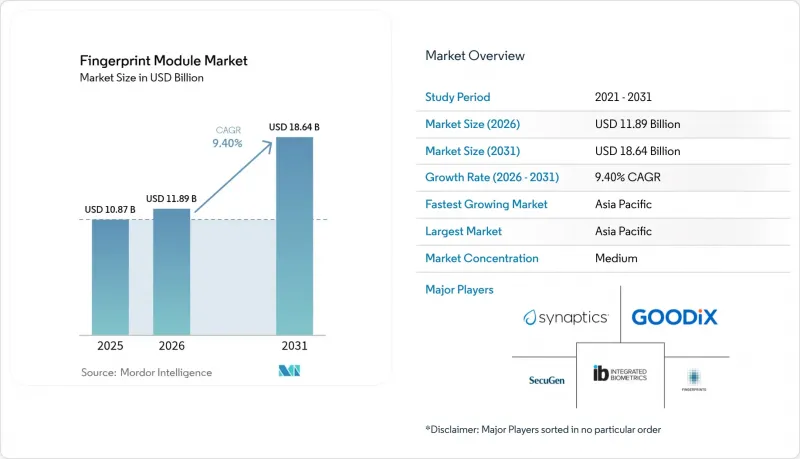
據 Mordor Intelligence 稱,2025 年指紋認證模組市值為 108.7 億美元,預計到 2031 年將達到 186.4 億美元,而 2026 年為 118.9 億美元,預測期(2026-2031 年)的複合年成長率為 9.40%。
本報告按技術(光學、電容式、超音波等)、感測器類型(區域/觸控、滑動等)、外形規格(獨立模組、系統晶片(SoC) 整合等)、終端用戶產業(政府和執法機關、家用電子電器等)、應用(身分和存取管理等)以及地區進行細分。市場預測以美元 (USD) 為單位。
全球指紋認證模組市場趨勢及洞察
政府主導的生物識別識別大型企劃正在迅速增加。
大規模國家識別項目正在重新定義市場需求。埃塞俄比亞的「法伊達」(Fayda)計畫獲得了3.5億美元的多邊資金支持,目標是在2030年前為9,000萬人進行身分識別。奈及利亞耗資4.3億美元的數位身分計畫旨在為超過2億公民實現全民覆蓋。這些合約明確規定使用耐用、長壽命的模組,並透過多年的持續更新需求來創造收入。其規模遠遠超過消費性電子設備的生命週期,從而確保了供應商可預測的需求,並穩定了整個指紋模組市場的工廠運轉率。
智慧型手機在設備內認證方面的爆炸性成長
目前,指紋生物識別已成為旗艦和中階行動電話的標配功能。屏下指紋辨識模組實現了全面屏設計,而超音波單元則透過讀取皮膚下的指紋紋路來增強安全性。北美和中國的安卓設備製造商正在採用雙感應區來提升解鎖速度,並增加每個設備的感應區數量。這一趨勢正在擴大目標市場規模,同時也對供應商提出了更嚴格的厚度和功耗限制。
資料隱私和資料外洩訴訟風險
根據伊利諾伊州《生物識別資訊隱私法案》(BIPA)等法規提起的集體訴訟,由於指紋採集不當,已導致數百萬美元的和解金,並增加了企業的合規成本。企業客戶現在要求在設備上儲存範本並採用可撤銷的授權流程,這延長了設計引進週期和監管諮詢時間。指紋模組解決方案供應商需要增加加密、安全元件隔離和第三方稽核等功能,這推高了材料清單(BOM) 和身分驗證成本。
細分市場分析
超音波辨識器在2025年仍佔市場佔有率的一小部分,但成長迅速,預計到2031年將以10.05%的複合年成長率成長,超過所有其他類別。電容式指紋辨識器仍佔據出貨量的大部分,預計到2025年將佔指紋模組市場佔有率的57.30%。電容式感測器指紋認證模組的市場規模擴大主要得益於低價安卓手機的興起,而超音波技術的普及則與價格更高的智慧型手機和金融級穿戴裝置密切相關。
開發者高度重視超音波技術,因為它能夠清晰地捕捉汗孔和皮下毛細血管結構,從而避免薄膜螢幕保護膜和局部污漬的影響。高通第三代「3D Sonic」封裝將Z軸堆疊高度控制在200微米以下,使OEM廠商能夠實現全面屏玻璃設計。現有電容式感測器製造商不斷提升空間解析度,並將待機功耗降低至5µA以下,進而在量產智慧型手機和消費性物聯網產品中維持市場佔有率。同時,光學模組正被應用於中階設備,透過重複利用顯示引擎的背光,可以降低成本。
面積/觸控模組憑藉其在消費性電子設備和企業門鎖領域久經考驗的可靠性,預計到2025年將佔據60.40%的市場佔有率。然而,屏下感測器預計將以11.1%的年均成長率成長至2031年,這反映了行動電話製造商向無縫OLED面板的競爭。與屏下設計相關的指紋認證模組的市場規模將受益於較高的平均售價(ASP),從而抵消裝置端密度下降的影響。
滑動式感測器仍應用於窄邊框的POS終端和堅固耐用的手持終端機。在筆記型電腦廠商中,結合觸控和壓力感應的混合封裝正日益普及,這種封裝可以將感測器整合到掌託中,而無需增加機殼。這些感測器類型表明,指紋模組產業正在向「隱形生物識別」轉型,這與工業設計的目標相契合。
區域分析
亞太地區擁有全球最大的生產基地和部署計劃,預計到2025年將佔據40.60%的市場佔有率,並在2031年之前以9.55%的複合年成長率成長。中國行動電話OEM生態系統每月消耗數千萬個感測器,而印度國內私部門的需求也因「數位之旅」(Digi Yatra)的推廣和機場電子閘門的競標而不斷成長。東協致力於建立可互通的數位公共基礎設施,這推動了標準化進程,使供應商能夠在多個司法管轄區交付具有通用模組尺寸的產品。
在北美,一個成熟且盈利豐厚的市場正在崛起。由於行動電話更換週期、穿戴式裝置升級和企業安全維修,出貨量保持穩定,但嚴格的隱私法規推高了平均售價 (ASP),因為買家更傾向於將範本儲存在自己的裝置上。指紋模組市場持續受益於美國汽車生物識別技術的發展。北卡羅來納州一家石英礦停產後,晶圓生產受到威脅,奢侈品牌正在將採購本地化以規避供應鏈風險。
在歐洲,由於各國紛紛推出符合GDPR要求的電子識別計畫以及銀行主導的生物識別卡的發行,市場正在不斷擴張。在中東和非洲,潛在需求正透過國家身分識別計畫逐步轉化為現實,例如喀麥隆根據一項為期15年的特許經營協議,計畫於2025年推出生物識別卡。在南美洲,由於智慧型手機在中產階級的普及以及各國政府對社會福利支付平台的現代化改造,市場呈現穩定成長的態勢,但宏觀經濟波動正在延長採購週期。
其他好處:
- Excel格式的市場預測(ME)表
- 3個月的分析師支持
目錄
第1章:引言
- 調查結果
- 研究的先決條件
- 調查範圍
第2章:調查方法
第3章執行摘要
第4章 市場狀況
- 市場概覽
- 市場促進因素
- 政府大規模生物識別身分計畫正在迅速增加。
- 智慧型手機在設備內認證方面的爆炸性成長
- 電容式和光模組平均售價(ASP)的下降導致其應用日益廣泛。
- 汽車和智慧型槍支製造商正在採用基於指紋的啟動/觸發模組。
- 生物識別支付卡已達到大規模發行階段。
- 市場限制因素
- 與資料隱私和資料外洩相關的訴訟風險
- 後疫情時代觸摸感應器的衛生耐受性
- MEMS 供應短缺/ IC封裝產能限制了供應彈性。
- 價值供應鏈分析
- 監理情勢
- 技術展望
- 波特五力模型
第5章 市場規模與成長預測
- 透過技術
- 光學
- 電容式
- 超音波
- 熱
- 頻譜
- 依感測器類型
- 區域/觸摸
- 滑動
- 顯示螢幕
- 混合/組合
- 按外形規格
- 獨立模組
- 系統晶片(SoC) 整合
- 嵌入式ASIC/板級
- 按最終用戶行業分類
- 政府和執法機關
- 家用電子產品
- BFSI
- 衛生保健
- 航空
- 車
- 智慧家庭和物聯網
- 其他行業
- 透過使用
- 身分和存取管理
- 支付和交易認證
- 考勤管理
- 邊境管制和移民管制
- 解鎖您的裝置
- 按地區
- 北美洲
- 美國
- 加拿大
- 墨西哥
- 南美洲
- 巴西
- 阿根廷
- 其他南美國家
- 歐洲
- 德國
- 英國
- 法國
- 義大利
- 西班牙
- 俄羅斯
- 其他歐洲國家
- 亞太地區
- 中國
- 日本
- 韓國
- 印度
- 澳洲和紐西蘭
- ASEAN-5
- 其他亞太國家
- 中東和非洲
- 中東
- UAE
- 沙烏地阿拉伯
- 土耳其
- 其他中東國家
- 非洲
- 南非
- 奈及利亞
- 肯亞
- 其他非洲國家
- 中東
- 北美洲
第6章 競爭情勢
- 市場集中度
- 策略趨勢
- 市佔率分析
- 公司簡介
- Fingerprint Cards AB
- GOODIX Technology Inc.
- Synaptics Incorporated
- Integrated Biometrics LLC
- SecuGen Corporation
- HID Global Corporation
- Qualcomm Technologies Inc.
- Suprema Inc.
- Apple Inc.
- NITGEN Co., Ltd.
- NEC Corporation
- NEXT Biometrics ASA
- Anviz Global
- IDEMIA France SAS
- Thales Group
- Egis Technology Inc.
- IDEX Biometrics ASA
- Infineon Technologies AG
- Samsung Electronics Co., Ltd.
- ZKTeco Co., Ltd.
- Precise Biometrics AB
- Shenzhen SYNOCHEM Microelectronics
第7章 市場機會與未來展望
According to Mordor Intelligence, the fingerprint module market size was valued at USD 10.87 billion in 2025 and estimated to grow from USD 11.89 billion in 2026 to reach USD 18.64 billion by 2031, at a CAGR of 9.40% during the forecast period (2026-2031).
This report is Segmented by Technology (Optical, Capacitive, Ultrasonic, and More), Sensor Type (Area/Touch, Swipe, and More), Form Factor (Stand-Alone Module, System-On-Chip Integrated, and More), End-User Industry (Government and Law Enforcement, Consumer Electronics, and More), Application (Identity and Access Management, and More), and by Geography. The Market Forecasts are Provided in Terms of Value (USD).
Global Fingerprint Module Market Trends and Insights
Government Biometric ID Megaprojects Surge
Large-scale national identity programs are rewriting baseline demand. Ethiopia's Fayda scheme targets 90 million registrations by 2030, backed by USD 350 million in multilateral funding.Nigeria's USD 430 million digital ID project pursues universal coverage for more than 200 million citizens. Such contracts specify robust, long-life modules and create multi-year replenishment revenue. The volume sheerly outstrips consumer-device cycles, ensuring predictable pull for suppliers and stabilizing factory utilization across the fingerprint module market.
Explosive Smartphone Integration for On-Device Authentication
Flagship and mid-tier handsets now treat fingerprint biometrics as baseline functionality. Under-display modules permit full-screen designs, while ultrasonic units lift security by imaging sub-epidermal ridges. Android handset makers in North America and China have embedded dual sensing zones to quicken unlock speed, raising average content per device. This trend expands addressable volume and pressures suppliers to meet tighter thickness and power-budget envelopes.
Data-Privacy & Breach Litigation Risk
Class actions under statutes such as Illinois' BIPA have generated multimillion-dollar settlements for improper fingerprint capture, raising compliance overheads for enterprises. Corporate buyers now demand on-device template storage and revocable consent flows, extending design-in cycles and regulatory consultations. Vendors marketing the fingerprint module market solutions must add encryption, secure-element isolation, and third-party audits, which inflate the bill-of-materials and certification costs.
Other drivers and restraints analyzed in the detailed report include:
- Falling ASP of Capacitive & Optical Modules Broadens Adoption
- Biometric Payment Cards Reach Mass-Issuance Stage
- Hygiene Backlash on Touch Sensors in Post-Pandemic Settings
For complete list of drivers and restraints, kindly check the Table Of Contents.
Segment Analysis
Ultrasonic units contributed a minor yet fast-advancing slice of 2025 revenue and should expand at 10.05% CAGR to 2031, outpacing all other categories. Capacitive solutions still delivered the bulk of shipments, anchoring 57.30% fingerprint module market share in 2025. The fingerprint module market size for capacitive sensors rose on the back of low-cost Android models, whereas ultrasonic adoption correlated with premium ASP smartphones and finance-grade wearables.
Developers prize ultrasonic technology for its capacity to image sweat pores and sub-dermal capillary structures, defeating thin-film screen protectors and partial contaminants. Qualcomm's third-generation 3D Sonic packages achieve sub-200-micron Z-stack height, freeing OEMs to pursue edge-to-edge glass builds. Capacitive incumbents continue to raise spatial resolution and cut idle power below 5 µA, preserving relevance in mass-market phones and consumer IoT. Optical modules, meanwhile, land in mid-tier devices where backlighting can be reused from display engines to trim costs.
Area/touch modules accounted for 60.40% of 2025 due to proven reliability across consumer devices and enterprise door locks. Nonetheless, in-display sensors are forecast to climb 11.1% annually to 2031, reflecting handset makers' race for uninterrupted OLED panels. The fingerprint module market size linked to in-display designs will benefit from premium ASPs, offsetting lower density per handset.
Swipe sensors linger in point-of-sale terminals and rugged handhelds where narrow bezels remain. Hybrid touch-plus-pressure packages are gaining brand traction among notebook PC vendors, enabling palm-rest integration without enlarging the chassis. The sensor-type mix underlines the fingerprint module industry shift toward invisible biometrics that harmonize with industrial design goals.
Complete Report Scope:
- By Technology
- Optical
- Capacitive
- Ultrasonic
- Thermal
- Multispectral
- By Sensor Type
- Area/Touch
- Swipe
- In-display
- Hybrid/Combo
- By Form Factor
- Stand-alone Module
- System-on-Chip (SoC) Integrated
- Embedded ASIC/Board-level
- By End-user Industry
- Government and Law Enforcement
- Consumer Electronics
- BFSI
- Healthcare
- Aviation
- Automotive
- Smart Home and IoT
- Other Industrial
- By Application
- Identity and Access Management
- Payment and Transaction Authentication
- Time and Attendance
- Border Control and Immigration
- Device Unlocking
- By Geography
- North America
- United States
- Canada
- Mexico
- South America
- Brazil
- Argentina
- Rest of South America
- Europe
- Germany
- United Kingdom
- France
- Italy
- Spain
- Russia
- Rest of Europe
- APAC
- China
- Japan
- South Korea
- India
- Australia and New Zealand
- ASEAN-5
- Rest of APAC
- Middle East and Africa
- Middle East
- UAE
- Saudi Arabia
- Turkey
- Rest of Middle East
- Africa
- South Africa
- Nigeria
- Kenya
- Rest of Africa
- Middle East
- North America
Geography Analysis
Asia-Pacific combined the world's biggest production basin with the largest deployment programs, holding 40.60% market share in 2025 and tracking a 9.55% CAGR to 2031. China's handset OEM ecosystem absorbs tens of millions of sensors monthly, while India's Digi Yatra expansion and airport e-gate tenders elevate domestic civil demand. ASEAN's commitment to interoperable digital public infrastructure harmonizes standards, letting suppliers ship common module footprints across multiple jurisdictions.
North America shows mature yet lucrative conditions: handset replacement cycles, wearables upgrades, and enterprise security retrofits keep volumes stable, whereas stringent privacy legislation prompts buyers to favor on-device template storage, lifting ASPs. The fingerprint module market continues to profit from U.S. automotive biometrics, where luxury brands localize sourcing to hedge supply-chain risk after North Carolina quartz mine disruptions threatened wafer output.
Europe advances on the back of GDPR-aligned national e-ID plans and bank-driven biometric card launches. Middle East & Africa's latent demand crystallizes in national ID projects such as Cameroon's 2025 biometric card roll-out under a 15-year concession. South America provides incremental gains as smartphones penetrate mid-income cohorts and governments modernize social-benefits disbursement platforms, though macro volatility elongates procurement cycles.
- Fingerprint Cards AB
- GOODIX Technology Inc.
- Synaptics Incorporated
- Integrated Biometrics LLC
- SecuGen Corporation
- HID Global Corporation
- Qualcomm Technologies Inc.
- Suprema Inc.
- Apple Inc.
- NITGEN Co., Ltd.
- NEC Corporation
- NEXT Biometrics ASA
- Anviz Global
- IDEMIA France SAS
- Thales Group
- Egis Technology Inc.
- IDEX Biometrics ASA
- Infineon Technologies AG
- Samsung Electronics Co., Ltd.
- ZKTeco Co., Ltd.
- Precise Biometrics AB
- Shenzhen SYNOCHEM Microelectronics
Additional Benefits:
- The market estimate (ME) sheet in Excel format
- 3 months of analyst support
TABLE OF CONTENTS
1 INTRODUCTION
- 1.1 Study Deliverables
- 1.2 Study Assumptions
- 1.3 Scope of the Study
2 RESEARCH METHODOLOGY
3 EXECUTIVE SUMMARY
4 MARKET LANDSCAPE
- 4.1 Market Overview
- 4.2 Market Drivers
- 4.2.1 Government biometric ID megaprojects surge
- 4.2.2 Explosive smartphone integration for on-device authentication
- 4.2.3 Falling ASP of capacitive and optical modules broadens adoption
- 4.2.4 Automotive and smart-gun makers embed fingerprint start/trigger modules
- 4.2.5 Biometric payment cards reach mass-issuance stage
- 4.3 Market Restraints
- 4.3.1 Data-privacy and breach litigation risk
- 4.3.2 Hygiene backlash on touch sensors in post-pandemic settings
- 4.3.3 Tight MEMS / IC packaging capacity limits supply elasticity
- 4.4 Value / Supply-Chain Analysis
- 4.5 Regulatory Landscape
- 4.6 Technological Outlook
- 4.7 Porter's Five Forces
- 4.7.1 Threat of New Entrants
- 4.7.2 Bargaining Power of Buyers/Consumers
- 4.7.3 Bargaining Power of Suppliers
- 4.7.4 Threat of Substitute Products
- 4.7.5 Intensity of Competitive Rivalry
5 MARKET SIZE AND GROWTH FORECASTS (VALUE)
- 5.1 By Technology
- 5.1.1 Optical
- 5.1.2 Capacitive
- 5.1.3 Ultrasonic
- 5.1.4 Thermal
- 5.1.5 Multispectral
- 5.2 By Sensor Type
- 5.2.1 Area/Touch
- 5.2.2 Swipe
- 5.2.3 In-display
- 5.2.4 Hybrid/Combo
- 5.3 By Form Factor
- 5.3.1 Stand-alone Module
- 5.3.2 System-on-Chip (SoC) Integrated
- 5.3.3 Embedded ASIC/Board-level
- 5.4 By End-user Industry
- 5.4.1 Government and Law Enforcement
- 5.4.2 Consumer Electronics
- 5.4.3 BFSI
- 5.4.4 Healthcare
- 5.4.5 Aviation
- 5.4.6 Automotive
- 5.4.7 Smart Home and IoT
- 5.4.8 Other Industrial
- 5.5 By Application
- 5.5.1 Identity and Access Management
- 5.5.2 Payment and Transaction Authentication
- 5.5.3 Time and Attendance
- 5.5.4 Border Control and Immigration
- 5.5.5 Device Unlocking
- 5.6 By Geography
- 5.6.1 North America
- 5.6.1.1 United States
- 5.6.1.2 Canada
- 5.6.1.3 Mexico
- 5.6.2 South America
- 5.6.2.1 Brazil
- 5.6.2.2 Argentina
- 5.6.2.3 Rest of South America
- 5.6.3 Europe
- 5.6.3.1 Germany
- 5.6.3.2 United Kingdom
- 5.6.3.3 France
- 5.6.3.4 Italy
- 5.6.3.5 Spain
- 5.6.3.6 Russia
- 5.6.3.7 Rest of Europe
- 5.6.4 APAC
- 5.6.4.1 China
- 5.6.4.2 Japan
- 5.6.4.3 South Korea
- 5.6.4.4 India
- 5.6.4.5 Australia and New Zealand
- 5.6.4.6 ASEAN-5
- 5.6.4.7 Rest of APAC
- 5.6.5 Middle East and Africa
- 5.6.5.1 Middle East
- 5.6.5.1.1 UAE
- 5.6.5.1.2 Saudi Arabia
- 5.6.5.1.3 Turkey
- 5.6.5.1.4 Rest of Middle East
- 5.6.5.2 Africa
- 5.6.5.2.1 South Africa
- 5.6.5.2.2 Nigeria
- 5.6.5.2.3 Kenya
- 5.6.5.2.4 Rest of Africa
- 5.6.5.1 Middle East
- 5.6.1 North America
6 COMPETITIVE LANDSCAPE
- 6.1 Market Concentration
- 6.2 Strategic Moves
- 6.3 Market Share Analysis
- 6.4 Company Profiles (includes Global level Overview, Market level overview, Core Segments, Financials as available, Strategic Information, Market Rank/Share for key companies, Products and Services, and Recent Developments)
- 6.4.1 Fingerprint Cards AB
- 6.4.2 GOODIX Technology Inc.
- 6.4.3 Synaptics Incorporated
- 6.4.4 Integrated Biometrics LLC
- 6.4.5 SecuGen Corporation
- 6.4.6 HID Global Corporation
- 6.4.7 Qualcomm Technologies Inc.
- 6.4.8 Suprema Inc.
- 6.4.9 Apple Inc.
- 6.4.10 NITGEN Co., Ltd.
- 6.4.11 NEC Corporation
- 6.4.12 NEXT Biometrics ASA
- 6.4.13 Anviz Global
- 6.4.14 IDEMIA France SAS
- 6.4.15 Thales Group
- 6.4.16 Egis Technology Inc.
- 6.4.17 IDEX Biometrics ASA
- 6.4.18 Infineon Technologies AG
- 6.4.19 Samsung Electronics Co., Ltd.
- 6.4.20 ZKTeco Co., Ltd.
- 6.4.21 Precise Biometrics AB
- 6.4.22 Shenzhen SYNOCHEM Microelectronics
7 MARKET OPPORTUNITIES AND FUTURE OUTLOOK
- 7.1 White-space and Unmet-Need Assessment

 指紋掃描器市場規模、佔有率和成長分析:按產品類型、外形規格尺寸、應用、最終用戶和地區分類-2026-2033年產業預測
 指紋生物識別市場:依技術、外形規格、部署方式、應用和最終用戶分類-2026-2032年全球市場預測嵌入式網路實體隔離主機市場(按組件、部署類型、最終用戶和安全等級分類),全球預測(2026-2032 年)
 指紋辨識模組市場規模、佔有率和成長分析(按模組類型、外形規格、最終用戶產業、應用、分銷管道和地區分類)-2026-2033年產業預測
 指紋生物識別市場-全球產業規模、佔有率、趨勢、機會、預測:按類型、產品、最終用戶、地區和競爭對手分類,2021-2031年顯示器指紋晶片市場(按技術、應用和終端用戶產業分類)-2025 年至 2030 年全球預測