


 |
市場調查報告書
商品編碼
2122616
欺騙技術:市場佔有率分析、產業趨勢與統計、成長預測(2026-2031)Deception Technology - Market Share Analysis, Industry Trends & Statistics, Growth Forecasts (2026 - 2031) |
||||||

※ 本網頁內容可能與最新版本有所差異。詳細情況請與我們聯繫。
據 Mordor Intelligence 稱,2025 年欺騙技術市場價值 24.1 億美元,預計到 2031 年將從 2026 年的 27.3 億美元成長到 50.4 億美元,預測期(2026-2031 年)的複合年成長率為 13.08%。
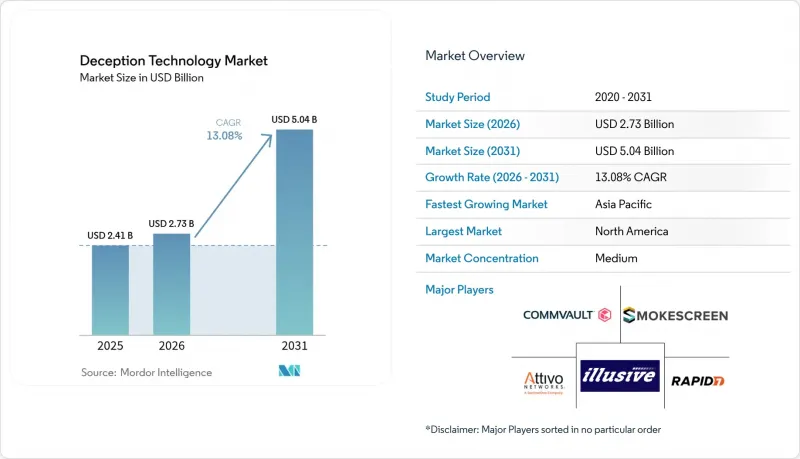
本報告按部署類型(本地部署和雲端部署)、組織規模(大型企業和中小企業)、服務(託管服務和專業服務)、欺騙堆疊(資料安全、應用程式安全等)、最終用戶(政府、國防、銀行、金融服務和保險、IT 和電信等)以及地區進行分類。
全球欺騙技術市場趨勢與洞察
零時差攻擊和定向高級持續性威脅(APT)正在增加。
國家支持的組織正在利用人工智慧實現自動化偵察,以遠超基於特徵碼的防禦機制適應速度發現新的漏洞。安全與技術研究所指出,自動化偵察正在縮短攻擊者的延遲,迫使防禦者修改其被動應對策略。欺騙平台部署可信賴的誘餌資產,利用攻擊者的好奇心。警報會在偵測到威脅後的幾秒鐘內觸發,但不會影響生產系統。由於偵測基於攻擊者的行為而非威脅情報,欺騙科技市場能夠有效抵禦規避哈希匹配控制的客製化惡意軟體。供應商現在正在為工業控制系統和SaaS API打包誘餌,這反映出攻擊者的目標已轉向營運技術(OT)。
雲端原生工作負載的激增正在擴大攻擊面。
由於容器化和無伺服器應用程式可以在幾分鐘內啟動和停止,安全營運中心很容易失去對東西向流量的追蹤。 Zscaler 部署了生成式 AI 誘餌,模擬大規模語言模型端點,將攻擊者引誘到受監控的沙箱中。這些誘餌在 Kubernetes 命名空間內自動擴展,即使底層微服務發生變化,也能確保持續覆蓋。這種欺騙技術市場利用雲端提供者的元資料API 在虛擬私有雲端中設置陷阱,而無需安裝代理程式。隨著企業採用多重雲端策略,編配跨提供者的誘餌技術正成為一項採購標準,尤其是在受監管的行業中,集中式日誌記錄在單一區域是不可行的。
對傳統誘餌系統的持續依賴
許多公司仍在運行多年前部署的靜態誘餌系統。攻擊者現在可以根據協定特性和運作模式輕鬆識別並繞過這些資產。這種「成本沉沒偏差」阻礙了向自適應誘餌的升級,而自適應誘餌可以更改操作系統橫幅或自動輪換憑證。此外,傳統誘餌系統需要手動分析日誌,消耗了本應集中用於實際攻擊途徑的資源。由於這些工具產生的有效警報很少,董事會質疑其投資回報率,導致新投資有限,並減緩了欺騙技術市場的成長。
細分市場分析
到2025年,本地部署將佔欺騙技術市場67.12%的佔有率,這表明企業需要從合規性和取證管理的角度出發,在關鍵核心系統附近部署高度互動的誘餌系統。然而,管理這些誘餌系統需要硬體更新周期和變更管理開銷,這限制了其靈活性。雲端部署目前市佔率較小,但預計到2031年將以14.84%的複合年成長率成長,成為欺騙技術市場中成長最快的領域。基於雲端的主機可以在幾分鐘內跨區域啟動誘餌系統,對於全球分支機構部署而言,這是一個極具吸引力的選擇。
混合模式正逐漸成為一種切實可行的橋樑,它允許團隊在本地部署敏感資料庫誘餌,同時將分析和擴展任務卸載到公共雲端。隨著多重雲端採用率的提高,買家要求在 AWS、Azure 和 Google Cloud 之間取得統一的視圖,而服務供應商則被迫投資於身分識別聯合和不可變基礎架構藍圖。這些功能正在擴大雲端模組欺騙技術的市場規模,並使受嚴格監管的產業相信,責任分擔模型也能滿足審計管理要求。
預計到2025年,大型企業仍將佔據69.55%的收入佔有率,它們將繼續透過大力推進API深度、MITRE ATT&CK®相容性和高級分析功能來製定其功能藍圖。同時,中小企業(SME)目前正以14.41%的速度成長,在欺騙科技市場的擴張速度超過了大型企業。按資產計費的收費託管欺騙服務降低了准入門檻,並可根據小規模團隊的能力提供客製化的警報。
雲端主機無需採購硬體,從而節省了協同效應帶來的成本節約,使中小企業能夠將資金重新投入意識提升計劃中。對於供應商而言,這一細分市場的可擴展性極具吸引力。數千家中型企業客戶的潛在授權收入相當於數家財富 500 強企業。因此,低程式碼劇本和自動化誘餌部署已成為產品藍圖上的優先事項。這些功能旨在將部署時間從數週縮短至數小時,從而擴大中小企業欺騙技術市場的規模。
區域分析
預計到2025年,北美將佔全球收入的41.35%。這主要得益於嚴格的監管,例如美國網路安全和基礎設施安全局 (CISA) 的事件報告指令,以及財富100強企業總部集中於此,這些企業有能力投資於專業的安全措施。聯邦政府合約中擴大納入欺騙技術,進一步鞏固了該地區在欺騙技術市場的主導地位。
在歐洲,隨著NIS2指令擴大了主動威脅偵測程序維護要求的範圍,相關工作正穩步推進。本地供應商強調資料主權,並確保日誌保留在歐盟境內。新興的歐盟雲端服務供應商提供符合合規要求的軟體包,這些軟體包原生整合了欺騙功能,並吸引了中型製造商的注意。
亞太地區仍是成長最快的地區,複合年成長率達13.44%。日本、印度和新加坡政府已啟動津貼計劃,共同資助包含欺騙技術的零信任試點計畫。電信業者部署5G獨立核心網路擴大了攻擊面,迫使營運商部署信令協定誘餌來偵測詐欺性基地台註冊行為。這些舉措共同推動了該地區欺騙技術市場規模的擴大。同時,在拉丁美洲、中東和非洲,欺騙技術正逐步融入關鍵基礎設施的現代化改造,但短期部署受到預算限制和缺乏熟練人員的阻礙。
其他好處:
- Excel格式的市場預測(ME)表
- 3個月的分析師支持
目錄
第1章:引言
- 研究假設和市場定義
- 調查範圍
第2章:調查方法
第3章執行摘要
第4章 市場狀況
- 市場概覽
- 市場促進因素
- 零時差攻擊和定向高級持續性威脅(APT)正在增加。
- 隨著雲端原生工作負載的增加,攻擊面也不斷擴大。
- 首席資訊安全長 (CISO) 通常喜歡操作簡單且無需代理的檢測工具。
- 人工智慧驅動的深度造假攻擊的興起。
- 零信任微隔離與欺騙的融合
- 網路保險合約要求主動偵測橫向移動。
- 市場限制因素
- 對傳統誘餌系統的根深蒂固的依賴
- 缺乏精通欺騙技巧的保全人員
- 一種敵方利用大規模語言模型的偵察能力來尋找誘餌的方法。
- 捆綁式EDR/XDR平台造成的預算蠶食
- 價值鏈分析
- 監理情勢
- 技術展望
- 波特五力分析
- 投資分析
- 評估宏觀經濟趨勢對市場的影響
第5章 市場規模與成長預測
- 不同的發展
- 現場
- 雲
- 按組織規模
- 大公司
- 中小企業
- 按服務
- 託管服務
- 專業服務
- 堆疊欺騙
- 資料安全
- 應用程式安全
- 端點安全
- 網路安全
- 最終用戶
- 政府
- 防禦
- BFSI
- 資訊科技/通訊
- 衛生保健
- 其他最終用戶
- 按地區
- 北美洲
- 美國
- 加拿大
- 墨西哥
- 歐洲
- 德國
- 英國
- 法國
- 義大利
- 西班牙
- 俄羅斯
- 其他歐洲國家
- 亞太地區
- 中國
- 日本
- 印度
- 韓國
- 澳洲和紐西蘭
- 其他亞太國家
- 南美洲
- 巴西
- 阿根廷
- 其他南美國家
- 中東和非洲
- 中東
- 沙烏地阿拉伯
- 阿拉伯聯合大公國
- 土耳其
- 其他中東國家
- 非洲
- 南非
- 奈及利亞
- 其他非洲國家
- 中東
- 北美洲
第6章 競爭情勢
- 市場集中度
- 策略趨勢
- 市佔率分析
- 公司簡介
- Illusive Networks
- Attivo Networks(SentinelOne)
- Rapid7
- Acalvio Technologies
- CounterCraft
- CyberTrap
- TrapX Security
- Smokescreen Technologies
- Ridgeback Network Defense
- LogRhythm
- WatchGuard Technologies
- Broadcom(Symantec)
- Morphisec
- Fortinet(FortiDeceptor)
- Zscaler
- Microsoft(Security Honeytokens)
- Akamai
- Palo Alto Networks
- Fidelis Cybersecurity
- Commvault(TrapX integration)
第7章 市場機會與未來展望
According to Mordor Intelligence, the deception technology market size was valued at USD 2.41 billion in 2025 and estimated to grow from USD 2.73 billion in 2026 to reach USD 5.04 billion by 2031, at a CAGR of 13.08% during the forecast period (2026-2031).
This report is Segmented by Deployment (On-Premises and Cloud), Organization Size (Large Enterprises and Small and Medium Enterprises (SMEs)), Service (Managed Services and Professional Services), Deception Stack (Data Security, Application Security, and More), End-User (Government, Defense, BFSI, IT and Telecommunication, and More), and Geography.
Global Deception Technology Market Trends and Insights
Surge in Zero-Day Exploits and Targeted APTs
State-sponsored collectives automate reconnaissance with AI, finding novel vulnerabilities faster than signature-based defenses adapt. The Institute for Security and Technology notes that automated reconnaissance compresses attacker dwell time, forcing defenders to rethink reactive playbooks. Deception platforms insert believable but fake assets that weaponize curiosity; once probed, alerts trigger in seconds while production systems stay untouched. Because detection is based on attacker behavior rather than threat-intelligence feeds, the deception technology market provides resilience against bespoke malware that evades hash-matching controls. Vendors now pre-package decoys for industrial control systems and SaaS APIs, reflecting attacker pivot toward operational technology.
Escalating Cloud-Native Workloads Broaden Attack Surface
Containerized and serverless applications can spin up and down within minutes, leaving security operations centers blind to east-west traffic. Zscaler deploys generative-AI decoys that mimic large-language-model endpoints, luring attackers into instrumented sandboxes. Because decoys scale automatically inside Kubernetes namespaces, defenders gain continuous coverage even as underlying microservices change. The deception technology market capitalizes on cloud providers' metadata APIs to place traps inside virtual private clouds without installing agents. As organizations adopt multi-cloud strategies, cross-provider decoy orchestration becomes a buying criterion, especially in regulated industries that cannot centralize logs in a single region.
Entrenched Reliance on Legacy Honeypots
Many firms still run static honeypots deployed years ago. Attackers now fingerprint such assets through protocol quirks or uptime patterns, bypassing them with ease. This sunk-cost bias delays upgrades to adaptive decoys able to morph operating-system banners or rotate credentials automatically. Legacy honeypots also demand manual log parsing, consuming resources that should focus on real attack paths. Because these tools produce few actionable alerts, boards question ROI, thereby constraining new investment and dampening growth of the deception technology market.
Other drivers and restraints analyzed in the detailed report include:
- CISO Preference for Low-Friction, Agent-Less Detection Tools
- Rise of AI-Generated Deepfake Identity Attacks
- Scarcity of Deception-Skilled SecOps Staff
For complete list of drivers and restraints, kindly check the Table Of Contents.
Segment Analysis
On-premises deployment commanded 67.12% of deception technology market share in 2025, illustrating enterprises' need to keep high-interaction decoys close to crown-jewel systems for compliance and forensic control. That control, however, brings hardware refresh cycles and change-management overhead that limit agility. Cloud deployment contributes a modest slice today but is slated to rise at a 14.84% CAGR through 2031, the fastest pace within the deception technology market. Cloud-based consoles spin up decoys across regions within minutes, making them attractive for global branch rollouts.
Hybrid models emerge as a pragmatic bridge, letting teams place sensitive database decoys on-premises while offloading analysis and scaling tasks to public clouds. As multicloud adoption rises, buyers demand single-pane views across AWS, Azure, and Google Cloud, pushing providers to invest in identity federation and immutable infrastructure blueprints. These capabilities enhance the deception technology market size for cloud modules and convince regulation-bound sectors that shared-responsibility models can still satisfy audit controls.
Large enterprises retained 69.55% revenue share in 2025 and continue shaping feature roadmaps by insisting on API depth, MITRE ATT&CK alignment, and advanced analytics. Yet SMEs now register a 14.41% growth trajectory, outpacing big-company spending within the deception technology market. Subscription-based managed deception services, billed per asset, cut entry barriers and deliver curated alerts that fit smaller teams' bandwidth.
Savings compound because cloud consoles eliminate hardware purchase, allowing SMEs to reallocate capital toward employee awareness programs. For vendors, the segment's scale effect is compelling; thousands of mid-sized customers can equal the license revenue of a handful of Fortune 500 accounts. Consequently, roadmap priorities now include low-code playbooks and automated decoy placement, features designed to compress onboarding from weeks to hours and thereby expand deception technology market size among smaller firms.
Complete Report Scope:
- By Deployment
- On-premises
- Cloud
- By Organization Size
- Large Enterprises
- Small and Medium Enterprises (SMEs)
- By Service
- Managed Services
- Professional Services
- By Deception Stack
- Data Security
- Application Security
- Endpoint Security
- Network Security
- By End-User
- Government
- Defense
- BFSI
- IT and Telecommunication
- Healthcare
- Other End-Users
- By Geography
- North America
- United States
- Canada
- Mexico
- Europe
- Germany
- United Kingdom
- France
- Italy
- Spain
- Russia
- Rest of Europe
- Asia-Pacific
- China
- Japan
- India
- South Korea
- Australia and New Zealand
- Rest of Asia-Pacific
- South America
- Brazil
- Argentina
- Rest of South America
- Middle East and Africa
- Middle East
- Saudi Arabia
- United Arab Emirates
- Turkey
- Rest of Middle East
- Africa
- South Africa
- Nigeria
- Rest of Africa
- Middle East
- North America
Geography Analysis
North America generated 41.35% of revenue in 2025, buoyed by stringent mandates such as CISA's directive on incident reporting and a concentration of Fortune 100 headquarters that can fund specialized controls. Federal contracts increasingly specify deception capabilities, further cementing the region's leadership within the deception technology market.
Europe advances steadily as the NIS2 Directive broadens the scope of entities required to maintain proactive threat-detection programs Local vendors stress data-sovereignty features, ensuring logs stay inside EU borders. Emerging EU cloud providers now embed deception natively, offering compliance-ready bundles that appeal to mid-market industrial manufacturers.
Asia-Pacific remains the fastest-growing territory at 13.44% CAGR. Governments in Japan, India, and Singapore launch grant programs that co-fund zero-trust pilots incorporating deception. Telecom rollouts of 5G standalone cores enlarge attack surfaces, pushing operators to install signaling-protocol decoys that detect rogue base-station registration attempts. These initiatives collectively enlarge deception technology market size in the region. Meanwhile, Latin America and Middle East and Africa start integrating deception into critical-infrastructure revamps, although budget constraints and talent gaps temper near-term uptake.
- Illusive Networks
- Attivo Networks (SentinelOne)
- Rapid7
- Acalvio Technologies
- CounterCraft
- CyberTrap
- TrapX Security
- Smokescreen Technologies
- Ridgeback Network Defense
- LogRhythm
- WatchGuard Technologies
- Broadcom (Symantec)
- Morphisec
- Fortinet (FortiDeceptor)
- Zscaler
- Microsoft (Security Honeytokens)
- Akamai
- Palo Alto Networks
- Fidelis Cybersecurity
- Commvault (TrapX integration)
Additional Benefits:
- The market estimate (ME) sheet in Excel format
- 3 months of analyst support
TABLE OF CONTENTS
1 INTRODUCTION
- 1.1 Study Assumptions and Market Definition
- 1.2 Scope of the Study
2 RESEARCH METHODOLOGY
3 EXECUTIVE SUMMARY
4 MARKET LANDSCAPE
- 4.1 Market Overview
- 4.2 Market Drivers
- 4.2.1 Surge in zero-day exploits and targeted APTs
- 4.2.2 Escalating cloud-native workloads broaden attack surface
- 4.2.3 CISO preference for low-friction, agent-less detection tools
- 4.2.4 Rise of AI-generated deepfake identity attacks
- 4.2.5 Convergence of deception with zero-trust micro-segmentation
- 4.2.6 Cyber-insurance policies demanding proactive lateral-movement detection
- 4.3 Market Restraints
- 4.3.1 Entrenched reliance on legacy honeypots
- 4.3.2 Scarcity of deception-skilled SecOps staff
- 4.3.3 Adversary use of large-language-model recon to spot decoys (under-the-radar)
- 4.3.4 Budget cannibalization by bundled EDR/XDR platforms
- 4.4 Value Chain Analysis
- 4.5 Regulatory Landscape
- 4.6 Technological Outlook
- 4.7 Porter's Five Forces Analysis
- 4.7.1 Threat of New Entrants
- 4.7.2 Bargaining Power of Suppliers
- 4.7.3 Bargaining Power of Buyers
- 4.7.4 Threat of Substitutes
- 4.7.5 Intensity of Competitive Rivalry
- 4.8 Investment Analysis
- 4.9 Assessment of the Impact of Macroeconomic Trends on the Market
5 MARKET SIZE AND GROWTH FORECASTS (VALUE)
- 5.1 By Deployment
- 5.1.1 On-premises
- 5.1.2 Cloud
- 5.2 By Organization Size
- 5.2.1 Large Enterprises
- 5.2.2 Small and Medium Enterprises (SMEs)
- 5.3 By Service
- 5.3.1 Managed Services
- 5.3.2 Professional Services
- 5.4 By Deception Stack
- 5.4.1 Data Security
- 5.4.2 Application Security
- 5.4.3 Endpoint Security
- 5.4.4 Network Security
- 5.5 By End-User
- 5.5.1 Government
- 5.5.2 Defense
- 5.5.3 BFSI
- 5.5.4 IT and Telecommunication
- 5.5.5 Healthcare
- 5.5.6 Other End-Users
- 5.6 By Geography
- 5.6.1 North America
- 5.6.1.1 United States
- 5.6.1.2 Canada
- 5.6.1.3 Mexico
- 5.6.2 Europe
- 5.6.2.1 Germany
- 5.6.2.2 United Kingdom
- 5.6.2.3 France
- 5.6.2.4 Italy
- 5.6.2.5 Spain
- 5.6.2.6 Russia
- 5.6.2.7 Rest of Europe
- 5.6.3 Asia-Pacific
- 5.6.3.1 China
- 5.6.3.2 Japan
- 5.6.3.3 India
- 5.6.3.4 South Korea
- 5.6.3.5 Australia and New Zealand
- 5.6.3.6 Rest of Asia-Pacific
- 5.6.4 South America
- 5.6.4.1 Brazil
- 5.6.4.2 Argentina
- 5.6.4.3 Rest of South America
- 5.6.5 Middle East and Africa
- 5.6.5.1 Middle East
- 5.6.5.1.1 Saudi Arabia
- 5.6.5.1.2 United Arab Emirates
- 5.6.5.1.3 Turkey
- 5.6.5.1.4 Rest of Middle East
- 5.6.5.2 Africa
- 5.6.5.2.1 South Africa
- 5.6.5.2.2 Nigeria
- 5.6.5.2.3 Rest of Africa
- 5.6.5.1 Middle East
- 5.6.1 North America
6 COMPETITIVE LANDSCAPE
- 6.1 Market Concentration
- 6.2 Strategic Moves
- 6.3 Market Share Analysis
- 6.4 Company Profiles (includes Global level Overview, Market level overview, Core Segments, Financials as available, Strategic Information, Market Rank/Share for key companies, Products and Services, and Recent Developments)
- 6.4.1 Illusive Networks
- 6.4.2 Attivo Networks (SentinelOne)
- 6.4.3 Rapid7
- 6.4.4 Acalvio Technologies
- 6.4.5 CounterCraft
- 6.4.6 CyberTrap
- 6.4.7 TrapX Security
- 6.4.8 Smokescreen Technologies
- 6.4.9 Ridgeback Network Defense
- 6.4.10 LogRhythm
- 6.4.11 WatchGuard Technologies
- 6.4.12 Broadcom (Symantec)
- 6.4.13 Morphisec
- 6.4.14 Fortinet (FortiDeceptor)
- 6.4.15 Zscaler
- 6.4.16 Microsoft (Security Honeytokens)
- 6.4.17 Akamai
- 6.4.18 Palo Alto Networks
- 6.4.19 Fidelis Cybersecurity
- 6.4.20 Commvault (TrapX integration)
7 MARKET OPPORTUNITIES AND FUTURE OUTLOOK
- 7.1 White-space and Unmet-need Assessment

 欺騙技術市場報告:按欺騙技術堆疊、服務、部署模式、組織規模、最終用戶和地區分類(2026-2034 年)
 欺騙技術市場:按組件、欺騙技術棧和地區分類
 2026年全球欺騙技術市場報告
 欺騙技術市場分析及預測(至2035年):依類型、產品類型、服務、技術、組件、應用、部署類型、最終用戶及功能分類
 欺騙科技市場 - 全球產業規模、佔有率、趨勢、機會、預測:按部署方式、組件、欺騙技術堆疊、最終用戶、地區和競爭對手分類,2021-2031 年
 欺騙技術市場規模、佔有率和成長分析(按組件、欺騙技術棧、部署模式、公司類型、垂直產業和地區分類)-2026-2033年產業預測