


 |
市場調查報告書
商品編碼
2122614
液位感測器:市場佔有率分析、產業趨勢與統計、成長預測(2026-2031)Level Sensor - Market Share Analysis, Industry Trends & Statistics, Growth Forecasts (2026 - 2031) |
||||||

※ 本網頁內容可能與最新版本有所差異。詳細情況請與我們聯繫。
根據 Mordor Intelligence 預測,液位感測器市場規模預計將在 2026 年達到 64.8 億美元,到 2031 年達到 86.8 億美元,年複合成長率為 6.04%。
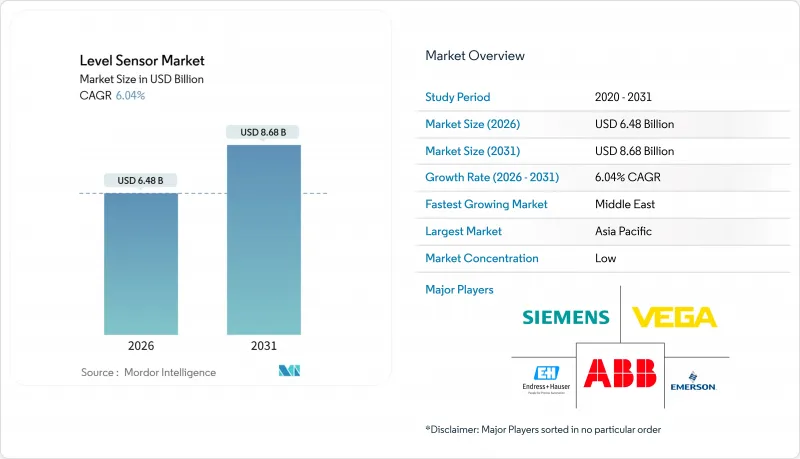
本報告按監測方法(點式液位感測器和連續式液位感測器)、技術(接觸式感測器和非接觸式感測器)、感測器技術(電容式、電導式、光電式、微波/雷達式等)、組件(感測元件和探頭、變送器/轉換器、顯示器和控制器)以及地區進行細分。市場預測以美元計價。
全球液位感測器市場趨勢與洞察
北美貨物交接系統中向 80 GHz FMCW 雷達的過渡
為了滿足美國石油學會 (API) 制定的更嚴格的石油計量標準,美國和加拿大的管線營運商和煉油商正從傳統的 24吉赫感測器過渡到 80吉赫調頻連續波 (FMCW) 設備。更高的頻率可以縮小波束角,最大限度地減少高而窄的儲槽中的虛假回波,同時實現 ±0.5 毫米的精度。目前,合約條款明確規定原油碼頭、液化石油氣 (LPG) 儲存設施和液化天然氣 (LNG) 出口泊位必須使用 80吉赫設備。供應商正在整合 WirelessHART 和 IO-Link 技術,以消除對訊號電纜的需求,並實現預測性診斷,從而在精度下降之前檢測到天線污垢。預計到 2029 年,墨西哥灣沿岸和加拿大西部將有約 12,000 個儲槽進行維修,這將創造永續的收入來源。
海灣合作理事會(GCC)地區數位化主導的儲槽自動化快速發展
沙烏地阿美、阿布達比國家石油公司 (ADNOC) 和科威特石油公司正在對超過 10,000 個儲存槽進行自動化改造,部署符合 IEC 61511 風險降低要求的冗餘架構的雷達和導波發射器。取消人工計量將減少產品損失索賠,並透過實現基於配方的調和來提高煉油廠的每桶利潤率。每個項目都要求碳氫化合物應用獲得安全完整性等級 (SIL) 2 認證,硫化氫環境獲得 SIL 3 認證,這增加了對擁有全面認證組合的供應商的需求。海灣合作理事會 (GCC) 國家對無人值守站點的偏好進一步加速了基於雲端的庫存儀錶板的普及。
8吋GaAs MMIC代工廠產能短缺,無法滿足80 GHz前端應用的需求
全球能夠加工8吋砷化鎵(GaAs)晶圓的代工廠不到10家,其中三家就佔了超過70%的產量。汽車雷達、5G和衛星相關應用的訂單正在擠壓工業需求,導致前置作業時間延長至52週。由於電子遷移率目標值超過8000 cm²V⁻¹時缺陷密度增加,80 吉赫前端晶圓的良率徘徊在60%左右。中型感測器供應商正在推遲產品發布或轉而採用24 吉赫平台,犧牲了計量客戶所需的精度。由於IQE和AWSC的新產能預計要到2027年下半年才能投入運營,發送器運作居高不下,這給水處理和食品加工行業的競標利潤率帶來了壓力。
細分市場分析
預計到2025年,連續測量設備將佔據67.80%的銷售佔有率,並隨著煉油廠、化工園區和電池電解生產線對庫存可視性的需求不斷成長,其銷售佔有率將繼續以8.50%的複合年成長率成長。雷達、超音波和磁致伸縮解決方案能夠即時檢測泡沫層、攪拌渦流和層流界面,從而將意外停機時間減少約20%。 HART、Profibus和Foundation Fieldbus等數位協定透過將校準和診斷資料整合到發送器中,縮短了試運行時間並實現了遠端效能測試。相較之下,點位測量設備的銷售成長相對滯後,因為它們依賴二進制邏輯來實現泵浦聯鎖、溢流預防和低液位警報,儘管它們在小型儲罐和日用容器中仍然保持著強勁的需求。機械浮球仍然在設備老舊且儀器技術有限的領域中使用,但隨著安全審核要求升級,其市場佔有率正在逐年下降。液位感測器市場受益於高價值流程工廠的強制性預測性維護,這促使即使是保守的營運商也轉向連續測量架構。
點式液位感測器在固態處理、溢流警報和低成本水箱等領域仍將保持其重要的市場地位。振動叉式液位感測器採用故障安全設計,因為頻率下降可以指示乾燥和故障狀態。電導率探頭在酸性和鹽水應用中仍然備受青睞,但其對介電常數的依賴性限制了其在碳氫化合物流體中的應用。長距離電纜浮球式液位感測器在發展中地區仍然適用,尤其是在雷達部署成本仍然過高的露天油庫中。整體而言,隨著工業IoT(IIoT) 計畫的擴展,持續監控,結合資產管理儀表板和供應商託管的雲端分析,正在推動液位感測器市場的轉變。
預計到2025年,非接觸式技術將佔總裝置容量的62.10%,年複合成長率達9.32%。超音波裝置在15公尺以內的水和污水應用中佔據主導地位,而80 吉赫雷達因其小於3度的窄波束角和對介電常數變化的免疫力,在計量領域佔據主導地位。光學紅外線感測器用於製藥行業的衛生應用以及透明液體的測量,在這些應用中,接觸式探頭會使基於21 CFR Part 11的清潔驗證變得複雜。接觸式探頭在100 bar以上的高壓反應器和-160 度C以下的低溫碳氫化合物中仍然非常重要,磁致伸縮雷達和波導雷達可提供亞毫米級解析度。靜壓變送器仍廣泛應用於密封槽應用中,利用不受泡沫或蒸氣成分影響的差壓測量。
儘管波導雷達由於探頭形成的死區容易滋生生物膜,在遵守衛生法規方面面臨挑戰,但該技術在液化天然氣儲罐領域表現出色,因為高介電常數和分層現象使得非接觸式檢測難以實現。因此,接觸式和非接觸式檢測方法並存,但由於成本降低和無線協議的普及,非接觸式檢測方法正日益流行。這種兩極化凸顯了液位感測器市場存在的兩種成長機會。
區域分析
到2025年,亞太地區將佔全球銷售額的38.50%,並繼續保持其最大市場佔有率的地位。光是在中國,2024年至2025年間就將新增180吉瓦時的鋰離子電池產能,每座超級工廠都將配備用於六氟磷酸鋰和碳酸乙烯酯儲槽的雷達和磁致伸縮感測器。在印度,海水淡化廠的建設每個項目需要超過4000套雷達和超音波設備;而在東南亞,液化天然氣(LNG)進口終端正在使用導波雷達進行低溫乙烷儲存。在日本和韓國,石化產業園區正在實施持續的升級改造,以確保符合IEC 61508標準;而在澳大利亞,銅礦、鎳礦和鋰礦的尾礦壩正在安裝高耐久性雷達。
預計中東地區將維持最高的成長率,到2031年複合年成長率將達到10.40%。沙烏地阿美在拉斯塔諾拉、朱拜勒和延布的自動化項目已取消了人工稱重,並將雷達發送器整合到雲端控制面板中,從而減少了15%的產品損失索賠。在卡達北部液化天然氣(LNG)擴建工程中,導波雷達被用於-160 度C環境下的丙烷儲存槽。無人值守碼頭戰略、IEC 61511標準的採用以及各國氫能發展藍圖的製定,正在創造有利於SIL認證品牌的高階需求。
到2025年,北美和歐洲合計將佔全球銷售額的近一半。美國石油學會(API)法規的變更正在加速從墨西哥灣沿岸到亞伯達油砂吉赫的過渡。儘管由於歐洲的SIL-3安全等級要求,整個產業的產量趨於平穩,但雙雷達架構的採用仍在持續。在南美洲,由於當地原始設備製造商(OEM)需要承擔認證成本以及8英寸砷化鎵雷達鑄造廠資源有限,80吉赫的過渡速度正在放緩。
其他好處:
- Excel格式的市場預測(ME)表
- 3個月的分析師支持
目錄
第1章:引言
- 研究假設和市場定義
- 調查範圍
第2章:調查方法
第3章執行摘要
第4章 市場狀況
- 市場概覽
- 市場促進因素
- 波灣合作理事會(GCC)正在經歷數位化驅動的儲槽區自動化浪潮。
- 亞太地區海水淡化和污水處理大型企劃的快速擴張
- 歐洲化工園區強制性的 SIL-3 安全審核正在推動雷達系統的應用。
- 北美校準和稱重系統中向 80 GHz FMCW 雷達的過渡
- 中國對電池式電動車電解生產能力的投資
- LNG浮體式儲存再氣化裝置(FSRU)的訂單正在加速點級需求。
- 市場限制因素
- 鋼鐵廠中由電磁干擾 (EMI) 引起的精度波動阻礙了該技術在印度的應用。
- 波導雷達在衛生製藥生產線(美國和歐盟 GMP)的應用率較低。
- 8吋GaAs MMIC代工廠產能不足,無法滿足80GHz前端的需求
- 南美洲小規模OEM廠商SIL認證的複雜成本
- 產業價值鏈分析
- 監理情勢
- 技術展望
- 宏觀經濟因素的影響
- 波特五力分析
第5章 市場規模與成長預測
- 按監測類型
- 點位感應器
- 機械浮子和磁浮子
- 電容式
- 震動探頭
- 導電性
- 其他點位感測器
- 連續液位感測器
- 雷射
- 超音波
- 磁致伸縮型
- 雷達
- 其他連續液位感測器
- 機械浮子和磁浮子
- 透過技術
- 接觸式感應器
- 靜水壓型
- 磁致伸縮型
- 波導雷達
- 非接觸式感測器
- 超音波
- 24 GHz 雷達
- 80 GHz 雷達
- 光學/紅外線
- 接觸式感應器
- 感測器技術
- 電容式
- 導電
- 光學/光電
- 微波/雷達
- 超音波
- 振動叉
- 按組件
- 檢測指示器和探頭
- 發送器/轉換器
- 顯示器和控制器
- 點位感應器
- 按地區
- 北美洲
- 美國
- 加拿大
- 墨西哥
- 歐洲
- 德國
- 英國
- 法國
- 義大利
- 西班牙
- 俄羅斯
- 其他歐洲國家
- 亞太地區
- 中國
- 日本
- 印度
- 韓國
- 澳洲
- 其他亞太國家
- 中東
- 沙烏地阿拉伯
- 阿拉伯聯合大公國
- 土耳其
- 其他中東國家
- 非洲
- 南非
- 奈及利亞
- 其他非洲國家
- 南美洲
- 巴西
- 阿根廷
- 其他南美國家
- 北美洲
第6章 競爭情勢
- 市場集中度
- 策略趨勢
- 市佔率分析
- 公司簡介
- ABB Ltd
- Emerson Electric Co.
- Honeywell International Inc.
- Siemens AG
- Endress+Hauser AG
- Sick AG
- VEGA Grieshaber KG
- KROHNE Group
- Baumer Group
- TE Connectivity Ltd
- First Sensor AG
- BinMaster Inc.
- AMETEK Inc.
- Pepperl+Fuchs SE
- Anton Paar GmbH
- Omega Engineering Inc.
- ifm electronic GmbH
- Yokogawa Electric Corp.
- Omron Corporation
- Rockwell Automation Inc.
- KOBOLD Messring GmbH
第7章 市場機會與未來展望
According to Mordor Intelligence, the level sensors market size stands at USD 6.48 billion in 2026 and is forecast to reach USD 8.68 billion by 2031, advancing at a 6.04% CAGR.
This report is Segmented by Monitoring Type (Point Level Sensors, and Continuous Level Sensors), Technology (Contact Sensors, and Non-Contact Sensors), Sensor Technology (Capacitive, Conductive, Optical/Photoelectric, Microwave/Radar, and More), Component (Sensing Element and Probe, Transmitter/Converter, and Display and Controller), and Geography. The Market Forecasts are Provided in Terms of Value (USD).
Global Level Sensor Market Trends and Insights
Transition to 80 GHz FMCW Radar in North American Custody-Transfer Systems
Pipeline operators and refiners in the United States and Canada are migrating from legacy 24 gigahertz sensors to 80 gigahertz frequency-modulated continuous-wave units to meet the American Petroleum Institute's tighter manual of petroleum measurement standards. The higher frequency narrows the beam angle, minimizing false echoes in tall, slender tanks while achieving +-0.5 millimeter accuracy. Contract clauses now explicitly require 80-gigahertz devices for crude-oil terminals, liquefied petroleum gas caverns, and liquefied natural gas export berths. Vendors embed WirelessHART and IO-Link to eliminate signal cabling and enable predictive diagnostics that flag antenna fouling before accuracy drifts. Roughly 12,000 tanks on the Gulf Coast and in Western Canada are slated for retrofit by 2029, creating a durable replacement revenue stream.
Digitization-Driven Tank-Farm Automation Surge in Gulf Cooperation Council
Saudi Aramco, ADNOC, and Kuwait Petroleum Corporation are automating more than 10,000 storage tanks, installing radar and guided-wave transmitters with redundant architectures that satisfy IEC 61511 risk-reduction factors . The removal of manual gauging trims product-loss claims and enables recipe-based blending that lifts refinery margin per barrel. Projects specify Safety Integrity Level 2 certification for hydrocarbon service and SIL 3 for hydrogen-sulfide environments, pushing demand toward vendors with full certificate portfolios. The GCC's preference for unmanned sites further accelerates the adoption of cloud-based inventory dashboards.
Shortage of 8-Inch GaAs MMIC Foundry Capacity for 80 GHz Front-Ends
Fewer than 10 foundries worldwide can process 8-inch gallium-arsenide wafers, and three of them account for over 70% of the volume. Automotive radar, 5G, and satellite contracts crowd out industrial demand, stretching lead times to 52 weeks. Yield for 80 gigahertz front-ends hovers near 60% because defect densities rise as electron mobility targets climb above 8,000 cm^2 V-s. Mid-tier sensor vendors have postponed launches or reverted to 24-gigahertz platforms, sacrificing the accuracy that custody-transfer clients demand. New capacity from IQE and AWSC arrives only in late 2027, keeping transmitter prices elevated and squeezing margins on water-treatment and food-processing bids.
Other drivers and restraints analyzed in the detailed report include:
- Rapid Build-Out of Desalination and Waste-Water Megaprojects Across Asia-Pacific
- Mandatory SIL-3 Safety Audits in European Chemical Parks Boosting Radar Installations
- EMI-Induced Accuracy Drift in Steel Mills Limiting Adoption in India
For complete list of drivers and restraints, kindly check the Table Of Contents.
Segment Analysis
Continuous devices captured a 67.80% revenue share in 2025 and will keep expanding at an 8.50% CAGR as refineries, chemical parks, and battery-electrolyte lines pursue inventory transparency. Radar, ultrasonic, and magnetostrictive solutions reduce unplanned shutdowns by roughly 20% because they detect foam blankets, agitator swirl, and stratified interfaces in real time. Digital protocols such as HART, Profibus, and Foundation Fieldbus embed calibration and diagnostic data within the transmitter, cutting commissioning hours and enabling remote proof tests. In contrast, point-level devices rely on binary logic for pump interlock, overfill protection, and low-level alarms, so their revenue growth trails but remains resilient in small tanks and day vessels. Mechanical floats linger in legacy installations and regions with limited instrumentation expertise, yet their footprint erodes each year as safety audits force upgrades. The level sensors market benefits from predictive-maintenance mandates in high-value process plants, nudging even conservative operators toward continuous architectures.
Point-level sensors will keep a valuable niche in solids handling, overfill alarms, and low-cost water tanks. Vibratory forks offer a fail-safe design because frequency drops signal both dry and fault conditions. Conductivity probes retain traction in acid and brine service, but dielectric dependence limits usage in hydrocarbon streams. Long-span cable floats survive in developing regions, particularly for open reservoirs where radar budgets remain prohibitive. Overall, as Industrial Internet of Things initiatives spread, continuous monitoring aligns with asset-management dashboards and vendor-hosted cloud analytics, reinforcing the shift inside the level sensors market.
Non-contact technologies accounted for 62.10% of 2025 deployments and are headed for a 9.32% CAGR. Ultrasonic units dominate water and wastewater applications up to 15 meters, while 80 gigahertz radar leads in custody transfer thanks to a beam angle narrower than 3 degrees and independence from dielectric constant variation. Optical infrared sensors cover hygienic and transparent-liquid duties in pharmaceuticals where contact probes complicate cleaning validation under 21 CFR Part 11. The contact segment retains relevance in high-pressure reactors above 100 bar and cryogenic hydrocarbons below -160 °C, where magnetostrictive and guided-wave radar demonstrate sub-millimeter resolution. Hydrostatic transmitters persist for sealed-tank applications, leveraging differential-pressure measurement that remains immune to foam and vapor composition.
Guided-wave radar struggles with hygienic regulations because probes create dead-leg zones susceptible to biofilm, yet the technology excels in liquefied natural gas tanks where high dielectric and stratified layers complicate non-contact sensing. Contact and non-contact approaches therefore coexist, but the value narrative leans toward non-contact as costs fall and wireless protocols proliferate. This split underlines the dual-thrust growth opportunities inside the level sensors market.
Complete Report Scope:
- By Monitoring Type
- Point Level Sensors
- Mechanical and Magnetic Float
- Capacitance
- Vibratory Probe
- Conductivity
- Other Point Level Sensors
- Continuous Level Sensors
- Laser
- Ultrasonic
- Magnetostrictive
- Radar
- Other Continuous Level Sensors
- Mechanical and Magnetic Float
- By Technology
- Contact Sensors
- Hydrostatic
- Magnetostrictive
- Guided-Wave Radar
- Non-Contact Sensors
- Ultrasonic
- 24 GHz Radar
- 80 GHz Radar
- Optical / IR
- Contact Sensors
- By Sensor Technology
- Capacitive
- Conductive
- Optical / Photoelectric
- Microwave / Radar
- Ultrasonic
- Vibratory Fork
- By Component
- Sensing Element and Probe
- Transmitter / Converter
- Display and Controller
- Point Level Sensors
- By Geography
- North America
- United States
- Canada
- Mexico
- Europe
- Germany
- United Kingdom
- France
- Italy
- Spain
- Russia
- Rest of Europe
- Asia-Pacific
- China
- Japan
- India
- South Korea
- Australia
- Rest of Asia-Pacific
- Middle East
- Saudi Arabia
- United Arab Emirates
- Turkey
- Rest of Middle East
- Africa
- South Africa
- Nigeria
- Rest of Africa
- South America
- Brazil
- Argentina
- Rest of South America
- North America
Geography Analysis
Asia-Pacific generated 38.50% of global revenue in 2025 and maintains the largest installed base. China alone added 180 gigawatt-hours of lithium-ion cell capacity during 2024-2025, each gigafactory outfitted with radar and magnetostrictive sensors for lithium hexafluorophosphate and ethylene carbonate tanks. India's desalination build-out requires more than 4,000 radar and ultrasonic units per project, and Southeast Asia's liquefied natural gas import terminals select guided-wave radar for cryogenic ethane storage. Japan and South Korea execute steady replacement cycles to secure IEC 61508 compliance in petrochemical parks, while Australia's copper, nickel, and lithium mines install heavy-duty radar in tailings dams.
The Middle East is poised for the fastest 10.40% CAGR through 2031. Saudi Aramco's Ras Tanura, Jubail, and Yanbu automation projects eliminate manual gauging and integrate radar transmitters into cloud dashboards that cut product-loss claims by 15%. Qatar's North Field liquefied natural gas expansion specifies guided-wave radar for propane spheres at -160 °C. Unmanned terminal strategies, IEC 61511 adoption, and national hydrogen roadmaps create premium demand that favors brands with SIL certificates.
North America and Europe together account for just under half of 2025 revenue. Updated American Petroleum Institute rules trigger an 80 gigahertz replacement wave from the Gulf Coast to Alberta oil sands. Europe's SIL-3 mandates drive twin-radar architectures even as overall industrial output plateaus. South America lags because local original equipment manufacturers bear high certification costs and minimal access to 8-inch gallium-arsenide foundries, limiting the pace of 80 gigahertz migration.
- ABB Ltd
- Emerson Electric Co.
- Honeywell International Inc.
- Siemens AG
- Endress + Hauser AG
- Sick AG
- VEGA Grieshaber KG
- KROHNE Group
- Baumer Group
- TE Connectivity Ltd
- First Sensor AG
- BinMaster Inc.
- AMETEK Inc.
- Pepperl + Fuchs SE
- Anton Paar GmbH
- Omega Engineering Inc.
- ifm electronic GmbH
- Yokogawa Electric Corp.
- Omron Corporation
- Rockwell Automation Inc.
- KOBOLD Messring GmbH
Additional Benefits:
- The market estimate (ME) sheet in Excel format
- 3 months of analyst support
TABLE OF CONTENTS
1 INTRODUCTION
- 1.1 Study Assumptions and Market Definition
- 1.2 Scope of the Study
2 RESEARCH METHODOLOGY
3 EXECUTIVE SUMMARY
4 MARKET LANDSCAPE
- 4.1 Market Overview
- 4.2 Market Drivers
- 4.2.1 Digitisation-Driven Tank-Farm Automation Surge in Gulf Cooperation Council (GCC)
- 4.2.2 Rapid Build-Out of Desalination and Waste-Water Megaprojects Across Asia-Pacific
- 4.2.3 Mandatory SIL-3 Safety Audits in European Chemical Parks Boosting Radar Installations
- 4.2.4 Transition to 80 GHz FMCW Radar in North-American Custody-Transfer Systems
- 4.2.5 Battery-Electric Vehicle Electrolyte Production Capacity Investments in China
- 4.2.6 LNG Floating Storage and Regasification Unit Orders Accelerating Point-Level Demand
- 4.3 Market Restraints
- 4.3.1 EMI-Induced Accuracy Drift in Steel Mills Limiting Adoption in India
- 4.3.2 Low Acceptance of Guided-Wave Radar in Hygienic Pharma Lines (US and EU GMP)
- 4.3.3 Shortage of 8-inch GaAs MMIC Foundry Capacity for 80 GHz Front-Ends
- 4.3.4 Complex SIL Certification Cost for Small OEMs in South America
- 4.4 Industry Value Chain Analysis
- 4.5 Regulatory Landscape
- 4.6 Technological Outlook
- 4.7 Impact of Macroeconomic Factors
- 4.8 Porter's Five Forces Analysis
- 4.8.1 Threat of New Entrants
- 4.8.2 Bargaining Power of Suppliers
- 4.8.3 Bargaining Power of Buyers
- 4.8.4 Threat of Substitutes
- 4.8.5 Competitive Rivalry
5 MARKET SIZE AND GROWTH FORECASTS (VALUE)
- 5.1 By Monitoring Type
- 5.1.1 Point Level Sensors
- 5.1.1.1 Mechanical and Magnetic Float
- 5.1.1.1.1 Capacitance
- 5.1.1.1.2 Vibratory Probe
- 5.1.1.1.3 Conductivity
- 5.1.1.1.4 Other Point Level Sensors
- 5.1.1.2 Continuous Level Sensors
- 5.1.1.2.1 Laser
- 5.1.1.2.2 Ultrasonic
- 5.1.1.2.3 Magnetostrictive
- 5.1.1.2.4 Radar
- 5.1.1.2.5 Other Continuous Level Sensors
- 5.1.1.1 Mechanical and Magnetic Float
- 5.1.2 By Technology
- 5.1.2.1 Contact Sensors
- 5.1.2.1.1 Hydrostatic
- 5.1.2.1.2 Magnetostrictive
- 5.1.2.1.3 Guided-Wave Radar
- 5.1.2.2 Non-Contact Sensors
- 5.1.2.2.1 Ultrasonic
- 5.1.2.2.2 24 GHz Radar
- 5.1.2.2.3 80 GHz Radar
- 5.1.2.2.4 Optical / IR
- 5.1.2.1 Contact Sensors
- 5.1.3 By Sensor Technology
- 5.1.3.1 Capacitive
- 5.1.3.2 Conductive
- 5.1.3.3 Optical / Photoelectric
- 5.1.3.4 Microwave / Radar
- 5.1.3.5 Ultrasonic
- 5.1.3.6 Vibratory Fork
- 5.1.4 By Component
- 5.1.4.1 Sensing Element and Probe
- 5.1.4.2 Transmitter / Converter
- 5.1.4.3 Display and Controller
- 5.1.1 Point Level Sensors
- 5.2 By Geography
- 5.2.1 North America
- 5.2.1.1 United States
- 5.2.1.2 Canada
- 5.2.1.3 Mexico
- 5.2.2 Europe
- 5.2.2.1 Germany
- 5.2.2.2 United Kingdom
- 5.2.2.3 France
- 5.2.2.4 Italy
- 5.2.2.5 Spain
- 5.2.2.6 Russia
- 5.2.2.7 Rest of Europe
- 5.2.3 Asia-Pacific
- 5.2.3.1 China
- 5.2.3.2 Japan
- 5.2.3.3 India
- 5.2.3.4 South Korea
- 5.2.3.5 Australia
- 5.2.3.6 Rest of Asia-Pacific
- 5.2.4 Middle East
- 5.2.4.1 Saudi Arabia
- 5.2.4.2 United Arab Emirates
- 5.2.4.3 Turkey
- 5.2.4.4 Rest of Middle East
- 5.2.5 Africa
- 5.2.5.1 South Africa
- 5.2.5.2 Nigeria
- 5.2.5.3 Rest of Africa
- 5.2.6 South America
- 5.2.6.1 Brazil
- 5.2.6.2 Argentina
- 5.2.6.3 Rest of South America
- 5.2.1 North America
6 COMPETITIVE LANDSCAPE
- 6.1 Market Concentration
- 6.2 Strategic Moves
- 6.3 Market Share Analysis
- 6.4 Company Profiles (includes Global level Overview, Market level overview, Core Segments, Financials as available, Strategic Information, Market Rank/Share for key companies, Products and Services, and Recent Developments)
- 6.4.1 ABB Ltd
- 6.4.2 Emerson Electric Co.
- 6.4.3 Honeywell International Inc.
- 6.4.4 Siemens AG
- 6.4.5 Endress + Hauser AG
- 6.4.6 Sick AG
- 6.4.7 VEGA Grieshaber KG
- 6.4.8 KROHNE Group
- 6.4.9 Baumer Group
- 6.4.10 TE Connectivity Ltd
- 6.4.11 First Sensor AG
- 6.4.12 BinMaster Inc.
- 6.4.13 AMETEK Inc.
- 6.4.14 Pepperl + Fuchs SE
- 6.4.15 Anton Paar GmbH
- 6.4.16 Omega Engineering Inc.
- 6.4.17 ifm electronic GmbH
- 6.4.18 Yokogawa Electric Corp.
- 6.4.19 Omron Corporation
- 6.4.20 Rockwell Automation Inc.
- 6.4.21 KOBOLD Messring GmbH
7 MARKET OPPORTUNITIES AND FUTURE OUTLOOK
- 7.1 White-Space and Unmet-Need Assessment

 智慧水位感測器市場:全球市場預測,2026-2032年
 全球液位感測器市場
 污泥濃度感測器市場:全球產業分析、市場規模、市場佔有率及預測(按感測器類型、應用、最終用戶、安裝類型、國家和地區分類)-2026年至2033年
 2026-2030年全球液位感測器與開關市場光電式水位感測器市場報告:趨勢、預測及競爭分析(至2035年)液位感測器與開關市場-2026-2032年全球市場預測液位感測器市場:按技術、測量方法、材質、安裝方式、精度等級和最終用戶產業分類-2026-2032年全球市場預測腳踏開關墊市場報告:趨勢、預測與競爭分析(至2035年)
 液位感測器市場:按技術、產品和地區分類無浮球式液位開關市場:依驅動方式、開關類型、安裝方式、輸出類型及最終用途產業分類-2026-2032年全球市場預測