


 |
市場調查報告書
商品編碼
2122608
碳化矽功率半導體:市場佔有率分析、產業趨勢與統計及成長預測(2026-2031 年)Silicon Carbide Power Semiconductor - Market Share Analysis, Industry Trends & Statistics, Growth Forecasts (2026 - 2031) |
||||||

※ 本網頁內容可能與最新版本有所差異。詳細情況請與我們聯繫。
據 Mordor Intelligence 稱,碳化矽功率半導體市場預計到 2026 年價值 34.1 億美元,高於 2025 年的 27.3 億美元,預計到 2031 年將達到 102.6 億美元。
預計從 2026 年到 2031 年,其複合年成長率將達到 24.68%。
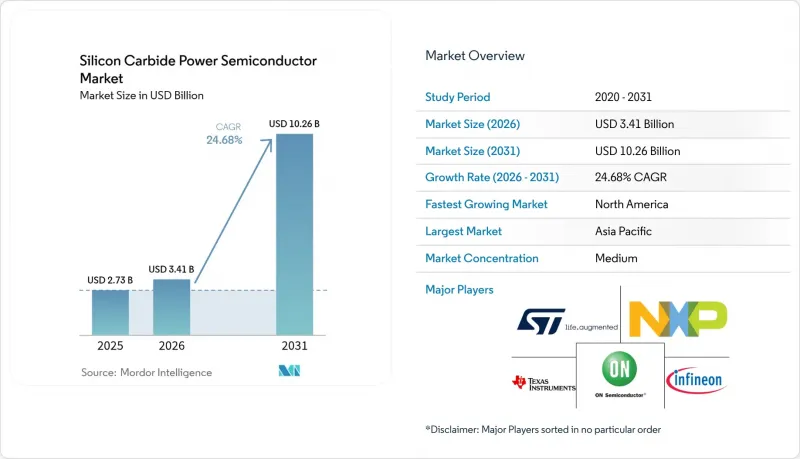
本報告按終端用戶產業(汽車、IT及電信等)、裝置類型(分離式MOSFET/JFET、功率模組等)、額定電壓(600-900V、1.0kV-3.3kV及以上)、晶圓尺寸、封裝技術(焊線、燒結、壓入封裝)及地區進行細分。市場預測以美元(USD)為單位。
全球碳化矽功率半導體市場趨勢及洞察
關於電動車牽引逆變器效率的法規
歐洲和中國的監管壓力迫使汽車製造商最大限度地提高動力傳動系統的效率。基於碳化矽 (SiC) MOSFET 的 800V 架構相比矽 IGBT 解決方案可節省 2-4% 的能源,從而減輕電池組重量並延長續航里程。歐盟委員會針對 2025-2030 年汽車二氧化碳排放的限制進一步推動了 SiC 從利基市場走向主流市場。同時,比亞迪的兆瓦級快速充電原型凸顯了降低開關損耗如何能有效控制充電站的資本支出 (CAPEX)。特斯拉的長期晶圓採購協議是原始設備製造商 (OEM) 策略性地採用 SiC 的一個典型例子,透過大規模生產降低成本,這將惠及整個碳化矽功率半導體市場。
擴大全球碳化矽晶圓廠產能(150毫米和200毫米)
從150毫米晶圓轉向200毫米晶圓,將使每個製造週期的晶片產量提高約2.2倍,同時降低單位成本高達40%。 Wolfspeed位於紐約州莫霍克谷的工廠和英飛凌位於馬來西亞的Klim 2生產線便是數十億美元投資的例證,凸顯了該領域極高的准入門檻。台灣國家原子能研究所(NARLabs)近期展示了奈秒雷射研磨技術,該技術可將晶圓破損率降低一半,從而加速8吋晶圓的普及應用。隨著資本流入集中在亞太地區,西方國家的資金籌措計畫旨在降低區域依賴所帶來的風險。
SiC晶片缺陷密度與成本溢價
位錯和基底缺陷的含量仍比成熟矽的基準值高出 5 到 10 倍,導致良率下降,晶圓成本上漲 3 到 5 倍。雖然晶體生長技術的進步正在縮小差距,但持續的高成本仍然阻礙了價格敏感型逆變器領域的應用。向 200 毫米製程過渡的學習曲線可能會暫時擴大成本差距,但產能的提高有望使碳化矽功率半導體市場的價格水準恢復到與矽增強型半導體相當的水平。
細分市場分析
預計到2025年,汽車業將佔碳化矽(SiC)功率半導體市場總銷售額的61.45%,凸顯其在市場擴張中的關鍵作用。電動車製造商在轉型為800V系統時,將SiC指定為實現效率和充電目標的首選材料。快速充電基礎設施雖然在2024年規模較小,但卻是成長最快的細分市場,預計到2031年將以26.25%的複合年成長率成長,因為充電網路正朝著350kW以上的充電器發展。 IT和通訊產業是第二大買家,這主要得益於資料中心營運商日益成長的需求,他們正在伺服器電源架中採用SiC以降低轉換損耗。 SiC正被用於可再生能源功率轉換器和工業運動驅動器,透過頻率切換實現磁性元件的小型化,同時其耐高溫特性也正被考慮應用於鐵路和電動航空平台。安森美半導體斥資 1.15 億美元收購 JFET,顯示該公司對人工智慧和雲端工作負載進行了策略性押注,這可能會在預測期內使其收入來源多元化,不再局限於傳統半導體領域。
碳化矽 (SiC) 在移動出行領域的價值提案在於其可量化的生命週期成本降低。 SiC 的應用能夠實現更小的電池組、更短的安裝停機時間和更簡化的冷卻迴路,從而形成良性循環,擴大碳化矽 (SiC) 功率半導體的潛在基本客群。與能源效率標準掛鉤的政府補貼計畫進一步提升了原始設備製造商 (OEM) 採用 SiC 的興趣。同時,一級供應商透過將 SiC 逆變器控制板與先進的閘極驅動器捆綁銷售,縮短了平台級產品上市時間,並加強了生態系統鎖定。
預計到2025年,分立式MOSFET和JFET將佔據43.35%的市場佔有率,深受注重設計柔軟性和成本最佳化的工程師青睞。然而,隨著功率模組以10.05%的複合年成長率成長,整合商轉向單封裝解決方案以簡化散熱路徑並縮短認證週期,功率模組正日益取代分離式元件。肖特基二極體在同步整流中發揮輔助作用,通常整合在模組內部以最大限度地減少寄生元件。
隨著垂直整合策略與OEM產能擴張相契合,用於功率模組的碳化矽功率半導體市場預計將快速成長。模壓成型和壓入式模組的發展藍圖可望進一步提升導通電阻(RDS(on))的均勻性,而整合電流檢測功能則簡化了控制迴路。裸晶和代工服務的銷售額也隨之成長,為電力和可再生能源領域需要客製化佈局的專業公司提供服務。元件供應商正利用專有的溝槽拓撲結構和JFET級聯技術來突破效率極限,從而保持性能持續提升的良性循環,這也證明了碳化矽相對於矽超接面MOSFET更高的成本是合理的。
區域分析
亞太地區憑藉其在中國電動車市場的主導地位、日本在晶體生長技術的領先地位以及韓國的模組組裝能力,預計到2025年將佔全球銷售額的55.92% 。全部區域的協同效應正在縮短前置作業時間並降低成本,即使在出口限制的不確定性凸顯的情況下,也鞏固了亞太地區主要企業的領先地位。像TankeBlue這樣的國內基板供應商正在減少對歐美晶錠供應商的依賴,從而能夠建立垂直整合的產業鏈,為國內汽車OEM廠商供貨。
預計到2031年,北美地區的複合年成長率將達到27.35%,超過其他所有地區。當地需求受到《晶片法案》(CHIPS Act)激勵措施、Wolfspeed在莫霍克谷的晶圓生產以及美國中西部汽車工廠現代化改造的推動。資料中心營運商採用800V直流拓樸結構的需求也是一大利好因素。此外,Shinry與Wolfspeed在增壓器製造方面的跨國合作表明,美國企業樂於尋求能夠確保快速擴張產能的合作模式。
歐洲市佔率緊隨其後,這得益於整車二氧化碳減排目標和強力的可再生能源計畫。在IPCEI的資助下,諸如卡塔尼亞「碳化矽谷」等計畫已經啟動,旨在將基板、外延層和裝置的製造集中在一個地區。然而,由於當地碳錠產能有限,該地區不得不依賴進口,政策制定者正致力於透過與日本晶體生長專家成立合資企業來彌補這一缺口。中東、非洲和南美洲等新興地區目前小規模,但透過大規模太陽能發電競標(強調碳化矽的耐高溫性能)和電動公車試點項目,展現出潛在的需求。
其他好處:
- Excel格式的市場預測(ME)表
- 3個月的分析師支持
目錄
第1章:引言
- 研究假設和市場定義
- 調查範圍
第2章:調查方法
第3章執行摘要
第4章 市場狀況
- 市場概覽
- 市場促進因素
- 關於電動車牽引逆變器效率的規定
- 全球SiC晶圓廠產能擴張(150毫米和200毫米)
- 與寬能隙相關的政策獎勵(美國的CHIPS,歐盟的IPCEI)
- 擴大高功率快速充電(350千瓦或以上)
- 原始設備製造商 (OEM) 的晶圓採購垂直整合
- 一個被忽略的趨勢:資料中心電源架中碳化矽的應用。
- 市場限制因素
- SiC晶片缺陷密度與成本溢價
- 封裝熱循環可靠性的局限性
- 氫蝕刻爐停機風險
- 一個被忽略的趨勢:採用 FZ 方法生長的 GaN 在 650 V 節點上具有競爭力。
- 產業價值鏈分析
- 監理情勢
- 技術展望
- 波特五力分析
第5章 市場規模與成長預測
- 按最終用戶行業分類
- 汽車(電動車、充電基礎設施)
- IT 與通訊(5G、伺服器)
- 電力(太陽能、風能、UPS、ESS)
- 工業(馬達驅動、機器人)
- 交通運輸-鐵路和航空
- 其他終端用戶(石油和天然氣、醫療、研發等)
- 依設備類型
- 分立式 MOSFET/JFET
- 電源模組
- 肖特基二極體
- 裸晶/鑄造服務
- 按額定電壓
- 600~900 V
- 1.0 kV~3.3 kV
- 超過 3.3 千伏
- 按晶圓尺寸
- 4吋
- 6吋(150毫米)
- 8吋(200毫米或以上)
- 透過包裝技術
- 焊線
- 燒結
- 壓入式
- 覆晶/嵌入式晶片
- 按地區
- 北美洲
- 美國
- 加拿大
- 墨西哥
- 歐洲
- 英國
- 德國
- 法國
- 義大利
- 其他歐洲國家
- 亞太地區
- 中國
- 日本
- 印度
- 韓國
- 其他亞洲國家
- 中東
- 以色列
- 沙烏地阿拉伯
- 阿拉伯聯合大公國
- 土耳其
- 其他中東國家
- 非洲
- 南非
- 埃及
- 其他非洲國家
- 南美洲
- 巴西
- 阿根廷
- 其他南美國家
- 北美洲
第6章 競爭情勢
- 市場集中度
- 策略趨勢
- 市佔率分析
- 公司簡介
- Infineon Technologies AG
- STMicroelectronics NV
- Wolfspeed Inc.
- onsemi Corporation
- ROHM Co., Ltd.
- Semikron Danfoss GmbH & Co. KG
- Mitsubishi Electric Corporation
- Fuji Electric Co., Ltd.
- Toshiba Electronic Devices & Storage Corporation
- Microchip Technology Inc.
- Qorvo SiC(United Silicon Carbide)
- GeneSiC Semiconductor Inc.
- Littelfuse Inc.(IXYS)
- Navitas Semiconductor Corp.
- Power Integrations Inc.
- Hitachi Energy Ltd.
- Global Power Technologies Group Inc.
- StarPower Semiconductor Ltd.
- BYD Semiconductor Co., Ltd.
- CRRC Times Electric Co., Ltd.
第7章 市場機會與未來展望
According to Mordor Intelligence, silicon carbide power semiconductor market size in 2026 is estimated at USD 3.41 billion, growing from 2025 value of USD 2.73 billion with 2031 projections showing USD 10.26 billion, growing at 24.68% CAGR over 2026-2031.
This report is Segmented by End-User Industry (Automotive, IT and Telecommunication and More), Device Type (Discrete MOSFET/JFET, Power Module and More), Voltage Rating (600-900V, 1. 0kV-3. 3kV and More), Wafer Size, Packaging Technology (Wire-Bonded, Sintered, Press-Fit), and Geography. The Market Forecasts are Provided in Terms of Value (USD).
Global Silicon Carbide Power Semiconductor Market Trends and Insights
EV Traction-Inverter Efficiency Mandates
Regulatory pressure in Europe and China compels automakers to squeeze every percentage of drivetrain efficiency. SiC MOSFET-based 800 V architectures deliver 2-4% energy savings relative to silicon IGBT solutions, translating to lighter battery packs or extended range. The European Commission's 2025-2030 fleet CO2 limits elevate SiC from niche to mainstream, while BYD's megawatt-class flash-charging prototype highlights how lower switching losses curb station-level CAPEX. Tesla's long-term wafer sourcing agreements exemplify how OEMs treat SiC access as strategic, reinforcing volume-driven cost erosion that benefits the broader Silicon carbide power semiconductor market.
Global SiC-Fab Capacity Expansions (150 and 200 mm)
Transitions from 150 mm to 200 mm wafers multiply die output per run by roughly 2.2X while cutting unit costs up to 40%. Wolfspeed's Mohawk Valley fab in New York and Infineon's Kulim 2 line in Malaysia exemplify the USD-billion-scale investments required, reinforcing high entry barriers. Taiwan's National Applied Research Laboratories recently demonstrated nanosecond-laser grinding that halves wafer breakage, accelerating 8-inch adoption. As capital flows concentrate in APAC, Western funding programs aim to de-risk regional dependence.
SiC Wafer Defect Density and Cost Premium
Threading dislocations and basal-plane defects remain 5-10X above mature silicon benchmarks, depressing yields and elevating die costs by 3-5X. While crystal-growth refinements are closing the gap, the interim premium delays adoption in price-sensitive inverters. Process-learning curves tied to 200 mm migrations may briefly widen cost deltas before improved throughputs guide the Silicon carbide power semiconductor market back toward silicon-plus parity.
Other drivers and restraints analyzed in the detailed report include:
- Wide-Bandgap Policy Incentives (US CHIPS, EU IPCEI)
- High-Voltage Fast-Charging Roll-Out (>350 kW)
- Packaging Thermal-Cycle Reliability Limits
For complete list of drivers and restraints, kindly check the Table Of Contents.
Segment Analysis
The automotive segment generated 61.45% of 2025 revenue, underscoring its pivotal role in scaling the Silicon carbide power semiconductor market. EV makers migrating to 800 V systems specify SiC as default to meet efficiency and charging objectives. Fast-charging infrastructure, despite a smaller 2024 base, is the fastest-growing subsegment at 26.25% CAGR to 2031 as networks move to >350 kW dispensers. Rising interest from data-center operators positions IT and telecom as the second-largest buyer pool, with server power shelves using SiC to pare conversion losses. Renewable power converters and industrial motion drives adopt SiC for frequency-switching gains that shrink magnetics, while rail and e-aviation platforms explore high-temperature resilience. Onsemi's USD 115 million JFET buy signals strategic bets on AI and cloud workloads that could diversify revenue streams beyond traction over the forecast window.
SiC's value proposition in mobility stands on quantifiable lifetime savings. Adoption enables smaller battery packs, shorter installation downtimes, and fewer cooling loops, creating a positive feedback loop that widens the Silicon carbide power semiconductor market addressable base. Government credits tied to efficiency thresholds further sharpen OEM focus. Concurrently, tier-one suppliers bundle SiC inverter control boards with advanced gate drivers to accelerate platform-level time-to-market, reinforcing ecosystem lock-in.
Discrete MOSFETs and JFETs held 43.35% share in 2025, favoured by engineers prioritizing design flexibility and cost optimization. Yet power modules, growing at 10.05% CAGR, increasingly displace discrete as integrators transition toward single-package solutions that streamline thermal paths and shorten qualification cycles. Schottky diodes fill complementary roles in synchronous rectification, often paired within module footprints to minimize parasitic.
The Silicon carbide power semiconductor market size for power modules is projected to expand quickly as vertical integration strategy aligns with OEM production ramps. Moulded and press-fit module roadmaps promise tighter RDS (on) uniformity, while integrated current-sense functions simplify control loops. Bare die and foundry service sales rise in tandem, serving specialized traction and renewable players that require custom layouts. Device suppliers leverage proprietary trench topologies and JFET cascades to push efficiency limits, sustaining a cycle of incremental gains that justify SiC's premium over silicon super junction MOSFETs.
Complete Report Scope:
- Segmentation by End-user Industry
- Automotive (xEV, Charging Infrastructure)
- IT and Telecommunication (5G, Servers)
- Power (PV, Wind, UPS, ESS)
- Industrial (Motor Drives, Robotics)
- Transportation - Rail and Aviation
- Other End-User (Oil and Gas, Medical, R&D)
- Segmentation by Device Type
- Discrete MOSFET / JFET
- Power Module
- Schottky Diode
- Bare Die / Foundry Service
- Segmentation by Voltage Rating
- 600 - 900 V
- 1.0 kV - 3.3 kV
- > 3.3 kV
- Segmentation by Wafer Size
- 4-inch
- 6-inch (150 mm)
- 8-inch (200 mm+)
- Segmentation by Packaging Technology
- Wire-Bonded
- Sintered
- Press-fit
- Flip-Chip / Embedded Die
- Segmentation by Geography
- North America
- United States
- Canada
- Mexico
- Europe
- United Kingdom
- Germany
- France
- Italy
- Rest of Europe
- Asia-Pacific
- China
- Japan
- India
- South Korea
- Rest of Asia
- Middle East
- Israel
- Saudi Arabia
- United Arab Emirates
- Turkey
- Rest of Middle East
- Africa
- South Africa
- Egypt
- Rest of Africa
- South America
- Brazil
- Argentina
- Rest of South America
- North America
Geography Analysis
Asia-Pacific retained 55.92% of 2025 revenue, leveraging China's EV dominance, Japan's crystal-growth leadership, and South Korea's module-assembly competence. Region-wide synergies shorten lead times and compress costs, reinforcing first-mover advantage for APAC champions even as export-control uncertainties loom. Home-grown substrate vendors such as TankeBlue reduce reliance on Western boule suppliers, enabling vertically integrated stacks that serve domestic auto OEMs.
North America is projected to outpace all other regions with a 27.35% CAGR to 2031. CHIPS Act incentives, Wolfspeed's Mohawk Valley wafer output, and automotive plant re-tooling's in the US Midwest converge to lift local demand. Data-center operators adopting 800 V DC topologies provide an additional pull, while cross-border partnerships-Shinry and Wolfspeed on supercharger build-outs-demonstrate the openness of US firms to alliances that secure fast-ramp volumes.
Europe follows in market share, propelled by fleet-wide CO2 targets and a robust renewable-energy pipeline. IPCEI funding has seeded projects such as the "SiC Valley" in Catania, anchoring substrate, epi, and device fabrication in a single locale. However, limited native boule capacity leaves the region dependent on imports, a gap policymakers aim to close through joint ventures with Japanese crystal-growth specialists. Emerging regions in the Middle East, Africa, and South America remain minor today but signal latent demand through large-scale solar tenders and e-bus fleet pilots that favour SiC's high-temperature resilience.
- Infineon Technologies AG
- STMicroelectronics N.V.
- Wolfspeed Inc.
- onsemi Corporation
- ROHM Co., Ltd.
- Semikron Danfoss GmbH & Co. KG
- Mitsubishi Electric Corporation
- Fuji Electric Co., Ltd.
- Toshiba Electronic Devices & Storage Corporation
- Microchip Technology Inc.
- Qorvo SiC (United Silicon Carbide)
- GeneSiC Semiconductor Inc.
- Littelfuse Inc. (IXYS)
- Navitas Semiconductor Corp.
- Power Integrations Inc.
- Hitachi Energy Ltd.
- Global Power Technologies Group Inc.
- StarPower Semiconductor Ltd.
- BYD Semiconductor Co., Ltd.
- CRRC Times Electric Co., Ltd.
Additional Benefits:
- The market estimate (ME) sheet in Excel format
- 3 months of analyst support
TABLE OF CONTENTS
1 INTRODUCTION
- 1.1 Study Assumptions and Market Definition
- 1.2 Scope of the Study
2 RESEARCH METHODOLOGY
3 EXECUTIVE SUMMARY
4 MARKET LANDSCAPE
- 4.1 Market Overview
- 4.2 Market Drivers
- 4.2.1 EV traction-inverter efficiency mandates
- 4.2.2 Global SiC-fab capacity expansions (150- and 200 mm)
- 4.2.3 Wide-bandgap policy incentives (US CHIPS, EU IPCEI)
- 4.2.4 High-voltage fast-charging roll-out (>350 kW)
- 4.2.5 OEM vertical integration to secure wafers
- 4.2.6 Under-the-radar: SiC adoption in data-center power shelves
- 4.3 Market Restraints
- 4.3.1 SiC wafer defect density and cost premium
- 4.3.2 Packaging thermal-cycle reliability limits
- 4.3.3 Downtime risk from hydrogen-etch furnaces
- 4.3.4 Under-the-radar: FZ-grown GaN competing in 650 V nodes
- 4.4 Industry Value-Chain Analysis
- 4.5 Regulatory Landscape
- 4.6 Technological Outlook
- 4.7 Porter's Five Forces Analysis
- 4.7.1 Bargaining Power of Suppliers
- 4.7.2 Bargaining Power of Consumers
- 4.7.3 Threat of New Entrants
- 4.7.4 Intensity of Competitive Rivalry
- 4.7.5 Threat of Substitutes
5 MARKET SIZE AND GROWTH FORECASTS (VALUE)
- 5.1 Segmentation by End-user Industry
- 5.1.1 Automotive (xEV, Charging Infrastructure)
- 5.1.2 IT and Telecommunication (5G, Servers)
- 5.1.3 Power (PV, Wind, UPS, ESS)
- 5.1.4 Industrial (Motor Drives, Robotics)
- 5.1.5 Transportation - Rail and Aviation
- 5.1.6 Other End-User (Oil and Gas, Medical, R&D)
- 5.2 Segmentation by Device Type
- 5.2.1 Discrete MOSFET / JFET
- 5.2.2 Power Module
- 5.2.3 Schottky Diode
- 5.2.4 Bare Die / Foundry Service
- 5.3 Segmentation by Voltage Rating
- 5.3.1 600 - 900 V
- 5.3.2 1.0 kV - 3.3 kV
- 5.3.3 > 3.3 kV
- 5.4 Segmentation by Wafer Size
- 5.4.1 4-inch
- 5.4.2 6-inch (150 mm)
- 5.4.3 8-inch (200 mm+)
- 5.5 Segmentation by Packaging Technology
- 5.5.1 Wire-Bonded
- 5.5.2 Sintered
- 5.5.3 Press-fit
- 5.5.4 Flip-Chip / Embedded Die
- 5.6 Segmentation by Geography
- 5.6.1 North America
- 5.6.1.1 United States
- 5.6.1.2 Canada
- 5.6.1.3 Mexico
- 5.6.2 Europe
- 5.6.2.1 United Kingdom
- 5.6.2.2 Germany
- 5.6.2.3 France
- 5.6.2.4 Italy
- 5.6.2.5 Rest of Europe
- 5.6.3 Asia-Pacific
- 5.6.3.1 China
- 5.6.3.2 Japan
- 5.6.3.3 India
- 5.6.3.4 South Korea
- 5.6.3.5 Rest of Asia
- 5.6.4 Middle East
- 5.6.4.1 Israel
- 5.6.4.2 Saudi Arabia
- 5.6.4.3 United Arab Emirates
- 5.6.4.4 Turkey
- 5.6.4.5 Rest of Middle East
- 5.6.5 Africa
- 5.6.5.1 South Africa
- 5.6.5.2 Egypt
- 5.6.5.3 Rest of Africa
- 5.6.6 South America
- 5.6.6.1 Brazil
- 5.6.6.2 Argentina
- 5.6.6.3 Rest of South America
- 5.6.1 North America
6 COMPETITIVE LANDSCAPE
- 6.1 Market Concentration
- 6.2 Strategic Moves
- 6.3 Market Share Analysis
- 6.4 Company Profiles (includes Global-level Overview, Market-level Overview, Core Segments, Financials as available, Strategic Information, Market Rank/Share, Products and Services, Recent Developments)
- 6.4.1 Infineon Technologies AG
- 6.4.2 STMicroelectronics N.V.
- 6.4.3 Wolfspeed Inc.
- 6.4.4 onsemi Corporation
- 6.4.5 ROHM Co., Ltd.
- 6.4.6 Semikron Danfoss GmbH & Co. KG
- 6.4.7 Mitsubishi Electric Corporation
- 6.4.8 Fuji Electric Co., Ltd.
- 6.4.9 Toshiba Electronic Devices & Storage Corporation
- 6.4.10 Microchip Technology Inc.
- 6.4.11 Qorvo SiC (United Silicon Carbide)
- 6.4.12 GeneSiC Semiconductor Inc.
- 6.4.13 Littelfuse Inc. (IXYS)
- 6.4.14 Navitas Semiconductor Corp.
- 6.4.15 Power Integrations Inc.
- 6.4.16 Hitachi Energy Ltd.
- 6.4.17 Global Power Technologies Group Inc.
- 6.4.18 StarPower Semiconductor Ltd.
- 6.4.19 BYD Semiconductor Co., Ltd.
- 6.4.20 CRRC Times Electric Co., Ltd.
7 MARKET OPPORTUNITIES AND FUTURE OUTLOOK
- 7.1 White-space and Unmet-need Assessment

 2026-2034年超高壓碳化矽功率元件全球市場規模、佔有率、趨勢與成長分析報告
 碳化矽功率半導體市場預測至2034年-按元件類型、晶圓尺寸、晶圓類型、電壓範圍、應用、最終用戶和地區分類的全球分析2026-2034年全球碳化矽功率半導體市場規模、佔有率、趨勢與成長分析報告
 碳化矽 (SiC) 電晶體市場分析及預測(至 2035 年):按類型、產品、技術、應用、材料類型、裝置、最終用戶、功能、安裝類型和解決方案分類
 電動汽車以碳化矽功率裝置市場:依元件類型、額定功率、應用、車輛類型和銷售管道,全球預測(2026-2032年)碳化矽肖特基二極體市場按額定電壓、額定電流、封裝類型、技術、終端用戶產業和應用分類-全球預測,2026-2032年基於碳化矽的電力電子逆變器市場分析及預測(至2035年):按類型、產品、技術、組件、應用、材料類型、裝置、最終用戶、部署模式和功能分類
 日本碳化矽(SiC)功率元件市場規模、佔有率、趨勢及預測(按類型、電壓範圍、應用和地區分類,2026-2034年)
 2026年全球碳化矽功率半導體市場報告GaN 和 SiC 功率元件市場:按材料、電壓範圍、裝置類型和應用分類-2026 年至 2032 年全球預測