


 |
市場調查報告書
商品編碼
2122570
生物塑化劑:市場佔有率分析、產業趨勢與統計、成長預測(2026-2031)Bio-plasticizers - Market Share Analysis, Industry Trends & Statistics, Growth Forecasts (2026 - 2031) |
||||||

※ 本網頁內容可能與最新版本有所差異。詳細情況請與我們聯繫。
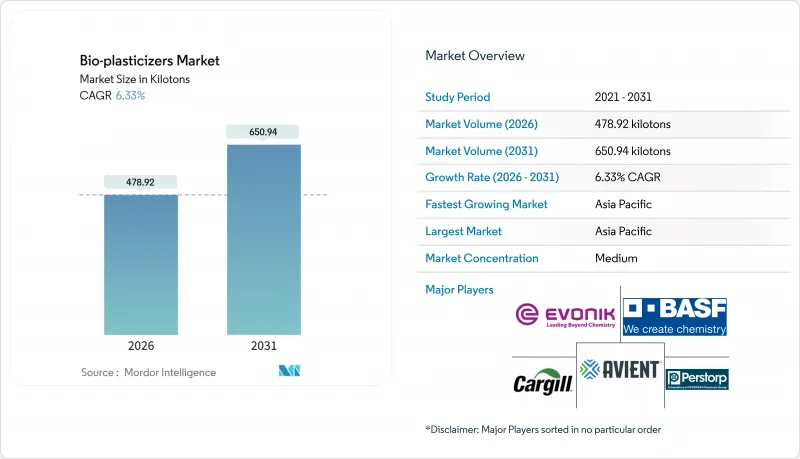
據 Mordor Intelligence 稱,2026 年生物塑化劑市場規模估計為 478.92 千噸,預計在預測期(2026-2031 年)內將以 6.33% 的複合年成長率成長,到 2031 年達到 650.94 千噸。
本報告按產品類型(例如蓖麻油)、原料來源(例如植物油、有機酸和酸酐、甘油酯)、應用領域(例如電線電纜、薄膜和片材、地板材料)、終端用戶行業(例如包裝、建築)以及地區(例如亞太地區、北美)進行細分。市場預測以噸為單位。
全球生物塑化劑市場趨勢與洞察
電線電纜絕緣材料對軟性PVC的需求激增。
到2025年,隨著亞太地區電力公司對電網進行現代化改造以符合低煙標準,電線電纜絕緣材料在生物塑化劑出貨量中佔據了相當大的佔有率。印度的國家基礎設施計畫強制要求使用符合IEC 60502標準的電纜,這推動了對含有阻燃環氧基團的環氧大豆油的需求。東南亞的項目包含生物含量揭露條款,顯示其對檸檬酸鹽和環氧大豆油(ESBO)的偏好。在中國,競標週期逐年推動需求成長,越南和印尼也正在採取類似的電網擴建策略。這些趨勢共同為生物塑化劑市場創造了永續成長的軌道。
嚴格的鄰苯二甲酸酯法規正在加速生物基替代品的採用。
隨著監管機構收緊鄰苯二甲酸酯的暴露限值,預計鄰苯二甲酸酯禁令將推動複合年成長率的提升。從2027年起,美國環保署(EPA)禁止在消費品中使用八種鄰苯二甲酸酯,這將強制要求每年對軟性聚氯乙烯(PVC)的配方進行調整。同時,歐洲化學品管理局(ECHA)已將四種鄰苯二甲酸酯列入其REACH法規候選清單,要求零售商自有品牌產品的生物基含量進行認證。在加州,根據65號提案提起的訴訟進一步加速了產業向檸檬酸鹽的轉型。在日本,食品接觸薄膜中鄰苯二甲酸酯的遷移量已受到限制,這實際上已將傳統塑化劑從超級市場包裝中剔除。這些全球協調一致的努力不僅淘汰了傳統選擇,也為生物替代品創造了快速的市場機會。
植物油價格波動
受阿根廷乾旱和巴西引入B15生物柴油混合燃料等因素的影響,2024年1月至2025年12月期間,大豆油價格大幅上漲。印度實施出口限制後,蓖麻油價格也隨之飆升,對歐洲和北美的混合燃料生產商帶來壓力。印尼出口附加費的調整導致棕櫚油價格波動,進而推高了甘油酯的價格。小規模生產商依靠短期現貨合約維持運營,利潤空間受到擠壓,並將這些成本上漲轉嫁給消費者,導致生物替代品的價格高於鄰苯二甲酸酯。除非原物料避期保值條件改善,否則這些成本上漲預計將對預期的複合年成長率產生負面影響。
細分市場分析
預計到2025年,環氧化大豆油的銷售量將佔總銷售量的40.31%,在軟性薄膜領域展現出成本績效優勢。 「其他」生物塑化劑市場預計將以8.12%的複合年成長率成長,因為琥珀酸二酯和木質素基化合物正逐步滲透到耐高溫汽車零件市場。為了滿足OEM廠商的需求,BASF在北美的生物琥珀酸酯產品線生產的塑化劑耐熱溫度高達200 度C。蓖麻油衍生物符合醫療設備的ISO 10993生物相容性標準。檸檬酸鹽在食品接觸膜和醫藥薄膜領域佔據主導地位,但由於歐洲集中採購的政策,其在歐洲面臨挑戰。由Itaconix公司推出的新型化學品,例如伊康酸,具有抗菌性能,為醫療包裝領域帶來競爭優勢。隨著食用油消費量的減少,創業投資越來越支持以木質素為基礎、利用紙漿產品的生產方法,導致成本下降。
像Matrica這樣的專業公司正策略性地將生物丁二醇和琥珀酸的生產基地整合到同一地點,以最大限度地提高中間產品的利潤率。一家領先的發酵技術領導企業正在生產二辛基琥珀酸,在減少碳足跡的同時,保持了己二酸酯的柔軟性。贏創的「VESTINOL」系列產品簡化了製藥業客戶的合格流程。透過將環氧化亞麻籽油和磷酸鹽穩定劑結合,混合配方實現了150 度C以上的熱穩定性。這些進展共同表明,塑化劑市場正朝著性能導向型方向發展,從而拓寬了生物塑化劑市場的前景。
到2025年,植物油將佔50.22%的市場佔有率,但源自「其他原料」的生物塑化劑市場規模預計到2031年將以7.59%的複合年成長率成長。嘉吉公司利用非基因改造大豆油,在確保醫藥級塑化劑供應的同時,也實現了高利潤率。檸檬酸酐和馬來酸酐作為聚氯乙烯(PVC)的pH穩定劑,佔據了相當大的市場佔有率。榮布恩茨勞爾公司正透過將瑞士檸檬酸產量的一部分用於生產塑化劑,來鞏固其市場地位。
由於歐盟RED III指令對農作物衍生生質柴油的限制,甘油酯面臨供應緊張的局面。此限制抑制了甘油的供應,導致價格上漲。為因應此問題,Emery Oleochemicals公司已將粗甘油純化至高純度,用於醫藥領域。 UPM公司正在測試硫酸鹽木質素為基礎的塑化劑,將紙漿廢棄物轉化為收入來源,並避免陷入食品與燃料之爭。這種向非食品原料的策略轉型不僅緩解了價格衝擊,也滿足了品牌所有者對不涉及森林砍伐的供應鏈的需求,從而增強了生物塑化劑市場的韌性。
區域分析
預計到2025年,亞太地區將佔全球市場規模的35.22%,並以7.81%的複合年成長率成長,這主要得益於電網基礎設施的建設和新包裝法規的實施。在中國,超高壓電纜合約中強制要求使用阻燃PVC,特別是與ESBO相容的PVC。在印度,雄心勃勃的基礎設施建設計劃正在進行中,這將推動電纜產業向低毒電纜轉型。日本透過「綠色轉型」補貼計畫支持製造商,促進生物基化學品的應用,並加強國內複合材料生產商的能力建設。韓國的K-REACH法規對鄰苯二甲酸酯的進口實施了限制,促使市場需求轉向國內生物基替代品。同時,東南亞正在大力投資可再生能源,生物基含量條款在採購過程中也變得越來越重要。
北美在2025年佔據了顯著的市場佔有率。隨著美國環保署(EPA)對鄰苯二甲酸酯的禁令即將生效,業界正準備進行配方的大幅調整。加拿大的「化學品管理計劃」與美國的計劃高度一致。在墨西哥,汽車工廠正在改用檸檬酸鹽化合物,以符合美國原始設備製造商(OEM)的規格要求。此外,美國農業部的「生物優先」(BioPreferred)計畫正在投入大量聯邦資金用於認證塑化劑。
歐洲也佔據了相當大的佔有率。 《包裝和包裝廢棄物法規》對薄膜的生物基含量提出了要求。德國聯邦環境局(Umweltbundesamt)建議在建築材料中添加生物塑化劑,以便獲得補助。在英國,自脫歐以來,相關法規已與REACH法規保持一致,以確保鄰苯二甲酸酯的限制得以維持。法國的AGEC法案堅決反對一次性塑膠,並鼓勵加工商過渡到ESBO(大豆植物油),ESBO可無縫整合到PVC回收流程。在南美洲,當地生產的大豆油正被用於ESBO的生產,而沙烏地阿拉伯的「2030願景」基礎設施計畫正在推動中東地區新興的需求。
其他好處:
- Excel格式的市場預測(ME)表
- 三個月的分析師支持
目錄
第1章:引言
- 研究假設和市場定義
- 調查範圍
第2章:調查方法
第3章執行摘要
第4章 市場狀況
- 市場概覽
- 市場促進因素
- 用作電線電纜絕緣材料的軟性PVC需求激增。
- 對鄰苯二甲酸酯的嚴格監管正在加速生物基替代品的採用。
- 亞太地區生物煉製產能快速擴張。
- 包裝行業的永續發展
- 原始設備製造商正在推動醫用導管中採用非遷移性塑化劑。
- 市場限制因素
- 植物油價格波動
- 高溫應用中的性能差異
- 降低生質柴油的摻混比例後,全球甘油過剩問題將得到緩解。
- 價值鏈分析
- 波特五力模型
第5章 市場規模與成長預測
- 依產品類型
- 環氧大豆油(ESBO)
- 蓖麻油
- 檸檬酸鹽
- 琥珀酸
- 其他類型(例如伊康酸)
- 按原料來源
- 植物油
- 有機酸和酸酐
- 甘油酯
- 其他(例如木質素類化合物)
- 透過使用
- 電線電纜
- 薄膜和片材
- 地板材料、屋頂和牆壁材料
- 醫療器材
- 消費品
- 其他用途(汽車內裝零件等)
- 按最終用戶行業分類
- 包裝
- 建築/施工
- 衛生保健
- 電氣和電子設備
- 車
- 消費品
- 其他(紡織品、鞋類等)
- 按地區
- 亞太地區
- 中國
- 印度
- 日本
- 韓國
- 其他亞太國家
- 北美洲
- 美國
- 加拿大
- 墨西哥
- 歐洲
- 德國
- 英國
- 法國
- 義大利
- 其他歐洲國家
- 南美洲
- 巴西
- 阿根廷
- 其他南美國家
- 中東和非洲
- 沙烏地阿拉伯
- 南非
- 其他中東和非洲國家
- 亞太地區
第6章 競爭情勢
- 市場集中度
- 策略趨勢
- 市佔率和排名分析
- 公司簡介
- Avient Corporation
- Baerlocher GmbH
- BASF SE
- Cargill, Incorporated.
- ChemPoint
- Danimer Scientific
- DIC Corporation
- Dow
- Emery Oleochemicals
- Evonik Industries AG
- Hebei Jingu Plasticizer Co. Ltd.
- JIAAO ENPROTECH
- Jungbunzlauer Suisse AG, Basel
- KLJ Group
- LANXESS
- Matrica SpA
- OXEA GmbH
- Perstorp
- PTT Global Chemical Public Company Limited
- Roquette Freres
- Teknor Apex
第7章 市場機會與未來展望
According to Mordor Intelligence, the bio-plasticizers market size is estimated at 478.92 kilotons in 2026, and is expected to reach 650.94 kilotons by 2031, at a CAGR of 6.33% during the forecast period (2026-2031).
This report is Segmented by Product Type (Castor Oil, and More), Raw-Material Source (Plant Oils, Organic Acids and Anhydrides, Glycerol Esters, and Others), Application (Wire and Cable, Film and Sheet, Flooring, and More), End-User Industry (Packaging, Building and Construction, and More), and Geography (Asia-Pacific, North America, and More). The Market Forecasts are Provided in Terms of Volume (Tons).
Global Bio-plasticizers Market Trends and Insights
Surging Flexible-PVC Demand from Wire and Cable Insulation
In 2025, wire and cable insulation accounted for a significant share of the bio-plasticizer volume, driven by Asia-Pacific utilities modernizing grids to adhere to low-smoke, halogen-free standards. India's National Infrastructure Pipeline mandates IEC 60502-compliant cables, bolstering demand for epoxidized soybean oil due to its epoxy groups that enhance flame retardancy. Projects in Southeast Asia come with bio-content disclosure clauses, showing a preference for citrates and ESBO. China's tender cycle has front-loaded demand annually, with Vietnam and Indonesia mirroring this grid-expansion strategy. Collectively, these developments provide a sustained growth trajectory for the bio-plasticizers market.
Stringent Phthalate Regulations Accelerating Bio-options Adoption
As regulators tighten exposure limits, phthalate bans are projected to boost the forecast CAGR. Starting in 2027, the U.S. EPA's ban on eight phthalates in consumer goods mandates the annual reformulation of flexible PVC. Meanwhile, the European Chemicals Agency has added four phthalates to the REACH Candidate List, leading retailers to insist on bio-content certification for their private-label products. In California, Proposition 65 lawsuits have further accelerated the industry's shift towards citrate esters. Japan has set a limit on phthalate migration in food-contact films, effectively sidelining traditional plasticizers from supermarket packaging. These coordinated global actions not only eliminate established options but also create a swift market opportunity for bio-alternatives.
Price Volatility of Vegetable Oils
Soybean oil prices increased significantly from January 2024 to December 2025, driven by a drought in Argentina and Brazil's adoption of B15 biodiesel blends. Castor oil prices rose sharply after India restricted exports, putting pressure on formulators in Europe and North America. Palm oil prices experienced fluctuations due to changes in export levies by Indonesia, making glycerol esters more expensive. Small producers operating on short-term spot contracts faced margin compressions and passed on these increased costs, resulting in bio-alternatives being priced higher than phthalates. Unless there's an improvement in feedstock hedging, these cost surges are projected to impact the forecast CAGR negatively.
Other drivers and restraints analyzed in the detailed report include:
- Rapid Capacity Additions of Bio-refineries in Asia-Pacific
- Growth of the Sustainable Packaging Industry
- Performance Gap in High-temperature Applications
For complete list of drivers and restraints, kindly check the Table Of Contents.
Segment Analysis
Epoxidized soybean oil held 40.31% of the 2025 volume, demonstrating cost-performance leadership in flexible films. The bio-plasticizers market size for "Other Types" is set to accelerate at an 8.12% CAGR as succinic acid diesters and lignin-based compounds penetrate high-temperature automotive parts. Addressing OEM demands, BASF's North American bio-succinic line produces plasticizers resilient up to 200 °C. Castor oil derivatives meet ISO 10993 biocompatibility standards for medical devices. While citrates lead in food-contact and pharmaceutical films, they grapple with procurement consolidation challenges in Europe. New chemistries, like itaconic acid-brought to market by Itaconix-boast antimicrobial properties, giving them a competitive advantage in healthcare packaging. Highlighting a shift from edible oils, venture capital is increasingly backing lignin-derived methods that utilize cost-negative pulp by-products.
Specialty firms, such as Matrica, are strategically co-locating bio-butanediol and succinic acid production to maximize intermediary margins. Fermentation leaders are producing dioctyl succinate, achieving the flexibility of adipate while reducing carbon footprints. Evonik's VESTINOL range streamlines the qualification process for pharmaceutical clients. By combining epoxidized linseed oil with phosphite stabilizers, hybrid formulations achieve thermal stability exceeding 150 °C. Collectively, these advancements signal a shift towards performance-centric plasticizers, broadening the horizons of the bio-plasticizers market.
Plant oils held a 50.22% share in 2025, yet the bio-plasticizers market size derived from "Other Raw Material Sources" is forecast to grow at a 7.59% CAGR through 2031. Cargill's initiative with non-GMO soybean oil ensures a pharmaceutical-grade supply and secures premium margins. Citric and maleic anhydrides, playing dual roles as pH stabilizers in PVC, captured a significant share. Jungbunzlauer, solidifying its position, allocates a portion of its Swiss citric output to the plasticizer grade.
Glycerol esters grapple with a constrained feedstock as the EU RED-III caps crop-based biodiesel. This limitation curtails glycerol supply, leading to price increases. In response, Emery Oleochemicals has refined crude glycerol to a high purity for pharmaceutical applications. UPM is testing kraft lignin plasticizers, turning pulp waste into profit and avoiding the food-versus-fuel controversy. This strategic shift towards non-food inputs not only mitigates price shocks but also aligns with brand-owner demands for deforestation-free supply chains, enhancing resilience in the bio-plasticizers market.
Complete Report Scope:
- By Product Type
- Epoxidized Soybean Oil (ESBO)
- Castor oil
- Citrates
- Succinic acid
- Other Types (Itaconic acid, etc.)
- By Raw-Material Source
- Plant Oils
- Organic Acids and Anhydrides
- Glycerol Esters
- Others (Lignin-based Compounds, etc.)
- By Application
- Wire and Cable
- Film and Sheet
- Flooring, Roofing and Wall-covering
- Medical Devices
- Consumer Goods
- Other Applications (Automotive Interior Parts, etc.)
- By End-User Industry
- Packaging
- Building and Construction
- Healthcare
- Electrical and Electronics
- Automotive
- Consumer Products
- Others (Textile, Footwear, etc.)
- By Geography
- Asia-Pacific
- China
- India
- Japan
- South Korea
- Rest of Asia-Pacific
- North America
- United States
- Canada
- Mexico
- Europe
- Germany
- United Kingdom
- France
- Italy
- Rest of Europe
- South America
- Brazil
- Argentina
- Rest of South America
- Middle-East and Africa
- Saudi Arabia
- South Africa
- Rest of Middle-East and Africa
- Asia-Pacific
Geography Analysis
Asia-Pacific held 35.22% of the 2025 volume and is primed for a 7.81% CAGR, fueled by grid infrastructure and emerging packaging mandates. In China, ultra-high-voltage contracts mandate the use of flame-retardant PVC, specifically compatible with ESBO. India's ambitious infrastructure pipeline is leaning towards low-toxicity cables. Japan is incentivizing its manufacturers through Green Transformation subsidies, promoting the adoption of bio-based chemicals, and bolstering domestic compounders. South Korea's K-REACH registration is imposing restrictions on phthalate imports, creating a shift in demand towards local bio-alternatives. Meanwhile, Southeast Asia is channeling funding towards renewables, with an emphasis on bio-content clauses in their procurement processes.
In 2025, North America secured a notable share. With the EPA's phthalate ban set to take effect, the industry is bracing for significant reformulation. Canada's Chemicals Management Plan is closely aligned with U.S. timelines. In Mexico, automotive plants are turning to citrate compounds to ensure compliance with U.S. OEM specifications. Additionally, the USDA BioPreferred program is directing substantial federal spending towards certified plasticizers.
Europe managed to capture a notable share. The Packaging and Packaging Waste Regulation mandates a bio-content requirement for films. Germany's Umweltbundesamt is advocating for bio-plasticizer inclusion in construction products to qualify for subsidies. The UK, post-Brexit, is harmonizing its regulations with REACH, ensuring phthalate limits remain intact. France's AGEC law is taking a firm stance against single-use plastics, nudging converters towards ESBO, which seamlessly integrates into PVC recycling streams. In South America, local soybean oil is being harnessed for ESBO production, and Saudi Arabia's Vision 2030 infrastructure initiative is sparking a budding demand in the Middle East.
- Avient Corporation
- Baerlocher GmbH
- BASF SE
- Cargill, Incorporated.
- ChemPoint
- Danimer Scientific
- DIC Corporation
- Dow
- Emery Oleochemicals
- Evonik Industries AG
- Hebei Jingu Plasticizer Co. Ltd.
- JIAAO ENPROTECH
- Jungbunzlauer Suisse AG, Basel
- KLJ Group
- LANXESS
- Matrica SpA
- OXEA GmbH
- Perstorp
- PTT Global Chemical Public Company Limited
- Roquette Freres
- Teknor Apex
Additional Benefits:
- The market estimate (ME) sheet in Excel format
- 3 months of analyst support
TABLE OF CONTENTS
1 Introduction
- 1.1 Study Assumptions and Market Definition
- 1.2 Scope of the Study
2 Research Methodology
3 Executive Summary
4 Market Landscape
- 4.1 Market Overview
- 4.2 Market Drivers
- 4.2.1 Surging flexible-PVC demand from wire and cable insulation
- 4.2.2 Stringent phthalate regulations accelerating bio-options adoption
- 4.2.3 Rapid capacity additions of bio-refineries in Asia-Pacific
- 4.2.4 Growth of the sustainable packaging industry
- 4.2.5 OEM push for non-migratory plasticizers in medical tubing
- 4.3 Market Restraints
- 4.3.1 Price volatility of vegetable oils
- 4.3.2 Performance gap in high-temperature applications
- 4.3.3 Limited global glycerol surplus after biodiesel blend-rate cuts
- 4.4 Value Chain Analysis
- 4.5 Porter's Five Forces
- 4.5.1 Bargaining Power of Suppliers
- 4.5.2 Bargaining Power of Buyers
- 4.5.3 Threat of New Entrants
- 4.5.4 Threat of Substitutes
- 4.5.5 Degree of Competition
5 Market Size and Growth Forecasts (Volume)
- 5.1 By Product Type
- 5.1.1 Epoxidized Soybean Oil (ESBO)
- 5.1.2 Castor oil
- 5.1.3 Citrates
- 5.1.4 Succinic acid
- 5.1.5 Other Types (Itaconic acid, etc.)
- 5.2 By Raw-Material Source
- 5.2.1 Plant Oils
- 5.2.2 Organic Acids and Anhydrides
- 5.2.3 Glycerol Esters
- 5.2.4 Others (Lignin-based Compounds, etc.)
- 5.3 By Application
- 5.3.1 Wire and Cable
- 5.3.2 Film and Sheet
- 5.3.3 Flooring, Roofing and Wall-covering
- 5.3.4 Medical Devices
- 5.3.5 Consumer Goods
- 5.3.6 Other Applications (Automotive Interior Parts, etc.)
- 5.4 By End-User Industry
- 5.4.1 Packaging
- 5.4.2 Building and Construction
- 5.4.3 Healthcare
- 5.4.4 Electrical and Electronics
- 5.4.5 Automotive
- 5.4.6 Consumer Products
- 5.4.7 Others (Textile, Footwear, etc.)
- 5.5 By Geography
- 5.5.1 Asia-Pacific
- 5.5.1.1 China
- 5.5.1.2 India
- 5.5.1.3 Japan
- 5.5.1.4 South Korea
- 5.5.1.5 Rest of Asia-Pacific
- 5.5.2 North America
- 5.5.2.1 United States
- 5.5.2.2 Canada
- 5.5.2.3 Mexico
- 5.5.3 Europe
- 5.5.3.1 Germany
- 5.5.3.2 United Kingdom
- 5.5.3.3 France
- 5.5.3.4 Italy
- 5.5.3.5 Rest of Europe
- 5.5.4 South America
- 5.5.4.1 Brazil
- 5.5.4.2 Argentina
- 5.5.4.3 Rest of South America
- 5.5.5 Middle-East and Africa
- 5.5.5.1 Saudi Arabia
- 5.5.5.2 South Africa
- 5.5.5.3 Rest of Middle-East and Africa
- 5.5.1 Asia-Pacific
6 Competitive Landscape
- 6.1 Market Concentration
- 6.2 Strategic Moves
- 6.3 Market Share(%)/Ranking Analysis
- 6.4 Company Profiles (includes Global level Overview, Market level overview, Core Segments, Financials, Strategic Information, Products and Services, Recent Developments)
- 6.4.1 Avient Corporation
- 6.4.2 Baerlocher GmbH
- 6.4.3 BASF SE
- 6.4.4 Cargill, Incorporated.
- 6.4.5 ChemPoint
- 6.4.6 Danimer Scientific
- 6.4.7 DIC Corporation
- 6.4.8 Dow
- 6.4.9 Emery Oleochemicals
- 6.4.10 Evonik Industries AG
- 6.4.11 Hebei Jingu Plasticizer Co. Ltd.
- 6.4.12 JIAAO ENPROTECH
- 6.4.13 Jungbunzlauer Suisse AG, Basel
- 6.4.14 KLJ Group
- 6.4.15 LANXESS
- 6.4.16 Matrica SpA
- 6.4.17 OXEA GmbH
- 6.4.18 Perstorp
- 6.4.19 PTT Global Chemical Public Company Limited
- 6.4.20 Roquette Freres
- 6.4.21 Teknor Apex
7 Market Opportunities and Future Outlook
- 7.1 White-space and Unmet-Need Assessment

 生物基塑化劑市場預測至2034年-按產品類型、原料、應用、適用性、最終用戶和地區分類的全球分析
 生物塑化劑市場:依產品類型、原料、應用、最終用途、國家及地區分類-產業分析、市場規模、市場佔有率及2026年至2033年預測
 生物塑化劑市場:依原料、應用和最終用途產業分類-2026-2032年全球市場預測
 生物塑化劑市場規模、佔有率、趨勢和預測:按產品、應用和地區分類,2026-2034年
 生物塑化劑市場:按產品、應用和地區分類
 2026年全球生物塑化劑市場報告
 2026-2030年全球塑化劑市場
 塑化劑市場規模、佔有率及成長分析(按產品、應用及地區分類)-2026-2033年產業預測
 生物塑化劑市場-全球產業規模、佔有率、趨勢、機會和預測,依產品、應用、地區和競爭格局分類,2020-2030年預測