


 |
市場調查報告書
商品編碼
2122509
雲端人工智慧:市場佔有率分析、產業趨勢與統計、成長預測(2026-2031)Cloud AI - Market Share Analysis, Industry Trends & Statistics, Growth Forecasts (2026 - 2031) |
||||||

※ 本網頁內容可能與最新版本有所差異。詳細情況請與我們聯繫。
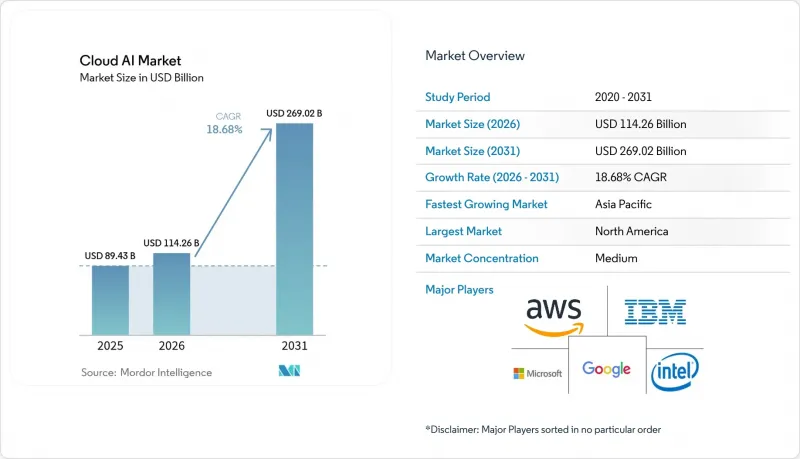
根據 Mordor Intelligence 預測,到 2025 年,雲端 AI 市場規模將達到 894.3 億美元,到 2026 年將達到 1,142.6 億美元,到 2031 年將達到 2,690.2 億美元,2026 年至 2031 年的複合年成長率為 18.68%。
本報告按類型(解決方案和服務)、最終用戶產業(銀行、金融服務和保險、醫療保健、汽車和旅遊等)、部署模式(公共雲端、私有雲端、混合雲和多重雲端)、應用(客戶服務和客服中心人工智慧等)、技術(機器學習、電腦視覺等)以及地區進行細分。市場預測以價值(美元)表示。
全球雲端人工智慧市場趨勢與洞察
巨量資料量正在不斷成長。
到2025年,各組織將產生120澤字節的數據,只有可擴展的雲AI平台才能經濟高效地攝取、標註和分析如此龐大的多模態資料集。透過利用公共雲端物件存儲,製造商可以長期、低成本地存儲用於預測性維護演算法的機器視覺影像,這些演算法可以提前數週檢測到熱異常。金融機構正在將交易日誌和客服中心對話記錄聚合到雲端資料湖中,並應用自然語言處理(NLP)來發現基於規則的引擎可能遺漏的新型詐騙活動。憑藉9/11事件般的持久性保證和低於每GB 0.02美元的價格,人們對擴展本地儲存以用於AI用例的興趣幾乎正在減弱。因此,對自動化資料管道、特徵儲存和可擴展標註服務的需求正在進一步加速雲端AI市場的成長。
人工智慧即服務 (AIaaS) 的日益普及
隨著機器學習專業知識有限的公司紛紛採用承包模型API,人工智慧即服務(AIaaS)收入在2025年達到了280億美元。 Databricks的模型服務每月處理140億次推理調用,並證明一鍵部署可以將生產週期從幾個季度縮短到幾週。 Snowflake Cortex使SQL分析師能夠在熟悉的查詢中運行情緒分析和翻譯模型,從而將其應用範圍擴展到資料科學團隊之外。 2025年的一項調查顯示,42%的歐洲中小企業已經在使用雲端自然語言處理(NLP)或視覺API,這主要得益於按需付費的付費使用制,該模式消除了初始授權成本的風險。這些趨勢正在推動各種規模的企業在短期內採用AIaaS雲端人工智慧。
熟練人員短缺和資料安全的擔憂
到2025年,全球將出現140萬機器學習(ML)專業人才缺口,而矽谷的薪資中位數已達38.5萬美元,許多中型企業將難以招募人才。目前僅有8.7萬人獲得人工智慧博士學位,遠低於市場需求的成長速度。一次雲端儲存桶配置錯誤導致23億筆記錄洩露,使得34%的資訊長推遲了資料遷移,直到零信任和加密措施成熟。 GDPR和CCPA的罰款總額已達20.3億美元,進一步凸顯了處理高度敏感個人資料的產業合規的重要性。如果訓練系統和安全工具的自動化程度不提高,人才短缺和資料外洩的擔憂仍將是主要障礙。
細分市場分析
到 2025 年,解決方案將佔據雲端 AI 市場 62.39% 的佔有率。這反映出企業傾向於選擇承包基礎設施、PaaS 工具以及能夠縮短開發週期的廣泛市場。所有超大規模資料中心業者供應商提供的 GPU 最佳化實例仍然是一項主要支出,而 Databricks Lakehouse AI 和 Snowflake Cortex 則抽象化了資料準備和版本控制,使零售商能夠按時部署假期季節建議引擎。像 Hugging Face 這樣的模型中心託管了 34 萬個演算法,使團隊能夠微調 BERT 或 Stable Diffusion 模型,而無需從頭開始訓練。此外,隨著電腦視覺和程式碼產生工作負載的激增,客戶繼續為承諾可預測延遲和內建管治的解決方案包預留預算。
預計到2031年,服務市場將以20.19%的複合年成長率成長,這主要得益於專家對偏差緩解的指導以及能夠保證生產推理99.9%運轉率的託管服務。隨著歐盟人工智慧法案於2026年生效,67%的歐洲公司已表示有意將合規性審計和模型文件外包,預計這將提升服務市場在預測期內整體雲端人工智慧市場的佔有率。現有的訓練合約已包含漂移警報、對抗性過濾和零日漏洞修補等功能,使客戶能夠在不增加人事費用下解決人工智慧人才短缺問題。這些因素共同作用,使得供應商即使在那些繼續自行營運核心基礎設施的企業中,也能提高其預算佔有率。
預計到2025年,公共雲端將佔總支出的70.24%,其靈活的容量和對新晶片(H100、H200、MI300X)的快速存取仍將是決定性優勢。尤其是數位原生企業,它們非常重視付費使用制模式,這使它們能夠避免在資料中心、冷卻和高速網路方面進行資本支出(CAPEX)。公有平台現在提供打包的AutoML和基礎建模API,使業務分析師能夠在幾天內而非幾個季度內啟動試點營運。然而,監管機構繼續敦促金融、醫療保健和政府用戶將敏感資料保留在國內,這迫使團隊對其架構進行拆分。
混合雲和多重雲端部署預計將以 22.31% 的複合年成長率 (CAGR) 成長。這是因為 54% 的企業目前至少在兩個雲端服務供應商之間調度其 AI 工作負載,以避免供應商鎖定並實現延遲目標。銀行正在將其交易帳簿遷移回私有雲端以符合 GDPR 的要求,同時將匿名化特徵發送回公共叢集以進行大規模模型訓練。醫療保健網路也遵循類似的模式,將個人健康資訊 (PHI) 儲存在本地,並將提取的特徵張量發送到 GPU 叢集進行聯邦學習。因此,能夠跨供應商標準化 MLOps、特徵儲存、可觀測性儀表板和策略引擎的工具正在成為雲端 AI 市場成長要素。
區域分析
預計到2025年,北美將佔據全球雲端人工智慧市場的40.59%。這反映了財富500強企業雄厚的預算,以及超大規模資料中心業者資料中心營運商在同年超過2,000億美元的新資料中心建設投資。自主計算計劃也在不斷擴展。加拿大的泛加拿大人工智慧戰略累計24億加幣(約17.7億美元)用於人才引進和本地GPU叢集建設。墨西哥利用近岸外包模式在其汽車和電子供應鏈中部署雲端人工智慧,使該地區的雲端業務收益年增19%。在美國,企業報告稱,生成式人工智慧試點部署的投資回報率中位數高達240%,這項成果推動了該地區雲端人工智慧市場的持續成長。這些因素共同確保了北美在大型參數化模型的訓練和推理應用領域中保持領先地位。
預計到2031年,亞太地區將以22.74%的複合年成長率實現最高成長,這主要得益於政府主導的政策以及對本地化模型生態系統的私人投資增加。在中國的「自主人工智慧」策略指導下,每年約有180億美元的企業支出轉向國內人工智慧雲,加速了本地訓練的基礎模式的普及應用。印度的「國家人工智慧計畫」撥款1,030億印度盧比(約12.4億美元)用於在多個城市建設GPU叢集,並向1.4萬家新創公司提供運算資源補貼,從而為開發者利用先進半導體晶片創造了更多機會。日本和韓國已總合投資15億美元用於邊緣雲端基礎設施和國內人工智慧晶片生產,致力於降低智慧城市和自動駕駛項目中的推理延遲。
到2025年,涵蓋歐洲、南美以及中東和非洲的地區將佔全球收入的37%,而全部區域的監管趨勢目前正在影響採購標準。即將實施的歐盟人工智慧法案將使62%的受訪公司能夠在2026年正式實施前部署可解釋人工智慧工具並聘請合規顧問。德國的「歐洲人工智慧」計畫已撥款30億歐元(約33.9億美元)用於建造主權雲端節點,並在第一年就吸引了340家企業租戶。巴西銀行和阿根廷農業技術公司正透過詐欺分析和精密農業解決方案,推動南美洲雲端人工智慧市場規模在2025年成長18%。海灣合作理事會(GCC)國家正在人工智慧基礎設施投資120億美元,沙烏地阿拉伯的NEOM計畫正在推進自動駕駛汽車試驗和智慧電網最佳化。在非洲,到2025年,電信業者將利用人工智慧驅動的信用評分系統,為820萬銀行帳戶的成年人提供小額貸款。這顯示該地區仍處於發展初期,蘊藏著巨大的商業機會和發展潛力。
其他好處:
- Excel格式的市場預測(ME)表
- 3個月的分析師支持
目錄
第1章:引言
- 研究假設和市場定義
- 調查範圍
第2章:調查方法
第3章執行摘要
第4章 市場狀況
- 市場概覽
- 產業價值鏈分析
- 宏觀經濟因素對市場的影響
- 市場促進因素
- 巨量資料日益成長
- 擴大人工智慧即服務 (AIaaS) 的應用
- 對虛擬助理和生成式人工智慧聊天機器人的需求日益成長
- GenAI 的 GPU 共享方案正在擴大中小企業的使用範圍。
- 邊緣雲端人工智慧互通性標準(例如 ONNX、MEDAL)
- 獎勵碳感知型工作負載編配
- 市場限制因素
- 熟練勞動力短缺和資料安全擔憂
- GPU和HBM供應鏈的供不應求依然存在。
- 人工智慧資料中心的能源限制和碳排放法規
- 法律規範
- 監理情勢
- 技術展望
- 波特五力分析
第5章 市場規模與成長預測
- 按類型
- 解決方案
- 基礎設施(運算、儲存、網路)
- 人工智慧平台即服務 (PaaS)
- 模型市場
- 服務
- 專業服務
- 託管服務
- 解決方案
- 按最終用戶行業分類
- 銀行、金融服務和保險(BFSI)
- 衛生保健
- 汽車與出行
- 零售與電子商務
- 政府/公共部門
- 教育
- 製造業
- 按部署模式
- 公共雲端
- 私有雲端
- 混合雲端和多重雲端
- 透過使用
- 人工智慧在客戶服務和客服中心的應用
- 預測性維護和資產管理
- 詐欺和風險分析
- 行銷與個人化
- 電腦視覺即服務
- 透過技術
- 機器學習
- 自然語言處理
- 電腦視覺
- 人工智慧世代
- 強化學習和邊緣人工智慧
- 按地區
- 北美洲
- 美國
- 加拿大
- 墨西哥
- 南美洲
- 巴西
- 阿根廷
- 智利
- 其他南美國家
- 歐洲
- 德國
- 英國
- 法國
- 義大利
- 西班牙
- 荷蘭
- 俄羅斯
- 其他歐洲國家
- 亞太地區
- 中國
- 印度
- 日本
- 韓國
- ASEAN
- 其他亞太國家
- 中東
- GCC
- 土耳其
- 其他中東國家
- 非洲
- 南非
- 奈及利亞
- 肯亞
- 其他非洲國家
- 北美洲
第6章 競爭情勢
- 市場集中度
- 策略趨勢
- 市佔率分析
- 公司簡介
- Amazon Web Services
- Microsoft Corp.
- Google LLC
- IBM Corp.
- Salesforce Inc.
- NVIDIA Corp.
- Oracle Corp.
- Alibaba Cloud
- SAP SE
- ServiceNow Inc.
- Databricks Inc.
- Snowflake Inc.
- Hugging Face Inc.
- OpenAI LP
- Anthropic PBC
- CoreWeave Inc.
- AMD Inc.
- Intel Corp.
- Wipro Ltd.
- Infosys Ltd.
- SoundHound AI Inc.
- Twilio Inc.
- Cohere Inc.
- Tencent Cloud
第7章 市場機會與未來展望
According to Mordor Intelligence, the cloud AI market size is projected to be USD 89.43 billion in 2025, USD 114.26 billion in 2026, and reach USD 269.02 billion by 2031, growing at a CAGR of 18.68% from 2026 to 2031.
This report is Segmented by Type (Solutions, and Services), End-User Vertical (BFSI, Healthcare, Automotive and Mobility, and More), Deployment Model (Public Cloud, Private Cloud, and Hybrid and Multi-Cloud), Application (Customer Service and Contact-Center AI, and More), Technology (Machine Learning, Computer Vision, and More), and Geography. The Market Forecasts are Provided in Terms of Value (USD).
Global Cloud AI Market Trends and Insights
Rising Big-Data Volume
Organizations generated 120 zettabytes of data in 2025, and only scalable cloud AI platforms can cost-effectively ingest, label, and analyze multimodal datasets at that magnitude. Public-cloud object stores give manufacturers inexpensive retention of machine-vision footage used for predictive-maintenance algorithms that spot thermal anomalies weeks in advance. Financial institutions are funneling transaction logs and call-center transcripts into cloud data lakes, then applying NLP to surface emerging fraud behaviors that rule-based engines miss. Eleven-nines durability guarantees and sub-USD 0.02 per-gigabyte pricing have all but ended interest in on-premises storage expansions for AI use cases. As a result, demand for data-pipeline automation, feature stores, and scalable annotation services is amplifying the growth of the cloud AI market.
Growing Adoption of AI-as-a-Service (AIaaS)
AIaaS revenue reached USD 28 billion in 2025 as firms without deep ML talent embraced turnkey model APIs. Databricks' Model Serving processed 14 billion monthly inference calls, demonstrating how one-click deployment compresses time-to-production from quarters to weeks. Snowflake Cortex enabled SQL analysts to run sentiment and translation models inside familiar queries, widening access beyond data-science teams. A 2025 survey showed 42% of European SMEs already consume cloud NLP or vision APIs because consumption pricing removes up-front licensing risk. These dynamics position AIaaS as a near-term accelerator of cloud AI uptake across company sizes.
Lack of Skilled Workforce and Data-Security Concerns
The global shortage of 1.4 million ML professionals in 2025 pushed Silicon Valley median compensation to USD 385,000, pricing out many mid-market firms. Universities produced only 87,000 AI-focused doctorates, well below demand growth. Misconfigured cloud buckets exposed 2.3 billion records, triggering 34% of CIOs to postpone migrations until zero-trust and encryption controls mature. GDPR and CCPA fines reached USD 2.03 billion, raising the compliance stakes for sectors handling sensitive personal data. Without improved training pipelines and automated security tooling, talent scarcity and breach fears remain formidable obstacles.
Other drivers and restraints analyzed in the detailed report include:
- Increasing Demand for Virtual Assistants and Generative-AI Chatbots
- GenAI GPU-Fractionalization Expanding SME Access
- Persistent GPU and HBM Supply-Chain Shortages
For complete list of drivers and restraints, kindly check the Table Of Contents.
Segment Analysis
Solutions held a 62.39% cloud AI market share in 2025, reflecting enterprises' preference for turnkey infrastructure, PaaS tooling, and expansive model marketplaces that shorten development cycles. GPU-optimized instances from every hyperscaler remained the anchor purchase, while Databricks Lakehouse AI and Snowflake Cortex abstracted data prep and version control so retailers could roll out holiday recommendation engines on time. Model hubs such as Hugging Face hosted 340,000 algorithms, letting teams fine-tune BERT or Stable Diffusion instead of training from scratch, computer vision, and code-generation workloads proliferate, customers continue to funnel budget toward solution bundles that promise predictable latency and embedded governance.
Services are set to post a 20.19% CAGR through 2031, driven by professional guidance on bias mitigation and managed offerings that guarantee 99.9% uptime for production inference. As the EU AI Act starts enforcement in 2026, 67% of European firms intend to outsource compliance audits and model documentation, raising the services slice of overall cloud AI market size during the forecast window. Continuous-training contracts already cover drift alerts, adversarial filtering, and zero-day patching, helping clients bridge the AI-talent gap without ballooning payrolls. Collectively, these factors position service vendors to capture a growing share of budget even among organizations that keep core infrastructure in-house.
Public cloud accounted for 70.24% of 2025 spending, with elastic capacity and rapid access to new silicon, H100, H200, MI300X, remaining decisive advantages. Digital-native firms especially prize the pay-as-you-go economics that avoid capex on data centers, cooling, and high-speed networking. Public platforms now package AutoML and foundation-model APIs, letting business analysts stand up pilots in days rather than quarters. Yet regulators continue to push finance, healthcare, and government users to retain sensitive data within national borders, forcing teams to bifurcate architectures.
Hybrid and multi-cloud deployments are projected to expand at a 22.31% CAGR, as 54% of enterprises now schedule AI workloads across at least two providers to sidestep lock-in and meet latency goals. Banks repatriate transaction ledgers to private clouds for GDPR compliance, while anonymized features flow back to public clusters for large-scale model training. Healthcare networks follow a similar pattern by storing PHI on-premises and shipping stripped tensors to GPU farms for federated learning. Tooling that normalizes MLOps across providers, feature stores, observability dashboards, and policy engines, is therefore emerging as a pivotal growth vector for the cloud AI market.
Complete Report Scope:
- By Type
- Solution
- Infrastructure (Compute, Storage, Networking)
- Platform-as-a-Service for AI
- Model Marketplace
- Service
- Professional Services
- Managed Services
- Solution
- By End-User Vertical
- Banking, Financial Services, and Insurance (BFSI)
- Healthcare
- Automotive and Mobility
- Retail and E-Commerce
- Government and Public Sector
- Education
- Manufacturing
- By Deployment Model
- Public Cloud
- Private Cloud
- Hybrid and Multi-Cloud
- By Application
- Customer Service and Contact-Center AI
- Predictive Maintenance and Asset Operations
- Fraud and Risk Analytics
- Marketing and Personalization
- Computer-Vision-as-a-Service
- By Technology
- Machine Learning
- Natural Language Processing
- Computer Vision
- Generative AI
- Reinforcement and Edge AI
- By Geography
- North America
- United States
- Canada
- Mexico
- South America
- Brazil
- Argentina
- Chile
- Rest of South America
- Europe
- Germany
- United Kingdom
- France
- Italy
- Spain
- Netherlands
- Russia
- Rest of Europe
- Asia-Pacific
- China
- India
- Japan
- South Korea
- ASEAN
- Rest of Asia-Pacific
- Middle East
- GCC
- Turkey
- Rest of Middle East
- Africa
- South Africa
- Nigeria
- Kenya
- Rest of Africa
- North America
Geography Analysis
North America commanded a 40.59% cloud AI market share in 2025, reflecting deep Fortune 500 budgets and hyperscaler capital expenditure that topped USD 200 billion on new datacenter builds during the year. Sovereign-compute initiatives are also scaling: Canada's Pan-Canadian AI Strategy earmarked CAD 2.4 billion (USD 1.77 billion) to retain talent and fund local GPU clusters. Mexico leveraged near-shoring to infuse cloud AI into automotive and electronics supply chains, pushing regional cloud-services revenue up 19% year over year. Across the United States, enterprises report median 240% ROI on generative-AI pilots, an outcome that fuels continued expansion of the cloud AI market in the region. Taken together, these factors keep North America at the forefront of large-parameter model training and inference consumption.
Asia-Pacific is projected to record the fastest 22.74% CAGR through 2031, propelled by state-led mandates and rising private investment in localized model ecosystems. China redirected roughly USD 18 billion in annual enterprise spending toward domestic AI clouds under its sovereign-AI directive, accelerating adoption of locally trained foundation models. India's National AI Mission allocated INR 103 billion (USD 1.24 billion) for multi-city GPU clusters and subsidized compute credits for 14,000 startups, broadening developer access to advanced silicon. Japan and South Korea committed a combined USD 1.5 billion to edge-cloud infrastructure and domestic AI-chip production, actions that shorten inference latency for smart-city and autonomous-mobility projects.
Europe, South America, Middle East, and Africa together accounted for 37% of 2025 revenue, and regulatory dynamics now shape procurement criteria across these territories. The forthcoming EU AI Act is prompting 62% of surveyed enterprises to adopt explainable-AI tooling and engage compliance consultants before 2026 go-live. Germany's AI Made in Europe program set aside EUR 3 billion (USD 3.39 billion) for sovereign cloud nodes, attracting 340 enterprise tenants in its first year. Brazil's banks and Argentina's agritech firms pushed South American cloud AI market size upward by 18% in 2025 through fraud analytics and precision-farming solutions. GCC nations invested USD 12 billion in AI infrastructure, with Saudi Arabia's NEOM project piloting autonomous fleets and smart-grid optimization. In Africa, mobile carriers used AI-powered credit scoring to extend micro-loans to 8.2 million unbanked adults in 2025, underscoring the region's early-stage yet high-impact opportunity set.
- Amazon Web Services
- Microsoft Corp.
- Google LLC
- IBM Corp.
- Salesforce Inc.
- NVIDIA Corp.
- Oracle Corp.
- Alibaba Cloud
- SAP SE
- ServiceNow Inc.
- Databricks Inc.
- Snowflake Inc.
- Hugging Face Inc.
- OpenAI LP
- Anthropic PBC
- CoreWeave Inc.
- AMD Inc.
- Intel Corp.
- Wipro Ltd.
- Infosys Ltd.
- SoundHound AI Inc.
- Twilio Inc.
- Cohere Inc.
- Tencent Cloud
Additional Benefits:
- The market estimate (ME) sheet in Excel format
- 3 months of analyst support
TABLE OF CONTENTS
1 INTRODUCTION
- 1.1 Study Assumptions and Market Definition
- 1.2 Scope of the Study
2 RESEARCH METHODOLOGY
3 EXECUTIVE SUMMARY
4 MARKET LANDSCAPE
- 4.1 Market Overview
- 4.2 Industry Value Chain Analysis
- 4.3 Impact of Macroeconomic Factors on the Market
- 4.4 Market Drivers
- 4.4.1 Rising Big-Data Volume
- 4.4.2 Growing Adoption of AI-as-a-Service (AIaaS)
- 4.4.3 Increasing Demand for Virtual Assistants and Generative-AI Chatbots
- 4.4.4 GenAI GPU-Fractionalization Expanding SME Access
- 4.4.5 Edge-Cloud AI Interoperability Standards (e.g., ONNX, MEDAL)
- 4.4.6 Carbon-Aware Workload Orchestration Incentives
- 4.5 Market Restraints
- 4.5.1 Lack of Skilled Workforce and Data-Security Concerns
- 4.5.2 Persistent GPU and HBM Supply-Chain Shortages
- 4.5.3 AI Datacenter Energy Constraints and Carbon Regulations
- 4.5.4 Geopolitical GPU Export-Control Frameworks
- 4.6 Regulatory Landscape
- 4.7 Technological Outlook
- 4.8 Porter's Five Forces Analysis
- 4.8.1 Threat of New Entrants
- 4.8.2 Bargaining Power of Suppliers
- 4.8.3 Bargaining Power of Buyers
- 4.8.4 Threat of Substitutes
- 4.8.5 Intensity of Competitive Rivalry
5 MARKET SIZE AND GROWTH FORECASTS (VALUE)
- 5.1 By Type
- 5.1.1 Solution
- 5.1.1.1 Infrastructure (Compute, Storage, Networking)
- 5.1.1.2 Platform-as-a-Service for AI
- 5.1.1.3 Model Marketplace
- 5.1.2 Service
- 5.1.2.1 Professional Services
- 5.1.2.2 Managed Services
- 5.1.1 Solution
- 5.2 By End-User Vertical
- 5.2.1 Banking, Financial Services, and Insurance (BFSI)
- 5.2.2 Healthcare
- 5.2.3 Automotive and Mobility
- 5.2.4 Retail and E-Commerce
- 5.2.5 Government and Public Sector
- 5.2.6 Education
- 5.2.7 Manufacturing
- 5.3 By Deployment Model
- 5.3.1 Public Cloud
- 5.3.2 Private Cloud
- 5.3.3 Hybrid and Multi-Cloud
- 5.4 By Application
- 5.4.1 Customer Service and Contact-Center AI
- 5.4.2 Predictive Maintenance and Asset Operations
- 5.4.3 Fraud and Risk Analytics
- 5.4.4 Marketing and Personalization
- 5.4.5 Computer-Vision-as-a-Service
- 5.5 By Technology
- 5.5.1 Machine Learning
- 5.5.2 Natural Language Processing
- 5.5.3 Computer Vision
- 5.5.4 Generative AI
- 5.5.5 Reinforcement and Edge AI
- 5.6 By Geography
- 5.6.1 North America
- 5.6.1.1 United States
- 5.6.1.2 Canada
- 5.6.1.3 Mexico
- 5.6.2 South America
- 5.6.2.1 Brazil
- 5.6.2.2 Argentina
- 5.6.2.3 Chile
- 5.6.2.4 Rest of South America
- 5.6.3 Europe
- 5.6.3.1 Germany
- 5.6.3.2 United Kingdom
- 5.6.3.3 France
- 5.6.3.4 Italy
- 5.6.3.5 Spain
- 5.6.3.6 Netherlands
- 5.6.3.7 Russia
- 5.6.3.8 Rest of Europe
- 5.6.4 Asia-Pacific
- 5.6.4.1 China
- 5.6.4.2 India
- 5.6.4.3 Japan
- 5.6.4.4 South Korea
- 5.6.4.5 ASEAN
- 5.6.4.6 Rest of Asia-Pacific
- 5.6.5 Middle East
- 5.6.5.1 GCC
- 5.6.5.2 Turkey
- 5.6.5.3 Rest of Middle East
- 5.6.6 Africa
- 5.6.6.1 South Africa
- 5.6.6.2 Nigeria
- 5.6.6.3 Kenya
- 5.6.6.4 Rest of Africa
- 5.6.1 North America
6 COMPETITIVE LANDSCAPE
- 6.1 Market Concentration
- 6.2 Strategic Moves
- 6.3 Market Share Analysis
- 6.4 Company Profiles (includes Global Level Overview, Market Level Overview, Core Segments, Financials as available, Strategic Information, Market Rank/Share, Products and Services, Recent Developments)
- 6.4.1 Amazon Web Services
- 6.4.2 Microsoft Corp.
- 6.4.3 Google LLC
- 6.4.4 IBM Corp.
- 6.4.5 Salesforce Inc.
- 6.4.6 NVIDIA Corp.
- 6.4.7 Oracle Corp.
- 6.4.8 Alibaba Cloud
- 6.4.9 SAP SE
- 6.4.10 ServiceNow Inc.
- 6.4.11 Databricks Inc.
- 6.4.12 Snowflake Inc.
- 6.4.13 Hugging Face Inc.
- 6.4.14 OpenAI LP
- 6.4.15 Anthropic PBC
- 6.4.16 CoreWeave Inc.
- 6.4.17 AMD Inc.
- 6.4.18 Intel Corp.
- 6.4.19 Wipro Ltd.
- 6.4.20 Infosys Ltd.
- 6.4.21 SoundHound AI Inc.
- 6.4.22 Twilio Inc.
- 6.4.23 Cohere Inc.
- 6.4.24 Tencent Cloud
7 MARKET OPPORTUNITIES AND FUTURE OUTLOOK
- 7.1 White-Space and Unmet-Need Assessment

 2026-2030年全球人工智慧雲端基礎設施市場
 雲端人工智慧市場規模、佔有率和成長分析:按組件、部署模式、技術、應用、最終用戶產業、組織規模和地區分類-2026-2033年產業預測
 AI雲端工作負載AI雲端工作負載:市場數據概覽(2026年第二季)
 2026年全球付費語言模式市場報告2026年全球本地部署大型語言模型(LLM)交付平台市場報告
 雲端人工智慧市場:2026-2032年全球市場預測(按組件、技術、託管模式、應用、最終用戶產業、部署模式和企業規模分類)2026年全球大規模語言模型(LLM)雲端服務市場報告2026年全球雲端運算人工智慧市場報告
 雲端人工智慧市場規模、佔有率和趨勢分析報告:按技術、類型、行業、地區和細分市場預測(2026-2033 年)