


 |
市場調查報告書
商品編碼
2122495
外骨骼:市場佔有率分析、產業趨勢與統計、成長預測(2026-2031)Exoskeleton - Market Share Analysis, Industry Trends & Statistics, Growth Forecasts (2026 - 2031) |
||||||

※ 本網頁內容可能與最新版本有所差異。詳細情況請與我們聯繫。
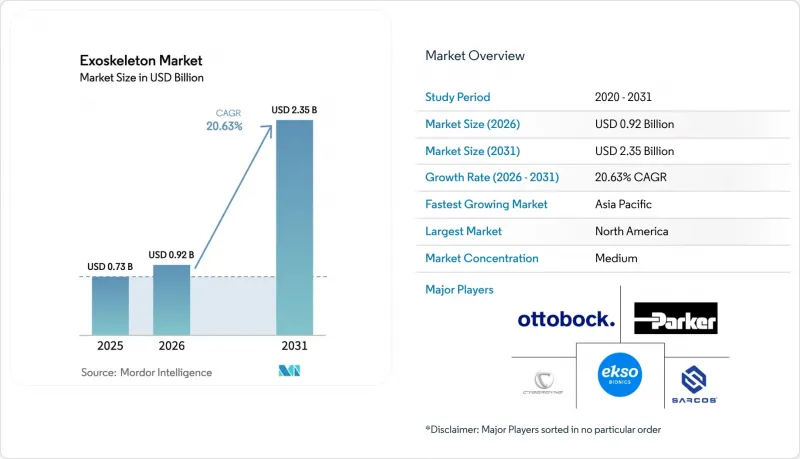
據 Mordor Intelligence 稱,2025 年外骨骼市場價值為 7.3 億美元,預計到 2031 年將達到 23.5 億美元,而 2026 年為 9.2 億美元,預測期(2026-2031 年)的複合年成長率為 20.63%。
本報告按移動方式(下肢、上肢、全身、特定關節/腰椎系統)、動力源/驅動系統(動力/主動、被動、混合、軟體外骨骼)、身體部位(上肢、下肢、全身)、最終用戶(醫院/復健中心、其他)和地區(北美、歐洲、亞太、中東/非洲、南美)進行細分。市場預測以美元計價。
全球外骨骼市場趨勢及洞察
人口老化和神經系統疾病盛行率上升,導致復健需求不斷增加。
全球60歲及以上老年人口預計到2050年將加倍,達到21億,將進一步增加中風、帕金森氏症和脊髓損傷的發生率。在日本,數據顯示機器人步行療法可將中風後患者的平均住院時間縮短14天,因此政策制定者於2024年擴大了Cyberdyne公司HAL機器人的保險覆蓋範圍。歐洲保險公司的試點計畫也印證了類似的結果,顯示基於結果的合約將成為復健設備採購的標準方式。在美國和歐盟,獲得FDA 510(k)認證和符合ISO 13482標準已成為醫療機構部署此類設備的基本要求。這些進展凸顯了市場對能夠恢復直立行走能力、降低壓瘡風險和維持骨骼密度的下肢復健系統的持續需求。
勞動安全法規促進了工業領域的採用
美國職業安全與健康管理局 (OSHA) 修訂後的指導方針將於 2024 年實施,屆時美國雇主將對超過 10 公斤的重物和高空作業進行審核,從而為採用肩部支撐裝置提供監管獎勵。德國聯邦職業安全與健康實驗室的報告顯示,使用被動式外骨骼的工人三角肌肌電圖 (EMG) 活動降低了 30% 至 40%,這促使汽車製造商在焊接、噴漆和組裝廠擴大了此類設備的使用範圍。由於肌肉骨骼疾病的索賠減少導致保險費下降,工廠正利用上身穿戴設備帶來的兩位數內部效益。
資金成本高,贖回有限
臨床外骨骼設備的價格在 8 萬至 15 萬美元之間,且僅限於大學醫院和大型復健連鎖機構購買。在美國,聯邦醫療保險 (Medicare) 要求提供文件證明傳統物理治療無效,並由醫生出具 30 分鐘站立耐受力的證明,這排除了近一半的潛在用戶。私人保險公司將家用型號歸類為「臨床實驗」產品,儘管已獲得美國食品藥物管理局 (FDA) 的批准,但許多患者仍被迫自費。在德國,醫院治療費用可根據診斷相關分組 (DRG) 代碼報銷,但個人設備的報銷則不予考慮;而在義大利和法國,支付機制仍不完善。這些不一致之處阻礙了高成長的居家照護領域的應用,因此,人們越來越需要與真實世界結果數據掛鉤的打包支付試點計畫。
細分市場分析
到2025年,下肢外骨骼設備將佔據外骨骼市場87.81%的佔有率。這反映了它們在中風和脊髓損傷復健領域的成熟應用,在這些領域,步態訓練方案依賴可程式設計的膝關節和髖關節輔助功能。這些設備正持續為復健中心和退伍軍人醫院帶來更新換代的需求。相較之下,上肢外骨骼系統在組裝線上的應用正在加速成長,因為大型汽車製造商和航太公司正在努力解決肩部損傷的成本問題。肩部損傷造成的損失每年超過10億美元,主要原因是生產力下降和索賠,其複合年成長率高達24.06%。工廠的試驗測試證實,在擋風玻璃安裝和機翼鑽孔等任務中,生產效率提高了15-20%,投資回收期極短。這種雙線發展意味著,下肢外骨骼設備正在推動臨床領域的收入成長,而上肢外骨骼設備則在擴大工業領域的收入,並豐富供應商的訂單組合。
上身支撐裝置的進步如今已符合美國和歐盟認證審核中常見的人體工學要求。重量不足3公斤的輕型被動式支架因其可在換班時快速穿戴而廣受歡迎;而結合了高峰值扭矩和預測性維護遙測技術的電動肩部裝置,則正在增強服務合約帶來的經常性收入。全身外骨骼目前仍主要面向需要搬運90公斤重物的重工業用戶,但能夠支撐特定關節的腰部支撐裝置在面臨小包裹處理量空前高企的物流中心正日益受到青睞。
到2025年,動力型外骨骼將佔據外骨骼市場82.83%的佔有率,這對於治療性步態控制和減輕士兵負重至關重要。在臨床應用中,無刷直流馬達結合諧波驅動器可產生40牛頓米的膝關節扭矩,延遲小於50毫秒,這對於神經可塑性復健至關重要。基於彈簧和凸輪的被動式框架非常適合工廠中的高空作業,因為它們無需充電且維護量極低。混合型外骨骼將被動式負載分配與高功率馬達的瞬時輸出相結合,可將運作延長至8-10小時,並符合美國職業安全與健康管理局(OSHA)規定的輪班時間限制。因此,混合型外骨骼的複合年成長率高達27.77%,並且已在汽車行業人體工學工程師的新提案需求中佔據主導地位。
儘管電池驅動型外骨骼仍需遵守IEC 60601標準的監管要求,但被動式外骨骼卻不受許多醫療設備法規的約束。目前,供應商正在韌體能夠根據用戶步態數據調整輔助曲線的固件,將混合型外骨骼定位為“軟體定義資產”,其性能可透過空中升級不斷提升。這種策略著重於能夠產生持續收入的捆綁銷售模式,從而推動訂閱模式超越傳統銷售方式,實現飛躍式發展。隨著能量密度的提高,那些已經最佳化扭力功率比的供應商有望在競爭中脫穎而出,並在日益數據化的價值鏈中鞏固其市場佔有率。
區域分析
到2025年,北美將佔據外骨骼市場40.65%的佔有率。這得益於北美FDA批准的產品系列以及耐用醫療設備供應商強大的經銷網路。美國在凱斯勒醫療中心和謝潑德醫療中心等醫療機構的臨床部署方面處於領先地位,保險公司正基於真實世界數據制定相關法規。美國職業安全與健康管理局(OSHA)2024年人體工學評估指令正在加速從底特律到西雅圖等地的工廠試點部署,環境、健康與安全(EHS)合規預算正被重新分配用於支付外骨骼租賃費用。由於省級預算上限,加拿大發展滯後,而墨西哥的新興市場則在等待社會安全法改革以促進報銷。
亞太地區預計將成為成長最快的地區,到2031年複合年成長率將達到26.87%,這主要得益於中國2.97億60歲及以上人口以及日本的超老齡化社會(該國29%的人口年齡在65歲及以上)。中國當地的醫院正在利用「健康中國2030」計畫的補貼訂購步行治療機器人,而日本的國民健康保險目前已將HAL機器人用於治療八種神經肌肉疾病。韓國設立了500億韓元的機器人基金,扶持國內執行器製造工廠以降低零件成本。澳洲正利用其國家殘障人士保險計畫為試點計畫提供津貼,而印度則正在吸引外國直接投資(FDI),以組裝低成本設備,造福其龐大的中風患者群體。
歐洲的兩極化依然明顯。德國、法國和英國正在實施基於新人體工學指令的大規模工業試點項目,並透過DRG代碼購買帶有CE標誌的復健設備。同時,由於南歐國家採用的報銷機制較為分散,阻礙了資本投資計畫的製定,且向醫療器材法規(MDR)過渡的進度也令進口商捉襟見肘,因此推廣速度較為緩慢。斯堪地那維亞國家正在試驗為農村老年護理機構提供軟體服津貼,而東歐國家則致力於利用歐盟團結基金擴大中風復健體系。在中東,阿拉伯聯合大公國和沙烏地阿拉伯等醫療中心正在為示範醫院引進最先進的設備。相較之下,除巴西聖保羅和里約熱內盧的先導計畫外,非洲和南美洲的推廣應用較為有限。這些試點計畫也受到關稅制度和外匯波動的影響。
其他好處
- Excel格式的市場預測(ME)表
- 3個月的分析師支持
目錄
第1章:引言
- 研究假設和市場定義
- 調查範圍
第2章:調查方法
第3章執行摘要
第4章 市場狀況
- 市場概覽
- 市場促進因素
- 人口老化和神經系統疾病盛行率上升,導致復健需求不斷增加。
- 勞動安全法規促進了工業領域的採用
- 透過國防預算加快研發,以增強士兵的能力。
- TAM 的擴張是由於中等價位、面向消費者的戶外外骨骼的普及。
- 透過 EaaS(外骨骼即服務)訂閱模式降低中小企業的進入門檻。
- 透過基於雲端的療效分析實現基於價值的復健支付。
- 市場限制因素
- 資金成本高,贖回有限
- 電池能量密度限制了運作時間。
- 由於缺乏人體工學測試標準,人們對法律責任表示擔憂。
- 關稅導致執行器部件成本波動,對利潤率造成壓力。
- 價值供應鏈分析
- 監理情勢
- 技術展望
- 波特五力分析
第5章 市場規模與成長預測
- 按交通方式
- 下半身外骨骼
- 上半身外骨骼
- 全身外骨骼
- 特定關節/腰椎系統
- 透過動力源/驅動系統
- 電源類型/主動類型
- 被動的
- 混合
- 軟體外骨骼
- 按身體部位
- 上肢
- 下肢
- 全身
- 最終用戶
- 醫院及復健中心
- 個人和居家照護用戶
- 其他最終用戶
- 按地區
- 北美洲
- 美國
- 加拿大
- 墨西哥
- 歐洲
- 德國
- 英國
- 法國
- 義大利
- 西班牙
- 其他歐洲國家
- 亞太地區
- 中國
- 日本
- 印度
- 澳洲
- 韓國
- 其他亞太國家
- 中東和非洲
- GCC
- 南非
- 其他中東和非洲國家
- 南美洲
- 巴西
- 阿根廷
- 南美洲其他地區
- 北美洲
第6章 競爭情勢
- 市場集中度
- 市佔率分析
- 公司簡介
- B-Temia Inc.
- BIONIK Laboratories Corp.
- Bioness Inc.(Bioventus)
- Bioservo Technologies AB
- CYBERDYNE Inc.
- Ekso Bionics Holdings Inc.
- Fourier Intelligence
- Gogoa Mobility Robots
- Lockheed Martin Corporation
- Myomo Inc.
- Ottobock SE & Co. KGaA
- Panasonic Corporation
- Parker Hannifin Corporation
- RB3D SAS
- ReWalk Robotics Ltd.
- Rehab-Robotics Co. Ltd.
- Sarcos Technology & Robotics Corporation
- Seismic Powered Clothing
- Wearable Robotics SRL
第7章 市場機會與未來展望
According to Mordor Intelligence, the exoskeleton market size was valued at USD 0.73 billion in 2025 and is estimated to grow from USD 0.92 billion in 2026 to reach USD 2.35 billion by 2031, at a CAGR of 20.63% during the forecast period (2026-2031).
This report is Segmented by Mobility Type (Lower-Body, Upper-Body, Full-Body, Joint-Specific/Waist Systems), Power Source/Mode (Powered/Active, Passive, Hybrid, Soft Exosuits), Body Part (Upper Limb, Lower Limb, Full Body), End User (Hospitals & Rehab Centers, and More), and Geography (North America, Europe, Asia-Pacific, Middle East & Africa, South America). Market Forecasts are Provided in Terms of Value (USD).
Global Exoskeleton Market Trends and Insights
Aging Population & Neurological-Disorder Prevalence Boosting Rehab Demand
Worldwide, the cohort aged 60 and above will double to 2.1 billion by 2050, intensifying the incidence of stroke, Parkinson's disease, and spinal-cord injury. Japanese policymakers widened coverage for Cyberdyne's HAL in 2024 after data showed that robotic gait therapy shortened the average post-stroke hospital stay by 14 days. Similar evidence is informing European payer pilots, signaling that outcome-based contracts will become the default procurement method for rehabilitation devices. FDA 510(k) clearances and ISO 13482 compliance now serve as baseline requirements for clinic adoption in the United States and the European Union. Together, these trends highlight the enduring demand for lower-limb systems that restore upright mobility, mitigate pressure ulcer risk, and maintain bone density.
Work-Safety Regulations Spurring Industrial Adoption
Revised OSHA guidelines, effective in 2024, oblige U.S. employers to audit overhead tasks and loads above 10 kg, creating a regulatory incentive for shoulder-support rigs. Germany's Federal Institute for Occupational Safety and Health reported 30-40% reductions in deltoid EMG when workers used passive exoskeletons, prompting automakers to extend deployments across weld, paint, and assembly shops. As insurance premiums fall alongside musculoskeletal disorder claims, factories capitalize on double-digit internal rate of return metrics for upper-body wearables.
High Capital Cost & Limited Reimbursement
Clinic-grade exoskeletons list at USD 80,000-150,000, restricting purchases to academic medical centers or flagship rehabilitation chains. U.S. Medicare requires documented failure of conventional physiotherapy and physician attestation of 30-minute upright tolerance, disqualifying nearly half of potential candidates. Private insurers label take-home models "investigational," compelling many patients to self-fund despite FDA clearance. Germany reimburses hospital sessions under DRG codes, but refuses to reimburse personal devices, while Italy and France have yet to establish payment pathways. The mismatch depresses adoption in the high-growth home-care segment and reinforces calls for bundled-payment pilots tied to real-world outcome data.
Other drivers and restraints analyzed in the detailed report include:
- Defense Budgets Accelerating Soldier-Augmentation R&D
- Emergence of Mid-Priced Consumer/Outdoor Exosuits Enlarges TAM
- Battery-Energy Density Limits Field Endurance
For complete list of drivers and restraints, kindly check the Table Of Contents.
Segment Analysis
Lower-body rigs held an 87.81% exoskeleton market share in 2025, reflecting their entrenched use in stroke and spinal cord injury rehabilitation, where gait training protocols depend on programmable knee and hip assistance. These units generate steady replacement demand from rehabilitation centers and veterans' hospitals. In contrast, upper-body systems experienced faster adoption in assembly lines, with a 24.06% CAGR, as automakers and aerospace primes addressed shoulder-injury costs that previously exceeded USD 1 billion annually in lost productivity and compensation claims. Factory pilots validate throughput gains of 15-20% in tasks such as windshield fastening and wing drilling, confirming immediate payback periods. The dual-track dynamic positions lower-limb rigs to dominate clinical revenues while upper-body devices expand industrial revenues and diversify supplier order books.
Upper-body progress aligns with ergonomic mandates now commonly found in U.S. and EU certification audits. Light passive braces weighing under 3 kg win favor for their drop-in compatibility with shift changes, whereas powered shoulder units combine high-peak torque with predictive-maintenance telemetry that reinforces service-contract annuity streams. Full-body exoskeletons remain a niche market for heavy-industry users with handling demands of 90 kg, and joint-specific waist supports are gaining traction in e-commerce distribution centers that face record parcel volumes.
Powered architectures commanded 82.83% of the exoskeleton market size in 2025, necessary for therapeutic gait modulation and soldier-load reduction. Clinics rely on brushless DC motors paired with harmonic drives to deliver 40 Nm of knee torque with sub-50 ms latency, which is vital for neuroplastic rehabilitation. Passive frames, built on springs and cams, excel in overhead factory tasks due to their zero recharge requirements and minimal maintenance. Hybrids integrate passive load-sharing with bright motor bursts, lifting runtime to 8-10 hours and aligning with OSHA-defined shift blocks. Consequently, hybrids are growing at 27.77% CAGR and already dominate new proposal requests from automotive ergonomists.
Battery-intensive powered models still bear regulatory burdens under IEC 60601, while passive frames fall outside many medical device regimes. Vendors now tout firmware that tunes assist curves to user gait data, positioning hybrid exoskeletons as software-defined assets whose performance improves via over-the-air updates. The strategy focuses on recurring-revenue bundles and underpins the subscription leap beyond traditional sales. Suppliers that master torque-to-watt optimization will differentiate themselves as energy density increases, consolidating their share in an increasingly data-rich value chain.
Complete Report Scope:
- By Mobility Type
- Lower-Body Exoskeletons
- Upper-Body Exoskeletons
- Full-Body Exoskeletons
- Joint-Specific / Waist Systems
- By Power Source / Mode
- Powered / Active
- Passive
- Hybrid
- Soft Exosuits
- By Body Part
- Upper Limb
- Lower Limb
- Full Body
- By End User
- Hospitals & Rehab Centers
- Personal / Home-care Users
- Other End Users
- By Geography
- North America
- United States
- Canada
- Mexico
- Europe
- Germany
- United Kingdom
- France
- Italy
- Spain
- Rest of Europe
- Asia-Pacific
- China
- Japan
- India
- Australia
- South Korea
- Rest of Asia-Pacific
- Middle East & Africa
- GCC
- South Africa
- Rest of Middle East & Africa
- South America
- Brazil
- Argentina
- Rest of South America
- North America
Geography Analysis
North America accounted for 40.65% of the exoskeleton market share in 2025, driven by FDA-cleared product portfolios and a robust distribution network of durable medical equipment suppliers. The United States leads clinical deployments at centers such as Kessler and Shepherd, where real-world evidence informs payer rule-making. OSHA's 2024 ergonomic assessment directive is catalyzing factory pilots from Detroit to Seattle, converting EHS compliance budgets into exoskeleton leases. Canada lags due to provincial budget ceilings, whereas Mexico's nascent market awaits revisions to its social security code to spur reimbursement.
Asia Pacific registers the fastest growth at a 26.87% CAGR through 2031, propelled by China's 297 million citizens aged 60+ and Japan's super-aged demographic, where 29% of residents exceed 65 years. Mainland hospitals tap Healthy China 2030 subsidies to order gait-therapy robots, while Japan's national insurance now reimburses HAL for eight neuromuscular indications. South Korea's KRW 50 billion robotics fund is nurturing domestic actuator plants that lower bill-of-materials costs. Australia leverages its National Disability Insurance Scheme for pilot grants, and India courts FDI to assemble budget devices for a vast stroke population.
Europe remains bifurcated. Germany, France, and the United Kingdom undertake large-scale industrial pilots under fresh ergonomic directives and secure CE-marked rehab units through DRG codes. Southern Europe lags because fragmented reimbursement hinders capital expenditure planning, and MDR transition timelines strain importer resources. Scandinavia experiments with soft-suit subsidies for rural eldercare, while Eastern Europe focuses EU cohesion funds on stroke rehab capacity. Middle East healthcare hubs in the UAE and Saudi Arabia procure flagship units for showcase hospitals. Still, Africa and South America exhibit limited uptake beyond Brazil's pilot projects in Sao Paulo and Rio, which are constrained by tariff regimes and currency fluctuations.
- B-Temia
- BIONIK Laboratories Corp.
- Bioness Inc. (Bioventus)
- Bioservo Technologies
- CYBERDYNE Inc.
- Ekso Bionics
- Fourier Intelligence
- Gogoa Mobility Robots
- Lockheed Martin Corporation
- Myomo Inc.
- Ottobock
- Panasonic Corporation
- Parker Hannifin
- RB3D SAS
- ReWalk Robotics
- Rehab-Robotics Co. Ltd.
- Sarcos Technology & Robotics Corporation
- Seismic Powered Clothing
- Wearable Robotics SRL
Additional Benefits:
- The market estimate (ME) sheet in Excel format
- 3 months of analyst support
TABLE OF CONTENTS
1 Introduction
- 1.1 Study Assumptions & Market Definition
- 1.2 Scope of the Study
2 Research Methodology
3 Executive Summary
4 Market Landscape
- 4.1 Market Overview
- 4.2 Market Drivers
- 4.2.1 Aging Population & Neurological-Disorder Prevalence Boosting Rehab Demand
- 4.2.2 Work-Safety Regulations Spurring Industrial Adoption
- 4.2.3 Defense Budgets Accelerating Soldier-Augmentation R&D
- 4.2.4 Emergence of Mid-Priced Consumer/Outdoor Exosuits Enlarges TAM
- 4.2.5 Subscription "Exoskeleton-As-A-Service" Lowers SME Entry Barriers
- 4.2.6 Cloud-Based Outcome Analytics Enabling Value-Based Rehab Payments
- 4.3 Market Restraints
- 4.3.1 High Capital Cost & Limited Reimbursement
- 4.3.2 Battery-Energy Density Limits Field Endurance
- 4.3.3 Absence of Ergonomic Test Standards Creates Liability Concerns
- 4.3.4 Tariff-Driven Actuator-Component Cost Volatility Squeezes Margins
- 4.4 Value / Supply-Chain Analysis
- 4.5 Regulatory Landscape
- 4.6 Technological Outlook
- 4.7 Porter's Five Forces Analysis
- 4.7.1 Threat of New Entrants
- 4.7.2 Bargaining Power of Buyers
- 4.7.3 Bargaining Power of Suppliers
- 4.7.4 Threat of Substitutes
- 4.7.5 Competitive Rivalry
5 Market Size & Growth Forecasts
- 5.1 By Mobility Type
- 5.1.1 Lower-Body Exoskeletons
- 5.1.2 Upper-Body Exoskeletons
- 5.1.3 Full-Body Exoskeletons
- 5.1.4 Joint-Specific / Waist Systems
- 5.2 By Power Source / Mode
- 5.2.1 Powered / Active
- 5.2.2 Passive
- 5.2.3 Hybrid
- 5.2.4 Soft Exosuits
- 5.3 By Body Part
- 5.3.1 Upper Limb
- 5.3.2 Lower Limb
- 5.3.3 Full Body
- 5.4 By End User
- 5.4.1 Hospitals & Rehab Centers
- 5.4.2 Personal / Home-care Users
- 5.4.3 Other End Users
- 5.5 By Geography
- 5.5.1 North America
- 5.5.1.1 United States
- 5.5.1.2 Canada
- 5.5.1.3 Mexico
- 5.5.2 Europe
- 5.5.2.1 Germany
- 5.5.2.2 United Kingdom
- 5.5.2.3 France
- 5.5.2.4 Italy
- 5.5.2.5 Spain
- 5.5.2.6 Rest of Europe
- 5.5.3 Asia-Pacific
- 5.5.3.1 China
- 5.5.3.2 Japan
- 5.5.3.3 India
- 5.5.3.4 Australia
- 5.5.3.5 South Korea
- 5.5.3.6 Rest of Asia-Pacific
- 5.5.4 Middle East & Africa
- 5.5.4.1 GCC
- 5.5.4.2 South Africa
- 5.5.4.3 Rest of Middle East & Africa
- 5.5.5 South America
- 5.5.5.1 Brazil
- 5.5.5.2 Argentina
- 5.5.5.3 Rest of South America
- 5.5.1 North America
6 Competitive Landscape
- 6.1 Market Concentration
- 6.2 Market Share Analysis
- 6.3 Company Profiles (includes Global level Overview, Market-level Overview, Core Segments, Financials, Strategic Information, Market Rank/Share, Products & Services, Recent Developments)
- 6.3.1 B-Temia Inc.
- 6.3.2 BIONIK Laboratories Corp.
- 6.3.3 Bioness Inc. (Bioventus)
- 6.3.4 Bioservo Technologies AB
- 6.3.5 CYBERDYNE Inc.
- 6.3.6 Ekso Bionics Holdings Inc.
- 6.3.7 Fourier Intelligence
- 6.3.8 Gogoa Mobility Robots
- 6.3.9 Lockheed Martin Corporation
- 6.3.10 Myomo Inc.
- 6.3.11 Ottobock SE & Co. KGaA
- 6.3.12 Panasonic Corporation
- 6.3.13 Parker Hannifin Corporation
- 6.3.14 RB3D SAS
- 6.3.15 ReWalk Robotics Ltd.
- 6.3.16 Rehab-Robotics Co. Ltd.
- 6.3.17 Sarcos Technology & Robotics Corporation
- 6.3.18 Seismic Powered Clothing
- 6.3.19 Wearable Robotics SRL
7 Market Opportunities & Future Outlook
- 7.1 White-space & Unmet-need Assessment

 雙側下肢復健外骨骼市場:全球市場預測,2026-2032年
 2026年全球剛性外骨骼市場報告外骨骼機器人市場-2026-2032年全球市場預測建築外骨骼市場-2026-2032年全球市場預測外骨骼市場:全球市場依產品類型、材料類型、控制系統和應用分類的預測-2026-2032年
 2035年建築機器人外骨骼市場分析與預測:類型、產品類型、技術、組件、應用、最終用戶、功能、安裝配置、設備、模式
 外骨骼系統市場報告:按組件、類型、移動性、應用領域、最終用途領域和地區分類(2026-2034 年)外骨骼市場分析及預測(至2035年):類型、產品、技術、組件、應用、材料類型、部署模式、最終使用者、功能、模式2026年全球建築外骨骼市場報告腰椎輔助外骨骼市場依產品類型、動力來源、最終用戶和通路分類,全球預測(2026-2032年)