


 |
市場調查報告書
商品編碼
2122465
針刺棉:市場佔有率分析、產業趨勢與統計、成長預測(2026-2031)Needle Coke - Market Share Analysis, Industry Trends & Statistics, Growth Forecasts (2026 - 2031) |
||||||

※ 本網頁內容可能與最新版本有所差異。詳細情況請與我們聯繫。
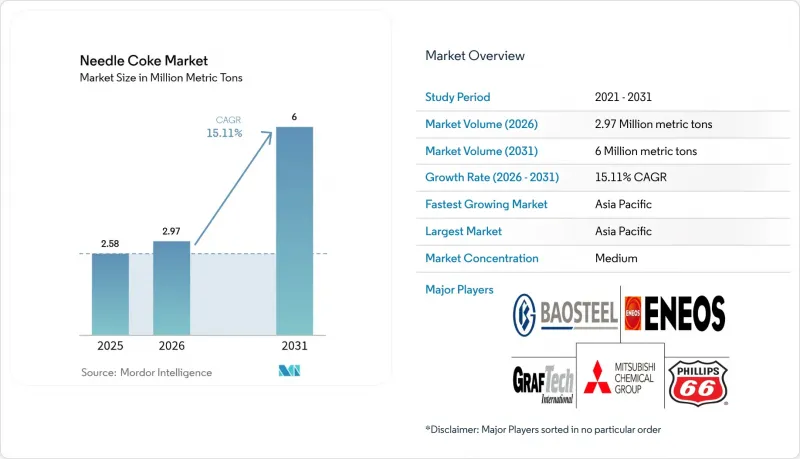
根據 Mordor Intelligence 預測,針狀焦市場規模將從 2025 年的 258 萬噸成長到 2026 年的 297 萬噸,然後在 2031 年達到 600 萬噸,2026 年至 2031 年的複合年成長率為 15.11%。
本報告按產品類型(石油基針狀焦和煤焦油瀝青基針狀焦)、應用領域(石墨電極、鋰離子電池及其他應用)和地區(亞太地區、北美地區、歐洲地區、南美地區以及中東和非洲地區)進行細分。市場預測以銷售量(公噸)為單位。
全球針焦市場趨勢與洞察
建設計畫增加電弧爐(EAF)煉鋼產能
目前,全球電弧爐(EAF)計畫總產能達3.37億噸,幾乎佔所有已公佈煉鋼產能擴張計畫的一半。每新增100萬噸EAF產能,大約需要消耗1360噸高功率石墨電極。以40%的轉換率計算,該計畫相當於增加約18.3萬噸針狀焦原料。 EAF煉鋼廠運作週期短、資本密集度低、直接排放量顯著減少,使其成為一個極具發展潛力的領域,而長期市場對符合嚴格灰分和硫含量限制的石油基鋼材的需求也進一步推動了這一成長。
面向電動車的鋰離子電池超級工廠的全球擴張。
預計到2025年,電動車銷量將超過2700萬輛,每輛車需要50-80公斤合成石墨負極材料。雖然中國負極材料產能可能在本十年後半期出現輕微過剩,但目前全球石油焦產量中只有三分之一符合電池級純度標準。例如,韓國浦項鋼鐵未來M公司(POSCO Future M)透過一項3億美元的計劃,將其負極級產能提高了四倍,該計劃整合了其鋼鐵、電極和電池業務,以確保原料供應。因此,儘管一些地區出現局部石墨過剩,但針狀焦市場仍供不應求。
延遲焦化中的勞工和環境風險
美國環保署 (EPA) 的苯排放法規要求每座煉油廠的維修8,000 萬至 1.2 億美元,這對許多中小煉油廠來說難以負擔。自 2021 年以來,北美已有約 180 萬噸焦炭產能退出市場,目前焦炭生產集中在那些財務實力雄厚且擁有嚴格環保合規計畫的公司手中。
細分市場分析
到2025年,石油衍生針狀焦將佔總量的85.23%,預計到2031年,隨著與煉廠一體化的生產商獲得超低硫原料,其針狀焦市場佔有率將以16.18%的複合年成長率進一步成長。煤焦油衍生產品的生產路線仍面臨灰分含量高、硫含量波動大等限制因素,但中國生產商正在擴大每年30萬噸的深層加工項目,預計將縮小純度差距。鑑於石油衍生產品的每噸生命週期排放量更低,歐盟日益嚴格的碳足跡法規進一步強化了其優勢。三菱化學的「包封抑制劑瀝青」等製程創新可望在2027年後提高煤焦油衍生產品的產率,但實用化仍存在不確定性。
從成本角度來看,煉製路線也具有優勢。這是因為聯合生產系統可以將燃料焦和硫的生產成本作為固定成本分攤。 Phillips 66 的 Humber 煉製廠每年可為 130 萬輛電動車供應足夠的電池級產品,而 Graphtec 的 Seedlift 工廠的產能約佔全球(不包括中國)總產能的 19% 至 20%,並且該公司已穩定了其電極利潤率。
區域分析
到2025年,亞太地區將在針狀焦市場佔據主導地位,佔全球出貨量的87.88%,預計到2031年將以15.56%的複合年成長率持續成長。 2024年,光是中國就供應了全球大部分針狀焦,隨著煤焦油和石油平台產量的成長,這一規模還在進一步擴大。韓國浦項鋼鐵公司(POSCO)的Future M計劃於2026年運作一條年產能3.6萬噸的合成石墨生產線,而印度石油公司(IOC)的Paradip項目預計將於2028年運作,其鍛燒石墨年產能將達到5.6萬噸,這凸顯了區域一體化的進展。
北美目前市佔率適中,但受益於其自身優勢,例如GrafTech公司年產14萬噸的Seedlift工廠和Phillips 66公司位於查爾斯湖的煉油廠(該煉油廠與Epsilon Advanced Materials公司簽訂了2025年的供應合約)。美國能源局已將針狀焦指定為關鍵電池材料,並津貼1,600萬美元用於促進國內計畫。這些進展預計將提高該地區的針狀焦產量,並降低其對進口的依賴,預計到2031年,美國針狀焦的市場佔有率將成長至多2個百分點。
在歐洲,供不應求依然嚴峻,光是菲利普斯66公司位於亨伯的煉油廠每年生產的電池級針狀焦就足以滿足130萬輛電動車的用電需求。東海碳素公司退出德國電極業務,凸顯了利潤率持續承壓的現狀。然而,歐盟電池法規2023/1542正在推動試點回收生產線的發展,例如EMR公司位於伯明罕的工廠,該廠年產能達2000噸,可提供符合ASTM標準的99.9%純度再生石墨。
其他好處:
- Excel格式的市場預測(ME)表
- 3個月的分析師支持
目錄
第1章:引言
- 研究假設和市場定義
- 調查範圍
第2章:調查方法
第3章執行摘要
第4章 市場狀況
- 市場概覽
- 市場促進因素
- 電弧爐煉鋼產能擴建計劃
- 在全球範圍內,用於生產電動車鋰離子電池的超級工廠正在不斷擴張。
- 中國和歐盟的強制性廢鐵處理措施
- 煉油廠設備升級改造,用於生產超低硫滗析油
- 加快與石墨陽極回收利用相關的專利申請
- 市場限制因素
- 延遲焦化過程中的職業和環境危害
- 原物料價格波動
- 生物基硬碳負極的出現
- 價值鏈分析
- 波特五力模型
- 定價概覽
第5章 市場規模與成長預測
- 依產品類型
- 石油衍生針狀焦
- 煤焦油瀝青基針狀焦
- 透過使用
- 石墨電極
- 鋰離子電池
- 其他用途
- 按地區
- 亞太地區
- 中國
- 印度
- 日本
- 韓國
- 其他亞太國家
- 北美洲
- 美國
- 加拿大
- 墨西哥
- 歐洲
- 德國
- 英國
- 法國
- 義大利
- 俄羅斯
- 其他歐洲國家
- 南美洲
- 巴西
- 阿根廷
- 其他南美國家
- 中東和非洲
- 沙烏地阿拉伯
- 南非
- 其他中東和非洲國家
- 亞太地區
第6章 競爭情勢
- 市場集中度
- 策略趨勢
- 市佔率和排名分析
- 公司簡介
- China Baowu Steel Group Corp., Ltd.
- China National Petroleum Corporation
- ENEOS Corporation
- GrafTech International
- Indian Oil Corporation
- Mitsubishi Chemical Group Corporation
- Nippon Steel Corporation
- PetroChina
- Phillips 66 Company
- POSCO Future M
- Shandong Yida New Materials Co., Ltd.
- Shanxi Hongte Coal Chemical Co Ltd
- Sinopec
- Tokai Carbon Co., Ltd
第7章 市場機會與未來展望
According to Mordor Intelligence, the needle coke market size is expected to grow from 2.58 Million metric tons in 2025 to 2.97 Million metric tons in 2026 and is forecast to reach 6 Million metric tons by 2031 at 15.11% CAGR over 2026-2031.
This report is Segmented by Product Type (Petroleum-Based Needle Coke and Coal-Tar Pitch-Based Needle Coke), Application (Graphite Electrodes, Lithium-Ion Batteries, and Other Applications), and Geography (Asia-Pacific, North America, Europe, South America, and Middle-East and Africa). The Market Forecasts are Provided in Terms of Volume (Metric Tons).
Global Needle Coke Market Trends and Insights
Increasing EAF-Steel Capacity Pipelines
Global EAF projects totaling 337 million metric tons now represent nearly half of all announced steelmaking additions, and every 1 million metric tons of new EAF capacity consumes roughly 1,360 metric tons of ultra-high-power graphite electrodes. Based on a 40% conversion ratio, this pipeline translates into about 183,000 metric tons of incremental needle coke feedstock. Faster commissioning, lower capital intensity, and sharply lower direct-emission profiles position EAF mills as the favored growth vector, thereby reinforcing long-run demand for petroleum-based grades that meet stringent ash and sulfur limits.
EV Li-ion Battery Gigafactories Scaling Globally
Electric-vehicle sales are on track to top 27 million units in 2025, and each vehicle requires 50-80 kg of synthetic graphite anode material. Although Chinese anode capacity could run a small surplus later in the decade, only one-third of global petroleum coke output currently meets battery-grade purity thresholds. South Korea's POSCO Future M, for example, is quadrupling anode-grade capacity under a USD 300 million program that pairs steel, electrode, and battery businesses to secure feedstock. Net result: the needle coke market continues to tighten despite pockets of localized graphite surplus.
Occupational and Environmental Hazards in Delayed Coking
U.S. EPA benzene-control rules require USD 80-120 million retrofits per unit, costs that many smaller refiners cannot absorb. Roughly 1.8 million t of North American coke capacity has already exited since 2021, concentrating output among firms with strong balance sheets and rigorous environmental compliance programs.
Other drivers and restraints analyzed in the detailed report include:
- Scrap-Steel Mandates in China and European Union
- Refinery Upgrades Producing Ultra-Low-Sulfur Decant Oil
- Emergence of Bio-Based Hard-Carbon Anodes
For complete list of drivers and restraints, kindly check the Table Of Contents.
Segment Analysis
Petroleum-based needle coke accounted for 85.23% of 2025 volume, and their share of the needle coke market size is projected to rise further at a 16.18% CAGR through 2031 as refinery-integrated producers secure ultra-low-sulfur feedstock. Coal-tar routes remain constrained by higher ash and sulfur variability, yet Chinese producers are scaling 300,000 tpa deep-processing projects that could narrow the purity gap. Tightening EU carbon-footprint rules reinforce the petroleum advantage, given lower life-cycle emissions per tonne. Process innovation-such as Mitsubishi Chemical's encapsulated inhibitor pitch-may lift coal-tar yields after 2027, but commercialization remains uncertain.
Cost spreads also favor refinery paths because co-production metrics allow fixed-cost absorption across fuel-grade coke and sulfur. Phillips 66's Humber refinery supplies battery-grade output adequate for 1.3 million EVs annually, while GrafTech's Seadrift plant covers about 19-20% of ex-China capacity, stabilizing its electrode margins.
Complete Report Scope:
- By Product Type
- Petroleum-based Needle Coke
- Coal-tar Pitch-based Needle Coke
- By Application
- Graphite Electrodes
- Lithium-ion Batteries
- Other Applications
- By Geography
- Asia-Pacific
- China
- India
- Japan
- South Korea
- Rest of Asia-Pacific
- North America
- United States
- Canada
- Mexico
- Europe
- Germany
- United Kingdom
- France
- Italy
- Russia
- Rest of Europe
- South America
- Brazil
- Argentina
- Rest of South America
- Middle-East and Africa
- Saudi Arabia
- South Africa
- Rest of Middle-East and Africa
- Asia-Pacific
Geography Analysis
Asia-Pacific dominated the needle coke market in 2025 with 87.88% volume and is forecast to keep expanding at a 15.56% CAGR through 2031. China alone supplied the majority of global output in 2024 and is growing as coal-tar and petroleum platforms ramp up. POSCO Future M in South Korea plans a 36,000 tpa synthetic-graphite line by 2026, while Indian Oil Corporation's Paradip project will bring 56,000 tpa calcined capacity online by 2028, underlining regional integration.
North America presently holds a moderate share yet benefits from captive assets such as GrafTech's 140,000 tpa Seadrift plant and Phillips 66's Lake Charles refinery, which inked a 2025 supply deal with Epsilon Advanced Materials. The U.S. Department of Energy lists needle coke as a critical battery material and has earmarked USD 16 million in grant funding to spur domestic projects. These moves are projected to lift regional output and reduce import reliance, raising the needle coke market share in the United States by up to 2 percentage points by 2031 .
Europe remains supply-short with only Phillips 66's Humber refinery producing battery-grade output sufficient for 1.3 million EVs annually. Tokai Carbon's retreat from its German electrode unit underscores lingering margin pressure. EU Battery Regulation 2023/1542, however, is catalyzing 2,000 tpa pilot recycling lines such as EMR's Birmingham facility, which offers 99.9%-purity recovered graphite compliant with ASTM specifications.
- China Baowu Steel Group Corp., Ltd.
- China National Petroleum Corporation
- ENEOS Corporation
- GrafTech International
- Indian Oil Corporation
- Mitsubishi Chemical Group Corporation
- Nippon Steel Corporation
- PetroChina
- Phillips 66 Company
- POSCO Future M
- Shandong Yida New Materials Co., Ltd.
- Shanxi Hongte Coal Chemical Co Ltd
- Sinopec
- Tokai Carbon Co., Ltd
Additional Benefits:
- The market estimate (ME) sheet in Excel format
- 3 months of analyst support
TABLE OF CONTENTS
1 Introduction
- 1.1 Study Assumptions and Market Definition
- 1.2 Scope of the Study
2 Research Methodology
3 Executive Summary
4 Market Landscape
- 4.1 Market Overview
- 4.2 Market Drivers
- 4.2.1 Increasing EAF-steel capacity pipelines
- 4.2.2 EV Li-ion battery gigafactories scaling globally
- 4.2.3 Scrap-steel mandates in China and European Union
- 4.2.4 Refinery upgrades producing ultra-low-sulphur decant oil
- 4.2.5 Accelerated anode-grade graphite recycling patents
- 4.3 Market Restraints
- 4.3.1 Occupational and environmental hazards in delayed coking
- 4.3.2 Feed-stock price volatility
- 4.3.3 Emergence of bio-based hard-carbon anodes
- 4.4 Value Chain Analysis
- 4.5 Porter's Five Forces
- 4.5.1 Bargaining Power of Suppliers
- 4.5.2 Bargaining Power of Buyers
- 4.5.3 Threat of New Entrants
- 4.5.4 Threat of Substitutes
- 4.5.5 Degree of Competition
- 4.6 Price Overview
5 Market Size and Growth Forecasts (Volume)
- 5.1 By Product Type
- 5.1.1 Petroleum-based Needle Coke
- 5.1.2 Coal-tar Pitch-based Needle Coke
- 5.2 By Application
- 5.2.1 Graphite Electrodes
- 5.2.2 Lithium-ion Batteries
- 5.2.3 Other Applications
- 5.3 By Geography
- 5.3.1 Asia-Pacific
- 5.3.1.1 China
- 5.3.1.2 India
- 5.3.1.3 Japan
- 5.3.1.4 South Korea
- 5.3.1.5 Rest of Asia-Pacific
- 5.3.2 North America
- 5.3.2.1 United States
- 5.3.2.2 Canada
- 5.3.2.3 Mexico
- 5.3.3 Europe
- 5.3.3.1 Germany
- 5.3.3.2 United Kingdom
- 5.3.3.3 France
- 5.3.3.4 Italy
- 5.3.3.5 Russia
- 5.3.3.6 Rest of Europe
- 5.3.4 South America
- 5.3.4.1 Brazil
- 5.3.4.2 Argentina
- 5.3.4.3 Rest of South America
- 5.3.5 Middle-East and Africa
- 5.3.5.1 Saudi Arabia
- 5.3.5.2 South Africa
- 5.3.5.3 Rest of Middle-East and Africa
- 5.3.1 Asia-Pacific
6 Competitive Landscape
- 6.1 Market Concentration
- 6.2 Strategic Moves
- 6.3 Market Share(%)/Ranking Analysis
- 6.4 Company Profiles (includes Global Overview, Market Overview, Core Segments, Financials, Strategic Information, Products and Services, Recent Developments)
- 6.4.1 China Baowu Steel Group Corp., Ltd.
- 6.4.2 China National Petroleum Corporation
- 6.4.3 ENEOS Corporation
- 6.4.4 GrafTech International
- 6.4.5 Indian Oil Corporation
- 6.4.6 Mitsubishi Chemical Group Corporation
- 6.4.7 Nippon Steel Corporation
- 6.4.8 PetroChina
- 6.4.9 Phillips 66 Company
- 6.4.10 POSCO Future M
- 6.4.11 Shandong Yida New Materials Co., Ltd.
- 6.4.12 Shanxi Hongte Coal Chemical Co Ltd
- 6.4.13 Sinopec
- 6.4.14 Tokai Carbon Co., Ltd
7 Market Opportunities and Future Outlook
- 7.1 White-space and Unmet-need Assessment

 針狀焦市場:2026-2032年全球市場預測(依產品類型、製造技術、等級、形狀、應用和最終用途產業分類)
 針狀焦市場:依產品類型、應用和地區分類
 針狀焦市場規模、佔有率、趨勢和預測:按類型、等級、應用、最終用途行業和地區分類,2026-2034年
 針狀軟木塞全球市場規模、佔有率、趨勢和成長分析報告(2026-2034)
 針狀焦市場 - 全球產業規模、佔有率、趨勢、機會及預測(依產品類型、產品等級、應用、地區及競爭格局分類,2021-2031年)
 針狀焦市場規模、佔有率和成長分析(按產品類型、等級、應用、最終用途和地區分類)-2026-2033年產業預測針狀焦市場規模、佔有率、成長及全球產業分析:依類型、應用和地區劃分的洞察與預測(2024-2032)
 針狀焦市場機會、成長動力、產業趨勢分析及 2025 - 2034 年預測
 針狀焦市場,按類型、按等級、按應用、按最終用戶、按國家和地區 - 2025 年至 2032 年全球行業分析、市場規模、市場佔有率及預測
 全球針狀焦市場需求及預測分析(2018-2034)