


 |
市場調查報告書
商品編碼
2122458
矽酮添加劑:市場佔有率分析、行業趨勢和統計數據、成長預測(2026-2031)Silicone Additives - Market Share Analysis, Industry Trends & Statistics, Growth Forecasts (2026 - 2031) |
||||||

※ 本網頁內容可能與最新版本有所差異。詳細情況請與我們聯繫。
據 Mordor Intelligence 稱,2025 年矽酮添加劑市值為 20.9 億美元,預計到 2031 年將達到 29.8 億美元,而 2026 年為 22.2 億美元,預測期(2026-2031 年)的複合年成長率為 6.11%。
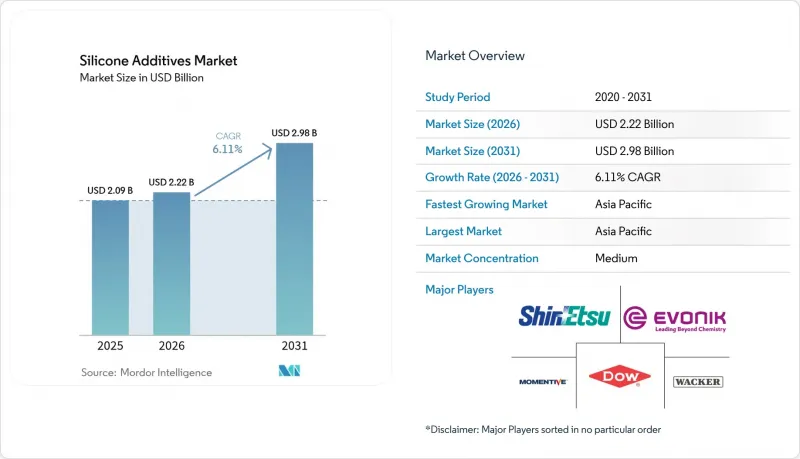
本報告按產品形態(液體和油類、彈性體和膠類、其他)、應用領域(消泡劑、流變改性劑、其他)、終端用戶行業(食品飲料、塑膠和複合材料、其他)以及地區(亞太地區、北美地區、歐洲地區、南美地區、中東和非洲)進行細分。市場預測以美元計價。
全球矽酮添加劑市場趨勢與洞察
個人護理行業需求增加
消費者往往偏好輕盈不油膩的質地,因此配方研發人員更傾向於使用能提供絲滑觸感和持久保濕效果的矽油。例如,信越化學的油包彈性體產品線可形成穩定的水包油乳液,在維持理想膚感的同時,還能滿足環狀矽氧烷的區域法規要求。供應商正陸續推出植物來源的C13-15烷烴載體,例如Elchem的「PURESIL ORG」凝膠,這顯示舒適的膚感和「天然」的定位可以兼得。亞太地區的品牌正利用這些特性,縮小與全球高階品牌的差距,並拓展彩妝和防曬油領域的矽油添加劑市場。
油漆和塗料行業對低VOC產品的興趣日益濃厚。
歐洲和北美的立法機構已對溶劑含量設定了限制,使得低VOC含量成為一項強制性要求,而不僅僅是一項特性。贏創的TEGO Guard 9000可在不超出生態標示基準值的前提下,為外牆塗料提供初始的防雨性能。 Siltec的研究表明,長鏈烷基矽酮可以在提高固態含量的同時降低總VOC含量,使配方開發人員能夠在保持耐久性的同時,達到綠色印章和LEED認證的目標。這種影響也正在向新興市場擴散,建築商擴大指定使用含有矽基表面添加劑的水性塗料,以增強塗料的防污性能並確保持久的色彩保持。
高溫下添加劑的遷移
當溫度高於 200 度C時,低分子量矽氧烷會滲出到表面,可能影響光學透明度並降低黏合力。雖然對高苯基矽橡膠的研究顯示其熱穩定性有所提高,在 478 度C時重量損失僅為 5%,但高品質等級的產品成本更高。電動車牽引馬達和航太管道等應用需要抑制揮發的化合物,這給研發預算帶來了壓力。
細分市場分析
預計到2025年,矽油添加劑市場中,矽油將佔38.87%的銷售額。這主要歸功於其在塗料、個人護理和潤滑劑領域作為潤滑劑、流平劑和導熱劑的廣泛應用。其低表面張力和寬廣的溫度穩定性支撐了其強勁的市場需求。乳液和樹脂與矽油相輔相成,尤其是在建築密封劑領域,可用於水性系統和結構飾面。相較之下,彈性體則主要面向墊圈、密封件和醫用導管等需要持久彈性的細分市場。
粉末和顆粒雖然銷售額佔比不到四分之一,但預期成長率最高,到2031年複合年成長率將達到7.34%。它們的乾燥形狀適用於3D列印原料和母粒配方,使配方設計人員能夠實現精確的流變控制和無塵稱量。新興的紫外光固化聚矽氧烷粉末簡化了按需交聯工藝,從而加快了快速原型製作,縮短了從設計到零件完成的周期,並擴大了積層製造中矽酮添加劑的市場規模。隨著3D列印機的應用範圍從航太擴展到牙科和消費品領域,粉狀矽酮正在開闢新的成長途徑。
區域分析
預計到2025年,亞太地區將以46.81%的市佔率引領矽酮添加劑市場,並持續以6.92%的複合年成長率成長至2031年。中國張家港和南京的叢集是瓦克化學和艾爾化學等公司的上游矽氧烷生產中心,確保了接近性為大型電子和電動汽車電池公司供貨。印度的「印度製造」政策刺激了國內對高品質塗料和黏合劑的需求,促使當地複合材料生產商採用矽酮添加劑以實現優質的表面處理和耐久性。日本和韓國也積極推動矽酮添加劑在高頻電子、光電和特殊薄膜等領域的先進研發。
北美市場成熟且充滿創新活力,緊隨其後。美國正積極推動符合FDA/USP標準的矽膠系統在醫療設備和航太複合材料領域的應用。陶氏化學在密西根州開展的矽膠回收試點計畫旨在將聚二甲基矽氧烷(PDMS)的碳足跡減少50%,該計畫引起了注重環境、社會和治理(ESG)的買家的共鳴。加拿大對電動車電池的投資以及墨西哥汽車產業叢集的發展預計將逐步提振對溫度控管添加劑的需求。
歐洲是全球第三大市場,但在永續發展方面的嚴謹程度卻位居榜首。 REACH法規以及即將實施的PFAS禁令正推動著無環矽酮和生物基替代品的研發。贏創的「智慧效應」業務部門正將矽氧烷與有機特種化學品結合,以滿足輕量化、電動車和數位醫療市場的需求。德國和法國正大力投資汽車電氣化津貼,而英國則專注於生命科學塗料,從而訂單了源源不絕的高利潤訂單。
其他好處:
- Excel格式的市場預測(ME)表
- 3個月的分析師支持
目錄
第1章:引言
- 研究假設和市場定義
- 調查範圍
第2章:調查方法
第3章執行摘要
第4章 市場狀況
- 市場概覽
- 市場促進因素
- 個人護理行業需求增加
- 油漆和塗料行業對低VOC產品的興趣日益濃厚。
- 食品加工業的需求不斷成長
- 在醫療保健領域不斷擴大應用
- 汽車產業的高利用率
- 市場限制因素
- 高溫下添加劑的遷移
- 原物料價格波動
- 技術挑戰,例如與過渡和整合相關的問題。
- 價值鏈分析
- 波特五力模型
第5章 市場規模與成長預測
- 按產品形式
- 液體和油
- 彈性體和樹膠
- 樹脂
- 粉末和顆粒
- 乳液
- 透過使用
- 消泡劑
- 流變改性劑
- 界面活性劑
- 潤濕劑和分散劑
- 潤滑劑
- 黏附促進劑
- 其他用途(例如,脫模劑)
- 按最終用戶行業分類
- 食品/飲料
- 塑膠和複合材料
- 油漆和塗料
- 個人護理
- 黏合劑和密封劑
- 紙漿和紙漿
- 石油和天然氣
- 其他終端用戶產業(電子和半導體等)
- 地區
- 亞太地區
- 中國
- 日本
- 印度
- 韓國
- 東南亞國協
- 其他亞太國家
- 北美洲
- 美國
- 加拿大
- 墨西哥
- 歐洲
- 德國
- 英國
- 法國
- 義大利
- 西班牙
- 俄羅斯
- 北歐國家
- 其他歐洲國家
- 南美洲
- 巴西
- 阿根廷
- 其他南美國家
- 中東和非洲
- 沙烏地阿拉伯
- 南非
- 其他中東和非洲國家
- 亞太地區
第6章 競爭情勢
- 市場集中度
- 策略趨勢
- 市佔率和排名分析
- 公司簡介
- AB Specialty Silicones
- Altana AG
- Bluestar Silicones
- BRB International
- Clariant AG
- Dow
- Elkem ASA
- Evonik Industries AG
- Jiangsu Maysta Chemical
- KCC SILICONE CORPORATION
- Momentive
- Shin-Etsu Chemical Co., Ltd.
- Silibase Silicone
- Siltech Corporation
- Supreme Silicones India Pvt. Ltd.
- The Lubrizol Corporation
- Wacker Chemie AG
第7章 市場機會與未來展望
According to Mordor Intelligence, the silicone additives market size was valued at USD 2.09 billion in 2025 and estimated to grow from USD 2.22 billion in 2026 to reach USD 2.98 billion by 2031, at a CAGR of 6.11% during the forecast period (2026-2031).
This report is Segmented by Product Form (Fluids and Oils, Elastomers and Gums, and More), Application (Defoamers, Rheology Modifiers, and More), End-User Industry (Food and Beverage, Plastics and Composites, and More), and Geography (Asia-Pacific, North America, Europe, South America, Middle East and Africa). The Market Forecasts are Provided in Terms of Value (USD).
Global Silicone Additives Market Trends and Insights
Increase in Demand from Personal Care Industry
Consumers gravitate toward light, non-oily textures, prompting formulators to favor silicone fluids for silky spread and lasting moisture. Shin-Etsu's elastomer-in-oil line, for example, builds stable oil-in-water emulsions that meet regional bans on cyclic siloxanes while sustaining the desired skin-feel. Suppliers are rolling out plant-origin C13-15 alkane carriers such as Elkem's PURESIL ORG gels, proving that sensory performance and natural positioning can coexist. Asia-Pacific labels are leveraging these attributes to bridge gaps with global premium brands, widening the silicone additives market in color cosmetics and sun care.
Growing Focus on Low-VOC Products in Paints and Coatings
Legislators in Europe and North America cap allowable solvent content, making low-VOC compliance a prerequisite rather than a feature. Evonik's TEGO Guard 9000 delivers early-rain resistance in exterior coatings without breaching eco-label thresholds. Siltech has shown that long-chain alkyl silicones lift solids content yet cut VOC totals, letting formulators maintain durability while meeting Green Seal or LEED targets. The ripple effect extends to emerging markets, where builders increasingly specify water-based paints fortified with silicone surface additives for stain repellence and long-term color retention.
Additive Migration at High Temperatures
Above 200 °C, low-molecular-weight siloxanes can bleed to surfaces, dulling optical clarity or weakening adhesion. Studies on high-phenyl silicone rubbers reveal improved thermal stability, with only 5% weight loss at 478 °C, yet premium grades raise costs. EV traction motors and aerospace ducting need formulations that curb volatilization, pressuring R&D budgets.
Other drivers and restraints analyzed in the detailed report include:
- Growing Demand from Food-Processing Industry
- Increasing Usage in Medical and Healthcare Applications
- Volatile Raw-Material Costs
For complete list of drivers and restraints, kindly check the Table Of Contents.
Segment Analysis
Silicone fluids accounted for 38.87% of the silicone additives market in 2025 by revenue, riding on wide use as slip, leveling, and heat-transfer agents in coatings, personal care, and lubricants. Their low surface tension and broad temperature stability underpin a resilient demand base. Emulsions and resins complement fluids by enabling water-borne systems and structural finishes, particularly in construction sealants. In contrast, elastomers address gasket, seal, and medical-tube niches needing lasting elasticity.
Powders and granules, although less than one-quarter of sales, post the fastest 7.34% CAGR through 2031. Their dry format aids 3D printing feedstocks and masterbatch compounding, granting formulators fine rheology control and dust-free dosing. Emerging UV-curable polysiloxane powders simplify on-demand cross-linking for rapid prototypes, shrinking design-to-part cycles and enlarging the silicone additives market size for additive manufacturing. As printer fleets spread beyond aerospace into dental and consumer goods, powdered silicones capture fresh avenues for growth.
Complete Report Scope:
- By Product Form
- Fluids and Oils
- Elastomers and Gums
- Resins
- Powders and Granules
- Emulsions
- By Application
- Defoamers
- Rheology Modifiers
- Surfactants
- Wetting and Dispersing Agents
- Lubricating Agents
- Adhesion Promoters
- Other Applications (Release Agents, etc.)
- By End-User Industry
- Food and Beverage
- Plastics and Composites
- Paints and Coatings
- Personal Care
- Adhesives and Sealants
- Paper and Pulp
- Oil and Gas
- Other End-User Industries (Electronics and Semiconductor, etc.)
- Geography
- Asia-Pacific
- China
- Japan
- India
- South Korea
- ASEAN Countries
- Rest of Asia-Pacific
- North America
- United States
- Canada
- Mexico
- Europe
- Germany
- United Kingdom
- France
- Italy
- Spain
- Russia
- NORDIC Countries
- Rest of Europe
- South America
- Brazil
- Argentina
- Rest of South America
- Middle East and Africa
- Saudi Arabia
- South Africa
- Rest of Middle East and Africa
- Asia-Pacific
Geography Analysis
Asia-Pacific sat atop the silicone additives market with 46.81% revenue share in 2025 and is marching at a 6.92% CAGR toward 2031. China's Zhangjiagang and Nanjing clusters anchor upstream siloxane capacity for Wacker and Elkem, ensuring supply proximity to electronics and EV battery giants. India's "Make in India" policy stokes domestic demand for quality-driven coatings and adhesives, compelling local formulators to incorporate silicone additives for premium finish and durability. Japan and South Korea each foster advanced R&D, channeling silicone additives into high-frequency electronics, photonics, and specialty films.
North America follows as a mature but innovation-rich arena. The United States leads adoption in medical devices and aerospace composites, relying on FDA/USP compliant silicone systems. Dow's silicone recycling pilot in Michigan aims to trim polydimethylsiloxane (PDMS) carbon footprints by 50% and resonates with buyers under ESG mandates. Canada's EV-battery investments and Mexico's automotive clusters promise incremental pull-through for thermal-management additives.
Europe ranks third in size yet first in sustainability stringency. REACH and impending PFAS bans intensify R&D for cyclic-free and bio-based silicone alternatives. Evonik's Smart Effects business line combines siloxane and organic specialties to tackle lightweighting, e-mobility, and digital health markets. Germany and France concentrate vehicle electrification grants, while the United Kingdom emphasizes life-science coatings, collectively protecting a steady flow of high-margin orders.
- AB Specialty Silicones
- Altana AG
- Bluestar Silicones
- BRB International
- Clariant AG
- Dow
- Elkem ASA
- Evonik Industries AG
- Jiangsu Maysta Chemical
- KCC SILICONE CORPORATION
- Momentive
- Shin-Etsu Chemical Co., Ltd.
- Silibase Silicone
- Siltech Corporation
- Supreme Silicones India Pvt. Ltd.
- The Lubrizol Corporation
- Wacker Chemie AG
Additional Benefits:
- The market estimate (ME) sheet in Excel format
- 3 months of analyst support
TABLE OF CONTENTS
1 Introduction
- 1.1 Study Assumptions and Market Definition
- 1.2 Scope of the Study
2 Research Methodology
3 Executive Summary
4 Market Landscape
- 4.1 Market Overview
- 4.2 Market Drivers
- 4.2.1 Increase in Demand from Personal Care Industry
- 4.2.2 Growing Focus on Low-VOC Products in Paints and Coatings
- 4.2.3 Growing Demand from Food-Processing Industry
- 4.2.4 Increasing Usage in Medical and Healthcare Applications
- 4.2.5 High Utilization from the Automotive Industry
- 4.3 Market Restraints
- 4.3.1 Additive Migration at High Temperatures
- 4.3.2 Volatile Raw-material Costs
- 4.3.3 Technical Challenges such as Migration and Adhesion Issues
- 4.4 Value Chain Analysis
- 4.5 Porter's Five Forces
- 4.5.1 Bargaining Power of Suppliers
- 4.5.2 Bargaining Power of Buyers
- 4.5.3 Threat of New Entrants
- 4.5.4 Threat of Substitutes
- 4.5.5 Degree of Competition
5 Market Size and Growth Forecasts
- 5.1 By Product Form
- 5.1.1 Fluids and Oils
- 5.1.2 Elastomers and Gums
- 5.1.3 Resins
- 5.1.4 Powders and Granules
- 5.1.5 Emulsions
- 5.2 By Application
- 5.2.1 Defoamers
- 5.2.2 Rheology Modifiers
- 5.2.3 Surfactants
- 5.2.4 Wetting and Dispersing Agents
- 5.2.5 Lubricating Agents
- 5.2.6 Adhesion Promoters
- 5.2.7 Other Applications (Release Agents, etc.)
- 5.3 By End-User Industry
- 5.3.1 Food and Beverage
- 5.3.2 Plastics and Composites
- 5.3.3 Paints and Coatings
- 5.3.4 Personal Care
- 5.3.5 Adhesives and Sealants
- 5.3.6 Paper and Pulp
- 5.3.7 Oil and Gas
- 5.3.8 Other End-User Industries (Electronics and Semiconductor, etc.)
- 5.4 Geography
- 5.4.1 Asia-Pacific
- 5.4.1.1 China
- 5.4.1.2 Japan
- 5.4.1.3 India
- 5.4.1.4 South Korea
- 5.4.1.5 ASEAN Countries
- 5.4.1.6 Rest of Asia-Pacific
- 5.4.2 North America
- 5.4.2.1 United States
- 5.4.2.2 Canada
- 5.4.2.3 Mexico
- 5.4.3 Europe
- 5.4.3.1 Germany
- 5.4.3.2 United Kingdom
- 5.4.3.3 France
- 5.4.3.4 Italy
- 5.4.3.5 Spain
- 5.4.3.6 Russia
- 5.4.3.7 NORDIC Countries
- 5.4.3.8 Rest of Europe
- 5.4.4 South America
- 5.4.4.1 Brazil
- 5.4.4.2 Argentina
- 5.4.4.3 Rest of South America
- 5.4.5 Middle East and Africa
- 5.4.5.1 Saudi Arabia
- 5.4.5.2 South Africa
- 5.4.5.3 Rest of Middle East and Africa
- 5.4.1 Asia-Pacific
6 Competitive Landscape
- 6.1 Market Concentration
- 6.2 Strategic Moves
- 6.3 Market Share(%)/Ranking Analysis
- 6.4 Company Profiles (includes Global level Overview, Market level overview, Core Segments, Financials as available, Strategic Information, Market Rank/Share, Products and Services, Recent Developments)
- 6.4.1 AB Specialty Silicones
- 6.4.2 Altana AG
- 6.4.3 Bluestar Silicones
- 6.4.4 BRB International
- 6.4.5 Clariant AG
- 6.4.6 Dow
- 6.4.7 Elkem ASA
- 6.4.8 Evonik Industries AG
- 6.4.9 Jiangsu Maysta Chemical
- 6.4.10 KCC SILICONE CORPORATION
- 6.4.11 Momentive
- 6.4.12 Shin-Etsu Chemical Co., Ltd.
- 6.4.13 Silibase Silicone
- 6.4.14 Siltech Corporation
- 6.4.15 Supreme Silicones India Pvt. Ltd.
- 6.4.16 The Lubrizol Corporation
- 6.4.17 Wacker Chemie AG
7 Market Opportunities and Future Outlook
- 7.1 White-space and Unmet-need Analysis
- 7.2 Growing Research and Development to Improve the Sustainability of Silicones

 矽酮添加劑市場-2026-2032年全球市場預測
 矽酮改質劑市場規模、佔有率和成長分析:按產品類型、配方類型、應用、最終用途行業、銷售管道和地區分類 - 2026-2033 年行業預測
 全球矽酮添加劑市場規模、佔有率、趨勢和成長分析報告(2026-2034年)
 矽酮添加劑市場-全球產業規模、佔有率、趨勢、機會及按功能、應用、地區和競爭格局分類的預測(2021-2031年)矽膠拖鞋市場按類型、應用、終端用戶產業及銷售管道分類-2026-2032年全球預測
 全球有機矽添加劑市場規模研究與預測:依功能、最終用途產業和區域預測 2025-2035