


 |
市場調查報告書
商品編碼
2122436
自主移動機器人:市場佔有率分析、產業趨勢與統計及成長預測(2026-2031)Autonomous Mobile Robot - Market Share Analysis, Industry Trends & Statistics, Growth Forecasts (2026 - 2031) |
||||||

※ 本網頁內容可能與最新版本有所差異。詳細情況請與我們聯繫。
據 Mordor Intelligence 稱,自主移動機器人市場預計到 2026 年價值 51.8 億美元,高於 2025 年的 44.9 億美元,預計到 2031 年將達到 105.6 億美元。
預計 2026 年至 2031 年的複合年成長率為 15.31%。
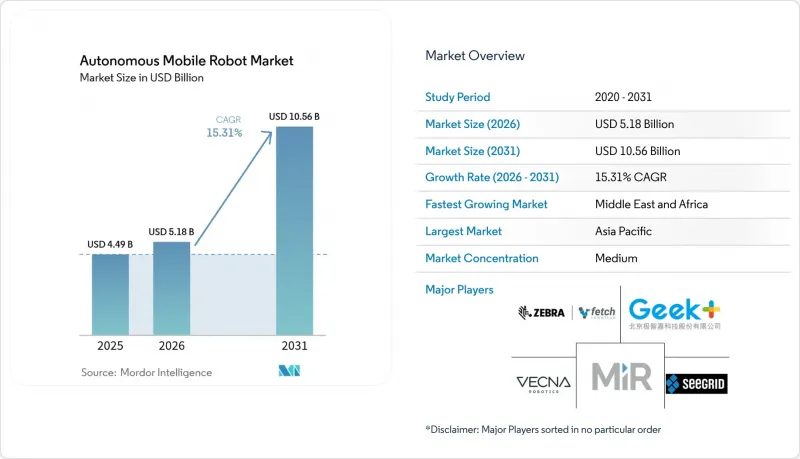
本報告按類型(無人地面車輛、人形機器人等)、導航技術(雷射雷達SLAM、視覺導航、磁感應/QR碼導航等)、終端用戶產業(倉儲物流、製造業、汽車業等)和地區進行細分。市場預測以美元計價。
全球自主移動機器人市場趨勢及洞察
電子商務履約需求激增
目前,線上零售依賴「當日送達」的預期。亞馬遜計畫在2025年7月部署超過100萬台機器人,並透過DeepFleet的智慧車隊將每次揀貨的行走時間縮短10%。這表明,在人員數量不變的情況下,行動自動化可以將處理能力提高四倍。 Locus Robotics在整合LocusOne軟體後,揀貨次數已超過30億次,生產效率提高了2到3倍,同時工傷事故減少了80%。因此,零售商正在採用緊湊型、自主移動機器人解決方案,這些方案可以靈活適應季節性工作量波動,並最大限度地減少設施變更。 Geek+和英特爾共同開發的「僅視覺導航」系統無需固定標記,從而降低了部署成本和時間。
經合組織市場倉儲勞動力短缺
經合組織成員國的倉庫業者反映,人手不足,尤其是在夜班和尖峰時段。歐洲職業安全與健康組織(EU-OSHA)強調,自動化對於彌補勞動年齡人口減少至關重要。斯凱奇(Skechers)透過用機器人取代輸送機,實現了80%的節能,這在技術純熟勞工稀缺的情況下證明了投資回報。如今,雇主們正圍繞著機器人監控和維護重新設計營運模式,不僅減輕了倉庫工作的體力消耗,也使其更具吸引力。
互通性標準碎片化
儘管 ISO 3691-4 和 ANSI/RIA R15.08 對安全性進行了詳細規定,但它們並未涵蓋車隊通訊協定,這使得買家只能依賴單一供應商的生態系統,從而增加了整合成本。中間件供應商正試圖彌合這一差距,但專有數據格式阻礙了技術的普及,並削弱了買家的議價能力。
細分市場分析
到2025年,無人地面車輛將佔總銷售額的45.42%。人形機器人雖然仍處於起步階段,但由於它們可以在不改變佈局的情況下穿梭於人類設計的空間,預計將以18.74%的複合年成長率成長。亞馬遜正在Rivian公司試行使用人形送貨機器人從電動貨車上裝載小包裹,顯示自主移動機器人市場正在向戶外領域擴展。無人機和無人水下機器人目前仍屬於小眾領域,但對於能源資產的巡查至關重要。一旦人形自主移動機器人的物體抓取和操作能力達到倉庫作業的性能標準,其市場規模預計將迅速擴大。
傳統機器人系統依賴針對特定任務最佳化的專用外形,但缺乏通用性。然而,人形機器人可以在同一平台上切換從貨架搬運到分類等多種角色,從而簡化了機器人系統。因此,投資正從純粹的行動硬體轉向人工智慧驅動的視覺識別和抓取能力,以媲美人類的靈巧度。這種轉變將降低生命週期成本,並催生「機器人即服務」等新型服務模式。
LiDARSLAM技術能夠在擁擠的通道中實現毫米級的重複定位精度,預計到2025年將佔40.88%的市場佔有率。基於視覺的系統正以20.64%的複合年成長率快速成長,由於無需昂貴的感測器和反射目標,因此能夠降低中端市場營運商的資本投入。 Geek+利用英特爾RealSense深度攝影機和板載AI技術,已展現出與雷射雷達相當的精度。隨著邊緣處理器能夠以低功耗處理即時影像分割,採用視覺導航的自主移動機器人市場預計將進一步擴大。
混合感測器融合技術結合了攝影機、LiDAR和慣性感測器,使機器人群能夠根據灰塵、眩光和頻寬等因素切換模式。這種自適應方法支援港口倉庫目前所需的室內外混合作業。認證跨模式性能的標準將加速多感測器系統的應用,並確保機器人穿越公共人行道時的安全。
區域分析
預計到2025年,亞太地區將佔全球銷售額的37.12%。像極智科技這樣的中國企業,憑藉成本優勢和政府支持計畫加速試點測試,出口量已超過其總產量的三分之一。日本和韓國的許多工廠目前正在採用中國品牌的機器人,以縮短投資回收期。北美仍然是自主移動機器人的第二大市場,這主要得益於亞馬遜在多地擴張的業務以及強大的軟體新創企業生態系統,這些企業為第三方物流供應商客製化編配層。
歐洲則受惠於一套完善的補貼體系。歐盟的「未來工廠」舉措為自動化硬體的資本投資提供高達20%的補貼,加速了中型製造商採用該技術。隨著補貼範圍從2025年起進一步擴大,預計歐洲自主移動機器人的市佔率將持續成長。中東和非洲是成長最快的地區,年複合成長率高達18.46%,這主要得益於沙烏地阿拉伯的「2030願景」以及NEOM在建築機器人技術領域7.746億美元的投資。高昂的物流成本和新建倉庫的需求,使得企業從一開始就將機器人技術納入設計考量。
南美洲仍處於起步階段。在巴西和墨西哥,進口自動化設備的關稅豁免促進了試點計畫的開展,但外匯波動減緩了全面推廣。在非洲,自動化技術的應用主要集中在南非和摩洛哥,這兩個國家的汽車組裝廠需要準時交付到生產線。
其他好處:
- Excel格式的市場預測(ME)表
- 3個月的分析師支持
目錄
第1章:引言
- 研究假設和市場定義
- 調查範圍
第2章:調查方法
第3章執行摘要
第4章 市場狀況
- 市場概覽
- 市場促進因素
- 電子商務履約需求激增
- 經合組織市場倉儲勞動力短缺
- 鋰離子電池價格跌破每千瓦時 70 美元。
- 歐盟「未來工廠」計畫自2025年起津貼
- 5G-Advanced專用網路的部署
- 人工智慧驅動的「群組編配」平台
- 市場限制因素
- 互通性標準碎片化
- 網實整合安全漏洞
- 高負載容量自主移動機器人的初始資本投資相對較高。
- 工會抗議限制機器人部署密度
- 價值供應鏈分析
- 監理情勢
- 技術展望
- 波特五力分析
第5章 市場規模與成長預測
- 按類型
- 無人地面車輛(UGV)
- 人形
- 無人駕駛飛行器(UAV)
- 無人水面航行器(UMV)
- 導航技術
- LiDAR SLAM
- 基於視覺(2D/3D 相機)
- 磁感應式/感應式/QR碼感應式
- 混合式多感測器融合
- 按有效載荷能力
- 100公斤或以下
- 100~500 kg
- 500~1,000 kg
- 1000公斤或以上
- 按最終用戶行業分類
- 倉儲/物流
- 製造業
- 車
- 食品/飲料
- 衛生保健
- 零售與電子商務
- 國防與安全
- 採礦和礦產
- 能源與電力
- 石油和天然氣
- 按地區
- 北美洲
- 美國
- 加拿大
- 墨西哥
- 歐洲
- 英國
- 德國
- 法國
- 義大利
- 其他歐洲國家
- 亞太地區
- 中國
- 日本
- 印度
- 韓國
- 其他亞太國家
- 中東
- 以色列
- 沙烏地阿拉伯
- 阿拉伯聯合大公國
- 土耳其
- 其他中東國家
- 非洲
- 南非
- 埃及
- 其他非洲國家
- 南美洲
- 巴西
- 阿根廷
- 其他南美國家
- 北美洲
第6章 競爭情勢
- 市場集中度
- 策略趨勢
- 市佔率分析
- 公司簡介
- Zebra Technologies Corporation(Fetch Robotics)
- Teradyne Inc.-Mobile Industrial Robots(MiR)
- Geek+Technology Co., Ltd.
- Vecna Robotics, Inc.
- Seegrid Corporation
- Aethon, Inc.(ST Engineering)
- Omron Corporation
- Clearpath Robotics Inc.(OTTO Motors)
- HIK Robot Co., Ltd.
- SoftBank Robotics Group Corp.
- SMP Robotics Systems Corp.
- Locus Robotics Corp.
- Amazon.com, Inc.(Kiva/System Robotics)
- Agilox Services GmbH
- Balyo SA
- Vendor Positioning Analysis
- Investment Analysis
第7章 市場機會與未來展望
According to Mordor Intelligence, autonomous mobile robot market size in 2026 is estimated at USD 5.18 billion, growing from 2025 value of USD 4.49 billion with 2031 projections showing USD 10.56 billion, growing at 15.31% CAGR over 2026-2031.
This report is Segmented by Type (Unmanned Ground Vehicles, Humanoids and More), Navigation Technology (LiDAR SLAM, Vision-Based, Magnetic/Inductive/QR Guided and More), End-User Industry (Warehouse & Logistics, Manufacturing, Automotive and More), and Geography. The Market Forecasts are Provided in Terms of Value (USD).
Global Autonomous Mobile Robot Market Trends and Insights
Rapid e-commerce fulfilment demand
Online retail now hinges on same-day delivery expectations. Amazon surpassed 1 million deployed robots by July 2025 and cut travel time per pick by 10% through DeepFleet fleet intelligence, proving that mobile automation can quadruple throughput using the same headcount. Locus Robotics crossed 3 billion picks after integrating its LocusOne software, which doubled to tripled productivity while reducing injuries by 80%. Retailers are therefore adopting compact autonomous mobile robot market solutions that flex with seasonal volumes and require minimal facility changes. Vision-only navigation, showcased in the Geek+-Intel design, trims installation cost and time because no fixed markers are needed.
Scarcity of warehouse labour in OECD markets
OECD operators report persistent vacancies for night and peak-season shifts. The European Agency for Safety and Health at Work highlights automation as essential for offsetting shrinking working-age populations. Skechers logged 80% energy savings after replacing conveyors with robots, validating the return on investment where skilled labour is scarce. Employers now redesign rolls around robot supervision and maintenance, making warehouse jobs less physically demanding and more attractive.
Fragmented interoperability standards
ISO 3691-4 and ANSI/RIA R15.08 detail safety, yet they omit fleet communication protocols, forcing buyers into single-vendor ecosystems and inflating integration cost. Middleware suppliers attempt to bridge gaps, but proprietary data formats slow deployment and reduce bargaining power.
Other drivers and restraints analyzed in the detailed report include:
- Falling Li-ion battery cost below USD 70/kWh
- AI-enabled swarm orchestration platforms
- Cyber-physical security vulnerabilities
For complete list of drivers and restraints, kindly check the Table Of Contents.
Segment Analysis
Unmanned ground vehicles controlled 45.42% revenue in 2025. Humanoids, although young, are forecast to expand at 18.74% CAGR because they navigate human-designed spaces without layout changes. Amazon is piloting humanoid couriers that load parcels from Rivian electric vans, hinting at outdoor extension of the autonomous mobile robot market. Unmanned aerial and marine robots remain niche but critical for inspection in energy assets. The autonomous mobile robot market size for humanoids is likely to rise quickly once manipulation reliability reaches warehouse performance benchmarks.
Traditional fleets rely on specialized form factors that optimize one task but lack versatility. Humanoids promise fleet simplification because one platform can switch roles, from shelving to sorting. Investment has therefore shifted from pure mobility hardware to artificial intelligence vision and grasping capability that matches human dexterity. This transition will lower life-cycle cost and unlock new service models such as robot-as-a-service subscriptions.
LiDAR SLAM held 40.88% share in 2025 because of millimetre-level repeatability in congested aisles. Vision-based systems, expanding at 20.64% CAGR, eliminate expensive sensors and reflective targets, which reduces capital outlay for mid-market operators. Geek+ demonstrated LiDAR-equivalent accuracy through Intel RealSense depth cameras and onboard AI. The autonomous mobile robot market size for vision navigation will further increase as edge processors handle real-time image segmentation at lower power budgets.
Hybrid sensor fusion combines cameras, LiDAR and inertial sensors so fleets can switch modes when dust, glare or bandwidth constraints appear. This adaptive approach supports mixed indoor-outdoor operations that warehouses at ports now demand. Standards that certify performance across modalities will accelerate multi-sensor adoption, ensuring safety as robots cross public walkways.
Complete Report Scope:
- By Type
- Unmanned Ground Vehicles (UGV)
- Humanoids
- Unmanned Aerial Vehicles (UAV)
- Unmanned Marine Vehicles (UMV)
- By Navigation Technology
- LiDAR SLAM
- Vision-based (2D/3D camera)
- Magnetic / Inductive / QR Guided
- Hybrid & Multi-Sensor Fusion
- By Payload Capacity
- Up to 100 kg
- 100 - 500 kg
- 500 - 1,000 kg
- Above 1,000 kg
- By End-user Industry
- Warehouse and Logistics
- Manufacturing
- Automotive
- Food and Beverage
- Healthcare
- Retail and E-commerce
- Defense and Security
- Mining and Minerals
- Energy and Power
- Oil and Gas
- By Geography
- North America
- United States
- Canada
- Mexico
- Europe
- United Kingdom
- Germany
- France
- Italy
- Rest of Europe
- Asia-Pacific
- China
- Japan
- India
- South Korea
- Rest of Asia-Pacific
- Middle East
- Israel
- Saudi Arabia
- United Arab Emirates
- Turkey
- Rest of Middle East
- Africa
- South Africa
- Egypt
- Rest of Africa
- South America
- Brazil
- Argentina
- Rest of South America
- North America
Geography Analysis
Asia-Pacific generated 37.12% of 2025 revenue. Chinese firms such as Geek+ export over one-third of production, leveraging cost advantages and government support programs that expedite piloting. Many Japanese and Korean factories now source robots from Chinese brands to cut payback periods. North America remains the second-largest autonomous mobile robot market owing to Amazon's multi-site expansion and a deep ecosystem of software startups that tailor orchestration layers for third-party logistics providers.
Europe benefits from structured subsidies. The EU "Factory of the Future" initiative reimburses up to 20% of automation hardware capital expenditure, which accelerates adoption among mid-sized manufacturers. The autonomous mobile robot market share for Europe will rise as grants kick in post-2025. The Middle East and Africa is the fastest-growing region at a 18.46% CAGR, driven by Saudi Arabia's Vision 2030 and NEOM's USD 774.6 million commitment to construction robotics. High logistics spend and greenfield warehouses allow operators to design around robots from day one.
South America remains early stage. Duty exemptions on imported automation in Brazil and Mexico encourage pilots, yet currency volatility slows wide rollout. Africa's uptake concentrates in South Africa and Morocco where automotive assembly plants demand just-in-time delivery to lineside.
- Zebra Technologies Corporation (Fetch Robotics)
- Teradyne Inc. - Mobile Industrial Robots (MiR)
- Geek+ Technology Co., Ltd.
- Vecna Robotics, Inc.
- Seegrid Corporation
- Aethon, Inc. (ST Engineering)
- Omron Corporation
- Clearpath Robotics Inc. (OTTO Motors)
- HIK Robot Co., Ltd.
- SoftBank Robotics Group Corp.
- SMP Robotics Systems Corp.
- Locus Robotics Corp.
- Amazon.com, Inc. (Kiva/System Robotics)
- Agilox Services GmbH
- Balyo SA
Additional Benefits:
- The market estimate (ME) sheet in Excel format
- 3 months of analyst support
TABLE OF CONTENTS
1 INTRODUCTION
- 1.1 Study Assumptions and Market Definition
- 1.2 Scope of the Study
2 RESEARCH METHODOLOGY
3 EXECUTIVE SUMMARY
4 MARKET LANDSCAPE
- 4.1 Market Overview
- 4.2 Market Drivers
- 4.2.1 Rapid e-commerce fulfilment demand
- 4.2.2 Scarcity of warehouse labor in OECD markets
- 4.2.3 Falling Li-ion battery $/kWh below USD 70
- 4.2.4 Post-2025 EU "Factory of the Future" grants
- 4.2.5 5G-Advanced private network roll-outs
- 4.2.6 AI-enabled "swarm orchestration" platforms
- 4.3 Market Restraints
- 4.3.1 Fragmented interoperability standards
- 4.3.2 Cyber-physical security vulnerabilities
- 4.3.3 High up-front capex for heavy-payload AMRs
- 4.3.4 Union push-back on robot density limits
- 4.4 Value / Supply-Chain Analysis
- 4.5 Regulatory Landscape
- 4.6 Technological Outlook
- 4.7 Porter's Five Forces Analysis
- 4.7.1 Bargaining Power of Suppliers
- 4.7.2 Bargaining Power of Buyers
- 4.7.3 Threat of New Entrants
- 4.7.4 Threat of Substitutes
- 4.7.5 Intensity of Competitive Rivalry
5 MARKET SIZE AND GROWTH FORECASTS (VALUE)
- 5.1 By Type
- 5.1.1 Unmanned Ground Vehicles (UGV)
- 5.1.2 Humanoids
- 5.1.3 Unmanned Aerial Vehicles (UAV)
- 5.1.4 Unmanned Marine Vehicles (UMV)
- 5.2 By Navigation Technology
- 5.2.1 LiDAR SLAM
- 5.2.2 Vision-based (2D/3D camera)
- 5.2.3 Magnetic / Inductive / QR Guided
- 5.2.4 Hybrid & Multi-Sensor Fusion
- 5.3 By Payload Capacity
- 5.3.1 Up to 100 kg
- 5.3.2 100 - 500 kg
- 5.3.3 500 - 1,000 kg
- 5.3.4 Above 1,000 kg
- 5.4 By End-user Industry
- 5.4.1 Warehouse and Logistics
- 5.4.2 Manufacturing
- 5.4.3 Automotive
- 5.4.4 Food and Beverage
- 5.4.5 Healthcare
- 5.4.6 Retail and E-commerce
- 5.4.7 Defense and Security
- 5.4.8 Mining and Minerals
- 5.4.9 Energy and Power
- 5.4.10 Oil and Gas
- 5.5 By Geography
- 5.5.1 North America
- 5.5.1.1 United States
- 5.5.1.2 Canada
- 5.5.1.3 Mexico
- 5.5.2 Europe
- 5.5.2.1 United Kingdom
- 5.5.2.2 Germany
- 5.5.2.3 France
- 5.5.2.4 Italy
- 5.5.2.5 Rest of Europe
- 5.5.3 Asia-Pacific
- 5.5.3.1 China
- 5.5.3.2 Japan
- 5.5.3.3 India
- 5.5.3.4 South Korea
- 5.5.3.5 Rest of Asia-Pacific
- 5.5.4 Middle East
- 5.5.4.1 Israel
- 5.5.4.2 Saudi Arabia
- 5.5.4.3 United Arab Emirates
- 5.5.4.4 Turkey
- 5.5.4.5 Rest of Middle East
- 5.5.5 Africa
- 5.5.5.1 South Africa
- 5.5.5.2 Egypt
- 5.5.5.3 Rest of Africa
- 5.5.6 South America
- 5.5.6.1 Brazil
- 5.5.6.2 Argentina
- 5.5.6.3 Rest of South America
- 5.5.1 North America
6 COMPETITIVE LANDSCAPE
- 6.1 Market Concentration
- 6.2 Strategic Moves
- 6.3 Market Share Analysis
- 6.4 Company Profiles (includes Global level Overview, Market level overview, Core Segments, Financials as available, Strategic Information, Market Rank/Share for key companies, Products & Services, and Recent Developments)
- 6.4.1 Zebra Technologies Corporation (Fetch Robotics)
- 6.4.2 Teradyne Inc. - Mobile Industrial Robots (MiR)
- 6.4.3 Geek+ Technology Co., Ltd.
- 6.4.4 Vecna Robotics, Inc.
- 6.4.5 Seegrid Corporation
- 6.4.6 Aethon, Inc. (ST Engineering)
- 6.4.7 Omron Corporation
- 6.4.8 Clearpath Robotics Inc. (OTTO Motors)
- 6.4.9 HIK Robot Co., Ltd.
- 6.4.10 SoftBank Robotics Group Corp.
- 6.4.11 SMP Robotics Systems Corp.
- 6.4.12 Locus Robotics Corp.
- 6.4.13 Amazon.com, Inc. (Kiva/System Robotics)
- 6.4.14 Agilox Services GmbH
- 6.4.15 Balyo SA
- 6.5 Vendor Positioning Analysis
- 6.6 Investment Analysis
7 MARKET OPPORTUNITIES AND FUTURE OUTLOOK
- 7.1 White-space and Unmet-need Assessment

 協作式移動機器人市場預測至2034年—按產品、組件、移動方式、應用、最終用戶和地區分類的全球分析
 全球自主移動機器人市場規模、佔有率、趨勢和成長分析報告(2026-2034)自主移動機器人市場:預測至2034年—按機器人類型、組件、導航技術、有效載荷能力、應用、最終用戶和地區分類的全球分析自主貨架掃描機器人市場預測至2034年-按產品類型、組件、技術、應用、最終用戶和地區分類的全球分析
 自主移動機械手臂機器人市場分析與預測(至2035年):類型、產品類型、服務、技術、組件、應用、部署模式、最終用戶、功能、安裝模式
 2026年全球微型機器人市場報告
 微型機器人市場規模、佔有率和成長分析:按機器人類型、組件、應用、最終用戶產業、銷售管道和地區分類-2026-2033年產業預測
 自動駕駛機器人市場:按類型、終端用戶產業和地區分類
 自主移動機器人市場:按組件、有效載荷能力、導航技術、電池類型、應用和最終用戶分類-2026-2032年全球市場預測工業配送機器人市場:按應用、終端用戶產業、機器人類型、自主程度、有效載荷能力、導航技術、運作環境、電池類型分類,全球預測,2026-2032年