


 |
市場調查報告書
商品編碼
2122425
陶瓷基質複合材料:市場佔有率分析、產業趨勢與統計、成長預測(2026-2031)Ceramic Matrix Composites - Market Share Analysis, Industry Trends & Statistics, Growth Forecasts (2026 - 2031) |
||||||

※ 本網頁內容可能與最新版本有所差異。詳細情況請與我們聯繫。
據 Mordor Intelligence 稱,陶瓷基質材料的市場規模預計在 2026 年達到 74.1 億美元,高於 2025 年的 68.1 億美元,預計到 2031 年將達到 113.2 億美元。
預計從 2026 年到 2031 年,其複合年成長率將達到 8.84%。
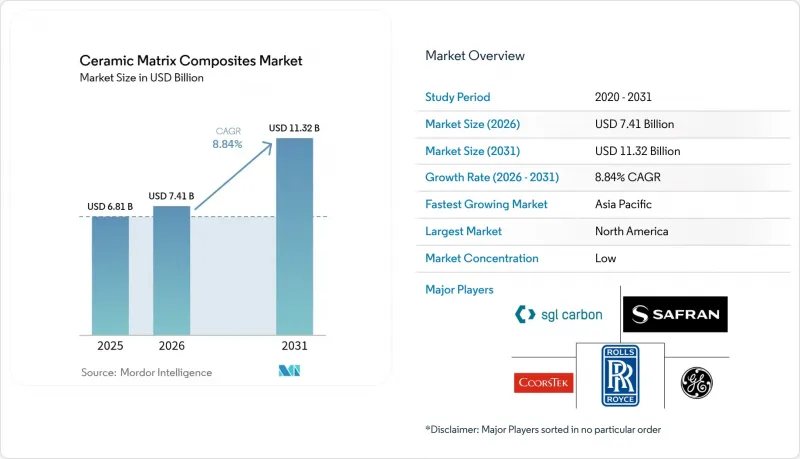
本報告按產品類型(C/C、C/SiC、氧化物/氧化物等)、終端用戶產業(汽車、航太、國防等)和地區(亞太、北美、歐洲、南美、中東和非洲)對產業進行細分。市場預測以美元計價。
全球陶瓷基質複合材料市場趨勢及洞察
擴大隔熱材料在國防領域的應用。
目前,國防機構正將耐熱性作為首要設計標準。美國高超音速武器專案要求材料即使在攝氏2000度C以上的高溫下也能保持結構穩定性,而大多數超合金都無法滿足此要求。洛克希德馬丁公司的一系列測試凸顯了陶瓷基閾值材料(CMC)在提升電子設備環境適應性和保護飛機外殼方面的必要性。國防相關企業為提高生存能力願意付出高昂代價,這加速了CMC的早期認證,並形成了一個學習曲線,該曲線也將惠及其他領域。碳纖維增強碳化矽複合材料即使經過多次高溫循環也能重複使用,此優勢改變了生命週期成本的計算公式。
對輕量化汽車平臺的需求
在電動車和自動駕駛汽車專案中,減重目標備受關注,因為每減輕一公斤重量都能提升續航里程和冷卻效率。陶瓷基質材料比鎳基合金輕65%,即使在高溫排氣條件下也能維持功能強度。日本的示範性陶瓷燃氣渦輪機在實現超過40%的熱效率的同時,零件重量也降低了兩位數。汽車生產正促使供應商轉向近淨成形加工,例如自動纖維鋪放(AFP)技術,將以往需要數小時的層壓製程縮短至幾分鐘。
與高溫合金相比:製造成本高
由於高溫纖維提取和耗時的浸漬工藝,CMC零件的成本仍然是同類金屬零件的3到5倍。 SCANCUT專案透過創新的銑削路徑,將加工時間縮短了70%,類似的自動化突破性進展正在縮小成本差距。雖然隨著CMC使用壽命的延長,總擁有成本有所降低,但初始投資價格仍然是電力和汽車行業中對價格敏感的用戶的一大障礙。通用電氣在阿拉巴馬州投資2億美元的工廠旨在透過航太領域的規模生產來降低成本。
細分市場分析
預計到2025年,SiC/SiC複合材料將佔據陶瓷基質材料市場54.62%的佔有率,並在2031年之前以10.83%的複合年成長率成長。細間距纖維的引入,使其強度超過2 GPa,從而拓展了其結構應用領域。隨著新型噴射引擎核心零件中用於SiC/SiC複合材料的罩殼、燃燒室襯裡和噴嘴延伸段的認證,SiC/SiC複合材料在陶瓷基質複合材料應用領域的市場規模預計將快速成長。碳/碳基材料在需要控制氧化的火箭噴嘴領域仍佔有一席之地,而氧化物/氧化物基材料在工業熱交換器領域正日益受到青睞,因為在這些領域,固有的氧化穩定性比最高耐溫性更為重要。
製程進步包括奈米工程界面層,可減少熱循環過程中纖維的損傷。三菱化學集團的碳纖維基C/SiC複合材料適用於1500 度C度C環境,顯示混合化學成分正在拓展太空船耐熱性的上限。將SiC漿料層壓到編織預成型件上,可以製造出傳統層壓方法無法實現的複雜冷卻通道。這些創新保持了SiC/SiC基材料的優越性,並吸引了主要渦輪機製造商的投資。
區域分析
由於航太和國防領域緊密整合的生態系統,預計2025年,北美將佔據陶瓷基質材料市場37.55%的佔有率。該地區擁有垂直整合的供應鏈,涵蓋碳化矽纖維拉伸、零件層壓、機械加工和引擎組裝等環節。政府主導的各項舉措,例如先進複合材料製造創新研究所(Institute for Advanced Composites Manufacturing Innovation),正透過津貼試點生產線來支持區域產能。勞斯萊斯和通用電氣已獲得多年期訂單,這有助於緩解需求週期波動,並為進一步擴建工廠提供基礎。
亞太地區預計將成為成長最快的地區,到2031年複合年成長率將達到10.56%,這主要得益於中國和日本加強了其戰略材料計劃。各國計畫的目標是在2035年實現高性能纖維的自給自足。汽車電氣化也刺激了該地區對輕質耐熱部件的需求。低廉的人事費用和強力的補貼政策使得該地區能夠提供具有競爭力的出口價格,使其成為陶瓷基質複合材料市場的重要消費國和全球供應商。
歐洲透過對高比例可再生能源電網支援的渦輪機進行維修,以及研發新型飛機引擎驗證機(例如羅爾斯·羅伊斯公司的「UltraFan」),維持著穩定的市場佔有率。歐盟的研究網路整合了公共和私人資金,正在研發適用於工業爐的氧化物-氧化物複合材料,並拓展其應用範圍。嚴格的排放法規為陶瓷基複合材料(CMCs)等能源效率提升材料創造了有利的政策環境,從而刺激了歐洲的需求。
其他好處:
- Excel格式的市場預測(ME)表
- 3個月的分析師支持
目錄
第1章:引言
- 研究假設和市場定義
- 調查範圍
第2章:調查方法
第3章執行摘要
第4章 市場狀況
- 市場概覽
- 市場促進因素
- 擴大隔熱材料在國防領域的應用。
- 對輕量化汽車平臺的需求
- 陶瓷基質複合材料在國防領域的應用日益廣泛
- 利用可再生能源改造燃氣渦輪機的趨勢正在不斷擴大。
- 加速高超音速飛機的研發
- 市場限制因素
- 高昂的製造成本以及與高溫合金的比較
- 一個複雜且多階段的製造過程
- 更嚴格的紡織粉塵排放標準。
- 價值鏈分析
- 波特五力模型
第5章 市場規模與成長預測
- 依產品類型
- C/C
- C/SiC
- 氧化物/氧化物
- SiC/SiC
- 按最終用戶行業分類
- 車
- 航太
- 防禦
- 能源與電力
- 電氣和電子設備
- 其他終端用戶產業(例如醫療保健)
- 按地區
- 亞太地區
- 中國
- 印度
- 日本
- 韓國
- 馬來西亞
- 泰國
- 印尼
- 越南
- 其他亞太國家
- 北美洲
- 美國
- 加拿大
- 墨西哥
- 歐洲
- 德國
- 英國
- 法國
- 義大利
- 西班牙
- 土耳其
- 俄羅斯
- 北歐國家
- 其他歐洲國家
- 南美洲
- 巴西
- 阿根廷
- 哥倫比亞
- 其他南美國家
- 中東和非洲
- 沙烏地阿拉伯
- 阿拉伯聯合大公國
- 卡達
- 埃及
- 奈及利亞
- 南非
- 其他中東和非洲國家
- 亞太地區
第6章 競爭情勢
- 市場集中度
- 策略趨勢
- 市佔率和排名分析
- 公司簡介
- 3M
- applied thin films inc.
- CeramTec GmbH
- COIC
- CoorsTek Inc.
- General Electric Company
- HTMS Ltd.
- KYOCERA Corporation
- LANCER SYSTEMS
- Mitsubishi Chemical Group Corporation
- Pratt & Whitney
- Rolls-Royce
- Safran
- SGL Carbon
- Starfire Systems Inc.
- TORAY INDUSTRIES, INC.
- UBE Corporation
第7章 市場機會與未來展望
According to Mordor Intelligence, ceramic matrix composites market size in 2026 is estimated at USD 7.41 billion, growing from 2025 value of USD 6.81 billion with 2031 projections showing USD 11.32 billion, growing at 8.84% CAGR over 2026-2031.
This report Segments the Industry by Product Type (C/C, C/SiC, Oxide/Oxide, and More), End-User Industry (Automotive, Aerospace, Defense, and More), and Geography (Asia-Pacific, North America, Europe, South America, and Middle East and Africa). The Market Forecasts are Provided in Terms of Value (USD).
Global Ceramic Matrix Composites Market Trends and Insights
Increasing Defense-Grade Thermal Barrier Applications
Defense agencies now treat thermal capability as a primary design filter. Hypersonic munitions programs in the United States require materials that remain structurally stable above 2,000 °C, a threshold that eliminates most super-alloys. Lockheed Martin's test series highlights the need for CMCs in electronics ruggedization and aero-shell protection. The premium prices defense contractors accept for survivability accelerate early CMC qualification, generating learning curves that benefit other sectors. Carbon-fiber reinforced silicon carbide composites have demonstrated reusable performance after multiple high-heat cycles, an advantage that shifts life-cycle cost equations.
Lightweight Vehicle Platforms Demand
Electric and autonomous vehicle programs pursue aggressive mass-reduction targets because every kilogram saved improves driving range and cooling efficiency. Ceramic matrix composites weigh up to 65% less than nickel-based alloys yet retain functional strength at exhaust temperatures. Demonstration ceramic gas turbines in Japan reached thermal efficiencies above 40% while cutting component weight by double-digit percentages. Automotive production volumes push suppliers toward near-net-shape processes such as automated fiber placement that convert hours-long layups into minute-level cycles.
High Production Cost vs. Super-Alloys
CMC parts still cost 3-5 times more than comparable metallic parts due to high-temperature fiber draw and lengthy infiltration steps. The SCANCUT project cut machining time by 70% through novel milling paths, and similar automation breakthroughs are narrowing the gap. Total cost of ownership improves as CMC lifetimes lengthen, but initial acquisition price remains a hurdle for price-sensitive power and automotive users. GE's USD 200 million Alabama facility targets cost parity at scale geaerospace.
Other drivers and restraints analyzed in the detailed report include:
- Growing Renewable Gas-Turbine Retrofits
- Hypersonic Vehicle R&D Acceleration
- Complex Multi-Step Manufacturing Routes
For complete list of drivers and restraints, kindly check the Table Of Contents.
Segment Analysis
SiC/SiC composites held 54.62% ceramic matrix composites market share in 2025 and are projected to grow at an 10.83% CAGR to 2031. Integration of finer pitch fibers delivering strengths above 2 GPa has expanded their structural envelope. The ceramic matrix composites market size for SiC/SiC applications is forecast to rise sharply as new jet engine cores qualify shrouds, combustor liners, and nozzle extensions. Carbon/carbon systems maintain niches in rocket nozzles where oxidation can be controlled, and oxide/oxide grades gain traction in industrial heat exchangers that value inherent oxidation stability over peak temperature.
Process advances include nano-engineered interphases that mitigate fiber damage during thermal cycling. Mitsubishi Chemical Group's carbon-fiber-based C/SiC, qualified for 1,500 °C exposure, shows how hybrid chemistries extend temperature ceilings for space vehicles. The additive deposition of SiC slurry onto woven preforms makes complex cooling passages not feasible with legacy layups. Such innovations maintain the lead of the SiC/SiC family and attract investment from turbine primes.
Complete Report Scope:
- By Product Type
- C/C
- C/SiC
- Oxide/Oxide
- SiC/SiC
- By End-user Industry
- Automotive
- Aerospace
- Defense
- Energy & Power
- Electrical & Electronics
- Other End-User Industries (Medical, etc.)
- By Geography
- Asia-Pacific
- China
- India
- Japan
- South Korea
- Malaysia
- Thailand
- Indonesia
- Vietnam
- Rest of Asia-Pacific
- North America
- United States
- Canada
- Mexico
- Europe
- Germany
- United Kingdom
- France
- Italy
- Spain
- Turkey
- Russia
- Nordic Countries
- Rest of Europe
- South America
- Brazil
- Argentina
- Colombia
- Rest of South America
- Middle East and Africa
- Saudi Arabia
- United Arab Emirates
- Qatar
- Egypt
- Nigeria
- South Africa
- Rest of Middle East and Africa
- Asia-Pacific
Geography Analysis
Due to dense aerospace and defense ecosystems, North America commanded 37.55% of the ceramic matrix composites market revenue in 2025. The region houses vertically integrated supply chains that span SiC fiber draw, component layup, machining, and engine assembly. Government initiatives like the Institute for Advanced Composites Manufacturing Innovation funnel grants toward pilot lines, underpinning local capacity. Rolls-Royce and GE place multi-year orders that smooth demand cycles and justify further plant expansions.
Asia-Pacific delivers the fastest 10.56% CAGR through 2031 as China and Japan escalate strategic materials programs. National plans seek supply independence for high-performance fibers, with milestone targets set for 2035. Automotive electrification also stimulates regional demand for lightweight, thermally resilient parts. Lower labor costs and proactive subsidies enable competitive export pricing, positioning the region as a significant consumer and global ceramic matrix composites market supplier.
Europe maintains a steady share through turbine retrofits that support renewable-heavy grids and through new aircraft engine demonstrators such as Rolls-Royce UltraFan. EU research networks pool public and private funds to mature oxide-oxide grades suitable for industrial furnaces, widening application scope. Strict emission regulations create a positive policy environment for efficiency-raising materials like CMCs, reinforcing European demand.
- 3M
- applied thin films inc.
- CeramTec GmbH
- COIC
- CoorsTek Inc.
- General Electric Company
- HTMS Ltd.
- KYOCERA Corporation
- LANCER SYSTEMS
- Mitsubishi Chemical Group Corporation
- Pratt & Whitney
- Rolls-Royce
- Safran
- SGL Carbon
- Starfire Systems Inc.
- TORAY INDUSTRIES, INC.
- UBE Corporation
Additional Benefits:
- The market estimate (ME) sheet in Excel format
- 3 months of analyst support
TABLE OF CONTENTS
1 Introduction
- 1.1 Study Assumptions & Market Definition
- 1.2 Scope of the Study
2 Research Methodology
3 Executive Summary
4 Market Landscape
- 4.1 Market Overview
- 4.2 Market Drivers
- 4.2.1 Increasing defense-grade thermal barrier applications
- 4.2.2 Lightweight vehicle platforms demand
- 4.2.3 Increasing Application of Ceramic Matrix Composites in Defense Sector
- 4.2.4 Growing renewable gas-turbine retrofits
- 4.2.5 Hypersonic vehicle R&D acceleration
- 4.3 Market Restraints
- 4.3.1 High production cost vs. super-alloys
- 4.3.2 Complex multi-step manufacturing routes
- 4.3.3 Stricter fibre-dust emission norms
- 4.4 ValueChain Analysis
- 4.5 Porter's Five Forces
- 4.5.1 Bargaining Power of Suppliers
- 4.5.2 Bargaining Power of Buyers
- 4.5.3 Threat of New Entrants
- 4.5.4 Threat of Substitutes
- 4.5.5 Degree of Competition
5 Market Size & Growth Forecasts (Value)
- 5.1 By Product Type
- 5.1.1 C/C
- 5.1.2 C/SiC
- 5.1.3 Oxide/Oxide
- 5.1.4 SiC/SiC
- 5.2 By End-user Industry
- 5.2.1 Automotive
- 5.2.2 Aerospace
- 5.2.3 Defense
- 5.2.4 Energy & Power
- 5.2.5 Electrical & Electronics
- 5.2.6 Other End-User Industries (Medical, etc.)
- 5.3 By Geography
- 5.3.1 Asia-Pacific
- 5.3.1.1 China
- 5.3.1.2 India
- 5.3.1.3 Japan
- 5.3.1.4 South Korea
- 5.3.1.5 Malaysia
- 5.3.1.6 Thailand
- 5.3.1.7 Indonesia
- 5.3.1.8 Vietnam
- 5.3.1.9 Rest of Asia-Pacific
- 5.3.2 North America
- 5.3.2.1 United States
- 5.3.2.2 Canada
- 5.3.2.3 Mexico
- 5.3.3 Europe
- 5.3.3.1 Germany
- 5.3.3.2 United Kingdom
- 5.3.3.3 France
- 5.3.3.4 Italy
- 5.3.3.5 Spain
- 5.3.3.6 Turkey
- 5.3.3.7 Russia
- 5.3.3.8 Nordic Countries
- 5.3.3.9 Rest of Europe
- 5.3.4 South America
- 5.3.4.1 Brazil
- 5.3.4.2 Argentina
- 5.3.4.3 Colombia
- 5.3.4.4 Rest of South America
- 5.3.5 Middle East and Africa
- 5.3.5.1 Saudi Arabia
- 5.3.5.2 United Arab Emirates
- 5.3.5.3 Qatar
- 5.3.5.4 Egypt
- 5.3.5.5 Nigeria
- 5.3.5.6 South Africa
- 5.3.5.7 Rest of Middle East and Africa
- 5.3.1 Asia-Pacific
6 Competitive Landscape
- 6.1 Market Concentration
- 6.2 Strategic Moves
- 6.3 Market Share (%)/Ranking Analysis
- 6.4 Company Profiles (includes Global level Overview, Market level overview, Core Segments, Financials as available, Strategic Information, Market Rank/Share for key companies, Products & Services, and Recent Developments)
- 6.4.1 3M
- 6.4.2 applied thin films inc.
- 6.4.3 CeramTec GmbH
- 6.4.4 COIC
- 6.4.5 CoorsTek Inc.
- 6.4.6 General Electric Company
- 6.4.7 HTMS Ltd.
- 6.4.8 KYOCERA Corporation
- 6.4.9 LANCER SYSTEMS
- 6.4.10 Mitsubishi Chemical Group Corporation
- 6.4.11 Pratt & Whitney
- 6.4.12 Rolls-Royce
- 6.4.13 Safran
- 6.4.14 SGL Carbon
- 6.4.15 Starfire Systems Inc.
- 6.4.16 TORAY INDUSTRIES, INC.
- 6.4.17 UBE Corporation
7 Market Opportunities & Future Outlook
- 7.1 White-space & Unmet-Need Assessment

 碳化矽基陶瓷複合材料市場:全球市場預測,2026-2032年陶瓷基質複合材料市場:依基體類型、增強體類型、製造技術、應用、終端用戶產業及通路分類-2026-2032年全球市場預測
 陶瓷基質複合材料市場預測至2034年—按纖維類型、基體材料、製造流程、應用、最終用戶和地區分類的全球分析
 全球陶瓷基質材料市場規模、佔有率、趨勢和成長分析報告(2026-2034)
 陶瓷基質材料市場規模、佔有率、趨勢及預測(按複合材料材料類型、纖維類型、纖維材料、應用和地區分類),2026-2034年
 陶瓷基複合材料市場規模、佔有率和趨勢分析報告:按產品、應用、地區和細分市場預測(2026-2033 年)
 2026年全球陶瓷基質複合材料市場報告日本陶瓷基複合材料市場報告(按複合材料類型、纖維類型、纖維材料、應用和地區分類,2026-2034年)
 陶瓷基質材料市場規模、佔有率、成長分析(按纖維類型、基體類型、纖維材料、終端應用產業和地區分類)-2026-2033年產業預測
 陶瓷基複合材料市場-全球產業規模、佔有率、趨勢、機會和預測,依產品類型、應用、地區和競爭格局分類,2020-2030年預測