


 |
市場調查報告書
商品編碼
2122422
高速鋼:市場佔有率分析、產業趨勢與統計、成長預測(2026-2031)High Speed Steel - Market Share Analysis, Industry Trends & Statistics, Growth Forecasts (2026 - 2031) |
||||||

※ 本網頁內容可能與最新版本有所差異。詳細情況請與我們聯繫。
根據 Mordor Intelligence 估計,2026 年高速鋼市場規模為 57.2 億美元,預計到 2031 年將達到 87.4 億美元,在預測期(2026-2031 年)內複合年成長率為 8.84%。
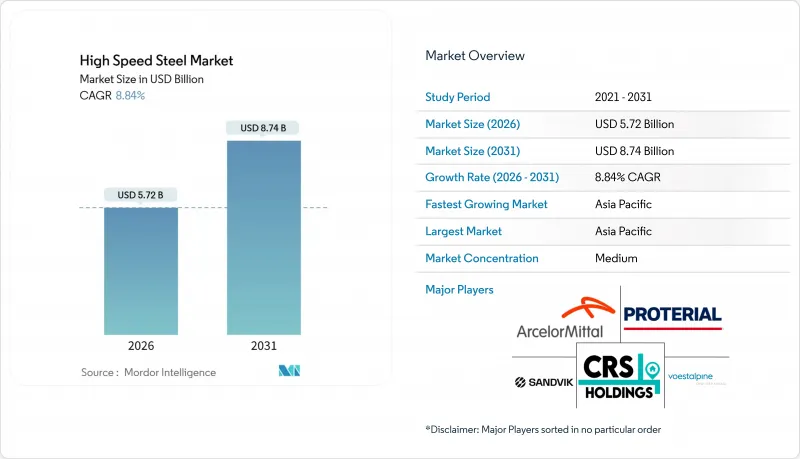
本報告按類型(鎢基高速鋼、鉬基高速鋼及其他)、產品類型(金屬切削刀具、冷加工刀具及其他)、終端用戶產業(汽車、航太、塑膠及其他)及地區(亞太、北美、歐洲及其他)進行細分。市場預測以美元計價。
全球高速鋼市場趨勢及洞察
電動車的普及帶動了汽車機械加工需求的成長。
隨著電池式電動車產量激增,加工公差要求也越來越嚴格,甚至低於50微米。這種變化加速了刀具磨損,顯著增加了鑽頭和端銑刀的更換頻率。因此,特斯拉在擴建其位於德克薩斯州和柏林的工廠的同時,也擴大了切削刀具的採購量。同時,中國工業和資訊化部報告稱,新能源汽車產量有所成長。如此大的產量往往更青睞鉬基鋼,因為鉬基鋼無需額外添加鈷即可在550-600 度C下保持硬度。這一趨勢正在推動高速鋼市場的持續成長。
對航太引擎和飛機工具的需求增加
波音公司在2025年財報中揭露了其民航機累積訂單,空中巴士也宣布其部分訂單待交付。儘管高速鋼已全面過渡到硬質合金,但高速鋼市場仍然強勁,因為鈦合金殼體的二次鑽孔和鉸孔仍然依賴高速鋼的韌性。由於硬質合金在振動負荷下斷裂的風險較高,普惠公司繼續使用高速鋼成形刀具來精加工龍骨槽。
快速轉向硬質合金和陶瓷替代品
2024年的測試表明,在銑削Inconel 718合金時,陶瓷刀片的使用壽命比塗層高速鋼刀片更長。通用電氣航空航太公司2025年的供應商指南將高速鋼刀片排除在許多航太相關應用之外,強制要求所有主切削都使用硬質合金或立方氮化硼(CBN)刀片。山特維克公司公佈,2024年硬質合金刀片的銷量顯著成長,凸顯了其市場佔有率的重大轉變。
細分市場分析
預計到2025年,鉬合金的銷售額將佔高速鋼總銷售額的37.16%,到2031年,其複合年成長率將達到9.43%。這使得鉬合金成為高速鋼市場中成長最快的細分市場,其表現優於所有其他競爭合金。由於鉬合金相比鎢合金具有成本優勢,且在高達600 度C的溫度下性能穩定,因此買家持續選擇鉬合金。粉末冶金加工技術能夠分散細小的碳化物,進而提高韌性和研磨。鎢合金在650 度C以上的溫度範圍內仍保持著一定的市場需求,但其價格飆升限制了其廣泛應用。同時,富鈷合金憑藉著在間歇負荷下具有的高赤熱硬度,已在高速齒輪滾齒和拉削領域佔據了一席之地。
受2024年至2025年鎢價波動的影響,汽車製造商已將目光轉向鉬基合金。 Proterial公司的M42鈷鉬合金產品具有較高的洛氏硬度C,且相比鎢含量更高的T15合金,成本優勢顯著。同時,中國製造商天工高速鋼在2024年實現了鉬基高速鋼銷量的顯著成長,並透過向中國和印度的汽車企業供貨,鞏固了其在高速鋼領域的主導地位。
區域分析
預計到2025年,亞太地區將佔全球高速鋼銷售額的64.28%,並在2031年之前以9.34%的複合年成長率成長。因此,亞太地區的高速鋼市場預計將呈現高於其他所有地區的成長速度。 2024年,中國在全球切削刀俱生產中佔據重要佔有率,主要得益於其位於江蘇和浙江兩省的生產基地。同時,預計到2025年,印度製造業將吸引大量外資,其中大部分訂單將流向當地刀具供應商。日本將繼續保持主導地位,而韓國將在2025年憑藉工具機產量的激增進一步鞏固其在該地區的主導地位,這主要得益於半導體和汽車行業的投資。
2025年,北美和歐洲合計佔據了相當大的市場。波音公司龐大的訂單積壓,加上普惠公司在渦輪機相關領域的努力,凸顯了高速鋼在航太領域二次應用的強勁地位。 2025年,德國的工具機生產強勁,切削刀具的消耗量也顯著成長。由於歐盟旨在促進鎢回收利用的《基本原料法》,福斯特阿爾卑斯公司在2024年成功地從廢料中回收了大量鎢,從而加強了該地區的供應鏈。
南美洲以及中東和非洲佔據了剩餘的市場佔有率。 2025年,淡水河谷對其採礦設施進行了大量現代化改造投資,其中以高速鋼刀具加工中心為核心。同年,沙烏地阿拉伯公共投資基金向先進製造業項目撥款,其中包括一家旨在發展國內高速鋼生產的合資企業。儘管面臨進口產品的競爭,南非2025年的汽車生產仍提振了當地對切削刀具的需求。
其他好處:
- Excel格式的市場預測(ME)表
- 3個月的分析師支持
目錄
第1章:引言
- 研究假設和市場定義
- 調查範圍
第2章:調查方法
第3章執行摘要
第4章 市場狀況
- 市場概覽
- 市場促進因素
- 受電動車推動,汽車機械加工需求不斷成長。
- 對航太引擎和機身模具的需求不斷成長
- 自動化和工業4.0正在增加工具更換的頻率。
- 高速鋼級粉末冶金刀具,可延長刀具壽命。
- 促進鎢回收的循環經濟
- 市場限制因素
- 快速轉向碳化物和陶瓷替代品
- 鎢和鉬等原物料價格的波動
- 3D列印硬質合金刀具正在縮短高速鋼刀具的使用壽命。
- 價值鏈分析
- 波特五力模型
第5章 市場規模與成長預測
- 按類型
- 鎢基高速鋼
- 鉬基高速鋼
- 其他類型(鈷高速鋼、鉻高速鋼、釩高速鋼)
- 依產品類型
- 切削刀具
- 冷作工具
- 其他產品類型(銑削工具、鑽孔工具等)
- 按最終用戶行業分類
- 車
- 航太
- 塑膠
- 其他終端用戶產業(採礦、製造業、工具製造等)
- 地區
- 亞太地區
- 中國
- 印度
- 日本
- 韓國
- 馬來西亞
- 泰國
- 印尼
- 越南
- 其他亞太國家
- 北美洲
- 美國
- 加拿大
- 墨西哥
- 歐洲
- 德國
- 英國
- 法國
- 義大利
- 西班牙
- 北歐國家
- 土耳其
- 俄羅斯
- 其他歐洲國家
- 南美洲
- 巴西
- 阿根廷
- 哥倫比亞
- 其他南美國家
- 中東和非洲
- 沙烏地阿拉伯
- 南非
- 奈及利亞
- 卡達
- 埃及
- 阿拉伯聯合大公國
- 其他中東和非洲國家
- 亞太地區
第6章 競爭情勢
- 市場集中度
- 策略趨勢
- 市佔率和排名分析
- 公司簡介
- ArcelorMittal
- CRS Holdings, LLC
- ERASTEEL
- Friedr. Lohmann GmbH
- Graphite India Limited
- Hudson Tool Steel
- Jiangsu Tiangong Tools Co., Ltd.
- NIPPON KOSHUHA STEEL CO,. LTD.
- Proterial, Ltd.
- Sandvik AB
- voestalpine BOHLER Edelstahl GmbH & Co KG
第7章 市場機會與未來展望
According to Mordor Intelligence, the high speed steel market size is estimated at USD 5.72 billion in 2026, and is expected to reach USD 8.74 billion by 2031, at a CAGR of 8.84% during the forecast period (2026-2031).
This report is Segmented by Type (Tungsten High Speed Steel, Molybdenum High Speed Steel, and Other Types), Product Type (Metal Cutting Tools, Cold Working Tools, and Other Product Types), End-User Industry (Automotive, Aerospace, Plastics, and Other End-User Industries), and Geography (Asia-Pacific, North America, Europe, and More). The Market Forecasts are Provided in Terms of Value (USD).
Global High Speed Steel Market Trends and Insights
Expansion of EV Driven Automotive Machining Demand
As battery-electric vehicle production surges, tolerance bands are tightening below 50 µm. This shift leads to quicker tool wear and a significant uptick in drill and end-mill turnover. In tandem, Tesla ramped up its cutting tool procurement during its plant expansions in Texas and Berlin. Meanwhile, the Chinese Ministry of Industry and Information Technology reported an increase in new-energy vehicle production. Such production volumes favor molybdenum grades, which maintain hardness at 550-600 °C without incurring the cobalt premium. This preference bolsters the continuous growth of the high-speed steel market.
Rising Aerospace Engine and Air Frame Tooling Needs
Boeing reported a commercial backlog in its 2025 filing, while Airbus announced it has orders pending delivery. The high-speed steel market remains resilient against a complete shift to carbide, as secondary drilling and reaming on titanium shells still depend on the toughness of high-speed steel. Pratt & Whitney, citing the heightened risk of carbide fractures under vibratory loads, continues to use high-speed steel form tools for finishing fir-tree slots.
Rapid Shift Toward Carbide and Ceramic Substitutes
In 2024 trials, ceramic inserts outlasted coated high-speed steel when milling Inconel 718. GE Aerospace's 2025 supplier guide has eliminated high-speed steel from many aerospace operations, mandating carbide or CBN for all primary cuts. Sandvik revealed growth in carbide insert sales in 2024, underscoring a notable shift in market share.
Other drivers and restraints analyzed in the detailed report include:
- Automation and Industry 4.0 Boosting Tool Change Frequency
- Powder Metallurgy High Speed Steel Grades Extending Tool Life
- Volatile Tungsten and Molybdenum Input Prices
For complete list of drivers and restraints, kindly check the Table Of Contents.
Segment Analysis
Molybdenum compositions held 37.16% of 2025 revenue, and the cohort is set for a 9.43% CAGR through 2031. This positions molybdenum grades as the fastest-growing segment in the high-speed steel market, outpacing all rival alloys. Buyers remain loyal, drawn by cost advantages over tungsten blends and consistent performance up to 600 °C. The powder-metallurgy processing technique, which disperses fine carbides, enhances toughness and grindability. While tungsten grades maintain a niche for temperatures exceeding 650 °C, their rising prices limit broader adoption. Meanwhile, cobalt-enriched alloys find their place in high-speed gear hobbing and broaching, where they offer added red-hardness for intermittent loads.
In response to price fluctuations in tungsten during 2024-2025, OEMs shifted their focus to molybdenum variants. Proterial's M42 cobalt-molybdenum product achieved high Rockwell C hardness, boasting a significant cost advantage over the tungsten-rich T15. Meanwhile, Chinese producer Tiangong recorded notable sales growth in molybdenum high-speed steel in 2024, predominantly catering to automotive tiers in China and India, solidifying its leadership in the high-speed steel arena.
Complete Report Scope:
- By Type
- Tungsten High Speed Steel
- Molybdenum High Speed Steel
- Other Types (Cobalt High-Speed Steel, Chromium High-Speed Steel, and Vanadium High-Speed Steel)
- By Product Type
- Metal Cutting Tools
- Cold Working Tools
- Other Product Types (Milling Tools, Drilling Tools, etc.)
- By End-user Industry
- Automotive
- Aerospace
- Plastics
- Other End-user Industries (Mining, Manufacturing, Tool Making, etc)
- Geography
- Asia-Pacific
- China
- India
- Japan
- South Korea
- Malaysia
- Thailand
- Indonesia
- Vietnam
- Rest of Asia-Pacific
- North America
- United States
- Canada
- Mexico
- Europe
- Germany
- United Kingdom
- France
- Italy
- Spain
- NORDIC Countries
- Turkey
- Russia
- Rest of Europe
- South America
- Brazil
- Argentina
- Colombia
- Rest of South America
- Middle-East and Africa
- Saudi Arabia
- South Africa
- Nigeria
- Qatar
- Egypt
- United Arab Emirates
- Rest of Middle-East and Africa
- Asia-Pacific
Geography Analysis
Asia-Pacific generated 64.28% of global revenue in 2025 and is forecast to grow at a 9.34% CAGR to 2031. As a result, the high-speed steel market in Asia-Pacific is set to outpace all other regions in growth. In 2024, China, primarily from its Jiangsu and Zhejiang hubs, was responsible for a substantial portion of global cutting tool production. Meanwhile, India drew in considerable foreign manufacturing investments in 2025, directing a significant portion of these orders to local tool suppliers. Japan continues to lead in precision, and South Korea's machine-tool output surged in 2025, driven by investments in semiconductors and automotive sectors, further solidifying the region's dominance.
North America and Europe together accounted for a notable share of the 2025 market value. Boeing's substantial backlog, alongside Pratt & Whitney's turbine initiatives, underscores the stronghold of high-speed steel in secondary aerospace applications. In 2025, Germany boasted a robust machine-tool output, with a notable uptick in cutting-tool consumption. The EU's Critical Raw Materials Act, aimed at boosting tungsten recycling, saw voestalpine successfully recover a significant amount from scrap in 2024, bolstering the region's supply chains.
South America, along with the Middle East and Africa, accounted for the remaining share of the market. In 2025, Vale invested heavily in upgrading mine equipment, which prominently featured machining centers utilizing high-speed steel tooling. Saudi Arabia's Public Investment Fund, in 2025, allocated substantial resources towards advanced manufacturing projects, including a joint venture eyeing domestic high-speed steel production. Despite facing import competition, South Africa's vehicle production in 2025 bolstered the demand for local cutting tools.
- ArcelorMittal
- CRS Holdings, LLC
- ERASTEEL
- Friedr. Lohmann GmbH
- Graphite India Limited
- Hudson Tool Steel
- Jiangsu Tiangong Tools Co., Ltd.
- NIPPON KOSHUHA STEEL CO,. LTD.
- Proterial, Ltd.
- Sandvik AB
- voestalpine BOHLER Edelstahl GmbH & Co KG
Additional Benefits:
- The market estimate (ME) sheet in Excel format
- 3 months of analyst support
TABLE OF CONTENTS
1 Introduction
- 1.1 Study Assumptions and Market Definition
- 1.2 Scope of the Study
2 Research Methodology
3 Executive Summary
4 Market Landscape
- 4.1 Market Overview
- 4.2 Market Drivers
- 4.2.1 Expansion of EV-driven automotive machining demand
- 4.2.2 Rising aerospace engine and air-frame tooling needs
- 4.2.3 Automation and Industry 4.0 boosting tool-change frequency
- 4.2.4 Powder-metallurgy HSS grades extending tool life
- 4.2.5 Circular-economy push for tungsten recycling
- 4.3 Market Restraints
- 4.3.1 Rapid shift toward carbide and ceramic substitutes
- 4.3.2 Volatile tungsten and molybdenum input prices
- 4.3.3 3-D-printed carbide tools shortening HSS life-cycle
- 4.4 Value Chain Analysis
- 4.5 Porter's Five Forces
- 4.5.1 Bargaining Power of Suppliers
- 4.5.2 Bargaining Power of Buyers
- 4.5.3 Threat of New Entrants
- 4.5.4 Threat of Substitutes
- 4.5.5 Degree of Competition
5 Market Size and Growth Forecasts (Value)
- 5.1 By Type
- 5.1.1 Tungsten High Speed Steel
- 5.1.2 Molybdenum High Speed Steel
- 5.1.3 Other Types (Cobalt High-Speed Steel, Chromium High-Speed Steel, and Vanadium High-Speed Steel)
- 5.2 By Product Type
- 5.2.1 Metal Cutting Tools
- 5.2.2 Cold Working Tools
- 5.2.3 Other Product Types (Milling Tools, Drilling Tools, etc.)
- 5.3 By End-user Industry
- 5.3.1 Automotive
- 5.3.2 Aerospace
- 5.3.3 Plastics
- 5.3.4 Other End-user Industries (Mining, Manufacturing, Tool Making, etc)
- 5.4 Geography
- 5.4.1 Asia-Pacific
- 5.4.1.1 China
- 5.4.1.2 India
- 5.4.1.3 Japan
- 5.4.1.4 South Korea
- 5.4.1.5 Malaysia
- 5.4.1.6 Thailand
- 5.4.1.7 Indonesia
- 5.4.1.8 Vietnam
- 5.4.1.9 Rest of Asia-Pacific
- 5.4.2 North America
- 5.4.2.1 United States
- 5.4.2.2 Canada
- 5.4.2.3 Mexico
- 5.4.3 Europe
- 5.4.3.1 Germany
- 5.4.3.2 United Kingdom
- 5.4.3.3 France
- 5.4.3.4 Italy
- 5.4.3.5 Spain
- 5.4.3.6 NORDIC Countries
- 5.4.3.7 Turkey
- 5.4.3.8 Russia
- 5.4.3.9 Rest of Europe
- 5.4.4 South America
- 5.4.4.1 Brazil
- 5.4.4.2 Argentina
- 5.4.4.3 Colombia
- 5.4.4.4 Rest of South America
- 5.4.5 Middle-East and Africa
- 5.4.5.1 Saudi Arabia
- 5.4.5.2 South Africa
- 5.4.5.3 Nigeria
- 5.4.5.4 Qatar
- 5.4.5.5 Egypt
- 5.4.5.6 United Arab Emirates
- 5.4.5.7 Rest of Middle-East and Africa
- 5.4.1 Asia-Pacific
6 Competitive Landscape
- 6.1 Market Concentration
- 6.2 Strategic Moves
- 6.3 Market Share/Ranking Analysis
- 6.4 Company Profiles (includes Global level Overview, Market level overview, Core Segments, Financials as available, Strategic Information, Products and Services, Recent Developments)
- 6.4.1 ArcelorMittal
- 6.4.2 CRS Holdings, LLC
- 6.4.3 ERASTEEL
- 6.4.4 Friedr. Lohmann GmbH
- 6.4.5 Graphite India Limited
- 6.4.6 Hudson Tool Steel
- 6.4.7 Jiangsu Tiangong Tools Co., Ltd.
- 6.4.8 NIPPON KOSHUHA STEEL CO,. LTD.
- 6.4.9 Proterial, Ltd.
- 6.4.10 Sandvik AB
- 6.4.11 voestalpine BOHLER Edelstahl GmbH & Co KG
7 Market Opportunities and Future Outlook
- 7.1 White-space and Unmet-Need Assessment


