


 |
市場調查報告書
商品編碼
2122421
氧化鎂奈米粉:市場佔有率分析、產業趨勢與統計、成長預測(2026-2031)Magnesium Oxide Nanopowder - Market Share Analysis, Industry Trends & Statistics, Growth Forecasts (2026 - 2031) |
||||||

※ 本網頁內容可能與最新版本有所差異。詳細情況請與我們聯繫。
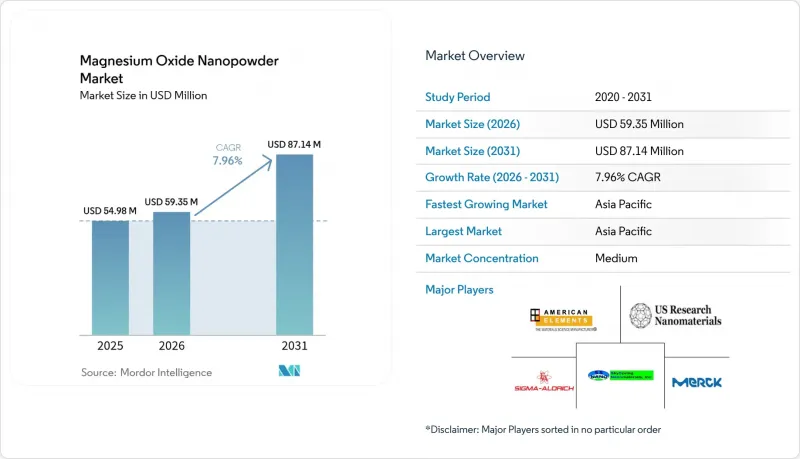
據 Mordor Intelligence 稱,2025 年氧化鎂奈米粉末市值為 5,498 萬美元,預計到 2031 年將達到 8,714 萬美元,而 2026 年為 5,935 萬美元,預測期(2026-2031 年)的複合年成長率為 7.96%。
本報告按應用領域(耐火材料、電絕緣材料、燃料添加劑等)、合成方法(物理方法、化學沉澱法等)、終端用戶產業(汽車/冶金、建築等)和地區(亞太地區、北美地區、歐洲地區、南美地區、中東和非洲地區)進行細分。市場預測以美元計價。
全球氧化鎂奈米粉市場趨勢及洞察
耐火材料產業需求不斷成長
以奈米級氧化鎂配製的鎂碳磚具有更高的密度,可減少鹼性氧氣轉爐和電弧爐中因孔隙率引起的破損。中國、日本和韓國的鋼鐵企業正在對用於鋼包、中間包和連鑄機內襯的奈米粉末進行標準化,以使其能夠承受快速的熱循環。隨著一體化鋼鐵企業之間的整合不斷推進,一些買家獲得了更大的購買力,但他們往往願意為可靠性支付更高的價格,以避免計劃外停機。隨著全部區域電弧爐產能的擴張,對氧化鎂奈米粉末的需求與廢鋼產量的成長密切相關。擁有垂直整合生產系統和耐火材料配方專業知識的供應商可以透過聯合研發協議獲得長期合約。
電氣絕緣應用領域的成長
含有1 wt%氧化鎂奈米顆粒的環氧樹脂在230 度C下仍能維持13的介電常數,且其導熱係數是純樹脂的兩倍。這些特性解決了碳化矽功率模組和牽引逆變器中散熱和電阻率之間長期存在的矛盾。電動車的傳動系統總電壓超過800 V,以及外形規格的小型化,推動了對即使在局部放電條件下也能保持化學惰性的高溫絕緣填料的需求。亞太地區的電纜製造商正在擴大填充冷凍乾燥氧化鎂泡沫的聚乙烯化合物的大規模生產,這種泡沫可以抑制空間電荷的累積。此外,隨著風力發電機逆變器容量的增加,歐洲電力公司擴大指定在海上變電站中使用填充奈米顆粒的灌封化合物。
高昂的生產和精煉成本
一座日產能1425公斤的溶膠-凝膠工廠需要超過4.5萬美元的投資,以目前的價格結構,需要三年以上的時間才能收回投資。高能耗的水熱和煅燒製程使得該工廠對歐盟和美國部分州的碳價波動高度敏感。超過99.8wt%的嚴格純度要求推高了試劑和過濾成本,而這些成本無法透過通用產品的產量攤提。亞太地區以外的小規模生產商面臨規模劣勢,這限制了它們競標大規模耐火材料競標和汽車添加劑供應合約的能力。
細分市場分析
2025年,耐火材料佔氧化鎂奈米粉市場規模的42.10%,其主要應用領域包括鎂碳磚和鋼鋁熔煉製程的中間包襯。電弧爐技術的進步使得人們更傾向於使用顆粒分佈更細、能提高磚體微觀結構密度的產品。隨著廢鋼煉鋼在亞洲的普及,節能型爐襯對提高生產效率至關重要。儘管預計其市場主導地位將維持到2030年,但隨著新應用領域的拓展,其市佔率預計將會下降。
受前所未有的監管壓力推動,旨在減少公路和非公路車輛的顆粒物和氮氧化物排放,預計到2031年,燃油添加劑市場將以8.63%的複合年成長率成長。奈米顆粒分散體能夠改善霧化效果,提高火焰溫度均勻性,並減少煙塵前體,且不會影響引擎硬體的保固。歐盟和中國的試點車輛測試表明,燃油效率提高了2%以上。儘管該市場目前基準較低,但其成長速度使其成為面向汽車行業客戶、尋求即用型解決方案的製造商的焦點。
區域分析
預計到2025年,亞太地區將佔全球氧化鎂奈米粉市場收入的51.72%,並在2031年之前以8.55%的複合年成長率持續成長。這主要得益於該地區完善的供應鏈、具有成本競爭力的原料以及鋼鐵、電子和電池製造商的密集叢集。中國是推動區域需求的主要力量,而日本在陶瓷領域的專業技術以及韓國的半導體產業生態系統也進一步提升了對超高純度氧化鎂的需求。政府針對能源轉型硬體的獎勵策略預計將進一步推動電動車溫度控管和固態固態電池試驗生產線等領域的需求成長。
北美市場規模雖小,但技術高度發達,航太、國防和先進電力電子等產業對高規格粉末的需求量很大。美國正採取措施確保國內供應穩定,而像Magrathea這樣的新創公司正在試行從海水中提取碳中和鎂。到2020年代末,這有望降低原物料採購風險,並加強區域價值鏈。加拿大的關鍵礦產策略包括津貼,以降低奈米粉末精整線的資本門檻,這有望使該地區從特種粉末進口國轉變為出口國。
在歐洲,由於建築規範中更嚴格的阻燃標準以及汽車製造商擴大採用鎂基電動車零件,鎂基材料市場保持穩定成長。德國憑藉其汽車和化學產業的強勁需求引領消費,而英國受益於航太和國防專案對高溫隔熱的需求。歐盟循環經濟法規鼓勵使用礦物基阻燃劑取代鹵素基填料,為氧化鎂奈米粉體的擴張提供了監管方面的利多。此外,歐盟能源戰略指令正在資助固態電池聯盟,其中氧化鎂發揮至關重要的介面作用。
其他好處:
- Excel格式的市場預測(ME)表
- 3個月的分析師支持
目錄
第1章:引言
- 研究假設和市場定義
- 調查範圍
第2章:調查方法
第3章執行摘要
第4章 市場狀況
- 市場概覽
- 市場促進因素
- 耐火材料產業需求增加
- 電氣絕緣應用範圍的擴大
- 擴大其作為燃料添加劑的用途
- 阻燃聚合物複合材料的廣泛應用
- 固態電池電解質的新作用
- 市場限制因素
- 高昂的生產成本和精煉成本
- 聚合與累積問題
- 加強職場奈米顆粒暴露法規
- 鎂原料供應的波動性
- 價值鏈分析
- 波特五力模型
第5章 市場規模與成長預測
- 透過使用
- 防火材料
- 電氣絕緣
- 燃油添加劑
- 阻燃劑
- 磁性裝置
- 其他(催化劑、吸附劑、生物醫學應用等)
- 透過合成方法
- 物理方法
- 化學沉澱法
- 綠色/生物基合成
- 按最終用戶行業分類
- 冶金
- 建造
- 石油和天然氣
- 車
- 電氣和電子設備
- 其他終端用戶產業(化學/石油化工、醫療保健/製藥等)
- 按地區
- 亞太地區
- 中國
- 日本
- 印度
- 韓國
- 東南亞國協
- 其他亞太國家
- 北美洲
- 美國
- 加拿大
- 墨西哥
- 歐洲
- 德國
- 英國
- 法國
- 義大利
- 西班牙
- 俄羅斯
- 北歐國家
- 其他歐洲國家
- 南美洲
- 巴西
- 阿根廷
- 其他南美國家
- 中東和非洲
- 沙烏地阿拉伯
- 南非
- 其他中東和非洲國家
- 亞太地區
第6章 競爭情勢
- 市場集中度
- 策略趨勢
- 市佔率和排名分析
- 公司簡介
- Alfa Aesar(Thermo Fisher)
- American Elements
- Ascensus
- Grecian Magnesite
- High Purity Laboratory Chemicals Pvt. Ltd.
- Hongwu International Group Ltd
- Inframat Advanced Materials
- Martin Marietta Magnesia Specialties
- Merck KGaA
- Nanografi Advanced Materials.
- Nanoshel LLC
- Nanostructured & Amorphous Materials, Inc.
- Platonic Nanotech
- Sigma-Aldrich(MilliporeSigma)
- SkySpring Nanomaterials, Inc.
- Tateho Chemical Industries Co.,Ltd.
- US Research Nanomaterials, Inc.
第7章 市場機會與未來展望
According to Mordor Intelligence, the magnesium oxide nanopowder market size was valued at USD 54.98 million in 2025 and estimated to grow from USD 59.35 million in 2026 to reach USD 87.14 million by 2031, at a CAGR of 7.96% during the forecast period (2026-2031).
This report is Segmented by Application (Refractory Materials, Electric Insulation, Fuel Additive and More), Synthesis Method (Physical Method, Chemical Precipitation, and More), End-User Industry (Auto Metallurgy, Construction, and More), and Geography (Asia-Pacific, North America, Europe, South America, and Middle-East and Africa). The Market Forecasts are Provided in Terms of Value (USD).
Global Magnesium Oxide Nanopowder Market Trends and Insights
Rising Demand from Refractory Industry
Magnesia-carbon bricks incorporating nanoscale magnesium oxide show higher densification that lowers porosity-induced failure in basic oxygen and electric arc furnaces. Steelmakers in China, Japan and South Korea have standardised nanopowder grades in ladle, tundish and continuous-caster linings to withstand rapid thermal cycling. Consolidation among integrated steel producers means fewer buyers wield greater purchasing power, but they pay premiums for reliability that avoids unplanned shutdowns. As electric arc furnace capacity expands across Asia-Pacific, magnesium oxide nanopowder market demand remains closely correlated with rising scrap-based steel output. Suppliers with vertically integrated production and refractory formulation expertise can capture long-term contracts anchored in joint R&D agreements.
Growth in Electrical Insulation Applications
Epoxy systems loaded with 1 wt% magnesium oxide nanoparticles maintain a dielectric constant of 13 at 230 °C and double the thermal conductivity versus neat resin. These attributes solve the chronic trade-off between heat dissipation and electrical resistivity in silicon carbide power modules and traction inverters. Electric-vehicle drive-train voltages above 800 V, combined with miniaturised form factors, amplify the need for high-temperature insulation fillers that stay chemically inert under partial discharge. Asia-Pacific cable makers are scaling polyethylene compounds filled with freeze-dried magnesium oxide foams that suppress space-charge accumulation. As wind-turbine inverters grow in capacity, European utilities are also specifying nanoparticle-filled potting compounds for offshore substations.
High Production and Purification Costs
Sol-gel plants capable of 1,425 kg day-1 output require capital spending above USD 45,000 and return on investment stretches beyond three years under today's price structure. Energy-intensive hydrothermal and calcination steps heighten sensitivity to carbon-pricing trajectories in the EU and selected US states. Purity specifications tighter than 99.8 wt% raise reagent and filtration costs that cannot be amortised across commodity volumes. Smaller producers outside Asia-Pacific face scale disadvantages, which limits their ability to bid for large refractory tenders or automotive additive supply contracts.
Other drivers and restraints analyzed in the detailed report include:
- Increasing Use as Fuel Additive
- Expanding Adoption in Flame-Retardant Polymer Composites
- Aggregation and Agglomeration Issues
For complete list of drivers and restraints, kindly check the Table Of Contents.
Segment Analysis
Refractory materials generated 42.10% of the magnesium oxide nanopowder market size in 2025, anchored in magnesia-carbon bricks and tundish linings for steel and aluminium melt processing. Technical upgrades in electric arc furnaces favour finer particle distributions that densify brick microstructures. As scrap-based steel makes deeper inroads across Asia, energy-efficient linings remain critical for productivity. Market leadership is expected to persist through 2030, though its proportional share will slip as newer uses scale.
The fuel-additive category shows an 8.63% CAGR to 2031, reflecting unprecedented regulatory pressure to cut particulate and NOx emissions in both on-road and off-road fleets. Nanoparticle dispersions improve atomisation, raise flame temperature uniformity and reduce soot precursors without compromising engine hardware warranties. Pilot fleet tests in the EU and China report fuel-economy gains above 2%. Although the segment starts from a small baseline, its growth pace makes it a focal point for producers targeting automotive clients seeking drop-in solutions.
Complete Report Scope:
- By Application
- Refractory Materials
- Electric Insulation
- Fuel Additive
- Fire Retardent
- Magnetic Devices
- Others (Catalysts & Adsorbents,Biomedical, etc.)
- By Synthesis Method
- Physical Methods
- Chemical Precipitation
- Green/Bio-based Synthesis
- By End-user Industry
- Metallurgy
- Construction
- Oil & Gas
- Automotive
- Electrical & Electronics
- Other End-user Industries (Chemical & Petrochemical,Healthcare & Pharmaceuticals, etc.)
- By Geography (Value)
- Asia-Pacific
- China
- Japan
- India
- South Korea
- ASEAN Countries
- Rest of Asia-Pacific
- North America
- United States
- Canada
- Mexico
- Europe
- Germany
- United Kingdom
- France
- Italy
- Spain
- Russia
- NORDIC Countries
- Rest of Europe
- South America
- Brazil
- Argentina
- Rest of South America
- Middle-East and Africa
- Saudi Arabia
- South Africa
- Rest of Middle-East and Africa
- Asia-Pacific
Geography Analysis
Asia-Pacific owned 51.72% of 2025 revenue in the magnesium oxide nanopowder market and is forecast to advance at an 8.55% CAGR through 2031, underpinned by integrated supply chains, cost-advantaged feedstock and dense clusters of steel, electronics and battery manufacturers. China anchors regional demand, yet Japan's ceramics expertise and South Korea's semiconductor ecosystem provide incremental pull for ultra-high-purity grades. Government stimulus aimed at energy-transition hardware drives additional volume in electric-vehicle thermal management and solid-state battery pilot lines.
North America is a smaller but technologically rich arena in which aerospace, defence and advanced power electronics consume high-spec powders. The United States requisitioned domestic supply security measures, and start-ups such as Magrathea are piloting carbon-neutral magnesium extraction from seawater, which could de-risk feedstock procurement and reinforce local value chains by the late 2020s. Canada's critical-minerals strategy includes grants that lower capital hurdles for nanopowder finishing lines, potentially repositioning the region as an exporter of specialty grades rather than an importer.
Europe maintains steady growth as building codes tighten flame-retardancy thresholds and automakers adopt magnesium-rich e-mobility components. Germany leads consumption due to its automotive and chemical base, whereas the United Kingdom taps aerospace and defence projects requiring high-temperature insulation. EU circular-economy regulations encourage mineral-based fire-retardant fillers over halogenated alternatives, offering regulatory tailwinds for magnesium oxide nanopowder market expansion. The bloc's energy-strategy directives also channel funds into solid-state battery consortia where MgO plays a critical interface role.
- Alfa Aesar (Thermo Fisher)
- American Elements
- Ascensus
- Grecian Magnesite
- High Purity Laboratory Chemicals Pvt. Ltd.
- Hongwu International Group Ltd
- Inframat Advanced Materials
- Martin Marietta Magnesia Specialties
- Merck KGaA
- Nanografi Advanced Materials.
- Nanoshel LLC
- Nanostructured & Amorphous Materials, Inc.
- Platonic Nanotech
- Sigma-Aldrich (MilliporeSigma)
- SkySpring Nanomaterials, Inc.
- Tateho Chemical Industries Co.,Ltd.
- US Research Nanomaterials, Inc.
Additional Benefits:
- The market estimate (ME) sheet in Excel format
- 3 months of analyst support
TABLE OF CONTENTS
1 Introduction
- 1.1 Study Assumptions & Market Definition
- 1.2 Scope of the Study
2 Research Methodology
3 Executive Summary
4 Market Landscape
- 4.1 Market Overview
- 4.2 Market Drivers
- 4.2.1 Rising demand from refractory industry
- 4.2.2 Growth in electrical insulation applications
- 4.2.3 Increasing use as fuel additive
- 4.2.4 Expanding adoption in flame-retardant polymer composites
- 4.2.5 Emergent role in solid-state battery electrolytes
- 4.3 Market Restraints
- 4.3.1 High production and purification costs
- 4.3.2 Aggregation and agglomeration issues
- 4.3.3 Tightening workplace exposure regulations for nanoparticles
- 4.3.4 Volatile magnesium feedstock supply
- 4.4 Value Chain Analysis
- 4.5 Porter's Five Forces
- 4.5.1 Bargaining Power of Suppliers
- 4.5.2 Bargaining Power of Buyers
- 4.5.3 Threat of New Entrants
- 4.5.4 Threat of Substitutes
- 4.5.5 Degree of Competition
5 Market Size & Growth Forecasts (Value)
- 5.1 By Application
- 5.1.1 Refractory Materials
- 5.1.2 Electric Insulation
- 5.1.3 Fuel Additive
- 5.1.4 Fire Retardent
- 5.1.5 Magnetic Devices
- 5.1.6 Others (Catalysts & Adsorbents,Biomedical, etc.)
- 5.2 By Synthesis Method
- 5.2.1 Physical Methods
- 5.2.2 Chemical Precipitation
- 5.2.3 Green/Bio-based Synthesis
- 5.3 By End-user Industry
- 5.3.1 Metallurgy
- 5.3.2 Construction
- 5.3.3 Oil & Gas
- 5.3.4 Automotive
- 5.3.5 Electrical & Electronics
- 5.3.6 Other End-user Industries (Chemical & Petrochemical,Healthcare & Pharmaceuticals, etc.)
- 5.4 By Geography (Value)
- 5.4.1 Asia-Pacific
- 5.4.1.1 China
- 5.4.1.2 Japan
- 5.4.1.3 India
- 5.4.1.4 South Korea
- 5.4.1.5 ASEAN Countries
- 5.4.1.6 Rest of Asia-Pacific
- 5.4.2 North America
- 5.4.2.1 United States
- 5.4.2.2 Canada
- 5.4.2.3 Mexico
- 5.4.3 Europe
- 5.4.3.1 Germany
- 5.4.3.2 United Kingdom
- 5.4.3.3 France
- 5.4.3.4 Italy
- 5.4.3.5 Spain
- 5.4.3.6 Russia
- 5.4.3.7 NORDIC Countries
- 5.4.3.8 Rest of Europe
- 5.4.4 South America
- 5.4.4.1 Brazil
- 5.4.4.2 Argentina
- 5.4.4.3 Rest of South America
- 5.4.5 Middle-East and Africa
- 5.4.5.1 Saudi Arabia
- 5.4.5.2 South Africa
- 5.4.5.3 Rest of Middle-East and Africa
- 5.4.1 Asia-Pacific
6 Competitive Landscape
- 6.1 Market Concentration
- 6.2 Strategic Moves
- 6.3 Market Share(%)/Ranking Analysis
- 6.4 Company Profiles (includes Global level Overview, Market level overview, Core Segments, Financials as available, Strategic Information, Market Rank/Share for key companies, Products & Services, and Recent Developments)
- 6.4.1 Alfa Aesar (Thermo Fisher)
- 6.4.2 American Elements
- 6.4.3 Ascensus
- 6.4.4 Grecian Magnesite
- 6.4.5 High Purity Laboratory Chemicals Pvt. Ltd.
- 6.4.6 Hongwu International Group Ltd
- 6.4.7 Inframat Advanced Materials
- 6.4.8 Martin Marietta Magnesia Specialties
- 6.4.9 Merck KGaA
- 6.4.10 Nanografi Advanced Materials.
- 6.4.11 Nanoshel LLC
- 6.4.12 Nanostructured & Amorphous Materials, Inc.
- 6.4.13 Platonic Nanotech
- 6.4.14 Sigma-Aldrich (MilliporeSigma)
- 6.4.15 SkySpring Nanomaterials, Inc.
- 6.4.16 Tateho Chemical Industries Co.,Ltd.
- 6.4.17 US Research Nanomaterials, Inc.
7 Market Opportunities & Future Outlook
- 7.1 White-space & Unmet-need Assessment

 全球氧化鎂奈米粉市場報告(2026 年)
 氧化鎂奈米粉市場規模、佔有率及成長分析(依產品類型、粒徑、應用、終端用戶產業及地區分類)-2026-2033年產業預測
 全球氧化鎂奈米粉市場:產業分析、規模、佔有率、成長、趨勢與預測(2025-2032)