


 |
市場調查報告書
商品編碼
2122417
大規模MIMO:市場佔有率分析、產業趨勢與統計、成長預測(2026-2031年)Massive MIMO - Market Share Analysis, Industry Trends & Statistics, Growth Forecasts (2026 - 2031) |
||||||

※ 本網頁內容可能與最新版本有所差異。詳細情況請與我們聯繫。
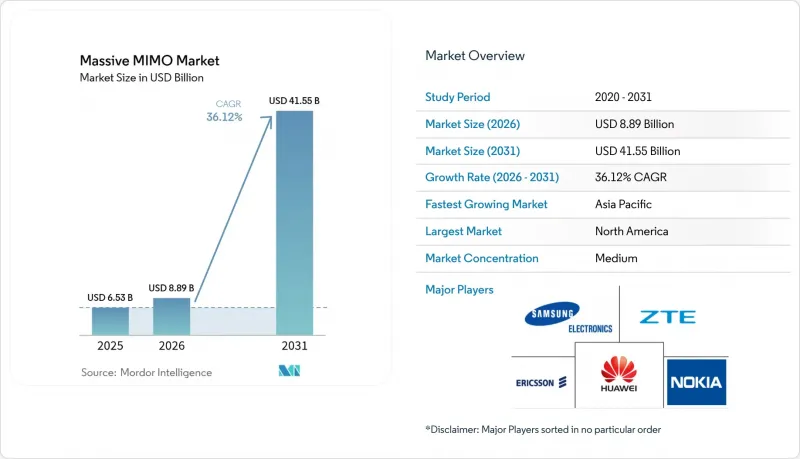
根據 Mordor Intelligence 預測,大規模 MIMO 市場將從 2025 年的 65.3 億美元成長到 2026 年的 88.9 億美元,然後在 2031 年達到 415.5 億美元,2026 年至 2031 年的複合年成長率為 36.12%。
[1] Fredrik Jejdling,“愛立信移動報告 2025”,ericsson.com。隨著電信營運商穩步從廣域部署轉向以容量為中心的都市區部署,需求正在不斷成長。這是因為波束成形技術可以提高頻譜效率並增加每位用戶平均收入 (ARPU)。該報告按技術(LTE (4G)、5G NR Sub-6 GHz 等)、天線類型(16T16R、32T32R 等)、部署類型(集中式 RAN (C-RAN)、分佈式 RAN 等)、架構(時分雙工 (TDD)、頻分雙工 (FDD) 等)、最終用戶應用(行動裝置(時分雙工 (TDD)、頻分雙工 (FDD) 等)、最終用戶、
全球大規模MIMO市場趨勢與洞察
行動數據流量和設備密度快速成長
預計到2030年,中國的行動數據流量將成長四倍,由此產生的流量密度將使傳統的小區分割策略難以有效應對。固定無線接入線路預計將從2024年的1.6億條增加到2030年的3.5億條,其中80%的流量預計將由以大規模MIMO無線陣列(中興通訊)為核心的5G-Advanced網路提供。工業IoT(IIoT)的興起進一步加劇了這種壓力。中國計劃在2027年建成1萬家無線工廠,每家工廠都對網路容量提出了嚴格的性能要求。隨著5G在主要市場的滲透率超過75.9%,小區邊緣的擁塞日益加劇,波束成形技術對於維持一致的使用者體驗至關重要。因此,大規模MIMO市場與流量的成長直接相關,它使營運商能夠在不相應增加基地台規模的情況下滿足吞吐量需求。
5G NR(6GHz 以下頻段和毫米波)在全球範圍內的快速部署
根據愛立信預測,到2024年底,全球獨立組網(SA)5G用戶數量預計將達到12億,到2030年將達到36億。中國計畫到2025年新建450萬個5G基地台,並強制要求新基地台採用大規模MIMO作為預設天線系統。印度將於2024年10月實現全國5G覆蓋,隨著回程傳輸升級的進行,高階陣列的需求正在加速成長。愛立信表示,毫米波的經濟效益有所提升,愛立信、NBN公司和高通公司於2025年展示了利用先進波束成形技術實現的14公里Gigabit鏈路。在私有5G領域,無線接取網路(RAN)營收預計在2024年成長超過40%,而具備干擾管理能力的無線電設備對於確保服務等級協定(SLA)的履行至關重要。
射頻前端成本高、功耗高
中國佔據了全球98%的氮化鎵晶圓生產佔有率,這引發了人們對射頻前端模組(高階陣列的關鍵組件)供應穩定性和價格的擔憂。組件製造商Qorvo的數據顯示,由於行動電話需求放緩,2025年第三季的銷售額下降了12.4%。這顯示成本推動型通膨已經開始擠壓供應商的利潤空間。人工智慧驅動的節能演算法可以將無線電功耗降低高達80%,但這需要額外的半導體晶片,在產能擴大之前增加物料清單(BOM)成本。美國國防部正在資助一項國內氮化鎵加工試點項目,但預計商業規模的生產要到2027年或更晚才能實現,這使得電信業者容易受到外匯波動和出口限制的影響。這些因素正在抑製成本敏感地區的短期應用,並促使用戶推遲升級計畫。
細分市場分析
5G NR Sub-6 GHz 技術憑藉其支援廣域覆蓋和室內穿透的傳播特性,預計到 2025 年將佔銷售額的 57.30%,成為早期 5G 部署的首選。此細分市場受益於多個地區中頻段的統一分配,這簡化了設備生態系統並降低了無線成本。相較之下,5G NR 毫米波目前僅限於高階應用場景,但其 39.05% 的複合年成長率表明,其在固定無線存取和體育場館熱點領域的部署正在加速。隨著營運商複製澳洲 14 公里鄉村鏈路的成功案例,並證明高頻率在非都市區寬頻應用的經濟性,毫米波大規模 MIMO 的市場規模預計將顯著擴大。
儘管如此,Sub-6頻段作為控制平面的基礎仍然至關重要,它為營運商提供了一種平衡覆蓋範圍和容量的頻率策略。 Reliance Jio的AirFiber試驗表明,與光纖相比,毫米波固定無線存取(FWA)可以縮短最後一公里部署時間。雖然目前日本的5G私有化牌照發放仍專注於Sub-6頻段,但早期在倉庫中開展的毫米波計畫預示著未來將出現多元化發展。隨著終端成本的降低和5G-Advanced技術傳播特性的日益成熟,毫米波的佔有率將會上升,並在2031年之前在龐大的MIMO市場中擴大其收入佔有率。
64T64R面板在單元邊緣實現了高吞吐量,同時重量和功耗也控制在可接受範圍內,預計到2025年將佔據38.25%的市場佔有率。電信業者在升級人口密集大都會圈的宏基地台時傾向於選擇這種配置,因為它安裝時所需的結構加固工作量極少。對於128T128R及更高等級的面板,預計其複合年成長率將達到40.15%,這主要得益於廠商在散熱器效率方面的改進以及透過人工智慧工具降低了波束校準的開銷。喬治亞理工學院的研究表明,在27-41 GHz頻寬,接收器架構能夠支援大量的單元,這表明超大型陣列在實際應用中是可行的。
隨著應用領域朝向延展實境(XR)和工業機器人發展,對穩定多Gigabit吞吐量的需求日益成長,電信業者也開始測試256單元原型機。預計到2031年,128T128R系統的大規模MIMO市場規模將達到148.8億美元,佔總營收的35.80%。高通的4096單元千兆MIMO概念展現了顯著提升容量的潛力,但預計要到2028年後才能實現商業化,屆時功率放大器的效率將有所提高。短期內,由於塔架重量限制,難以安裝更重的面板,預計32T32R陣列仍將繼續用於農村和成本敏感型部署,從而維持多層次的市場結構。
區域分析
預計到2025年,北美將佔全球收入的39.50%,這主要得益於C頻段的積極部署、企業固定無線接入網(FWA)的廣泛應用以及對開放式無線接入網(Open RAN)的有利政策。 Verizon計劃在2025年投入175億至185億美元的資本支出,其中相當一部分將用於升級64T64R扇區,以保持每位用戶的吞吐量競爭力。加拿大電信公司TELUS與三星合作,正在部署該國首個全國性虛擬化無線存取網(VRAN),凸顯了該地區對軟體定義無線電)的強勁需求。美國聯邦通訊委員會(FCC)關於70/80/90 GHz回程傳輸和37 GHz共用的監管改革,進一步拓展了毫米波(mmWave)在農村寬頻領域的商業價值。
亞太地區是成長最快的地區,預計到2031年複合年成長率將達到36.95%。在中國,到2025年3月,5G基地台數量將超過440萬個,到同年年底還將新增450萬個。在印度,到2024年底將實現全國範圍的5G覆蓋,其中Reliance Jio佔據了85%的運作中小區,這將對32T32R和64T64R無線電模組產生大規模的採購需求。政府的「Bharat 6G」等項目強調本土技術的研發,這可能會改變該地區的廠商市場佔有率。中國聯通計劃在2025年底將「5G-Advanced」覆蓋範圍擴大到300個城市,這將進一步增加天線訂單,帶來規模經濟效益,並加大全球價格的下行壓力。
在歐洲,電信業者在尋求資本效率的同時,也需遵守監理機關對供應商多元化的監理要求,因此市場呈現謹慎擴張的態勢。三星和O2 Telefónica於2024年在德國運作了首個採用64T64R無線電技術的商用虛擬無線接取網路(vRAN)站點,顯示市場願意試行解耦式協定棧。愛立信和MasOrange在西班牙展示了一個開放式可編程網路,專注於自動化和能源最佳化,而不是單純的容量擴張。法國和義大利的頻譜競標傾向於連續的3.4-3.8 GHz頻段,進一步強化了TDD(電報傳輸儲存)系統的優勢。因此,每瓦性能和供應鏈韌性是支撐歐洲大規模MIMO市場穩定成長的關鍵因素。
其他好處:
- Excel格式的市場預測(ME)表
- 3個月的分析師支持
目錄
第1章:引言
- 研究假設和市場定義
- 調查範圍
第2章:調查方法
第3章執行摘要
第4章 市場狀況
- 市場概覽
- 市場促進因素
- 行動資料通訊激增和設備普及率提高。
- 5G NR(6GHz 以下頻段和毫米波)在全球範圍內的快速部署
- 透過提高波束成形效率來降低電信業者的資本支出(CAPEX)。
- 推動開放式無線接取網路(Open-RAN)實現多廠商mMIMO的關鍵因素
- 細胞邊緣的AI驅動光束最佳化
- 市場限制因素
- 射頻前端的高單位成本與高功耗
- 站點級部署和維護的複雜性
- 半導體級氮化鎵(GaN)的供應風險
- 反對暴露於電磁波(EMF)和城市發展
- 價值鏈分析
- 監理情勢
- 技術展望
- 波特五力分析
第5章 市場規模與成長預測
- 透過技術
- LTE(4G)
- 5G NR Sub-6 GHz
- 5G NR 毫米波
- 依天線類型
- 16T16R
- 32T32R
- 64T64R
- 128T128R 或更高版本
- 依部署類型
- 集中式(C-RAN)
- 分散式無線存取網
- Open RAN
- 以建築學為例
- 時分雙工(TDD)
- 頻分雙工(FDD)
- 混合雙股
- 透過最終用戶應用程式
- 行動網路營運商
- 企業及私人網路
- 公共安全與國防
- 固定無線接入(FWA)
- 按地區
- 北美洲
- 美國
- 加拿大
- 墨西哥
- 南美洲
- 巴西
- 其他南美國家
- 歐洲
- 德國
- 英國
- 法國
- 俄羅斯
- 其他歐洲國家
- 亞太地區
- 中國
- 印度
- 日本
- 韓國
- ASEAN
- 其他亞太國家
- 中東和非洲
- 中東
- 沙烏地阿拉伯
- UAE
- 土耳其
- 其他中東國家
- 非洲
- 南非
- 奈及利亞
- 其他非洲國家
- 中東
- 北美洲
第6章 競爭情勢
- 市場集中度
- 策略趨勢
- 市佔率分析
- 公司簡介
- Samsung Electronics
- Ericsson
- Huawei
- Nokia
- ZTE
- Qualcomm
- Intel
- Texas Instruments
- Qorvo
- NEC
- Fujitsu
- CommScope
- Airspan Networks
- Mavenir
- Parallel Wireless
- Keysight Technologies
- Rohde and Schwarz
- Viavi Solutions
- Analog Devices
- Renesas
第7章 市場機會與未來展望
According to Mordor Intelligence, the massive MIMO market size is expected to grow from USD 6.53 billion in 2025 to USD 8.89 billion in 2026 and is forecast to reach USD 41.55 billion by 2031 at 36.12% CAGR over 2026-2031.
[1] Fredrik Jejdling, "Ericsson Mobility Report 2025," ericsson.com Steady operator migration from broad-coverage roll-outs toward capacity-oriented urban deployments is amplifying demand, because beamforming increases spectral efficiency and lifts average revenue per user. This report is Segmented by Technology (LTE (4G), 5G NR Sub-6 GHz, and More), Antenna Type (16T16R, 32T32R, and More), Deployment Type (Centralised (C-RAN), Distributed RAN, and More), Architecture (Time-Division Duplex (TDD), Frequency-Division Duplex (FDD), and More), End-User Application (Mobile Network Operators, Enterprises and Private Networks, and More), and Geography.
Global Massive MIMO Market Trends and Insights
Surging Mobile-Data Traffic and Device Density
China expects mobile data traffic to quadruple by 2030, creating density levels that legacy cell-splitting strategies cannot manage cost-effectively. Fixed-wireless-access lines are forecast to climb from 160 million in 2024 to 350 million by 2030, with 80% serviced by 5 G-Advanced networks anchored by massive MIMO radio arrays, ZTE. Industrial IoT adds further load; China targets 10,000 wireless-enabled factories by 2027, each placing tight performance constraints on network capacity. As 5G penetration exceeds 75.9% in leading markets, congestion at the cell edge intensifies, making beamforming vital for sustaining a consistent user experience. The massive MIMO market, therefore, aligns directly with traffic growth, positioning operators to meet throughput needs without proportional site expansion.
Rapid Global Roll-out of 5G NR (Sub-6 GHz and mmWave)
Standalone 5G subscriptions reached 1.2 billion worldwide by end-2024 and are forecast to touch 3.6 billion by 2030, according to Ericsson. China plans to add 4.5 million new 5G base stations by 2025, mandating massive MIMO as the default antenna system for fresh sites. India achieved nationwide 5G coverage by October 2024, accelerating demand for high-order arrays during back-haul upgrades. mmWave economics improved in 2025 when Ericsson, NBN Co, and Qualcomm demonstrated 14 km gigabit links that rely on advanced beamforming, according to Ericsson. Private 5G saw over 40% RAN revenue growth in 2024, and interference-managed radios are indispensable for guaranteed service-level agreements.
High Unit Cost and Power-Consumption of RF Front-end
China controls 98% of gallium nitride wafer output, raising supply-security and pricing concerns for RF front-end modules essential in high-order arrays. Component maker Qorvo recorded a 12.4% sales decline in Q3 2025 as handset demand softened, hinting that vendor margins already feel pressure from cost-push inflation. AI-enabled power-saving algorithms can trim radio energy draw by up to 80%, but they require additional silicon, raising bill-of-materials until volume scales. The U.S. Defense Department has funded domestic gallium processing pilots, yet commercial volumes will lag beyond 2027, leaving operators exposed to currency swings and export controls. These factors restrain near-term adoption in cost-sensitive geographies and encourage deferred upgrades.
Other drivers and restraints analyzed in the detailed report include:
- Operator CAPEX Savings via Beamforming Efficiency
- Open RAN Catalysts Enabling Multi-vendor Massive MIMO
- Complex Site-level Deployment and Maintenance
For complete list of drivers and restraints, kindly check the Table Of Contents.
Segment Analysis
5G NR Sub-6 GHz technology commanded 57.30% revenue in 2025 because its propagation traits support wide-area coverage and indoor penetration, making it the default option for early 5G launches. The segment benefited from harmonized mid-band allocations across several regions, which streamlined device ecosystems and reduced radio costs. In contrast, 5G NR mmWave occupies only premium use cases today, but its 39.05% CAGR indicates accelerating take-up in fixed wireless access and stadium hotspots. The massive MIMO market size for mmWave is projected to widen significantly as operators replicate the 14 km rural link success in Australia, proving high-frequency economics for non-urban broadband.
The Sub-6 layer nevertheless remains essential for control-plane anchoring, giving carriers a balanced spectrum strategy that marries coverage and capacity. Reliance Jio's AirFiber trials show mmWave FWA cutting last-mile rollout times compared with fiber. Japan's private 5G licensing landscape still favors Sub-6, but early mmWave projects in warehouses hint at forthcoming diversification. Once device costs fall and propagation enhancements mature under 5G-Advanced, the mmWave share should climb, contributing a rising portion of the massive MIMO market revenue through 2031.
64T64R panels held 38.25% volume share in 2025 by balancing high cell-edge throughput with manageable weight and power draw. Operators favor this format when upgrading macro sites in dense metros because installation requires minimal structural reinforcement. The 128T128R and larger class will register a 40.15% CAGR as vendors improve heat-sink efficiency and as AI tools mitigate beam calibration overhead. Research at Georgia Tech demonstrates receiver architectures that support substantial element counts across 27-41 GHz bands, signaling practical viability for extremely large-scale arrays.
As applications migrate toward XR and industrial robotics, demand for consistent multi-gigabit throughput climbs, prompting carriers to test 256-element prototypes. The massive MIMO market size for 128T128R systems is projected to reach USD 14.88 billion by 2031, equal to 35.80% of overall sales. Qualcomm's 4,096-element Giga-MIMO concept underlines the runway for step-function capacity gains, although commercial adoption is likely after 2028 when power-amplifier efficiency improves. Near-term, 32T32R arrays still serve rural and cost-sensitive deployments where tower loading limits preclude heavier panels, preserving a multi-tier market structure.
Complete Report Scope:
- By Technology
- LTE (4G)
- 5G NR Sub-6 GHz
- 5G NR mmWave
- By Antenna Type
- 16T16R
- 32T32R
- 64T64R
- 128T128R and Above
- By Deployment Type
- Centralised (C-RAN)
- Distributed RAN
- Open RAN
- By Architecture
- Time-Division Duplex (TDD)
- Frequency-Division Duplex (FDD)
- Hybrid Duplex
- By End-user Application
- Mobile Network Operators
- Enterprises and Private Networks
- Public Safety and Defence
- Fixed Wireless Access (FWA)
- By Geography
- North America
- United States
- Canada
- Mexico
- South America
- Brazil
- Rest of South America
- Europe
- Germany
- United Kingdom
- France
- Russia
- Rest of Europe
- Asia Pacific
- China
- India
- Japan
- South Korea
- ASEAN
- Rest of Asia Pacific
- Middle East and Africa
- Middle East
- Saudi Arabia
- UAE
- Turkey
- Rest of Middle East
- Africa
- South Africa
- Nigeria
- Rest of Africa
- Middle East
- North America
Geography Analysis
North America generated 39.50% of global revenue in 2025 on the back of aggressive C-band roll-outs, enterprise FWA adoption, and favorable policy toward Open RAN. Verizon plans USD 17.5-18.5 billion in 2025 capital outlays, a sizable share earmarked for 64T64R sector upgrades that keep per-subscriber throughput competitive. Canada's TELUS is partnering with Samsung to deploy the first nationwide virtualized RAN, underscoring regional appetite for software-defined radios. FCC reforms around 70/80/90 GHz backhaul and 37 GHz sharing further broaden mmWave business cases for rural broadband.
Asia Pacific is the fastest-growing territory, forecast at 36.95% CAGR to 2031 as China surpasses 4.4 million 5G sites by March 2025 and commits to 4.5 million additional base stations within the year. India reached nationwide 5G coverage in late 2024, with Reliance Jio responsible for 85% of active cells, creating a sizable procurement funnel for 32T32R and 64T64R radios. Government programs such as Bharat 6G emphasize indigenous R&D, potentially reshaping regional vendor shares. China Unicom's 5G-Advanced coverage across 300 cities by end-2025 further raises antenna order volumes, providing economies of scale that exert downward price pressure globally.
Europe shows measured expansion as operators juggle capital efficiency and regulatory scrutiny over vendor diversification. Samsung and O2 Telefonica activated Germany's first commercial vRAN site with 64T64R radios in 2024, signaling market willingness to test disaggregated stacks. Ericsson and MasOrange demonstrated an open programmable network in Spain, focusing on automation and energy optimization rather than raw capacity. Spectrum auctions in France and Italy favored contiguous 3.4-3.8 GHz blocks, reinforcing TDD dominance. The European massive MIMO market therefore emphasizes performance per watt and supply-chain resilience, supporting gradual but firm growth.
- Samsung Electronics
- Ericsson
- Huawei
- Nokia
- ZTE
- Qualcomm
- Intel
- Texas Instruments
- Qorvo
- NEC
- Fujitsu
- CommScope
- Airspan Networks
- Mavenir
- Parallel Wireless
- Keysight Technologies
- Rohde and Schwarz
- Viavi Solutions
- Analog Devices
- Renesas
Additional Benefits:
- The market estimate (ME) sheet in Excel format
- 3 months of analyst support
TABLE OF CONTENTS
1 INTRODUCTION
- 1.1 Study Assumptions and Market Definition
- 1.2 Scope of the Study
2 RESEARCH METHODOLOGY
3 EXECUTIVE SUMMARY
4 MARKET LANDSCAPE
- 4.1 Market Overview
- 4.2 Market Drivers
- 4.2.1 Surging mobile-data traffic and device density
- 4.2.2 Rapid global roll-out of 5G NR (Sub-6 GHz and mmWave)
- 4.2.3 Operator CAPEX savings via beam-forming efficiency
- 4.2.4 Open-RAN catalysts enabling multi-vendor mMIMO
- 4.2.5 AI-assisted cell-edge beam-optimization
- 4.3 Market Restraints
- 4.3.1 High unit cost and power-consumption of RF front-end
- 4.3.2 Complex site-level deployment and maintenance
- 4.3.3 Semiconductor-grade gallium nitride (GaN) supply risk
- 4.3.4 EMF-exposure and urban footprint opposition
- 4.4 Value Chain Analysis
- 4.5 Regulatory Landscape
- 4.6 Technological Outlook
- 4.7 Porter's Five Forces Analysis
- 4.7.1 Bargaining Power of Suppliers
- 4.7.2 Bargaining Power of Consumers
- 4.7.3 Threat of New Entrants
- 4.7.4 Threat of Substitutes
- 4.7.5 Intensity of Competitive Rivalry
5 MARKET SIZE AND GROWTH FORECASTS (VALUE)
- 5.1 By Technology
- 5.1.1 LTE (4G)
- 5.1.2 5G NR Sub-6 GHz
- 5.1.3 5G NR mmWave
- 5.2 By Antenna Type
- 5.2.1 16T16R
- 5.2.2 32T32R
- 5.2.3 64T64R
- 5.2.4 128T128R and Above
- 5.3 By Deployment Type
- 5.3.1 Centralised (C-RAN)
- 5.3.2 Distributed RAN
- 5.3.3 Open RAN
- 5.4 By Architecture
- 5.4.1 Time-Division Duplex (TDD)
- 5.4.2 Frequency-Division Duplex (FDD)
- 5.4.3 Hybrid Duplex
- 5.5 By End-user Application
- 5.5.1 Mobile Network Operators
- 5.5.2 Enterprises and Private Networks
- 5.5.3 Public Safety and Defence
- 5.5.4 Fixed Wireless Access (FWA)
- 5.6 By Geography
- 5.6.1 North America
- 5.6.1.1 United States
- 5.6.1.2 Canada
- 5.6.1.3 Mexico
- 5.6.2 South America
- 5.6.2.1 Brazil
- 5.6.2.2 Rest of South America
- 5.6.3 Europe
- 5.6.3.1 Germany
- 5.6.3.2 United Kingdom
- 5.6.3.3 France
- 5.6.3.4 Russia
- 5.6.3.5 Rest of Europe
- 5.6.4 Asia Pacific
- 5.6.4.1 China
- 5.6.4.2 India
- 5.6.4.3 Japan
- 5.6.4.4 South Korea
- 5.6.4.5 ASEAN
- 5.6.4.6 Rest of Asia Pacific
- 5.6.5 Middle East and Africa
- 5.6.5.1 Middle East
- 5.6.5.1.1 Saudi Arabia
- 5.6.5.1.2 UAE
- 5.6.5.1.3 Turkey
- 5.6.5.1.4 Rest of Middle East
- 5.6.5.2 Africa
- 5.6.5.2.1 South Africa
- 5.6.5.2.2 Nigeria
- 5.6.5.2.3 Rest of Africa
- 5.6.5.1 Middle East
- 5.6.1 North America
6 COMPETITIVE LANDSCAPE
- 6.1 Market Concentration
- 6.2 Strategic Moves
- 6.3 Market Share Analysis
- 6.4 Company Profiles (includes Global level Overview, Market level overview, Core Segments, Financials as available, Strategic Information, Market Rank/Share for key companies, Products and Services, and Recent Developments)
- 6.4.1 Samsung Electronics
- 6.4.2 Ericsson
- 6.4.3 Huawei
- 6.4.4 Nokia
- 6.4.5 ZTE
- 6.4.6 Qualcomm
- 6.4.7 Intel
- 6.4.8 Texas Instruments
- 6.4.9 Qorvo
- 6.4.10 NEC
- 6.4.11 Fujitsu
- 6.4.12 CommScope
- 6.4.13 Airspan Networks
- 6.4.14 Mavenir
- 6.4.15 Parallel Wireless
- 6.4.16 Keysight Technologies
- 6.4.17 Rohde and Schwarz
- 6.4.18 Viavi Solutions
- 6.4.19 Analog Devices
- 6.4.20 Renesas
7 MARKET OPPORTUNITIES AND FUTURE OUTLOOK
- 7.1 White-space and Unmet-need Assessment


