


 |
市場調查報告書
商品編碼
2122405
堆高機:市場佔有率分析、產業趨勢與統計、成長預測(2025-2031)Forklift Trucks - Market Share Analysis, Industry Trends & Statistics, Growth Forecasts (2025 - 2031) |
||||||

※ 本網頁內容可能與最新版本有所差異。詳細情況請與我們聯繫。
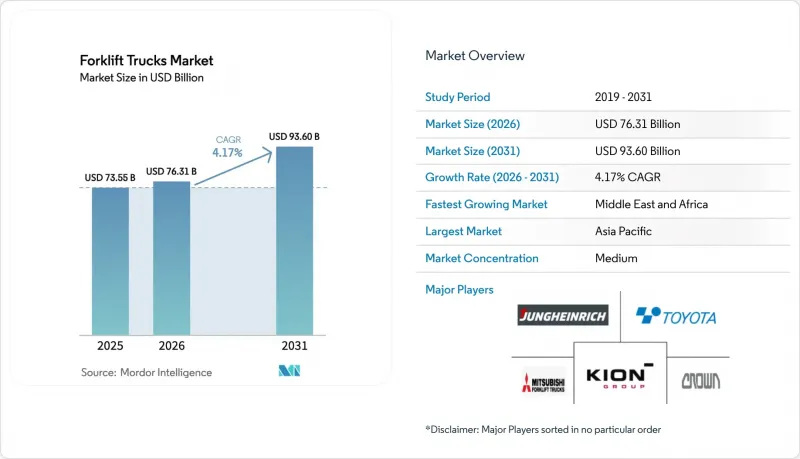
據 Mordor Intelligence 稱,2025 年堆高機市場價值為 735.5 億美元,預計到 2031 年將達到 936 億美元,而 2026 年為 763.1 億美元,預測期(2026-2031 年)的複合年成長率為 4.17%。
本報告按動力傳動系統類型(內燃機、電動、其他)、車輛級別(I級、II級、III級、其他)、有效載荷能力(5噸以下、5-15噸、其他)、終端用戶行業(製造業、物流倉儲業、其他)和地區進行細分。市場預測以價值(美元)和銷售(輛)為單位呈現。
全球堆高機市場趨勢及洞察
透過亞太地區的排放氣體法規促進電動堆高機的普及。
作為空氣污染防治計畫的一部分,中國計劃在不久的將來強制要求主要城市非道路機械實現零排放。印度的「PM E-DRIVE」計畫為充電基礎設施建設提供大量資金,並為電動堆高機提供巨額資本津貼。在日本,由於工時法規的限制,倉庫擴大採用配備快速充電鋰離子電池的堆高機。同時,韓國的「綠色新政2.0」旨在未來十年內大幅提高商用車中電動車的佔比。預計這些舉措將在未來幾年內大幅提升亞太地區電動式堆高機的市場佔有率,其成長速度將超過西方國家。
北美自動化與電子商務倉庫的擴張
大型電商公司正在加速部署「無人化」履約中心,將自主移動機器人與先進的倉庫管理系統無縫整合。亞馬遜位於卡加利的大型新倉庫配備了多台FoxBot機器人,最佳化了通道寬度,顯著提高了托盤密度。同時,沃爾瑪在門市部署無人機和清潔機器人,不僅簡化了營運流程,也為投資窄巷道堆高機創造了空間,這些堆高機目前正與運作,即使整體堆高機市場成長放緩。此外,物聯網軟體和電池分析平台的整合正迅速成為一項標準配置。
電動堆高機的高初始成本阻礙了其廣泛應用。
採用鋰離子技術的電動堆高機比柴油堆高機成本高很多。因此,電動堆高機的售價高於柴油堆高機。尤其值得一提的是,電池成本佔總製造成本的很大一部分。近年來,碳酸鋰的價格波動較大。許多中小企業在獲取抵押品方面面臨挑戰,這限制了它們獲得綠色融資的機會。歐洲投資銀行的清潔交通融資機制提供極具競爭力的利率,但由於中小企業勞動力有限,其採用率仍然很低。在印度,雖然有針對電動卡車的補貼,但這些補貼僅適用於車輛總數的一小部分,凸顯了此類獎勵覆蓋率的限制。此外,在電池組成本大幅下降之前,電動堆高機的普及可能仍將受到限制,尤其是在對成本較為敏感的買家群體中。
細分市場分析
隨著營運商努力降低生命週期成本,預計到2025年,電動堆高機的出貨量將佔總出貨量的67.73%。在電動堆高機領域,鋰離子電池實現了顯著成長,與幾年前相比已成為主流選擇。氫燃料電池堆高機目前市佔率較小,但預計將穩定成長,到2031年將維持4.19%的複合年成長率,這主要得益於其在關鍵工業領域的應用。內燃機堆高機仍佔據相當大的市場佔有率,主要用於戶外和新興市場應用。美國能源局(DOE)的目標是在未來幾年內將氫氣價格降低到具有競爭力的水平,這有望顯著縮小營運成本差距。大型冷庫用戶越來越傾向於使用氫氣,因為氫氣可以快速加註燃料,並支援多班次不間斷運作。堆高機市場正積極應對電池成本的下降,原始設備製造商(OEM)正在逐步淘汰高階機型中的鉛酸電池。
目前,氫動力堆高機在堆高機市場僅佔一小部分。然而,隨著可再生能源供給能力的擴大以及港口當局推出零排放法規,氫動力正逐漸被認可為長期的替代方案。同時,在充電基礎設施完善、可與遠端資訊處理系統整合以及安全認證不斷完善(從而降低保險風險)的推動下,鋰離子技術預計在可預見的未來仍將是更受青睞的投資選擇。
隨著電商公司將通道寬度縮窄至 8 英尺(約 2.4 公尺)以提高裝卸效率,I 類電動搭乘用的年複合成長率 (CAGR) 達到 4.25%。亞馬遜位於卡加利的倉庫正在使用自動搭乘用乘用車在更窄的通道中作業,這清晰地展現了這一轉變。 III 類托盤搬運車仍將佔據市場主導地位,預計到 2025 年將佔總銷量的 43.47%,但在飽和的零售通路中,其成長速度正在放緩。 II 類窄通道車輛受惠於製藥和電子產業,這些產業的高價值 SKU 促使企業採用高階設備。 IV 類和 V 類內燃機車型共同保持著一定的市場佔有率,它們在地形起伏和重型機械運作的建築工地等場所至關重要。 2024 年,林德集團的 KAnIS 計畫在馬士基鹿特丹港展示了將 V 類電動車與 5G 控制系統結合的高容量自動化解決方案。
對高機動性I類堆高機的需求顯示倉庫設計將持續重組。隨著越來越多的設施整合夾層和自動化倉庫,導航精度和電池續航力預計將成為原始設備製造商(OEM)的差異化因素。在堆高機市場,預計到本十年末,I類堆高機的市場規模將比III類堆高機進一步擴大。
區域分析
到2025年,亞太地區將佔據堆高機市場47.63%的佔有率,這主要得益於中國龐大的生產規模。杭叉、合力、EP等國內製造商正透過向東南亞和非洲大量出口堆高機,挑戰傳統供應商的地位。
中國設定了2026年實現城市零排放的目標,預計2028年,電氣化率將超過五分之四。在印度,生產連結獎勵計畫計畫(PLI)推動的倉儲建設擴張預計將在2027年之前顯著提升年度需求。中東和非洲的複合年成長率(CAGR)為4.27%,這主要得益於薩勒曼國王國際機場和傑貝阿里冷庫等大型企劃的建設。
歐洲佔了大部分收入,歐盟嚴格的電池法規正在加速鋰電池的普及。北美雖然銷量較小,但受益於生產回流以及建設計畫,這些都確保了穩定的大訂單。南美由於貨幣波動,在豪華電動車的普及方面落後於其他地區,但巴西的糧食運輸走廊有局部需求。
其他好處
- Excel格式的市場預測(ME)表
- 3個月的分析師支持
目錄
第1章:引言
- 研究假設和市場定義
- 調查範圍
第2章:調查方法
第3章執行摘要
第4章 市場狀況
- 市場概覽
- 市場促進因素
- 透過亞太地區的排放氣體法規促進電動堆高機的普及。
- 北美自動化與電子商務倉庫的擴張
- 疫情後製造業回流導致美國堆高機需求激增。
- 在歐洲冷鏈設施中引入鋰離子堆高機
- 日本和韓國老舊堆高機的更換週期
- 透過海灣合作理事會基礎設施投資形成新的物流樞紐
- 市場限制因素
- 電動堆高機的高初始成本阻礙了其廣泛應用。
- 歐洲和北歐國家熟練堆高機操作員短缺
- 租賃車隊之間的激烈競爭給原始設備製造商的利潤率帶來了壓力。
- 供應鏈中斷會阻礙零件供應。
- 價值供應鏈分析
- 監理情勢
- 技術展望
- 波特五力模型
第5章 市場規模與成長預測
- 依動力傳動系統類型
- 內燃機(ICE)
- 電的
- 鉛酸電池
- 鋰離子電池
- 氫燃料電池汽車(HFCV)
- 按車輛類別
- 一級(電動自行車賽道)
- II 類(窄巷電氣化)
- 三級(電動托盤)
- IV級(冰雪緩衝輪胎)
- 第五類(ICE充氣輪胎)
- 按載重能力
- 5噸或以下
- 5-15噸
- 15噸或以上
- 按最終用戶行業分類
- 製造業
- 物流/倉儲業
- 建設基礎設施
- 零售和批發
- 食品和飲料冷鏈
- 按地區
- 北美洲
- 美國
- 加拿大
- 其他北美國家
- 南美洲
- 巴西
- 阿根廷
- 其他南美國家
- 歐洲
- 德國
- 英國
- 法國
- 義大利
- 西班牙
- 其他歐洲國家
- 亞太地區
- 中國
- 印度
- 日本
- 韓國
- 其他亞太國家
- 中東和非洲
- 阿拉伯聯合大公國
- 沙烏地阿拉伯
- 南非
- 土耳其
- 其他中東和非洲國家
- 北美洲
第6章 競爭情勢
- 市場集中度
- 策略趨勢
- 市佔率分析
- 公司簡介
- Toyota Industries Corp.
- KION Group AG
- Jungheinrich AG
- Hyster-Yale Materials Handling Inc.
- Mitsubishi Logisnext Co. Ltd.
- Crown Equipment Corp.
- Hangcha Group Co.
- Doosan Industrial Vehicles Co. Ltd.
- Komatsu Ltd.
- Anhui Heli Co. Ltd.
- Clark Material Handling Co.
- Caterpillar Inc.(CAT Lift Trucks)
- Hyundai Material Handling
- Lonking Holdings Ltd.
- Manitou Group
- Godrej & Boyce Mfg. Co.
- EP Equipment Co.
- Liugong Machinery Co.
- UniCarriers Corp.
- SANY Group Co.
第7章 市場機會與未來展望
According to Mordor Intelligence, the forklift trucks market size was valued at USD 73.55 billion in 2025 and estimated to grow from USD 76.31 billion in 2026 to reach USD 93.60 billion by 2031, at a CAGR of 4.17% during the forecast period (2026-2031).
This report is Segmented by Powertrain Type (Internal Combustion Engine (ICE), Electric, and More), Vehicle Class (Class I, Class II, Class III, and More), Load Capacity (Less Than 5 Tons, 5-15 Tons, and More), End-User Industry (Manufacturing, Logistics and Warehousing, and More), and Geography. Market Forecasts are Provided in Value (USD) and Volume (Units).
Global Forklift Trucks Market Trends and Insights
APAC's Emission Mandates Propel Electric Forklift Adoption
China mandates zero-emission non-road machines in major cities starting in the near future as part of its Air Pollution Action Plan . India's PM E-DRIVE scheme provides significant funding for charging infrastructure and offers a substantial capital grant for electric forklifts. Japan's working-hour ceiling is driving warehouses to adopt faster-charging lithium-ion fleets. Meanwhile, South Korea's Green New Deal 2.0 aims to achieve a considerable electric share for commercial vehicles within the next decade. Given these converging initiatives, the electric share of the forklift truck market in the Asia Pacific region is projected to grow significantly in the coming years, outpacing Western counterparts.
North America's Automated and E-commerce Warehouses Expand
E-commerce giants are ramping up the deployment of "lights-out" fulfillment centers, seamlessly integrating autonomous mobile robots with advanced warehouse management systems. Amazon's sprawling new facility in Calgary has integrated several FoxBot robotic units, optimizing aisle widths and significantly boosting pallet density . Meanwhile, Walmart's introduction of in-store drones and cleaning robots has not only streamlined operations but also liberated capital for narrow-aisle lift trucks, which now work in harmony with automated racking systems. In a significant move, Prologis has allocated substantial funding for Prologis Labs in 2024, setting the stage to test VisionNav and Multiway's autonomous forklifts at multiple sites across the United States and Europe . These initiatives are poised to drive strong growth for Class I and Class II electric units over the next few years, even as the broader forklift truck market sees a slowdown. Furthermore, the integration of IoT software and battery analytics platforms is swiftly becoming a standard requirement.
Electric Forklift's High Upfront Cost Hinders Adoption
Electric trucks, powered by lithium-ion technology, are significantly more expensive than their diesel counterparts. This places electric trucks in a higher price range compared to diesel models. Notably, batteries constitute a substantial portion of the total build cost. Over recent years, lithium-carbonate prices have shown considerable volatility, fluctuating widely. Many small enterprises face challenges in securing collateral, which limits their access to green financing. While the European Investment Bank's Clean Transport Facility offers highly competitive interest rates, adoption remains low among smaller firms with limited employee numbers. In India, subsidies are available for electric trucks, but they cover only a small fraction of the total fleet, highlighting the limited reach of such incentives. Additionally, until battery pack costs decrease significantly, the adoption of electric forklift trucks will remain constrained, particularly among cost-conscious buyers.
Other drivers and restraints analyzed in the detailed report include:
- European Cold-Chain Facilities Embrace Lithium-ion Forklifts
- Aging Forklift Fleet Replacement Cycle in Japan and South Korea
- Europe and Nordics Face Shortage of Skilled Forklift Operators
For complete list of drivers and restraints, kindly check the Table Of Contents.
Segment Analysis
Electric units accounted for 67.73% of 2025 shipments as operators chase a minimal lifetime cost. Within the electric segment, lithium-ion packs experienced substantial growth, becoming the dominant choice compared to their position a few years ago. While hydrogen fuel-cell forklifts currently hold a minimal share, they are expected to grow steadily with a robust CAGR of 4.19% through 2031, supported by deployments in key industrial operations. Internal combustion continues to maintain a considerable share, primarily catering to outdoor and emerging-market applications. The U.S. Department of Energy (DOE) aims to achieve a competitive hydrogen price within the next few years, which could significantly reduce operating-cost differences. Heavy users in cold storage increasingly prefer hydrogen due to its quick refueling capability, which supports uninterrupted multi-shift operations. The forklift truck market is adapting to declining battery costs, with OEMs gradually phasing out lead-acid batteries in premium models.
At present, hydrogen represents a very small portion of the forklift truck market. However, with the expansion of renewable energy capacities and the implementation of zero-emission mandates by port authorities, hydrogen is gaining recognition as a viable long-term alternative. Meanwhile, lithium-ion technology is expected to remain the preferred investment choice in the foreseeable future, driven by its established charging infrastructure, integration with telematics, and improved safety certifications that reduce insurance risks.
Class I electric rider trucks are growing at a 4.25% CAGR as e-commerce firms condense aisle widths to 8 feet for greater cube efficiency. Amazon's Calgary site illustrates the shift, using autonomous riders for narrower corridors. Class III pallet trucks still led 2025 volume at 43.47% but logged slower growth in saturated retail channels. Class II narrow-aisle machines benefit from pharmaceuticals and electronics verticals where high-value SKUs support premium equipment. Class IV and V combustion models held a combined share, indispensable on uneven terrains and heavy-construction zones. In 2024, Linde's KAnIS project combined Class V electrics with 5G controls at Maersk Rotterdam, showcasing high-capacity automation.
Demand for agile Class I units signals a lasting reorder of warehouse design. As more sites integrate mezzanines and automated storage, navigation accuracy and battery productivity will shape OEM differentiation. The Forklift trucks market size for Class I equipment is projected to widen its gap over Class III by the decade's end.
Complete Report Scope:
- By Powertrain Type
- Internal Combustion Engine (ICE)
- Electric
- Lead-acid
- Li-ion
- Hydrogen Fuel-cell Vehicle (HFCV)
- By Vehicle Class
- Class I (Electric Rider Trucks)
- Class II (Electric Narrow-Aisle)
- Class III (Electric Pallet)
- Class IV (ICE Cushion-Tire)
- Class V (ICE Pneumatic-Tire)
- By Load Capacity
- Less than 5 Tons
- 5-15 Tons
- Above 15 Tons
- By End-user Industry
- Manufacturing
- Logistics & Warehousing
- Construction & Infrastructure
- Retail & Wholesale
- Food & Beverage Cold-Chain
- By Geography
- North America
- United States
- Canada
- Rest of North America
- South America
- Brazil
- Argentina
- Rest of South America
- Europe
- Germany
- United Kingdom
- France
- Italy
- Spain
- Rest of Europe
- Asia Pacific
- China
- India
- Japan
- South Korea
- Rest of Asia Pacific
- Middle East and Africa
- United Arab Emirates
- Saudi Arabia
- South Africa
- Turkey
- Rest of Middle East and Africa
- North America
Geography Analysis
Asia Pacific held a 47.63% slice of the Forklift trucks market in 2025, anchored by China's vast production scale. Domestic makers Hangcha, Heli, and EP exported a massive number of units to Southeast Asia and Africa, challenging traditional suppliers.
China's city-level zero-emission deadline of 2026 is likely to drive electric penetration past four-fifths by 2028. India's warehousing build-out, tied to the Production-Linked Incentive program, could lift annual demand by a vast number of units by 2027. The Middle East and Africa, with a 4.27% CAGR, are driving megaprojects such as King Salman Airport and Jebel Ali's cold-store build.
Europe controls most of the revenue, with the strict EU Battery Regulation accelerating the uptake of lithium. North America, with a minimal volume, benefits from reshoring, as well as gigafactory pipelines that secure steady, heavy-duty orders. South America lags premium electrics due to currency volatility but finds localized demand in Brazil's grain corridors.
- Toyota Industries Corp.
- KION Group AG
- Jungheinrich AG
- Hyster-Yale Materials Handling Inc.
- Mitsubishi Logisnext Co. Ltd.
- Crown Equipment Corp.
- Hangcha Group Co.
- Doosan Industrial Vehicles Co. Ltd.
- Komatsu Ltd.
- Anhui Heli Co. Ltd.
- Clark Material Handling Co.
- Caterpillar Inc. (CAT Lift Trucks)
- Hyundai Material Handling
- Lonking Holdings Ltd.
- Manitou Group
- Godrej & Boyce Mfg. Co.
- EP Equipment Co.
- Liugong Machinery Co.
- UniCarriers Corp.
- SANY Group Co.
Additional Benefits:
- The market estimate (ME) sheet in Excel format
- 3 months of analyst support
TABLE OF CONTENTS
1 Introduction
- 1.1 Study Assumptions and Market Definition
- 1.2 Scope of the Study
2 Research Methodology
3 Executive Summary
4 Market Landscape
- 4.1 Market Overview
- 4.2 Market Drivers
- 4.2.1 Asia Pacific's Emission Mandates Propel Electric Forklift Adoption
- 4.2.2 North America's Automated and E-commerce Warehouses Expand
- 4.2.3 United States Forklift Demand Surges Amid Post-pandemic Manufacturing Reshoring
- 4.2.4 European Cold-Chain Facilities Embrace Lithium-ion Forklifts
- 4.2.5 Aging Forklift Fleet Replacement Cycle in Japan and South Korea
- 4.2.6 GCC's Infrastructure Investments Forge New Logistics Hubs
- 4.3 Market Restraints
- 4.3.1 Electric Forklift's High Upfront Cost Hinders Adoption
- 4.3.2 Europe and Nordics Face Shortage of Skilled Forklift Operators
- 4.3.3 OEM Margins Squeeze Amid Fierce Rental-Fleet Competition
- 4.3.4 Supply Chain Disruptions Hinder Component Availability
- 4.4 Value / Supply-Chain Analysis
- 4.5 Regulatory Landscape
- 4.6 Technological Outlook
- 4.7 Porter's Five Forces
- 4.7.1 Bargaining Power of Suppliers
- 4.7.2 Bargaining Power of Buyers
- 4.7.3 Threat of New Entrants
- 4.7.4 Threat of Substitutes
- 4.7.5 Competitive Rivalry
5 Market Size & Growth Forecasts (Value (USD) and Volume (Units))
- 5.1 By Powertrain Type
- 5.1.1 Internal Combustion Engine (ICE)
- 5.1.2 Electric
- 5.1.2.1 Lead-acid
- 5.1.2.2 Li-ion
- 5.1.3 Hydrogen Fuel-cell Vehicle (HFCV)
- 5.2 By Vehicle Class
- 5.2.1 Class I (Electric Rider Trucks)
- 5.2.2 Class II (Electric Narrow-Aisle)
- 5.2.3 Class III (Electric Pallet)
- 5.2.4 Class IV (ICE Cushion-Tire)
- 5.2.5 Class V (ICE Pneumatic-Tire)
- 5.3 By Load Capacity
- 5.3.1 Less than 5 Tons
- 5.3.2 5-15 Tons
- 5.3.3 Above 15 Tons
- 5.4 By End-user Industry
- 5.4.1 Manufacturing
- 5.4.2 Logistics & Warehousing
- 5.4.3 Construction & Infrastructure
- 5.4.4 Retail & Wholesale
- 5.4.5 Food & Beverage Cold-Chain
- 5.5 By Geography
- 5.5.1 North America
- 5.5.1.1 United States
- 5.5.1.2 Canada
- 5.5.1.3 Rest of North America
- 5.5.2 South America
- 5.5.2.1 Brazil
- 5.5.2.2 Argentina
- 5.5.2.3 Rest of South America
- 5.5.3 Europe
- 5.5.3.1 Germany
- 5.5.3.2 United Kingdom
- 5.5.3.3 France
- 5.5.3.4 Italy
- 5.5.3.5 Spain
- 5.5.3.6 Rest of Europe
- 5.5.4 Asia Pacific
- 5.5.4.1 China
- 5.5.4.2 India
- 5.5.4.3 Japan
- 5.5.4.4 South Korea
- 5.5.4.5 Rest of Asia Pacific
- 5.5.5 Middle East and Africa
- 5.5.5.1 United Arab Emirates
- 5.5.5.2 Saudi Arabia
- 5.5.5.3 South Africa
- 5.5.5.4 Turkey
- 5.5.5.5 Rest of Middle East and Africa
- 5.5.1 North America
6 Competitive Landscape
- 6.1 Market Concentration
- 6.2 Strategic Moves
- 6.3 Market Share Analysis
- 6.4 Company Profiles (includes Global Level Overview, Market Level Overview, Core Segments, Financials as Available, Strategic Information, Market Rank/Share for Key Companies, Products and Services, SWOT Analysis, and Recent Developments)
- 6.4.1 Toyota Industries Corp.
- 6.4.2 KION Group AG
- 6.4.3 Jungheinrich AG
- 6.4.4 Hyster-Yale Materials Handling Inc.
- 6.4.5 Mitsubishi Logisnext Co. Ltd.
- 6.4.6 Crown Equipment Corp.
- 6.4.7 Hangcha Group Co.
- 6.4.8 Doosan Industrial Vehicles Co. Ltd.
- 6.4.9 Komatsu Ltd.
- 6.4.10 Anhui Heli Co. Ltd.
- 6.4.11 Clark Material Handling Co.
- 6.4.12 Caterpillar Inc. (CAT Lift Trucks)
- 6.4.13 Hyundai Material Handling
- 6.4.14 Lonking Holdings Ltd.
- 6.4.15 Manitou Group
- 6.4.16 Godrej & Boyce Mfg. Co.
- 6.4.17 EP Equipment Co.
- 6.4.18 Liugong Machinery Co.
- 6.4.19 UniCarriers Corp.
- 6.4.20 SANY Group Co.
7 Market Opportunities & Future Outlook
- 7.1 White-space & Unmet-need Assessment

 堆高機市場分析及預測(至2035年):類型、產品、技術、組件、應用、最終用戶、功能、設備、解決方案、操作方法
 堆高機市場:全球市場預測,2026-2032年堆高機市場:2026-2032年全球市場預測(依產品類型、驅動系統、輪胎類型、操作方式、負載能力、提升高度、應用及最終用戶產業分類)
 堆高機市場:依產品類型、等級、燃料類型、引擎類型、載重能力、最終用途產業和地區分類
 小型堆高機市場機會、成長要素、產業趨勢分析及2026-2035年預測
 堆高機市場:市場規模、佔有率和趨勢分析(按等級、動力來源、負載容量、電池類型、應用和地區分類),細分市場預測(2026-2033 年)堆高機變速箱市場:依負載能力、動力來源及終端用戶產業分類-2026-2032年全球市場預測
 堆高機市場規模、佔有率、趨勢和預測:按產品類型、技術、等級、應用和地區分類,2026-2034年超窄巷道堆高機市場:依產品類型、負載能力、作業範圍類型、應用、最終用戶產業、通路分類,全球預測(2026-2032年)
 港口堆高機市場規模、佔有率和成長分析:按產品類型、載重能力、應用、最終用戶產業、分銷管道、地區和產業預測分類,2026-2033年