


 |
市場調查報告書
商品編碼
2122404
液壓幫浦:市場佔有率分析、產業趨勢與統計、成長預測(2026-2031)Hydraulic Pumps - Market Share Analysis, Industry Trends & Statistics, Growth Forecasts (2026 - 2031) |
||||||

※ 本網頁內容可能與最新版本有所差異。詳細情況請與我們聯繫。
據 Mordor Intelligence 稱,2025 年液壓泵市值為 139 億美元,預計到 2031 年將達到 189.9 億美元,而 2026 年為 146.4 億美元,預測期(2026-2031 年)的複合年成長率為 5.35%。
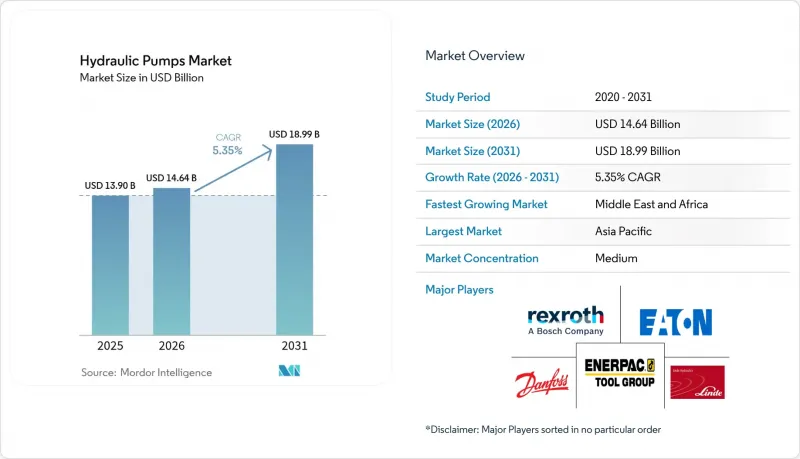
本報告按泵浦類型(齒輪泵浦、葉片泵浦及其他)、工作壓力範圍(低於3,000 psi、3,000–5,000 psi、高於5,000 psi)、應用領域(移動油壓設備、工業機械、流程和能源)、終端用戶產業(建築、石油和天然氣及其他)以及地區進行細分。市場預測以美元計價。
全球液壓幫浦市場趨勢及洞察
中國和印度的基礎設施更新計劃
預計到2025年,兩國政府資助的建設項目將維持每年超過1,350萬台液壓泵的需求。公共部門專案的本地化政策正在促進合資企業的成立,這些合資企業將投資約42億美元用於高科技泵浦的生產,並加速國內產能建設。採用中國設備標準的區域承包商正在將其供應鏈擴展到中東和非洲,從而拓寬亞太地區製造商的出口前景。預計這些項目將支撐到2027年的基準需求,特別是對於額定壓力高於5000 psi的產品。
工業自動化(維修到工業4.0)
採用變頻驅動的智慧電源單元可將待機能耗降低 25%。物聯網閘道可將即時資料傳輸至預測性維護平台,進而降低 45% 的營運成本,並將意外排放事件減少 75%。英國一家供水事業使用蘇爾壽控制器進行的測試證實了這一點。利用數位孿生模型進行遠端最佳化,可實現 30% 的節能和 20% 的總擁有成本 (TCO) 降低。自從美國網路安全和基礎設施安全局 (CISA) 發布建議,指出 CVSS 評分高達 9.8 的泵浦控制器有漏洞以來,網路安全問題持續受到關注。
鎳和鋼價格波動
隨著美國基礎設施建設支出的恢復,含鎳合金的成本在2024年底上漲,隨後短暫回落,但在2025年初再次反彈,這給泵浦製造商的利潤率帶來壓力,並導致庫存計劃難以製定。高壓(超過3000 psi)泵浦受影響最大,因為安全標準要求使用高品質鋼材。依賴進口高品質合金的中國製造商面臨外匯風險加劇和額外物流成本的雙重負擔。
細分市場分析
2025年,齒輪幫浦的市佔率維持在36.45%,主要得益於移動機械的需求。預計到2031年,活塞泵的複合年成長率將達到6.45%,這主要受原始設備製造商(OEM)對更高容積效率和更精確排量控制的需求所驅動。派克漢尼汾的PV140活塞泵系列在全生命週期成本方面展現出卓越的優勢,在澳洲礦用車輛中,其大修間隔可達14,000運作小時。葉片泵浦和螺旋泵浦則繼續應用於一些對流量平穩性和船用級可靠性有較高要求的特定領域。
第二代活塞幫浦設計採用了硬化滑閥和加強型斜盤,將平均故障間隔時間 (MTBF) 延長至 15,000 小時,使用壽命是傳統機械幫浦的兩倍。該泵浦在加長型堆高機、挖土機和射出成型機的應用,凸顯了向能源最佳化和二氧化碳減排的系統性轉變。預計採用活塞技術的液壓泵在工業和可再生能源裝置中的市場佔有率將持續擴大。
至2025年,3000-5000 psi級泵浦將佔全球市場佔有率的41.35%,涵蓋主流施工機械和農業鑽機。額定壓力高於5000 psi的泵浦正以每年7.95%的速度成長,主要受氫氣壓縮、離岸風力發電和先進加工中心需求的驅動。 North Ridge Pumps公司獲得ATEX防爆認證的多級增壓幫浦可滿足電解槽開發商在1000 bar壓力下連續運作的需求。而額定壓力低於3000 psi的泵浦則在對成本需求較高、性能要求相對較低的市場中保持著穩定的供應。
上游製程的創新主要集中在密封系統和微精加工表面處理上,旨在抑制極端壓力下的洩漏。雙相不銹鋼和奈米塗層等材料科學領域的突破旨在提高抗疲勞性能,而即時降壓演算法則可防止災難性故障的發生。這些進步進一步鞏固了高壓液壓泵專家在能源轉換項目中的市場佔有率。
區域分析
亞太地區的主導地位源自於其無可比擬的生產規模和國內消費能力,預計到2025年,光是中國就將採購1,350萬台。印度的「智慧城市計畫」等政府計畫正將資金投入水資源管理、地鐵和經濟適用住宅等需要高壓液壓系統的計畫。日本供應商在可靠性方面持續引領業界標準。川崎重工的K3VL軸活塞系列產品常用於高階挖土機。供應鏈中斷和技術純熟勞工短缺正推動自動化和區域多元化發展,越南和印尼等國成為新的市場選擇。
中東地區的快速成長得益於對石油和天然氣產業的再投資以及向可再生能源領域的多元化策略。沙烏地阿拉伯公共投資基金(PIF)正斥資數十億美元建造太陽能和風力發電廠,其中液壓偏航變槳驅動裝置有助於提高渦輪機的運作。阿拉伯聯合大公國的電網升級改造促使其進口用於變電站冷卻和海水淡化的高壓幫浦。達曼和阿布達比的合資企業正在縮短前置作業時間並滿足在地採購要求。
在北美和歐洲,技術先進的機械設備正得到維護。美國的《基礎設施投資與就業法案》重振了土木工程領域的支出,刺激了滑移裝載機和攤舖機等設備的更新換代需求。歐盟旨在促進循環經濟的法規透過再製造創造了新的收入來源,同時,符合EN ISO 14971認證的環保型泵浦的需求也在不斷成長。這兩個地區都面臨著勞動力老化的挑戰,遠距離診斷的應用正在不斷擴展,以緩解服務交付中的瓶頸問題。
其他好處
- Excel格式的市場預測(ME)表
- 3個月的分析師支持
目錄
第1章:引言
- 研究假設和市場定義
- 調查範圍
第2章:調查方法
第3章執行摘要
第4章 市場狀況
- 市場概覽
- 市場促進因素
- 中國和印度的基礎設施更新計劃
- 工業自動化(維修到工業4.0)
- 非公路用車輛電氣化帶動了對電液幫浦的需求。
- 風力發電機偏航變槳系統的需求
- 擴建氫電解設備(幫浦壓力超過1000巴)
- 強制再製造(歐盟循環經濟)
- 市場限制因素
- 鎳和鋼價格波動
- 全電動執行器的快速普及
- 智慧型幫浦的網路安全風險
- 認證流體動力學工程師短缺
- 價值供應鏈分析
- 監理情勢
- 技術展望
- 波特五力分析
第5章 市場規模與成長預測
- 泵浦類型
- 齒輪
- 貝恩
- 活塞
- 擰緊
- 按工作壓力範圍
- 小於3000磅/平方英寸
- 3,000~5,000psi
- 超過5000磅/平方英寸
- 按最終用戶行業分類
- 建造
- 石油和天然氣
- 發電
- 飲食
- 供水/污水處理
- 化學品
- 其他終端使用者產業(農業、礦業、汽車業)
- 透過使用
- 移動式油壓設備
- 工業機械
- 過程能源(包括風能、水能和氫能)
- 按地區
- 北美洲
- 美國
- 加拿大
- 墨西哥
- 南美洲
- 巴西
- 阿根廷
- 其他南美國家
- 歐洲
- 德國
- 英國
- 法國
- 義大利
- 西班牙
- 其他歐洲國家
- 亞太地區
- 中國
- 日本
- 韓國
- 印度
- 澳洲
- 紐西蘭
- 其他亞太國家
- 中東和非洲
- 阿拉伯聯合大公國
- 沙烏地阿拉伯
- 南非
- 其他中東和非洲國家
- 北美洲
第6章 競爭情勢
- 市場集中度
- 策略趨勢
- 市佔率分析
- 公司簡介
- Bosch Rexroth AG
- Eaton Corporation plc
- Danfoss Power Solutions A/S
- Enerpac Tool Group Corp.
- Linde Hydraulics GmbH and Co. KG
- Dynamatic Technologies Limited
- HYDAC International GmbH
- Parker Hannifin Corporation
- Kawasaki Heavy Industries Ltd.
- Daikin Industries Ltd.
- Bucher Hydraulics GmbH
- KYB Corporation
- Shimadzu Corporation
- Permco Inc.
- Casappa SpA
- Ningbo Baichi Hydraulic
- HAWE Hydraulik SE
- Sun Hydraulics LLC
- Bosch Mahle Turbosystems Hydraulic(BMT)
- Bosch Rexroth India Pvt Ltd(regional)
第7章 市場機會與未來展望
According to Mordor Intelligence, the hydraulic pumps market size was valued at USD 13.9 billion in 2025 and estimated to grow from USD 14.64 billion in 2026 to reach USD 18.99 billion by 2031, at a CAGR of 5.35% during the forecast period (2026-2031).
This report is Segmented by Pump Type (Gear, Vane, and More), Operating-Pressure Range (5, 000 Psi), Application (Mobile Hydraulics, Industrial Machinery, Process and Energy), End-User Vertical (Construction, Oil and Gas, and More) and Geography. The Market Forecasts are Provided in Terms of Value (USD).
Global Hydraulic Pumps Market Trends and Insights
Infrastructure renewal programs in China and India
Government-funded construction pipelines in both nations sustain annual demand for more than 13.5 million hydraulic pump units by 2025. Localization rules for public-sector projects incentivise joint ventures, channelling roughly USD 4.2 billion into high-tech pump production and accelerating domestic capability building. Regional contractors adopting Chinese equipment standards are extending the supply chain into the Middle East and Africa, broadening export prospects for APAC manufacturers. These programmes are expected to underpin baseline demand through 2027, particularly for units rated above 5000 psi.
Industrial automation (Industry 4.0 retrofits)
Smart power units equipped with variable-frequency drives trim idle-time energy consumption by 25%. IoT gateways stream real-time data into predictive-maintenance platforms, cutting operating costs by 45% and reducing unplanned emissions events by 75%, as shown in UK water-utility trials with Sulzer controllers. Digital twin models enable remote optimisation that delivers 30% energy savings and 20% reduction in total cost of ownership. Cyber-security remains a rising concern following US CISA advisories on pump-controller vulnerabilities carrying CVSS scores up to 9.8.
Volatile nickel-steel prices
Nickel-bearing alloy costs climbed through late-2024 on renewed US infrastructure spending before receding, then rebounded in early-2025, compressing pump-maker margins and complicating inventory planning. High-pressure (>3000 psi) models suffer the most, as safety codes mandate premium steel grades. Chinese producers, reliant on imported high-grade alloy, face added currency risk and logistics surcharges.
Other drivers and restraints analyzed in the detailed report include:
- Off-highway electrification needs electro-hydraulic pumps
- Hydrogen electrolyser build-out (>1000 bar pumps)
- Rapid penetration of all-electric actuators
For complete list of drivers and restraints, kindly check the Table Of Contents.
Segment Analysis
Gear pumps retained 36.45% revenue share in 2025 on the strength of mobile-machinery demand. Piston pumps are outpacing at 6.45% CAGR to 2031 as OEMs migrate toward higher volumetric efficiency and precise displacement control. Parker Hannifin's PV140 piston series recorded 14,000 operating hours between overhauls in Australian mining vehicles, illustrating lifecycle cost advantages. Vane and screw pumps continue serving niche applications requiring smooth flow or marine-grade reliability.
Second-generation piston designs use hardened spool valves and reinforced swash plates to extend mean-time-between-failure to 15,000 hours, doubling service life relative to legacy units. Their adoption in telehandlers, excavators, and injection-moulding machines underscores a systemic pivot toward energy optimisation and reduced CO2 footprints. The hydraulic pumps market size for piston technology is expected to capture an incremental share in both industrial and renewable-energy installations.
The 3000-5000 psi class represented 41.35% of global value in 2025, covering mainstream construction and agricultural rigs. Pumps rated above 5000 psi are growing 7.95% annually, propelled by hydrogen compression, offshore wind, and advanced machining centres. North Ridge Pumps' multi-stage boosters, certified for ATEX zones, meet electrolyser developers' need for continuous duty at 1000 bar. Below-3000-psi units maintain volume stability in cost-sensitive markets where performance thresholds remain modest.
Upstream innovation focuses on sealing systems and micro-finish surfaces to curb leakage at extreme pressures. Material-science breakthroughs in duplex stainless and nano-coatings aim to raise fatigue resistance, while real-time pressure-derating algorithms prevent catastrophic failures. These advances reinforce the hydraulic pumps market share held by high-pressure specialists amid energy-transition projects.
Complete Report Scope:
- By Pump Type
- Gear
- Vane
- Piston
- Screw
- By Operating-Pressure Range
- <3,000 psi
- 3,000 - 5,000 psi
- >5,000 psi
- By End-user Vertical
- Construction
- Oil and Gas
- Power Generation
- Food and Beverage
- Water and Waste-water
- Chemicals
- Others (Agriculture, Mining, Automotive)
- By Application
- Mobile Hydraulics
- Industrial Machinery
- Process and Energy (incl. wind, hydro, hydrogen)
- By Geography
- North America
- United States
- Canada
- Mexico
- South America
- Brazil
- Argentina
- Rest of Latin America
- Europe
- Germany
- United Kingdom
- France
- Italy
- Spain
- Rest of Europe
- Asia-Pacific
- China
- Japan
- South Korea
- India
- Australia
- New Zealand
- Rest of Asia-Pacific
- Middle East and Africa
- United Arab Emirates
- Saudi Arabia
- South Africa
- Rest of Middle East and Africa
- North America
Geography Analysis
APAC's leadership derives from unmatched production scale and domestic consumption, with China alone purchasing 13.5 million units in 2025. Government programmes such as India's Smart Cities Mission funnel capital into water-management, metro-rail, and affordable-housing projects requiring high-pressure hydraulic systems. Japanese suppliers continue to set benchmarks for reliability; Kawasaki's K3VL axial piston line is frequently specified on premium excavators. Supply-chain disruptions and skilled-labour shortages encourage automation and regional diversification into Vietnam and Indonesia.
The Middle East's swift growth rests on oil-and-gas reinvestment and renewable diversification agendas. Saudi Arabia's Public Investment Fund channels billions into solar- and wind-farm construction, where hydraulic yaw and pitch drives underpin turbine uptime. UAE's transmission grid upgrades import high-pressure pumps for substation cooling and seawater desalination. Joint-venture manufacturing in Dammam and Abu Dhabi shortens lead times and meets local-content mandates.
North America and Europe maintain technologically advanced fleets. The US Infrastructure Investment and Jobs Act revived civil works outlays, fuelling replacements across skid-steer loaders and pavers. EU regulations promoting circular-economy compliance create new remanufacturing revenue and elevate demand for eco-design pumps certified under EN ISO 14971. Both regions contend with an ageing technician workforce, prompting wider deployment of remote diagnostics to ease service bottlenecks.
- Bosch Rexroth AG
- Eaton Corporation plc
- Danfoss Power Solutions A/S
- Enerpac Tool Group Corp.
- Linde Hydraulics GmbH and Co. KG
- Dynamatic Technologies Limited
- HYDAC International GmbH
- Parker Hannifin Corporation
- Kawasaki Heavy Industries Ltd.
- Daikin Industries Ltd.
- Bucher Hydraulics GmbH
- KYB Corporation
- Shimadzu Corporation
- Permco Inc.
- Casappa S.p.A.
- Ningbo Baichi Hydraulic
- HAWE Hydraulik SE
- Sun Hydraulics LLC
- Bosch Mahle Turbosystems Hydraulic (BMT)
- Bosch Rexroth India Pvt Ltd (regional)
Additional Benefits:
- The market estimate (ME) sheet in Excel format
- 3 months of analyst support
TABLE OF CONTENTS
1 INTRODUCTION
- 1.1 Study Assumptions and Market Definition
- 1.2 Scope of the Study
2 RESEARCH METHODOLOGY
3 EXECUTIVE SUMMARY
4 MARKET LANDSCAPE
- 4.1 Market Overview
- 4.2 Market Drivers
- 4.2.1 Infrastructure renewal programmes in China and India
- 4.2.2 Industrial automation (Industry 4.0 retrofits)
- 4.2.3 Off-highway electrification needs electro-hydraulic pumps
- 4.2.4 Wind-turbine yaw and pitch system demand
- 4.2.5 Hydrogen electrolyser build-out (>1 000 bar pumps)
- 4.2.6 Mandatory remanufacturing quotas (EU Circular Economy)
- 4.3 Market Restraints
- 4.3.1 Volatile nickel-steel prices
- 4.3.2 Rapid penetration of all-electric actuators
- 4.3.3 Cyber-security risks in smart pumps
- 4.3.4 Shortage of certified fluid-power technicians
- 4.4 Value / Supply-Chain Analysis
- 4.5 Regulatory Landscape
- 4.6 Technological Outlook
- 4.7 Porter's Five Forces Analysis
- 4.7.1 Bargaining Power of Suppliers
- 4.7.2 Bargaining Power of Consumers
- 4.7.3 Threat of New Entrants
- 4.7.4 Threat of Substitutes
- 4.7.5 Intensity of Competitive Rivalry
5 MARKET SIZE AND GROWTH FORECASTS (VALUE)
- 5.1 By Pump Type
- 5.1.1 Gear
- 5.1.2 Vane
- 5.1.3 Piston
- 5.1.4 Screw
- 5.2 By Operating-Pressure Range
- 5.2.1 <3,000 psi
- 5.2.2 3,000 - 5,000 psi
- 5.2.3 >5,000 psi
- 5.3 By End-user Vertical
- 5.3.1 Construction
- 5.3.2 Oil and Gas
- 5.3.3 Power Generation
- 5.3.4 Food and Beverage
- 5.3.5 Water and Waste-water
- 5.3.6 Chemicals
- 5.3.7 Others (Agriculture, Mining, Automotive)
- 5.4 By Application
- 5.4.1 Mobile Hydraulics
- 5.4.2 Industrial Machinery
- 5.4.3 Process and Energy (incl. wind, hydro, hydrogen)
- 5.5 By Geography
- 5.5.1 North America
- 5.5.1.1 United States
- 5.5.1.2 Canada
- 5.5.1.3 Mexico
- 5.5.2 South America
- 5.5.2.1 Brazil
- 5.5.2.2 Argentina
- 5.5.2.3 Rest of Latin America
- 5.5.3 Europe
- 5.5.3.1 Germany
- 5.5.3.2 United Kingdom
- 5.5.3.3 France
- 5.5.3.4 Italy
- 5.5.3.5 Spain
- 5.5.3.6 Rest of Europe
- 5.5.4 Asia-Pacific
- 5.5.4.1 China
- 5.5.4.2 Japan
- 5.5.4.3 South Korea
- 5.5.4.4 India
- 5.5.4.5 Australia
- 5.5.4.6 New Zealand
- 5.5.4.7 Rest of Asia-Pacific
- 5.5.5 Middle East and Africa
- 5.5.5.1 United Arab Emirates
- 5.5.5.2 Saudi Arabia
- 5.5.5.3 South Africa
- 5.5.5.4 Rest of Middle East and Africa
- 5.5.1 North America
6 COMPETITIVE LANDSCAPE
- 6.1 Market Concentration
- 6.2 Strategic Moves
- 6.3 Market Share Analysis
- 6.4 Company Profiles (includes Global-level Overview, Market-level Overview, Core Segments, Financials, Strategic Information, Market Rank/Share, Products and Services, Recent Developments)
- 6.4.1 Bosch Rexroth AG
- 6.4.2 Eaton Corporation plc
- 6.4.3 Danfoss Power Solutions A/S
- 6.4.4 Enerpac Tool Group Corp.
- 6.4.5 Linde Hydraulics GmbH and Co. KG
- 6.4.6 Dynamatic Technologies Limited
- 6.4.7 HYDAC International GmbH
- 6.4.8 Parker Hannifin Corporation
- 6.4.9 Kawasaki Heavy Industries Ltd.
- 6.4.10 Daikin Industries Ltd.
- 6.4.11 Bucher Hydraulics GmbH
- 6.4.12 KYB Corporation
- 6.4.13 Shimadzu Corporation
- 6.4.14 Permco Inc.
- 6.4.15 Casappa S.p.A.
- 6.4.16 Ningbo Baichi Hydraulic
- 6.4.17 HAWE Hydraulik SE
- 6.4.18 Sun Hydraulics LLC
- 6.4.19 Bosch Mahle Turbosystems Hydraulic (BMT)
- 6.4.20 Bosch Rexroth India Pvt Ltd (regional)
7 Market Opportunities and Future Outlook
- 7.1 White-space and Unmet-Need Assessment

 液壓泵市場規模、佔有率、趨勢和預測:按產品類型、壓力範圍、應用、最終用戶和地區分類,2026-2034年
 液壓泵市場:按泵浦類型、排氣量類型、額定壓力和最終用途產業分類-2026-2032年全球市場預測
 液壓幫浦市場:策略性洞察與預測(2026-2031年)日本液壓泵市場規模、佔有率、趨勢和預測:按產品類型、壓力範圍、應用、最終用戶和地區分類,2026-2034年
 2026年全球液壓幫浦市場報告
 液壓泵市場規模、佔有率和成長分析(按類型、壓力範圍、控制方式、應用、最終用途和地區分類)-2026-2033年產業預測
 亞太地區火箭電動幫浦市場:按最終用戶、火箭等級、幫浦類型和國家分類的分析與預測(2025-2035)
 歐洲電動火箭幫浦市場按最終用戶、火箭等級、幫浦和國家分類-分析與預測(2025-2035年)
 火箭電動幫浦市場 - 全球與區域分析:按最終用戶、火箭類別、幫浦類型和國家的分析和預測(2025-2035年)
 2032 年全球液壓幫浦市場預測(依產品類型、壓力範圍、排氣量類型、控制類型、動力來源、應用和地區)