


 |
市場調查報告書
商品編碼
2122395
紅外線攝影機:市場佔有率分析、產業趨勢與統計、成長預測(2026-2031)IR (Infrared) Camera - Market Share Analysis, Industry Trends & Statistics, Growth Forecasts (2026 - 2031) |
||||||

※ 本網頁內容可能與最新版本有所差異。詳細情況請與我們聯繫。
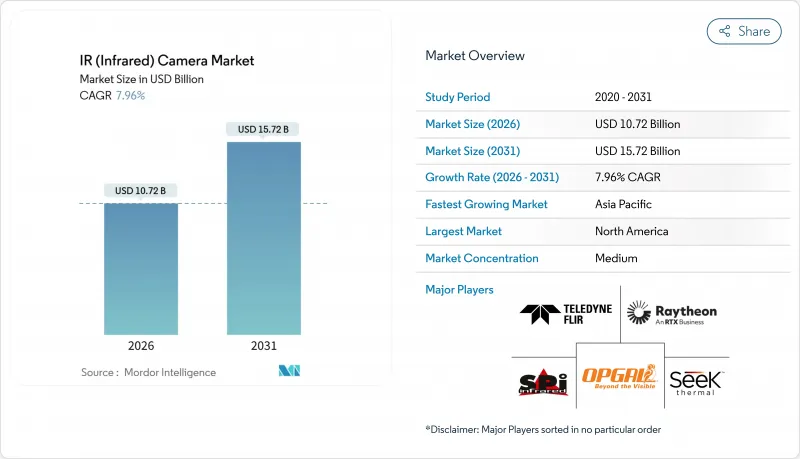
根據 Mordor Intelligence 預測,紅外線攝影機市場規模預計將在 2026 年達到 107.2 億美元,並在 2031 年擴大到 157.2 億美元,在此期間的複合年成長率為 7.96%。
本報告按檢測器(冷凍型、非製冷型)、材料(鍺、矽、藍寶石及其他材料)、波長類型(近紅外線、短波紅外線、中波紅外線、長波紅外線)、終端用戶領域(軍事和國防、汽車、工業、商業和公共領域及其他)以及地區進行細分。市場預測以美元計價。
全球紅外線攝影機市場趨勢與洞察
各行各業對監控的需求日益成長
紅外線攝影機正從被動偵測轉向主動威脅評估,構成多感測器安全網路的第一層。頻譜模型透過疊加影像和可見光影像來減少誤報,這對於關鍵基礎設施而言是一項顯著優勢,因為繁瑣的警報會給操作人員帶來負擔。美國安全指南建議在化工設施中採用熱成像周界安防,這促進了石化產業群的採購。商業房地產所有者現在正將熱成像數據與建築管理系統整合,以最佳化暖通空調負荷,而2024年能源價格的上漲將加速這一趨勢。隨著企業以分析型熱成像攝影機取代傳統的被動式紅外線偵測器,供應商報告銷售額實現了兩位數成長。
透過與基於人工智慧的影像分析相結合,拓展應用場景。
透過將神經網路處理器整合到相機中,熱成像可以作為診斷工具。邊緣推理技術能夠以每秒 30 幀的速度區分電氣故障、蒸氣洩漏和正常運作,從而消除雲端延遲。在汽車系統中,這種低於 100 毫秒的決策迴路對於夜間緊急煞車控制至關重要,歐洲原始設備製造商 (OEM) 正在加速採用這項技術。工業用戶正在利用熱模式提前數週預測軸承故障,從而減少意外停機時間。 GPU 供應商正在擴展其對熱成像管線的支持,使整合商能夠對可見光和紅外線資料流進行整合分析。
關於兩用紅外線檢測器的出口管制條例
由於《國際武器貿易條例》(ITAR)的限制,高規格的製冷檢測器被歸類為國防物品,導致出口許可證審查期延長至6-12個月,並禁止向受禁運國家銷售。 2024年《瓦塞納爾協定》的修訂將高靈敏度非製冷陣列也列入了管制物品清單,迫使企業只能交付性能較低的替代產品以符合法規要求。為此,中國買家正轉向國內採購,但美國當局正在收緊指定供應商名單,擾亂了光學儀器和檢測器的分銷。每次出貨的合規成本平均高達15,000美元,給中小型製造商帶來了巨大壓力,並促使產業整合。
細分市場分析
到2025年,非製冷紅外線相機技術將佔據紅外線相機市場74.72%的主導佔有率。這主要得益於其低於800美元的價格以及便捷的攜帶式操作,使其適用於商業監控和手持式檢測。像素間距的縮小和讀出電路的改進已將雜訊等效溫差降低到40毫開爾文以下,使得這些檢測器能夠用於預測性維護和建築診斷。然而,由於國防專案要求識別距離達到20公里,而科學研究用戶在極低光子應用領域需要低於20毫開爾文的靈敏度,預計到2031年,冷凍感測器將以9.21%的複合年成長率保持強勁成長。最近一份價值4250萬美元的無人機系統合約表明,人們仍然願意為遠距離清晰影像支付溢價。
儘管性能差距正在縮小,但在導彈追蹤和天文學等光子數極低的領域,製冷型紅外線相機仍然佔據主導地位。供應商正致力於將斯特林冷卻器的壽命延長至15000小時以上,並透過縮小尺寸、減輕重量和降低功耗來提高可靠性,從而拓展其在航空航太領域的應用。同時,由於晶圓良率的提高,非製冷型紅外線檢測器的成本進一步降低,鞏固了其在紅外線相機市場量產中的主導地位。
預計到2025年,鍺光學元件將佔銷售額的41.62%。這得歸功於其在8–14µm頻寬高達63%的透射率,使其能夠建造緊湊型透鏡陣列,用於周界安防和建築檢測應用。然而,由於鍺的脆性以及提煉產能集中導致的價格波動,使用者正擴大嘗試使用藍寶石作為替代品。藍寶石市場正以8.44%的複合年成長率成長。藍寶石的莫氏硬度為9,能夠延長透鏡在嚴苛工業環境中的使用壽命。此外,其0.2–5.5µm的寬透射頻寬使其能夠進行雙波段成像,用於檢測石化廠的氣體洩漏。
根據2025年藍圖,採用鍺作為前鏡片、聚合物作為後鏡片的混合鏡頭組件,可在維持85%光學性能的同時,降低22%的成本。硒化鋅和硫系玻璃由於高成本且易碎,目前仍屬於小眾材料,但隨著出口限制和價格波動使得依賴單一供應商存在風險,材料多樣化策略的重要性日益凸顯。因此,紅外線相機行業正在努力平衡光學性能要求、容錯能力和整體擁有成本。
區域分析
到2025年,北美將佔全球收入的38.73%。這主要得益於超過8500億美元的國防預算,該預算為部署遠端系統提供了基礎設施支援。電氣設備維護標準的修訂(現建議對資料中心開關設備進行季度熱成像掃描)正在推動連接到雲端分析的固定網路攝影機的需求。在加拿大較冷的省份,由於公共產業的補貼可涵蓋經認證的住宅檢查員安裝攝影機成本的50%,住宅領域的熱成像技術應用正在逐步普及。在墨西哥,熱成像檢測正被整合到汽車工廠的最終品質保證(QA)站中,進一步推動了該地區的成長。
預計到2031年,亞太地區的複合年成長率將達到8.55%。這部分歸功於光是2024年,中國智慧城市計畫就部署了超過40萬台紅外線攝影機。垂直整合型企業獲得了30-40%的成本優勢,並正在加速公共安全、交通運輸和建築火災偵測網路等領域的解決方案應用。印度已啟動一項2億美元的研發舉措,旨在實現國防應用檢測器的本地化生產;在日本,超過50年的建築必須進行熱橋檢測。韓國半導體製造廠已運作數千個短波紅外線(SWIR)檢測站,用於亞微米級缺陷檢測;澳洲礦場也正在使用紅外線攝影機來預防輸送機火災。這些案例表明,該地區的應用場景涵蓋政府、工業和資源等多個領域。
歐洲的成長主要得益於嚴格的能源效率和車輛安全法規。 《建築能源性能指令》要求2030年對大規模商業建築進行熱成像審計。德國汽車製造商已在其14款車型中整合熱感應器,這些車型將在2024年獲得Euro NCAP五星評級。法國核能發電廠正在運作數千個鏡頭,用於檢測蒸氣洩漏,從而減少維護運作。同時,中東的主要石油公司正在利用熱成像技術來滿足甲烷排放報告標準。在非洲,熱成像技術的應用仍集中在採礦和電力產業,但儘管設備成本受到限制,隨著區域系統整合商提供價格合理的維護服務,其覆蓋範圍正在逐步擴大。
其他好處:
- Excel格式的市場預測(ME)表
- 3個月的分析師支持
目錄
第1章:引言
- 市場分析與定義的前提條件
- 分析範圍
第2章 分析方法
第3章執行摘要
第4章 市場狀況
- 市場概覽
- 市場促進因素
- 各領域對監控的需求日益成長
- 紅外線感測器的平均售價正在下降。
- 透過與人工智慧影像分析技術的整合,其應用場景正在不斷擴展。
- 電動車電池溫度控管實施現狀
- 消防安全標準要求進行熱測試。
- 小型衛星用空間紅外線成像技術的發展
- 市場限制因素
- 對兩用紅外線檢測器的出口限制
- 與配備人工智慧影像增強功能的低成本CMOS可見光相機展開競爭。
- 鍺和其他紅外線級材料的供應鏈受到限制
- 遠端熱成像精度缺乏標準化校準
- 產業價值鏈分析
- 監理情勢
- 技術展望
- 宏觀經濟因素對市場的影響
- 波特五力分析
- 宏觀經濟因素對市場的影響
第5章 市場規模與成長預測
- 檢測器類型
- 冷卻類型
- 非冷卻型
- 材料
- 鎗
- 矽
- 藍寶石
- 其他材料
- 依波長類型
- 近紅外線和短波紅外線(SWIR)
- 中波紅外線(MWIR)
- 長波紅外線(LWIR)
- 按最終用戶類別
- 軍事/國防
- 車
- 產業
- 商業/公共
- 住宅
- 其他最終用戶字段
- 按地區
- 北美洲
- 美國
- 加拿大
- 墨西哥
- 南美洲
- 巴西
- 阿根廷
- 其他南美國家
- 歐洲
- 英國
- 德國
- 法國
- 義大利
- 西班牙
- 其他歐洲國家
- 亞太地區
- 中國
- 日本
- 印度
- 韓國
- 澳洲和紐西蘭
- 其他亞太國家
- 中東和非洲
- 中東
- 沙烏地阿拉伯
- 阿拉伯聯合大公國
- 土耳其
- 其他中東國家
- 非洲
- 南非
- 奈及利亞
- 其他非洲國家
- 中東
- 北美洲
第6章 競爭情勢
- 市場集中度
- 策略趨勢
- 市佔率分析
- 公司簡介
- Teledyne FLIR LLC
- Raytheon Technologies Corporation
- Hangzhou Hikvision Digital Technology Co., Ltd
- Axis Communications AB
- Zhejiang Dahua Technology Co., Ltd
- Opgal Optronic Industries Ltd
- Leonardo DRS, Inc.
- Guide Sensmart Tech Co., Ltd
- Seek Thermal, Inc.
- Fluke Corporation
- Testo SE & Co. KGaA
- InfraTec GmbH Infrarotsensorik und Messtechnik
- SPI Corp.
- Bosch Security Systems GmbH
- Honeywell International Inc.
- L3Harris Technologies, Inc.
- Princeton Infrared Technologies, Inc.
- Excelitas Technologies Corp.
- Xenics nv
- Workswell sro
第7章 市場機會與未來展望
According to Mordor Intelligence, the infrared camera market size reached USD 10.72 billion in 2026 and is projected to advance to USD 15.72 billion by 2031, reflecting a 7.96% CAGR across the period.
This report is Segmented by Detector (Cooled and Uncooled), Material (Germanium, Silicon, Sapphire, and Rest of Materials), Wavelength Type (Near and Short-Wavelength IR, Medium-Wavelength IR, and Long-Wavelength IR), End-User Vertical (Military and Defense, Automotive, Industrial, Commercial and Public, and More), and Geography. The Market Forecasts are Provided in Terms of Value (USD).
Global IR (Infrared) Camera Market Trends and Insights
Rising Demand for Surveillance Across Multiple Sectors
Thermal cameras have shifted from reactive detection to proactive threat assessment, forming the first layer in multi-sensor security grids. Bi-spectrum models overlay thermal and visible feeds to cut false alarms, a key benefit for critical-infrastructure sites where nuisance alerts burden operators. U.S. security guidance recommends thermal perimeters for chemical facilities, driving procurement in petrochemical corridors. Commercial real-estate owners now integrate thermal feeds with building-management systems to optimize HVAC loads, a practice that expanded after 2024 energy-price spikes. Vendors report double-digit revenue growth as enterprises replace legacy passive-infrared sensors with analytics-ready thermal units.
Integration with AI-Based Video Analytics Enhancing Use Cases
Embedding neural processors in cameras enables thermal imaging to serve as a diagnostic tool. Edge inference distinguishes between electrical faults, steam leaks, and normal operation at 30 frames per second, eliminating cloud latency. Automotive systems rely on this sub-100 millisecond decision loop for emergency braking in darkness, reinforcing adoption by European OEMs. Industrial users apply thermal patterns to forecast bearing failures weeks ahead, reducing unplanned downtime. GPU suppliers expanded their support for thermal pipelines, enabling integrators to run unified analytics across both visible and infrared streams.
Export Control Regulations on Dual-Use Infrared Detectors
ITAR restrictions classify high-spec cooled detectors as defense articles, extending export-license cycles to 6-12 months and blocking sales to embargoed nations. The 2024 Wassenaar amendments added high-sensitivity uncooled arrays to control lists, causing firms to ship detuned variants to remain compliant. Chinese buyers respond by sourcing domestically, while U.S. authorities have tightened entity listings, disrupting optic and detector flows. Compliance costs average USD 15,000 per shipment, pressuring small manufacturers and encouraging industry consolidation.
Other drivers and restraints analyzed in the detailed report include:
- Adoption in Electric Vehicle Battery Thermal Management
- Falling Average Selling Prices of Infrared Sensors
- Supply Chain Constraints for Germanium and Other IR-Grade Materials
For complete list of drivers and restraints, kindly check the Table Of Contents.
Segment Analysis
Uncooled technology held a dominant 74.72% share of the infrared camera market in 2025, buoyed by sub-USD 800 price points and instant-on operation that suits commercial surveillance and handheld inspections. Pixel-pitch reductions and improved readout circuits pushed noise-equivalent temperature differences below 40 mK, making these detectors viable for predictive maintenance and building diagnostics. Nevertheless, cooled sensors are projected to post a robust 9.21% CAGR through 2031 as defense programs pursue 20 km identification ranges and scientific users demand sub-20 mK sensitivity for photon-starved applications. A recent USD 42.5 million contract for unmanned aerial systems highlights continued willingness to pay premiums for long-range clarity.
The performance gap is narrowing, yet cooled cameras still dominate missile-tracking and astronomy scenarios where photon counts are minimal. Vendors have enhanced reliability by extending Stirling-cooler lifetimes beyond 15,000 hours and reducing the size, weight, and power envelopes, thereby broadening airborne and space-borne deployment options. Meanwhile, uncooled detectors are benefitting from higher wafer yields that further depress costs, reinforcing their role as the volume engine of the infrared camera market.
Germanium optics owned 41.62% revenue in 2025, reflecting unrivaled 63% transmission across the 8-14 µm band, which enables compact lens stacks for perimeter security and building audits. Yet germanium's brittleness and price volatility, driven by concentrated refining capacity, are prompting users to trial sapphire alternatives, which are growing at an 8.44% CAGR. Sapphire's Mohs hardness of 9 boosts lens life in harsh industrial settings and its broad 0.2-5.5 µm transmission window supports dual-band imaging that detects gas leaks in petrochemical plants.
Hybrid lens assemblies mix germanium front elements with polymer rears to reduce costs by 22% while retaining 85% optical performance, according to a 2025 roadmap. Zinc selenide and chalcogenide glass remain niche due to high cost or brittleness, but material diversification strategies are gaining importance as export controls and price swings make single-source reliance risky. The infrared camera industry is therefore balancing optical performance requirements against resilience and total cost of ownership.
Complete Report Scope:
- By Detector
- Cooled
- Uncooled
- By Material
- Germanium
- Silicon
- Sapphire
- Rest of Materials
- By Wavelength Type
- Near and Short-wavelength IR (SWIR)
- Medium-wavelength IR (MWIR)
- Long-wavelength IR (LWIR)
- By End-user Vertical
- Military and Defense
- Automotive
- Industrial
- Commercial and Public
- Residential
- Rest of End-user Verticals
- By Geography
- North America
- United States
- Canada
- Mexico
- South America
- Brazil
- Argentina
- Rest of South America
- Europe
- United Kingdom
- Germany
- France
- Italy
- Spain
- Rest of Europe
- Asia-Pacific
- China
- Japan
- India
- South Korea
- Australia and New Zealand
- Rest of Asia Pacific
- Middle East and Africa
- Middle East
- Saudi Arabia
- United Arab Emirates
- Turkey
- Rest of Middle East
- Africa
- South Africa
- Nigeria
- Rest of Africa
- Middle East
- North America
Geography Analysis
North America held 38.73% of global revenue in 2025 as defense budgets above USD 850 billion sustained a large installed base of long-range systems. Updated electrical-maintenance codes now recommend quarterly thermal scans of data-center switchgear, driving demand for fixed networked cameras connected to cloud analytics. Residential adoption is rising in Canada's cold provinces, where utility rebates cover up to 50% of camera costs for certified home inspectors, and Mexico's automotive plants incorporate thermal inspection at final QA stations, reinforcing regional growth momentum.
The Asia-Pacific region is forecast to post an 8.55% CAGR through 2031, as Chinese smart-city programs deployed more than 400,000 thermal cameras in 2024 alone. Vertically integrated players achieve 30-40% cost advantages, catalyzing the adoption of solutions across public-safety, traffic, and building-fire detection networks. India launched a USD 200 million R&D initiative to localize detector production for defense, while Japan mandates thermal bridge inspections on structures older than 50 years. South Korea's fabs operate thousands of SWIR stations for sub-micron defect detection, and Australia's mines utilize thermal cameras to prevent conveyor fires, demonstrating that regional use cases span the government, industrial, and resource sectors.
Europe's growth is anchored by stringent energy-efficiency and automotive safety regulations. The Energy Performance of Buildings Directive mandates thermal audits for large commercial properties by 2030. German OEMs have already integrated thermal sensors into 14 vehicle models that achieved 5-star Euro NCAP ratings in 2024. France's nuclear fleet operates thousands of cameras for steam-leak detection, reducing maintenance downtime, while the Middle East's oil majors deploy thermal imaging to meet methane-emission reporting standards. Africa's uptake remains focused on mining and power sectors, constrained by equipment costs but gradually widening as regional integrators bundle affordable maintenance services.
- Teledyne FLIR LLC
- Raytheon Technologies Corporation
- Hangzhou Hikvision Digital Technology Co., Ltd
- Axis Communications AB
- Zhejiang Dahua Technology Co., Ltd
- Opgal Optronic Industries Ltd
- Leonardo DRS, Inc.
- Guide Sensmart Tech Co., Ltd
- Seek Thermal, Inc.
- Fluke Corporation
- Testo SE & Co. KGaA
- InfraTec GmbH Infrarotsensorik und Messtechnik
- SPI Corp.
- Bosch Security Systems GmbH
- Honeywell International Inc.
- L3Harris Technologies, Inc.
- Princeton Infrared Technologies, Inc.
- Excelitas Technologies Corp.
- Xenics nv
- Workswell s.r.o.
Additional Benefits:
- The market estimate (ME) sheet in Excel format
- 3 months of analyst support
TABLE OF CONTENTS
1 INTRODUCTION
- 1.1 Study Assumptions and Market Definition
- 1.2 Scope of the Study
2 RESEARCH METHODOLOGY
3 EXECUTIVE SUMMARY
4 MARKET LANDSCAPE
- 4.1 Market Overview
- 4.2 Market Drivers
- 4.2.1 Rising Demand for Surveillance Across Multiple Sectors
- 4.2.2 Falling Average Selling Prices of Infrared Sensors
- 4.2.3 Integration with AI-based Video Analytics Enhancing Use Cases
- 4.2.4 Adoption in Electric Vehicle Battery Thermal Management
- 4.2.5 Mandatory Fire Safety Codes Requiring Thermal Inspection
- 4.2.6 Growth of Space-Based Infrared Imaging for Smallsats
- 4.3 Market Restraints
- 4.3.1 Export Control Regulations on Dual-Use Infrared Detectors
- 4.3.2 Competition from Low-cost CMOS Visible Cameras with AI Upscaling
- 4.3.3 Supply Chain Constraints for Germanium and Other IR-grade Materials
- 4.3.4 Lack of Standardized Calibration for Long-range Thermal Accuracy
- 4.4 Industry Value Chain Analysis
- 4.5 Regulatory Landscape
- 4.6 Technological Outlook
- 4.7 Impact of Macroeconomic Factors on the Market
- 4.8 Porter's Five Forces Analysis
- 4.8.1 Threat of New Entrants
- 4.8.2 Bargaining Power of Buyers
- 4.8.3 Bargaining Power of Suppliers
- 4.8.4 Threat of Substitutes
- 4.8.5 Intensity of Competitive Rivalry
- 4.9 Impact of Macroeconomic Factors on the Market
5 MARKET SIZE AND GROWTH FORECASTS (VALUE)
- 5.1 By Detector
- 5.1.1 Cooled
- 5.1.2 Uncooled
- 5.2 By Material
- 5.2.1 Germanium
- 5.2.2 Silicon
- 5.2.3 Sapphire
- 5.2.4 Rest of Materials
- 5.3 By Wavelength Type
- 5.3.1 Near and Short-wavelength IR (SWIR)
- 5.3.2 Medium-wavelength IR (MWIR)
- 5.3.3 Long-wavelength IR (LWIR)
- 5.4 By End-user Vertical
- 5.4.1 Military and Defense
- 5.4.2 Automotive
- 5.4.3 Industrial
- 5.4.4 Commercial and Public
- 5.4.5 Residential
- 5.4.6 Rest of End-user Verticals
- 5.5 By Geography
- 5.5.1 North America
- 5.5.1.1 United States
- 5.5.1.2 Canada
- 5.5.1.3 Mexico
- 5.5.2 South America
- 5.5.2.1 Brazil
- 5.5.2.2 Argentina
- 5.5.2.3 Rest of South America
- 5.5.3 Europe
- 5.5.3.1 United Kingdom
- 5.5.3.2 Germany
- 5.5.3.3 France
- 5.5.3.4 Italy
- 5.5.3.5 Spain
- 5.5.3.6 Rest of Europe
- 5.5.4 Asia-Pacific
- 5.5.4.1 China
- 5.5.4.2 Japan
- 5.5.4.3 India
- 5.5.4.4 South Korea
- 5.5.4.5 Australia and New Zealand
- 5.5.4.6 Rest of Asia Pacific
- 5.5.5 Middle East and Africa
- 5.5.5.1 Middle East
- 5.5.5.1.1 Saudi Arabia
- 5.5.5.1.2 United Arab Emirates
- 5.5.5.1.3 Turkey
- 5.5.5.1.4 Rest of Middle East
- 5.5.5.2 Africa
- 5.5.5.2.1 South Africa
- 5.5.5.2.2 Nigeria
- 5.5.5.2.3 Rest of Africa
- 5.5.5.1 Middle East
- 5.5.1 North America
6 COMPETITIVE LANDSCAPE
- 6.1 Market Concentration
- 6.2 Strategic Moves
- 6.3 Market Share Analysis
- 6.4 Company Profiles (includes Global Level Overview, Market Level Overview, Core Segments, Financials as available, Strategic Information, Market Rank/Share for key companies, Products and Services, and Recent Developments)
- 6.4.1 Teledyne FLIR LLC
- 6.4.2 Raytheon Technologies Corporation
- 6.4.3 Hangzhou Hikvision Digital Technology Co., Ltd
- 6.4.4 Axis Communications AB
- 6.4.5 Zhejiang Dahua Technology Co., Ltd
- 6.4.6 Opgal Optronic Industries Ltd
- 6.4.7 Leonardo DRS, Inc.
- 6.4.8 Guide Sensmart Tech Co., Ltd
- 6.4.9 Seek Thermal, Inc.
- 6.4.10 Fluke Corporation
- 6.4.11 Testo SE & Co. KGaA
- 6.4.12 InfraTec GmbH Infrarotsensorik und Messtechnik
- 6.4.13 SPI Corp.
- 6.4.14 Bosch Security Systems GmbH
- 6.4.15 Honeywell International Inc.
- 6.4.16 L3Harris Technologies, Inc.
- 6.4.17 Princeton Infrared Technologies, Inc.
- 6.4.18 Excelitas Technologies Corp.
- 6.4.19 Xenics nv
- 6.4.20 Workswell s.r.o.
7 MARKET OPPORTUNITIES AND FUTURE OUTLOOK
- 7.1 White-Space and Unmet-Need Assessment

 紅外線熱像儀市場:按類型、波段、測量功能、解析度類型、便攜性類型、銷售管道、應用和最終用戶產業分類-2026-2032年全球市場預測
 人工智慧熱成像攝影機市場規模、佔有率和成長分析:按技術、應用、最終用戶、分銷管道和地區分類——2026-2033年行業預測
 冷凍紅外線攝影機市場報告:按技術、銷售管道、最終用途和地區分類(2026-2034 年)冷凍型紅外線熱像儀市場:2026-2032年全球市場預測(依終端用戶產業、技術、檢測器類型、冷卻方式和應用分類)
 2026年全球人工智慧體溫偵測攝影機市場報告
 人工智慧體溫偵測攝影機市場分析及預測(至2035年):按類型、產品類型、技術、組件、應用、最終用戶、部署類型、功能、安裝類型和解決方案分類
 紅外線攝影機市場 - 全球產業規模、佔有率、趨勢、機會、預測:按檢測器、類型、材料、最終用戶、地區和競爭格局分類,2021-2031年全球小型長波紅外線高熱成像相機市場(按感測器類型、技術類型、相機類型、影格速率、應用和分銷管道分類)預測(2026-2032年)
 紅外線攝影機市場規模、佔有率和成長分析(按技術、材料、類型、應用和地區分類)—2026-2033年產業預測
 2025-2029年全球基於人工智慧的發燒偵測攝影機市場