


 |
市場調查報告書
商品編碼
2122391
燃氣發電機:市場佔有率分析、產業趨勢與統計、成長預測(2026-2031)Gas Generator - Market Share Analysis, Industry Trends & Statistics, Growth Forecasts (2026 - 2031) |
||||||

※ 本網頁內容可能與最新版本有所差異。詳細情況請與我們聯繫。
據 Mordor Intelligence 稱,燃氣發電機市場預計到 2026 年價值 59 億美元,高於 2025 年的 54.3 億美元,預計到 2031 年將達到 89.2 億美元。
預計 2026 年至 2031 年的複合年成長率為 8.64%。
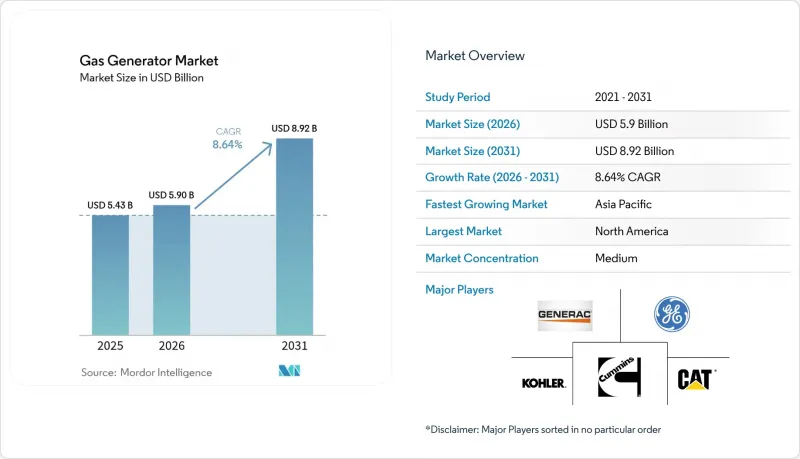
本報告額定功率(小於 75 kVA、75–375 kVA、375–750 kVA 和 750 kVA 及以上)、應用領域(備用電源、尖峰用電調節、主用/連續運行)、最終用戶(工業、商業、住宅)和地區(北美、歐洲、亞太、南美、中東和非洲)進行細分。市場規模和預測均以美元計價。
全球燃氣發電機市場趨勢與洞察
天然氣管道基礎設施的快速擴張
管道網路的擴張降低了燃料運輸成本,並提高了燃氣發電機組市場安裝地點的柔軟性。光是在美國,諸如山谷管道(Mountain Valley Pipeline)和二疊紀外輸管線(Permian Takeaway Line)等項目在2024年就新增了178億立方英尺/日(Bcf/d)的輸送能力,增強了分散式資產的供應穩定性。印度也出現了類似的趨勢,城市燃氣發行網路向服務不足地區的擴張預計到2030年將使國內需求增加60%。特別是對於75-375千伏安(kVA)級別的發電機組而言,穩定的燃料供應將有利於商業和輕工業負荷,並支持依賴可預測天然氣價格的尖峰用電調節計劃的經濟效益。持續的投資——計劃在二疊紀盆地新增73億立方英尺/日(Bcf/d)的運作能力——將鞏固成熟經濟體和新興經濟體燃氣發電機組市場的結構性利好因素。
與柴油發電機相比,運轉成本和排放量更低。
天然氣發電機利用全球燃料價格差異,並最大限度地減少換油、更換濾芯和後處理維護,從而顯著降低運行成本。與同類柴油發電機相比,營運商通常可以節省 20% 至 30% 的年度支出,而在徵收碳排放稅的地區,節省的成本甚至更高。加州第五階段非道路排放法規清楚地反映了這種監管趨勢的轉變。更嚴格的氮氧化物排放上限促使消費者轉向符合法規且無需尿素噴射或顆粒物過濾器的天然氣發電機。因此,其成本和排放優勢正在加速其在工業園區、購物中心和市政設施中的應用。在這些場所,生命週期成本和環境績效與初始購買價格同等重要。
偏遠地區天然氣供應網不足
將管道延伸至人口稀少地區仍然不經濟,這限制了依賴柴油或液化石油氣(LPG)的地區(例如礦山、農場或島嶼)採用燃氣發電機。 *Energies* 的一項全面調查顯示,偏遠地區的微電網負責人仍然傾向於使用可攜式燃料,因為在低負載率下,管道延伸所需的資本投資無法收回。在北極地區,可靠性面臨挑戰,現場燃料儲存比依賴管道更受歡迎。由於缺乏虛擬管道和小規模液化天然氣(LNG)物流系統,這些地區 75 kVA 以下和 75 至 375 kVA 型號的燃氣發電機普及率停滯不前。因此,燃氣發電機製造商需要提供液化石油氣套件或與其產品整合的混合太陽能/電池組件,才能在離網環境中保持競爭力。
細分市場分析
到2025年,75千伏安以下功率的燃氣發電機將佔燃氣發電機市場佔有率的47.10%,鞏固其在家庭和小規模企業中的主導地位,因為這些場所對負載相對較輕且安裝快速的需求至關重要。相較之下,75-375千伏安頻寬預計將以9.62%的複合年成長率成為所有功率等級中成長最快的,這主要得益於商業建築和輕工業廠房為應對近期電力中斷激增而加強的電力系統韌性。 375千伏安以上功率的燃氣發電機市場規模也在不斷擴大,因為資料中心和醫院專案開始採用兆瓦級機組作為標準配置,但即便如此,這些功率等級的總價值仍然不如入門級和中端市場。
製造商正透過模組化框架(便於並聯連接)和支援尖峰用電調節循環的數位控制器來強化其75-375 kVA的產品線。與柴油發電機相比,遠端監控可減少服務次數並降低生命週期成本。同時,75 kVA以下的型號在住宅建設項目中越來越受歡迎,這些項目通常會預先佈線以安裝永久備用電源設備,例如Generac與德克薩斯州建築商的合作項目。在所有額定功率範圍內,能夠相容於未來氫燃料的靈活燃料設計有助於延長資產使用壽命,以應對日益嚴格的脫碳目標。
區域分析
到2025年,北美將佔據全球燃氣發電機市場佔有率的35.05%。這主要得益於其擁有全球規模最大的管道網路之一,以及旨在逐步淘汰柴油引擎的政策。光是在美國,2024年每天就有178億立方英尺的新管道運作,確保墨西哥灣沿岸和阿巴拉契亞地區用戶用電設施的燃料供應充足。維吉尼亞和德克薩斯州的資料中心叢集正在使用兆瓦級燃氣發電機組,這些發電機組既可作為備用電源,又可用於尖峰用電調節;而超級市場和市政加油站則正在採用150千伏安至300千伏安的機組,以提高抵禦風暴的能力。加州強制要求空氣品質不達標的縣逐步淘汰柴油發電機,這項規定進一步刺激了對更清潔的火星點火式燃氣發電機的投資,鞏固了該地區的主導地位。
在亞太地區,管道建設、液化天然氣進口和工業現代化共同推動天然氣市場成長,預計2031年複合年成長率將達到9.31%,成為成長最快的地區。印度的天然氣需求預計到2030年將成長60%,城市燃氣供應網路向農村地區的擴展為375千伏安以下的燃氣裝置創造了廣泛的需求基礎。在中國,工廠自動化提高了電力品質標準,使得現場燃氣發電更具優勢,同時省級激勵計畫為高效汽電共生(CHP)機組提供高達20%的資本成本補貼。在日本和韓國,氫燃料相容引擎的示範測試正在進行中,但在再氫化成本下降之前,天然氣預計仍將繼續作為備用電源和電網支援應用的主要燃料。
在歐洲,儘管TTF價格飆升對燃料成本優勢構成壓力,但熱電聯產(CHP)技術仍在逐步擴張。德國和荷蘭的能源安全政策正在推動熱電聯產設施的維修,而符合都市區噪音限值(65 dB(A))的靜音外殼正在為人口稠密的都市區拓展商機。燃氣引擎和電池相結合的混合動力系統使設施能夠通過嚴格的併網測試,並滿足75-375 kVA和375-750 kVA兩個功率範圍內的需求。在南美洲、中東和非洲,由於新建的跨境管道和液化天然氣(LNG接收站,供應量正在擴大,訂單也在加速成長,但偏遠地區農村電網的不發達仍然限制了熱電聯產技術的應用。
其他好處:
- Excel格式的市場預測(ME)表
- 3個月的分析師支持
目錄
第1章:引言
- 研究假設和市場定義
- 調查範圍
第2章:調查方法
第3章執行摘要
第4章 市場狀況
- 市場概覽
- 市場促進因素
- 天然氣管道基礎設施的快速擴張
- 與柴油發電機相比,營運成本(OPEX)和排放量均降低。
- 資料中心和醫院對緊急電源的需求不斷成長。
- 極端天氣事件促使備用設備投入使用。
- 符合熱電聯產標準的小型燃氣發電機的成長
- 在空氣品質不符合標準的地區逐步淘汰柴油發電機。
- 市場限制因素
- 偏遠地區天然氣供應網不足
- 天然氣價格波動
- 與氫能和燃料電池解決方案的競爭
- 加強都市區的噪音和甲烷外洩管制
- 供應鏈分析
- 監理情勢
- 技術展望
- 波特五力模型
第5章 市場規模與成長預測
- 額定功率
- 小於75千伏安
- 75~375 kVA
- 375~750 kVA
- 750千伏安或以上
- 透過使用
- 支援
- 尖峰用電調節
- 主/連續
- 最終用戶
- 產業
- 商業的
- 住宅
- 按地區
- 北美洲
- 美國
- 加拿大
- 墨西哥
- 歐洲
- 德國
- 英國
- 法國
- 義大利
- 北歐國家
- 俄羅斯
- 其他歐洲國家
- 亞太地區
- 中國
- 印度
- 日本
- 韓國
- 東南亞國協
- 其他亞太國家
- 南美洲
- 巴西
- 阿根廷
- 其他南美國家
- 中東和非洲
- 沙烏地阿拉伯
- 阿拉伯聯合大公國
- 南非
- 埃及
- 其他中東和非洲國家
- 北美洲
第6章 競爭情勢
- 市場集中度
- 策略趨勢(併購、聯盟、購電協議)
- 市場佔有率分析(主要公司的市場排名和佔有率)
- 公司簡介
- Generac Holdings Inc.
- Caterpillar Inc.
- Cummins Inc.
- Kohler Co.
- Mitsubishi Heavy Industries Ltd.
- Atlas Copco AB
- AKSA Power Generation
- Doosan Portable Power
- Briggs & Stratton LLC
- Wacker Neuson SE
- Himoinsa(Sumitomo)
- Yanmar Holdings Co.
- FG Wilson(Caterpillar UK)
- MTU America Inc.
- Pramac Generator SpA
- Wartsila Corp.
- Honda Power Equipment
- Siemens Energy AG
第7章 市場機會與未來展望
According to Mordor Intelligence, gas generator market size in 2026 is estimated at USD 5.9 billion, growing from 2025 value of USD 5.43 billion with 2031 projections showing USD 8.92 billion, growing at 8.64% CAGR over 2026-2031.
This report is Segmented by Power Rating (Below 75 KVA, 75 To 375 KVA, 375 To 750 KVA, and Above 750 KVA), Application (Standby, Peak Shaving, and Prime/Continuous), End-User (Industrial, Commercial, and Residential), and Geography (North America, Europe, Asia-Pacific, South America, and Middle East and Africa). The Market Sizes and Forecasts are Provided in Terms of Value (USD).
Global Gas Generator Market Trends and Insights
Rapid Expansion of Natural-Gas Pipeline Infrastructure
Widening pipeline networks cuts delivered fuel costs and expands siting flexibility for the gas generator market. The United States alone added 17.8 Bcf/d of new capacity in 2024 through projects such as Mountain Valley Pipeline and Permian takeaway lines, reinforcing supply security for distributed assets. India mirrors this trend as city-gas distribution grids expand to underserved districts, supporting a 60% rise in national demand by 2030. Consistent fuel availability, particularly for the 75-375 kVA class, benefits commercial and light-industrial loads, while also underpinning the economics of peak-shaving schemes that rely on predictable gas pricing. Continued investment-another 7.3 Bcf/d set to enter service from the Permian Basin-locks in a structural tailwind for the gas generator market across both mature and emerging economies.
Lower OPEX & Emissions Versus Diesel Gensets
Natural-gas units slash running costs by capitalizing on the global fuel-price gap and by minimizing oil changes, filter swaps, and after-treatment upkeep. Operators typically realize a 20-30% lower annual expenditure compared to comparable diesel sets, a saving that is amplified wherever carbon fees apply. California's Tier 5 off-road rules illustrate the regulatory swing: tougher NOx ceilings push buyers toward gas models that comply without urea injection or particulate filters. The cost-emissions advantage therefore accelerates adoption in industrial parks, shopping malls, and municipal facilities-settings where life-cycle economics and environmental scorecards now matter as much as initial purchase price.
Sparse Gas-Grid Access in Remote Areas
Extending pipelines to low-density territories remains uneconomical, limiting gas generator penetration in areas where mines, farms, or islands rely on diesel or LPG. A comprehensive Energies review shows that remote microgrid planners still prefer transportable fuels because the capital expenditure for pipe extensions cannot be recouped at modest load factors. Arctic operations face reliability challenges that favor on-site fuel storage over reliance on pipelines. Without virtual-pipeline or small-scale LNG logistics, adoption of below-75 kVA and 75-375 kVA stalls in these regions. Consequently, gas-set suppliers must pair offerings with LPG kits or hybrid PV-battery packages to stay relevant off-grid.
Other drivers and restraints analyzed in the detailed report include:
- Backup-Power Boom in Data-Centers & Hospitals
- Extreme-Weather Events Driving Standby Installations
- Volatile Natural-Gas Pricing
For complete list of drivers and restraints, kindly check the Table Of Contents.
Segment Analysis
The <75 kVA class claimed 47.10% of the gas generator market share in 2025, confirming its dominance in homes and small businesses, where modest loads and quick installation are most important. In contrast, the 75-375 kVA band is projected to post a 9.62% CAGR, the fastest pace among all ratings, as commercial buildings and light-industrial plants enhance resilience after recent outage spikes. The gas generator market size for units above 375 kVA is expanding as data center and hospital projects specify multi-megawatt blocks; however, those tiers together still trail the entry and mid-range segments in total value.
Manufacturers strengthen the 75-375 kVA offering through modular frames that parallel easily and through digital controllers that support peak-shaving cycles. Remote monitoring reduces service visits, improving lifetime economics compared to diesel sets. Meanwhile, models below 75 kVA are gaining traction in new-home construction programs that pre-wire for permanent backup, such as Generac's partnership with Texas builders. Across all ratings, fuel-flexible designs that can accept future hydrogen blends help protect asset life as decarbonization targets become tighter.
Complete Report Scope:
- By Power Rating
- Below 75 kVA
- 75 to 375 kVA
- 375 to 750 kVA
- Above 750 kVA
- By Application
- Standby
- Peak Shaving
- Prime/Continuous
- By End-User
- Industrial
- Commercial
- Residential
- By Geography
- North America
- United States
- Canada
- Mexico
- Europe
- Germany
- United Kingdom
- France
- Italy
- NORDIC Countries
- Russia
- Rest of Europe
- Asia Pacific
- China
- India
- Japan
- South Korea
- ASEAN Countries
- Rest of Asia-Pacific
- South America
- Brazil
- Argentina
- Rest of South America
- Middle East and Africa
- Saudi Arabia
- United Arab Emirates
- South Africa
- Egypt
- Rest of Middle East and Africa
- North America
Geography Analysis
North America accounted for 35.05% of the gas generator market share in 2025, driven by the world's largest pipeline grid and a policy shift away from diesel engines. The United States alone placed 17.8 Bcf per day of new pipe in service during 2024, ensuring ample fuel for behind-the-meter assets across the Gulf Coast and Appalachia. Data-center clusters in Virginia and Texas utilize multi-megawatt gas blocks that serve both standby and peak-shaving roles, while supermarkets and municipal pumps employ 150 kVA to 300 kVA frames for storm resilience. California regulations that phase out diesel gensets in non-attainment counties further channel spending toward cleaner spark-ignition models, cementing regional leadership.
The Asia Pacific is projected to post the fastest 9.31% CAGR through 2031, as pipeline build-out, LNG imports, and industrial modernization converge. India's natural-gas demand is set to climb 60% by 2030, and city-gas distribution schemes now reach secondary towns, unlocking a broad base for <375 kVA equipment. In China, factory automation drives tighter power-quality specs that favor on-site gas generation, while provincial incentive programs reimburse up to 20% of capital cost for high-efficiency CHP units. Japan and South Korea pair pilot hydrogen-ready engines, yet natural gas remains the primary fuel for backup and grid-support duties until the costs of reen hydrogen call.
Europe maintains gradual expansion despite high TTF prices that squeeze fuel-cost advantages. Energy-security policies in Germany and the Netherlands are driving combined heat and power retrofits, while silent enclosures that meet 65 dB(A) city limits open up opportunities in densely populated urban districts. Hybrid systems that combine gas engines with battery storage enable facilities to pass stringent grid-interconnection tests, sustaining demand in both the 75-375 kVA and 375-750 kVA ranges. South America and the Middle East & Africa register accelerating orders as new cross-border pipelines and LNG terminals unlock supply, though sparse rural grids still cap penetration in remote provinces.
- Generac Holdings Inc.
- Caterpillar Inc.
- Cummins Inc.
- Kohler Co.
- Mitsubishi Heavy Industries Ltd.
- Atlas Copco AB
- AKSA Power Generation
- Doosan Portable Power
- Briggs & Stratton LLC
- Wacker Neuson SE
- Himoinsa (Sumitomo)
- Yanmar Holdings Co.
- FG Wilson (Caterpillar UK)
- MTU America Inc.
- Pramac Generator S.p.A.
- Wartsila Corp.
- Honda Power Equipment
- Siemens Energy AG
Additional Benefits:
- The market estimate (ME) sheet in Excel format
- 3 months of analyst support
TABLE OF CONTENTS
1 Introduction
- 1.1 Study Assumptions & Market Definition
- 1.2 Scope of the Study
2 Research Methodology
3 Executive Summary
4 Market Landscape
- 4.1 Market Overview
- 4.2 Market Drivers
- 4.2.1 Rapid expansion of natural-gas pipeline infrastructure
- 4.2.2 Lower OPEX & emissions versus diesel gensets
- 4.2.3 Backup-power boom in data-centers & hospitals
- 4.2.4 Extreme-weather events driving standby installations
- 4.2.5 Growth of CHP-ready micro-gas generators
- 4.2.6 Diesel-genset phase-outs in air-quality non-attainment zones
- 4.3 Market Restraints
- 4.3.1 Sparse gas-grid access in remote areas
- 4.3.2 Volatile natural-gas pricing
- 4.3.3 Competition from hydrogen & fuel-cell solutions
- 4.3.4 Tightening urban noise & methane-slip rules
- 4.4 Supply-Chain Analysis
- 4.5 Regulatory Landscape
- 4.6 Technological Outlook
- 4.7 Porters Five Forces
- 4.7.1 Bargaining Power of Suppliers
- 4.7.2 Bargaining Power of Buyers
- 4.7.3 Threat of New Entrants
- 4.7.4 Threat of Substitute Products
- 4.7.5 Intensity of Competitive Rivalry
5 Market Size & Growth Forecasts
- 5.1 By Power Rating
- 5.1.1 Below 75 kVA
- 5.1.2 75 to 375 kVA
- 5.1.3 375 to 750 kVA
- 5.1.4 Above 750 kVA
- 5.2 By Application
- 5.2.1 Standby
- 5.2.2 Peak Shaving
- 5.2.3 Prime/Continuous
- 5.3 By End-User
- 5.3.1 Industrial
- 5.3.2 Commercial
- 5.3.3 Residential
- 5.4 By Geography
- 5.4.1 North America
- 5.4.1.1 United States
- 5.4.1.2 Canada
- 5.4.1.3 Mexico
- 5.4.2 Europe
- 5.4.2.1 Germany
- 5.4.2.2 United Kingdom
- 5.4.2.3 France
- 5.4.2.4 Italy
- 5.4.2.5 NORDIC Countries
- 5.4.2.6 Russia
- 5.4.2.7 Rest of Europe
- 5.4.3 Asia Pacific
- 5.4.3.1 China
- 5.4.3.2 India
- 5.4.3.3 Japan
- 5.4.3.4 South Korea
- 5.4.3.5 ASEAN Countries
- 5.4.3.6 Rest of Asia-Pacific
- 5.4.4 South America
- 5.4.4.1 Brazil
- 5.4.4.2 Argentina
- 5.4.4.3 Rest of South America
- 5.4.5 Middle East and Africa
- 5.4.5.1 Saudi Arabia
- 5.4.5.2 United Arab Emirates
- 5.4.5.3 South Africa
- 5.4.5.4 Egypt
- 5.4.5.5 Rest of Middle East and Africa
- 5.4.1 North America
6 Competitive Landscape
- 6.1 Market Concentration
- 6.2 Strategic Moves (M&A, Partnerships, PPAs)
- 6.3 Market Share Analysis (Market Rank/Share for key companies)
- 6.4 Company Profiles (includes Global level Overview, Market level overview, Core Segments, Financials as available, Strategic Information, Products & Services, and Recent Developments)
- 6.4.1 Generac Holdings Inc.
- 6.4.2 Caterpillar Inc.
- 6.4.3 Cummins Inc.
- 6.4.4 Kohler Co.
- 6.4.5 Mitsubishi Heavy Industries Ltd.
- 6.4.6 Atlas Copco AB
- 6.4.7 AKSA Power Generation
- 6.4.8 Doosan Portable Power
- 6.4.9 Briggs & Stratton LLC
- 6.4.10 Wacker Neuson SE
- 6.4.11 Himoinsa (Sumitomo)
- 6.4.12 Yanmar Holdings Co.
- 6.4.13 FG Wilson (Caterpillar UK)
- 6.4.14 MTU America Inc.
- 6.4.15 Pramac Generator S.p.A.
- 6.4.16 Wartsila Corp.
- 6.4.17 Honda Power Equipment
- 6.4.18 Siemens Energy AG
7 Market Opportunities & Future Outlook
- 7.1 White-space & Unmet-Need Assessment

 燃氣發電機市場-2026-2032年全球市場預測
 氮氣充裝系統市場規模、佔有率和成長分析:按系統類型、技術、組件、應用、終端用戶產業、行動旅行和地區分類-2026-2033年產業預測
 燃氣發電機組市場:市場機會、成長促進因素、產業趨勢分析及未來預測(2026-2035)
 惰性氣體發生器系統市場報告:趨勢、預測和競爭分析(至2035年)
 工業氣體發生器市場分析:按類型、最終用途和地區分類(2026-2034 年)
 全球燃氣壁爐市場規模、佔有率、趨勢和成長分析報告(2026-2034年)工業氣體發生器市場:2026-2032年全球市場預測(按燃料類型、輸出功率、安裝類型、冷卻系統、應用和最終用戶產業分類)惰性氣體發生器市場:按類型、應用和最終用戶分類-2026年至2032年全球市場預測燃氣發電系統市場:2026-2032年全球市場預測(依燃料類型、系統、額定輸出功率、安裝類型和應用分類)全球木材燃氣發電機市場規模、佔有率、趨勢和成長分析報告(2026-2034年)