


 |
市場調查報告書
商品編碼
2122380
去氧劑:市場佔有率分析、行業趨勢和統計數據、成長預測(2026-2031 年)Oxygen Scavengers - Market Share Analysis, Industry Trends & Statistics, Growth Forecasts (2026 - 2031) |
||||||

※ 本網頁內容可能與最新版本有所差異。詳細情況請與我們聯繫。
根據 Mordor Intelligence 預測,去氧劑市場規模將從 2025 年的 32.9 億美元成長到 2026 年的 34.4 億美元,到 2031 年將達到 42.9 億美元,2026 年至 2031 年的複合年成長率為 4.55%。
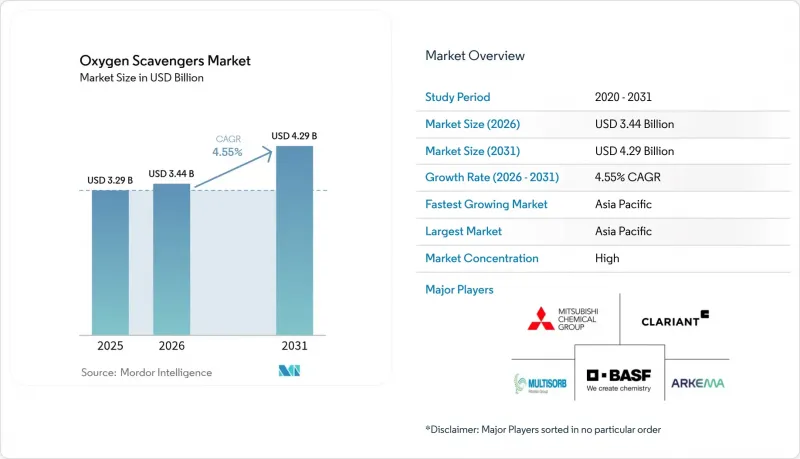
本報告按類型(金屬去氧劑、非金屬去氧劑)、終端用戶產業(食品飲料、製藥、石油天然氣、電力等)和地區(亞太地區、北美地區、南美地區、歐洲地區、中東和非洲地區)對產業進行分類。市場預測以美元計價。
全球去氧劑市場趨勢及洞察
生鮮食品、調理食品和冷藏加工食品的快速成長
隨著消費者飲食習慣轉向速食,主動式氧氣管理技術在肉類、魚貝類和熟食等領域的應用日益廣泛。品牌商正將小袋吸氧層融入熱成型托盤中,以確保產品在長期冷藏保管和零售展示過程中保持顏色穩定。區域超級市場認為,減少廢棄物和提高產品展示的柔軟性是關鍵優勢,委託製造製造商指定使用能夠在低溫下快速啟動的解決方案。因此,設備供應商正在改進高速托盤封口生產線,以適應預先填充吸氧樹脂的多層薄膜,同時確保封口強度不受影響。這一趨勢正推動美國和德國的薄膜擠出製造商訂單持續成長,從而支撐去氧劑市場的基本面成長。
更嚴格的藥典標準,要求藥品包裝中不得含有殘留氧氣。
美國藥典 (USP) 和歐洲藥品管理局 (EMA) 的最新指南規定了注射劑和固態劑包裝中殘留氧氣的上限,要求製藥企業檢驗其阻隔系統,確保在規定的保存期限內氧氣濃度始終低於 0.5%。聚合物基氧氣清除劑,例如 Colorcon 的 PharmaKeep 系列產品,可在 10% 至 90% 的相對濕度範圍內發揮作用,既能解決藥品對水分的敏感性問題,又能避免金屬離子帶來的風險。歐洲的法規也遵循類似的趨勢,修訂後的歐盟食品接觸材料法規將於 2025 年 3 月生效,其中對藥品包裝材料的純度和遷移限量提出了更嚴格的要求。合約開發組織 (CDO) 正在將此類添加劑直接添加到聚烯泡殼包裝中,與使用獨立包裝袋相比,這簡化了生產線的合格。這些進展對於生物製藥尤其重要,因為即使是微量的氧氣也會加速蛋白質分解;此外,對於對水分敏感的小分子藥物而言,這些進展也至關重要,因為它們需要數年的穩定性數據。
對金屬離子污染和感官污染的擔憂
鐵基袋會釋放微量離子,這些離子會加速敏感膳食補充劑中的氧化反應,或使高檔茶和咖啡產生金屬異味。監管機構現在要求在最惡劣的濕度條件下進行浸出測試,一些品牌所有者正著手在高價值產品中徹底淘汰鐵基系統。聚合物封裝降低了直接接觸的風險,但會增加原料消耗,使中小型製造商難以承擔。這種權衡導致傳統包裝袋在醫藥和特色食品通路的短期推廣速度放緩,並抑制了部分去氧劑市場的發展。
細分市場分析
金屬配方憑藉其成熟的供應鏈、快速的吸收動力學和低廉的單位成本,在2025年仍將佔據去氧劑市場57.12%的佔有率。該領域的規模經濟效應促成了與全球肉類加工商和零食製造商的大規模契約,從而構成了入門級應用去氧劑市場規模的基礎。然而,非金屬體係正以7.99%的複合年成長率成長,是所有材料類別中成長最快的。聚合物添加劑產品無需在生產線末端使用小袋,從而縮短了高速填充和封口生產線的換線時間。酵素和抗壞血酸配方進一步拓展了清真、猶太潔食和潔淨標示品牌的選擇範圍,這些品牌限制使用金屬添加劑。在藥品審計中,由於聚合物材料與濕度控制倉庫的兼容性,它們正受到越來越多的關注,這促使泡殼薄膜擠出機採用“Amosorb”和“PharmaKeep”濃縮液。奈米複合催化劑的持續研發表明,尤其當其單價能夠與主流休閒食品的價格相媲美時,非金屬催化劑可能從2031年起逐步削弱鐵基材料的主導地位。這些趨勢共同作用,進一步豐富了去氧劑市場的材料種類。
第二代化學技術也符合回收義務。這是因為它們將吸收功能整合到單一材料的PET或PP結構中,而非複合薄膜中,這種方法符合歐盟法規2025/40規定的循環經濟目標。樹脂供應商正在展示瓶到瓶的可回收性,同時最大限度地減少霧度增加,從而滿足飲料品牌到2030年使用30%再生材料的承諾。同時,金屬小袋製造商正在透過最佳化粉末粒徑和添加吸濕緩衝劑來減緩海運過程中過早活化。因此,各材料平台之間的競爭集中在活化控制、單位經濟性和下游可回收性之間的平衡,而這種競爭將影響去氧劑市場中加工商和全球消費品買家的採購決策。
區域分析
預計到2025年,亞太地區將佔全球需求的37.62%,並在2031年之前保持7.21%的複合年成長率,這主要得益於中國醫藥出口基地的擴張以及印度軟性薄膜加工行業產能的快速成長。該地區各國政府持續津貼冷鏈物流,並制定了減少食物廢棄物的國家目標,加速了主動式阻隔解決方案的普及。該地區受益於成熟的原料供應鏈以及食品加工業不斷成長的需求,這些需求既供應國內市場也供應出口市場。三菱瓦斯化學透過其子公司,例如日本的MGC AGELESS和泰國的AGLESS,在該地區擁有強大的業務基礎,這凸顯了該地區完善的去氧劑生產和分銷基礎設施。
北美是去氧劑成熟且技術先進的市場。美國食品藥物管理局 (FDA) 的嚴格監管要求進行全面的遷移測試,從而推動了對完整記錄的聚合物配方的需求。品牌所有者優先考慮符合各州生產者延伸責任制 (EPR) 法規規定的機械回收目標的解決方案。加拿大肉類加工商在處理出口到亞洲的貨物時,指定使用大容量小袋和自動分配器,支撐了穩定的替換需求。在墨西哥,快速成長的速食食品產業進一步推動了區域成長,但成本壓力促使人們傾向於採用被動和主動阻隔相結合的解決方案。
歐洲與北美在監管方面存在相似之處,但其日益成長的循環經濟目標使其面臨更多挑戰。歐盟第2025/40號法規規定,到2030年所有包裝材料必須可回收利用,並鼓勵投資於具備吸氧功能的單一材料結構。法國和德國的主要飲料集團正在試行使用含有非金屬添加劑的寶特瓶,將氧氣防護與押金返還機制結合。東歐的薄膜擠出企業擴大從西歐供應商進口聚合物濃縮物,從而彌合技術差距並擴大應用範圍。中東、非洲和南美洲的絕對銷售量雖然落後於其他地區,但隨著現代食品零售業態的擴張,這些地區對吸氧劑的興趣日益濃厚。在全部區域,由開發銀行資助的示範計畫正在證明主動氧氣管理在減少食品劣化的有效性,這表明去氧劑市場在中期內將持續成長。
其他好處:
- Excel格式的市場預測(ME)表
- 3個月的分析師支持
目錄
第1章:引言
- 市場分析與定義的前提條件
- 分析範圍
第2章 分析方法
第3章執行摘要
第4章 市場狀況
- 市場概覽
- 市場促進因素
- 生鮮食品、調理食品和冷藏加工食品的快速成長
- 更嚴格的藥典標準,要求藥品包裝中不得含有殘留氧氣。
- 無菌冷鏈食材自煮包物流的擴展
- 奈米複合聚合物清除劑的商業化
- 電子商務對更長運輸和倉儲期限的需求
- 市場限制因素
- 對金屬離子污染和感官污染的擔憂。
- 一種性價比高、進入門檻高的薄膜替代方案。
- 鐵礦石和特殊催化劑價格劇烈波動
- 價值鏈分析
- 波特五力分析
第5章:預測市場規模與成長率
- 按類型
- 金屬基去氧劑
- 非金屬去氧劑
- 按最終用戶行業分類
- 食品/飲料
- 製藥
- 石油和天然氣
- 電力
- 化學品
- 紙漿和造紙
- 其他終端用戶產業(供水和污水處理等)
- 按地區
- 亞太地區
- 中國
- 印度
- 日本
- 韓國
- 泰國
- 印尼
- 越南
- 馬來西亞
- 菲律賓
- 其他亞太國家
- 北美洲
- 美國
- 加拿大
- 墨西哥
- 歐洲
- 德國
- 英國
- 法國
- 義大利
- 西班牙
- 俄羅斯
- 北歐國家
- 土耳其
- 其他歐洲國家
- 南美洲
- 巴西
- 阿根廷
- 哥倫比亞
- 其他南美國家
- 中東和非洲
- 沙烏地阿拉伯
- 阿拉伯聯合大公國
- 卡達
- 南非
- 奈及利亞
- 埃及
- 其他中東和非洲國家
- 亞太地區
第6章 競爭情勢
- 市場集中度
- 策略趨勢
- 市佔率和排名分析
- 公司簡介
- Accepta Water Treatment
- Arkema
- Avient Corporation
- BASF
- Clariant
- Desiccare Inc.
- Ecolab
- MITSUBISHI GAS CHEMICAL COMPANY, INC.
- Multisorb
- Solenis
- Veolia
第7章 市場機會與未來展望
According to Mordor Intelligence, the oxygen scavengers market size is expected to grow from USD 3.29 billion in 2025 to USD 3.44 billion in 2026 and is forecast to reach USD 4.29 billion by 2031 at 4.55% CAGR over 2026-2031.
This report Segments the Industry by Type (Metallic Oxygen Scavengers and Non-Metallic Oxygen Scavengers), End-User Industry (Food and Beverage, Pharmaceutical, Oil and Gas, Power and More), and Geography (Asia-Pacific, North America, South America, Europe, and Middle East and Africa). The Market Forecasts are Provided in Terms of Value (USD).
Global Oxygen Scavengers Market Trends and Insights
Rapid Growth in Fresh-Ready & Chilled Packaged Meals
Shifts in consumer habits toward convenience foods have widened deployment of active oxygen management across meat, seafood and deli categories. Brand owners integrate sachet-free scavenging layers into thermoformed trays so products remain color-stable throughout extended chilled storage and retail display. Regional supermarket chains cite reduced waste and improved merchandising flexibility as key benefits, prompting co-packers to specify solutions that activate rapidly at low temperatures. Equipment suppliers are therefore adapting high-speed tray-sealing lines to accommodate multilayer films pre-loaded with scavenging resins that do not compromise seal integrity. This adoption dynamic feeds a steady order pipeline for film extruders located in the United States and Germany, reinforcing baseline growth for the oxygen scavengers market.
Stricter Pharmacopeia Limits on Residual Oxygen in Drug Packs
The latest USP and EMA guidelines cap residual oxygen in parenteral and solid-dose packs, urging drug makers to validate barrier systems that sustain <=0.5% oxygen throughout the stated shelf life. Polymer-based scavengers such as Colorcon's PharmaKeep series can function across 10-90% relative humidity, addressing drug-product moisture sensitivity while avoiding metal-ion risks. the European regulations are following similar trajectories, with the EU's revised food contact material regulations effective March 2025 introducing enhanced purity requirements and migration limits that affect pharmaceutical packaging materials .Contract development organizations embed such additives directly into polyolefin blisters, which simplifies line qualification versus separate sachets. These advances are most visible in biologics, where trace oxygen can catalyze protein degradation, and in moisture-reactive small-molecule therapies that require multi-year stability data.
Metal-Ion Contamination & Sensory-Taint Concerns
Iron-based sachets release trace ions that can catalyze oxidative reactions in sensitive nutraceuticals and lead to metallic off-notes in premium teas and coffees. Regulatory auditors now require migration testing under worst-case humidity, prompting some brand owners to exclude ferrous systems entirely for high-value SKUs. Polymer encapsulation methods lower direct contact risk, yet they raise raw-material costs that smaller manufacturers struggle to absorb. This trade-off tempers near-term penetration of traditional sachets in pharmaceutical and specialty-food channels, restraining a portion of the oxygen scavengers market.
Other drivers and restraints analyzed in the detailed report include:
- Expansion of Aseptic Cold-Chain Meal-Kit Logistics
- Commercialization of Nanocomposite Polymer Scavengers
- Cost-Effective and High-Barrier Film Substitutes
For complete list of drivers and restraints, kindly check the Table Of Contents.
Segment Analysis
Metallic formulations retained 57.12% oxygen scavengers market share in 2025 thanks to established supply chains, rapid absorption kinetics and low unit cost. The segment's scale advantage translates into volume contracts with global meat processors and snack producers, anchoring the oxygen scavengers market size for entry-level applications. However, non-metallic systems are growing at an 7.99% CAGR, the fastest among all material groups. Polymer-integrated variants eliminate the need for end-of-line sachet insertion, which shortens changeover time on high-speed fill-and-seal lines. Enzyme and ascorbic-acid formulations further widen options for halal, kosher and clean-label brands that restrict metallic additives. Pharmaceutical audits increasingly cite polymer systems' compatibility with humidity-controlled warehouses, encouraging blister-film extruders to adopt Amosorb and PharmaKeep concentrates. Continuous R-&D around nanocomposite catalysts suggests non-metallic solutions could erode iron's lead beyond 2031, especially if unit prices align with mainstream snack food budgets. Collectively, these dynamics reinforce material-segment diversity within the oxygen scavengers market.
Second-generation chemistries also align with recycling mandates because they embed scavenging capacity in mono-material PET or PP structures rather than laminated foil, an approach that supports circular-economy targets under EU Regulation 2025/40. Resin suppliers have demonstrated bottle-to-bottle recyclability with minimal haze increase, satisfying beverage-brand commitments to 30% recycled content by 2030. Meanwhile, metallic sachet makers counter by optimizing powder particle size and adding moisture-absorbing buffers that delay premature activation during ocean transit. Competition across material platforms therefore centers on balancing activation control, unit economics and downstream recycling performance, a contest that will shape procurement decisions for both converters and global CPG buyers in the oxygen scavengers market.
Complete Report Scope:
- By Type
- Metallic Oxygen Scavengers
- Non-metallic Oxygen Scavengers
- By End-user Industry
- Food and Beverage
- Pharmaceutical
- Oil and Gas
- Power
- Chemical
- Pulp and Paper
- Other End-user Industries (Water and Waste-Water Treatment, etc.)
- By Geography
- Asia-Pacific
- China
- India
- Japan
- South Korea
- Thailand
- Indonesia
- Vietnam
- Malaysia
- Philippines
- Rest of Asia-Pacific
- North America
- United States
- Canada
- Mexico
- Europe
- Germany
- United Kingdom
- France
- Italy
- Spain
- Russia
- NORDIC Countries
- Turkey
- Rest of Europe
- South America
- Brazil
- Argentina
- Colombia
- Rest of South America
- Middle East and Africa
- Saudi Arabia
- United Arab Emirates
- Qatar
- South Africa
- Nigeria
- Egypt
- Rest of Middle East and Africa
- Asia-Pacific
Geography Analysis
Asia-Pacific accounted for 37.62% of 2025 demand and is projected to deliver a 7.21% CAGR to 2031, underpinned by China's expanding pharmaceutical export base and India's rapid capacity additions in flexible-film conversion. Governments across the region continue to subsidize cold-chain logistics and set national targets for food-waste reduction, stimulating adoption of active barrier solutions. The region benefits from established supply chains for raw materials and growing demand from food processing industries that serve both domestic and export markets. Mitsubishi Gas Chemical's strong presence in the region through subsidiaries like MGC AGELESS Co., Ltd. in Japan and AGLESS (THAILAND) CO., LTD. demonstrates the established infrastructure supporting oxygen scavenger production and distribution.
North America represents a mature but technically advanced arena for the oxygen scavengers market. Stringent FDA oversight mandates exhaustive migration testing and drives demand for fully documented polymer formulations. Brand owners prioritize solutions compatible with mechanical recycling targets under state-level extended producer responsibility rules. Canadian meat processors, dealing with export voyages toward Asia, specify high-capacity sachets and automated insertion equipment, sustaining steady replacement demand. Mexico's rising convenience-food sector further supports regional growth, although cost pressures favour a mix of passive and active barriers.
Europe mirrors North American regulatory drivers but layers additional circular-economy ambitions. EU Regulation 2025/40 will require all packaging to be recyclable by 2030, spurring investments in mono-material structures with embedded scavenging capability. Large beverage groups in France and Germany pilot PET bottle preforms containing non-metallic additives, aligning oxygen protection with deposit-return systems. Eastern European film extruders increasingly import polymer concentrates from Western suppliers, bridging technology gaps and spreading adoption. The Middle East & Africa and South America trail in absolute volume yet show accelerating interest as modern grocery retail formats expand. Across these emerging regions, demonstration projects funded by development banks illustrate the spoilage-reduction benefits of active oxygen management, pointing toward steady medium-term demand inflows for the oxygen scavengers market.
- Accepta Water Treatment
- Arkema
- Avient Corporation
- BASF
- Clariant
- Desiccare Inc.
- Ecolab
- MITSUBISHI GAS CHEMICAL COMPANY, INC.
- Multisorb
- Solenis
- Veolia
Additional Benefits:
- The market estimate (ME) sheet in Excel format
- 3 months of analyst support
TABLE OF CONTENTS
1 Introduction
- 1.1 Study Assumptions & Market Definition
- 1.2 Scope of the Study
2 Research Methodology
3 Executive Summary
4 Market Landscape
- 4.1 Market Overview
- 4.2 Market Drivers
- 4.2.1 Rapid Growth in Fresh-Ready and Chilled Packaged Meals
- 4.2.2 Stricter Pharmacopeia Limits on Residual Oxygen in Drug Packs
- 4.2.3 Expansion of Aseptic Cold-Chain Mealkit Logistics
- 4.2.4 Commercialisation of Nanocomposite Polymer Scavengers
- 4.2.5 E-commerce Demand for Longer Transit Shelf-Life
- 4.3 Market Restraints
- 4.3.1 Metal-Ion Contamination & Sensory-Taint Concerns
- 4.3.2 Cost-Fffective and High-Barrier Film Substitutes
- 4.3.3 Volatile Iron-Ore and Specialty Catalyst Price Swings
- 4.4 Value Chain Analysis
- 4.5 Porter's Five Forces
- 4.5.1 Bargaining Power of Suppliers
- 4.5.2 Bargaining Power of Buyers
- 4.5.3 Threat of New Entrants
- 4.5.4 Threat of Substitutes
- 4.5.5 Degree of Competition
5 Market Size & Growth Forecasts (Value)
- 5.1 By Type
- 5.1.1 Metallic Oxygen Scavengers
- 5.1.2 Non-metallic Oxygen Scavengers
- 5.2 By End-user Industry
- 5.2.1 Food and Beverage
- 5.2.2 Pharmaceutical
- 5.2.3 Oil and Gas
- 5.2.4 Power
- 5.2.5 Chemical
- 5.2.6 Pulp and Paper
- 5.2.7 Other End-user Industries (Water and Waste-Water Treatment, etc.)
- 5.3 By Geography
- 5.3.1 Asia-Pacific
- 5.3.1.1 China
- 5.3.1.2 India
- 5.3.1.3 Japan
- 5.3.1.4 South Korea
- 5.3.1.5 Thailand
- 5.3.1.6 Indonesia
- 5.3.1.7 Vietnam
- 5.3.1.8 Malaysia
- 5.3.1.9 Philippines
- 5.3.1.10 Rest of Asia-Pacific
- 5.3.2 North America
- 5.3.2.1 United States
- 5.3.2.2 Canada
- 5.3.2.3 Mexico
- 5.3.3 Europe
- 5.3.3.1 Germany
- 5.3.3.2 United Kingdom
- 5.3.3.3 France
- 5.3.3.4 Italy
- 5.3.3.5 Spain
- 5.3.3.6 Russia
- 5.3.3.7 NORDIC Countries
- 5.3.3.8 Turkey
- 5.3.3.9 Rest of Europe
- 5.3.4 South America
- 5.3.4.1 Brazil
- 5.3.4.2 Argentina
- 5.3.4.3 Colombia
- 5.3.4.4 Rest of South America
- 5.3.5 Middle East and Africa
- 5.3.5.1 Saudi Arabia
- 5.3.5.2 United Arab Emirates
- 5.3.5.3 Qatar
- 5.3.5.4 South Africa
- 5.3.5.5 Nigeria
- 5.3.5.6 Egypt
- 5.3.5.7 Rest of Middle East and Africa
- 5.3.1 Asia-Pacific
6 Competitive Landscape
- 6.1 Market Concentration
- 6.2 Strategic Moves
- 6.3 Market Share (%)/Ranking Analysis
- 6.4 Company Profiles (includes Global level Overview, Market level overview, Core Segments, Financials as available, Strategic Information, Market Rank/Share for key companies, Products & Services, and Recent Developments)
- 6.4.1 Accepta Water Treatment
- 6.4.2 Arkema
- 6.4.3 Avient Corporation
- 6.4.4 BASF
- 6.4.5 Clariant
- 6.4.6 Desiccare Inc.
- 6.4.7 Ecolab
- 6.4.8 MITSUBISHI GAS CHEMICAL COMPANY, INC.
- 6.4.9 Multisorb
- 6.4.10 Solenis
- 6.4.11 Veolia
7 Market Opportunities & Future Outlook
- 7.1 White-space & unmet-need assessment

 氧氣吸收劑和乾燥劑市場預測至2034年—按產品類型、材料類型、包裝、分銷管道、最終用戶和地區分類的全球分析
 除氧劑市場:按類型、形式、最終用途產業和地區分類-全球市場預測至2031年
 氧氣清除劑市場-2026-2032年全球市場預測氧氣吸收劑包裝市場預測至2034年—按類型、形式、整合方法、材料、應用、最終用戶和地區分類的全球分析脫氧劑市場:依產品類型、等級、應用、最終用途產業和通路分類-全球預測,2026-2032年
 2026年全球氧氣吸收劑市場報告
 除氧劑市場規模、佔有率和趨勢分析報告:按產品、應用、地區和細分市場預測,2026-2033年
 去氧劑市場-2026-2031年預測
 氧氣清除劑市場規模、佔有率和成長分析(按類型、配方、劑型、最終用戶和地區分類)—2026-2033年產業預測
 鋁脫氧劑市場報告:趨勢、預測和競爭分析(至 2031 年)