


 |
市場調查報告書
商品編碼
2122379
鉑族金屬:市場佔有率分析、產業趨勢與統計、成長預測(2026-2031)Platinum Group Metals - Market Share Analysis, Industry Trends & Statistics, Growth Forecasts (2026 - 2031) |
||||||

※ 本網頁內容可能與最新版本有所差異。詳細情況請與我們聯繫。
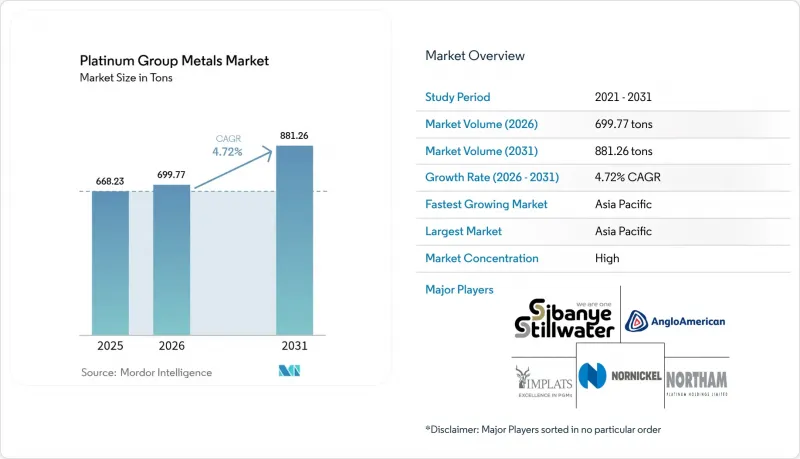
據 Mordor Intelligence 稱,2025 年鉑族金屬市場價值為 668.23 噸,預計到 2031 年將從 2026 年的 699.77 噸成長至 881.26 噸,預測期(2026-2031 年)複合年成長率為 4.72%。
本報告按金屬類型(鉑、鈀、銠等)、應用領域(汽車催化劑、電氣和電子設備等)、來源(原生(採礦)、回收/再生)、終端用戶行業(汽車、工業化學品等)以及地區(亞太地區、北美地區、歐洲地區、南美地區、中東和非洲)進行細分。市場預測以噸為單位。
全球鉑族金屬市場趨勢與洞察
新興市場對內燃機汽車催化劑的需求激增。
2024年,印度將生產420萬輛乘用車。根據BS-VI第二階段排放標準,為符合嚴格的氮氧化物排放上限,每輛車的鉑族金屬使用量將增加60%以上。泰國、印尼和越南2024年將合計組裝約400萬輛汽車。巴西的靈活燃料汽車將配備富銠催化劑,以承受更高的燃燒溫度。墨西哥生產的350萬輛汽車將出口到美國,這些汽車需遵守Tier 3 Bin 70排放標準,該標準鼓勵提高金屬含量。國際清潔交通委員會(ICCT)預測,2026年至2031年,新興市場輕型汽車銷售將增加1,200萬輛,並預測在價格敏感型細分市場,內燃機仍將佔據70%以上的市場。
在氫能樞紐開發PEM型電解槽
預計到2028年,與氫氣相關的鉑金需求量將達到47.6萬盎司,高於2023年的4萬盎司,其中大部分成長將來自PEM系統。美國《通膨削減法案》撥款70億美元用於區域中心,這些中心到2027年每兆瓦將消耗200-250克鉑金和15-20克銥。歐洲的「Fit for 55」計畫的目標是到2030年生產1000萬噸可再生氫,但由於銥供不應求,除非其他電解技術廣泛應用,否則PEM產能可能僅限於約45吉瓦。
鉑族金屬價格的持續波動限制了原始設備製造商的合約。
銠價從2021年的每盎司29,800美元暴跌85%至2024年的4,500美元,隨著固定合約到期,一級供應商的利潤率被壓縮了多達500個基點。鈀金價格年波動幅度高達40%,迫使日本和德國汽車製造商將避險期限縮短至6-9個月,將庫存風險轉移給了煉油廠。銥金缺乏長期期貨曲線,因此其價格形成依賴小批量雙邊交易,這阻礙了對長期產能的投資。
細分市場分析
銥是鉑族金屬市場中成長最快的元素,年複合成長率高達8.92%,儘管到2025年其用量僅3-4噸。 PEM電解槽製造商正在將塗層厚度從3微米減薄至1微米,這將使銥的使用量減半,但其需求量仍高於2023年的基準。隨著中國電池式電動車銷量的成長以及美國和歐盟加速以汽油車平台取代鉑金,鈀的市場佔有率(46.55%)正在萎縮。由於銠的價格波動較大,原始設備製造商(OEM)正在開發鈀銠合金以確保成本可預測性,即使這意味著轉換效率會降低5-8%。釕的年需求量增加了10-12噸,因為它被用作波長小於5奈米的導線材料,而鋨仍然處於一個不到500公斤的小眾市場。這些變化共同作用,正在將鉑族金屬的市場佔有率重新分配到一個更加多元化的組成中。
預計燃料電池市場將以28.47%的複合年成長率成長,到2031年,隨著豐田、現代和中國卡車製造商推出PEM驅動系統和資料中心備用系統,燃料電池市場規模有望超過鉑族金屬市場規模的10%。珠寶飾品的成長速度將放緩。汽車催化劑在銷量方面仍將佔據主導地位,但隨著電池式電動車到2026年在主要市場的新車銷量中佔比達到四分之一,其市場佔有率預計將會下降。在電子產業,對釕互連線的需求將逐步成長,而醫療和化學催化劑將提供穩定的基礎需求。
區域分析
亞太地區佔鉑族金屬市場出貨量的51.60%,預計將以5.03%的年均成長率成長。印度的BS-VI第二階段排放標準、東協400萬輛的汽車組裝基地以及韓國半導體生產的擴張都支撐了市場需求。在北美,一項針對氫能中心的70億美元激勵計畫正在推動1,050萬輛輕型汽車的生產。這些車輛需要大量的觸媒才能達到Tier 3排放標準。歐洲的「Fit for 55」計畫和延遲實施的歐7排放標準正在增加對氫氣和汽車催化劑的需求,儘管回收已經滿足了57%的需求。南非供應全球70%以上的鉑金,但由於電力、水資源和採礦深度的限制,預計2024年其鉑金產量將出現兩位數的下降,而津巴布韋新增的45萬盎司鉑金產量也無法完全彌補這些損失。這些趨勢導致該地區供需持續緊張,進一步提升了鉑族金屬市場回收的戰略價值。
其他好處:
- Excel格式的市場預測(ME)表
- 3個月的分析師支持
目錄
第1章:引言
- 市場分析與定義的前提條件
- 分析範圍
第2章 分析方法
第3章執行摘要
第4章 市場狀況
- 市場概覽
- 市場促進因素
- 新興市場對內燃機汽車催化劑的需求正在激增。
- 北美及歐盟氫能中心PEM電解槽裝置的擴建
- 高階電子設備基板的蓬勃發展(以釕為重點)
- 由於催化劑中用鈀代替了鉑,雙金屬市場正在復甦。
- 用於船用電子燃料的鉑基氨分解溶液
- 市場限制因素
- 鉑族金屬價格的持續波動為原始設備製造商的採購協議帶來了限制。
- 南非深層礦井能源和水資源消耗增加
- 閉合迴路回收的擴展正在降低對原生金屬的需求。
- 價值鏈分析
- 波特五力分析
第5章:預測市場規模與成長率
- 按金屬類型
- 鉑
- 鈀
- 銠
- 銥
- 釕
- 鋇
- 透過使用
- 汽車觸媒
- 電氣和電子設備
- 燃料電池
- 玻璃、陶瓷、顏料
- 珠寶
- 醫療(牙科和製藥)
- 化工
- 其他領域(航太、感測器、水處理、法醫學)
- 按供應來源
- 初級(採礦)
- 繁殖/次要
- 按最終用途行業分類
- 車
- 工業化學品
- 可再生能源和氫能
- 電子和半導體
- 珠寶飾品和奢侈品
- 醫療設備
- 玻璃製造
- 煉油
- 其他
- 按地區
- 亞太地區
- 中國
- 印度
- 日本
- 韓國
- ASEAN
- 其他亞太國家
- 北美洲
- 美國
- 加拿大
- 墨西哥
- 歐洲
- 德國
- 英國
- 法國
- 義大利
- 西班牙
- 其他歐洲國家
- 南美洲
- 巴西
- 阿根廷
- 其他南美國家
- 中東和非洲
- 沙烏地阿拉伯
- 南非
- 其他中東和非洲國家
- 亞太地區
第6章 競爭情勢
- 市場集中度
- 策略趨勢
- 市佔率和排名分析
- 公司簡介
- African Rainbow Minerals Limited
- Anglo American plc
- BASF SE
- DOWA Holdings Co., Ltd
- Glencore
- Heraeus Group
- Impala Platinum Holdings Ltd
- Ivanhoe Mines
- Jinchuan Group International Resources Co. Ltd
- Johnson Matthey
- Norilsk Nickel
- Northam Platinum Holdings Limited
- Platinum Group Metals Ltd
- Sibanye-Stillwater Limited
- TANAKA PRECIOUS METAL GROUP Co., Ltd.
- Umicore
- Vale
第7章 市場機會與未來展望
According to Mordor Intelligence, the platinum group metals market size was valued at 668.23 tons in 2025 and is estimated to grow from 699.77 tons in 2026 to reach 881.26 tons by 2031, at a CAGR of 4.72% during the forecast period (2026-2031).
This report is Segmented by Metal Type (Platinum, Palladium, Rhodium, and More), Application (Auto Catalysts, Electrical and Electronics, and More), Source (Primary (Mined), Recycled/Secondary), End-Use Industry (Automotive, Industrial Chemicals, and More), and Geography (Asia-Pacific, North America, Europe, South America, and Middle East and Africa). The Market Forecasts are Provided in Terms of Volume (tons).
Global Platinum Group Metals Market Trends and Insights
Surging Demand for Autocatalysts in Emerging-Market ICE Vehicles
India produced 4.2 million passenger vehicles in 2024, and BS-VI Phase 2 rules raised platinum group metal loadings more than 60% per unit to hit stringent nitrogen-oxide caps. Thailand, Indonesia, and Vietnam together assembled about 4 million vehicles in 2024, and flex-fuel cars in Brazil added rhodium-rich catalysts to withstand higher combustion temperatures. Mexico's 3.5 million-unit production for U.S. exports faces Tier 3 Bin 70 rules that prompt over-specification of metal content. The International Council on Clean Transportation foresees 12 million extra light-vehicle sales across emerging markets between 2026 and 2031, with internal-combustion engines still holding more than 70% share in price-sensitive segments.
PEM-Electrolyser Build-Out Across Hydrogen Hubs
Platinum demand for hydrogen climbed from 40 thousand ounces in 2023 to an expected 476 thousand ounces by 2028, with PEM systems contributing most of the rise. The US Inflation Reduction Act earmarked USD 7 billion for regional hubs that will consume 200-250 g of platinum and 15-20 g of iridium per MW by 2027. Europe's Fit for 55 package targets 10 million t of renewable hydrogen by 2030, but iridium scarcity could cap PEM capacity at roughly 45 GW unless alternative electrolysis technologies scale.
Persistent PGM Price Volatility Constraining OEM Contracts
Rhodium plunged 85% from USD 29,800 / oz in 2021 to USD 4,500 / oz in 2024, squeezing tier-one supplier margins by up to 500 bps as fixed contracts matured. Palladium's 40% intrayear swings forced Japanese and German automakers to shorten hedge horizons to six-nine months, shifting inventory risk to refiners. Iridium lacks a deep futures curve, so price discovery depends on thin bilateral trades, deterring long-run capacity investment.
Other drivers and restraints analyzed in the detailed report include:
- IC Substrate Plating Boom in Advanced Electronics
- Dual-Metal Upswing from Pd-for-Pt Catalyst Substitution
- Escalating Energy and Water Intensity of South African Mines
For complete list of drivers and restraints, kindly check the Table Of Contents.
Segment Analysis
Iridium's 8.92% CAGR positions it as the fastest-growing element inside the platinum group metals market, even though it accounted for only 3-4 t in 2025. PEM electrolyser makers are slicing coating thickness from 3 µm to 1 µm, which halves iridium intensity while still demanding more tonnage than the 2023 baseline. Palladium's 46.55% share is receding as battery-electric sales rise in China and substitution into platinum accelerates across US and EU gasoline platforms. Rhodium's volatility spurs OEMs to engineer palladium-rhodium blends that trade 5-8% conversion efficiency for cost predictability. Ruthenium's move into sub-5 nm interconnects lifts yearly demand by 10-12 t, while osmium stays a sub-500 kg niche. Combined, these shifts redistribute platinum group metals market share toward a more diversified mix.
Fuel cells are projected to climb at a 28.47% CAGR and could top 10% of the platinum group metals market size by 2031 as Toyota, Hyundai, and Chinese truck makers roll out PEM drivetrains and data-center backup systems. Jewelry, with a share of 28.75% in 2025, stagnates because Chinese and Indian consumers pivot to gold and synthetics when platinum breaches USD 1,000 / oz. Autocatalysts still dominate volume, but their share declines as battery-electric models take up a quarter of new-car sales in major markets by 2026. Electronics gain incremental lift from ruthenium interconnects, while medical and chemical catalysts provide a steady baseline demand.
Complete Report Scope:
- By Metal Type
- Platinum
- Palladium
- Rhodium
- Iridium
- Ruthenium
- Osmium
- By Application
- Auto Catalysts
- Electrical and Electronics
- Fuel Cells
- Glass, Ceramics and Pigments
- Jewellery
- Medical (Dental and Pharma)
- Chemical Industry
- Other (Aerospace, Sensors, Water, Forensics)
- By Source
- Primary (Mined)
- Recycled/Secondary
- By End-Use Industry
- Automotive
- Industrial Chemicals
- Renewable Energy and Hydrogen
- Electronics and Semiconductors
- Jewellery and Luxury Goods
- Healthcare Devices
- Glass Manufacturing
- Petroleum Refining
- Others
- By Geography
- Asia-Pacific
- China
- India
- Japan
- South Korea
- ASEAN
- Rest of Asia-Pacific
- North America
- United States
- Canada
- Mexico
- Europe
- Germany
- United Kingdom
- France
- Italy
- Spain
- Rest of Europe
- South America
- Brazil
- Argentina
- Rest of South America
- Middle-East and Africa
- Saudi Arabia
- South Africa
- Rest of Middle-East and Africa
- Asia-Pacific
Geography Analysis
Asia Pacific owns 51.60% of the platinum group metals market volume and is set to grow 5.03% annually. India's BS-VI Phase 2 standards, ASEAN's 4 million-vehicle assembly base, and South Korea's semiconductor expansions underpin demand. North America leverages USD 7 billion in hydrogen-hub incentives and produces 10.5 million light vehicles, which hold high catalyst loadings to satisfy Tier 3 standards. Europe's Fit for 55 plan and postponed Euro 7 rules raise both hydrogen and autocatalyst requirements, yet recycling already meets 57% of its needs. South Africa provides more than 70% of the world's platinum, but power, water, and depth constraints cut 2024 output by double digits, while Zimbabwe's incremental 450 k oz cannot fully offset losses. These dynamics keep regional supply-demand balances tight and reinforce the strategic value of recycling in the platinum group metals market.
- African Rainbow Minerals Limited
- Anglo American plc
- BASF SE
- DOWA Holdings Co., Ltd
- Glencore
- Heraeus Group
- Impala Platinum Holdings Ltd
- Ivanhoe Mines
- Jinchuan Group International Resources Co. Ltd
- Johnson Matthey
- Norilsk Nickel
- Northam Platinum Holdings Limited
- Platinum Group Metals Ltd
- Sibanye-Stillwater Limited
- TANAKA PRECIOUS METAL GROUP Co., Ltd.
- Umicore
- Vale
Additional Benefits:
- The market estimate (ME) sheet in Excel format
- 3 months of analyst support
TABLE OF CONTENTS
1 Introduction
- 1.1 Study Assumptions and Market Definition
- 1.2 Scope of the Study
2 Research Methodology
3 Executive Summary
4 Market Landscape
- 4.1 Market Overview
- 4.2 Market Drivers
- 4.2.1 Surging demand for autocatalysts in emerging-market ICE vehicles
- 4.2.2 PEM-electrolyser build-out across North America and EU hydrogen hubs
- 4.2.3 IC substrate plating boom in high-end electronics (Ruthenium focus)
- 4.2.4 Dual-metal upswing from Pd-for-Pt catalyst substitution
- 4.2.5 Platinum-based ammonia cracking solutions for maritime e-fuels
- 4.3 Market Restraints
- 4.3.1 Persistent PGM price volatility constraining OEM offtake contracts
- 4.3.2 Escalating energy and water intensity of deep-level South African mines
- 4.3.3 Closed-loop recycling growth reducing primary metal demand
- 4.4 Value Chain Analysis
- 4.5 Porter's Five Forces
- 4.5.1 Bargaining Power of Suppliers
- 4.5.2 Bargaining Power of Buyers
- 4.5.3 Threat of New Entrants
- 4.5.4 Threat of Substitutes
- 4.5.5 Degree of Competition
5 Market Size and Growth Forecasts (Volume)
- 5.1 By Metal Type
- 5.1.1 Platinum
- 5.1.2 Palladium
- 5.1.3 Rhodium
- 5.1.4 Iridium
- 5.1.5 Ruthenium
- 5.1.6 Osmium
- 5.2 By Application
- 5.2.1 Auto Catalysts
- 5.2.2 Electrical and Electronics
- 5.2.3 Fuel Cells
- 5.2.4 Glass, Ceramics and Pigments
- 5.2.5 Jewellery
- 5.2.6 Medical (Dental and Pharma)
- 5.2.7 Chemical Industry
- 5.2.8 Other (Aerospace, Sensors, Water, Forensics)
- 5.3 By Source
- 5.3.1 Primary (Mined)
- 5.3.2 Recycled/Secondary
- 5.4 By End-Use Industry
- 5.4.1 Automotive
- 5.4.2 Industrial Chemicals
- 5.4.3 Renewable Energy and Hydrogen
- 5.4.4 Electronics and Semiconductors
- 5.4.5 Jewellery and Luxury Goods
- 5.4.6 Healthcare Devices
- 5.4.7 Glass Manufacturing
- 5.4.8 Petroleum Refining
- 5.4.9 Others
- 5.5 By Geography
- 5.5.1 Asia-Pacific
- 5.5.1.1 China
- 5.5.1.2 India
- 5.5.1.3 Japan
- 5.5.1.4 South Korea
- 5.5.1.5 ASEAN
- 5.5.1.6 Rest of Asia-Pacific
- 5.5.2 North America
- 5.5.2.1 United States
- 5.5.2.2 Canada
- 5.5.2.3 Mexico
- 5.5.3 Europe
- 5.5.3.1 Germany
- 5.5.3.2 United Kingdom
- 5.5.3.3 France
- 5.5.3.4 Italy
- 5.5.3.5 Spain
- 5.5.3.6 Rest of Europe
- 5.5.4 South America
- 5.5.4.1 Brazil
- 5.5.4.2 Argentina
- 5.5.4.3 Rest of South America
- 5.5.5 Middle-East and Africa
- 5.5.5.1 Saudi Arabia
- 5.5.5.2 South Africa
- 5.5.5.3 Rest of Middle-East and Africa
- 5.5.1 Asia-Pacific
6 Competitive Landscape
- 6.1 Market Concentration
- 6.2 Strategic Moves
- 6.3 Market Share(%)/Ranking Analysis
- 6.4 Company Profiles (includes Global Overview, Market Overview, Core Segments, Financials, Strategic Information, Products and Services, Recent Developments)
- 6.4.1 African Rainbow Minerals Limited
- 6.4.2 Anglo American plc
- 6.4.3 BASF SE
- 6.4.4 DOWA Holdings Co., Ltd
- 6.4.5 Glencore
- 6.4.6 Heraeus Group
- 6.4.7 Impala Platinum Holdings Ltd
- 6.4.8 Ivanhoe Mines
- 6.4.9 Jinchuan Group International Resources Co. Ltd
- 6.4.10 Johnson Matthey
- 6.4.11 Norilsk Nickel
- 6.4.12 Northam Platinum Holdings Limited
- 6.4.13 Platinum Group Metals Ltd
- 6.4.14 Sibanye-Stillwater Limited
- 6.4.15 TANAKA PRECIOUS METAL GROUP Co., Ltd.
- 6.4.16 Umicore
- 6.4.17 Vale
7 Market Opportunities and Future Outlook
- 7.1 White-Space and Unmet-Need Assessment

 鋁合金圓錠市場:全球市場預測,2026-2032年釕市場:全球市場預測,2026-2032年銠市場:全球市場預測,2026-2032年
 鋼錠市場-全球產業規模、佔有率、趨勢、機會、預測:按產品、應用、區域和競爭格局分類,2021-2031年
 鉑族金屬市場規模、佔有率、趨勢和預測:按金屬類型、應用和地區分類,2026-2034年日本釕市場規模、佔有率、趨勢和預測:按類型、應用和地區分類,2026-2034年
 2026年全球鋼錠市場報告
 釕市場規模、佔有率、成長及全球產業分析:依產品類型、應用和地區劃分的洞察與預測(2026-2034)日本銠市場報告(按來源、產品類型、應用、最終用途產業和地區分類,2026-2034年)
 鉑金礦業市場規模、佔有率及成長分析(按開採方法、礦石品位、礦床類型、應用及地區分類)-產業預測(2026-2033)