


 |
市場調查報告書
商品編碼
2122377
風力發電機複合材料:市場佔有率分析、產業趨勢與統計及成長預測(2026-2031)Wind Turbine Composite Materials - Market Share Analysis, Industry Trends & Statistics, Growth Forecasts (2026 - 2031) |
||||||

※ 本網頁內容可能與最新版本有所差異。詳細情況請與我們聯繫。
據 Mordor Intelligence 稱,風力發電機複合材料的市場規模預計在 2026 年達到 142.6 億美元,高於 2025 年的 134.5 億美元,預計到 2031 年將達到 191.1 億美元。
預計 2026 年至 2031 年的複合年成長率為 6.02%。
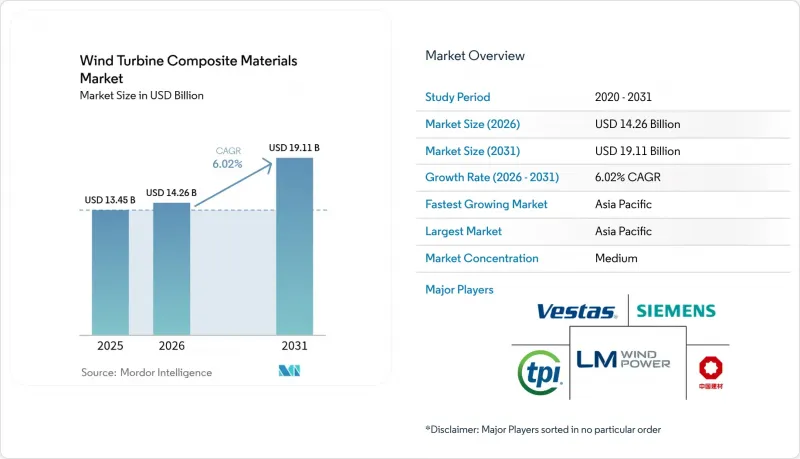
本報告按纖維類型(玻璃纖維、碳纖維、天然纖維和混合纖維)、樹脂類型(環氧樹脂、聚酯/乙烯基酯樹脂、聚氨酯樹脂、熱塑性樹脂)、製程(真空灌注、預浸料、其他)、應用(風力發電機葉片、機艙/鼻錐、其他)和地區(亞太地區、北美地區、歐洲、其他地區)進行細分。市場預測以美元計價。
全球風力發電機複合材料市場趨勢及洞察
陸上和離岸風力發電機。
目前,全球離岸風力發電機的額定輸出功率通常超過15兆瓦,導致葉片長度超過115米,結構負荷也翻倍,而只有高複合材料才能承受這些負荷。維斯塔斯V236-15兆瓦平台的115.5米葉片和西門子歌美颯未公開的21.5兆瓦原型機就是典型的例子,它們透過擴大尺寸來增加每個轉子使用的複合材料量,同時使更輕的碳纖維增強帽成為確保剛性和抗齒輪疲勞性的關鍵。光是在英國,目標是到2030年將離岸風力發電裝置容量提升至50吉瓦,這一目標鞏固了對高性能層壓板系統的長期需求,這些系統能夠在腐蝕性極強的海洋環境中達到25年的設計壽命。
政府脫碳目標和透過CFD競標加速風電發展
英國12億美元的差價合約(CfD,即「現金換債務」)融資計畫專門用於離岸風力發電,以及中國計畫在2024年新增創紀錄的117吉瓦風電裝置容量,這些支援框架正在鞏固吉瓦級專案的競標,並降低新建複合材料工廠的投資風險。鼓勵低碳供應鏈的清潔產業獎勵計畫正在刺激本地葉片生產和更環保的樹脂化學技術的發展。具有法律約束力的《2030年歐洲綠色交易》可再生能源目標以及德國「80%清潔能源」的目標,正在鞏固風力發電機複合材料的整體需求前景,並推動維斯塔斯、LM風電以及中國領先的玻璃纖維製造商擴大產能。碳定價和可再生能源認證(REC)進一步提升了專案的經濟效益,並確保了對輕量、耐用和可回收複合材料的持續需求。
碳纖維的價格和供應波動
預計到2027年,對長度超過100公尺的風力渦輪機葉片的需求將激增,碳纖維的消耗量將成長兩倍,但產能擴張速度跟不上需求,導致價格飆升。這阻礙了碳纖維在成本敏感型風力發電機中的廣泛應用。在中國市場,2023年碳纖維的消耗量為6.9萬噸,但出口限制和地緣政治緊張局勢擾亂了供應鏈,導致價格波動。因此,原始設備製造商(OEM)正在尋求採用玻璃纖維和碳纖維混合結構的複合材料,並優先選擇在地採購,以規避價格波動風險。在新增生產線將全球產量提升至預計的2030年45萬噸之前,風力發電機複合材料市場必須應對原料成本的波動。
細分市場分析
憑藉成本優勢和強大的供應鏈,玻璃纖維在2025年仍佔風力發電機複合材料市場71.10%的主導地位。然而,隨著原始設備製造商(OEM)追求輕量化,碳纖維正以6.85%的複合年成長率成長。這將使更長的轉子能夠在不承受過大載荷的情況下承受更高的葉尖速度。 LM Wind Power公司在其88.4米長的葉片中使用的碳纖維/纖維混合材質的葉尖蓋,已證明在不大幅增加成本的情況下實現了輕量化。
此外,紡織基碳纖維的日益普及(其價格比航太級材料低40%)使得中階風力渦輪機市場得以進入。天然纖維混紡織物正在發展一個永續的細分市場,棕櫚纖維和亞麻纖維的混紡織品在滿足關鍵機械性能要求的同時,也能降低製造所需的能源。在整個預測期內,隨著風力發電機材料市場在剛度、疲勞壽命和價格之間尋求平衡,混紡織策略預計將繼續發揮至關重要的作用。
環氧樹脂憑藉其成熟的性能,預計到2025年將佔銷售額的34.40%,而聚酯/乙烯基酯和聚氨酯共混物預計將以7.12%的複合年成長率實現最高成長。聚氨酯灌注製程已證實可將生產週期縮短10-25%,並改善潤濕性能,因此無需大量資本投資即可擴大年產量,是極具吸引力的選擇。
預計對生命週期排放量減少30-40%的生物基化學品的需求將推動配方研發,並擴大採用更環保樹脂的風力發電機複合材料的市場規模。這一趨勢在歐洲尤其顯著,歐洲已要求在競標中揭露碳足跡。 Baxxodur固化劑和可降低放熱峰值的添加劑包裝將進一步加劇環氧樹脂之間的競爭,確保多種樹脂類別在2031年之前共存。
區域分析
亞太地區仍將是風力發電機複合材料市場的核心區域,預計到2025年將佔全球銷售額的46.10%,並維持業界最高的複合年成長率(6.72%)。在有利於中國巨石和中國太平洋的在地採購政策的支持下,中國在2024年實現了創紀錄的117吉瓦新增裝機容量,鞏固了其無與倫比的供應鏈基礎,該供應鏈從原料到成品葉片,產品出口全球。
在此背景下,歐洲正在推廣成熟技術並實施嚴格的永續性法規。英國計畫在2030年實現高達50吉瓦的離岸風力發電,德國的目標是清潔能源佔比達到80%,法國則推行循環經濟政策,這些都迫使歐洲製造商轉向使用可回收熱塑性塑膠和封閉式製程。
在北美,聯邦稅額扣抵和州政府採購計劃的結合,正在推動大平原地區陸上風電場的擴張以及沿海風區設施的升級改造。美國能源局預測,到2027年,複合材料的需求將成長兩倍,促使TPI Composites和GE Vernova等公司投資於支管帽和根部嵌件的本地化生產。
其他好處
- Excel格式的市場預測(ME)表
- 3個月的分析師支持
目錄
第1章:引言
- 研究假設和市場定義
- 調查範圍
第2章:調查方法
第3章執行摘要
第4章 市場狀況
- 市場促進因素
- 陸上和離岸風力發電機。
- 政府脫碳目標和透過CFD競標加速風電發展
- 採用聚氨酯注射樹脂可縮短生產週期,從而節省成本。
- 透過生物基和可回收熱塑性樹脂系統拓展ESG金融。
- 利用智慧織物相容複合材料加速葉片的數位化孿生。
- 市場限制因素
- 碳纖維的價格和供應波動
- 未來對複合材料中雙酚A和苯乙烯排放的限制
- 新興設施先進輸液工藝熟練工人短缺
- 價值鏈分析
- 波特五力模型
第5章 市場規模與成長預測
- 依纖維類型
- 玻璃纖維
- 碳纖維
- 天然/混合纖維
- 依樹脂類型
- 環氧樹脂
- 聚酯/乙烯基酯
- 聚氨酯
- 熱塑性樹脂
- 透過技術
- 真空輸液
- 預孕
- 手工積層
- 纏繞成型與拉擠成型
- 透過使用
- 風力發電機葉片
- 鼻錐
- 輪圈、蓋子、配件
- 按地區
- 亞太地區
- 中國
- 印度
- 日本
- 韓國
- ASEAN
- 其他亞太國家
- 北美洲
- 美國
- 加拿大
- 墨西哥
- 歐洲
- 德國
- 英國
- 法國
- 義大利
- 西班牙
- 其他歐洲國家
- 南美洲
- 巴西
- 阿根廷
- 其他南美國家
- 中東和非洲
- 沙烏地阿拉伯
- 阿拉伯聯合大公國
- 南非
- 埃及
- 其他中東和非洲國家
- 亞太地區
第6章 競爭情勢
- 策略趨勢
- 市佔率分析
- 公司簡介
- AVIC Huiteng Windpower
- BASF
- China Jushi Co., Ltd.
- Covestro AG
- Exel Composites
- Gurit Holding AG
- Hexcel Corporation
- INCA Renewtech
- Lianyungang Zhongfu Lianzhong Composite Material Group Co., Ltd
- LM WIND POWER
- Molded Fiber Glass Companies
- Owens Corning
- Reliance Industries Limited
- SGL Carbon
- Siemens AG
- Sinoma Science & Technology Co.,Ltd.
- Teijin Limited
- TORAY INDUSTRIES, INC.
- TPI Composites
- Vestas
- Zhongfu Lianzhong Group
第7章 市場機會與未來展望
According to Mordor Intelligence, wind turbine composite materials market size in 2026 is estimated at USD 14.26 billion, growing from 2025 value of USD 13.45 billion with 2031 projections showing USD 19.11 billion, growing at 6.02% CAGR over 2026-2031.
This report is Segmented by Fiber Type (Glass Fiber, Carbon Fiber, Natural/Hybrid Fibers), Resin Type (Epoxy, Polyester/Vinyl-Ester, Polyurethane, Thermoplastic Resins), Technology (Vacuum Infusion, Prepreg, and More), Application (Wind Blades, Nacelles and Nose Cones, and More), and Geography (Asia-Pacific, North America, Europe, and More). The Market Forecasts are Provided in Terms of Value (USD).
Global Wind Turbine Composite Materials Market Trends and Insights
Increasing Onshore and Offshore Turbine Capacities Drive Demand for Advanced Composites
Global turbine ratings now routinely exceed 15 MW offshore, pushing blade lengths past 115 m and multiplying structural loads that only advanced composites can withstand. Vestas' 115.5 m-long blades on the V236-15 MW platform and Siemens Gamesa's confidential 21.5 MW prototype exemplify the scale-up that magnifies composite volume per rotor while simultaneously mandating lighter carbon-reinforced spar caps for stiffness and fatigue resistance. The United Kingdom alone aims to raise offshore capacity to as much as 50 GW by 2030, a target that cements long-term pull for high-performance laminate systems able to deliver a 25-year design life in corrosive marine environments.
Government Decarbonization Policies Accelerate Composite Material Adoption
Supportive frameworks, such as the United Kingdom's USD 1.2 billion CfD round dedicated to offshore wind and China's record 117 GW of 2024 wind installations, lock in multi-gigawatt auction pipelines and de-risk investments in new composite plants. Clean-industry bonus mechanisms that reward low-carbon supply chains are encouraging local blade production and greener resin chemistries. The European Green Deal's binding 2030 renewables targets, along with Germany's 80% clean-power ambition, consolidate demand visibility across the wind turbine composites market and motivate capacity expansions from Vestas, LM Wind Power, and Chinese glass-fiber majors. Carbon pricing and renewable energy certificates further boost project economics, ensuring sustained pull for lightweight, durable, and recyclable composites.
Carbon Fiber Price Volatility Constrains Premium Applications
Surging demand for 100 m-plus blades is expected to triple carbon consumption by 2027, yet capacity expansions lag, creating price spikes that discourage wider uptake in cost-sensitive turbines. China's market, which absorbed 69,000 t of carbon fiber in 2023, saw sharp swings as export restrictions and geopolitical frictions disrupted supply chains. OEMs, therefore, pursue hybrid glass-carbon architectures and localized sourcing to hedge volatility. Until additional lines lift global output toward the 450,000 tons predicted for 2030, the wind turbine composites market must navigate erratic input costs.
Other drivers and restraints analyzed in the detailed report include:
- Polyurethane Infusion Resins Transform Manufacturing Economics
- Bio-based Thermoplastic Systems Enable Circular-Economy Transition
- Regulatory Emission Limits Drive Manufacturing-Process Transformation
For complete list of drivers and restraints, kindly check the Table Of Contents.
Segment Analysis
Glass fiber retained a dominant 71.10% share of the wind turbine composites market in 2025, underpinned by favorable cost and robust supply chains. Carbon, however, is growing at 6.85% CAGR as OEMs chase mass reductions that let longer rotors survive higher tip speeds without excess loads. LM Wind Power's hybrid carbon/glass spar caps on its 88.4 m blade validated weight cuts without cost blowouts.
Incremental uptake also stems from textile-based carbon fibers that are 40% cheaper than aerospace grades, unlocking mid-tier turbine segments. Natural-fiber blends offer sustainable niches, with palm or flax hybrids matching key mechanical metrics while lowering embodied energy. Over the forecast horizon, hybridization strategies will remain pivotal as the wind turbine composites market balances stiffness, fatigue life and affordability.
Epoxy systems held 34.40% revenue share in 2025, thanks to well-characterized performance, yet polyester/vinyl-ester and polyurethane blends are tracking the fastest 7.12% CAGR. Proven 10-25% cycle-time savings and improved wet-out make polyurethane infusion the prime candidate for stretching annual output without large capex.
Demand for bio-based chemistries that curb life-cycle emissions by 30-40% will steer formulation research and development, broadening the wind turbine composites market size for greener resins, particularly in Europe, where carbon-footprint disclosures already feature in tenders. Baxxodur curing agents and additive packages that cut exotherm peaks further enhance epoxy competitiveness, ensuring multiple resin classes co-exist through 2031.
Complete Report Scope:
- By Fiber Type
- Glass Fiber
- Carbon Fiber
- Natural/Hybrid Fibers
- By Resin Type
- Epoxy
- Polyester/Vinyl-Ester
- Polyurethane
- Thermoplastic Resins
- By Technology
- Vacuum Infusion
- Prepreg
- Hand Lay-up
- Filament Winding / Pultrusion
- By Application
- Wind Blades
- Nacelles and Nose Cones
- Hubs, Covers and Ancillary Parts
- By Geography
- Asia-Pacific
- China
- India
- Japan
- South Korea
- ASEAN
- Rest of Asia-Pacific
- North America
- United States
- Canada
- Mexico
- Europe
- Germany
- United Kingdom
- France
- Italy
- Spain
- Rest of Europe
- South America
- Brazil
- Argentina
- Rest of South America
- Middle-East and Africa
- Saudi Arabia
- United Arab Emirates
- South Africa
- Egypt
- Rest of Middle-East and Africa
- Asia-Pacific
Geography Analysis
Asia Pacific, at 46.10% of 2025 revenue, remains the anchor region for the wind turbine composites market and posts a leading 6.72% CAGR. China's record 117 GW of 2024 additions, supported by local-content rules favoring China Jushi and CPIC, underpin an unrivaled supply-chain footprint that exports both raw fabrics and finished blades worldwide.
Europe follows with mature technology adoption and rigorous sustainability regulations. The United Kingdom's ambition to reach up to 50 GW of offshore wind by 2030, Germany's 80% clean-power target, and France's circular-economy mandates push European makers toward recyclable thermoplastics and closed molding.
North America couples federal tax credits with state procurement to expand onshore fleets in the Great Plains and repower coastal wind zones. The U.S. Department of Energy forecasts composite demand tripling by 2027, propelling investments from TPI Composites and GE Vernova that localize spar-cap and root-insert production.
- AVIC Huiteng Windpower
- BASF
- China Jushi Co., Ltd.
- Covestro AG
- Exel Composites
- Gurit Holding AG
- Hexcel Corporation
- INCA Renewtech
- Lianyungang Zhongfu Lianzhong Composite Material Group Co., Ltd
- LM WIND POWER
- Molded Fiber Glass Companies
- Owens Corning
- Reliance Industries Limited
- SGL Carbon
- Siemens AG
- Sinoma Science & Technology Co.,Ltd.
- Teijin Limited
- TORAY INDUSTRIES, INC.
- TPI Composites
- Vestas
- Zhongfu Lianzhong Group
Additional Benefits:
- The market estimate (ME) sheet in Excel format
- 3 months of analyst support
TABLE OF CONTENTS
1 Introduction
- 1.1 Study Assumptions and Market Definition
- 1.2 Scope of the Study
2 Research Methodology
3 Executive Summary
4 Market Landscape
- 4.1 Market Drivers
- 4.1.1 Increasing Onshore and Offshore Turbine Capacities Drive the Need for Lighter, Longer Blades.
- 4.1.2 Government Decarbonization Goals and CFD Auctions are Speeding Up Wind Energy Development.
- 4.1.3 Cost-Saving Polyurethane Infusion Resins Shorten Cycle Time
- 4.1.4 Bio-Based/Recyclable Thermoplastic Systems Unlock ESG Finance
- 4.1.5 Composites Compatible with Smart Fabrics Facilitate Digital Twinning of Blades.
- 4.2 Market Restraints
- 4.2.1 Carbon-Fiber Price and Supply Volatility
- 4.2.2 Upcoming BPA and Styrene Emission Limits for Composites
- 4.2.3 Skilled-Labour Deficit in Advanced Infusion for Emerging Hubs
- 4.3 Value Chain Analysis
- 4.4 Porter's Five Forces
- 4.4.1 Bargaining Power of Suppliers
- 4.4.2 Bargaining Power of Buyers
- 4.4.3 Threat of New Entrants
- 4.4.4 Threat of Substitutes
- 4.4.5 Degree of Competition
5 Market Size and Growth Forecasts (Value)
- 5.1 By Fiber Type
- 5.1.1 Glass Fiber
- 5.1.2 Carbon Fiber
- 5.1.3 Natural/Hybrid Fibers
- 5.2 By Resin Type
- 5.2.1 Epoxy
- 5.2.2 Polyester/Vinyl-Ester
- 5.2.3 Polyurethane
- 5.2.4 Thermoplastic Resins
- 5.3 By Technology
- 5.3.1 Vacuum Infusion
- 5.3.2 Prepreg
- 5.3.3 Hand Lay-up
- 5.3.4 Filament Winding / Pultrusion
- 5.4 By Application
- 5.4.1 Wind Blades
- 5.4.2 Nacelles and Nose Cones
- 5.4.3 Hubs, Covers and Ancillary Parts
- 5.5 By Geography
- 5.5.1 Asia-Pacific
- 5.5.1.1 China
- 5.5.1.2 India
- 5.5.1.3 Japan
- 5.5.1.4 South Korea
- 5.5.1.5 ASEAN
- 5.5.1.6 Rest of Asia-Pacific
- 5.5.2 North America
- 5.5.2.1 United States
- 5.5.2.2 Canada
- 5.5.2.3 Mexico
- 5.5.3 Europe
- 5.5.3.1 Germany
- 5.5.3.2 United Kingdom
- 5.5.3.3 France
- 5.5.3.4 Italy
- 5.5.3.5 Spain
- 5.5.3.6 Rest of Europe
- 5.5.4 South America
- 5.5.4.1 Brazil
- 5.5.4.2 Argentina
- 5.5.4.3 Rest of South America
- 5.5.5 Middle-East and Africa
- 5.5.5.1 Saudi Arabia
- 5.5.5.2 United Arab Emirates
- 5.5.5.3 South Africa
- 5.5.5.4 Egypt
- 5.5.5.5 Rest of Middle-East and Africa
- 5.5.1 Asia-Pacific
6 Competitive Landscape
- 6.1 Strategic Moves
- 6.2 Market Share Analysis
- 6.3 Company Profiles (includes Global level Overview, Market level overview, Core Segments, Financials as available, Strategic Information, Market Rank/Share for key companies, Products and Services, and Recent Developments)
- 6.3.1 AVIC Huiteng Windpower
- 6.3.2 BASF
- 6.3.3 China Jushi Co., Ltd.
- 6.3.4 Covestro AG
- 6.3.5 Exel Composites
- 6.3.6 Gurit Holding AG
- 6.3.7 Hexcel Corporation
- 6.3.8 INCA Renewtech
- 6.3.9 Lianyungang Zhongfu Lianzhong Composite Material Group Co., Ltd
- 6.3.10 LM WIND POWER
- 6.3.11 Molded Fiber Glass Companies
- 6.3.12 Owens Corning
- 6.3.13 Reliance Industries Limited
- 6.3.14 SGL Carbon
- 6.3.15 Siemens AG
- 6.3.16 Sinoma Science & Technology Co.,Ltd.
- 6.3.17 Teijin Limited
- 6.3.18 TORAY INDUSTRIES, INC.
- 6.3.19 TPI Composites
- 6.3.20 Vestas
- 6.3.21 Zhongfu Lianzhong Group
7 Market Opportunities and Future Outlook
- 7.1 White-space and Unmet-Need Assessment
- 7.2 Government net-zero targets are accelerating global wind power installations.

 風力發電機複合材料市場:依纖維類型、樹脂類型、製造流程、渦輪機類型和葉片長度分類-2026-2032年全球預測
 風力渦輪機複合材料市場機會、成長動力、產業趨勢分析及 2025 - 2034 年預測
 2024-2028年全球風力發電機複合材料市場