


 |
市場調查報告書
商品編碼
2122375
有機酸:市場佔有率分析、產業趨勢與統計、成長預測(2026-2031)Organic Acids - Market Share Analysis, Industry Trends & Statistics, Growth Forecasts (2026 - 2031) |
||||||

※ 本網頁內容可能與最新版本有所差異。詳細情況請與我們聯繫。
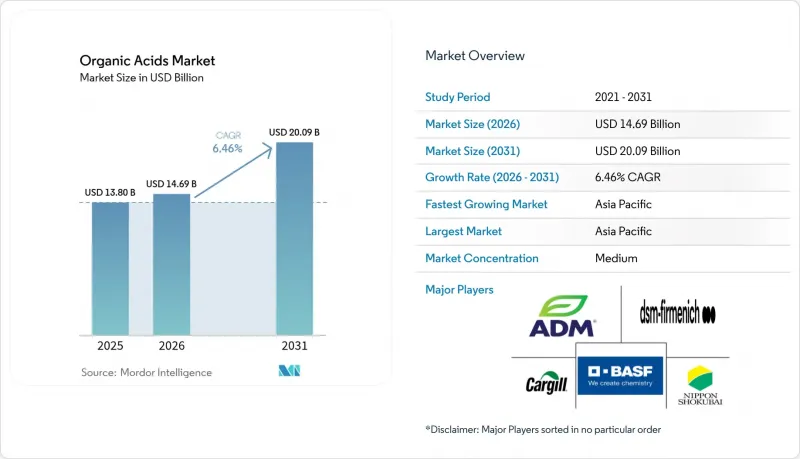
根據 Mordor Intelligence 估計,有機酸市場在 2026 年的價值將達到 146.9 億美元,高於 2025 年的 138 億美元,預計到 2031 年將達到 200.9 億美元。
預計2026年至2031年的複合年成長率將達到6.46%。這一成長主要得益於從石油化工方法向生物基發酵製程的重大轉變,以及食品、聚合物和製藥行業對潔淨標示產品需求的不斷成長。
本報告按類型(乙酸、檸檬酸、其他)、原料(生物基、石油化工基、混合/副產品基)、應用(食品飲料、動物飼料及營養、其他)、形態(液體、乾燥/結晶/粉末)和地區(北美、南美、歐洲、中東和非洲、亞太地區)進行細分。市場預測以價值(美元)和數量(單位)表示。
全球有機酸市場趨勢與洞察
用於太陽能電池的EVA薄膜中乙酸醋酸乙烯單體的快速擴散。
隨著太陽能產業的快速發展,生產醋酸乙烯單體(VAM)所需的醋酸需求顯著成長。這項需求主要由EVA封裝膜驅動,EVA封裝薄膜對於提高太陽能板的耐久性和效率至關重要。目前,生產商可以透過利用大豆油的非催化裂解,以可再生原料生產商業級VAM。這項創新製程所生產的醋酸是一種高價值產品,能夠滿足太陽能產業嚴格的品質要求。透過採用這種生物基生產管道,製造商既可以滿足永續性的要求,又能實現供應鏈多元化,並減少對石油化工衍生VAM的依賴。此外,將可再生乙醇衍生的乙烯與生物基醋酸結合,可以建立一條完全永續的VAM生產路線。這項進步使有機酸生產商能夠抓住快速成長的太陽能市場中高價銷售的機會。
注射劑中對藥用級乳酸的需求
醫藥級乳酸的需求是推動有機酸市場發展的重要因素,這主要得益於其在注射劑製劑中日益廣泛的應用。乳酸以其良好的生物相容性和生物分解性而聞名,在製藥行業中被廣泛用於增強藥物遞送系統。根據美國食品藥物管理局(FDA)的說法,在製劑中添加乳酸符合嚴格的安全性和有效性標準,使其成為注射劑的首選成分。此外,世界衛生組織(WHO)強調了此類生物相容性化合物在改善患者預後方面的重要性,尤其是在重症監護藥物領域。同時,糖尿病和心血管疾病等慢性病盛行率的不斷上升也推動了注射劑需求的激增,進一步增加了對醫藥級乳酸的需求。根據美國疾病管制與預防中心(CDC)預測,到2023年,美國成年人糖尿病盛行率將達到15.8%,這顯示對有效藥物遞送系統的需求日益成長。預計這一成長將直接影響醫藥應用領域對乳酸的需求。
嚴格的VOC法規限制了石油衍生的丙烯酸和己二酸的生產。
有機酸市場受到嚴格的揮發性有機化合物 (VOC) 法規的顯著限制,這些法規針對石油衍生的丙烯酸和己二酸實施。這些法規旨在透過限制使用會產生 VOC 排放的石油化學衍生物來減少環境污染並促進永續性。眾所周知,VOC 對人類健康和環境均有不利影響,包括加劇地表臭氧的形成和空氣品質惡化。因此,包括北美、歐洲和亞太地區在內的多個地區的監管機構正在實施嚴格的指導方針來遏制 VOC 排放,這直接影響到石油衍生的丙烯酸和己二酸的生產和使用。有機酸市場的生產商面臨遵守這些法規的挑戰,這可能導致生產成本增加,因為他們需要採用先進的技術和工藝來滿足合規標準。此外,這些法規迫使該行業探索和採用更環保的替代方案,例如生物基原料,但這些替代方案通常成本更高,且難以擴大生產規模。
細分市場分析
預計到2025年,乙酸將繼續保持在有機酸市場的主導地位,佔據33.72%的市場佔有率。這一主導地位源於其在紡織、食品飲料和製藥等多個行業的廣泛應用。乙酸在生產醋酸乙烯單體(VAM)中發揮著至關重要的作用,而VAM是黏合劑、油漆和塗料生產的關鍵前驅物。此外,乙酸也用於生產乙酸酐、對苯二甲酸和乙酸酯,進一步推動了其需求。乙酸的多功能性及其在終端用戶行業的廣泛需求持續推動其成長,鞏固了其市場領導地位。隨著新興經濟體對工業應用的日益關注以及對VAM需求的成長,預計未來幾年乙酸的成長速度將進一步加快。
同時,琥珀酸正成為有機酸市場中成長最快的細分市場。預計在2026年至2031年的預測期內,其複合年成長率將達到9.52%。這一成長主要得益於琥珀酸作為可生物分解聚合物組分的應用日益廣泛,而可生物分解聚合物正因人們日益關注環境問題以及監管機構對永續材料的支持而備受矚目。琥珀酸也用於樹脂、塗料和個人保健產品的生產,進一步擴大了其市場佔有率。此外,生物基生產技術的進步也使琥珀酸成為經濟高效且可再生的石油基化學品替代品。
2025年,石油化學衍生原料將主導有機酸市場,佔60.98%的顯著佔有率。這些原料將繼續在滿足包括食品飲料、製藥和化學等在內的各行業對有機酸的高需求方面發揮關鍵作用。完善的石油化學生產基礎設施和相對較低的生產成本支撐了其強大的市場地位。然而,對環境永續性的擔憂以及原油價格的波動可能會在未來幾年對石油化學衍生有機酸的成長構成挑戰。
同時,生物基有機酸預計在預測期內將以10.93%的顯著複合年成長率成長。這一成長主要得益於消費者對永續和環保產品日益成長的偏好,以及鼓勵採用可再生資源的嚴格環境法規。由於生物基有機酸由玉米、甘蔗和其他生質能等可再生原料生產,因此它們是比石油化工基有機酸更永續的替代方案。生物技術和發酵製程的進步進一步提高了生物基有機酸生產的效率和規模化能力,該領域正逐漸成為市場的主要驅動力。
區域分析
到2025年,亞太地區將主導全球有機酸市場,佔30.08%的最大區域市場佔有率,並保持最快的成長速度,預計到2031年複合年成長率將達到9.29%。這種雙重主導地位歸功於該地區強大的製造業生態系統以及不斷壯大的中產階級人口所推動的消費模式轉變。有機酸的需求強勁,尤其是在食品、醫藥和工業應用領域,這得益於都市化的加速和消費者偏好的改變。作為該地區的主要生產國,中國面臨產能過剩和持續不斷的貿易爭端等挑戰,這些挑戰可能會影響市場動態。然而,在快速經濟發展、有利的政府政策以及對全球永續性標準的遵守的推動下,印度和東南亞國家正在崛起為重要的成長要素。
北美在有機酸市場保持著強勁的地位,這得益於生物基生產技術的進步以及優先考慮永續性和高品質標準的法規結構。該地區對發酵能力的巨額投資彌補了傳統基礎設施的不足,從而實現了更有效率的生產流程。食品飲料、製藥和農業等各行各業對生物基替代品的日益普及,進一步推動了北美對有機酸的需求。該地區對創新和永續性的重視,使其成為開發滿足國內外市場的先進有機酸解決方案的領導者。這些因素確保了北美在全球市場格局中繼續保持主導地位。
在歐洲,有機酸市場已趨於成熟,高階應用和嚴格的監管合規性是重點。隨著各行業日益轉向永續和環保解決方案,該地區嚴格的環境標準為生物基生產商創造了機會。歐洲對有機酸的需求主要來自食品保鮮、製藥和工業流程等領域,這些領域對品質和永續性要求極高。同時,南美洲、中東和非洲在全球有機酸市場也蘊藏新的機會。這些地區受益於經濟發展和豐富的農業資源,為有機酸的生產和消費奠定了堅實的基礎。
其他好處
- Excel格式的市場預測(ME)表
- 3個月的分析師支持
目錄
第1章:引言
- 研究假設和市場定義
- 調查範圍
第2章:調查方法
第3章執行摘要
第4章 市場狀況
- 市場概覽
- 市場促進因素
- 用於太陽能電池的EVA薄膜中乙酸醋酸乙烯單體的快速擴散。
- 注射劑中對藥用級乳酸的需求
- 潔淨標示飲料中廣泛使用檸檬酸基天然防腐劑
- 琥珀酸作為生物基PBS和生物基BDO的結構單元的生長
- 在未感染非洲豬瘟(ASF)的豬飼料中採用飼料級甲酸和丙酸
- 在飼料中用作抗生素的替代品
- 市場限制因素
- 嚴格的VOC法規限制了石油衍生的丙烯酸和己二酸的生產。
- 中國低純度檸檬酸供應過剩,價格承壓。
- 人們對合成酸的環境擔憂阻礙了市場成長。
- 技術和基礎設施壁壘阻礙市場成長
- 供應鏈分析
- 監理展望
- 波特五力模型
第5章 市場規模與成長預測
- 按類型
- 醋酸
- 檸檬酸
- 乳酸
- 琥珀酸
- 蘋果酸
- 丙酸
- 甲酸
- 富馬酸和馬來酸
- 其他類型(苯甲酸、葡萄糖酸、己二酸等)
- 按原料
- 生物衍生
- 石油化工衍生性商品
- 混合/副產品衍生
- 透過使用
- 飲食
- 動物飼料和營養
- 藥品和醫療保健
- 個人護理和化妝品
- 工業化學品及中間體(VAM、PTA、丙烯酸酯等)
- 聚合物和生質塑膠(PLA、PBS、PHA)
- 其他用途(紡織品、潤滑劑、電子設備)
- 按形式
- 液體
- 乾粉/晶體/粉末
- 按地區
- 北美洲
- 美國
- 加拿大
- 墨西哥
- 其他北美國家
- 南美洲
- 巴西
- 阿根廷
- 其他南美國家
- 歐洲
- 德國
- 英國
- 法國
- 義大利
- 西班牙
- 俄羅斯
- 其他歐洲國家
- 中東和非洲
- 沙烏地阿拉伯
- 南非
- 其他中東和非洲國家
- 亞太地區
- 中國
- 印度
- 日本
- 澳洲
- 亞太其他地區
- 北美洲
第6章 競爭情勢
- 市場集中度
- 策略趨勢
- 市場排名分析
- 公司簡介
- BASF SE
- Cargill, Incorporated
- Archer Daniels Midland Company
- Royal DSM(Reverdia)
- Nippon Shokubai Co., Ltd.
- DSM-Firmenich AG
- Roquette Freres
- Celanese Corporation
- Corbion NV
- Thermo Fisher Scientific
- Bartek Ingredients Inc.
- Fuso Chemical Co., Ltd.
- Inner Mongolia
- Mitsubishi Chemical Group
- Fengchen Group Co.,Ltd
- RZBC GROUP CO., LTD
- TINNAKORN CHEMICAL & SUPPLY
- Shandong Feiyang Chemical
- Jinan Finer Chemical Co., Ltd
- Anhui BBCA Biochemical
第7章 市場機會與未來展望
According to Mordor Intelligence, the organic acids market size in 2026 is estimated at USD 14.69 billion, growing from 2025 value of USD 13.80 billion with 2031 projections showing USD 20.09 billion, growing at 6.46% CAGR over 2026-2031.This growth is largely driven by a notable transition from petrochemical methods to bio-based fermentation processes, alongside an increasing demand for clean-label products across food, polymer, and pharmaceutical sectors.
This report is Segmented by Type (Acetic Acid, Citric Acid, and More), Source (Bio-Based, Petro-Chemical, Hybrid/Co-product Streams), Application (Food and Beverages, Animal Feed and Nutrition, and More ), Form (Liquid, Dry/Crystal/Powder), and Geography (North America, South America, Europe, Middle East and Africa, Asia-Pacific). The Market Forecasts are Provided in Terms of Value (USD) and Volume (Units).
Global Organic Acids Market Trends and Insights
Rapid Uptake of Acetic Acid in Vinyl-Acetate-Monomer for Solar-EVA Films
The rapid growth of the photovoltaic industry has significantly increased the demand for acetic acid in the production of vinyl acetate monomers (VAM). EVA encapsulant films, which are essential for improving the durability and efficiency of solar panels, drive this demand. Producers can now manufacture commercial-grade VAM from renewable feedstocks by utilizing the non-catalytic cracking of soybean oil. This innovative process generates acetic acid as a valuable co-product that complies with the stringent quality requirements of the solar industry. By adopting this bio-based production pathway, manufacturers address sustainability mandates while diversifying supply chains to reduce reliance on petrochemical-derived VAM. Additionally, integrating ethylene derived from renewable ethanol with bio-based acetic acid establishes a fully sustainable VAM production route. This advancement enables organic acid producers to capitalize on premium pricing opportunities in the rapidly expanding solar market.
Pharmaceutical-grade Lactic Acid Demand for Injectable Drug Formulations
The demand for pharmaceutical-grade lactic acid is a significant driver in the organic acids market, particularly due to its increasing application in injectable drug formulations. Lactic acid, known for its biocompatibility and biodegradability, is widely used in the pharmaceutical industry to enhance drug delivery systems. According to the U.S. Food and Drug Administration (FDA), the adoption of lactic acid in drug formulations aligns with stringent safety and efficacy standards, making it a preferred choice for injectable drugs . Additionally, the World Health Organization emphasizes the importance of such biocompatible compounds in improving patient outcomes, especially in critical care medications. Moreover, the increasing prevalence of chronic diseases such as diabetes and cardiovascular disorders has led to a surge in demand for injectable drugs, further driving the need for pharmaceutical-grade lactic acid. According to the Centers for Disease Control and Prevention (CDC), the prevalence of total diabetes was 15.8% in all adults in the United States in 2023, highlighting the growing need for effective drug delivery systems. This growth is expected to directly impact the demand for lactic acid in pharmaceutical applications.
Stringent VOC Directives Limiting Petro-based Acrylic and Adipic Acids
The organic acid market is experiencing significant restraint due to stringent Volatile Organic Compound (VOC) directives imposed on petro-based acrylic and adipic acids. These directives aim to reduce environmental pollution and promote sustainability by limiting the use of petrochemical derivatives that contribute to VOC emissions. VOCs are known to have adverse effects on both human health and the environment, including contributing to ground-level ozone formation and air quality degradation. As a result, regulatory bodies across various regions, including North America, Europe, and Asia-Pacific, have implemented strict guidelines to curb VOC emissions, directly impacting the production and usage of petro-based acrylic and adipic acids. Manufacturers in the organic acid market are facing challenges in complying with these regulations, which may lead to increased production costs due to the need for advanced technologies and processes to meet compliance standards. Additionally, the restrictions are driving the industry to explore and adopt alternative raw materials, such as bio-based feedstocks, which are more environmentally friendly but often come with higher costs and scalability issues.
Other drivers and restraints analyzed in the detailed report include:
- Expansion of Citric-acid-based Natural Preservatives in Clean-Label Beverages
- Growth of Succinic Acid as a Building Block for Bio-PBS and Bio-BDO
- Environmental Concerns with Synthetic Acids Hindering the Market Growth
For complete list of drivers and restraints, kindly check the Table Of Contents.
Segment Analysis
In 2025, acetic acid holds a dominant 33.72% market share in the organic acids market, maintaining its leadership position. This dominance is attributed to its extensive applications across various industries, including textiles, food and beverages, and pharmaceuticals. Acetic acid plays a critical role in the production of vinyl acetate monomer (VAM), which is a key precursor for manufacturing adhesives, paints, and coatings. Additionally, its use in the production of acetic anhydride, terephthalic acid, and acetate esters further enhances its demand. The compound's versatility and widespread demand across end-user industries continue to drive its growth and solidify its position as a market leader. The increasing focus on industrial applications and the rising demand for VAM in emerging economies are expected to further bolster the growth of acetic acid in the coming years.
Succinic acid, on the other hand, is emerging as the fastest-growing segment in the organic acids market. It is projected to register a robust CAGR of 9.52% during the forecast period of 2026 to 2031. This growth is primarily fueled by its increasing adoption as a building block for biodegradable polymers, which are gaining traction due to rising environmental concerns and regulatory support for sustainable materials. Succinic acid is also used in the production of resins, coatings, and personal care products, further contributing to its expanding market presence. Moreover, advancements in bio-based production technologies have made succinic acid a cost-effective and renewable alternative to petroleum-based chemicals.
In 2025, petrochemical sources dominated the organic acids market, holding a significant 60.98% share. These sources continue to play a crucial role in meeting the high demand for organic acids across various industries, including food and beverages, pharmaceuticals, and chemicals. The established infrastructure for petrochemical production and the relatively lower production costs contribute to their strong market position. However, concerns regarding environmental sustainability and fluctuating crude oil prices may pose challenges to the growth of petrochemical-based organic acids in the coming years.
On the other hand, bio-based sources of organic acids are expected to grow at an impressive CAGR of 10.93% during the forecast period. This growth is driven by increasing consumer preference for sustainable and eco-friendly products, along with stringent environmental regulations encouraging the adoption of renewable resources. Bio-based organic acids are derived from renewable feedstocks such as corn, sugarcane, and other biomass, making them a more sustainable alternative to petrochemical sources. Advancements in biotechnology and fermentation processes are further enhancing the efficiency and scalability of bio-based organic acid production, positioning this segment as a key growth driver in the market.
Complete Report Scope:
- By Type
- Acetic Acid
- Citric Acid
- Lactic Acid
- Succinic Acid
- Malic Acid
- Propionic Acid
- Formic Acid
- Fumaric and Maleic Acids
- Others (Benzoic, Gluconic, Adipic, etc.)
- By Source
- Bio-based
- Petro-chemical
- Hybrid/Co-product Streams
- By Application
- Food and Beverages
- Animal Feed and Nutrition
- Pharmaceuticals and Healthcare
- Personal Care and Cosmetics
- Industrial Chemicals and Intermediates (VAM, PTA, Acrylates, etc.)
- Polymers and Bioplastics (PLA, PBS, PHA)
- Others (Textiles, Lubricants, Electronics)
- By Form
- Liquid
- Dry/Crystal/Powder
- Geographic Analysis
- North America
- United States
- Canada
- Mexico
- Rest of North America
- South America
- Brazil
- Argentina
- Rest of South America
- Europe
- Germany
- United Kingdom
- France
- Italy
- Spain
- Russia
- Rest of Europe
- Middle East and Africa
- Saudi Arabia
- South Africa
- Rest of Middle East and Africa
- Asia-Pacific
- China
- India
- Japan
- Australia
- Rest of Asia-Pacific
- North America
Geography Analysis
In 2025, Asia-Pacific dominated the global organic acids market, holding the largest regional market share of 30.08% and registering the fastest growth with a projected CAGR of 9.29% through 2031. This dual leadership stems from the region's robust manufacturing ecosystem and the rising consumption patterns of its expanding middle-class population. The demand for organic acids is particularly strong in food, pharmaceutical, and industrial applications, driven by increasing urbanization and changing consumer preferences. China, as a key producer in the region, faces challenges such as overcapacity and ongoing trade disputes, which could impact its market dynamics. However, India and Southeast Asian countries are emerging as significant growth contributors, supported by rapid economic development, favorable government policies, and alignment with global sustainability standards.
North America continues to maintain a strong foothold in the organic acids market, underpinned by its technological advancements in bio-based production and a regulatory framework that prioritizes sustainability and high-quality standards. The region has witnessed substantial investments in fermentation capacity, addressing previous infrastructure gaps and enabling more efficient production processes. The demand for organic acids in North America is further bolstered by the growing adoption of bio-based alternatives across various industries, including food and beverages, pharmaceuticals, and agriculture. The region's focus on innovation and sustainability has positioned it as a leader in the development of advanced organic acid solutions, catering to both domestic and international markets. These factors ensure North America's continued prominence in the global market landscape.
Europe, with its mature organic acids market, emphasizes premium applications and strict regulatory compliance. The region's stringent environmental standards create opportunities for bio-based producers, as industries increasingly shift towards sustainable and eco-friendly solutions.The demand for organic acids in Europe is driven by their applications in food preservation, pharmaceuticals, and industrial processes, where quality and sustainability are paramount. Meanwhile, South America and the Middle East & Africa represent emerging opportunities in the global organic acids market. These regions benefit from economic development and abundant agricultural resources, which provide a strong foundation for organic acid production and consumption.
- BASF SE
- Cargill, Incorporated
- Archer Daniels Midland Company
- Royal DSM (Reverdia)
- Nippon Shokubai Co., Ltd.
- DSM-Firmenich AG
- Roquette Freres
- Celanese Corporation
- Corbion N.V.
- Thermo Fisher Scientific
- Bartek Ingredients Inc.
- Fuso Chemical Co., Ltd.
- Inner Mongolia
- Mitsubishi Chemical Group
- Fengchen Group Co.,Ltd
- RZBC GROUP CO., LTD
- TINNAKORN CHEMICAL & SUPPLY
- Shandong Feiyang Chemical
- Jinan Finer Chemical Co., Ltd
- Anhui BBCA Biochemical
Additional Benefits:
- The market estimate (ME) sheet in Excel format
- 3 months of analyst support
TABLE OF CONTENTS
1 INTRODUCTION
- 1.1 Study Assumptions and Market Definition
- 1.2 Scope of the Study
2 RESEARCH METHODOLOGY
3 EXECUTIVE SUMMARY
4 MARKET LANDSCAPE
- 4.1 Market Overview
- 4.2 Market Drivers
- 4.2.1 Rapid Uptake of Acetic Acid in Vinyl-Acetate-Monomer for Solar-EVA Films
- 4.2.2 Pharmaceutical-grade Lactic Acid Demand for Injectable Drug Formulations
- 4.2.3 Expansion of Citric-acid-based Natural Preservatives in Clean-Label Beverages
- 4.2.4 Growth of Succinic Acid as a Building Block for Bio-PBS and Bio-BDO
- 4.2.5 Feed-grade Formic & Propionic Acids Adoption for ASF-Free Swine Diets
- 4.2.6 Use in Animal Feed as Antibiotic Alternatives
- 4.3 Market Restraints
- 4.3.1 Stringent VOC Directives Limiting Petro-based Acrylic and Adipic Acids
- 4.3.2 Over-capacity and Price Compression in Chinese Low-purity Citric Acid
- 4.3.3 Environmental Concerns with Synthetic Acids Hindering the Market Growth
- 4.3.4 Technological and Infrastructural Barriers Hampering the Market Growth
- 4.4 Supply-Chain Analysis
- 4.5 Regulatory Outlook
- 4.6 Porter's Five Forces
- 4.6.1 Threat of New Entrants
- 4.6.2 Bargaining Power of Buyers
- 4.6.3 Bargaining Power of Suppliers
- 4.6.4 Threat of Substitutes
- 4.6.5 Intensity of Competitive Rivalry
5 MARKET SIZE AND GROWTH FORECASTS (VALUE AND VOLUME)
- 5.1 By Type
- 5.1.1 Acetic Acid
- 5.1.2 Citric Acid
- 5.1.3 Lactic Acid
- 5.1.4 Succinic Acid
- 5.1.5 Malic Acid
- 5.1.6 Propionic Acid
- 5.1.7 Formic Acid
- 5.1.8 Fumaric and Maleic Acids
- 5.1.9 Others (Benzoic, Gluconic, Adipic, etc.)
- 5.2 By Source
- 5.2.1 Bio-based
- 5.2.2 Petro-chemical
- 5.2.3 Hybrid/Co-product Streams
- 5.3 By Application
- 5.3.1 Food and Beverages
- 5.3.2 Animal Feed and Nutrition
- 5.3.3 Pharmaceuticals and Healthcare
- 5.3.4 Personal Care and Cosmetics
- 5.3.5 Industrial Chemicals and Intermediates (VAM, PTA, Acrylates, etc.)
- 5.3.6 Polymers and Bioplastics (PLA, PBS, PHA)
- 5.3.7 Others (Textiles, Lubricants, Electronics)
- 5.4 By Form
- 5.4.1 Liquid
- 5.4.2 Dry/Crystal/Powder
- 5.5 Geographic Analysis
- 5.5.1 North America
- 5.5.1.1 United States
- 5.5.1.2 Canada
- 5.5.1.3 Mexico
- 5.5.1.4 Rest of North America
- 5.5.2 South America
- 5.5.2.1 Brazil
- 5.5.2.2 Argentina
- 5.5.2.3 Rest of South America
- 5.5.3 Europe
- 5.5.3.1 Germany
- 5.5.3.2 United Kingdom
- 5.5.3.3 France
- 5.5.3.4 Italy
- 5.5.3.5 Spain
- 5.5.3.6 Russia
- 5.5.3.7 Rest of Europe
- 5.5.4 Middle East and Africa
- 5.5.4.1 Saudi Arabia
- 5.5.4.2 South Africa
- 5.5.4.3 Rest of Middle East and Africa
- 5.5.5 Asia-Pacific
- 5.5.5.1 China
- 5.5.5.2 India
- 5.5.5.3 Japan
- 5.5.5.4 Australia
- 5.5.5.5 Rest of Asia-Pacific
- 5.5.1 North America
6 COMPETITIVE LANDSCAPE
- 6.1 Market Concentration
- 6.2 Strategic Moves
- 6.3 Market Ranking Analysis
- 6.4 Company Profiles (includes Global level Overview, Market level overview, Core Segments, Financials as available, Strategic Information, Market Rank/Share, Products & Services, and Recent Developments)
- 6.4.1 BASF SE
- 6.4.2 Cargill, Incorporated
- 6.4.3 Archer Daniels Midland Company
- 6.4.4 Royal DSM (Reverdia)
- 6.4.5 Nippon Shokubai Co., Ltd.
- 6.4.6 DSM-Firmenich AG
- 6.4.7 Roquette Freres
- 6.4.8 Celanese Corporation
- 6.4.9 Corbion N.V.
- 6.4.10 Thermo Fisher Scientific
- 6.4.11 Bartek Ingredients Inc.
- 6.4.12 Fuso Chemical Co., Ltd.
- 6.4.13 Inner Mongolia
- 6.4.14 Mitsubishi Chemical Group
- 6.4.15 Fengchen Group Co.,Ltd
- 6.4.16 RZBC GROUP CO., LTD
- 6.4.17 TINNAKORN CHEMICAL & SUPPLY
- 6.4.18 Shandong Feiyang Chemical
- 6.4.19 Jinan Finer Chemical Co., Ltd
- 6.4.20 Anhui BBCA Biochemical
7 MARKET OPPORTUNITIES AND FUTURE OUTLOOK

 夫西地酸市場-全球產業規模、佔有率、趨勢、機會、預測:銷售管道、最終用途、地區和競爭格局(2021-2031年)
 馬來酸市場:依產品類型、應用、終端用戶產業及地區分類
 有機酸市場規模、佔有率和趨勢分析報告:按產品、原料、應用、地區和細分市場預測(2026-2033 年)
 有機酸市場規模、佔有率和成長分析:按類型、原料、形態、應用和地區分類-2026-2033年產業預測
 有機酸市場報告:按類型、原料、最終用戶和地區分類(2026-2034 年)
 2026年全球有機酸市場報告
 夫西地酸市場:按給藥途徑、劑型、分銷管道、最終用戶和應用分類的全球市場預測,2026-2032年
 全球有機酸市場規模、佔有率、趨勢和成長分析報告(2026-2034年)2026年全球有機酸市場報告
 全球氫碘酸市場,2025-2029年