


 |
市場調查報告書
商品編碼
2122365
油漆和塗料用樹脂:市場佔有率分析、行業趨勢和統計數據以及成長預測(2026-2031 年)Resins In Paints And Coatings - Market Share Analysis, Industry Trends & Statistics, Growth Forecasts (2026 - 2031) |
||||||

※ 本網頁內容可能與最新版本有所差異。詳細情況請與我們聯繫。
根據 Mordor Intelligence 預測,油漆和塗料樹脂市場將從 2025 年的 388.9 億美元成長到 2026 年的 407.6 億美元,然後在 2031 年達到 516.5 億美元,2026 年至 2031 年的複合年成長率為 4.85%。
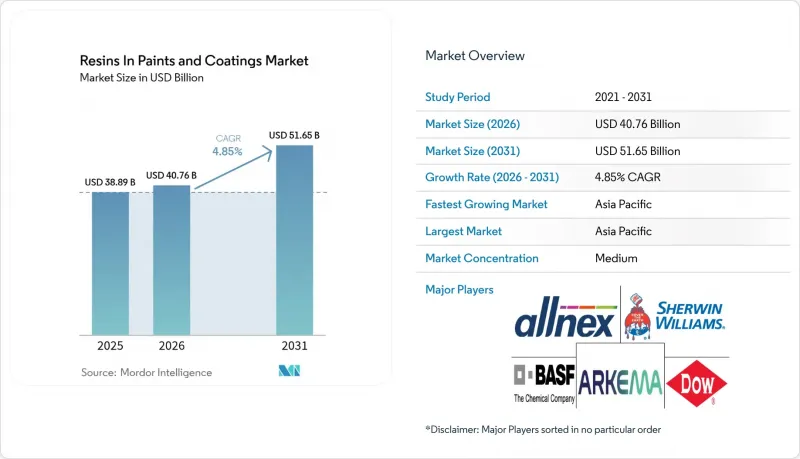
本報告按樹脂類型(丙烯酸樹脂、環氧樹脂、聚氨酯樹脂、聚酯樹脂、聚丙烯樹脂、醇酸樹脂及其他樹脂)、終端用戶行業(建築、工業、汽車、包裝及其他終端用戶行業)和地區(亞太地區、北美地區、歐洲地區、南美地區以及中東和非洲地區)進行細分。市場預測以美元計價。
全球油漆及塗料樹脂市場趨勢及洞察
亞太地區建築業蓬勃發展
中國、印度和東協的基礎設施發展計畫正將樹脂原料的需求轉向水性丙烯酸和混合聚氨酯系統的多年合約。在中國,已訂定法規,強制要求到2025年,面積超過10,000平方米的公共建築內牆塗料必須使用低VOC(揮發性有機化合物)含量的塗料,從而淘汰商業領域的溶劑型醇酸底漆。印度計劃在2027年新建1,000公里地鐵線路,並明確規定使用能夠承受季風濕氣的高固態環氧樹脂襯裡。在越南和印度尼西亞,與電子商務履約相關的倉庫建設中,丙烯酸或甲基丙烯酸甲酯聚合物被添加到聚合物混凝土地板材料中,從而縮短固化時間和停工時間。需求波動性依然高;中國住宅量下降10%可能導致丙烯酸年需求量減少約15萬噸,因此,靈活的乳液生產能力對於滿足此需求至關重要。
汽車產業需求不斷成長
在電池式電動車)生產線上,烘箱烘烤溫度被限制在120 度C,並且不再使用傳統的140-160 度C醇酸樹脂體系,而是採用新型催化劑封裝的雙組分聚氨酯或丙烯酸-三聚氰胺透明塗層。現代汽車公司計劃於2025年底前完成其位於蔚山的電泳塗裝工廠的升級改造,投資4,500萬美元,採用可在110度C下固化的低固化陰極環氧樹脂。此外,紫外光固化丙烯酸樹脂擴大用於塑膠外件的塗裝,從而完全消除了烘箱的能耗。這種兩極化的需求使資本配置變得複雜,因為供應商既要維護用於內燃機平台的醇酸樹脂體系,又要投資開發用於電動車的丙烯酸和聚氨酯乳液。
原物料價格波動
2025年第一季苯的平均價格為每噸820美元,但在裂解裝置停產後飆升了25%,之後在第四季回落至每噸840美元。這給苯乙烯-丙烯酸酯和不飽和聚酯生產商的運作帶來了壓力。隨著一個新的丙烷脫氫(PDH)裝置的運作,丙烯價格與原油價格脫鉤,加劇了預測的不確定性。如果價格波動風險超過15%,尚未對沖石腦油投資的樹脂生產商將推遲擴張計劃,這將導致供應緊張並加劇價格波動。生物基原料在一定程度上緩解了價格波動的影響,但供應仍受限。
細分市場分析
預計到2025年,丙烯酸樹脂將佔油漆和塗料樹脂市場佔有率的30.05%,並將以5.30%的複合年成長率成長至2031年,超過環氧樹脂和聚氨酯市場。其需求主要來自室內牆面塗料(目前主導住宅翻新粉刷市場)以及需要低溫固化性能的電動車底塗層。環氧樹脂在需要耐化學腐蝕性的船舶應用領域保持著高階利基市場地位,但隨著粉末塗料的日益普及,液態環氧樹脂的出貨量正在下降。聚氨酯樹脂分為兩類:用於航太複合材料的雙組分體系和用於櫥櫃的單組分水性分散體,後者價格較高。
聚酯在粉末塗料領域扮演關鍵角色,支撐著金屬塗料市場的成長,而高VOC市場對醇酸樹脂的需求卻在萎縮。特種矽改質丙烯酸樹脂和氟聚合物樹脂利潤率高,吸引了大量研發經費。連續乳液聚合和基於機器學習的製程控制相結合,清楚地解釋了為何在2025年歐洲塗料展上,丙烯酸樹脂的研發成果展示數量是其他化學塗料的四倍。
區域分析
預計到2025年,亞太地區將佔全球銷售額的44.15%,並在2031年之前維持5.36%的複合年成長率,成為成長最快的地區。在中國,2030年實現70%的都市區的目標正在推動室內塗料市場的發展;而在印度,高速公路和地鐵建設項目增加了對環氧樹脂和聚氨酯樹脂的需求,用於保護鋼材和混凝土。日本和韓國的汽車製造商正在調整其營運結構,以滿足電動車塗料的需求,並採購可降低20%能耗的低溫燒結樹脂。東協電子產業的擴張催生了對設備機殼耐用塗料的需求,導致丙烯酸和聚酯中間體的進口量增加。外匯波動和對苯進口的依賴是影響全部區域盈利的挑戰。
在北美,《基礎設施投資與就業法案》正在推動道路和橋樑建設,到2026年將投資1,100億美元。快速固化的丙烯酸和環氧樹脂塗料正被用於道路標線和橋面鋪裝。在加拿大,更嚴格的建築規範旨在確保室內環境低揮發性有機化合物(VOC),這加速了溶劑型醇酸樹脂的淘汰。在墨西哥的汽車產業叢集中,高固態聚氨酯塗料正在被使用,但隨著製造商採用更薄的塗層結構,每輛車的塗料用量正在減少。
在歐洲,維修補貼和嚴格的化學品政策正在重塑市場格局。德國於2025年設立的50億歐元維修基金,促進了採用矽改質丙烯酸樹脂(可抑制藻類生長)的外牆塗料的普及。法國和義大利已製定可再生原料含量標準,加速了公共工程項目中木質素基環氧樹脂的檢測。歐洲化學品管理局(ECHA)將於2027年實施的微塑膠禁令將迫使某些丙烯酸共聚物的配方進行調整,預計將帶來資本投資需求。此外,隨著巴西、沙烏地阿拉伯和埃及等國加大對住宅維修的投資,優先考慮耐用且低成本的乳液塗料,南美、中東和非洲的需求也在加速成長。
其他好處
- Excel格式的市場預測(ME)表
- 3個月的分析師支持
目錄
第1章:引言
- 研究假設和市場定義
- 調查範圍
第2章:調查方法
第3章執行摘要
第4章 市場狀況
- 市場概覽
- 市場促進因素
- 亞太地區建築業蓬勃發展
- 汽車產業需求不斷成長
- 中東和非洲住宅市場的翻新熱潮
- 現場3D列印修復樹脂的需求不斷成長。
- 擴大生物基環氧樹脂規模化生產的獎勵
- 市場限制因素
- 原物料價格波動
- 過渡到純粉末系統
- 收緊遊離單體的允許濃度限值
- 價值鏈分析
- 波特五力模型
第5章 市場規模與成長預測
- 依樹脂類型
- 丙烯酸纖維
- 環氧樹脂
- 聚氨酯
- 聚酯纖維
- 聚丙烯
- 阿爾基多
- 其他樹脂
- 按最終用戶行業分類
- 建築學
- 產業
- 車
- 包裝
- 其他終端用戶產業
- 按地區
- 亞太地區
- 中國
- 印度
- 日本
- 韓國
- ASEAN
- 其他亞太國家
- 北美洲
- 美國
- 加拿大
- 墨西哥
- 歐洲
- 德國
- 英國
- 法國
- 義大利
- 西班牙
- 俄羅斯
- 其他歐洲國家
- 南美洲
- 巴西
- 阿根廷
- 其他南美國家
- 中東和非洲
- 沙烏地阿拉伯
- 阿拉伯聯合大公國
- 南非
- 埃及
- 其他中東和非洲國家
- 亞太地區
第6章 競爭情勢
- 市場集中度
- 策略趨勢
- 市佔率和排名分析
- 公司簡介
- Allnex GMBH
- Arkema
- BASF
- Covestro AG
- Dow
- Evonik Industries AG
- Hexion
- Huntsman International LLC
- Kangnam Chemical
- KANSAI HELIOS
- Mitsubishi Shoji Chemical Corporation
- Mitsui Chemicals, Inc.
- Olin Corporation
- Reichhold LLC 2
- Solvay
- Synthomer plc
- The Sherwin-Williams Company
- Uniform Synthetics
- Vil Resins
- Wanhua
- Westlake Epoxy
第7章 市場機會與未來展望
According to Mordor Intelligence, the resins in paints and coatings market size is expected to grow from USD 38.89 billion in 2025 to USD 40.76 billion in 2026 and is forecast to reach USD 51.65 billion by 2031 at 4.85% CAGR over 2026-2031.
This report is Segmented by Resin Type (Acrylic, Epoxy, Polyurethane, Polyester, Polypropylene, Alkyd, and Other Resin Types), End-User Industry (Architectural, Industrial, Automotive, Packaging, and Other End-User Industries), and Geography (Asia-Pacific, North America, Europe, South America, and Middle-East and Africa). The Market Forecasts are Provided in Terms of Value (USD).
Global Resins In Paints And Coatings Market Trends and Insights
Construction Boom Across Asia-Pacific
Infrastructure programs in China, India, and ASEAN nations convert raw resin demand into multi-year contracts for waterborne acrylic and hybrid polyurethane systems. China's 2025 mandate requiring low-VOC interior coatings in public buildings above 10,000 m2 eliminated solvent-based alkyd primers from the commercial segment. India's plan to build 1,000 km of new metro track by 2027 specifies high-solids epoxy linings that resist monsoon moisture. Logistics-warehouse construction tied to e-commerce fulfillment in Vietnam and Indonesia embeds acrylic or methyl methacrylate polymers in polymer-concrete flooring, compressing cure times and downtime. Demand volatility remains high; a 10% dip in Chinese residential starts could strip roughly 150,000 t of annual acrylic volume, reinforcing the need for agile emulsion capacity.
Growing Demand from Automotive Industry
Battery-electric vehicle lines cap oven bake temperatures at 120 °C, replacing traditional 140-160 °C alkyd systems with 2-component polyurethane or acrylic-melamine clearcoats that rely on new catalyst packages. Hyundai's USD 45 million e-coat upgrade in Ulsan finished in late 2025, adopting low-cure cathodic epoxies that perform at 110 °C. UV-curable acrylic resins increasingly coat plastic exterior parts, removing oven energy entirely. Dual-track demand forces suppliers to maintain alkyd assets for internal-combustion platforms while investing in acrylic and polyurethane emulsions for EVs, complicating capital allocation.
Feedstock Price Volatility
Benzene averaged USD 820 t-1 in Q1 2025, spiked 25% after cracker outages, and fell back to USD 840 t-1 by Q4, eroding margins for styrene-acrylic and unsaturated polyester producers. Propylene's decoupling from crude oil following new PDH units adds forecasting uncertainty. Resin makers without naphtha hedges delay expansions when price-band risk exceeds 15%, tightening supply and amplifying cyclical swings. Bio-feedstocks provide partial insulation but remain volume-constrained.
Other drivers and restraints analyzed in the detailed report include:
- Refurbishment Wave in Middle-East and Africa Housing
- Growing Demand for On-Site 3D Printing Repair Resins
- Free Monomer Exposure Limits Tightening
For complete list of drivers and restraints, kindly check the Table Of Contents.
Segment Analysis
Acrylic resins held 30.05% of resins in paints and coatings market share in 2025 and are projected to advance at a 5.30% CAGR through 2031, outperforming epoxy and polyurethane segments. Demand originates from interior wall paints that now dominate residential repaint cycles and from EV basecoats requiring low-bake performance. Epoxy maintains a premium niche in chemical-resistant marine applications, yet powder-coating substitution trims its liquid volume. Polyurethane bifurcates into 2-component systems for aerospace composites and single-component waterborne dispersions for cabinetry, preserving price premiums.
Polyester's role in powder lines secures metal-finishing growth, while alkyd demand retrenches in high-VOC markets. Specialty silicone-modified acrylics and fluoropolymers command margins that attract R&D funding. Continuous emulsion polymerization coupled with machine-learning process control underscores why acrylic R&D filings at the 2025 European Coatings Show outnumbered rival chemistries four-to-one.
Complete Report Scope:
- By Resin Type
- Acrylic
- Epoxy
- Polyurethane
- Polyester
- Polypropylene
- Alkyd
- Other Resin Types
- By End-user Industry
- Architectural
- Industrial
- Automotive
- Packaging
- Other End-user Industries
- By Geography
- Asia-Pacific
- China
- India
- Japan
- South Korea
- ASEAN Countries
- Rest of Asia-Pacific
- North America
- United States
- Canada
- Mexico
- Europe
- Germany
- United Kingdom
- France
- Italy
- Spain
- Russia
- Rest of Europe
- South America
- Brazil
- Argentina
- Rest of South America
- Middle-East and Africa
- Saudi Arabia
- United Arab Emirates
- South Africa
- Egypt
- Rest of Middle-East and Africa
- Asia-Pacific
Geography Analysis
Asia-Pacific generated 44.15% of 2025 revenue and is projected to post the fastest 5.36% CAGR through 2031. China's urban-migration target of 70% by 2030 sustains interior repaint cycles, while India's highway and metro projects elevate epoxy and polyurethane demand for steel and concrete protection. Japanese and South Korean OEMs realign to EV coating requirements, sourcing low-bake resins that cut electricity use 20%. ASEAN's electronics expansion necessitates durable coatings for device enclosures, drawing imports of acrylic and polyester intermediates. Currency swings and import reliance for benzene challenge profitability across the region.
North America is buoyed by the U.S. Infrastructure Investment and Jobs Act, which funds USD 110 billion of road and bridge work through 2026. Traffic-marking and bridge-deck overlays lean on fast-cure acrylic and epoxy chemistries. Canada tightens building codes to enforce low-VOC interiors, further shifting away from solvent alkyds. Mexican automotive clusters apply high-solids polyurethanes but trim paint usage per vehicle as manufacturers adopt thinner coat architectures.
Europe is shaped by renovation grants and stringent chemical policy. Germany's EUR 5 billion retrofit fund in 2025 underwrote facade coatings with silicone-modified acrylics that limit algae growth. France and Italy stipulate renewable-content thresholds, accelerating lignin-based epoxy trials in public projects. The European Chemicals Agency's 2027 microplastics ban will necessitate reformulation of certain acrylic copolymers, signaling capex needs. South America and Middle-East and Africa demand is also accelerating because Brazil, Saudi Arabia, and Egypt bankroll housing upgrades emphasizing durable, low-cost emulsions.
- Allnex GMBH
- Arkema
- BASF
- Covestro AG
- Dow
- Evonik Industries AG
- Hexion
- Huntsman International LLC
- Kangnam Chemical
- KANSAI HELIOS
- Mitsubishi Shoji Chemical Corporation
- Mitsui Chemicals, Inc.
- Olin Corporation
- Reichhold LLC 2
- Solvay
- Synthomer plc
- The Sherwin-Williams Company
- Uniform Synthetics
- Vil Resins
- Wanhua
- Westlake Epoxy
Additional Benefits:
- The market estimate (ME) sheet in Excel format
- 3 months of analyst support
TABLE OF CONTENTS
1 Introduction
- 1.1 Study Assumptions and Market Definition
- 1.2 Scope of the Study
2 Research Methodology
3 Executive Summary
4 Market Landscape
- 4.1 Market Overview
- 4.2 Market Drivers
- 4.2.1 Construction boom across Asia-Pacific
- 4.2.2 Growing demand form automotive industry
- 4.2.3 Refurbishment wave in Middle-East and Africa housing
- 4.2.4 Grwoing demand for on-site 3-D printing repair resins
- 4.2.5 Increasing Bio-based epoxy scale-up incentives
- 4.3 Market Restraints
- 4.3.1 Feed-stock price volatility
- 4.3.2 Shift toward powder-only systems
- 4.3.3 Free monomer exposure limits tightening
- 4.4 Value Chain Analysis
- 4.5 Porter's Five Forces
- 4.5.1 Bargaining Power of Suppliers
- 4.5.2 Bargaining Power of Buyers
- 4.5.3 Threat of New Entrants
- 4.5.4 Threat of Substitutes
- 4.5.5 Degree of Competition
5 Market Size and Growth Forecasts (Value)
- 5.1 By Resin Type
- 5.1.1 Acrylic
- 5.1.2 Epoxy
- 5.1.3 Polyurethane
- 5.1.4 Polyester
- 5.1.5 Polypropylene
- 5.1.6 Alkyd
- 5.1.7 Other Resin Types
- 5.2 By End-user Industry
- 5.2.1 Architectural
- 5.2.2 Industrial
- 5.2.3 Automotive
- 5.2.4 Packaging
- 5.2.5 Other End-user Industries
- 5.3 By Geography
- 5.3.1 Asia-Pacific
- 5.3.1.1 China
- 5.3.1.2 India
- 5.3.1.3 Japan
- 5.3.1.4 South Korea
- 5.3.1.5 ASEAN Countries
- 5.3.1.6 Rest of Asia-Pacific
- 5.3.2 North America
- 5.3.2.1 United States
- 5.3.2.2 Canada
- 5.3.2.3 Mexico
- 5.3.3 Europe
- 5.3.3.1 Germany
- 5.3.3.2 United Kingdom
- 5.3.3.3 France
- 5.3.3.4 Italy
- 5.3.3.5 Spain
- 5.3.3.6 Russia
- 5.3.3.7 Rest of Europe
- 5.3.4 South America
- 5.3.4.1 Brazil
- 5.3.4.2 Argentina
- 5.3.4.3 Rest of South America
- 5.3.5 Middle-East and Africa
- 5.3.5.1 Saudi Arabia
- 5.3.5.2 United Arab Emirates
- 5.3.5.3 South Africa
- 5.3.5.4 Egypt
- 5.3.5.5 Rest of Middle-East and Africa
- 5.3.1 Asia-Pacific
6 Competitive Landscape
- 6.1 Market Concentration
- 6.2 Strategic Moves
- 6.3 Market Share(%)/Ranking Analysis
- 6.4 Company Profiles (includes Global level Overview, Market level overview, Core Segments, Financials as available, Strategic Information, Products and Services, and Recent Developments)
- 6.4.1 Allnex GMBH
- 6.4.2 Arkema
- 6.4.3 BASF
- 6.4.4 Covestro AG
- 6.4.5 Dow
- 6.4.6 Evonik Industries AG
- 6.4.7 Hexion
- 6.4.8 Huntsman International LLC
- 6.4.9 Kangnam Chemical
- 6.4.10 KANSAI HELIOS
- 6.4.11 Mitsubishi Shoji Chemical Corporation
- 6.4.12 Mitsui Chemicals, Inc.
- 6.4.13 Olin Corporation
- 6.4.14 Reichhold LLC 2
- 6.4.15 Solvay
- 6.4.16 Synthomer plc
- 6.4.17 The Sherwin-Williams Company
- 6.4.18 Uniform Synthetics
- 6.4.19 Vil Resins
- 6.4.20 Wanhua
- 6.4.21 Westlake Epoxy
7 Market Opportunities and Future Outlook
- 7.1 White-space and Unmet-Need Assessment

 船舶及防護塗料樹脂市場:全球市場預測,2026-2032年
 紙張塗佈黏合劑市場規模、佔有率和成長分析:按類型、應用、塗佈方法、最終用途產業、分銷管道和地區分類-2026-2033年產業預測
 全球塗料樹脂市場:依樹脂類型、技術、應用和地區分類-預測至2031年耐腐蝕樹脂市場:依樹脂類型、技術、基材、終端應用產業及通路分類-全球預測,2026-2032年
 耐腐蝕樹脂市場報告:按類型、技術、應用和地區分類(2026-2034年)
 塗料樹脂市場規模、佔有率和趨勢分析報告:按樹脂類型、應用、地區和細分市場預測(2026-2033 年)
 浸漬清漆市場規模、佔有率和成長分析:按樹脂類型、固化方法、塗裝流程、終端用戶產業和地區分類-2026-2033年產業預測
 耐腐蝕樹脂市場分析及預測(至2035年):類型、產品類型、應用、技術、成分、形態、材料類型、最終用戶、功能
 全球耐腐蝕樹脂市場規模、佔有率、趨勢和成長分析報告(2026-2034)
 耐腐蝕樹脂市場-全球產業規模、佔有率、趨勢、機會與預測:按類型、技術、應用、競爭對手、地區分類,2021-2031年