


 |
市場調查報告書
商品編碼
2122333
託管式IT基礎設施服務:市場佔有率分析、產業趨勢與統計、成長預測(2026-2031年)Managed IT Infrastructure Services - Market Share Analysis, Industry Trends & Statistics, Growth Forecasts (2026 - 2031) |
||||||

※ 本網頁內容可能與最新版本有所差異。詳細情況請與我們聯繫。
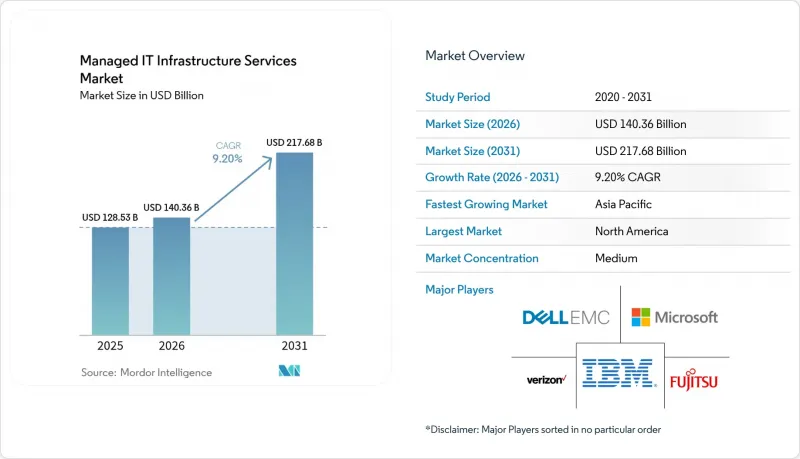
據 Mordor Intelligence 稱,2025 年託管IT基礎設施服務市場價值為 1285.3 億美元,預計到 2031 年將達到 2176.8 億美元,而 2026 年為 1403.6 億美元,預測期(2026-2031 年)的複合年成長率為 9.20%。
本報告按服務類別(虛擬化、網路、儲存、伺服器等)、企業規模(中小企業、大型企業)、部署模式(本地部署、雲端部署、混合部署)、最終用戶產業(IT與電信、銀行、金融服務和保險等)以及地區進行細分。市場預測以美元計價。
全球託管IT基礎設施基礎設施服務市場趨勢與洞察
透過外包實現成本最佳化
企業正以基於結果的夥伴關係取代基於人事費用套利的契約,並將節省下來的資金投入創新項目。託管服務供應商提供可預測的營運成本,使資訊長能夠將預算分配給人工智慧先導計畫和產品數位化。財務長的管治如今不再僅依據發票明細,而是根據運轉率、彈性和體驗評分來評估合作夥伴。這些趨勢再次表明,託管IT基礎設施服務市場不僅是降低成本的工具,更是創造價值的途徑。
變革浪潮:雲端優先與混合優先
雲端遷移已發展成熟,旨在最佳化跨多重雲端環境的工作負載部署。企業正在超大規模資料中心業者、託管資料中心和邊緣環境,以實現低延遲、資料主權和總體擁有成本 (TCO) 目標。 Oracle Database@Azure 專案已擴展至 24 個新區域,清楚地展示了共享服務目錄如何降低供應商鎖定風險並確保策略合規性。能夠設計和營運此類互聯基礎設施的供應商正在獲得規模更大、期限更長的契約,並推動託管IT基礎設施服務市場的發展。
安全和隱私問題
金融服務和醫療保健行業的董事會正從威脅暴露和合規性的角度仔細審查託管協議。 HIPAA 要求在工作負載離開醫院場所之前,必須簽訂完善的業務夥伴協議、採用多層加密並保留審計追蹤。冗長的實質審查可能會延長銷售週期並延遲獲利,這將抑制託管IT基礎設施服務市場的短期成長。
細分市場分析
到2025年,託管網路服務將佔總營收的33.72%,其中連線最佳化是整體需求的最大驅動力。企業持續推動SD-WAN和零信任架構的現代化改造,以支援混合辦公和對延遲敏感的SaaS服務。邊緣編配以11.33%的複合年成長率同步成長,反映了感測器密度的增加以及即時分析在工廠範圍內的擴展。在託管IT基礎設施服務市場,能夠將園區、分店、雲端和邊緣監控整合到單一可觀測性堆疊中的供應商備受青睞。
網路現代化也為高價值交叉銷售奠定了基礎。隨著線路和路由器逐漸被託管服務供應商(MSP) 遠端管理,SASE 閘道、防火牆即服務以及基於人工智慧的流量最佳化等相關服務也隨之興起。儘管隨著傳統硬體的精簡,虛擬化、儲存和伺服器管理的需求仍然強勁,但由於商品化,利潤率正在下降。相較之下,在多重雲端財務營運 (FinOps)、安全態勢管理和人工智慧工作負載調優的推動下,雲端基礎架構管理正在蓬勃發展。隨著託管IT基礎設施服務市場的日益成熟,能夠將這些層面打包成整合藍圖的供應商將獲得顯著的市場佔有率成長。
到2025年,大型企業將佔總收入的60.55%,這反映出其複雜的多區域環境需要全天候監控。同時,中小企業正受惠於訂閱定價模式,無需自建資料中心,預計到2031年,其複合年成長率將達到9.28%。雲端市場和自助服務入口網站使得即使是擁有500名員工的零售公司也能在數小時內完成託管防火牆、備份和可觀測性的部署。
由此帶來的用戶普及化正在推動託管IT基礎設施服務市場新客戶的成長。對MSP(託管服務供應商)而言,拓展中小企業客戶能夠提升營運效率,但其ARPU(每用戶平均收入)仍低於全球性企業。因此,規模經濟依賴自動化和人工智慧聊天機器人,以最大限度地減少人工工單處理,同時確保符合服務等級協定(SLA)。隨著消費模式的演變,靈活的合約條款和模組化套餐計劃仍將是贏得中小企業客戶的關鍵因素。
區域分析
預計到2025年,北美將維持34.12%的收入佔有率。這反映了其作為工作負載外包先驅的成熟度,以及支撐基於結果的合約的嚴格服務等級協議(SLA)。美國跨國公司正在續簽涵蓋雲端遷移、人工智慧共同開發和實現零信任的多年期合約。加拿大公司優先考慮混合平台以確保資料駐留,而墨西哥製造商正在部署與汽車4.0生產線相符的託管園區網路。該地區的供應商競爭異常激烈,中型託管服務供應商(MSP)和電信業者旗下公司之間的整合正在推進。
預計到2031年,亞太地區將以10.12%的複合年成長率成長,成為託管IT基礎設施服務市場成長最快的地區。在中國,政府主導的數位轉型正推動託管服務支出集中於智慧工廠平台。日本企業正在私有雲端上試點人工智慧叢集,以加速產品創新週期;而印度本土新創公司則直接從雲端採用按需計量收費的託管Kubernetes叢集。澳洲、韓國和東協五國正在經歷爆炸性成長,企業紛紛跳過傳統資料中心,直接遷移到SaaS和託管邊緣節點。
其他好處:
- Excel格式的市場預測(ME)表
- 3個月的分析師支持
目錄
第1章:引言
- 研究假設和市場定義
- 調查範圍
第2章:調查方法
第3章執行摘要
第4章 市場狀況
- 市場概覽
- 市場促進因素
- 透過外包實現成本最佳化
- 變革浪潮:雲端優先與混合優先
- 缺乏高階基礎設施維運方面的IT技能
- AI 驅動的超自動化縮短了平均修復時間(儘管它沒有得到太多關注)。
- 工業4.0中邊緣基礎設施的激增(一個經常被忽視的趨勢)
- 強制性綠色資料中心和ESG評分卡(未被注意到的發展)
- 市場限制因素
- 安全和隱私問題
- 供應商鎖定和整合複雜性
- MSP(託管服務提供者)的電力和冷卻相關營運成本(OPEX)增加(一個被忽視的因素)
- 資料主權/地緣政治分裂(這一點並未公開討論)
- 供應鏈分析
- 監理情勢
- 技術展望
- 波特五力分析
- 宏觀經濟因素對市場的影響
第5章 市場規模與成長預測
- 服務類別
- 虛擬化
- 網路
- 貯存
- 伺服器
- 雲端基礎設施管理
- 邊緣基礎設施管理
- 按公司規模
- 小型企業
- 大公司
- 按部署模式
- 現場
- 雲
- 混合
- 按最終用戶行業分類
- IT/通訊
- BFSI
- 製造業
- 零售與電子商務
- 運輸/物流
- 衛生保健
- 能源公用事業
- 區域分析
- 北美洲
- 美國
- 加拿大
- 墨西哥
- 南美洲
- 巴西
- 阿根廷
- 其他南美國家
- 歐洲
- 德國
- 英國
- 法國
- 義大利
- 西班牙
- 俄羅斯
- 其他歐洲國家
- 亞太地區
- 中國
- 日本
- 印度
- 韓國
- 澳洲
- 其他亞太國家
- 中東
- 沙烏地阿拉伯
- 阿拉伯聯合大公國
- 土耳其
- 其他中東國家
- 非洲
- 南非
- 奈及利亞
- 肯亞
- 其他非洲國家
- 北美洲
第6章 競爭情勢
- 市場集中度
- 策略趨勢
- 市佔率分析
- 公司簡介
- Accenture plc
- Amazon Web Services, Inc.
- ATandT Inc.
- Capgemini SE
- Cisco Systems, Inc.
- Cognizant Technology Solutions Corp.
- Dell Technologies Inc.
- DXC Technology Company
- Fujitsu Limited
- Google LLC
- HCL Technologies Ltd.
- Hewlett Packard Enterprise Co.
- IBM Corporation
- Kyndryl Holdings, Inc.
- Microsoft Corporation
- NTT DATA Corporation
- Rackspace Technology, Inc.
- Tata Consultancy Services Ltd.
- Verizon Communications Inc.
- Wipro Limited
第7章 市場機會與未來展望
According to Mordor Intelligence, the managed IT infrastructure services market size was valued at USD 128.53 billion in 2025 and estimated to grow from USD 140.36 billion in 2026 to reach USD 217.68 billion by 2031, at a CAGR of 9.20% during the forecast period (2026-2031).
This report is Segmented by Service Category (Virtualization, Networking, Storage, Servers, and More), Enterprise Size (Small and Medium Enterprises, Large Enterprises), Deployment Model (On-Premises, Cloud, Hybrid), End-User Industry (IT and Telecommunication, BFSI, and More), and Geography. The Market Forecasts are Provided in Terms of Value (USD).
Global Managed IT Infrastructure Services Market Trends and Insights
Cost Optimisation Through Outsourcing
Enterprises are replacing labour-arbitrage contracts with outcome-based partnerships that funnel savings into innovation programs. Managed vendors provide predictable operating expenses, freeing CIO budgets for AI pilots and product digitization. CFO stewardship now benchmarks partners on uptime, resiliency, and experience scores rather than invoice line items. These dynamics reaffirm the managed IT infrastructure services market as a lever for value creation rather than a cost-cutting commodity.
Cloud and Hybrid-First Transformation Wave
Cloud migration has matured into workload placement optimisation across multicloud estates. Enterprises mix hyperscaler, colocation, and edge footprints to satisfy latency, sovereignty, and TCO goals. The expanded Oracle Database@Azure program-now in 24 additional regions-underscores how joint service catalogs mitigate lock-in and achieve policy compliance. Providers able to engineer and operate these interwoven fabrics win larger, longer contracts that elevate the managed IT infrastructure services market.
Security and Privacy Concerns
Financial services and healthcare boards scrutinise managed deals for threat exposure and compliance posture. HIPAA requires robust Business Associate Agreements, layered encryption, and audit trails before workloads leave hospital campuses. Extended due diligence lengthens sales cycles and can delay revenue realisation, tempering near-term growth for the managed IT infrastructure services market.
Other drivers and restraints analyzed in the detailed report include:
- IT-Skills Shortage in Advanced Infrastructure Ops
- AI-Driven Hyper-Automation Lowers MTTR
- Vendor Lock-in and Integration Complexity
For complete list of drivers and restraints, kindly check the Table Of Contents.
Segment Analysis
In 2025, managed network services accounted for 33.72% of total revenue, making connectivity optimisation the biggest contributor to overall demand. Enterprises continue to modernise SD-WAN and zero-trust architectures to support hybrid work and latency-sensitive SaaS. Parallel growth in edge orchestration at an 11.33% CAGR mirrors rising sensor density and real-time analytics across factories. The managed IT infrastructure services market rewards vendors that merge campus, branch, cloud, and edge monitoring into single observability stacks.
Network modernisation also anchors higher-value cross-selling. Once circuits and routers fall under an MSP's remote management, adjacent services such as SASE gateways, firewall-as-a-service, and AI-based traffic optimisation follow. Virtualisation, storage, and server management maintain steady demand as legacy hardware is rationalised, but margins trend lower due to commoditisation. By contrast, cloud infrastructure management is ascending on the back of multicloud finops, security posture management, and AI workload tuning. Providers that package these layers in integrated blueprints will capture outsized wallet share as the managed IT infrastructure services market matures.
Large enterprises delivered 60.55% of 2025 billings, reflecting complex multiregional estates needing 24X7 oversight. However, SMEs now post a 9.28% CAGR to 2031, benefitting from subscription pricing that obviates data-center buildouts. Cloud marketplaces and self-service portals let a 500-employee retailer spin up managed firewalls, backups, and observability within hours.
The resulting democratization fuels net-new logo growth inside the managed IT infrastructure services market. For MSPs, SME onboarding drives volume efficiency, though ARPU remains lower than with global accounts. Economies of scale thus hinge on automation and AI chatbots that minimise manual ticket handling while preserving SLA adherence. As consumption models evolve, flexible term lengths and modular bundles will remain decisive in winning SME contracts.
Complete Report Scope:
- By Service Category
- Virtualization
- Networking
- Storage
- Servers
- Cloud Infrastructure Management
- Edge Infrastructure Management
- By Enterprise Size
- Small and Medium Enterprises
- Large Enterprises
- By Deployment Model
- On-premises
- Cloud
- Hybrid
- By End-User Industry
- IT and Telecommunication
- BFSI
- Manufacturing
- Retail and E-commerce
- Transportation and Logistics
- Healthcare
- Energy and Utilities
- Geographic Analysis
- North America
- United States
- Canada
- Mexico
- South America
- Brazil
- Argentina
- Rest of South America
- Europe
- Germany
- United Kingdom
- France
- Italy
- Spain
- Russia
- Rest of Europe
- Asia-Pacific
- China
- Japan
- India
- South Korea
- Australia
- Rest of Asia-Pacific
- Middle East
- Saudi Arabia
- United Arab Emirates
- Turkey
- Rest of Middle East
- Africa
- South Africa
- Nigeria
- Kenya
- Rest of Africa
- North America
Geography Analysis
North America sustained 34.12% revenue share in 2025, reflecting early-mover maturity in workload outsourcing and stringent SLAs that favour outcome-based contracts. United States multinationals execute multi-year renewals covering cloud migration, AI co-development, and zero-trust enablement. Canadian firms prioritise hybrid platforms to ensure data residency, and Mexican manufacturers deploy managed campus networks aligned with Automotive-4.0 production lines. Vendor competition here is intense, driving consolidation among midsized MSPs and telecom-carrier captives.
Asia Pacific is projected to grow at 10.12% CAGR through 2031, the fastest regional pace inside the managed IT infrastructure services market. China's state-incentivised digitisation funnels managed spend into smart-factory platforms. Japan's enterprises experiment with private-cloud AI clusters to accelerate product innovation cycles, while India's domestic startups adopt consumption-based managed Kubernetes clusters straight from the cloud. Australia, South Korea, and ASEAN-5 economies witness leapfrog uptake as businesses bypass legacy data centers and go straight to SaaS and managed edge nodes.
- Accenture plc
- Amazon Web Services, Inc.
- ATandT Inc.
- Capgemini SE
- Cisco Systems, Inc.
- Cognizant Technology Solutions Corp.
- Dell Technologies Inc.
- DXC Technology Company
- Fujitsu Limited
- Google LLC
- HCL Technologies Ltd.
- Hewlett Packard Enterprise Co.
- IBM Corporation
- Kyndryl Holdings, Inc.
- Microsoft Corporation
- NTT DATA Corporation
- Rackspace Technology, Inc.
- Tata Consultancy Services Ltd.
- Verizon Communications Inc.
- Wipro Limited
Additional Benefits:
- The market estimate (ME) sheet in Excel format
- 3 months of analyst support
TABLE OF CONTENTS
1 INTRODUCTION
- 1.1 Study Assumptions and Market Definition
- 1.2 Scope of the Study
2 RESEARCH METHODOLOGY
3 EXECUTIVE SUMMARY
4 MARKET LANDSCAPE
- 4.1 Market Overview
- 4.2 Market Drivers
- 4.2.1 Cost optimisation through outsourcing
- 4.2.2 Cloud and hybrid-first transformation wave
- 4.2.3 IT-skills shortage in advanced infrastructure ops
- 4.2.4 AI-driven hyper-automation lowers MTTR (under-radar)
- 4.2.5 Edge infrastructure surge in Industry 4.0 (under-radar)
- 4.2.6 Green-datacentre mandates and ESG scorecards (under-radar)
- 4.3 Market Restraints
- 4.3.1 Security and privacy concerns
- 4.3.2 Vendor lock-in and integration complexity
- 4.3.3 Escalating power-/cooling OPEX for MSPs (under-radar)
- 4.3.4 Data-sovereignty/geopolitical fragmentation (under-radar)
- 4.4 Supply-Chain Analysis
- 4.5 Regulatory Landscape
- 4.6 Technological Outlook
- 4.7 Porter's Five Forces Analysis
- 4.7.1 Threat of New Entrants
- 4.7.2 Bargaining Power of Buyers
- 4.7.3 Bargaining Power of Suppliers
- 4.7.4 Threat of Substitutes
- 4.7.5 Competitive Rivalry
- 4.8 Impact of Macroeconomic Factors on the Market
5 MARKET SIZE AND GROWTH FORECASTS (VALUE)
- 5.1 By Service Category
- 5.1.1 Virtualization
- 5.1.2 Networking
- 5.1.3 Storage
- 5.1.4 Servers
- 5.1.5 Cloud Infrastructure Management
- 5.1.6 Edge Infrastructure Management
- 5.2 By Enterprise Size
- 5.2.1 Small and Medium Enterprises
- 5.2.2 Large Enterprises
- 5.3 By Deployment Model
- 5.3.1 On-premises
- 5.3.2 Cloud
- 5.3.3 Hybrid
- 5.4 By End-User Industry
- 5.4.1 IT and Telecommunication
- 5.4.2 BFSI
- 5.4.3 Manufacturing
- 5.4.4 Retail and E-commerce
- 5.4.5 Transportation and Logistics
- 5.4.6 Healthcare
- 5.4.7 Energy and Utilities
- 5.5 Geographic Analysis
- 5.5.1 North America
- 5.5.1.1 United States
- 5.5.1.2 Canada
- 5.5.1.3 Mexico
- 5.5.2 South America
- 5.5.2.1 Brazil
- 5.5.2.2 Argentina
- 5.5.2.3 Rest of South America
- 5.5.3 Europe
- 5.5.3.1 Germany
- 5.5.3.2 United Kingdom
- 5.5.3.3 France
- 5.5.3.4 Italy
- 5.5.3.5 Spain
- 5.5.3.6 Russia
- 5.5.3.7 Rest of Europe
- 5.5.4 Asia-Pacific
- 5.5.4.1 China
- 5.5.4.2 Japan
- 5.5.4.3 India
- 5.5.4.4 South Korea
- 5.5.4.5 Australia
- 5.5.4.6 Rest of Asia-Pacific
- 5.5.5 Middle East
- 5.5.5.1 Saudi Arabia
- 5.5.5.2 United Arab Emirates
- 5.5.5.3 Turkey
- 5.5.5.4 Rest of Middle East
- 5.5.6 Africa
- 5.5.6.1 South Africa
- 5.5.6.2 Nigeria
- 5.5.6.3 Kenya
- 5.5.6.4 Rest of Africa
- 5.5.1 North America
6 COMPETITIVE LANDSCAPE
- 6.1 Market Concentration
- 6.2 Strategic Moves
- 6.3 Market Share Analysis
- 6.4 Company Profiles (includes Global level Overview, Market level overview, Core Segments, Financials as available, Strategic Information, Market Rank/Share for key companies, Products and Services, and Recent Developments)
- 6.4.1 Accenture plc
- 6.4.2 Amazon Web Services, Inc.
- 6.4.3 ATandT Inc.
- 6.4.4 Capgemini SE
- 6.4.5 Cisco Systems, Inc.
- 6.4.6 Cognizant Technology Solutions Corp.
- 6.4.7 Dell Technologies Inc.
- 6.4.8 DXC Technology Company
- 6.4.9 Fujitsu Limited
- 6.4.10 Google LLC
- 6.4.11 HCL Technologies Ltd.
- 6.4.12 Hewlett Packard Enterprise Co.
- 6.4.13 IBM Corporation
- 6.4.14 Kyndryl Holdings, Inc.
- 6.4.15 Microsoft Corporation
- 6.4.16 NTT DATA Corporation
- 6.4.17 Rackspace Technology, Inc.
- 6.4.18 Tata Consultancy Services Ltd.
- 6.4.19 Verizon Communications Inc.
- 6.4.20 Wipro Limited
7 MARKET OPPORTUNITIES AND FUTURE OUTLOOK
- 7.1 White-space and Unmet-Need Assessment


