


 |
市場調查報告書
商品編碼
2122332
銀行業物聯網:市場佔有率分析、產業趨勢與統計及成長預測(2026-2031 年)Internet Of Things In Banking - Market Share Analysis, Industry Trends & Statistics, Growth Forecasts (2026 - 2031) |
||||||

※ 本網頁內容可能與最新版本有所差異。詳細情況請與我們聯繫。
據 Mordor Intelligence 稱,2025 年銀行業物聯網市值為 391.6 億美元,預計到 2031 年將達到 2001.8 億美元,高於 2026 年的 514 億美元。
預測期(2026-2031 年)的複合年成長率預計為 31.25%。
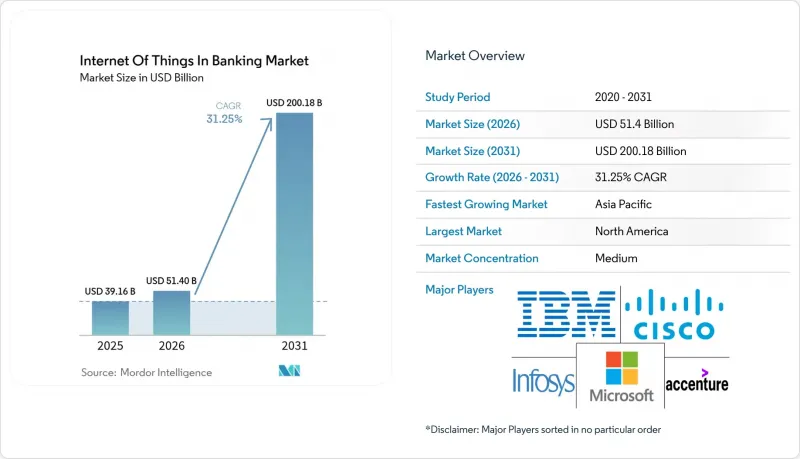
本報告按組件(解決方案、服務)、應用(安全、監控、其他)、組織規模(大型企業、中小企業)、最終用戶(零售銀行、公司銀行、投資銀行、其他)和地區進行分類。
全球銀行業物聯網市場趨勢與洞察
透過全通路策略提升客戶體驗
銀行正將感測器整合到ATM機、行動應用和穿戴式裝置中,以打造無縫銜接的線上線下客戶體驗。國民威斯敏斯特銀行(NatWest)升級了5,500台ATM機,配備了19吋觸控螢幕和即時遙測功能,可在故障發生前進行檢測。該銀行還發布了一款適用於Apple Vision Pro的零售銀行應用,讓客戶透過視線和手勢進行資金操作。這些整合使金融機構能夠結合位置、設備狀態和購買模式來預測客戶需求,在已實施的案例中,交叉銷售準確率提高了三分之一。利用感測器分析,分店可以在客戶到達前安排網點人員、發出排隊提醒並提供動態個人化優惠,從而使客戶滿意度評分提升兩位數。因此,銀行業物聯網市場正受惠於用戶留存率的提高和營運成本的降低。
即時詐欺偵測和安全
分散式感測器將資料傳送到異常偵測引擎,該引擎可在毫秒內標記可疑模式。結合裝置遙測資料和交易流的聯邦學習模型目前可實現 96.3% 的詐欺偵測準確率,同時將資料本地化以保護隱私。智慧攝影機和環境感測器監控 ATM 機和提款機,偵測讀卡機和異常溫度升高等竄改跡象。邊緣應用的區塊鏈雜湊生成防篡改日誌用於糾紛解決,而設備端 AI 則減少了曾經困擾客戶的誤報。早期採用者報告稱,在實施的第一年,詐欺相關損失減少了 20% 以上。隨著安全情勢日益嚴峻,持續的投資正在進行中,銀行業物聯網也在加強,以應對網路犯罪的威脅。
對資料隱私和網路安全的擔憂
歐盟的《網路彈性法案》強制要求製造商在出廠設備中配備自動安全更新功能,這使得無法維護無線修補程式的供應商面臨風險。銀行面臨著日益繁重的合規負擔,因為它們必須應對日益多樣化的法規,從加州的《消費者隱私法案》到印度的《數位個人資料保護法案》。糟糕的系統隔離可能導致單一感測器的漏洞破壞銀行的核心系統。雖然一項聯邦學習先導計畫已證明,在不匯出原始資料的情況下,模型準確率高達 99.94%,但許多金融機構在保護其設備生態系統方面仍面臨技能缺口。不斷上漲的網路保險費可能會推高專案成本,並減緩銀行業對物聯網的採用。
細分市場分析
到2025年,服務部門將佔總收入的57.40%,這凸顯了特定領域的專業知識、監管知識以及全天候支援對於複雜部署成功至關重要。預計銀行業物聯網市場服務板塊將以30.40%的複合年成長率成長,這反映出市場對整合商的需求,他們需要將感測器整合到傳統核心系統和雲端架構中。銀行通常會將威脅建模、合規性映射和設備生命週期管治,以降低風險。解決方案包括硬體套件、軟體平台和連接包,這些方案受益於向雲端原生技術的轉變,使金融機構能夠淘汰本地資料中心。 IBM和Wipro共同推出的人工智慧平台等產品,將分析功能與網路安全增強功能結合,加劇了解決方案供應商之間的競爭。
在第二代部署中,「按需付費」的託管收費更受歡迎,小規模的銀行也傾向於採用承包解決方案而非內部開發,因為內部開發會帶來巨大的資本投入負擔。供應商將邊緣運算節點與預先認證的開放銀行API連接器打包,以縮短價值實現時間。由於硬體利潤率仍然較低,供應商正將重心轉向以設備監控和預測性維護為中心的經常性收入模式。隨著雲端供應商發布金融級邊緣運算堆疊,銀行業物聯網市場正進一步向以服務為中心的經營模式轉型。
預計到2025年,安全應用將佔總收入的35.80%,年複合成長率(CAGR)為33.80%,主要受監管要求和攻擊途徑擴展的推動。預計到2026年,銀行業物聯網市場安全細分市場規模將達到187.6億美元,到2031年將超過802.9億美元。智慧型ATM可以偵測溫度、震動或竄改模式的異常情況,並自動鎖定提款機。設備級加密和信任根(RoT)晶片現已成為高階終端的標配,從而縮短了合規性審計所需的時間。
儘管監控、資料管理和客戶體驗模組共用基礎設施,但它們的分析能力卻各不相同。銀行正在利用遙測技術最佳化分店的能源使用,從而實現每年高達 12% 的電力成本降低。客戶體驗引擎將訪客計數感測器與客戶關係管理 (CRM) 歷史記錄整合,以便在分店內自動顯示個人化問候語。在同一感測器網路上託管多個應用程式的整合平台有助於降低整體擁有成本 (TCO),並提升物聯網市場在銀行業的整體吸引力。
區域分析
由於健全的網路安全法規以及金融科技公司與銀行早期建立的合作關係,北美預計將保持主導地位,到2025年將佔全球收入的37.90%。已部署感測器的分店生產力提高了30%至40%,量子試驗演算法的處理速度比傳統最佳化演算法快1000倍。在加拿大,透過社區聯網的ATM機,現金流通更加普及;而在墨西哥,基於物聯網的匯款自助終端正被用於降低交易費用。在銀行業物聯網市場,聯邦政府對服務欠缺地區5G部署的支持,正幫助縮小整個北美大陸的延遲差距。
亞太地區是成長的主要驅動力,正以32.70%的複合年成長率快速成長。在中國,愛信銀行利用融合物聯網資料的微服務核心,為超過1億客戶提供個人化貸款服務。在印度,邊緣微型資料中心正在部署,將行動銀行擴展到光纖基礎設施不足的農村地區。東南亞的超級應用程式正在整合叫車、外送和即時貸款等服務,並透過物聯網感測器追蹤駕駛者表現,實現動態溢價。區域監管機構正在加快沙盒核准流程,確保銀行業物聯網市場能夠充分利用智慧型手機日益成長的普及率。
在歐洲,隱私和ESG(環境、社會和治理)是取得進展的先決條件。目前正在討論的PSD3和PSR正在強制要求認證和API標準化,從而加速安全設備的普及。金融機構正在整合能源監測感測器,以衡量其碳足跡並與其淨零排放藍圖保持一致。設備製造商正在採用節能晶片,以應對人們對物聯網電力消耗的批評。在拉丁美洲、中東和非洲等新興地區,支付現代化專案和行動支付系統為物聯網的快速普及創造了有利條件。例如,巴西的PIX和奈及利亞的eNaira等支付基礎設施使物聯網終端能夠發起即時支付,豐富了銀行業物聯網市場的收入來源。
其他好處
- Excel格式的市場預測(ME)表
- 3個月的分析師支持
目錄
第1章:引言
- 研究假設和市場定義
- 調查範圍
第2章:調查方法
第3章執行摘要
第4章 市場狀況
- 市場概覽
- 市場促進因素
- 透過全通路策略提升客戶體驗
- 即時詐欺偵測和安全
- 開放銀行相關的監理義務
- 利用感測器最佳化分店和ATM的成本
- 支援物聯網的嵌入式支付系統(汽車和家用電器)
- 利用邊緣分析技術實現超個人化小額貸款
- 市場限制因素
- 對資料隱私和網路安全的擔憂
- 設備和平台之間的互通性差距
- 農村地區5G延遲相關的瓶頸
- ESG對物聯網能源消耗的審查
- 價值鏈分析
- 監理情勢
- 技術展望
- 波特五力分析
- 主要用例和案例研究
- 追蹤原料庫存,用於貸款申請審核。
- 靈活融資條件下的農業生產分析
- 基於物聯網的網路攻擊防禦系統
- 零售銀行業現狀
- 提前通知支援 Beacon 功能的 ATM(摩根大通)
- 提供殘障客戶分店內行動協助(巴克萊銀行)
- 振興未充分利用的分店(美國銀行和花旗銀行)
第5章 市場規模與成長預測
- 按組件
- 解決方案
- 服務
- 透過使用
- 安全
- 監測
- 資料管理
- 客戶經驗管理
- 其他
- 按組織規模
- 大公司
- 小型企業
- 最終用戶
- 零售銀行
- 企業銀行
- 投資銀行
- 非銀行金融公司
- 保險
- 按地區
- 北美洲
- 美國
- 加拿大
- 墨西哥
- 南美洲
- 巴西
- 阿根廷
- 其他南美國家
- 歐洲
- 德國
- 英國
- 法國
- 俄羅斯
- 其他歐洲國家
- 亞太地區
- 中國
- 印度
- 日本
- 韓國
- 其他亞太國家
- 中東和非洲
- 中東
- 沙烏地阿拉伯
- 阿拉伯聯合大公國
- 土耳其
- 其他中東國家
- 非洲
- 南非
- 奈及利亞
- 其他非洲地區
- 中東
- 北美洲
第6章 競爭情勢
- 市場集中度
- 策略趨勢
- 市佔率分析
- 公司簡介
- IBM Corporation
- Microsoft Corporation
- Cisco Systems Inc.
- Oracle Corporation
- Accenture plc
- Temenos AG
- Infosys Limited
- Software AG
- Vodafone Group plc
- Tibbo Systems
- SAP SE
- Capgemini SE
- Intel Corporation
- Amazon Web Services
- FIS Global
- NCR Atleos
- Thales Group
- Diebold Nixdorf
- HPE(Aruba)
- Huawei Technologies
第7章 市場機會與未來展望
According to Mordor Intelligence, the internet of things in banking market size was valued at USD 39.16 billion in 2025 and estimated to grow from USD 51.4 billion in 2026 to reach USD 200.18 billion by 2031, at a CAGR of 31.25% during the forecast period (2026-2031).
This report is Segmented by Component (Solutions and Services), Application (Security, Monitoring, and More), Organization Size (Large Enterprises and Small and Medium Enterprises), End User (Retail Banking, Corporate Banking, Investment Banking, and More), and Geography.
Global Internet Of Things In Banking Market Trends and Insights
Omnichannel Customer-Experience Push
Banks wire sensors into ATMs, mobile apps, and wearables to create journeys that pivot seamlessly across physical and digital environments. NatWest upgraded 5,500 ATMs with 19-inch touchscreens and live telemetry that flags downtime before it occurs. The bank also released a retail-banking app for Apple Vision Pro so clients can move funds using gaze and gesture. Such integrations let institutions blend geolocation, device health, and purchase patterns to anticipate needs, lifting cross-sell accuracy by one-third on mature rollouts. Sensor analytics enable pre-visit branch staffing, queue alerts, and dynamic personalized offers that raise customer satisfaction scores by double digits. The Internet of Things in Banking market, therefore, benefits from higher user stickiness and reduced operating costs.
Real-Time Fraud Detection and Security
Distributed sensors feed anomaly engines that flag suspicious patterns in milliseconds. A federated-learning model combining device telemetry with transaction streams now achieves 96.3% fraud-detection accuracy while keeping data local for privacy. Smart cameras and environmental sensors guard ATMs and cash machines, detecting skimming devices or abnormal temperature spikes that hint at tampering. Blockchain hashes applied at the edge create immutable logs for dispute resolution, and on-device AI reduces false positives that once annoyed customers. Early adopters report fraud-loss reductions of more than 20% in the first implementation year. Security urgency propels continual investment, fortifying the Internet of Things in the Banking market against cybercrime-related hesitancy.
Data-Privacy and Cybersecurity Concerns
The EU Cyber Resilience Act obliges manufacturers to ship devices with automatic security updates, exposing vendors that cannot maintain over-the-air patching. Banks must track diverging rules from California's Consumer Privacy Act to India's Digital Personal Data Protection law, adding compliance overhead. Breaches at a single sensor can undermine banking cores if segmentation is weak. Federated-learning pilots show 99.94% model accuracy without exporting raw data, but most lenders still face skills gaps in securing device fleets. Rising insurance premiums for cyber coverage inflate project costs and can slow adoption within the Internet of Things in Banking market.
Other drivers and restraints analyzed in the detailed report include:
- Regulatory Open-Banking Mandates
- IoT-Enabled Embedded Payments (Cars and Appliances)
- Device / Platform Interoperability Gaps
For complete list of drivers and restraints, kindly check the Table Of Contents.
Segment Analysis
Services hold 57.40% of 2025 revenue, underscoring that domain expertise, regulatory insight, and 24-hour support tilt outcomes in complex rollouts. The Internet of Things in Banking market size for services is projected to expand at 30.40% CAGR, reflecting demand for integrators who stitch sensors into legacy cores and cloud fabrics. Banks often outsource threat modeling, compliance mapping, and device-life-cycle governance to reduce risk. Solutions cover hardware kits, software platforms, and connectivity bundles, and they benefit from cloud-native shifts that let lenders retire on-premises data centers. Joint offers, such as IBM-Wipro's AI-enabled platform, bundle analytics and cyber hardening, amplifying competition among solution providers.
Second-generation deployments favor pay-as-you-grow managed services, pushing smaller banks to embrace turnkey bundles rather than capex-heavy in-house builds. Vendors are packaging edge-compute nodes with pre-certified connectors for open-banking APIs, trimming time to value. Hardware margins remain thin, so suppliers pivot to annuity models around device monitoring and predictive maintenance. As cloud vendors release financial-grade edge stacks, the Internet of Things in Banking market further tilts toward service-centric economics.
Security applications captured 35.80% of 2025 revenue and expand at 33.80% CAGR, riding regulatory imperatives and growing attack vectors. The Internet of Things in Banking market size for security reached USD 18.76 billion in 2026 and is forecast to exceed USD 80.29 billion by 2031. Smart ATMs detect temperature anomalies, shock events, or tampering patterns and can lock dispensers automatically. Device-level encryption and root-of-trust chips now ship by default in premium terminals, reducing compliance audit time.
Monitoring, data management, and customer experience modules share infrastructure but vary in analytics heft. Banks leverage telemetry to optimize branch energy use, cutting power costs by up to 12% year over year. Customer-experience engines marry foot-traffic sensors with CRM histories to trigger in-branch personalized greetings. Integrated platforms that host multiple applications on the same sensor grid help reduce overall TCO, broadening appeal across the Internet of Things in the Banking market.
Complete Report Scope:
- By Component
- Solutions
- Services
- By Application
- Security
- Monitoring
- Data Management
- Customer Experience Management
- Other Applications
- By Organization Size
- Large Enterprises
- Small and Medium Enterprises
- By End User
- Retail Banking
- Corporate Banking
- Investment Banking
- Non-Banking Financial Companies
- Insurance
- By Geography
- North America
- United States
- Canada
- Mexico
- South America
- Brazil
- Argentina
- Rest of South America
- Europe
- Germany
- United Kingdom
- France
- Russia
- Rest of Europe
- Asia Pacific
- China
- India
- Japan
- South Korea
- Rest of Asia Pacific
- Middle East and Africa
- Middle East
- Saudi Arabia
- United Arab Emirates
- Turkey
- Rest of Middle East
- Africa
- South Africa
- Nigeria
- Rest of Africa
- Middle East
- North America
Geography Analysis
North America retains leadership with 37.90% of 2025 revenue, buoyed by solid cyber legislation and early fintech-bank partnerships. Sensor-enabled branches post 30-40% productivity uplifts, and quantum-trial algorithms run 1,000 times faster than legacy optimizers. Canada advances cash-circle inclusion through connected community ATMs, while Mexico leverages IoT-based remittance kiosks that cut transaction fees. The Internet of Things in Banking market sees federal support for 5G expansion into underserved zones, flattening latency disparities across the continent.
Asia-Pacific is the growth engine, charging ahead at 32.70% CAGR. China's AIBank serves more than 100 million customers on microservices cores that ingest IoT data to personalize lending. India deploys edge mini-data centers to extend mobile banking into rural districts where fiber remains sparse. Southeast Asian super-apps fuse ride-hailing, food delivery, and instant credit, with IoT sensors tracking driver performance for dynamic insurance pricing. Regional regulators fast-track sandbox approvals, ensuring the Internet of Things in Banking market captures rising smartphone penetration.
Europe predicates progress on privacy and ESG. PSD3 and the pending PSR impose mandatory authentication and harmonized APIs, fostering secure device onboarding. Institutions integrate energy-monitoring sensors to gauge carbon footprints, aligning with commitments to net-zero roadmaps. Device makers embed power-thrifty chips, addressing scrutiny over IoT electricity draw. In emerging regions of Latin America and the Middle East and Africa, payments modernization programs and mobile-money regimes create fertile ground for leapfrogging deployments. For instance, Brazil's PIX and Nigeria's eNaira rails allow IoT endpoints to initiate real-time payments, diversifying revenue sources within the Internet of Things in Banking market.
- IBM Corporation
- Microsoft Corporation
- Cisco Systems Inc.
- Oracle Corporation
- Accenture plc
- Temenos AG
- Infosys Limited
- Software AG
- Vodafone Group plc
- Tibbo Systems
- SAP SE
- Capgemini SE
- Intel Corporation
- Amazon Web Services
- FIS Global
- NCR Atleos
- Thales Group
- Diebold Nixdorf
- HPE (Aruba)
- Huawei Technologies
Additional Benefits:
- The market estimate (ME) sheet in Excel format
- 3 months of analyst support
TABLE OF CONTENTS
1 INTRODUCTION
- 1.1 Study Assumptions and Market Definition
- 1.2 Scope of the Study
2 RESEARCH METHODOLOGY
3 EXECUTIVE SUMMARY
4 MARKET LANDSCAPE
- 4.1 Market Overview
- 4.2 Market Drivers
- 4.2.1 Omnichannel customer-experience push
- 4.2.2 Real-time fraud detection and security
- 4.2.3 Regulatory open-banking mandates
- 4.2.4 Branch/ATM cost-optimization via sensors
- 4.2.5 IoT-enabled embedded payments (cars and appliances)
- 4.2.6 Edge-analytics-driven hyper-personalized microlending
- 4.3 Market Restraints
- 4.3.1 Data-privacy and cybersecurity concerns
- 4.3.2 Device / platform interoperability gaps
- 4.3.3 Rural 5G latency bottlenecks
- 4.3.4 ESG scrutiny on IoT energy consumption
- 4.4 Value Chain Analysis
- 4.5 Regulatory Landscape
- 4.6 Technological Outlook
- 4.7 Porter's Five Forces Analysis
- 4.7.1 Bargaining Power of Suppliers
- 4.7.2 Bargaining Power of Buyers
- 4.7.3 Threat of New Entrants
- 4.7.4 Threat of Substitute Products
- 4.7.5 Intensity of Competitive Rivalry
- 4.8 Key Use-cases and Case Studies
- 4.8.1 Tracking raw-material inventory for loan underwriting
- 4.8.2 Farm-output analytics for flexible lending terms
- 4.8.3 IoT-driven cyber-attack prevention systems
- 4.9 Retail Banking Landscape
- 4.9.1 Beacon-enabled ATM pre-announce (JPM Chase)
- 4.9.2 In-branch navigation for disabled customers (Barclays)
- 4.9.3 Beacon revival of under-used branches (US Bank and Citi)
5 MARKET SIZE AND GROWTH FORECASTS (VALUE)
- 5.1 By Component
- 5.1.1 Solutions
- 5.1.2 Services
- 5.2 By Application
- 5.2.1 Security
- 5.2.2 Monitoring
- 5.2.3 Data Management
- 5.2.4 Customer Experience Management
- 5.2.5 Other Applications
- 5.3 By Organization Size
- 5.3.1 Large Enterprises
- 5.3.2 Small and Medium Enterprises
- 5.4 By End User
- 5.4.1 Retail Banking
- 5.4.2 Corporate Banking
- 5.4.3 Investment Banking
- 5.4.4 Non-Banking Financial Companies
- 5.4.5 Insurance
- 5.5 By Geography
- 5.5.1 North America
- 5.5.1.1 United States
- 5.5.1.2 Canada
- 5.5.1.3 Mexico
- 5.5.2 South America
- 5.5.2.1 Brazil
- 5.5.2.2 Argentina
- 5.5.2.3 Rest of South America
- 5.5.3 Europe
- 5.5.3.1 Germany
- 5.5.3.2 United Kingdom
- 5.5.3.3 France
- 5.5.3.4 Russia
- 5.5.3.5 Rest of Europe
- 5.5.4 Asia Pacific
- 5.5.4.1 China
- 5.5.4.2 India
- 5.5.4.3 Japan
- 5.5.4.4 South Korea
- 5.5.4.5 Rest of Asia Pacific
- 5.5.5 Middle East and Africa
- 5.5.5.1 Middle East
- 5.5.5.1.1 Saudi Arabia
- 5.5.5.1.2 United Arab Emirates
- 5.5.5.1.3 Turkey
- 5.5.5.1.4 Rest of Middle East
- 5.5.5.2 Africa
- 5.5.5.2.1 South Africa
- 5.5.5.2.2 Nigeria
- 5.5.5.2.3 Rest of Africa
- 5.5.5.1 Middle East
- 5.5.1 North America
6 COMPETITIVE LANDSCAPE
- 6.1 Market Concentration
- 6.2 Strategic Moves
- 6.3 Market Share Analysis
- 6.4 Company Profiles (includes Global level Overview, Market level overview, Core Segments, Financials as available, Strategic Information, Market Rank/Share for key companies, Products and Services, and Recent Developments)
- 6.4.1 IBM Corporation
- 6.4.2 Microsoft Corporation
- 6.4.3 Cisco Systems Inc.
- 6.4.4 Oracle Corporation
- 6.4.5 Accenture plc
- 6.4.6 Temenos AG
- 6.4.7 Infosys Limited
- 6.4.8 Software AG
- 6.4.9 Vodafone Group plc
- 6.4.10 Tibbo Systems
- 6.4.11 SAP SE
- 6.4.12 Capgemini SE
- 6.4.13 Intel Corporation
- 6.4.14 Amazon Web Services
- 6.4.15 FIS Global
- 6.4.16 NCR Atleos
- 6.4.17 Thales Group
- 6.4.18 Diebold Nixdorf
- 6.4.19 HPE (Aruba)
- 6.4.20 Huawei Technologies
7 MARKET OPPORTUNITIES AND FUTURE OUTLOOK
- 7.1 White-space and Unmet-need Assessment


