


 |
市場調查報告書
商品編碼
2122301
網路頻寬管理軟體:市場佔有率分析、產業趨勢與統計、成長預測(2026-2031)Network Bandwidth Management Software - Market Share Analysis, Industry Trends & Statistics, Growth Forecasts (2026 - 2031) |
||||||

※ 本網頁內容可能與最新版本有所差異。詳細情況請與我們聯繫。
根據 Mordor Intelligence 預測,網路頻寬管理軟體市場規模將從 2025 年的 32.1 億美元成長到 2026 年的 34.1 億美元,到 2031 年將達到 46.3 億美元,2026 年至 2031 年的複合年成長率為 6.29%。
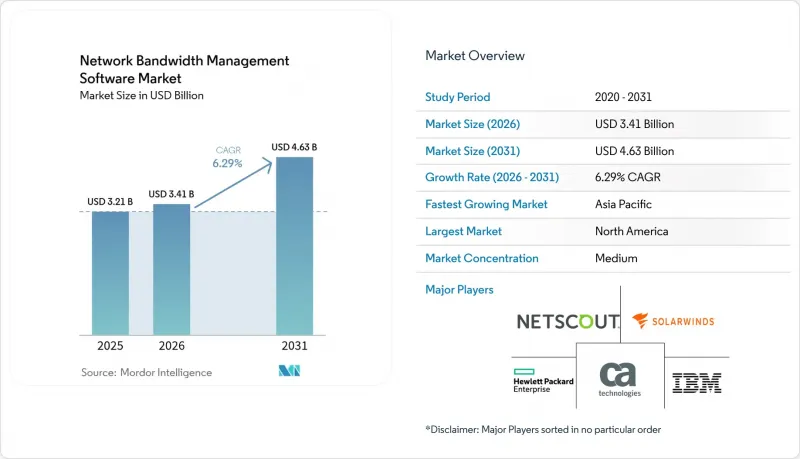
本報告按部署模式(本地部署、雲端部署)、企業規模(中小企業、大型企業)、解決方案類型(頻寬監控和報告等)、最終用戶產業(電信/IT、銀行、金融服務和保險等)、網路類型(有線網路等)和地區進行細分。市場預測以美元計價。
全球網路頻寬管理軟體市場趨勢與洞察
物聯網終端和專用 5G 企業網路的爆炸性成長
企業採用物聯網技術,在工廠、辦公室和物流中心等場所增加數千個感測器,所產生的流量難以預測,傳統的盡力而為路由方式無法應付。私有5G網路加劇了這項挑戰,因為超低延遲應用需要嚴格的頻寬保障。一個支援4萬名緊急應變人員提供專業服務的運作案例表明,關鍵任務使用者對精細化頻寬控制的依賴程度之高。因此,企業正在選擇人工智慧驅動的工具,這些工具能夠對流量進行分類、預測流量消耗,並在異質鏈路上即時重新分配資源。
對高速網際網路和SD-WAN部署的需求日益成長
SD-WAN 在 MPLS、寬頻和 5G 網路之間引入了應用感知路由,將頻寬管理從單純的報告任務轉變為創造業務價值的手段。已部署 SD-WAN 的企業透過將傳輸連結整合到單一策略引擎下,降低了 70% 的硬體成本並提高了營運效率。因此,頻寬管理軟體不僅需要針對吞吐量進行最佳化,還需要兼顧用戶體驗和業務優先級,並整合分析功能以保護創收應用程式。
免費增值/開放原始碼交通管理工具降低了進入門檻。
Zabbix 和 LibreQoS 等強大的免費工具為企業提供無需支付許可費的基本監控功能,減緩了企業向商業平台的轉型。為了因應這一趨勢,供應商紛紛推出包含核心感測器的免費入門套餐,並透過人工智慧驅動的洞察、自動化策略和進階支援來凸顯自身優勢。因此,監控功能日趨同質化,而編配功能的需求卻不斷成長。
細分市場分析
到 2025 年,雲端選項將佔總支出的 51.35%,這清楚地表明企業傾向於選擇可從任何位置存取的可擴展控制平台。預計到 2031 年,該細分市場將以 8.14% 的複合年成長率成長,遠超過本地部署。企業指出,由於無需硬體升級和簡化了修補程式計劃,整體擁有成本 (TCO) 降低了 40%。在需要本地控制以確保主權和超低延遲處理的情況下,本地系統仍然被使用。混合架構將用於敏感資料的邊緣閘道器與用於更廣泛可見性的雲端分析中心相結合。
降低管理成本是轉型經濟效益的核心。管理員無需出差即可在數百個地點部署策略變更,而多租用戶執行個體則使託管服務提供者 (MSP) 能夠為缺乏內部專業知識的中小型企業提供服務。因此,儘管網路頻寬管理軟體市場正穩步向 SaaS 模式轉型,但供應商仍為空氣間隙環境提供設備鏡像。這種雙軌發行策略既保障了現有收入,也為基於訂閱的成長鋪平了道路。
大型企業在2025年貢獻了63.05%的收入,鑑於其複雜的網路拓撲結構和合規性要求,投資高級套件是合理的。同時,隨著雲端原生定價與中小企業的營運預算相符,預計到2031年,中小企業的複合年成長率將達到6.48%。捆綁式託管服務使中小企業能夠外包監控、報告和策略執行,從而在不增加人員的情況下加快部署速度。
隨著中小企業 (SME) 採用率的不斷提高,供應商正透過自動化檢測、基於模板的策略和引導式糾正措施來提升上線效率。同時,大型企業仍需要能夠與其 ITSM 和 SIEM 系統整合的可自訂模組。這種兩極化的發展藍圖構成了網路頻寬管理軟體市場的基礎,為供應商提供了多種擴展途徑,同時保持了清晰的客戶細分。
區域分析
預計到2025年,北美將佔全球收入的34.05%,這得益於其成熟的IT預算、嚴格的合規體係以及對人工智慧資料中心的持續投資。超大規模資料中心超大規模資料中心業者斥資數十億美元建設基礎設施,推動了對流量可視性、容量規劃和服務等級協定(SLA)保障的持續需求。區域醫療保健和金融法規也促進了市場發展,因為這些法規要求持續監控和分段式架構。這些因素共同鞏固了北美在網路頻寬管理軟體市場中最大的市場佔有率。
預計亞太地區將實現最快成長,到2031年複合年成長率將達到7.05%。隨著各國政府優先發展數位基礎設施,5G部署加速推進,企業正同時採用雲端和SD-WAN技術,超越傳統的網路模式。由於網路成熟度差異巨大,靈活的授權模式至關重要,從新興市場的「按需付費」 收費到日本、韓國等已開發市場的全端套件,應有盡有。能夠提供本地語言支援和合規性模板的供應商預計將獲得顯著的市場佔有率。
其他好處:
- Excel格式的市場預測(ME)表
- 3個月的分析師支持
目錄
第1章:引言
- 研究假設和市場定義
- 調查範圍
第2章:調查方法
第3章執行摘要
第4章 市場狀況
- 市場概覽
- 市場促進因素
- 企業物聯網終端和專用 5G 網路爆炸性成長
- 對高速網際網路日益成長的需求以及SD-WAN的普及應用
- 數據密集型應用(4K/8K影片、AR/VR、AI分析)的激增
- 需要確定性頻寬人工智慧工作負載
- 透過 5G 網路切片實現每個切片的頻寬調整。
- 隨著向 AIOps 的轉變,嵌入式頻寬分析成為必要。
- 市場限制因素
- 免費增值模式和開放原始碼流量分析工具降低了進入門檻。
- 與傳統本地基礎設施整合的複雜性
- 由於隱私法規的限制,深層封包檢測功能受到限制。
- 對零信任的重視導致頻寬管理工具的預算分配減少。
- 供應鏈分析
- 監理情勢
- 技術展望
- 波特五力分析
第5章 市場規模與成長預測
- 按部署模式
- 現場
- 雲
- 按公司規模
- 中小企業
- 大公司
- 按解決方案類型
- 頻寬監控和報告
- 流量整形/QoS控制
- 廣域網路/網際網路連線最佳化
- SD-WAN頻寬管理
- 其他(基於政策、DPI 等)
- 按最終用戶行業分類
- 通訊/IT
- BFSI
- 衛生保健
- 零售與電子商務
- 教育
- 政府/國防
- 製造業
- 其他
- 依網路類型
- 有線網路
- 無線和Wi-Fi網路
- 按地區
- 北美洲
- 美國
- 加拿大
- 墨西哥
- 南美洲
- 巴西
- 阿根廷
- 其他南美國家
- 歐洲
- 德國
- 英國
- 法國
- 荷蘭
- 西班牙
- 其他歐洲國家
- 亞太地區
- 中國
- 日本
- 印度
- 韓國
- 澳洲和紐西蘭
- 其他亞太國家
- 中東和非洲
- 中東
- 沙烏地阿拉伯
- 阿拉伯聯合大公國
- 土耳其
- 以色列
- 其他中東國家
- 非洲
- 南非
- 奈及利亞
- 肯亞
- 其他非洲國家
- 中東
- 北美洲
第6章 競爭情勢
- 市場集中度
- 策略趨勢
- 市佔率分析
- 公司簡介
- Cisco Systems Inc.
- IBM Corporation
- NetScout Systems Inc.
- SolarWinds Corporation
- Broadcom Inc.(CA Technologies)
- Hewlett Packard Enterprise Company
- Juniper Networks Inc.
- InfoVista SA
- BMC Software Inc.
- Alcatel-Lucent Enterprise Holding
- GFI Software SA
- Axence Software Inc.
- Zoho Corporation Pvt. Ltd.
- Riverbed Technology LLC
- Paessler AG
- ManageEngine(Zoho Corp.)
- Auvik Networks Inc.
- Fortinet Inc.
- Huawei Technologies Co., Ltd.
- Extreme Networks Inc.
第7章 市場機會與未來展望
According to Mordor Intelligence, the network bandwidth management software market size is expected to grow from USD 3.21 billion in 2025 to USD 3.41 billion in 2026 and is forecast to reach USD 4.63 billion by 2031 at 6.29% CAGR over 2026-2031.
This report is Segmented by Deployment Model (On-Premise, Cloud), Enterprise Size (Small and Medium Enterprises, Large Enterprises), Solution Type (Bandwidth Monitoring and Reporting, and More), End-User Vertical (Telecommunication and IT, BFSI, and More), Network Type (Wired Networks, and More), and Geography. The Market Forecasts are Provided in Terms of Value (USD).
Global Network Bandwidth Management Software Market Trends and Insights
Explosion of IoT Endpoints and Private 5G Enterprise Networks
Enterprise IoT rollouts add thousands of sensors across factories, offices, and logistics hubs, generating unpredictable traffic that legacy best-effort routing cannot handle. Private 5G further intensifies the challenge because ultra-low-latency applications require strict bandwidth guarantees. A live deployment supporting 40,000 first responders for specialized services illustrates how mission-critical users depend on granular bandwidth control. Enterprises, therefore, select AI-driven tools that classify traffic, forecast consumption, and reallocate resources across heterogeneous links in real time.
Growing Need for High-Speed Internet and SD-WAN Adoption
SD-WAN introduces application-aware routing that spans MPLS, broadband, and 5G, turning bandwidth management from a reporting task into a business value lever. Organizations adopting SD-WAN have recorded 70% lower hardware spend and 74% higher operational efficiency by unifying transport links under a single policy engine. As a result, bandwidth software must optimize for user experience and business priority rather than raw throughput, embedding analytics to safeguard revenue-generating applications.
Freemium/Open-Source Traffic Tools Lower Entry Barriers
Robust free tools such as Zabbix and LibreQoS give firms basic visibility without license fees, delaying conversions to commercial platforms. Vendors counter by offering starter tiers that include core sensors at no cost, pushing differentiation toward AI insights, policy automation, and premium support. This commoditizes monitoring while raising the bar for orchestration features.
Other drivers and restraints analyzed in the detailed report include:
- Proliferation of Data-Rich Apps (4K/8K Video, AR/VR, AI Analytics)
- Edge AI Workloads Requiring Deterministic Bandwidth
- Integration Complexity with Legacy On-Premise Infrastructure
For complete list of drivers and restraints, kindly check the Table Of Contents.
Segment Analysis
Cloud options commanded 51.35% of total spending in 2025, illustrating how organizations favor scalable control planes accessed from anywhere. The segment is forecast to grow at 8.14% CAGR to 2031, far faster than on-premise deployments. Enterprises cite 40% lower total ownership through the elimination of hardware refreshes and simplified patching schedules. On-premise systems remain in place where sovereignty or ultra-low-latency processing dictates local control. Hybrid architectures combine edge gateways for sensitive data with cloud analytics hubs for broad visibility.
Lower management overhead sits at the heart of migration economics. Administrators can roll out policy changes across hundreds of sites without traveling, while multi-tenant instances enable MSPs to serve SMEs lacking in-house expertise. The Network Bandwidth Management Software market, therefore, tilts steadily toward SaaS models, although vendors still offer appliance images for air-gapped environments. This dual delivery strategy protects existing revenue while paving a path to subscription growth.
Large enterprises controlled 63.05% of 2025 revenue because complex topologies and compliance demands justified investment in advanced suites. Yet SMEs are on track for a 6.48% CAGR through 2031 as cloud-native pricing aligns with operating budgets. Managed services bundles allow smaller firms to outsource monitoring, reporting, and policy enforcement, accelerating adoption without adding headcount.
Volume growth among SMEs pushes vendors to streamline onboarding through auto-discovery, template-based policies, and guided remediation. At the same time, large enterprises continue to seek customizable modules that integrate with ITSM and SIEM stacks. This bifurcated roadmap anchors the Network Bandwidth Management Software market, giving suppliers multiple paths to expansion while maintaining clear account segmentation.
Complete Report Scope:
- By Deployment Model
- On-Premise
- Cloud
- By Enterprise Size
- Small and Medium Enterprises (SMEs)
- Large Enterprises
- By Solution Type
- Bandwidth Monitoring and Reporting
- Traffic Shaping / QoS Control
- WAN / Internet Link Optimization
- SD-WAN Bandwidth Management
- Others (Policy-based, DPI, etc.)
- By End-User Vertical
- Telecommunication and IT
- BFSI
- Healthcare
- Retail and E-commerce
- Education
- Government and Defense
- Manufacturing
- Others
- By Network Type
- Wired Networks
- Wireless and Wi-Fi Networks
- By Geography
- North America
- United States
- Canada
- Mexico
- South America
- Brazil
- Argentina
- Rest of South America
- Europe
- Germany
- United Kingdom
- France
- Netherlands
- Spain
- Rest of Europe
- Asia-Pacific
- China
- Japan
- India
- South Korea
- Australia and New Zealand
- Rest of Asia-Pacific
- Middle East and Africa
- Middle East
- Saudi Arabia
- United Arab Emirates
- Turkey
- Israel
- Rest of Middle East
- Africa
- South Africa
- Nigeria
- Kenya
- Rest of Africa
- Middle East
- North America
Geography Analysis
North America generated 34.05% of 2025 revenue, buoyed by mature IT budgets, tight compliance regimes, and ongoing investment in AI-enabled data centers. Hyperscalers' multibillion-dollar builds translate into sustained demand for traffic visibility, capacity planning, and SLA assurance. Regional healthcare and finance regulations add momentum because they mandate continuous monitoring and segmented architectures. Collectively, these forces cement North America as the largest slice of the Network Bandwidth Management Software market.
Asia-Pacific is poised for the fastest expansion with a 7.05% CAGR to 2031. Governments prioritize digital infrastructure, 5G rollouts advance quickly, and enterprises leapfrog legacy circuit models by adopting cloud and SD-WAN concurrently. Wide variance in network maturity encourages flexible licensing ranging from pay-as-you-grow SKUs for emerging economies to full-stack suites for advanced markets such as Japan and South Korea. Vendors that localize language support and compliance templates stand to capture outsized share.
- Cisco Systems Inc.
- IBM Corporation
- NetScout Systems Inc.
- SolarWinds Corporation
- Broadcom Inc. (CA Technologies)
- Hewlett Packard Enterprise Company
- Juniper Networks Inc.
- InfoVista SA
- BMC Software Inc.
- Alcatel-Lucent Enterprise Holding
- GFI Software SA
- Axence Software Inc.
- Zoho Corporation Pvt. Ltd.
- Riverbed Technology LLC
- Paessler AG
- ManageEngine (Zoho Corp.)
- Auvik Networks Inc.
- Fortinet Inc.
- Huawei Technologies Co., Ltd.
- Extreme Networks Inc.
Additional Benefits:
- The market estimate (ME) sheet in Excel format
- 3 months of analyst support
TABLE OF CONTENTS
1 INTRODUCTION
- 1.1 Study Assumptions and Market Definition
- 1.2 Scope of the Study
2 RESEARCH METHODOLOGY
3 EXECUTIVE SUMMARY
4 MARKET LANDSCAPE
- 4.1 Market Overview
- 4.2 Market Drivers
- 4.2.1 Explosion of IoT endpoints and private 5G enterprise networks
- 4.2.2 Growing need for high-speed internet and SD-WAN adoption
- 4.2.3 Proliferation of data-rich apps (4K/8K video, AR/VR, AI analytics)
- 4.2.4 Edge AI workloads requiring deterministic bandwidth (under-the-radar)
- 4.2.5 5G network-slicing unlocking per-slice bandwidth orchestration (under-the-radar)
- 4.2.6 Shift toward AIOps demanding embedded bandwidth analytics (under-the-radar)
- 4.3 Market Restraints
- 4.3.1 Freemium/open-source traffic tools lower entry barriers
- 4.3.2 Integration complexity with legacy on-prem infrastructure
- 4.3.3 Privacy regulations curb deep-packet inspection capability (under-the-radar)
- 4.3.4 Zero-trust focus diverts budgets from bandwidth tools (under-the-radar)
- 4.4 Supply-Chain Analysis
- 4.5 Regulatory Landscape
- 4.6 Technological Outlook
- 4.7 Porter's Five Forces Analysis
- 4.7.1 Threat of New Entrants
- 4.7.2 Bargaining Power of Buyers
- 4.7.3 Bargaining Power of Suppliers
- 4.7.4 Threat of Substitutes
- 4.7.5 Intensity of Competitive Rivalry
5 MARKET SIZE AND GROWTH FORECASTS (VALUE)
- 5.1 By Deployment Model
- 5.1.1 On-Premise
- 5.1.2 Cloud
- 5.2 By Enterprise Size
- 5.2.1 Small and Medium Enterprises (SMEs)
- 5.2.2 Large Enterprises
- 5.3 By Solution Type
- 5.3.1 Bandwidth Monitoring and Reporting
- 5.3.2 Traffic Shaping / QoS Control
- 5.3.3 WAN / Internet Link Optimization
- 5.3.4 SD-WAN Bandwidth Management
- 5.3.5 Others (Policy-based, DPI, etc.)
- 5.4 By End-User Vertical
- 5.4.1 Telecommunication and IT
- 5.4.2 BFSI
- 5.4.3 Healthcare
- 5.4.4 Retail and E-commerce
- 5.4.5 Education
- 5.4.6 Government and Defense
- 5.4.7 Manufacturing
- 5.4.8 Others
- 5.5 By Network Type
- 5.5.1 Wired Networks
- 5.5.2 Wireless and Wi-Fi Networks
- 5.6 By Geography
- 5.6.1 North America
- 5.6.1.1 United States
- 5.6.1.2 Canada
- 5.6.1.3 Mexico
- 5.6.2 South America
- 5.6.2.1 Brazil
- 5.6.2.2 Argentina
- 5.6.2.3 Rest of South America
- 5.6.3 Europe
- 5.6.3.1 Germany
- 5.6.3.2 United Kingdom
- 5.6.3.3 France
- 5.6.3.4 Netherlands
- 5.6.3.5 Spain
- 5.6.3.6 Rest of Europe
- 5.6.4 Asia-Pacific
- 5.6.4.1 China
- 5.6.4.2 Japan
- 5.6.4.3 India
- 5.6.4.4 South Korea
- 5.6.4.5 Australia and New Zealand
- 5.6.4.6 Rest of Asia-Pacific
- 5.6.5 Middle East and Africa
- 5.6.5.1 Middle East
- 5.6.5.1.1 Saudi Arabia
- 5.6.5.1.2 United Arab Emirates
- 5.6.5.1.3 Turkey
- 5.6.5.1.4 Israel
- 5.6.5.1.5 Rest of Middle East
- 5.6.5.2 Africa
- 5.6.5.2.1 South Africa
- 5.6.5.2.2 Nigeria
- 5.6.5.2.3 Kenya
- 5.6.5.2.4 Rest of Africa
- 5.6.5.1 Middle East
- 5.6.1 North America
6 COMPETITIVE LANDSCAPE
- 6.1 Market Concentration
- 6.2 Strategic Moves
- 6.3 Market Share Analysis
- 6.4 Company Profiles (includes Global level Overview, Market level overview, Core Segments, Financials as available, Strategic Information, Market Rank/Share, Products and Services, Recent Developments)
- 6.4.1 Cisco Systems Inc.
- 6.4.2 IBM Corporation
- 6.4.3 NetScout Systems Inc.
- 6.4.4 SolarWinds Corporation
- 6.4.5 Broadcom Inc. (CA Technologies)
- 6.4.6 Hewlett Packard Enterprise Company
- 6.4.7 Juniper Networks Inc.
- 6.4.8 InfoVista SA
- 6.4.9 BMC Software Inc.
- 6.4.10 Alcatel-Lucent Enterprise Holding
- 6.4.11 GFI Software SA
- 6.4.12 Axence Software Inc.
- 6.4.13 Zoho Corporation Pvt. Ltd.
- 6.4.14 Riverbed Technology LLC
- 6.4.15 Paessler AG
- 6.4.16 ManageEngine (Zoho Corp.)
- 6.4.17 Auvik Networks Inc.
- 6.4.18 Fortinet Inc.
- 6.4.19 Huawei Technologies Co., Ltd.
- 6.4.20 Extreme Networks Inc.
7 MARKET OPPORTUNITIES AND FUTURE OUTLOOK
- 7.1 White-space and Unmet-Need Assessment

 網路管理系統市場:2026-2032年全球市場預測(按交付方式、網路類型、組織規模、部署方式、應用程式和最終用戶分類)
 網路管理解決方案市場 - 全球產業規模、佔有率、趨勢、機會、預測:按組件、部署模式、企業規模、產業垂直領域、地區和競爭對手分類,2021-2031 年
 網路管理系統市場:按組件、部署類型、企業規模、產業和地區分類
 2026年全球網路管理系統市場報告
 網路管理系統市場分析及預測(至2035年):按類型、產品類型、服務、技術、組件、應用、部署類型、最終用戶、功能和解決方案分類網路管理市場 - 全球產業規模、佔有率、趨勢、機會、預測:按組件、部署、公司、地區和競爭對手分類,2021-2031 年網路管理系統市場 - 全球產業規模、佔有率、趨勢、機會及預測(按組件、組織規模、部署模式、最終用戶、地區和競爭格局分類),2021-2031年
 網路管理市場規模、佔有率和成長分析(按組件、解決方案、服務、部署類型、組織規模、最終用戶、服務供應商、垂直產業和地區分類)—2026-2033年產業預測
 網路管理系統市場規模、佔有率和成長分析(按組件、部署類型、組織規模、最終用戶、服務供應商、垂直產業和地區分類)-2026-2033年產業預測
 全球網路頻寬管理軟體市場