


 |
市場調查報告書
商品編碼
2122296
資料分析外包:市佔率分析、產業趨勢與統計、成長預測(2026-2031 年)Data Analytics Outsourcing - Market Share Analysis, Industry Trends & Statistics, Growth Forecasts (2026 - 2031) |
||||||

※ 本網頁內容可能與最新版本有所差異。詳細情況請與我們聯繫。
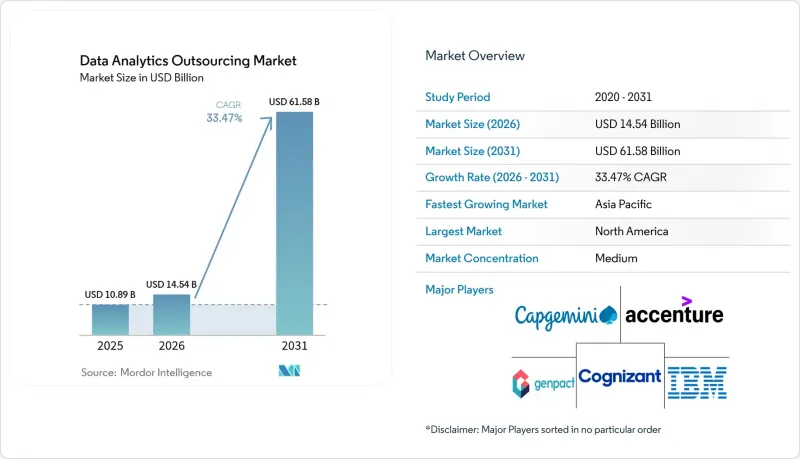
據 Mordor Intelligence 稱,2025 年數據分析外包市值為 108.9 億美元,預計到 2031 年將達到 615.8 億美元,而 2026 年為 145.4 億美元,預測期(2026-2031 年)的複合年成長率為 33.47%。
本報告按分析類型(說明分析、診斷性分析等)、最終用戶行業(零售/電子商務、銀行、金融服務和保險等)、服務模式(離岸、近岸、在岸/現場)、組織規模(大型企業和中小企業)、部署模式(純雲和混合雲端)以及地區進行細分。市場預測以美元計價。
全球數據分析外包市場趨勢與洞察
企業資料量和複雜性的快速成長
全球各地的組織機構目前正從行動應用、物聯網設備和全通路觸點產生Petabyte的結構化、半結構化和非結構化數據,這已超出其內部處理能力。內部資料工程和機器學習技能的匱乏進一步阻礙了資料處理速度的提升。外包合作夥伴正透過利用預先建置的資料擷取管道、可擴展的雲端基礎設施和特定產業的資料模型來彌補這些差距,從而加快洞察速度並降低整體擁有成本 (TCO)。許多客戶正在採用計量收費的「數據資料即服務」契約,利用靈活的定價機制將有限的資金重新分配到核心創新項目中。
全通路商務中近乎即時決策的需求
無論使用網路、行動裝置或實體店面通路,數位購物者都期望獲得即時個人化體驗和無縫的庫存可見性。這種期望推動了對能夠進行事件流處理、建議演算法更新和毫秒級干預的分析引擎的需求。自行建構這種低延遲技術堆疊需要在串流處理平台、記憶體內和邊緣伺服器方面投入大量資金。專業的第三方外包供應商提供承包即時分析平台,並提供全天候營運支持,使零售商和消費品牌能夠快速運作,同時從固定投資轉向基於使用量的靈活定價模式。
資料駐留要求和跨境資料傳輸法規
GDPR的實施以及未來人工智慧相關法規的訂定,正在加強對公民資料儲存和處理地點的監管。跨國公司正在審查其供應商組合,以確保合規文件、安全連接和地理圍欄功能。外包合約現在包含關於子處理者的詳細揭露和審計條款,這可能會增加法律複雜性,延長合約週期,並增加沒有認證本地設施的供應商的成本。
細分市場分析
到2025年,處方工具將佔總收入的39.48%,並逐漸轉向預測模型,但隨著企業越來越傾向於尋求建議而非事後儀表板,其佔有率仍將持續成長。預計2026年至2031年,處方解決方案的數據分析外包市場將以34.32%的複合年成長率成長。外包合作夥伴正透過整合場景最佳化引擎和互動式人工智慧來實現決策自動化,從而無需專業的編碼人員,從而實現差異化競爭優勢。
生成式人工智慧透過使領域專家能夠用自然語言表達業務約束,並由引擎將其轉化為最佳化邏輯,從而進一步普及了指示性分析。供應商正在整合框架來管理模型管治、版本控制和監管可解釋性,從而將自身定位為策略決策的合作夥伴,而不僅僅是報告撰寫者。隨著客戶期望轉向持續改進,供應商正在將迭代模型調優和A/B測試納入基於結果的合約中,以確保在整個合約期間內實現價值。
銀行、金融和保險 (BFSI) 行業在信用風險評分、詐欺檢測和監管報告方面長期投入,預計到 2025 年將佔據數據分析外包市場佔有率的 27.05%。然而,醫療保健產業預計將成為成長最快的產業,到 2031 年複合年成長率將達到 34.15%,這主要得益於遠距遠端醫療的普及、電子健康記錄的整合以及個人化醫療方案的推廣。提供符合 HIPAA 標準的資料湖和預認證臨床分析庫的供應商將獲得先發優勢。
生命科學公司正加大對真實世界證據收集和基因測序分析的外包力度,為擁有專業領域知識的供應商創造了豐厚的商機。同時,保險公司正與分析公司合作,將理賠數據與穿戴式感測器輸入結合,建構早期預警模型,從而降低住院成本。隨著支付方和醫療服務提供方向價值醫療模式靠攏,涵蓋臨床數據、行為數據和社會健康決定因素數據的縱向患者分析的需求日益成長。
區域分析
預計到2025年,北美將佔全球收入的38.35%,這反映出該地區雄厚的企業技術預算、成熟的法規結構以及對基於結果的供應商合約的早期採用。財富500強跨國公司依賴外包合作夥伴來管理支撐其全球營運的數據資產,同時滿足《薩班斯-奧克斯利法案》和《健康保險流通與責任法案》(HIPAA)的要求。然而,對離岸勞工實踐日益嚴格的審查以及聯邦政府對國內人工智慧研究的激勵措施,正促使部分工作轉移到加拿大和墨西哥的近岸中心,這些中心既具有文化親和性,又擁有雙語人才。
亞太地區是成長最快的地區,預計2026年至2031年複合年成長率將達到34.62%。印度的數位政府計畫、東南亞智慧城市的部署以及中國的大規模製造業分析項目,都為數據分析外包市場的擴張創造了沃土。儘管印度仍然是領先的服務供應商,但越南和印尼的新興企業也憑藉專注於人工智慧標註、邊緣運算和特定領域模型測試的專業分析服務而迅速崛起。印度的國家計劃「數位印度」正在主導數位化政府計劃,為公共和私營部門專案的分析外包發展創造了有利條件。
歐洲的趨勢深受即將實施的GDPR以及人工智慧風險監管法規的影響,這些法規更加強調資料來源和演算法的透明度。客戶越來越傾向於選擇能夠提供符合歐洲網路安全認證系統(ECCS)標準的本地資料中心的供應商。波蘭和葡萄牙的近岸資料中心因其符合歐盟合規要求且與西歐主要城市相比具有成本優勢,正吸引許多投資。儘管南美和中東及非洲地區目前的支出佔比相對較小,但由於各國都在推動數位經濟計劃,以及私部門對數據驅動決策的認知不斷提高,這些地區的需求正在加速成長。
其他好處:
- Excel格式的市場預測(ME)表
- 3個月的分析師支持
目錄
第1章:引言
- 研究假設和市場定義
- 調查範圍
第2章:調查方法
第3章執行摘要
第4章 市場狀況
- 市場概覽
- 市場促進因素
- 企業資料量和複雜性的激增
- 全通路商務中近乎即時決策的需求
- 成本壓力促使人們從資本支出(Capex)分析轉向變動成本(OpEx)分析。
- 向基於績效的定價模式過渡到銀行、金融服務和保險 (BFSI) 行業的詐欺和風險分析。
- 新興的人工智慧助理縮短了洞察交付週期。
- 主權雲的強制實施正在引發離岸和近岸營運的重新平衡。
- 市場限制因素
- 關於持續資料保留義務和跨境資料傳輸的規定
- 人才外流和配送中心(主要在印度)薪資上漲。
- 買家擔心LLM在外包生成式人工智慧分析方面存在「模型外洩」問題。
- 由於專有加速器和模板的存在,因此存在供應商鎖定風險。
- 宏觀經濟因素的影響
- 監理情勢
- 技術展望
- 波特五力分析
第5章 市場規模與成長預測
- 按分析類型
- 說明分析
- 診斷分析
- 預測分析
- 指示性分析
- 按最終用戶行業分類
- 零售與電子商務
- 銀行、金融服務和保險(BFSI)
- 醫療保健和生命科學
- 製造業
- IT/通訊
- 汽車和運輸設備
- 能源、公共產業、石油和天然氣
- 其他(媒體、公共部門等)
- 按服務模式
- 離岸
- 近岸
- 陸上
- 按組織規模
- 大公司
- 中小企業
- 按部署模式
- 僅限雲端
- 混合雲端
- 按地區
- 北美洲
- 美國
- 加拿大
- 歐洲
- 德國
- 英國
- 法國
- 俄羅斯
- 其他歐洲國家
- 亞太地區
- 中國
- 印度
- 日本
- 東南亞
- 其他亞太國家
- 南美洲
- 巴西
- 阿根廷
- 其他南美國家
- 中東和非洲
- 中東
- 沙烏地阿拉伯
- 阿拉伯聯合大公國
- 其他中東國家
- 非洲
- 南非
- 奈及利亞
- 其他非洲國家
- 中東
- 北美洲
第6章 競爭情勢
- 市場集中度
- 策略趨勢
- 市佔率分析
- 公司簡介
- Accenture plc
- Tata Consultancy Services Ltd.
- International Business Machines Corporation
- Cognizant Technology Solutions Corporation
- Wipro Limited
- Infosys Limited
- Genpact Limited
- Capgemini SE
- Deloitte Touche Tohmatsu Limited
- Ernst and Young Global Limited
- PricewaterhouseCoopers International Limited
- KPMG International Limited
- EXL Service Holdings, Inc.
- Mu Sigma Inc.
- Fractal Analytics Inc.
- LatentView Analytics Corporation
- Tiger Analytics, LLC
- ZS Associates, Inc.
- Opera Solutions, LLC
- LTI Mindtree Limited
- WNS(Holdings)Limited
- Happiest Minds Technologies Limited
第7章 市場機會與未來展望
According to Mordor Intelligence, the data analytics outsourcing market size was valued at USD 10.89 billion in 2025 and estimated to grow from USD 14.54 billion in 2026 to reach USD 61.58 billion by 2031, at a CAGR of 33.47% during the forecast period (2026-2031).
This report is Segmented by Analytics Type (Descriptive, Diagnostic, and More), End-User Industry (Retail and E-Commerce, BFSI, and More), Service Model (Offshore, Nearshore, and On-shore/On-site), Organization Size (Large Enterprises and SMEs), Deployment Model (Cloud-Only and Hybrid Cloud), and Geography. The Market Forecasts are Provided in Terms of Value (USD).
Global Data Analytics Outsourcing Market Trends and Insights
Surging Enterprise Data Volumes and Complexity
Global organizations now generate petabytes of structured, semi-structured, and unstructured data from mobile apps, IoT devices, and omnichannel touchpoints, overwhelming in-house processing capacity. Limited internal skills in data engineering and machine learning further hamper timeliness. Outsourcing partners address these gaps with pre-built ingestion pipelines, scalable cloud infrastructure, and industry-specific data models that shorten time to insight while lowering total cost of ownership. Many clients adopt pay-as-you-go data-as-a-service contracts that unlock variable pricing advantages, enabling redeployment of scarce capital toward core innovation initiatives.
Need for Near-Real-Time Decision-Making in Omnichannel Commerce
Digital shoppers expect instant personalization and seamless inventory visibility whether they engage on web, mobile, or physical channels. This expectation drives demand for analytics engines capable of processing event streams, updating recommendation algorithms, and triggering interventions within milliseconds. Building such low-latency stacks in-house requires large capital outlays in stream-processing platforms, in-memory databases, and edge servers. Specialist outsourcing vendors offer turnkey real-time analytics platforms, complete with 24X7 operations support, that let retailers and consumer brands go live quickly while converting fixed investments into variable fees tied to usage.
Persistent Data-Residency and Cross-Border Transfer Regulations
GDPR enforcement and forthcoming AI-specific statutes tighten rules on where citizen data can be stored and processed. Multinationals reassess vendor portfolios to ensure compliance documentation, secure connectivity, and geo-fencing capabilities. Outsourcing agreements now include detailed sub-processor disclosures and audit clauses, adding legal complexity that can slow deal cycles and raise costs for providers that lack certified local facilities.
Other drivers and restraints analyzed in the detailed report include:
- Cost Pressure to Convert Capex Analytics Stacks into Variable Opex
- BFSI Shift to Outcome-Based Pricing for Fraud and Risk Analytics
- Talent Attrition and Wage Inflation in India-Centric Delivery Hubs
For complete list of drivers and restraints, kindly check the Table Of Contents.
Segment Analysis
Prescriptive tools translated 39.48% of total revenue into predictive models during 2025, yet their share continues to rise because enterprises increasingly demand recommendations rather than retrospective dashboards. The data analytics outsourcing market size for prescriptive solutions is projected to advance at a 34.32% CAGR over 2026-2031. Outsourcing partners differentiate by integrating scenario optimization engines with conversational AI, delivering decision automation that bypasses the need for specialized coding talent.
Generative AI further democratizes prescriptive analytics by allowing domain specialists to articulate business constraints in natural language, which engines then translate into optimization logic. Vendors embed frameworks that manage model governance, version control, and regulatory explainability, positioning themselves as partners in strategic decision making instead of report builders. As client expectations shift toward continuous improvement, providers bundle iterative model tuning and A/B testing into outcome-based contracts, ensuring value realization throughout the engagement lifecycle.
BFSI retained 27.05% of data analytics outsourcing market share in 2025 owing to longstanding investment in credit-risk scoring, fraud detection, and regulatory reporting. Nonetheless, healthcare is climbing fastest with a 34.15% CAGR to 2031, propelled by telehealth adoption, electronic health record integration, and personalized medicine protocols. Providers offering HIPAA-compliant data lakes and pre-certified clinical analytics libraries enjoy a first-mover advantage.
Life-science firms increasingly outsource real-world evidence gathering and genomic sequencing analytics, creating high-margin opportunities for vendors with specialist domain expertise. Meanwhile, insurers partner with analytics firms to combine claims data and wearable sensor inputs, driving early-warning models that reduce hospitalization costs. As payers and providers converge around value-based care, demand rises for longitudinal patient-journey analytics that span clinical, behavioral, and social determinants of health data.
Complete Report Scope:
- By Analytics Type
- Descriptive Analytics
- Diagnostic Analytics
- Predictive Analytics
- Prescriptive Analytics
- By End-user Industry
- Retail and e-Commerce
- Banking, Financial Services and Insurance (BFSI)
- Healthcare and Life Sciences
- Manufacturing
- IT and Telecom
- Automotive and Transport
- Energy, Utilities and Oil-and-Gas
- Others (Media, Public Sector, etc.)
- By Service Model
- Offshore
- Nearshore
- On-shore
- By Organization Size
- Large Enterprises
- Small and Medium Enterprises (SMEs)
- By Deployment Model
- Cloud-Only
- Hybrid Cloud
- By Geography
- North America
- United States
- Canada
- Europe
- Germany
- United Kingdom
- France
- Russia
- Rest of Europe
- Asia-Pacific
- China
- India
- Japan
- South-East Asia
- Rest of Asia-Pacific
- South America
- Brazil
- Argentina
- Rest of South America
- Middle East and Africa
- Middle East
- Saudi Arabia
- United Arab Emirates
- Rest of Middle East
- Africa
- South Africa
- Nigeria
- Rest of Africa
- Middle East
- North America
Geography Analysis
North America generated 38.35% of 2025 revenue, reflecting the region's deep enterprise technology budgets, mature regulatory frameworks, and early adoption of outcome-based vendor agreements. Fortune 500 multinationals rely on outsourced partners to manage data estates that underpin global operations while meeting Sarbanes-Oxley and HIPAA mandates. However, rising scrutiny of offshore labor practices and federal incentives for on-shore AI research push some workloads into Canadian and Mexican nearshore centers that offer both cultural proximity and bilingual talent.
Asia Pacific is the fastest-growing geography with a projected 34.62% CAGR between 2026 and 2031. Digital-government initiatives in India, smart-city rollouts in Southeast Asia, and large-scale manufacturing analytics programs in China all create fertile ground for data analytics outsourcing market expansion. Though India remains the primary delivery hub, emerging players in Vietnam and Indonesia secure specialized analytics work focused on AI annotation, edge computing, and domain-specific model testing. Digital-government initiatives in India, spearheaded by the national Digital India programme, are creating fertile ground for analytics-outsourcing growth across public-sector and commercial projects.
Europe's trajectory is heavily shaped by GDPR enforcement and impending AI-risk regulations that heighten emphasis on data provenance and algorithmic transparency. Clients increasingly favor providers that can supply in-region data centers certified to European Cybersecurity Certification Scheme standards. Nearshore centers in Poland and Portugal attract investment because they blend EU compliance with cost advantages compared to Western European capitals. South America and the Middle East and Africa together account for a modest slice of current spending but display accelerating demand tied to national digital-economy plans and growing private-sector awareness of data-driven decision making.
- Accenture plc
- Tata Consultancy Services Ltd.
- International Business Machines Corporation
- Cognizant Technology Solutions Corporation
- Wipro Limited
- Infosys Limited
- Genpact Limited
- Capgemini SE
- Deloitte Touche Tohmatsu Limited
- Ernst and Young Global Limited
- PricewaterhouseCoopers International Limited
- KPMG International Limited
- EXL Service Holdings, Inc.
- Mu Sigma Inc.
- Fractal Analytics Inc.
- LatentView Analytics Corporation
- Tiger Analytics, LLC
- ZS Associates, Inc.
- Opera Solutions, LLC
- LTI Mindtree Limited
- WNS (Holdings) Limited
- Happiest Minds Technologies Limited
Additional Benefits:
- The market estimate (ME) sheet in Excel format
- 3 months of analyst support
TABLE OF CONTENTS
1 INTRODUCTION
- 1.1 Study Assumptions and Market Definition
- 1.2 Scope of the Study
2 RESEARCH METHODOLOGY
3 EXECUTIVE SUMMARY
4 MARKET LANDSCAPE
- 4.1 Market Overview
- 4.2 Market Drivers
- 4.2.1 Surging enterprise data volumes and complexity
- 4.2.2 Need for near-real-time decision-making in omnichannel commerce
- 4.2.3 Cost-pressure to convert capex analytics stacks into variable opex
- 4.2.4 BFSI shift to outcome-based pricing for fraud and risk analytics
- 4.2.5 Emerging Gen-AI copilots that compress insight-delivery cycles
- 4.2.6 Sovereign-cloud mandates triggering offshore/nearshore re-balancing
- 4.3 Market Restraints
- 4.3.1 Persistent data-residency and cross-border transfer regulations
- 4.3.2 Talent attrition and wage inflation in India-centric delivery hubs
- 4.3.3 Buyer concerns over LLM "model leakage" when outsourcing Gen-AI analytics
- 4.3.4 Vendor lock-in risk due to proprietary accelerators and templates
- 4.4 Impact of Macroeconomic Factors
- 4.5 Regulatory Landscape
- 4.6 Technological Outlook
- 4.7 Porter's Five Forces Analysis
- 4.7.1 Bargaining Power of Suppliers
- 4.7.2 Bargaining Power of Buyers
- 4.7.3 Threat of New Entrants
- 4.7.4 Intensity of Competitive Rivalry
- 4.7.5 Threat of Substitutes
5 MARKET SIZE AND GROWTH FORECASTS (VALUE)
- 5.1 By Analytics Type
- 5.1.1 Descriptive Analytics
- 5.1.2 Diagnostic Analytics
- 5.1.3 Predictive Analytics
- 5.1.4 Prescriptive Analytics
- 5.2 By End-user Industry
- 5.2.1 Retail and e-Commerce
- 5.2.2 Banking, Financial Services and Insurance (BFSI)
- 5.2.3 Healthcare and Life Sciences
- 5.2.4 Manufacturing
- 5.2.5 IT and Telecom
- 5.2.6 Automotive and Transport
- 5.2.7 Energy, Utilities and Oil-and-Gas
- 5.2.8 Others (Media, Public Sector, etc.)
- 5.3 By Service Model
- 5.3.1 Offshore
- 5.3.2 Nearshore
- 5.3.3 On-shore
- 5.4 By Organization Size
- 5.4.1 Large Enterprises
- 5.4.2 Small and Medium Enterprises (SMEs)
- 5.5 By Deployment Model
- 5.5.1 Cloud-Only
- 5.5.2 Hybrid Cloud
- 5.6 By Geography
- 5.6.1 North America
- 5.6.1.1 United States
- 5.6.1.2 Canada
- 5.6.2 Europe
- 5.6.2.1 Germany
- 5.6.2.2 United Kingdom
- 5.6.2.3 France
- 5.6.2.4 Russia
- 5.6.2.5 Rest of Europe
- 5.6.3 Asia-Pacific
- 5.6.3.1 China
- 5.6.3.2 India
- 5.6.3.3 Japan
- 5.6.3.4 South-East Asia
- 5.6.3.5 Rest of Asia-Pacific
- 5.6.4 South America
- 5.6.4.1 Brazil
- 5.6.4.2 Argentina
- 5.6.4.3 Rest of South America
- 5.6.5 Middle East and Africa
- 5.6.5.1 Middle East
- 5.6.5.1.1 Saudi Arabia
- 5.6.5.1.2 United Arab Emirates
- 5.6.5.1.3 Rest of Middle East
- 5.6.5.2 Africa
- 5.6.5.2.1 South Africa
- 5.6.5.2.2 Nigeria
- 5.6.5.2.3 Rest of Africa
- 5.6.5.1 Middle East
- 5.6.1 North America
6 COMPETITIVE LANDSCAPE
- 6.1 Market Concentration
- 6.2 Strategic Moves
- 6.3 Market Share Analysis
- 6.4 Company Profiles (includes Global level Overview, Market level overview, Core Segments, Financials as available, Strategic Information, Market Rank/Share for key companies, Products and Services, and Recent Developments)
- 6.4.1 Accenture plc
- 6.4.2 Tata Consultancy Services Ltd.
- 6.4.3 International Business Machines Corporation
- 6.4.4 Cognizant Technology Solutions Corporation
- 6.4.5 Wipro Limited
- 6.4.6 Infosys Limited
- 6.4.7 Genpact Limited
- 6.4.8 Capgemini SE
- 6.4.9 Deloitte Touche Tohmatsu Limited
- 6.4.10 Ernst and Young Global Limited
- 6.4.11 PricewaterhouseCoopers International Limited
- 6.4.12 KPMG International Limited
- 6.4.13 EXL Service Holdings, Inc.
- 6.4.14 Mu Sigma Inc.
- 6.4.15 Fractal Analytics Inc.
- 6.4.16 LatentView Analytics Corporation
- 6.4.17 Tiger Analytics, LLC
- 6.4.18 ZS Associates, Inc.
- 6.4.19 Opera Solutions, LLC
- 6.4.20 LTI Mindtree Limited
- 6.4.21 WNS (Holdings) Limited
- 6.4.22 Happiest Minds Technologies Limited
7 MARKET OPPORTUNITIES AND FUTURE OUTLOOK
- 7.1 White-space and Unmet-Need Assessment

 資料分析外包市場:2026-2032年全球市場預測(依服務類型、分析類型、組織規模、部署模式、應用和產業分類)
 數據分析外包市場規模、佔有率、趨勢和預測:按類型、應用、組件、行業和地區分類(2026-2034 年)
 數據分析外包市場:按服務類型、實施方法、最終用戶產業和地區分類
 全球數據分析外包市場規模、佔有率、趨勢和成長分析報告(2026-2034年)
 2026年全球數據分析外包市場報告全球數據分析外包市場:市場規模、佔有率、成長率、行業分析、依類型、應用和地區劃分的分析以及未來預測(2026-2034 年)
 2026-2030年全球資料分析外包市場
 資料分析外包市場規模、佔有率和成長分析(按分析類型、服務類型、應用、組織規模、垂直產業、部署模式和地區分類)-2026-2033年產業預測
 資料分析外包市場規模、佔有率、趨勢分析報告:按類型、應用、最終用途、地區和細分市場預測,2024-2030 年