


 |
市場調查報告書
商品編碼
2122283
OLED 微顯示器:市場佔有率分析、產業趨勢與統計及成長預測(2026-2031 年)OLED Microdisplay - Market Share Analysis, Industry Trends & Statistics, Growth Forecasts (2026 - 2031) |
||||||

※ 本網頁內容可能與最新版本有所差異。詳細情況請與我們聯繫。
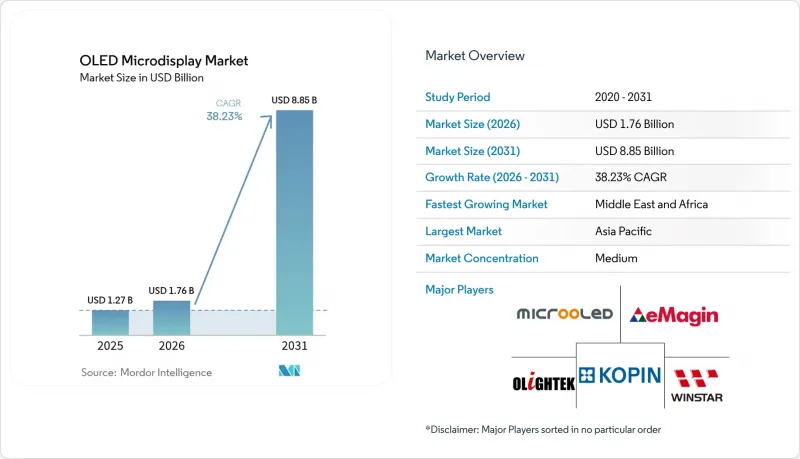
據 Mordor Intelligence 稱,OLED 微顯示器市場預計到 2026 年價值 17.6 億美元,高於 2025 年的 12.7 億美元,預計到 2031 年將達到 88.5 億美元。
預計 2026 年至 2031 年的複合年成長率將達到 38.23%。
本報告按類型(近眼顯示、投影式顯示、其他)、解析度(SVGA 或更低 (800x600 或更低)、XGA (1024x768)、其他)、技術(矽基基板RGB OLED、其他)、面板尺寸(對角線長度)(小於 0.5 吋、0.5 至 1.0 吋、其他產業)。市場預測以美元 (USD) 為單位。
全球OLED微顯示器市場趨勢與洞察
中國晶圓代工廠擴大矽基OLED(OLEDoS)產能。
京東方、世亞光電和愛瑞光電的產能擴張正為OLED微顯示器市場帶來高產量、高良率的供應。代工廠正將高像素密度前板與新建的矽背板生產線結合,以提高產能並加強製程控制。愛瑞光電對專用背板設備的投資反映了其對垂直整合的承諾,減少了外包工序,並提高了成本競爭力。這些發展正將亞太地區從區域供應中心轉變為全球供應中心,在規模和技術領先地位方面對老牌的日本和韓國企業構成挑戰。產能的提升也有助於穩定價格,鼓勵消費性電子設備OEM廠商在OLED微顯示器市場下達長期訂單。
北美地區加速採用MicroOLED顯示器作為軍用頭盔顯示器。
北美國防計畫正迅速從AMLCD轉向OLED微型顯示器,用於飛行員、地面部隊和夜視光學設備。 Kopin公司在2025年4月訂單750萬美元的產品,凸顯了市場對堅固耐用、輕巧便攜、對比度高、無運動模糊且重量更輕的近眼模組日益成長的需求。在F-35平台上的檢驗已證明其關鍵任務可靠性,促使其他專案也開始採用類似的顯示架構。目標瞄準系統和指揮控制眼鏡產品的多元化經營分散了採購風險,而軍方需求則為OLED微型顯示器市場提供了穩定的基礎。
OLEDoS中防止水分滲入的封裝挑戰
長期以來,水分滲入一直是OLED微型顯示器廣泛應用的一大技術障礙,尤其是在汽車和軍事等嚴苛的工作環境中。與傳統顯示器不同,微型顯示器的超緊湊外形規格極大地限制了傳統封裝方法的可用空間,從而帶來了影響生產良率和長期可靠性的根本性技術挑戰。韓國某大學近期推出的創新技術,為基於光纖的穿戴式OLED引進了多功能封裝技術,預計將為更可靠的解決方案鋪路。然而,在確保氣密性的同時保持光學清晰度,封裝解決方案的需求進一步加劇了這項挑戰的技術複雜性。當像素密度超過3000 ppi時,這種平衡變得愈發困難。這項限制尤其影響那些預期長期運作的應用,例如需要使用超過10年的汽車顯示器,這為能夠開發專有封裝技術的公司提供了競爭機會。
細分市場分析
預計到2025年,近眼設備的OLED微顯示器市場規模將達到8.1億美元,佔總銷售額的63.78%。混合實境(MR)頭戴裝置、訓練眼鏡和智慧頭盔的持續出貨量是推動這項需求的主要因素。平台所有者對生態系統的投資支持了解析度和亮度的年度升級,從而提高了平均售價和毛利率。
儘管2025年電子觀景器(EVF)市場規模相對較小,但預計到2031年將以40.15%的複合年成長率成長,這表明其具有巨大的成長潛力。索尼、尼康和佳能正在其專業無反光鏡相機機身中推廣採用OLED EVF,以實現無延遲取景和HDR預覽。隨著相機製造商簡化產品週期,面板出貨量預計將在三年內加倍,使EVF成為OLED微顯示器市場中一個具有戰略成長潛力的細分領域。
2025年,高畫質720p解析度的OLED微顯示器將佔據35.42%的市場佔有率,在確保清晰度和控制功耗方面,能夠滿足主流AR用戶的需求。然而,真正的成長動力將來自「全高清及以上」解析度,即像素密度超過3000ppi的顯示器。三星顯示器在2025年初發布的樣品實現了5000ppi的像素密度和20000尼特的峰值亮度,預計這些面板將應用於企業級VR和軍用偵察眼鏡等領域。
預計到2031年,「高於全高清」解析度的OLED面板出貨量複合年成長率將達到40.7%,佔據OLED微顯示器市場成長的大部分佔有率。這些面板結合了高頻寬介面和低延遲驅動器,進而帶動了對半導體的需求,使整合供應商受益。
區域分析
到2025年,亞太地區將佔全球銷售額的56.64%。這反映了該地區背板製造廠、發送器供應商和消費性電子設備組裝的高度集中。三星顯示器和中國主要晶圓代工廠持續擴大產能,確保了供應穩定,而跨境合資企業則促進了技術轉移。韓國和中國政府的支持措施進一步降低了生產成本,鞏固了該地區的領先地位。
北美地區對高規格模組的需求正在成長,尤其是在國防領域和企業級XR(擴增實境)部署方面,這些領域需要性能穩定、亮度高的模組。矽谷和波士頓的創業投資投資正在推動開發光學元件和驅動積體電路的新創公司發展,從而促進了原型顯示器在在地採購的採購。國防採購,例如F-35頭盔升級項目,也為北美地區的OLED微型顯示器提供了穩定的需求基礎。
在歐洲,我們正專注於拓展汽車領域和高利潤的醫療視覺化技術。德國和法國的一級供應商正與面板製造商合作,共同設計用於汽車抬頭顯示器(HUD)的低延遲介面。中東和非洲市場規模雖小,但由於國防現代化預算以及進口配備先進AR-HUD的豪華汽車,其複合年成長率(CAGR)高達40.6%。南美洲市場目前仍以消費市場為主,但當地相機生產和快速發展的遊戲社群正逐漸帶來新的商機。
其他好處
- Excel格式的市場預測(ME)表
- 3個月的分析師支持
目錄
第1章:引言
- 研究假設和市場定義
- 調查範圍
第2章:調查方法
第3章執行摘要
第4章 市場狀況
- 市場概覽
- 市場促進因素
- 中國晶圓代工廠擴大矽基OLED(OLEDoS)產能。
- 北美地區加速採用MicroOLED顯示器作為軍用頭盔顯示器。
- 歐洲汽車製造商引進採用MicroOLED面板的AR抬頭顯示器
- 日本和韓國高階無反光鏡相機中電子觀景窗(EVF)的激增
- 擴大對美國和以色列專注於OLED微顯示器的AR/VR新創公司的創業投資資金籌措(VC)
- 在 0.7 吋以下和 3000 ppi 以上的範圍內,與 MicroLED 相比具有成本績效優勢。
- 市場限制因素
- OLEDoS中防止水分滲入的封裝挑戰
- 與MicroLED相比,亮度限制在1000 cd/m2或更低。
- 日本與中國供應鏈集中所帶來的地緣政治風險
- 產品快速過時增加了原始設備製造商的庫存風險。
- 工業生態系分析
- 技術展望
- 波特五力分析
第5章 市場規模與成長預測
- 按類型
- 近眼 (NTE)
- 投影
- 電子觀景器(EVF)
- 通過決議
- SVGA 或更低解析度(800 x 600 或更低)
- XGA(1024×768)
- HD(720p)
- 全高清 (1080p)
- 全高清或更高解析度(2K~4K~Plus)
- 透過技術
- 矽基基板的RGB OLED
- 白色 OLED + 彩色濾光片
- AMOLED on Glass
- 高亮度OLED
- 按面板尺寸(對角線長度)
- 小於0.5英寸
- 0.5 至 1.0 英寸
- 超過 1.0 英寸
- 按最終用戶行業分類
- 家用電子產品
- AR/ VR頭戴裝置
- 數位相機和攝影機
- 智慧型穿戴裝置
- 車
- AR抬頭顯示器
- 側視鏡替換顯示螢幕
- 衛生保健
- 外科和診斷用穿戴設備
- 醫療影像設備
- 行業和公司
- 智慧眼鏡
- 機器視覺系統
- 航太/國防
- 頭盔顯示器
- 武器和熱成像瞄準器
- 執法安全
- 夜視鏡
- 執法記錄儀
- 其他(研究/教育)
- 家用電子產品
- 按地區
- 北美洲
- 美國
- 加拿大
- 墨西哥
- 歐洲
- 德國
- 英國
- 法國
- 義大利
- 西班牙
- 其他歐洲國家
- 亞太地區
- 中國
- 日本
- 韓國
- 印度
- 東南亞
- 澳洲
- 其他亞太國家
- 南美洲
- 巴西
- 其他南美國家
- 中東和非洲
- 中東
- 阿拉伯聯合大公國
- 沙烏地阿拉伯
- 其他中東國家
- 非洲
- 南非
- 其他非洲地區
- 中東
- 北美洲
第6章 競爭情勢
- 市場集中度
- 策略趨勢
- 市佔率分析
- 公司簡介
- Sony Semiconductor Solutions Corp.
- Seiko Epson Corporation
- Kopin Corporation
- eMagin Corporation
- Yunnan Olightek Opto-Electronic Technology
- Microoled SA
- WiseChip Semiconductor Inc.
- Fraunhofer FEP
- Sunlike Display Technology
- BOE Technology Group Co., Ltd.
- Raysolve Technology
- SeeYA Technology
- AUO Corporation
- Dresden Microdisplay GmbH
- Jasper Display Corp.
- Himax Technologies, Inc.
- United Microdisplay Partners
- HC SemiTek Corporation
- Plessey Semiconductors
- OLiGHTEK Optoelectronics Kunming Co.
- Truly Semiconductors Ltd.
第7章 市場機會與未來展望
According to Mordor Intelligence, OLED microdisplay market size in 2026 is estimated at USD 1.76 billion, growing from 2025 value of USD 1.27 billion with 2031 projections showing USD 8.85 billion, growing at 38.23% CAGR over 2026-2031.
This report is Segmented by Type (Near-To-Eye, Projections, and More), Resolution (SVGA and Below (<=800 X 600), XGA (1, 024 X 768), and More), Technology (RGB OLED-On-Silicon, and More), Panel Size (Diagonal) ( Less Than 0. 5 Inch, 0. 5-1. 0 Inch, and More), End-User Industry (Automotive, Healthcare, and More), and Geography. The Market Forecasts are Provided in Terms of Value (USD).
Global OLED Microdisplay Market Trends and Insights
Expansion of OLED-on-Silicon Capacity by Chinese Foundries
Production ramp-ups at BOE, SeeYA and IRay Group are injecting high-volume, high-yield supply into the oled microdisplay market. Foundries are pairing pixel-dense front-planes with newly built silicon backplane lines to raise throughput and tighten process control. IRay's dedicated backplane investment illustrates a vertical-integration push that reduces outsourcing steps, enhancing cost competitiveness.These moves reposition Asia Pacific from a regional to a global supply anchor, challenging Japanese and Korean incumbents on both scale and technology leadership. Wider capacity also stabilizes pricing, encouraging consumer device OEMs to commit to long-term oled microdisplay market orders.
Accelerated Adoption in Military Helmet-Mounted Displays
North American defense programs are rapidly shifting from AMLCD to OLED microdisplays for pilot, ground-troop and night-vision optics. Kopin's USD 7.5 million award in April 2025 underscores rising demand for ruggedized near-eye modules with superior contrast, zero-motion blur and reduced weight.Validation within the F-35 platform demonstrates mission-critical reliability, prompting other programs to specify similar display architectures. Diversification into weapon sights and command-control eyewear spreads procurement risk, making military demand a stable cornerstone of the oled microdisplay market.
Moisture-Ingress Encapsulation Challenges for OLEDoS
The persistent challenge of moisture ingress represents a significant technical barrier to widespread OLED microdisplay adoption, particularly in harsh operating environments like automotive and military applications. Unlike conventional displays, the ultra-compact form factor of microdisplays leaves minimal space for traditional encapsulation methods, creating a fundamental engineering challenge that impacts both manufacturing yield and long-term reliability. Recent innovations from Korean universities have introduced multi-functional encapsulation for fiber-based wearable OLEDs, potentially offering pathways to more robust solutions. The technical complexity of this challenge is compounded by the need for encapsulation solutions that maintain optical clarity while providing hermetic sealing-a balance that becomes increasingly difficult as pixel densities exceed 3,000 ppi. This constraint particularly impacts applications where extended operational lifetimes are expected, such as automotive displays with 10+ year service requirements, creating a competitive opportunity for companies that can develop proprietary encapsulation technologies.
Other drivers and restraints analyzed in the detailed report include:
- Automotive OEM Integration of AR Head-Up Displays
- Surge in High-End Mirrorless Camera EVFs
- Sub-1,000 cd/m2 Brightness Ceiling versus MicroLED
For complete list of drivers and restraints, kindly check the Table Of Contents.
Segment Analysis
The oled microdisplay market size for Near-to-Eye devices stood at USD 0.81 billion in 2025, equal to 63.78% of total revenue. Sustained shipments to mixed-reality headsets, training goggles and smart helmets anchor demand. Ecosystem investment from platform owners supports annual resolution and brightness upgrades, which in turn lift average selling prices and gross margins.
Electronic Viewfinders contributed a smaller base in 2025, yet their 40.15% CAGR prospect through 2031 signals ample headroom. Professional mirrorless bodies from Sony, Nikon and Canon are standardizing OLED EVFs to deliver lag-free framing and HDR previews. As camera makers streamline model cycles, panel volumes could double within three years, establishing EVFs as a strategic hedge within the oled microdisplay market.
The HD 720p tier held 35.42% of oled microdisplay market share in 2025, balancing acceptable clarity with tight power budgets for mainstream AR viewers. Growth momentum, however, lies in the Above-FHD tier where pixel densities exceed 3,000 ppi. Early 2025 samples from Samsung Display achieve 5,000 ppi and 20,000 nits peak luminance, positioning these panels for enterprise VR and military recon goggles.
A 40.7% CAGR forecast to 2031 for Above-FHD shipments will absorb much of the incremental oled microdisplay market size expansion. Higher bandwidth interfaces and low-latency drivers accompany these panels, creating ancillary silicon demand that benefits integrated suppliers.
Complete Report Scope:
- By Type
- Near-to-Eye (NTE)
- Projection
- Electronic Viewfinder (EVF)
- By Resolution
- SVGA and Below (<=800 X 600)
- XGA (1,024 X 768)
- HD (720p)
- Full HD (1080p)
- Above FHD (2K-4K-Plus)
- By Technology
- RGB OLED-on-Silicon
- White OLED + Color Filter
- AMOLED on Glass
- Top-Emitting OLED
- By Panel Size (Diagonal)
- <0.5 inch
- 0.5-1.0 inch
- >1.0 inch
- By End-User Industry
- Consumer Electronics
- AR/VR Headsets
- Digital Cameras and Camcorders
- Smart Wearables
- Automotive
- AR Head-Up Displays
- Side-Mirror Replacement Displays
- Healthcare
- Surgical and Diagnostic Wearables
- Medical Imaging Devices
- Industrial and Enterprise
- Smart Glasses
- Machine Vision Systems
- Aerospace and Defense
- Helmet-Mounted Displays
- Weapon and Thermal Sights
- Law Enforcement and Security
- Night-Vision Goggles
- Body-Worn Cameras
- Others (Research and Education)
- Consumer Electronics
- By Geography
- North America
- United States
- Canada
- Mexico
- Europe
- Germany
- United Kingdom
- France
- Italy
- Spain
- Rest of Europe
- Asia-Pacific
- China
- Japan
- South Korea
- India
- South East Asia
- Australia
- Rest of Asia-Pacific
- South America
- Brazil
- Rest of South America
- Middle East and Africa
- Middle East
- United Arab Emirates
- Saudi Arabia
- Rest of Middle East
- Africa
- South Africa
- Rest of Africa
- Middle East
- North America
Geography Analysis
Asia Pacific commanded 56.64% of global revenue in 2025, reflecting the region's dense network of backplane fabs, emitter suppliers and consumer-device assemblers. Ongoing capacity expansions by Samsung Display and leading Chinese foundries ensure supply continuity, while cross-border joint ventures smooth technology transfer. Government incentives in South Korea and China further lower production costs, sustaining regional leadership.
North America anchors high-specification demand, especially for defense and enterprise-XR deployments that demand ruggedized, high-brightness modules. Venture-capital funding in Silicon Valley and Boston fuels start-ups developing optics and driver ICs, which in turn elevates local sourcing of prototype displays. Defense procurement, led by programs such as the F-35 helmet upgrade, adds a stable layer to North American oled microdisplay market purchases.
Europe focuses on automotive rollouts and high-margin medical visualization. German and French tier-one suppliers work with panel makers to co-design low-latency interfaces for automotive head-up implementations. The Middle East & Africa region, although starting from a small base, is pacing at a 40.6% CAGR due to defense-modernization budgets and luxury-vehicle imports that include advanced AR-HUDs. South America remains largely consumer-oriented, with gradual opportunities arising from local camera production and burgeoning gaming communities.
- Sony Semiconductor Solutions Corp.
- Seiko Epson Corporation
- Kopin Corporation
- eMagin Corporation
- Yunnan Olightek Opto-Electronic Technology
- Microoled SA
- WiseChip Semiconductor Inc.
- Fraunhofer FEP
- Sunlike Display Technology
- BOE Technology Group Co., Ltd.
- Raysolve Technology
- SeeYA Technology
- AUO Corporation
- Dresden Microdisplay GmbH
- Jasper Display Corp.
- Himax Technologies, Inc.
- United Microdisplay Partners
- HC SemiTek Corporation
- Plessey Semiconductors
- OLiGHTEK Optoelectronics Kunming Co.
- Truly Semiconductors Ltd.
Additional Benefits:
- The market estimate (ME) sheet in Excel format
- 3 months of analyst support
TABLE OF CONTENTS
1 INTRODUCTION
- 1.1 Study Assumptions and Market Definition
- 1.2 Scope of the Study
2 RESEARCH METHODOLOGY
3 EXECUTIVE SUMMARY
4 MARKET LANDSCAPE
- 4.1 Market Overview
- 4.2 Market Drivers
- 4.2.1 Expansion of OLED-on-Silicon (OLEDoS) capacity by Chinese Foundries
- 4.2.2 Accelerated Adoption of MicroOLED in Military Helmet-Mounted Displays across North America
- 4.2.3 Automotive OEM Integration of AR Head-Up Displays Using MicroOLED Panels in Europe
- 4.2.4 Surge in High-End Mirrorless Camera EVFs in Japan and South Korea
- 4.2.5 Growing VC Funding for AR/VR Start-ups Focused on OLED Microdisplays in the United States and Israel
- 4.2.6 Cost-Performance Advantage over MicroLED in <0.7-inch, >3,000 ppi Range
- 4.3 Market Restraints
- 4.3.1 Moisture-Ingress Encapsulation Challenges for OLEDoS
- 4.3.2 Sub-1,000 cd/m2 Brightness Ceiling versus MicroLED
- 4.3.3 Supply-Chain Concentration in Japan-China Creating Geopolitical Risk
- 4.3.4 Rapid Product Obsolescence Increasing OEM Inventory Risk
- 4.4 Industry Ecosystem Analysis
- 4.5 Technological Outlook
- 4.6 Porter's Five Forces Analysis
- 4.6.1 Bargaining Power of Suppliers
- 4.6.2 Bargaining Power of Buyers
- 4.6.3 Threat of New Entrants
- 4.6.4 Threat of Substitute Products
- 4.6.5 Degree of Competition
5 MARKET SIZE AND GROWTH FORECASTS (VALUES)
- 5.1 By Type
- 5.1.1 Near-to-Eye (NTE)
- 5.1.2 Projection
- 5.1.3 Electronic Viewfinder (EVF)
- 5.2 By Resolution
- 5.2.1 SVGA and Below (<=800 X 600)
- 5.2.2 XGA (1,024 X 768)
- 5.2.3 HD (720p)
- 5.2.4 Full HD (1080p)
- 5.2.5 Above FHD (2K-4K-Plus)
- 5.3 By Technology
- 5.3.1 RGB OLED-on-Silicon
- 5.3.2 White OLED + Color Filter
- 5.3.3 AMOLED on Glass
- 5.3.4 Top-Emitting OLED
- 5.4 By Panel Size (Diagonal)
- 5.4.1 <0.5 inch
- 5.4.2 0.5-1.0 inch
- 5.4.3 >1.0 inch
- 5.5 By End-User Industry
- 5.5.1 Consumer Electronics
- 5.5.1.1 AR/VR Headsets
- 5.5.1.2 Digital Cameras and Camcorders
- 5.5.1.3 Smart Wearables
- 5.5.2 Automotive
- 5.5.2.1 AR Head-Up Displays
- 5.5.2.2 Side-Mirror Replacement Displays
- 5.5.3 Healthcare
- 5.5.3.1 Surgical and Diagnostic Wearables
- 5.5.3.2 Medical Imaging Devices
- 5.5.4 Industrial and Enterprise
- 5.5.4.1 Smart Glasses
- 5.5.4.2 Machine Vision Systems
- 5.5.5 Aerospace and Defense
- 5.5.5.1 Helmet-Mounted Displays
- 5.5.5.2 Weapon and Thermal Sights
- 5.5.6 Law Enforcement and Security
- 5.5.6.1 Night-Vision Goggles
- 5.5.6.2 Body-Worn Cameras
- 5.5.7 Others (Research and Education)
- 5.5.1 Consumer Electronics
- 5.6 By Geography
- 5.6.1 North America
- 5.6.1.1 United States
- 5.6.1.2 Canada
- 5.6.1.3 Mexico
- 5.6.2 Europe
- 5.6.2.1 Germany
- 5.6.2.2 United Kingdom
- 5.6.2.3 France
- 5.6.2.4 Italy
- 5.6.2.5 Spain
- 5.6.2.6 Rest of Europe
- 5.6.3 Asia-Pacific
- 5.6.3.1 China
- 5.6.3.2 Japan
- 5.6.3.3 South Korea
- 5.6.3.4 India
- 5.6.3.5 South East Asia
- 5.6.3.6 Australia
- 5.6.3.7 Rest of Asia-Pacific
- 5.6.4 South America
- 5.6.4.1 Brazil
- 5.6.4.2 Rest of South America
- 5.6.5 Middle East and Africa
- 5.6.5.1 Middle East
- 5.6.5.1.1 United Arab Emirates
- 5.6.5.1.2 Saudi Arabia
- 5.6.5.1.3 Rest of Middle East
- 5.6.5.2 Africa
- 5.6.5.2.1 South Africa
- 5.6.5.2.2 Rest of Africa
- 5.6.5.1 Middle East
- 5.6.1 North America
6 COMPETITIVE LANDSCAPE
- 6.1 Market Concentration
- 6.2 Strategic Moves
- 6.3 Market Share Analysis
- 6.4 Company Profiles (includes Global level Overview, Market level overview, Core Segments, Financials as available, Strategic Information, Market Rank/Share for key companies, Products and Services, and Recent Developments)
- 6.4.1 Sony Semiconductor Solutions Corp.
- 6.4.2 Seiko Epson Corporation
- 6.4.3 Kopin Corporation
- 6.4.4 eMagin Corporation
- 6.4.5 Yunnan Olightek Opto-Electronic Technology
- 6.4.6 Microoled SA
- 6.4.7 WiseChip Semiconductor Inc.
- 6.4.8 Fraunhofer FEP
- 6.4.9 Sunlike Display Technology
- 6.4.10 BOE Technology Group Co., Ltd.
- 6.4.11 Raysolve Technology
- 6.4.12 SeeYA Technology
- 6.4.13 AUO Corporation
- 6.4.14 Dresden Microdisplay GmbH
- 6.4.15 Jasper Display Corp.
- 6.4.16 Himax Technologies, Inc.
- 6.4.17 United Microdisplay Partners
- 6.4.18 HC SemiTek Corporation
- 6.4.19 Plessey Semiconductors
- 6.4.20 OLiGHTEK Optoelectronics Kunming Co.
- 6.4.21 Truly Semiconductors Ltd.
7 MARKET OPPORTUNITIES AND FUTURE OUTLOOK
- 7.1 White-Space and Unmet-Need Assessment


