


 |
市場調查報告書
商品編碼
2122280
硬體錢包:市場佔有率分析、產業趨勢與統計、成長預測(2026-2031)Hardware Wallet - Market Share Analysis, Industry Trends & Statistics, Growth Forecasts (2026 - 2031) |
||||||

※ 本網頁內容可能與最新版本有所差異。詳細情況請與我們聯繫。
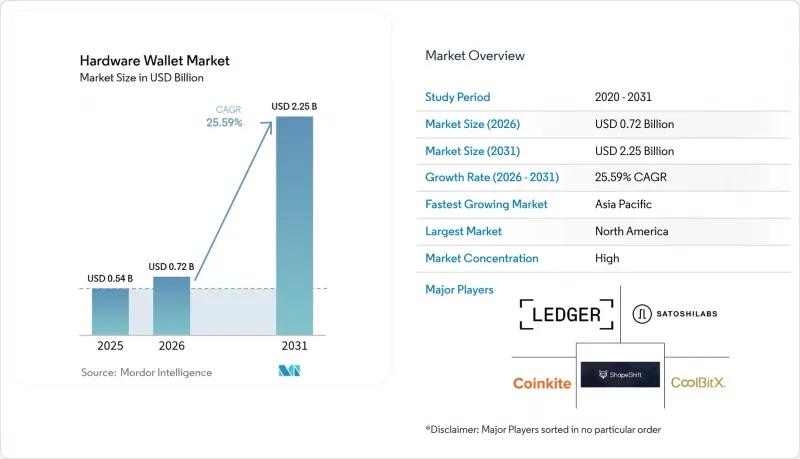
根據 Mordor Intelligence 預測,硬體錢包市場預計將從 2025 年的 5.4 億美元成長到 2026 年的 7.2 億美元,到 2031 年達到 22.5 億美元,2026 年至 2031 年的複合年成長率預計為 25.6%。
本報告按連接方式(USB、NFC、藍牙及其他)、錢包類型(熱錢包、冷錢包)、最終用戶(個人/零售、機構/企業)、分銷管道(線上、線下)和地區(北美、南美、歐洲、亞太、中東和非洲)進行細分。市場預測以美元計價。
全球硬體錢包市場趨勢及洞察
機構投資者正在加速採用自我管理解決方案。
在FTX倒閉和Bybit發生15億美元安全漏洞事件後,企業財務部門、家族辦公室和退休基金經理人加快了對加密設備的採購,他們認為交易對手風險超過了交易所儲存的便利性。 Gnosis Safe的數據顯示,到2025年,受硬體保護的多重簽名合約保護的資產將超過1000億美元,這證實了多層管治正在成為去中心化自治組織(DAO)的主流。雖然美國銀行可以根據第1170號和第1172號指南儲存加密資產,但許多機構仍然傾向於使用本地冷錢包來完全掌控自己的金鑰。在歐洲,《證券及市場法案》(MiCA)第76條規定,服務提供者必須隔離客戶資產,而硬體保護的冷藏保管最容易滿足此要求。 2024年1月比特幣現貨交易所交易基金(ETF)的核准提高了人們對審計的預期,評估保證等級5(EAL5)認證成為企業採購的事實標準。
由於網路安全漏洞報告激增,對離線金鑰的需求增加。
頻頻登上新聞頭條的駭客事件提醒消費者,連網金鑰容易招致攻擊。例如,Lazarus Group 對 Bybit 的攻擊,以及 2024 年 3 月 SafeWallet 的內容傳遞網路遭到入侵,都引發了完全空氣間隙的銷售量激增。 ELLIPAL 和 Keystone 等廠商在每次事件發生後的幾週內,訂單量都出現了三位數的成長。網際網路工程任務小組 (IETF) 於 2024 年提出的後量子密鑰封裝標準,為製造商提供了清晰的實施藍圖,並進一步增強了消費者的信心。普通用戶也面臨網路釣魚攻擊,攻擊者會發送假冒設備,因此建議用戶在首次使用前透過製造商的應用程式驗證全像防偽標籤。總而言之,媒體對安全漏洞的報告正在縮短用戶從交易所提取資金並將其冷藏保管的決策週期。
消費者體驗(UX)的複雜性依然存在。
對於初次使用的用戶來說,備份助記詞、更新韌體和驗證地址等任務仍然令人望而生畏。 Tangem 的無螢幕卡片式錢包簡化了初始設置,但交易驗證只能在智慧型手機上完成,這使得買家面臨「盲簽」的風險。 Ledger 的 Nano Gen5 透過大螢幕和藍牙配對提高了可視性,但用戶仍然需要滾動並驗證整個地址才能批准付款。標準的不一致加劇了這種混亂。 BIP39 和 SLIP39 產生的備份不相容,迫使使用多個品牌錢包的使用者同時管理不同的復原流程。 OpenZeppelin 的 ERC-7913 旨在將非 EVM 金鑰整合到以太坊合約中,但其應用仍僅限於高級用戶。除非一般用戶體驗到像行動銀行一樣直覺的工作流程,否則錢包的普及速度可能會落後於加密貨幣的普及速度。
細分市場分析
預計到2025年,USB設備將佔銷售額的45.21%,這鞏固了其作為審計友好型預設選擇的地位,尤其對於那些拒絕所有無線通訊功能的公司而言。同時,藍牙錢包預計到2031年將以26.0%的複合年成長率成長,隨著裝置螢幕認證功能的普及,中間人攻擊的風險降低,USB的領先優勢可能會縮小。有線型號仍然主導著金融機構的硬體錢包市場,但普通消費者更傾向於藍牙型號,因為它們可以與智慧型手機無縫配對,用於面對面支付和去中心化應用程式(DApps)。 Tangem的NFC卡套裝和Coinkite的Coldcard Q提供了適中的選擇,它們具備非接觸式簽名功能,可以限制被攔截的範圍。相較之下,Keystone和ELLIPAL的QR碼空氣間隙產品完全阻斷了無線通訊,吸引了那些即使犧牲速度也要將安全性放在首位的富裕用戶。預計不久後,所有連接類型的韌體都將整合一種結合傳統密鑰交換和格型密鑰交換的混合方案。此外,雖然無線更新可能會暫時模糊冷藏保管的純粹性,但普及曲線表明,藍牙將繼續逐步蠶食USB在行動優先用戶群中的市場佔有率。
在多重簽名基金管理工作流程中,USB 仍然至關重要,因為它能留下不可篡改的審計追蹤,符合《薩班斯-奧克斯利法案》的內部控制框架。因此,即使消費者錢包的無線化程度越來越高,支援 USB 的硬體錢包預計仍將在託管機構中保持較高的市場佔有率。藍牙的短期成長也將取決於面向現有用戶(尤其是那些錯過了前幾輪加密貨幣週期的用戶)的易用型配套應用程式的部署。總體而言,預計會出現兩極分化的趨勢。在硬體錢包市場,藍牙產品將推動出貨量的成長,而 USB 預計將在核心機構投資者群體中保持其價值密度。
由於密西根州保險法 (MiCA) 第 76 條和美國銀行業建議中嚴格的隔離要求,冷錢包在 2025 年佔據了 63.19% 的收入佔有率。預計到 2031 年,冷錢包的這一主導地位將以 26.2% 的複合年成長率持續成長,因為保險公司只會在密鑰存儲在評估保證級別 5 (EAL5) 或更高級別的安全元件中時才會報銷保費。熱錢包硬體錢包市場規模仍然小規模,主要針對需要即時簽名的去中心化金融 (DeFi) 交易者。然而,諸如 Bybit 資料外洩事件等公開揭露的漏洞事件,正在提高人們對線上金鑰風險溢價的認知。像 Ledger Nano Gen5 這樣的裝置試圖將冷錢包的安全性與熱錢包的便利性結合,即使在藍牙會話期間也能將金鑰隔離在安全元件中,從而模糊了不同類別之間的界限。
保險公司和合規審計公司仍然將空氣間隙視為強制性要求,因此即使交易員在網路擴充功能中持有少量餘額,企業財務負責人仍然會大量購買冷藏保管。由於監管措辭幾乎沒有解釋空間,冷藏保管硬體錢包的市場佔有率可能會逐步成長。未來,如果後量子密碼技術成為強制性要求,其長期持有特性可能會引發以冷儲存市場為中心的更新周期。
區域分析
到2025年,北美將佔全球銷售額的38.95%。這主要得益於美國貨幣監理署(OCC)的早期監管澄清以及美國證券交易委員會(SEC)對ETF的批准。機構資產管理公司要求設備達到評估保證等級5(EAL5)才能通過審計,而總部位於美國的去中心化自治組織(DAO)的財務部門持有大量多重簽名合約中的資產。在加拿大,省級監管機構強制執行的規範性隔離框架促使來自小規模但穩定的零售投資者的資金持續流入。同時,墨西哥的應用案例主要集中在匯款管道,跨境轉帳首選NFC卡錢包。這些趨勢共同建構了一個高價值的基礎,促使企業不斷訂購設備升級,以促進後量子時代的技術進步。
歐洲加密貨幣資訊共享協議(MiCA)於2024年12月全面生效,引發了一場廣泛的硬體更換浪潮,支付機構紛紛升級其託管系統以滿足第76條的要求。德國已頒發40張加密貨幣託管許可證,要求擁有者使用冷藏保管;法國PSAN註冊中心也實施了類似的離線儲存要求。歐洲銀行管理局(EBA)建議將估值保證等級6級以上作為最佳實踐,這推高了設備的平均價格。英國正在調整其脫歐後的監管規定,使其與MiCA保持一致;義大利和西班牙在個人市場滲透率方面落後,儘管它們正透過家族辦公室的投資在機構市場取得成長。
預計到2031年,中東地區的複合年成長率將達到26.5%,成為所有地區中成長最快的地區。這主要得益於阿拉伯聯合大公國主權財富基金和沙烏地阿拉伯正在開發的託管框架。杜拜的VARA許可證明確規定了安全的金鑰管理,促使當地託管機構大量訂購認證設備。巴林和卡達也發布了類似的指南,海灣國家的富裕人士更傾向於直接從高階電子產品商店購買。非洲市場規模仍然小規模,但在南非和奈及利亞卻蓬勃發展,硬體錢包正在幫助緩解貨幣貶值和資本管制等不利因素。
在亞太地區,香港和新加坡的加密貨幣市場正迅速發展。這兩個地區都已建立了完善的牌照制度,強制要求使用隔離帳戶。在日本,《支付服務法》的修訂加強了對交易所的監管,持懷疑態度的個人投資者也開始轉向自主管理。在澳大利亞,監管方面的討論仍在進行中,但由於買家將硬體錢包作為對沖政策不確定性的工具,銷售並未放緩。在印度,由於課稅的不確定性,市場情況依然不穩定,但儘管偶爾有交易所關閉的傳聞,家庭用戶對加密貨幣的興趣依然不減。受2021年交易禁令的影響,中國當地的加密貨幣市場依然低迷,該地區的成長潛力有限。
其他好處
- Excel格式的市場預測(ME)表
- 3個月的分析師支持
目錄
第1章:引言
- 研究假設和市場定義
- 調查範圍
第2章:調查方法
第3章執行摘要
第4章 市場狀況
- 市場概覽
- 市場促進因素
- 機構投資者正在加速採用自我管理解決方案。
- 由於網路安全漏洞報告激增,對離線金鑰的需求增加。
- 監管部門為加密資產隔離儲存所做的努力(MiCA、OCC)
- 整合與後量子密碼技術相容的安全元件晶片
- DAO財務管理中對多重簽章工作流程的需求日益成長。
- 為經認證的硬體錢包報銷保險費的保險公司
- 市場限制因素
- 消費者體驗(UX)的複雜性依然存在。
- 安全元件硬體供應鏈供不應求
- 錢包之間缺乏統一的助記詞恢復標準
- 由於二手市場轉售活動的增加,仿冒品的風險也隨之增加。
- 產業價值鏈分析
- 監理情勢
- 技術展望
- 波特五力分析
- 硬體錢包產品對比
- 宏觀經濟因素的影響
- 用例研究分析
第5章 市場規模與成長預測
- 透過連接方式
- USB
- NFC
- Bluetooth
- 其他連接方式
- 錢包類型
- 熱錢包
- 冷錢包
- 最終用戶
- 個人/零售
- 組織和公司
- 透過分銷管道
- 線上
- 離線
- 按地區
- 北美洲
- 美國
- 加拿大
- 墨西哥
- 南美洲
- 巴西
- 阿根廷
- 智利
- 其他南美國家
- 歐洲
- 德國
- 英國
- 法國
- 義大利
- 其他歐洲國家
- 亞太地區
- 中國
- 日本
- 印度
- 澳洲
- 其他亞太國家
- 中東
- 沙烏地阿拉伯
- 阿拉伯聯合大公國
- 其他中東國家
- 非洲
- 南非
- 奈及利亞
- 其他非洲地區
- 北美洲
第6章 競爭情勢
- 市場集中度
- 策略趨勢
- 市佔率分析
- 公司簡介
- Ledger SAS
- SatoshiLabs sro
- ShapeShift AG
- Coinkite Inc.
- CoolBitX Technology Ltd.
- Shift Crypto AG
- Penta Security Systems Inc.
- SecuX Technology Inc.
- ARCHOS SA
- ELLIPAL Ltd.
- BitLox Limited
- SafePal Technology Ltd.
- Keystone(Cobo Technology Ltd.)
- OPOLO SARL
- zSofitto NV(Sugi)
- KeepKey LLC
- IoTrust Co., Ltd.(D'CENT)
- Prokey Technologies Co., Ltd.
- CryoBit LLC
- BC VAULT doo
- Tangem AG
- OneKey Technology Co., Ltd.
第7章 市場機會與未來展望
According to Mordor Intelligence, the hardware wallet market size is expected to increase from USD 0.54 billion in 2025 to USD 0.72 billion in 2026 and reach USD 2.25 billion by 2031, growing at a CAGR of 25.6% over 2026-2031.
This report is Segmented by Connectivity (USB, NFC, Bluetooth, and More), Wallet Type (Hot Wallet, and Cold Wallet), End User (Individual/Retail, and Institutional/Enterprise), Distribution Channel (Online, and Offline), and Geography (North America, South America, Europe, Asia-Pacific, and Middle East, Africa). The Market Forecasts are Provided in Terms of Value (USD).
Global Hardware Wallet Market Trends and Insights
Intensifying Institutional Adoption of Self-Custody Solutions
Corporate treasuries, family offices, and pension managers accelerated device procurement after the FTX collapse and the USD 1.5 billion Bybit breach, concluding that counterparty risk outweighs the convenience of exchange custody. Gnosis Safe disclosed that assets protected by hardware-backed multi-signature contracts topped USD 100 billion in 2025, confirming that multi-layer governance has become mainstream for decentralized autonomous organizations. United States banks can custody crypto under Interpretive Letters 1170 and 1172, yet many institutions still prefer on-premises cold wallets to maintain total key control. In Europe, MiCA Article 76 obliges providers to segregate client assets, a requirement satisfied most easily with hardware-secured cold storage. The January 2024 approval of spot Bitcoin exchange-traded funds hardened audit expectations, making Evaluation Assurance Level 5 certification the de facto baseline for enterprise purchases.
Surge In Cyber-Breach Publicity Pushing Demand for Offline Keys
Headline hacks remind buyers that internet-connected keys invite adversaries. The Bybit attack attributed to the Lazarus Group triggered a sales spike for fully air-gapped devices, as did the March 2024 compromise of Safe{Wallet}'s content delivery network. Vendors such as ELLIPAL and Keystone reported triple-digit order growth within weeks of each incident. Draft standards on post-quantum key encapsulation finalized by the Internet Engineering Task Force in 2024 gave manufacturers a clear implementation roadmap, further bolstering consumer confidence. Retail users also confront phishing campaigns that ship counterfeit devices, prompting them to verify holographic seals via manufacturer apps before first use. Altogether, publicity around breaches shortens the decision cycle for moving funds off exchanges and into cold storage.
Persistent Consumer UX Complexity
First-time users still find seed-phrase backup, firmware updates, and address verification intimidating. Tangem's screen-less card wallets simplify onboarding but expose buyers to blind-signing risk because transactions are confirmed only on a smartphone. Ledger's Nano Gen5 improves readability through a larger display and Bluetooth pairing, yet users must still scroll full addresses before approving payments. Standards divergence compounds confusion: BIP39 and SLIP39 generate incompatible backups, so households with multiple brands juggle different recovery workflows. OpenZeppelin's ERC-7913 aims to bridge non-EVM keys into Ethereum contracts, but adoption remains limited to advanced users. Until mainstream buyers see workflows as intuitive as mobile banking, adoption will trail the broader crypto ownership curve.
Other drivers and restraints analyzed in the detailed report include:
- Regulatory Push for Segregated Crypto Custody (MiCA, OCC)
- Integration Of Secure Element Chips with Post-Quantum Cryptography Support
- Hardware Supply-Chain Shortages for Secure Elements
For complete list of drivers and restraints, kindly check the Table Of Contents.
Segment Analysis
USB devices owned 45.21% of 2025 revenue, confirming their role as the audit-friendly default for enterprise signers who refuse any radios. Bluetooth wallets, however, are set to expand at a 26.0% CAGR through 2031, shrinking the USB lead as screen-on-device verification mitigates man-in-the-middle concerns. The hardware wallet market size advantage still belongs to wired models among financial institutions, yet retail buyers gravitate to Bluetooth because it pairs seamlessly with smartphones during in-person payments or decentralized-app interactions. Tangem's NFC card bundle and Coinkite's Coldcard Q illustrate a middle path, offering contactless signing that limits interception range. In contrast, QR-code air-gap products from Keystone and ELLIPAL isolate radio entirely, attracting high-net-worth users who trade speed for maximal security. Firmware for all connectivity types will soon integrate hybrid classical-and-lattice key exchange, and over-the-air updates may momentarily blur cold-storage purism, but adoption curves suggest Bluetooth will keep eroding USB share among mobile-first demographics.
USB remains indispensable for multi-signature treasury workflows because it leaves an immutable audit trail that satisfies Sarbanes-Oxley internal-control frameworks. Hardware wallet market share for USB will therefore stay overweight inside custodians, even as consumer-grade portfolios turn wireless. Near-term Bluetooth growth also hinges on the rollout of easier-to-navigate companion apps designed for grandfathered users who skipped prior crypto cycles. Overall, expect a bifurcated path: hardware wallet market Bluetooth shipments lead volume growth, while USB retains value density in the institutional core.
Cold wallets captured 63.19% of 2025 sales thanks to strict segregation clauses under MiCA Article 76 and United States banking advisories. That dominance will persist with a 26.2% CAGR to 2031 because insurance carriers rebate premiums only when keys rest in Evaluation Assurance Level 5 or better secure elements. The hardware wallet market size for hot wallets remains modest, catering chiefly to decentralized-finance traders who need real-time signing. Yet each publicized exploit, such as the Bybit breach, widens the perceived risk premium on online keys. Devices like Ledger's Nano Gen5 try to blend cold-wallet security with hot-wallet convenience by isolating keys in secure elements even during Bluetooth sessions, softening the boundary between categories.
Insurance carriers and compliance auditors continue to treat airgap as table stakes, so corporate treasurers still bulk-buy cold storage even when traders keep small balances in web extensions. Hardware wallet market share for cold storage may inch higher because regulatory language leaves little room for alternative interpretations. Looking forward, the mandatory adoption of post-quantum cryptography will likely trigger refresh cycles concentrated in the cold segment, given its longer retention horizons.
Complete Report Scope:
- By Connectivity
- USB
- NFC
- Bluetooth
- Others, Connectivity
- By Wallet Type
- Hot Wallet
- Cold Wallet
- By End User
- Individual / Retail
- Institutional / Enterprise
- By Distribution Channel
- Online
- Offline
- By Geography
- North America
- United States
- Canada
- Mexico
- South America
- Brazil
- Argentina
- Chile
- Rest of South America
- Europe
- Germany
- United Kingdom
- France
- Italy
- Rest of Europe
- Asia-Pacific
- China
- Japan
- India
- Australia
- Rest of Asia-Pacific
- Middle East
- Saudi Arabia
- United Arab Emirates
- Rest of Middle East
- Africa
- South Africa
- Nigeria
- Rest of Africa
- North America
Geography Analysis
North America held 38.95% of global revenue in 2025, energized by early regulatory clarity from the Office of the Comptroller of the Currency and the Securities and Exchange Commission ETF approvals. Institutional asset managers insist on Evaluation Assurance Level 5 devices to pass audits, and decentralized-autonomous-organization treasuries headquartered in the United States represent a large share of assets inside multi-signature contracts. Canada's prescriptive segregation framework, enforced by provincial regulators, brought small but steady retail inflows, while Mexico's use case centers on remittance corridors that favour NFC card wallets for cross-border transfers. Combined, these trends anchor a high-value base that continues to spin off enterprise refresh orders each time post-quantum enhancements arrive.
Europe's MiCA regime, fully live since December 2024, ignited a broad hardware replacement cycle as payment institutions upgraded custody stacks to meet Article 76 mandates. Germany issued 40 crypto-custody licenses that bind holders to cold storage, and France's PSAN registry applies similar offline requirements. The European Banking Authority has suggested Evaluation Assurance Level 6+ as best practice, driving higher average device prices. The United Kingdom is aligning post-Brexit rules with MiCA, while Italy and Spain trail on retail penetration yet show institutional upticks via family-office allocations.
The Middle East will record the fastest regional CAGR at 26.5% through 2031, driven by sovereign funds in the United Arab Emirates and pending custody frameworks in Saudi Arabia. Dubai's VARA licensing explicitly references secure key management, so local custodians place bulk orders for certified devices. Bahrain and Qatar have followed with similar directives, and high-net-worth individuals in the Gulf favour in-person purchases at upscale electronics boutiques. Africa's market remains small but vibrant in South Africa and Nigeria, where hardware wallets solve currency-devaluation and capital-control headwinds.
Asia-Pacific features pockets of rapid adoption in Hong Kong and Singapore, each with full licensing that insists on segregated custody. Japan tightened exchange rules under its amended Payment Services Act, pushing sceptical retail holders toward self-custody. Australia's ongoing regulatory consultations have not slowed hardware sales, as buyers hedge against policy uncertainty. India remains volatile due to taxation ambiguities, but household interest persists despite occasional exchange-shutdown rumours. Mainland China stays chilled by the 2021 trading ban, limiting regional upside.
- Ledger SAS
- SatoshiLabs s.r.o.
- ShapeShift AG
- Coinkite Inc.
- CoolBitX Technology Ltd.
- Shift Crypto AG
- Penta Security Systems Inc.
- SecuX Technology Inc.
- ARCHOS S.A.
- ELLIPAL Ltd.
- BitLox Limited
- SafePal Technology Ltd.
- Keystone (Cobo Technology Ltd.)
- OPOLO SARL
- zSofitto NV (Sugi)
- KeepKey LLC
- IoTrust Co., Ltd. (D'CENT)
- Prokey Technologies Co., Ltd.
- CryoBit LLC
- BC VAULT d.o.o.
- Tangem AG
- OneKey Technology Co., Ltd.
Additional Benefits:
- The market estimate (ME) sheet in Excel format
- 3 months of analyst support
TABLE OF CONTENTS
1 INTRODUCTION
- 1.1 Study Assumptions and Market Definition
- 1.2 Scope of the Study
2 RESEARCH METHODOLOGY
3 EXECUTIVE SUMMARY
4 MARKET LANDSCAPE
- 4.1 Market Overview
- 4.2 Market Drivers
- 4.2.1 Intensifying Institutional Adoption of Self-Custody Solutions
- 4.2.2 Surge in Cyber-Breach Publicity Pushing Demand for Offline Keys
- 4.2.3 Regulatory Push for Segregated Crypto Custody (MiCA, OCC)
- 4.2.4 Integration of Secure Element Chips with Post-Quantum Cryptography Support
- 4.2.5 Rising Demand for Multi-Signature Workflows in DAO Treasury Management
- 4.2.6 Insurance Underwriters Providing Premium Rebates for Certified Hardware Wallets
- 4.3 Market Restraints
- 4.3.1 Persistent Consumer UX Complexity
- 4.3.2 Hardware Supply-Chain Shortages for Secure Elements
- 4.3.3 Lack of Uniform Seed Phrase Recovery Standards Across Wallets
- 4.3.4 Growing Secondary Grey-Market Reselling Increasing Counterfeit Risk
- 4.4 Industry Value-Chain Analysis
- 4.5 Regulatory Landscape
- 4.6 Technological Outlook
- 4.7 Porter's Five Forces Analysis
- 4.7.1 Bargaining Power of Suppliers
- 4.7.2 Bargaining Power of Buyers
- 4.7.3 Threat of New Entrants
- 4.7.4 Threat of Substitute Products
- 4.7.5 Intensity of Competitive Rivalry
- 4.8 Hardware Wallet Product Comparison
- 4.9 Impact of Macroeconomic Factors
- 4.10 Case Study Analysis
5 MARKET SIZE AND GROWTH FORECASTS (VALUE)
- 5.1 By Connectivity
- 5.1.1 USB
- 5.1.2 NFC
- 5.1.3 Bluetooth
- 5.1.4 Others, Connectivity
- 5.2 By Wallet Type
- 5.2.1 Hot Wallet
- 5.2.2 Cold Wallet
- 5.3 By End User
- 5.3.1 Individual / Retail
- 5.3.2 Institutional / Enterprise
- 5.4 By Distribution Channel
- 5.4.1 Online
- 5.4.2 Offline
- 5.5 By Geography
- 5.5.1 North America
- 5.5.1.1 United States
- 5.5.1.2 Canada
- 5.5.1.3 Mexico
- 5.5.2 South America
- 5.5.2.1 Brazil
- 5.5.2.2 Argentina
- 5.5.2.3 Chile
- 5.5.2.4 Rest of South America
- 5.5.3 Europe
- 5.5.3.1 Germany
- 5.5.3.2 United Kingdom
- 5.5.3.3 France
- 5.5.3.4 Italy
- 5.5.3.5 Rest of Europe
- 5.5.4 Asia-Pacific
- 5.5.4.1 China
- 5.5.4.2 Japan
- 5.5.4.3 India
- 5.5.4.4 Australia
- 5.5.4.5 Rest of Asia-Pacific
- 5.5.5 Middle East
- 5.5.5.1 Saudi Arabia
- 5.5.5.2 United Arab Emirates
- 5.5.5.3 Rest of Middle East
- 5.5.6 Africa
- 5.5.6.1 South Africa
- 5.5.6.2 Nigeria
- 5.5.6.3 Rest of Africa
- 5.5.1 North America
6 COMPETITIVE LANDSCAPE
- 6.1 Market Concentration
- 6.2 Strategic Moves
- 6.3 Market Share Analysis
- 6.4 Company Profiles (includes Global Level Overview, Market Level Overview, Core Segments, Financials as available, Strategic Information, Market Rank/Share, Products and Services, Recent Developments)
- 6.4.1 Ledger SAS
- 6.4.2 SatoshiLabs s.r.o.
- 6.4.3 ShapeShift AG
- 6.4.4 Coinkite Inc.
- 6.4.5 CoolBitX Technology Ltd.
- 6.4.6 Shift Crypto AG
- 6.4.7 Penta Security Systems Inc.
- 6.4.8 SecuX Technology Inc.
- 6.4.9 ARCHOS S.A.
- 6.4.10 ELLIPAL Ltd.
- 6.4.11 BitLox Limited
- 6.4.12 SafePal Technology Ltd.
- 6.4.13 Keystone (Cobo Technology Ltd.)
- 6.4.14 OPOLO SARL
- 6.4.15 zSofitto NV (Sugi)
- 6.4.16 KeepKey LLC
- 6.4.17 IoTrust Co., Ltd. (D'CENT)
- 6.4.18 Prokey Technologies Co., Ltd.
- 6.4.19 CryoBit LLC
- 6.4.20 BC VAULT d.o.o.
- 6.4.21 Tangem AG
- 6.4.22 OneKey Technology Co., Ltd.
7 MARKET OPPORTUNITIES AND FUTURE OUTLOOK
- 7.1 White-Space and Unmet-Need Assessment


