


 |
市場調查報告書
商品編碼
2122260
塑膠添加劑:市場佔有率分析、產業趨勢與統計、成長預測(2026-2031)Plastic Additives - Market Share Analysis, Industry Trends & Statistics, Growth Forecasts (2026 - 2031) |
||||||

※ 本網頁內容可能與最新版本有所差異。詳細情況請與我們聯繫。
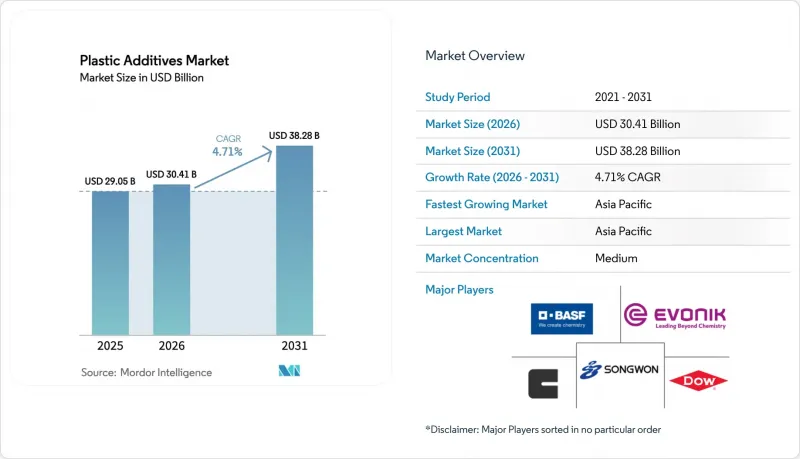
根據 Mordor Intelligence 預測,塑膠添加劑市場規模預計將在 2025 年達到 290.5 億美元,2026 年達到 304.1 億美元,到 2031 年達到 382.8 億美元,2026 年至 2031 年的複合年成長率為 4.71%。
本報告按類型(潤滑劑、加工助劑、流動改進劑等)、塑膠類型(聚乙烯 (PE)、聚丙烯 (PP) 等)、形態(母粒、粉末、濃縮液)、應用(包裝、消費品等)和地區(亞太地區、北美地區、歐洲地區、南美地區、中東和非洲地區)進行細分。市場預測以美元 (USD) 為單位。
全球塑膠添加劑市場趨勢與洞察
輕量化電動車零件正在推動對高性能添加劑的需求。
電池式電動車(EV) 平台需要能夠承受 150 度C以上高溫且重量不增加的聚合物零件。用於電力電子裝置的聚醯胺和聚碳酸酯外殼現在需要添加熱穩定劑和衝擊改質劑,即使在高溫環境下也能保持拉伸強度和阻燃性。潤滑劑生產商正在添加氟化和矽基化學品,這些化學品可將射出成型成型週期縮短 8% 至 12%,同時改善表面光潔度。特斯拉 2025 年供應商行為準則要求使用無鹵化解決方案,並符合 UL 94 V-0 標準,可能會使特種包裝的售價增加高達 35%。因此,擁有整合研發功能的製造商正在確保長期供應契約,並保護利潤率免受原料價格波動的影響。隨著汽車製造商發布更嚴格的永續性評分卡,能夠獲得低 VOC 和可回收性認證的添加劑供應商比競爭對手更有能力在不斷成長的塑膠添加劑市場中佔據更大的佔有率。
在消費品和工業領域,用塑膠取代金屬。
耐腐蝕性、輕量化和更高的設計靈活性正在加速泵殼、閥體和家用電器部件從金屬轉向增強塑膠的轉變。一家家用電器製造商用耐衝擊的ABS塑膠取代了鋅壓鑄件,實現了40%的成本降低,並利用套模製程的設計靈活性減少了零件數量。歐盟生態設計法規將於2025年生效,該法規賦予單一材料產品更高的循環性評分,從而促進了採用依賴先進封裝以確保機械強度的單一聚合物組件。隨著設計工程師追求更薄的壁厚,成核劑和長效熱穩定劑日益受到關注,增加了配方的複雜性。這一趨勢正在擴大全球和區域性混合料生產商之間的產能差距,進一步加速塑膠添加劑市場的整合。
錫和磷等原料價格的波動給利潤率帶來了壓力。
印尼將2025年的錫出口配額削減了15%,導致倫敦金屬交易所(LME)現貨價格在年底前從每噸2.5萬美元上漲至3.05萬美元。同時,緬甸的政治動盪擾亂了五氧化二磷的運輸,迫使歐洲穩定劑生產商以22%的溢價從摩洛哥採購。有機錫穩定劑仍然是硬質PVC管道的必需品,但鈣鋅替代品的用量高出30%,這削弱了加工商的獲利能力。利潤率壓力對沒有長期合約的中型複合材料生產商最為嚴重,迫使它們退出市場或多元化經營。因此,塑膠添加劑市場面臨短期成本波動,導致投資者對投資含錫量高的產品線感到猶豫。
細分市場分析
預計從2026年到2031年,加工助劑的複合年成長率將達到4.78%,成為成長最快的產業。這是因為加工商優先考慮的是提高熔融材料的流動性,避免其轉移到模塑產品的表面。氟聚合物加工助劑在PVC行業一直佔據主導地位,但如今由於全氟烷基物質(PFAS)含量超標,正面臨嚴格的審查,這導致性能達到90%的丙烯酸和矽基替代品迅速崛起。塑膠添加劑市場(歸類為“其他”,包括潤滑劑、爽滑劑和抗靜電劑)預計將在2025年達到最大規模,這主要得益於它們在聚乙烯薄膜和模塑包裝材料中的廣泛應用。擠出成型生產線的目標是將生產週期縮短5%至8%,而流動性增強劑尤其能夠使汽車內裝用聚丙烯面板更加輕薄,從而直接助力汽車製造商實現減重目標。
到2025年,著色劑將佔據塑膠添加劑市場45.87%的佔有率。這主要得益於包裝、建築和運輸業對美觀差異化、品牌推廣和功能性著色的需求。與再生聚合物相容的母粒的普及以及耐熱、耐紫外線和食品接觸相容性顏料的創新,正在推動著色劑的應用。用於高回收率薄膜和模塑件的先進著色劑進一步拓展了其應用範圍,並鞏固了其在市場中的重要作用。
聚乙烯廣泛應用於薄膜、農業包裝膜和吹塑成型容器中,用作爽滑劑和紫外線防護系統,以確保產品展示穩定性。預計到2025年,聚乙烯將佔據全球塑膠添加劑市場17.87%的佔有率。隨著再生材料含量目標的提高,對聚乙烯的需求持續成長,這需要能夠恢復熔體黏度和紅外線屏蔽性能的添加劑。聚苯乙烯,尤其是發泡聚苯乙烯,預計到2031年將以4.66%的複合年成長率成長,這得益於阻燃技術的創新,使得建築隔熱材料材料中無鹵阻燃劑的應用成為可能。
聚丙烯受益於電動車內裝應用,而對於滑石粉填充的聚丙烯,即使在-20 度C以下,也需要偶聯劑來維持其延展性,這推動了全部區域的中等個位數成長。聚氯乙烯對熱穩定劑的依賴正受到鄰苯二甲酸酯逐步淘汰的不利影響,但基礎設施項目中對硬質管道的需求支撐了基準供應。聚對苯二甲酸乙二醇酯(PET)正朝著高PCR(再生塑膠)共混物的方向發展,並使用擴鏈劑和乙醛清除劑來恢復其機械性能。聚碳酸酯和聚醯胺正被應用於引擎室零件和工業機械等高價值細分市場,在這些市場中,高品質的添加劑組合能夠確保產品在150 度C下的尺寸穩定性並符合UL 94 V-0標準,從而為塑膠添加劑市場的供應商提供了極佳的利潤空間。
區域分析
預計到2025年,亞太地區將佔全球塑膠添加劑市場佔有率的53.12%,並將以5.27%的複合年成長率持續成長至2031年。中國的「雙循環」政策鼓勵混煉企業利用本地添加劑供應商,推動了山東和浙江兩省產能的快速擴張。在這些地區,2025年聚丙烯新增加工量增加了12%。印度的「生產連結獎勵計畫計畫(PLI)」向先進化工領域的投資者提供12億美元的資金,刺激相關項目,目標是到2028年將添加劑年產能提高8.5萬噸。在日本,雖然產量保持平穩,但對工程樹脂專用添加劑的需求持續成長。同時,韓國主要電子公司正在指定使用無鹵化阻燃體系,推動國內消費成長達到中位數百分比。
北美正受惠於生產回流和《通膨抑制法案》,該法案支持德克薩斯州和路易斯安那州的特種化學品生產線,總合2026年年產量將達4萬噸。加拿大正在調整其鄰苯二甲酸酯禁令,使其與美國政策保持一致,並加快檸檬酸鹽。同時,在墨西哥,汽車出口推動了聚丙烯改質劑在保險桿飾板和儀表板中的應用。歐洲循環經濟立法優先考慮單一材料設計,這增加了對高性能添加劑包裝的需求,以取代金屬-塑膠混合材料。德國、法國和義大利正在擴大採用母粒生產可堆肥包裝,而斯堪地那維亞國家則強制要求在建築板材中使用無鹵阻燃劑,這為專業混煉公司創造了巨大的商機。
巴西正引領南美洲的成長。預計到2025年,巴西種植面積將擴大450萬公頃,因此對採用紫外線和光擴散系統的農業薄膜的需求不斷成長。在阿根廷,汽車零件的出口推動了聚丙烯和聚醯胺添加劑的應用,但外匯波動抑制了資本投資。在中東,沙烏地阿拉伯的本地複合材料計畫正在推動下游投資,為塑膠添加劑(主要是用於新運作的聚乙烯和聚丙烯生產線的加工助劑)開闢了一個新興市場。南非零售商正在指定使用抗菌包裝以延長保存期限,在冷鏈仍然存在限制的地區,抗菌包裝的早期應用正在穩步推進。
其他好處:
- Excel格式的市場預測(ME)表
- 3個月的分析師支持
目錄
第1章:引言
- 研究假設和市場定義
- 調查範圍
第2章:調查方法
第3章執行摘要
第4章 市場狀況
- 市場概覽
- 市場促進因素
- 輕量化電動車零件正在推動對高性能添加劑的需求。
- 在消費品和工業領域,塑膠正在取代金屬。
- 亞太地區的都市化正在擴大包裝需求。
- 強制性可生物分解包裝法規正在推動對生物添加劑母粒的需求。
- 抗菌表面材料在醫療領域以及食品飲料塑膠領域的迅速普及。
- 市場限制因素
- 錫和磷等原料價格的波動給利潤率帶來了壓力。
- 美國和歐洲逐步淘汰鄰苯二甲酸酯類塑化劑,導致目標市場規模縮小。
- 對含 PFAS 加工助劑的監管阻礙了其引入。
- 價值鏈分析
- 波特五力模型
第5章 市場規模與成長預測
- 按類型
- 潤滑劑
- 加工助劑(氟樹脂基)
- 流動改善劑
- 滑滑劑
- 抗靜電添加劑
- 顏料潤濕劑
- 著色劑
- 防霧添加劑
- 塑化劑
- 其他類型(填充物、分散劑、發泡、防黏劑、偶聯劑等)
- 按塑膠類型
- 聚乙烯(PE)
- 聚丙烯(PP)
- 聚氯乙烯(PVC)
- 聚苯乙烯(PS)
- 聚對苯二甲酸乙二醇酯(PET)
- 聚碳酸酯(PC)
- 聚醯胺(PA)
- 其他類型的塑膠
- 按形式
- 母粒
- 粉末
- 濃縮液液
- 透過使用
- 包裝
- 消費品
- 建造
- 車
- 其他(醫療、3D列印)
- 按地區
- 亞太地區
- 中國
- 印度
- 日本
- 韓國
- 其他亞太國家
- 北美洲
- 美國
- 加拿大
- 墨西哥
- 歐洲
- 德國
- 英國
- 法國
- 義大利
- 北歐國家
- 其他歐洲國家
- 南美洲
- 巴西
- 阿根廷
- 其他南美國家
- 中東和非洲
- 沙烏地阿拉伯
- 南非
- 其他中東和非洲國家
- 亞太地區
第6章 競爭情勢
- 市場集中度
- 策略趨勢
- 市佔率和排名分析
- 公司簡介(包括全球整體概覽、市場概覽、主要業務板塊、財務資訊、策略資訊、市場排名/佔有率、產品和服務以及近期發展動態)
- ADEKA CORPORATION
- Albemarle Corporation
- Arkema
- Avient Corporation
- Baerlocher GmbH
- BASF
- Clariant
- Croda International Plc
- Dow
- Emery Oleochemicals
- Evonik Industries AG
- Exxon Mobil Corporation
- KANEKA CORPORATION
- LANXESS
- Mitsui & Co.Plastics Ltd.
- Nouryon
- Peter Greven GmbH & Co. KG
- SABO SpA
- Solvay
- Songwon Industrial Co. Ltd.
- Struktol Company of America, LLC
第7章 市場機會與未來展望
According to Mordor Intelligence, the plastic additives market size is projected to be USD 29.05 billion in 2025, USD 30.41 billion in 2026, and reach USD 38.28 billion by 2031, growing at a CAGR of 4.71% from 2026 to 2031.
This report is Segmented by Type (Lubricants, Processing Aids, Flow Improvers, and More), Plastic Type (Polyethylene (PE), Polypropylene (PP) and More), Form (Masterbatch, Powder, and Liquid Concentrate), Application (Packaging, Consumer Goods, and More), and Geography (Asia-Pacific, North America, Europe, South America, Middle East and Africa). The Market Forecasts are Provided in Terms of Value (USD).
Global Plastic Additives Market Trends and Insights
Lightweight-EV Components Boosting High-Performance Additives
Battery-electric platforms demand polymer parts that tolerate temperatures above 150 °C without adding weight. Polyamide and polycarbonate housings for power electronics now require heat stabilizers and impact modifiers that preserve tensile and flammability performance at elevated service temperatures. Lubricant formulators are introducing fluorinated and silicone chemistries that cut injection-molding cycle times by 8%-12% while improving surface finish. Tesla's 2025 supplier code mandates UL 94 V-0 compliance using halogen-free solutions, inflating specialty-package selling prices by up to 35%. Producers with integrated research and development are consequently securing long-term supply contracts, shielding margins from raw-material swings. As automakers publish stricter sustainability scorecards, additive suppliers that can certify low-VOC and recyclability credentials are positioned to capture a disproportionate share of incremental volume in the plastics additives market.
Plastics Replacing Metals Across Consumer and Industrial Uses
Corrosion resistance, lightweighting, and shape versatility are accelerating the substitution of metals with reinforced plastics in pump housings, valve bodies, and appliance components. Appliance OEMs that swapped zinc die-casts for impact-modified ABS achieved 40% cost savings and reduced component and part count through mold-in design freedom. The European Union's Ecodesign Regulation, effective 2025, assigns higher circularity scores to mono-material goods, catalyzing single-polymer assemblies that rely on advanced additive packages for mechanical strength. As design engineers pursue ever-thinner wall sections, nucleating agents and long-term heat stabilizers gain favor, elevating formulation complexity. This dynamic widens the capability gap between global formulators and regionally focused blenders, reinforcing consolidation trends inside the plastics additives market.
Tin and Phosphorus Feedstock Volatility Compressing Margins
Indonesia cut its tin export quota by 15% in 2025, driving LME spot prices from USD 25,000/ton to USD 30,500/ton by year-end. Concurrently, Myanmar's political turbulence disrupted phosphorus pentoxide shipments, forcing European stabilizer makers to source from Morocco at 22% premiums. Organotin stabilizers remain indispensable for rigid PVC pipe, yet calcium-zinc alternatives need 30% higher dosages, undermining converter economics. Margin squeeze is most acute for mid-tier formulators lacking long-term contracts, compelling exit or diversification. The plastics additives market, therefore, confronts short-run cost volatility that discourages capital deployment in tin-intensive product lines.
Other drivers and restraints analyzed in the detailed report include:
- Asia-Pacific Urbanisation Expanding Packaging Demand
- Mandatory Compostable-Packaging Laws Lifting Bio-Additive Masterbatch
- Phthalate Plasticiser Phase-Out in United States and Europe Shrinking Addressable Volume
For complete list of drivers and restraints, kindly check the Table Of Contents.
Segment Analysis
Processing aids captured the fastest 4.78% CAGR outlook between 2026 and 2031 as converters prioritize melt-flow improvements that do not migrate to part surfaces. Fluoropolymer-based aids, historically entrenched in PVC, now grapple with PFAS scrutiny that has accelerated the rise of acrylic and silicone replacements delivering 90% comparable performance. The plastics additives market size for lubricants, slip, and antistatic agents, collectively grouped under "other types," reached the largest value pool in 2025 due to their ubiquity in polyethylene film and molded packaging. As extrusion lines target 5%-8% shorter cycles, flow improvers specifically enable thinner polypropylene panels for vehicle interiors, a direct contribution to OEM lightweight targets.
In 2025, colorants held a 45.87% share of the plastic additives market, driven by demand for aesthetic differentiation, branding, and functional coloration in packaging, construction, and mobility. The adoption of recycled polymer-compatible masterbatches and innovations in heat-stable, UV-resistant, and food-contact-compliant pigments are boosting usage. Advanced colorants for high recycled-content films and molded parts further expand their applications, cementing their key role in the market.
Polyethylene commanded 17.87% of the global plastics additives market share in 2025 thanks to expansive use in films, agricultural wraps, and blow-molded containers that rely on slip and UV systems for shelf integrity. Demand for polyethylene continues to build as recycled content targets advance, necessitating additive packages that re-establish melt viscosity and IR barrier performance. Polystyrene, particularly in its expanded form, is expected to post a 4.66% CAGR through 2031 after flame-retardant innovations enabled code-compliant absence of halogens in building insulation.
Polypropylene benefits from electric-vehicle interior applications where talc-filled grades need coupling agents to maintain ductility below -20 °C, underpinning mid-single-digit growth in plastics additives market size across Asia-Pacific. Polyvinyl chloride's ongoing dependence on heat stabilizers faces headwinds from phthalate withdrawals, yet rigid-pipe demand in infrastructure projects supports baseline volume. Polyethylene terephthalate, transitioning toward high-PCR blends, uses chain extenders and acetaldehyde scavengers to restore mechanical properties. Polycarbonate and polyamide serve high-value niches in under-hood components and industrial machinery, where premium additive packages enable 150 °C dimensional stability and UL 94 V-0 compliance, locking in superior margin opportunities for suppliers in the plastics additives market.
Complete Report Scope:
- By Type
- Lubricants
- Processing Aids (Fluro-polymer-based)
- Flow Improvers
- Slip Additives
- Antistatic Additives
- Pigment Wetting Agents
- Colorants
- Antifog Additives
- Plasticizers
- Other Types (Filler Dispersants, Blowing Agent, Anti-blocking Agents, Coupling agents, etc.)
- By Plastic Type
- Polyethylene (PE)
- Polypropylene (PP)
- Polyvinyl Chloride (PVC)
- Polystyrene (PS)
- Polyethylene Terephthalate (PET)
- Polycarbonate (PC)
- Polyamides (PA)
- Other Plastic Types
- By Form
- Masterbatch
- Powder
- Liquid Concentrate
- By Application
- Packaging
- Consumer Goods
- Construction
- Automotive
- Others (Medical, 3D Printing)
- By Geography
- Asia-Pacific
- China
- India
- Japan
- South Korea
- Rest of Asia-Pacific
- North America
- United States
- Canada
- Mexico
- Europe
- Germany
- United Kingdom
- France
- Italy
- NORDIC Countries
- Rest of Europe
- South America
- Brazil
- Argentina
- Rest of South America
- Middle East and Africa
- Saudi Arabia
- South Africa
- Rest of Middle East and Africa
- Asia-Pacific
Geography Analysis
Asia-Pacific held 53.12% of the plastics additives market share in 2025 and is projected to expand at a 5.27% CAGR through 2031. China's dual-circulation agenda steers compounders toward local additive suppliers, supporting rapid capacity additions in Shandong and Zhejiang provinces that logged 12% new polypropylene throughput in 2025. India's Production-Linked Incentive disbursed USD 1.2 billion to advanced-chemistry investors, catalyzing projects that will add 85,000 ton/year of additive output by 2028. Japan sustains specialty demand for engineering resin additives despite flat volume, while South Korea's electronics majors specify halogen-free flame systems, lifting local consumption growth to the mid-single digits.
North America benefits from reshoring and the Inflation Reduction Act, which underwrites domestic specialty-chemical lines in Texas and Louisiana, slated to total 40,000 tons/year by 2026. Canada aligns its phthalate bans with U.S. policy, accelerating citrate adoption, whereas Mexico's vehicle exports stimulate polypropylene modifier use in bumper fascia and dashboards. Europe's circular-economy laws prioritize mono-material designs, pushing demand for high-function additive packages that replace metal-plastic hybrids. Germany, France, and Italy lead bio-masterbatch penetration for compostable packaging, while Scandinavia mandates halogen-free flame retardants in construction panels, securing premium opportunities for specialized formulators.
South America's growth is led by Brazil, where a 4.5 million-hectare expansion in planted area during 2025 increased agricultural-film demand that employs UV and light-diffusion systems. Argentina's auto-parts exports propel incremental polypropylene and polyamide additive uptake, although currency volatility tempers capital spending. The Middle East invests downstream via Saudi Arabia's local compounding push, opening a nascent plastics additives market centered on processing aids for newly commissioned PE and PP lines. South Africa's retailers specify antimicrobial packages for extended shelf life, marking early adoption in a region still constrained by cold-chain limitations.
- ADEKA CORPORATION
- Albemarle Corporation
- Arkema
- Avient Corporation
- Baerlocher GmbH
- BASF
- Clariant
- Croda International Plc
- Dow
- Emery Oleochemicals
- Evonik Industries AG
- Exxon Mobil Corporation
- KANEKA CORPORATION
- LANXESS
- Mitsui & Co.Plastics Ltd.
- Nouryon
- Peter Greven GmbH & Co. KG
- SABO S.p.A.
- Solvay
- Songwon Industrial Co. Ltd.
- Struktol Company of America, LLC
Additional Benefits:
- The market estimate (ME) sheet in Excel format
- 3 months of analyst support
TABLE OF CONTENTS
1 Introduction
- 1.1 Study Assumptions and Market Definition
- 1.2 Scope of the Study
2 Research Methodology
3 Executive Summary
4 Market Landscape
- 4.1 Market Overview
- 4.2 Market Drivers
- 4.2.1 Lightweight-EV Components Boosting High-Performance Additives
- 4.2.2 Plastics Replacing Metals Across Consumer and Industrial Uses
- 4.2.3 Asia-Pacific Urbanisation Expanding Packaging Demand
- 4.2.4 Mandatory Compostable-Packaging Laws Lifting Bio-Additive Masterbatch
- 4.2.5 Rapid Adoption of Antimicrobial Surfaces in Healthcare and Food and Beverage Plastics
- 4.3 Market Restraints
- 4.3.1 Tin and Phosphorus Feedstock Volatility Compressing Margins
- 4.3.2 Phthalate Plasticiser Phase-Out in the United States and Europe Shrinking Addressable Volume
- 4.3.3 PFAS-Based Processing-Aid Restrictions Curbing Adoption
- 4.4 Value Chain Analysis
- 4.5 Porter's Five Forces
- 4.5.1 Bargaining Power of Suppliers
- 4.5.2 Bargaining Power of Buyers
- 4.5.3 Threat of New Entrants
- 4.5.4 Threat of Substitutes
- 4.5.5 Degree of Competition
5 Market Size and Growth Forecasts (Value)
- 5.1 By Type
- 5.1.1 Lubricants
- 5.1.2 Processing Aids (Fluro-polymer-based)
- 5.1.3 Flow Improvers
- 5.1.4 Slip Additives
- 5.1.5 Antistatic Additives
- 5.1.6 Pigment Wetting Agents
- 5.1.7 Colorants
- 5.1.8 Antifog Additives
- 5.1.9 Plasticizers
- 5.1.10 Other Types (Filler Dispersants, Blowing Agent, Anti-blocking Agents, Coupling agents, etc.)
- 5.2 By Plastic Type
- 5.2.1 Polyethylene (PE)
- 5.2.2 Polypropylene (PP)
- 5.2.3 Polyvinyl Chloride (PVC)
- 5.2.4 Polystyrene (PS)
- 5.2.5 Polyethylene Terephthalate (PET)
- 5.2.6 Polycarbonate (PC)
- 5.2.7 Polyamides (PA)
- 5.2.8 Other Plastic Types
- 5.3 By Form
- 5.3.1 Masterbatch
- 5.3.2 Powder
- 5.3.3 Liquid Concentrate
- 5.4 By Application
- 5.4.1 Packaging
- 5.4.2 Consumer Goods
- 5.4.3 Construction
- 5.4.4 Automotive
- 5.4.5 Others (Medical, 3D Printing)
- 5.5 By Geography
- 5.5.1 Asia-Pacific
- 5.5.1.1 China
- 5.5.1.2 India
- 5.5.1.3 Japan
- 5.5.1.4 South Korea
- 5.5.1.5 Rest of Asia-Pacific
- 5.5.2 North America
- 5.5.2.1 United States
- 5.5.2.2 Canada
- 5.5.2.3 Mexico
- 5.5.3 Europe
- 5.5.3.1 Germany
- 5.5.3.2 United Kingdom
- 5.5.3.3 France
- 5.5.3.4 Italy
- 5.5.3.5 NORDIC Countries
- 5.5.3.6 Rest of Europe
- 5.5.4 South America
- 5.5.4.1 Brazil
- 5.5.4.2 Argentina
- 5.5.4.3 Rest of South America
- 5.5.5 Middle East and Africa
- 5.5.5.1 Saudi Arabia
- 5.5.5.2 South Africa
- 5.5.5.3 Rest of Middle East and Africa
- 5.5.1 Asia-Pacific
6 Competitive Landscape
- 6.1 Market Concentration
- 6.2 Strategic Moves
- 6.3 Market Share(%)/Ranking Analysis
- 6.4 Company Profiles {includes Global level Overview, Market level overview, Core Segments, Financials, Strategic Information, Market Rank/Share, Products and Services, Recent Developments}
- 6.4.1 ADEKA CORPORATION
- 6.4.2 Albemarle Corporation
- 6.4.3 Arkema
- 6.4.4 Avient Corporation
- 6.4.5 Baerlocher GmbH
- 6.4.6 BASF
- 6.4.7 Clariant
- 6.4.8 Croda International Plc
- 6.4.9 Dow
- 6.4.10 Emery Oleochemicals
- 6.4.11 Evonik Industries AG
- 6.4.12 Exxon Mobil Corporation
- 6.4.13 KANEKA CORPORATION
- 6.4.14 LANXESS
- 6.4.15 Mitsui & Co.Plastics Ltd.
- 6.4.16 Nouryon
- 6.4.17 Peter Greven GmbH & Co. KG
- 6.4.18 SABO S.p.A.
- 6.4.19 Solvay
- 6.4.20 Songwon Industrial Co. Ltd.
- 6.4.21 Struktol Company of America, LLC
7 Market Opportunities and Future Outlook
- 7.1 White-space and Unmet-need Assessment
- 7.2 Rising Research Activities Research to Develop Bio-based Plastics

 高性能聚合物添加劑市場預測至2034年—按添加劑類型、聚合物類型、應用、功能、最終用戶和地區分類的全球分析
 生物分解性塑膠用抗氧化劑市場:全球市場預測,2026-2032年
 2026-2030年全球聚烯相容材料市場汽車塑膠添加劑市場:依添加劑類型、聚合物類型、車輛類型和應用分類-2026-2032年全球市場預測塑膠添加劑市場:按類型、原料、產品形式、可回收性、塑膠類型和最終用戶分類-2026-2032年全球市場預測塑膠添加劑市場預測至2034年—按添加劑類型、聚合物類型、功能、形態、最終用途產業和地區分類的全球分析
 塑膠添加劑市場報告:按添加劑類型、塑膠類型、應用、功能和地區分類,2026-2034年
 全球汽車塑膠添加劑市場規模、佔有率、趨勢和成長分析報告:2026-2034年塑膠添加劑市場規模、佔有率、成長及全球產業分析:按類型、應用和地區分類的洞察,2026-2034年高性能添加劑市場:依產品類型、配方類型、材料成分、終端用戶產業及通路分類-2026-2032年全球市場預測