


 |
市場調查報告書
商品編碼
2122250
雷達感測器:市場佔有率分析、產業趨勢與統計、成長預測(2026-2031)Radar Sensors - Market Share Analysis, Industry Trends & Statistics, Growth Forecasts (2026 - 2031) |
||||||

※ 本網頁內容可能與最新版本有所差異。詳細情況請與我們聯繫。
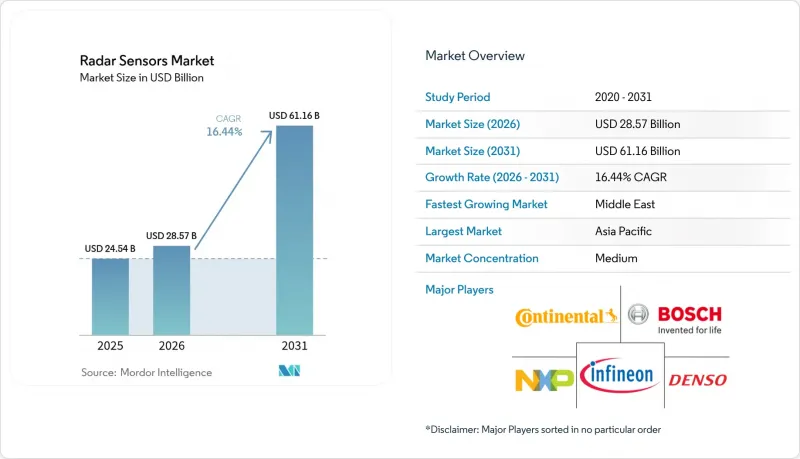
據 Mordor Intelligence 稱,雷達感測器市場預計將從 2025 年的 245.4 億美元成長到 2026 年的 285.7 億美元,到 2031 年達到 611.6 億美元,2026 年至 2031 年的複合年成長率為 16.44%。
本報告按類型(成像雷達、非成像雷達)、頻段(10 GHz 以下、24 GHz、60–64 GHz、77–81 GHz、94 GHz 以上)、探測範圍(短程雷達感測器、中程雷達感測器、遠程雷達感測器)、技術(脈衝雷達等)、最終用戶(汽車、航太與國防等)和地區進行細分。市場預測以美元計價。
全球雷達感測器市場趨勢及洞察
擴大77-81 GHz雷達在汽車安全系統的應用。
歐洲新車安全評鑑協會 (Euro NCAP) 2025 年的評測協議將評估車輛在夜間偵測弱勢道路使用者的能力。這一幕要求雷達的仰角解析度小於 1 度。因此,零件製造商正在推廣 77–81 GHz 頻段的調頻連續波 (FMCW) 設計,其距離解析度比傳統的 24 GHz 頻段雷達高 10 倍。隨著中國於 2026 年 1 月強制實施自動緊急煞車系統,所有新乘用車都將被要求至少配備三個角雷達和一個前視成像單元,預計量產將立即啟動。電訊(ITU) 對 76–81 GHz 頻段的全球統一分配,提供了監管確定性,促進了晶圓廠的投資,並降低了單位成本。 Mobileye 與歐洲領先汽車製造商簽訂的多車型合約進一步表明,雷達、LiDAR和攝影機數據正朝著整合到單一軟體平台的方向發展。綜合這些因素,預計到 2025 年至 2027 年間,每輛車的感測器數量將從 1.8 個增加到 2.6 個。
對用於無人機地形測繪的緊湊型成像雷達的需求正在迅速成長。
安裝在小型無人機上的四維成像雷達能夠穿透煙霧、茂密的植被和暴雨,產生公分級的高程模型,這是LiDAR在類似條件下無法實現的。 HiRain公司的LRR615模組以30幀/秒的速度每幀進行2000次探測,從而能夠對地形進行即時分類,用於自主著陸和野火評估任務。該公司與美國地質調查局(USGS)於2025年簽訂的合約將使測繪成本比直升機搭載的雷射雷達降低90%以上,從而開闢來自政府服務的持續收入來源。 Ambarella公司的虛擬孔徑技術可將無人機有效載荷重量降低40%,使用標準鋰聚合物電池組可將飛行時間延長至40分鐘以上。歐洲的「地平線」計畫正在資助更多用於農業的有效載荷,以追蹤土壤濕度和作物脅迫情況,這表明商業無人機服務供應商將採用成像雷達作為標準感測器,與頻譜相機並駕齊驅。
10 GHz 以下頻寬的頻率分配限制
行動網路監管機構已將3.3-3.8 GHz頻段重新分配給5G,迫使傳統的S波段氣象雷達要麼接受潛在的干擾,要麼遷移到更高的頻段。美國聯邦通訊委員會(FCC)在2025年提案中,針對海事相關人員申訴9.3 GHz卡車系統干擾船舶X波段顯示器的問題,限制了10 GHz以下車載雷達的使用,僅限緊急車輛使用。歐洲電信標準化協會(ETSI)將24 GHz短程雷達的輸出功率限制在20 dBm,使其有效探測距離僅30米,迫使供應商轉向更昂貴的77 GHz晶片。印度2025年的頻率競標減少了機場監控的頻寬,並強制要求進行價值4,200印度盧比(約5億美元)的升級。由於監管差異,日本在79 GHz頻段提供了4 GHz的頻寬,而韓國僅分配了1 GHz,迫使汽車製造商在不同地區維護不同的硬體版本。
細分市場分析
到2025年,成像雷達將佔據雷達感測器市場49.46%的佔有率,預計到2031年將以16.83%的複合年成長率成長,因為汽車製造商將採用成本僅為雷射雷達十分之一的點雲識別技術,其性能可與LiDAR相媲美。 Zadar Labs於2026年1月收購Fusionride,顯示對軟體定義協定堆疊的投資正在增加,該協定堆疊無需硬體變更即可透過無線電進行演算法更新。 2025年,非成像系統仍保持50.54%的市場佔有率,因為在不需要高度數據的氣象監測和空中交通管制領域,成熟的脈衝多普勒方法仍然是標準。然而,混合動力汽車架構現在將一個成像單元與四個非成像模組相結合,以滿足歐洲新車安全評鑑協會(Euro NCAP)的五星標準,同時將每輛車的感測器組件成本控制在180美元以下。因此,隨著每個前向模組的大規模生產成本降至45美元以下,預計到2028年,成像雷達的銷售量將超過傳統設計。
晶片組的創新也推動了這一成長動能。 Arbe Robotics 的虛擬孔徑合成技術每幀可實現超過 2000 次檢測,而傳統的調頻連續波 (FMCW) 系統每幀僅能檢測 64 次,即使在夜間也能實現更可靠的行人識別。汽車製造商正透過訂閱功能將這種高解析度轉化為收益,用戶購買後即可使用高級自動駕駛功能,從而將雷達從一次性硬體成本轉變為能夠持續產生收入的軟體平台。然而,77-81 GHz 頻段的大氣衰減會降低訊號雜訊比,削弱成像雷達在 250 公尺以外的優勢。因此,對於每天運作超過 5 小時的主動式車距維持定速系統,貨運卡車 OEM 仍然傾向於使用非成像遠端模組。總體而言,預計到預測期結束時,成像解決方案將佔據雷達感測器市場最大的佔有率。
電訊(ITU) 將 77–81 GHz 頻段指定為汽車短程雷達的全球標準,該頻段支援矽鍺晶片生產的規模經濟,預計到 2025 年將佔銷售額的 43.89%。德克薩斯(TI) 的 AWR2944 系列產品,其藍圖94 GHz 的工作頻率和 10 GHz 的瞬時頻寬,預計到 2031 年,W 波段的複合年成長率 (CAGR) 將達到 17.41%。 10 GHz 以下的雷達對於地面穿透和穿牆成像至關重要,其複合年成長率為 15.2%,但由於 5G 服務的擴展,其市場佔有率受到干擾,儘管土木工程測繪領域的需求依然存在,但其市場佔有率卻在萎縮。監管政策的變化正在加速向 77–81 GHz 平台的轉變,迫使供應商要么放棄 24 GHz 的汽車設計,要么接受探測範圍限制在 30 公尺的現實。
在汽車產業之外,60-64 GHz頻段的免授權設備在智慧建築人員佔用偵測領域的應用正迅速成長。英飛凌的BGT60TR13C能夠透過石膏板在10公尺範圍內偵測呼吸聲,並在一個試驗維修專案中將暖通空調系統的能耗降低了18%。國防系統整合商正將目光投向94 GHz頻段,用於製造緊湊型探求者頭,因為其更寬的掃描寬度能夠實現無人機任務所需的亞厘米級解析度。在此背景下,隨著晶圓代工廠擴大氮化鎵製程的量產,預計到2029年W波段矽的價格將下降35%,而到2031年,94 GHz頻段預計將佔據雷達感測器市場12%以上的佔有率。
區域分析
預計到2025年,亞太地區將佔據雷達感測器市場34.59%的佔有率,複合年成長率(CAGR)為16.8%。這主要得益於中國L2+級自動駕駛法規的實施,該法規要求所有新乘用車至少配備四個雷達感測器;以及印度為國防雷達升級累計726億美元。到2025年,中國將佔該地區需求的一半以上,因為中國本土供應商的成像模組價格比西方競爭對手低25%,加速了其在量產電動車的訂單。印度仍然是成長最快的國家,複合年成長率為18.3%,這主要得益於商用卡車碰撞預警法規的實施以及對國產Uttam AESA雷達的大量訂單。由於汽車生產基地萎縮,日本的複合年成長率僅15.6%,不過電裝(Denso)和日立Astemo正在擴大用於高階混合動力汽車的94 GHz泊車雷達的量產。韓國受益於「新政 2.0」提供的 12 兆韓元補貼,這使得現代和起亞能夠為其車型配備 L3 安全系統,並導致到 2031 年的區域出貨量預測被上調。
預計到2025年,歐洲將佔全球電動車銷量的26.1%,年複合成長率(CAGR)為16.2%。這主要得益於歐盟通用安全法規2(GSR 2),該法規強制要求所有在2024年7月之後推出的新平台必須配備智慧速度輔助、車道維持和緊急煞車系統。到2025年,德國將佔據歐洲雷達感測器市場38%的佔有率。這主要歸功於大眾、寶馬和梅賽德斯-奔馳在其電動車架構中實現了成像單元的標準化。同時,英國在該地區的成長速度更快,年複合成長率達到17.1%。這主要得益於英國斥資8.5億英鎊進行的L4級自動駕駛汽車公共示範測試,該測試要求配備冗餘感測器組,包括每輛測試車輛配備兩個成像雷達。法國和義大利的成長率也達到了15%左右,但由於電動車普及速度較慢以及獎勵,兩國並未躋身領先行列。修訂後的 EN 302 858 功率限制從 55 dBm 提高到 58 dBm,於 2025 年 9 月生效,使得使用單個 77 GHz 單元即可滿足主動車距控制巡航系統的要求,而此前自適應巡航控制需要雙感測器對。
預計2025年,北美將佔英飛凌全球銷量的28.3%,複合年成長率(CAGR)為15.9%。這主要得益於美國國家公路交通安全管理局(NHTSA)提案每年強制1700萬輛輕型車輛安裝自動緊急煞車系統(AEB)。由於加拿大12億加幣的策略創新基金,英飛凌預計將於2026年第三季在渥太華運作其在北美的首條模組化生產線,從而增強整個北美地區的供應鏈韌性。英飛凌位於墨西哥瓜達拉哈拉和蒙特雷的工廠目前組裝該地區總產量的18%,這得益於其人事費用比美國平均水平低40%,以及毗鄰德克薩斯州和密西根州組裝廠的地理優勢。南美洲佔全球銷售量的4.2%,其中巴西佔68%,但由於平均售價較低,巴西在先進駕駛輔助系統(ADAS)方面的預算有限,且雷達普及率低於12%。中東和非洲合計佔6.9%,但中東地區複合年成長率最高,達17.46%。這是因為沙烏地阿拉伯的NEOM項目和阿拉伯聯合大公國的關鍵基礎設施計畫等項目,都需要在所有新建交通走廊安裝交通和周邊監控雷達。
其他好處:
- Excel格式的市場預測(ME)表
- 3個月的分析師支持
目錄
第1章:引言
- 研究假設和市場定義
- 調查範圍
第2章:調查方法
第3章執行摘要
第4章 市場狀況
- 市場概覽
- 市場促進因素
- 汽車安全系統中77-81 GHz頻段雷達的擴展
- 無人機地形測繪用小型成像雷達的需求激增。
- 亞太地區軍方加大對主動相控陣雷達(AESA雷達)的投入。
- 工業機器人防碰撞領域對毫米波感測器的需求日益成長。
- 促進歐洲智慧高速公路和交通監控雷達的基礎建設
- 在氣候變遷背景下,沿海地區引入多普勒天氣雷達
- 市場限制因素
- 10 GHz 以下頻段頻率分配的限制
- 成像雷達陣列的校準和維護成本很高
- 高功率毫米波晶片組的溫度控管挑戰
- 零售業圍繞3D人員追蹤雷達的資料隱私問題
- 產業價值鏈分析
- 監理展望
- 技術展望
- 宏觀經濟因素對市場的影響
- 波特五力分析
第5章 市場規模與成長預測
- 按類型
- 成像雷達
- 非成像雷達
- 按頻段
- 小於 10 GHz
- 24 GHz
- 60~64 GHz
- 77~81 GHz
- 94 GHz 或更高
- 檢測距離
- 短程雷達感測器
- 中程雷達感測器
- 遠程雷達感測器
- 透過技術
- 脈衝雷達
- 調頻連續波雷達
- 相位陣列/AESA雷達
- 數位調變與MIMO雷達
- 最終用戶
- 車
- 航太/國防
- 安全監控(固定和移動)
- 工業自動化與機器人技術
- 環境和氣象監測
- 交通監控和智慧基礎設施
- 醫療保健和輔助住宅
- 其他最終用戶
- 按地區
- 北美洲
- 美國
- 加拿大
- 墨西哥
- 南美洲
- 巴西
- 阿根廷
- 其他南美國家
- 歐洲
- 英國
- 德國
- 法國
- 義大利
- 其他歐洲國家
- 亞太地區
- 中國
- 日本
- 印度
- 韓國
- 其他亞太國家
- 中東和非洲
- 中東
- 阿拉伯聯合大公國
- 沙烏地阿拉伯
- 其他中東國家
- 非洲
- 南非
- 埃及
- 其他非洲國家
- 中東
- 北美洲
第6章 競爭情勢
- 市場集中度
- 策略性舉措(併購、資金籌措、合作)
- 市佔率分析
- 公司簡介
- Robert Bosch GmbH
- Continental AG
- Infineon Technologies AG
- NXP Semiconductors NV
- Denso Corporation
- Hella GmbH and Co. KGaA
- Veoneer Inc.
- STMicroelectronics NV
- Texas Instruments Incorporated
- Analog Devices Inc.
- Renesas Electronics Corporation
- Aptiv PLC
- ZF Friedrichshafen AG
- Valeo SA
- Hitachi Astemo Ltd.
- Smart Microwave Sensors GmbH
- InnoSenT GmbH
- Baumer Group
- Banner Engineering Corp.
- Lockheed Martin Corporation
- Raytheon Technologies Corp.
- Northrop Grumman Corp.
- Thales Group
- Honeywell International Inc.
- Arbe Robotics Ltd.
- Uhnder Inc.
- Echodyne Corp.
- Oculii Corporation
第7章 市場機會與未來展望
According to Mordor Intelligence, the radar sensors market size is expected to increase from USD 24.54 billion in 2025 to USD 28.57 billion in 2026 and reach USD 61.16 billion by 2031, growing at a CAGR of 16.44% over 2026-2031.
This report is Segmented by Type (Imaging Radar, and Non-Imaging Radar), Frequency Band (Less Than 10 GHz, 24 GHz, 60-64 GHz, 77-81 GHz, 94 GHz and Above), Range (Short-Range Radar Sensor, Medium-Range Radar Sensor, Long-Range Radar Sensor), Technology (Pulsed Radar, and More), End-User (Automotive, Aerospace and Defense, and More), and Geography. The Market Forecasts are Provided in Terms of Value (USD).
Global Radar Sensors Market Trends and Insights
Increasing Adoption of 77-81 GHz Radars in Automotive Safety Systems
Euro NCAP's 2025 protocol rewards vehicles that detect vulnerable road users at night, a scenario that requires radar with sub-degree elevation resolution. Component makers have therefore standardized on 77-81 GHz frequency-modulated continuous-wave designs that offer ten-times finer range resolution than 24 GHz legacy sets. China's January 2026 mandate for automatic emergency braking pushes every new passenger car to include at least three corner radars and one forward-facing imaging unit, triggering immediate scale production. Consistent global allocation of the 76-81 GHz band by the International Telecommunication Union offers regulatory certainty, encouraging wafer-fab investments and lowering per-unit costs. Mobileye's multi-model agreement with a leading European automaker further signals the consolidation of radar, lidar, and camera data into a single software platform. Collectively, these forces are projected to lift automotive penetration from 1.8 to 2.6 sensors per light vehicle between 2025-2027.
Surging Demand for Compact Imaging Radars in Drone-Based Terrain Mapping
Four-dimensional imaging radar mounted on small unmanned aircraft can pierce smoke, dense foliage, and heavy rain to create centimeter-level elevation models that lidar cannot deliver under the same conditions. HiRain's LRR615 module outputs 2,000 detections per frame at 30 fps, providing real-time terrain classification for autonomous landing and wildfire assessment missions. U.S. Geological Survey contracts issued in 2025 have cut survey costs by more than 90% versus helicopter-based lidar, opening a recurring government services revenue stream. Ambarella's virtual-aperture technique reduces drone payload mass by 40%, extending flight times beyond 40 minutes with standard lithium-polymer packs. Europe's Horizon projects fund additional agriculture-focused payloads that track soil moisture and crop stress, suggesting that commercial drone service providers will adopt imaging radar as a standard sensor alongside multispectral cameras.
Spectrum Allocation Constraints in Sub-10 GHz Bands
Mobile-network regulators have reassigned 3.3-3.8 GHz for 5G, forcing legacy S-band weather radars to accept potential interference or migrate to higher frequencies. The FCC's 2025 proposal restricts automotive radar below 10 GHz to emergency vehicles, after maritime complaints that 9.3 GHz truck systems corrupt ship-borne X-band displays. ETSI caps 24 GHz short-range radar at 20 dBm, limiting effective range to 30 m and pushing suppliers toward costlier 77 GHz chips. India's 2025 spectrum auction reduced bandwidth for airport surveillance, obliging upgrades worth INR 4,200 crore (USD 500 million). Divergent rules: Japan offers 4 GHz bandwidth at 79 GHz, while South Korea grants only 1 GHz, forcing automakers to maintain region-specific hardware versions.
Other drivers and restraints analyzed in the detailed report include:
- Rising Military Spend on Active Electronically Scanned Array Radars in Asia-Pacific
- Growing Need for mm-Wave Sensors in Industrial Robot Collision Avoidance
- High Calibration and Maintenance Cost of Imaging Radar Arrays
For complete list of drivers and restraints, kindly check the Table Of Contents.
Segment Analysis
Imaging radar accounted for 49.46% of the radar sensors market share in 2025, expanding at a 16.83% CAGR through 2031 as automakers adopt point-cloud perception comparable to lidar at one-tenth the cost. Zadar Labs' January 2026 acquisition of Fusionride underscores rising investment in software-defined stacks that allow over-the-air algorithm updates without hardware changes. Non-imaging systems retained 50.54% in 2025 because long-proven pulsed-Doppler systems remain the standard for weather monitoring and air traffic control, where elevation data are unnecessary. Yet hybrid vehicle architectures now pair one imaging unit with four non-imaging modules to satisfy Euro NCAP's five-star protocol while capping sensor bills of materials below USD 180 per vehicle. Consequently, imaging radar's revenue is projected to overtake legacy designs by 2028 as volume pricing falls under USD 45 per forward-facing module.
Growth momentum also stems from chipset innovation. Arbe Robotics' virtual-aperture synthesis yields more than 2,000 detections per frame, compared with 64 in classic frequency-modulated continuous-wave systems, enabling reliable pedestrian classification at night. Automakers monetize this resolution through subscription features that unlock higher levels of autonomy post-sale, shifting radar from a one-time hardware cost to a recurring software platform. However, imaging radar's advantage narrows beyond 250 m because atmospheric attenuation at 77-81 GHz degrades signal-to-noise ratio, so freight-truck OEMs still favor non-imaging long-range modules for adaptive cruise control duty cycles that exceed 5 hours daily. Overall, imaging solutions are set to capture the largest share of the radar sensors market by the end of the forecast window.
The 77-81 GHz band accounted for 43.89% of 2025 revenue, as the International Telecommunication Union designates it the global standard for automotive short-range radar, supporting economies of scale in silicon-germanium chip production. Texas Instruments' AWR2944 family demonstrates a roadmap to 94 GHz operation with 10 GHz instantaneous bandwidth, catalyzing a 17.41% CAGR for the W-band segment through 2031. Sub-10 GHz radar, important for ground-penetrating and through-wall imaging, is growing at a 15.2% CAGR but faces interference from expanding 5G services, trimming its share despite demand in civil engineering surveys. Regulatory shifts have already forced suppliers to migrate 24 GHz automotive designs or accept detection ranges capped at 30 m, accelerating the transition to 77-81 GHz platforms.
Beyond automotive, 60-64 GHz unlicensed devices are surging in smart-building occupancy sensing. Infineon's BGT60TR13C detects respiration through drywall up to 10 m, lowering HVAC energy use by 18% in pilot retrofits. Defense integrators are eyeing 94 GHz for compact seeker heads because wider sweep widths deliver the sub-centimeter resolution needed for counter-UAS missions. Against this backdrop, W-band silicon prices are forecast to fall 35% by 2029 as foundries ramp gallium-nitride processes, positioning 94 GHz to claim more than 12% of the radar sensors market size by 2031.
Complete Report Scope:
- By Type
- Imaging Radar
- Non-Imaging Radar
- By Frequency Band
- Less than 10 GHz
- 24 GHz
- 60-64 GHz
- 77-81 GHz
- 94 GHz and Above
- By Range
- Short-range Radar Sensor
- Medium-range Radar Sensor
- Long-range Radar Sensor
- By Technology
- Pulsed Radar
- Frequency-Modulated Continuous-Wave Radar
- Phased-Array / AESA Radar
- Digital Modulation and MIMO Radar
- By End-User
- Automotive
- Aerospace and Defense
- Security and Surveillance (Fixed and Mobile)
- Industrial Automation and Robotics
- Environment and Weather Monitoring
- Traffic Monitoring and Smart Infrastructure
- Healthcare and Assisted-Living
- Other End-Users
- By Geography
- North America
- United States
- Canada
- Mexico
- South America
- Brazil
- Argentina
- Rest of South America
- Europe
- United Kingdom
- Germany
- France
- Italy
- Rest of Europe
- Asia Pacific
- China
- Japan
- India
- South Korea
- Rest of Asia Pacific
- Middle East and Africa
- Middle East
- United Arab Emirates
- Saudi Arabia
- Rest of Middle East
- Africa
- South Africa
- Egypt
- Rest of Africa
- Middle East
- North America
Geography Analysis
Asia-Pacific commanded 34.59% of the radar sensor market share in 2025 and is expanding at a 16.8% CAGR, as China's Level 2+ mandate requires at least 4 sensors in every new passenger car and India earmarks USD 72.6 billion for defense radar upgrades. China generated more than half of regional demand in 2025 because domestic suppliers price imaging modules 25% below Western competitors, accelerating fitment across mass-market electric vehicles. India remains the fastest-growing country, with an 18.3% CAGR, driven by collision-warning rules for commercial trucks and large orders for indigenous Uttam AESA sets. A shrinking auto-production base tempers Japan's 15.6% CAGR, yet Denso and Hitachi Astemo are scaling 94 GHz parking radars for premium hybrids. South Korea benefits from KRW 12 trillion in New Deal 2.0 subsidies that underwrite Level 3 systems on Hyundai and Kia models, lifting regional shipment forecasts through 2031.
Europe delivered 26.1% of global revenue in 2025 and is sustaining a 16.2% CAGR, underpinned by the General Safety Regulation 2, which requires intelligent speed assistance, lane-keeping, and emergency braking on all new platforms after July 2024. Germany accounted for 38% of the continent's radar sensor market in 2025, as Volkswagen, BMW, and Mercedes-Benz standardized imaging units across electric-vehicle architectures. The United Kingdom is outpacing the region with a 17.1% CAGR because GBP 850 million in public trials of Level 4 shuttles require redundant sensor stacks, including two imaging radars per test vehicle. France and Italy post mid-teen growth but trail leaders due to slower electric-vehicle uptake and constrained incentive budgets. Revised EN 302 858 power limits, rising from 55 dBm to 58 dBm in September 2025, now allow a single 77 GHz unit to meet adaptive-cruise targets once handled by dual-sensor pairs.
North America accounted for 28.3% of 2025 revenue and is tracking a 15.9% CAGR, as the National Highway Traffic Safety Administration proposes an automatic emergency braking mandate covering 17 million light vehicles annually. Canada's CAD 1.2 billion Strategic Innovation Fund brings Infineon's first North American module line online in Ottawa by Q3 2026, enhancing continental supply resilience. Mexican plants in Guadalajara and Monterrey already assemble 18% of regional output, leveraging labor prices 40% below U.S. averages and proximity to Texas and Michigan assembly hubs. South America represents 4.2% of global revenue, with Brazil accounting for 68% of that total, yet radar penetration is below 12% because average transaction prices leave little budget for advanced driver-assistance systems. The Middle East and Africa together contribute 6.9%, though the Middle East clocks the fastest regional CAGR at 17.46%, as Saudi Arabia's NEOM project and the UAE's critical infrastructure programs require traffic and perimeter radars on every new corridor.
- Robert Bosch GmbH
- Continental AG
- Infineon Technologies AG
- NXP Semiconductors N.V.
- Denso Corporation
- Hella GmbH and Co. KGaA
- Veoneer Inc.
- STMicroelectronics N.V.
- Texas Instruments Incorporated
- Analog Devices Inc.
- Renesas Electronics Corporation
- Aptiv PLC
- ZF Friedrichshafen AG
- Valeo SA
- Hitachi Astemo Ltd.
- Smart Microwave Sensors GmbH
- InnoSenT GmbH
- Baumer Group
- Banner Engineering Corp.
- Lockheed Martin Corporation
- Raytheon Technologies Corp.
- Northrop Grumman Corp.
- Thales Group
- Honeywell International Inc.
- Arbe Robotics Ltd.
- Uhnder Inc.
- Echodyne Corp.
- Oculii Corporation
Additional Benefits:
- The market estimate (ME) sheet in Excel format
- 3 months of analyst support
TABLE OF CONTENTS
1 INTRODUCTION
- 1.1 Study Assumptions and Market Definition
- 1.2 Scope of the Study
2 RESEARCH METHODOLOGY
3 EXECUTIVE SUMMARY
4 MARKET LANDSCAPE
- 4.1 Market Overview
- 4.2 Market Drivers
- 4.2.1 Increasing Adoption of 77-81 GHz Radars in Automotive Safety Systems
- 4.2.2 Surging Demand for Compact Imaging Radars in Drone-based Terrain Mapping
- 4.2.3 Rising Military Spend on Active Electronically Scanned Array Radars in Asia-Pacific
- 4.2.4 Growing Need for mm-Wave Sensors in Industrial Robot Collision Avoidance
- 4.2.5 Infrastructure Push for Smart Highways and Traffic-Monitoring Radars in Europe
- 4.2.6 Climate-change-driven Uptake of Doppler Weather Radars in Coastal Regions
- 4.3 Market Restraints
- 4.3.1 Spectrum Allocation Constraints in Sub-10 GHz Bands
- 4.3.2 High Calibration and Maintenance Cost of Imaging Radar Arrays
- 4.3.3 Thermal Management Challenges in High-power mm-Wave Chipsets
- 4.3.4 Data-privacy Concerns over 3-D People-tracking Radars in Retail
- 4.4 Industry Value Chain Analysis
- 4.5 Regulatory Outlook
- 4.6 Technological Outlook
- 4.7 Impact of Macroeconomic Factors on the Market
- 4.8 Porter's Five Forces Analysis
- 4.8.1 Bargaining Power of Suppliers
- 4.8.2 Bargaining Power of Buyers
- 4.8.3 Threat of New Entrants
- 4.8.4 Threat of Substitutes
- 4.8.5 Threat of Competitive Rivalry
5 MARKET SIZE AND GROWTH FORECASTS (VALUE)
- 5.1 By Type
- 5.1.1 Imaging Radar
- 5.1.2 Non-Imaging Radar
- 5.2 By Frequency Band
- 5.2.1 Less than 10 GHz
- 5.2.2 24 GHz
- 5.2.3 60-64 GHz
- 5.2.4 77-81 GHz
- 5.2.5 94 GHz and Above
- 5.3 By Range
- 5.3.1 Short-range Radar Sensor
- 5.3.2 Medium-range Radar Sensor
- 5.3.3 Long-range Radar Sensor
- 5.4 By Technology
- 5.4.1 Pulsed Radar
- 5.4.2 Frequency-Modulated Continuous-Wave Radar
- 5.4.3 Phased-Array / AESA Radar
- 5.4.4 Digital Modulation and MIMO Radar
- 5.5 By End-User
- 5.5.1 Automotive
- 5.5.2 Aerospace and Defense
- 5.5.3 Security and Surveillance (Fixed and Mobile)
- 5.5.4 Industrial Automation and Robotics
- 5.5.5 Environment and Weather Monitoring
- 5.5.6 Traffic Monitoring and Smart Infrastructure
- 5.5.7 Healthcare and Assisted-Living
- 5.5.8 Other End-Users
- 5.6 By Geography
- 5.6.1 North America
- 5.6.1.1 United States
- 5.6.1.2 Canada
- 5.6.1.3 Mexico
- 5.6.2 South America
- 5.6.2.1 Brazil
- 5.6.2.2 Argentina
- 5.6.2.3 Rest of South America
- 5.6.3 Europe
- 5.6.3.1 United Kingdom
- 5.6.3.2 Germany
- 5.6.3.3 France
- 5.6.3.4 Italy
- 5.6.3.5 Rest of Europe
- 5.6.4 Asia Pacific
- 5.6.4.1 China
- 5.6.4.2 Japan
- 5.6.4.3 India
- 5.6.4.4 South Korea
- 5.6.4.5 Rest of Asia Pacific
- 5.6.5 Middle East and Africa
- 5.6.5.1 Middle East
- 5.6.5.1.1 United Arab Emirates
- 5.6.5.1.2 Saudi Arabia
- 5.6.5.1.3 Rest of Middle East
- 5.6.5.2 Africa
- 5.6.5.2.1 South Africa
- 5.6.5.2.2 Egypt
- 5.6.5.2.3 Rest of Africa
- 5.6.5.1 Middle East
- 5.6.1 North America
6 COMPETITIVE LANDSCAPE
- 6.1 Market Concentration
- 6.2 Strategic Moves (M and A, Funding, Partnerships)
- 6.3 Market Share Analysis
- 6.4 Company Profiles (includes Global Level Overview, Market Level Overview, Core Segments, Financials as available, Strategic Information, Market Rank/Share, Products and Services, Recent Developments)
- 6.4.1 Robert Bosch GmbH
- 6.4.2 Continental AG
- 6.4.3 Infineon Technologies AG
- 6.4.4 NXP Semiconductors N.V.
- 6.4.5 Denso Corporation
- 6.4.6 Hella GmbH and Co. KGaA
- 6.4.7 Veoneer Inc.
- 6.4.8 STMicroelectronics N.V.
- 6.4.9 Texas Instruments Incorporated
- 6.4.10 Analog Devices Inc.
- 6.4.11 Renesas Electronics Corporation
- 6.4.12 Aptiv PLC
- 6.4.13 ZF Friedrichshafen AG
- 6.4.14 Valeo SA
- 6.4.15 Hitachi Astemo Ltd.
- 6.4.16 Smart Microwave Sensors GmbH
- 6.4.17 InnoSenT GmbH
- 6.4.18 Baumer Group
- 6.4.19 Banner Engineering Corp.
- 6.4.20 Lockheed Martin Corporation
- 6.4.21 Raytheon Technologies Corp.
- 6.4.22 Northrop Grumman Corp.
- 6.4.23 Thales Group
- 6.4.24 Honeywell International Inc.
- 6.4.25 Arbe Robotics Ltd.
- 6.4.26 Uhnder Inc.
- 6.4.27 Echodyne Corp.
- 6.4.28 Oculii Corporation
7 MARKET OPPORTUNITIES AND FUTURE OUTLOOK
- 7.1 White-space and Unmet-need Assessment

 雷達感測器市場規模、佔有率、成長、全球產業分析、區域趨勢及2026年至2034年預測。
 物聯網雷達感測器市場規模、佔有率和成長分析:按雷達類型、頻段、偵測功能、應用和地區分類-2026-2033年產業預測
 機器人雷達市場規模、佔有率和成長分析:按雷達類型、頻段、機器人類型、應用和地區分類-2026-2033年產業預測
 雷達感測器市場:全球市場預測(2026-2032)
 雷達感測器市場規模、佔有率和成長分析:按類型、探測範圍、應用、最終用戶、組件和地區分類-2026-2033年產業預測
 雷達感測器市場分析及預測(至2035年):類型、產品類型、技術、組件、應用、最終用戶、功能、安裝配置、解決方案非接觸式雷達市場:依產品類型、應用領域和頻率分類,全球預測(2026-2032年)
 智慧城市應用雷達感測器市場-全球產業規模、佔有率、趨勢、機會及預測:技術、組件、類型、頻率、應用、區域及競爭格局,2021-2031年微波雷達感測器模組市場按頻率、技術、距離類型、平台和應用分類,全球預測(2026-2032年)