


 |
市場調查報告書
商品編碼
2122243
分類系統:市場佔有率分析、產業趨勢與統計、成長預測(2026-2031)Sortation Systems - Market Share Analysis, Industry Trends & Statistics, Growth Forecasts (2026 - 2031) |
||||||

※ 本網頁內容可能與最新版本有所差異。詳細情況請與我們聯繫。
根據 Mordor Intelligence 預測,分類系統市場將從 2025 年的 59.6 億美元成長到 2026 年的 62.6 億美元,然後在 2031 年達到 80.2 億美元,2026 年至 2031 年的複合年成長率為 5.08%。
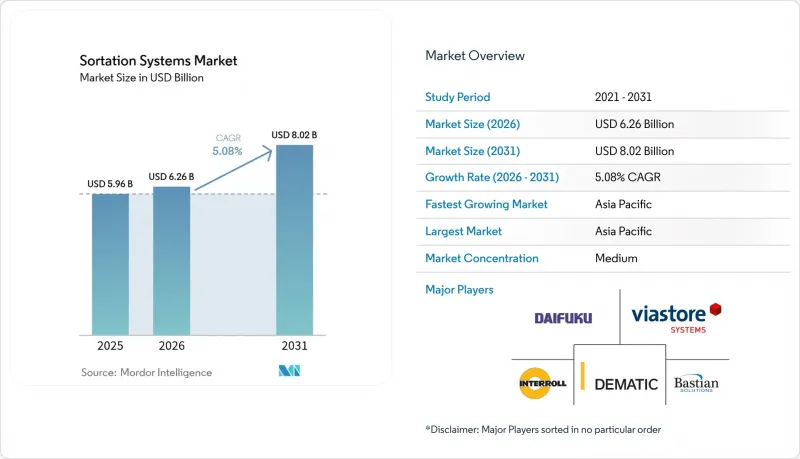
本報告按分類機類型(交叉帶式分揀機、傾斜托盤式分揀機、滑靴式分揀機等)、終端用戶行業(郵政和小包裹、電子商務和全通路零售、機場等)、產品(硬體和軟體)、處理能力(低速、中速等)以及地區進行細分。市場預測以美元計價。
全球分類系統市場趨勢及洞察
電子商務小包裹激增
小包裹數量的成長正在改變產能規劃的方式。預計2028年,美國每年處理的小包裹量將達到280億件,年增率為5%。中國的跨境經銷商正在加速數位轉型,並利用生成式人工智慧來提高需求預測的準確性,這使得物流中心能夠從被動應對高峰轉向基於預測的負載平衡。能夠自動適應貨量激增並即時調整路由規則的分類機,如今正在為旺季期間的業務連續性提供支援。
人事費用上升和勞動短缺
倉庫人事費用上升和熟練技術人員短缺給專案實施進度帶來了壓力。 63%的企業表示缺乏熟練勞動力是最大的障礙,預計到2020年代中期,供應鏈技術人員將有77萬個職缺。採購標準越來越重視遠距離診斷、簡化維護以及標稱處理能力。
高額資本投入與投資報酬率的不確定性
實施一套完整的分類系統需要數百萬美元的投入,以及設施維修。希望在18到24個月內獲得投資回報的企業通常會推遲實施,並傾向於選擇模組化附加組件,雖然這些組件可以延長投資回報期,但會損害長期效率。量化諸如降低客戶流失和提高客戶忠誠度等「軟性回報」仍然是一項具有挑戰性的任務。
細分市場分析
預計到2025年,交叉皮帶分類機將佔銷售額的37.60%,年成長率達7.52%,使其成為分類系統市場中規模最大、成長最快的細分市場。使用者讚賞其能夠處理形狀不規則的包裹而不降低分揀速度。在易碎品和尺寸統一的瓦楞紙箱普遍存在的環境中,傾斜托盤式和滑靴式分揀系統仍然發揮著至關重要的作用。窄帶式分類系統繼續在占地面積有限的老舊建築中得到應用。隨著營運商尋求更高的柔軟性和運轉率,彈出式滾輪和分流器式分類系統的使用率持續下降。
預計到2031年,交叉傳送帶平台分類系統市場規模將超過31.5億美元,這標誌著該市場正從利基市場穩步向主流市場轉型。同時,滑動式分類系統產品在分類系統市場中佔據中等個位數的佔有率,並呈現低個位數的成長,繼續適用於需要輕柔控制物料流動的服裝和小包裹轉運中心。
預計到2025年,電子商務和全通路零售商將佔銷售額的40.70%,年增率為7.18%。郵政和小包裹營運商仍是第二大細分市場,但利潤率面臨的壓力意味著自動化更多地成為一種成本削減工具,而不是成長催化劑。在機場,隨著樞紐機場對其行李傳送系統進行現代化改造,企劃為基礎的穩定業務機會正在湧現。食品、飲料和製藥業正在採用高精度分類技術以確保合規性,從而推動了配備眾多感測器的交叉傳送帶和高速托盤裝置的部署。
預計到2031年,電子商務領域將佔分類系統市場規模的32.7億美元以上。機場相關項目雖然波動較大,但在客運和貨運服務投資的推動下,可望實現中等個位數的複合年成長率。
區域分析
亞太地區在分類系統市場佔據主導地位,預計2025年將佔據35.90%的市場佔有率,並以8.25%的複合年成長率持續成長。在中國物流產業,人工智慧的應用使收貨效率提高了30%,配送效率提高了35%,這進一步推動了智慧分類機的應用。印度自動化進程的加速發展以DAIFUKU CO. LTD. )的2025年製造中心為例證,該中心旨在實現生產在地化並縮短前置作業時間。東南亞電子商務的蓬勃發展也推動了都市區微型倉配中心對彈性分類系統的投資。
北美仍然是主要的收入來源,這主要得益於機場行李處理系統的重組和小包裹中心的持續升級。由於許多首批設施已經自動化,成長速度已放緩至4%左右,支出正轉向現有設備、軟體的維修以及對永續性的投資。在歐洲,環保法規與營運績效之間需要取得平衡。業者正選擇節能馬達和可回收的傳送帶材料,以符合歐盟的循環經濟目標。
在中東和非洲,隨著海灣國家機場加大對樞紐功能的投資,以及非洲電子商務迅速超越傳統零售,需求已初現成長跡象。在南美洲,分類機正選擇性地引入大都會圈,這些地區不斷成長的小包裹量和人事費用證明了資本投資的合理性。巴西和智利的政策制定者已表示有意簡化海關程序,間接促進了出口導向物流園區引入分類機。
其他好處:
- Excel格式的市場預測(ME)表
- 3個月的分析師支持
目錄
第1章:引言
- 研究假設和市場定義
- 調查範圍
第2章:調查方法
第3章執行摘要
第4章 市場狀況
- 市場概覽
- 市場促進因素
- 電子商務帶來的小包裹數量激增
- 人事費用上升和勞動短缺
- 隨著 SKU 數量的快速成長,準確性變得越來越重要。
- 機場行李處理設施現代化
- 配備人工智慧視覺的動態分類機
- 永續性驅動的節能措施
- 市場限制因素
- 大額資本投資和投資報酬率的不確定性
- 熟練技術人員短缺
- 軟體層互通性差距
- 城市噪音法規
- 價值供應鏈分析
- 監理情勢
- 技術展望
- 波特五力模型
第5章 市場規模與成長預測
- 依分類機類型
- 交叉帶分類機
- 傾斜托盤分類機
- 滑鞋式分類分類機
- 窄頻分類機
- 推式托盤/分盤分類機
- 彈出式輪式分類機
- 按最終用戶行業分類
- 郵政和小包裹服務提供者
- 電子商務與全通路零售
- 機場(行李處理)
- 食品/飲料
- 藥品和醫療保健
- 第三方物流和合約物流
- 汽車和工業製造
- 報價
- 硬體
- 軟體
- 服務(安裝、MRO)
- 按處理能力
- 低速(低於3公里/小時)
- 中速(3k-10k)
- 高速(10k-25k)
- 速度超快(超過 25k)
- 按地區
- 北美洲
- 美國
- 加拿大
- 墨西哥
- 南美洲
- 巴西
- 阿根廷
- 其他南美國家
- 歐洲
- 德國
- 英國
- 法國
- 義大利
- 西班牙
- 荷蘭
- 其他歐洲國家
- 亞太地區
- 中國
- 日本
- 印度
- 韓國
- 澳洲和紐西蘭
- 東南亞
- 其他亞太國家
- 中東和非洲
- 海灣合作理事會(不包括沙烏地阿拉伯)
- 沙烏地阿拉伯
- 土耳其
- 南非
- 以色列
- 其他中東和非洲國家
- 北美洲
第6章 競爭情勢
- 市場集中度
- 策略趨勢
- 市佔率分析
- 公司簡介
- Daifuku Co., Ltd.
- Vanderlande Industries
- Honeywell Intelligrated
- Siemens Logistics
- Beumer Group GmbH
- Interroll Holding AG
- Dematic Corporation(KION Group)
- Murata Machinery Ltd.
- KNAPP AG
- Bastian Solutions
- Viastore Systems Gmbh
- SSI Schaefer
- TGW Logistics
- Fives Intralogistics
- BOWE SYSTEC
- Pitney Bowes
- Equinox MHE
- Falcon Autotech
- GBI Intralogistics
- OPEX Corporation
- Okura Yusoki
- Zebra Technologies(Fetch Robotics)
第7章 市場機會與未來展望
According to Mordor Intelligence, the sortation systems market size is expected to grow from USD 5.96 billion in 2025 to USD 6.26 billion in 2026 and is forecast to reach USD 8.02 billion by 2031 at 5.08% CAGR over 2026-2031.
This report is Segmented by Sorter Type (Cross-Belt Sorters, Tilt-Tray Sorters, Sliding-Shoe Sorters, and More), by End-User Industry (Post and Parcel, E-Commerce and Omnichannel Retail, Airport, and More), by Offering (Hardware, and Software), by Throughput Rate (Low-Speed, Medium-Speed, and More), and by Geography. The Market Forecasts are Provided in Terms of Value (USD).
Global Sortation Systems Market Trends and Insights
E-commerce parcel surge
Parcel growth reshapes capacity planning. United States annual parcel flow is forecast to hit 28 billion by 2028, a 5% yearly increase. Chinese cross-border sellers accelerate digitalisation and employ generative AI to improve demand forecasting, allowing facilities to move from reactive peaks to predictive load balancing.Sorters that self-adjust to volume spikes and shift routing rules on the fly now underpin peak-season resilience.
Labor-cost escalation & scarcity
Warehouse payroll inflation and technician shortages compress deployment timelines. A 63% majority of operators cite skilled labour gaps as the top obstacle, while 770,000 supply-chain technician vacancies are expected by mid-decade. Procurement criteria now weigh remote diagnostics and simplified maintenance as heavily as nominal throughput.
High capex & ROI uncertainty
Full-scale sorters require multimillion-dollar outlays plus facility remodelling. Operators demanding 18-24-month payback often delay adoption, favouring modular add-ons that can stretch ROI but impair long-term efficiency. Quantifying soft returns such as reduced churn and customer loyalty remains challenging.
Other drivers and restraints analyzed in the detailed report include:
- SKU proliferation demands accuracy
- Airport baggage-handling upgrades
- AI-vision powered dynamic sorters
- Sustainability-driven energy savings
- Skilled-technician shortage
For complete list of drivers and restraints, kindly check the Table Of Contents.
Segment Analysis
Cross-belt units generated 37.60% revenue in 2025 and are set to rise 7.52% annually, giving the sorter class the largest and fastest path within the sortation systems market. Facilities prefer its capability to handle irregular packages without speed loss. Tilt-tray and sliding-shoe equipment stay relevant where either fragile goods or uniform cartons dominate. Narrow-belt installations persist in legacy buildings with limited floor plates. Pop-up wheel and diverter systems continue to fade as operators pursue higher flexibility and uptime.
The sortation systems market size for cross-belt platforms is projected to exceed USD 3.15 billion by 2031, reflecting entrenched migration from niche to mainstream. Meanwhile, sliding-shoe products hold a mid-single-digit sortation systems market share and show low-single-digit expansion as they retain fit in apparel and parcel hubs demanding gentle flow control.
E-commerce and omnichannel retailers captured 40.70% of 2025 turnover and are increasing 7.18% annually. Post-and-parcel operators remain the second-largest cohort, yet margin pressure converts automation into a cost-containment lever rather than growth catalyst. Airports contribute stable, project-based opportunities as hubs modernise baggage loops. Food, beverage and pharma lines embrace high-accuracy sorting to honour compliance, fuelling adoption of sensor-laden cross-belt and high-speed tray units.
By 2031, the e-commerce segment is expected to command more than USD 3.27 billion of the sortation systems market size. Airport programmes, though lumpy, could achieve mid-single-digit CAGR on the back of combined passenger and cargo investments.
Complete Report Scope:
- By Sorter Type
- Cross-belt Sorters
- Tilt-tray Sorters
- Sliding-shoe Sorters
- Narrow-belt Sorters
- Push-tray / Split-tray Sorters
- Pop-up Wheel & Diverter Sorters
- By End-user Industry
- Post & Parcel Operators
- E-commerce & Omnichannel Retail
- Airports (Baggage Handling)
- Food & Beverages
- Pharmaceuticals & Healthcare
- 3PL & Contract Logistics
- Automotive & Industrial Manufacturing
- By Offering
- Hardware
- Software
- Services (Installation, MRO)
- By Throughput Rate
- Low-speed (<3k)
- Medium-speed (3k-10k)
- High-speed (10k-25k)
- Ultra High-speed (>25k)
- By Geography
- North America
- United States
- Canada
- Mexico
- South America
- Brazil
- Argentina
- Rest of South America
- Europe
- Germany
- United Kingdom
- France
- Italy
- Spain
- Netherlands
- Rest of Europe
- APAC
- China
- Japan
- India
- South Korea
- Australia & New Zealand
- Southeast Asia
- Rest of APAC
- Middle East & Africa
- GCC (ex-Saudi)
- Saudi Arabia
- Turkey
- South Africa
- Israel
- Rest of Middle East & Africa
- North America
Geography Analysis
APAC dominated the sortation systems market with 35.90% 2025 share and is expanding at 8.25% CAGR. China's logistics sector uses AI to lift collection efficiency 30% and delivery 35%, spurring further adoption of intelligent sorters. India's automation drive is illustrated by Daifuku's 2025 manufacturing complex designed to localise production and lower lead times. Southeast Asian e-commerce growth also channels investment into flexible sorting in urban micro-fulfilment nodes.
North America remains a core revenue pillar through airport baggage rebuilds and ongoing parcel-centre upgrades. Growth moderates to a mid-4% rate as many first-wave facilities are already automated, causing spend to pivot towards retrofits, software, and sustainability upgrades. Europe balances green mandates with performance. Operators favour energy-efficient motors and recyclable belt materials to align with EU circularity targets.
Middle East and Africa present nascent but rising demand as Gulf airports invest in hub capability and African e-commerce leapfrogs conventional retail. South America exhibits selective uptake in metropolitan corridors where parcel volumes and labour inflation justify capital outlays. Policymakers in Brazil and Chile have signalled intent to streamline customs processes, indirectly supporting sorter adoption in export-oriented logistics parks.
- Daifuku Co., Ltd.
- Vanderlande Industries
- Honeywell Intelligrated
- Siemens Logistics
- Beumer Group GmbH
- Interroll Holding AG
- Dematic Corporation (KION Group)
- Murata Machinery Ltd.
- KNAPP AG
- Bastian Solutions
- Viastore Systems Gmbh
- SSI Schaefer
- TGW Logistics
- Fives Intralogistics
- BOWE SYSTEC
- Pitney Bowes
- Equinox MHE
- Falcon Autotech
- GBI Intralogistics
- OPEX Corporation
- Okura Yusoki
- Zebra Technologies (Fetch Robotics)
Additional Benefits:
- The market estimate (ME) sheet in Excel format
- 3 months of analyst support
TABLE OF CONTENTS
1 INTRODUCTION
- 1.1 Study Assumptions and Market Definition
- 1.2 Scope of the Study
2 RESEARCH METHODOLOGY
3 EXECUTIVE SUMMARY
4 MARKET LANDSCAPE
- 4.1 Market Overview
- 4.2 Market Drivers
- 4.2.1 E-commerce parcel surge
- 4.2.2 Labor-cost escalation & scarcity
- 4.2.3 SKU proliferation demands accuracy
- 4.2.4 Airport baggage-handling upgrades
- 4.2.5 AI-vision powered dynamic sorters
- 4.2.6 Sustainability-driven energy savings
- 4.3 Market Restraints
- 4.3.1 High capex & ROI uncertainty
- 4.3.2 Skilled-technician shortage
- 4.3.3 Software-layer interoperability gaps
- 4.3.4 Urban-noise compliance limits
- 4.4 Value / Supply-Chain Analysis
- 4.5 Regulatory Landscape
- 4.6 Technological Outlook
- 4.7 Porter's Five Forces
- 4.7.1 Bargaining Power of Suppliers
- 4.7.2 Bargaining Power of Buyers
- 4.7.3 Threat of New Entrants
- 4.7.4 Threat of Substitutes
- 4.7.5 Competitive Rivalry
5 MARKET SIZE AND GROWTH FORECASTS (VALUE)
- 5.1 By Sorter Type
- 5.1.1 Cross-belt Sorters
- 5.1.2 Tilt-tray Sorters
- 5.1.3 Sliding-shoe Sorters
- 5.1.4 Narrow-belt Sorters
- 5.1.5 Push-tray / Split-tray Sorters
- 5.1.6 Pop-up Wheel & Diverter Sorters
- 5.2 By End-user Industry
- 5.2.1 Post & Parcel Operators
- 5.2.2 E-commerce & Omnichannel Retail
- 5.2.3 Airports (Baggage Handling)
- 5.2.4 Food & Beverages
- 5.2.5 Pharmaceuticals & Healthcare
- 5.2.6 3PL & Contract Logistics
- 5.2.7 Automotive & Industrial Manufacturing
- 5.3 By Offering
- 5.3.1 Hardware
- 5.3.2 Software
- 5.3.3 Services (Installation, MRO)
- 5.4 By Throughput Rate
- 5.4.1 Low-speed (<3k)
- 5.4.2 Medium-speed (3k-10k)
- 5.4.3 High-speed (10k-25k)
- 5.4.4 Ultra High-speed (>25k)
- 5.5 By Geography
- 5.5.1 North America
- 5.5.1.1 United States
- 5.5.1.2 Canada
- 5.5.1.3 Mexico
- 5.5.2 South America
- 5.5.2.1 Brazil
- 5.5.2.2 Argentina
- 5.5.2.3 Rest of South America
- 5.5.3 Europe
- 5.5.3.1 Germany
- 5.5.3.2 United Kingdom
- 5.5.3.3 France
- 5.5.3.4 Italy
- 5.5.3.5 Spain
- 5.5.3.6 Netherlands
- 5.5.3.7 Rest of Europe
- 5.5.4 APAC
- 5.5.4.1 China
- 5.5.4.2 Japan
- 5.5.4.3 India
- 5.5.4.4 South Korea
- 5.5.4.5 Australia & New Zealand
- 5.5.4.6 Southeast Asia
- 5.5.4.7 Rest of APAC
- 5.5.5 Middle East & Africa
- 5.5.5.1 GCC (ex-Saudi)
- 5.5.5.2 Saudi Arabia
- 5.5.5.3 Turkey
- 5.5.5.4 South Africa
- 5.5.5.5 Israel
- 5.5.5.6 Rest of Middle East & Africa
- 5.5.1 North America
6 COMPETITIVE LANDSCAPE
- 6.1 Market Concentration
- 6.2 Strategic Moves
- 6.3 Market Share Analysis
- 6.4 Company Profiles (includes Global level Overview, Market level overview, Core Segments, Financials as available, Strategic Information, Market Rank/Share, Products & Services, Recent Developments)
- 6.4.1 Daifuku Co., Ltd.
- 6.4.2 Vanderlande Industries
- 6.4.3 Honeywell Intelligrated
- 6.4.4 Siemens Logistics
- 6.4.5 Beumer Group GmbH
- 6.4.6 Interroll Holding AG
- 6.4.7 Dematic Corporation (KION Group)
- 6.4.8 Murata Machinery Ltd.
- 6.4.9 KNAPP AG
- 6.4.10 Bastian Solutions
- 6.4.11 Viastore Systems Gmbh
- 6.4.12 SSI Schaefer
- 6.4.13 TGW Logistics
- 6.4.14 Fives Intralogistics
- 6.4.15 BOWE SYSTEC
- 6.4.16 Pitney Bowes
- 6.4.17 Equinox MHE
- 6.4.18 Falcon Autotech
- 6.4.19 GBI Intralogistics
- 6.4.20 OPEX Corporation
- 6.4.21 Okura Yusoki
- 6.4.22 Zebra Technologies (Fetch Robotics)
7 MARKET OPPORTUNITIES AND FUTURE OUTLOOK
- 7.1 White-space & Unmet-need Assessment


