


 |
市場調查報告書
商品編碼
2122180
智慧燃氣表:市場佔有率分析、產業趨勢與統計及成長預測(2026-2031)Smart Gas Meter - Market Share Analysis, Industry Trends & Statistics, Growth Forecasts (2026 - 2031) |
||||||

※ 本網頁內容可能與最新版本有所差異。詳細情況請與我們聯繫。
據 Mordor Intelligence 稱,2025 年智慧燃氣表市值為 22.4 億美元,預計到 2031 年將達到 37.8 億美元,而 2026 年為 24.4 億美元,預測期(2026-2031 年)的複合年成長率為 9.12%。
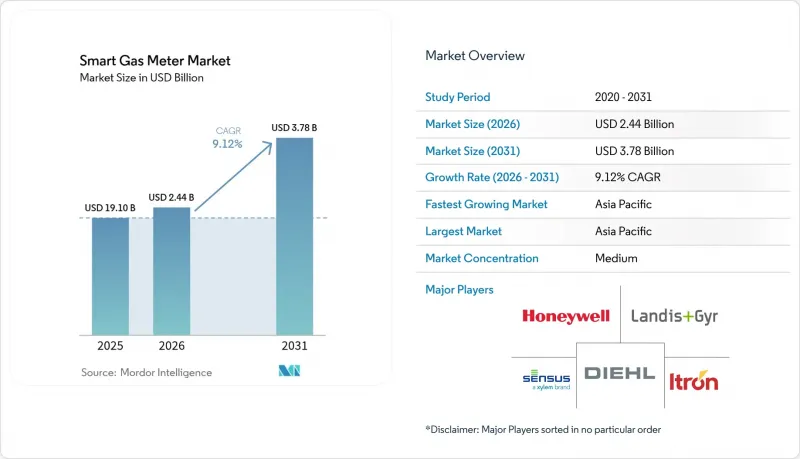
本報告按電錶類型(隔膜式、超音波、渦輪式、旋轉活塞式、MEMS/固態式)、通訊技術(射頻、PLC、GSM/GPRS、NB-IoT/LTE-M、LoRaWAN)、部署模式(AMR、AMI)、最終用戶(住宅、商業、工業)和地區進行細分。市場預測以價值(美元)和銷售量(出貨量)兩種形式呈現。
全球智慧燃氣表市場趨勢及洞察
強制性法規和大規模實施
各國政府不再僅僅鼓勵自願採用,而是設定嚴格的最後期限,強制公共產業採取行動,無論其內部投資報酬率面臨何種挑戰。澳洲能源市場委員會強制要求到2030年,住宅必須全面部署智慧燃氣表;德國則要求從2025年起,所有新建的熱泵設備都必須安裝瓦斯表。歐盟批准在電網中摻入高達2%的氫氣,這增加了新的合規要求,因為傳統的隔膜式燃氣表無法滿足精度標準。 FortisBC公司計劃在2025年至2028年間實施110萬個燃氣表的更換項目,這表明監管正在將自願投資轉變為強制採購。由於政策制定者將部署批准與資料保護標準掛鉤,因此擁有網路安全和互通性認證的供應商將獲得優先考慮。
降低公共產業公司的營運成本並提高計費準確性
公共產業正苦於應對不斷上漲的人事費用和人工抄表造成的延誤,而透過整合電力和天然氣系統,現場抄表次數可減少 80% 至 90%,同時計費準確率可從 95% 提升至 99.5%。英國國家電網公司 (National Grid) 的電力和天然氣整合實施案例表明,持續的資料流能夠實現分時電價,從而轉移用電需求並推遲成本高昂的高峰期擴容。洩漏偵測分析可減少不明原因的天然氣洩漏,降低安全事故發生率,從而在 15 年的電錶使用壽命週期內顯著節省營運成本 (OPEX)。這些經濟效益足以成為加快實施該系統的有力理由,即使在沒有強制要求的地區也是如此。
高額資本支出(CAPEX)和緩慢的投資報酬率(ROI)
智慧電錶的單價在 150 美元到 300 美元之間,而機械電錶的單價僅為 30 美元到 50 美元。如果將通訊回程傳輸、前端軟體和網路安全升級等費用也計算在內,總部署成本可能會翻倍。投資回收期長達 7 到 12 年,這與公共產業希望加快投資週期的偏好相違背。在新興市場,外匯波動和有限的優惠融資進一步加重了部署成本,尤其是對於用戶數量不到 10 萬的小規模地方政府公共產業而言。
細分市場分析
預計到2025年,隔膜式瓦斯表將佔智慧燃氣表市場規模的41.75%。這主要歸功於其在成本和現有安裝記錄方面的傳統優勢。超音波表雖然價格較高,但由於在氫氣污染和多種氣體混合使用等場景下對更高精度的需求,預計其複合年成長率將達到12.1%。
這種轉變趨勢在歐洲和日本最為顯著,監管機構已將超音波表的性能作為其氫氣合規標準的基準。燃氣業者傾向於選擇面向未來的設備,以避免隨著氫氣含量增加而可能產生的「擱淺成本」。 eTron 已交付超過一百萬台超音波表,展現了規模經濟效益和更高的可靠性。渦輪式和旋轉活塞式燃氣表在高流量工業細分市場仍然發揮重要作用,而基於 MEMS 的固態感測器仍處於早期階段,受到溫度漂移問題的限制。隨著產能的擴大,超音波燃氣表的標價自 2023 年以來已下降 18%,縮小了價格差距,並加快了智慧燃氣表市場的更新換代週期。
在歐洲,預計到 2025 年,工作頻率為 169 MHz 和 902–928 MHz 的射頻解決方案將佔據智慧燃氣表市場 38.10% 的佔有率。然而,NB-IoT/LTE-M 正以 10.72% 的複合年成長率快速成長,隨著公共產業利用其全國行動電話網路部署,其市場佔有率也在擴大。
蜂窩模組提供空中下載 (FOTA)韌體更新、運營商級安全保障和強大的室內穿透能力。在中國和義大利,國內營運商為公共產業提供折扣的 NB-IoT費率方案,顯著降低了連接的營運成本 (OPEX)。在公共產業希望擁有網路所有權的地區,例如亞伯達省的油田和印尼的農村地區,以及蜂窩網路覆蓋不足的地區,射頻 (RF) 技術仍然具有競爭力。電力線通訊 (PLC) 技術在一些電力線基礎設施已經完善的細分市場中仍然佔有一席之地,主要應用於歐洲的多用戶住宅。 LoRaWAN 技術則應用於人口稀少、需要遠距離、低位元率連接的地區。在預測期內,結合射頻網狀回程傳輸和 NB-IoT 邊緣冗餘的混合架構正在湧現,旨在最大限度地提高智慧燃氣表市場的可靠性。
區域分析
預計到2025年,亞太地區將以41.65%的市佔率主導智慧燃氣表市場,並將在2031年之前以15.2%的複合年成長率持續成長。在中國省級智慧城市預算中,燃氣表部署是一項優先事項;而日本的淨零排放藍圖則促使公共產業升級到與氫氣相容的設備。與進口產品相比,本地製造生態系統可將硬體成本降低12%至18%,進而提高專案內部報酬率(IRR)的運算效率。大阪瓦斯網路採用MEEQ SIM卡進行行動物聯網管理,象徵該地區在網路創新方面的領先地位。
北美仍然是全球第二大智慧燃氣表市場,該市場的發展受到系統性更新和網路安全法規的影響。 FortisBC計劃在2025年至2028年間部署110萬台設備,這清楚地表明了該地區智慧燃氣表市場穩步發展的態勢。將於2025年生效的聯邦能源監管委員會(FERC)網路安全標準將提高認證門檻,有利於擁有檢驗的加密協議堆疊的成熟供應商。此外,美國《通貨膨脹控制法案》中關於減少甲烷洩漏的獎勵進一步增強了智慧瓦斯表(AMI)普及的經濟效益。
在歐洲,由於地緣政治動盪和能源安全問題,對氫氣混合能源的需求日益成長,市場呈現強勁成長動能。德國2025年熱泵法規和英國力推100%氫能電網的舉措,都為採購提供了支持。歐盟的「韌性與復原基金」提供的補貼,幫助小規模配電業者(DSO)為高級計量基礎設施(AMI)升級提供資金,而隱私和互通性標準則確保了供應商的責任。
儘管中東和非洲的規模較小,但由於各國政府都在基於5.5G連接開發智慧城市項目,因此這兩個地區的成長速度也高於平均水準。在沙烏地阿拉伯的「NEOM」和阿拉伯聯合大公國的「Masdar城」中,NB-IoT智慧電錶已被明確納入總體規劃。雖然外匯波動和技術人員短缺等挑戰依然存在,但世界銀行的「EDGE舉措」等多邊組織正在介入,透過優惠貸款提供支持,減緩技術普及的步伐。
其他好處:
- Excel格式的市場預測(ME)表
- 3個月的分析師支持
目錄
第1章:引言
- 研究假設和市場定義
- 調查範圍
第2章:調查方法
第3章執行摘要
第4章 市場狀況
- 市場概覽
- 市場促進因素
- 監管義務和大規模部署
- 降低公共產業營運成本 (OPEX) 並確保帳單準確性
- 下游產業對天然氣的需求增加
- NB-IoT 和 LPWAN 可延長電池壽命並擴大通訊範圍。
- 強制更換老化的隔膜式流量計
- 過渡到具有關閉功能的超音波流量計,優先考慮安全性。
- 市場限制因素
- 資本投入大,投資報酬率低
- 與網路安全和資料隱私相關的風險
- 半導體和電池供應受限
- 混合車隊改裝中的互通性差距
- 價值鏈分析
- 監理情勢
- 天然氣消費統計數據
- 波特五力分析
- 評估宏觀經濟對市場的影響
第5章 市場規模與成長預測
- 依計量器類型
- 隔膜式
- 超音波
- 渦輪
- 旋轉活塞式
- 微機電系統/固態
- 透過通訊技術
- RF(169/868 MHz)
- PLC
- GSM/GPRS
- NB-IoT/LTE-M
- LoRaWAN
- 按部署模式
- 自動抄表(AMR)
- 先進計量基礎設施(AMI)
- 最終用戶
- 住宅
- 商業
- 產業
- 按地區
- 北美洲
- 美國
- 加拿大
- 墨西哥
- 南美洲
- 巴西
- 阿根廷
- 其他南美國家
- 歐洲
- 德國
- 英國
- 法國
- 義大利
- 西班牙
- 俄羅斯
- 其他歐洲國家
- 亞太地區
- 中國
- 日本
- 韓國
- 印度
- 澳洲和紐西蘭
- 其他亞太國家
- 中東
- 沙烏地阿拉伯
- 阿拉伯聯合大公國
- 土耳其
- 其他中東國家
- 非洲
- 南非
- 奈及利亞
- 其他非洲國家
- 北美洲
第6章 競爭情勢
- 市場集中度
- 策略趨勢
- 市佔率分析
- 公司簡介
- Landis+Gyr Group AG
- Itron Inc.
- Honeywell International Inc.
- Sensus(Xylem Inc.)
- Diehl Stiftung and Co. KG
- Wasion Group Holdings Limited
- Azbil Kimmon Co. Ltd.
- Apator SA
- Zenner International GmbH
- Pietro Fiorentini SpA
- AEM Limited
- Holley Technology Ltd.
- Secure Meters Ltd.
- Chongqing Shancheng Gas Equipment Co., Ltd.
- Flonidan A/S
- SICK AG
第7章 市場機會與未來展望
According to Mordor Intelligence, the smart gas meter market size was valued at USD 2.24 billion in 2025 and estimated to grow from USD 2.44 billion in 2026 to reach USD 3.78 billion by 2031, at a CAGR of 9.12% during the forecast period (2026-2031).
This report is Segmented by Meter Type (Diaphragm, Ultrasonic, Turbine, Rotary Piston, MEMS/Solid-state), Communication Technology (RF, PLC, GSM/GPRS, NB-IoT/LTE-M, Lorawan), Deployment Model (AMR, AMI), End-User (Residential, Commercial, Industrial), and Geography. The Market Forecasts are Provided in Terms of Value (USD) and Volume (Shipments).
Global Smart Gas Meter Market Trends and Insights
Regulatory Mandates and Mass Roll-outs
Governments have moved beyond voluntary adoption by setting hard deadlines that force utilities to act regardless of internal ROI hurdles. Australia's Energy Market Commission requires full residential smart gas coverage by 2030, while Germany mandates meters on all new heat-pump installations from 2025. The European Union's allowance of up to 2% hydrogen in distribution networks adds a compliance layer because legacy diaphragm devices cannot meet accuracy thresholds. FortisBC's 1.1 million-unit exchange running 2025-2028 illustrates how regulations convert discretionary investment into obligatory procurement. Vendors with certified cybersecurity and interoperability credentials are preferred as policymakers tie rollout approvals to data-protection standards.
Utility OPEX Reduction and Billing Accuracy
Utilities battling labor inflation and manual-reading delays can cut 80-90% of truck rolls while bumping billing accuracy from 95% to 99.5% . National Grid's combined electric-gas deployment shows that continuous data streams unlock time-of-use tariffs that shift demand and defer expensive peak-capacity upgrades. Leak-detection analytics reduce unaccounted-for gas losses and mitigate safety incidents, magnifying lifetime OPEX savings over 15-year meter lifecycles. These economic paybacks justify accelerated rollouts even in jurisdictions lacking direct mandates.
High CAPEX and Slow ROI
Smart meters cost USD 150-300 each versus USD 30-50 for mechanical units. When communications backhaul, head-end software, and cybersecurity upgrades are included, full-deployment costs can double. Payback periods stretch to 7-12 years, clashing with utilities' preference for quicker investment cycles. In emerging markets, foreign-exchange volatility and limited concessional funding widen the affordability gap, especially for small municipal utilities with sub-100,000 customer bases.
Other drivers and restraints analyzed in the detailed report include:
- Rising Downstream Natural-Gas Demand
- NB-IoT and LPWAN Boosting Battery Life and Coverage
- Cybersecurity and Data Privacy Risks
For complete list of drivers and restraints, kindly check the Table Of Contents.
Segment Analysis
Diaphragm devices accounted for 41.75% of the smart gas meters market size in 2025, a legacy advantage built on cost and incumbent installed base. Ultrasonic meters, though pricier, are projected to grow at a 12.1% CAGR as hydrogen blending and multi-gas scenarios demand higher accuracy bands.
The migration is most visible in Europe and Japan, where regulators reference ultrasonic performance in hydrogen-ready standards. Utilities prefer future-proof assets to avoid stranded costs should hydrogen ratios rise. Itron has shipped more than 1 million ultrasonic units, confirming scale economics and reliability gains. Turbine and rotary piston meters stay relevant in high-flow industrial niches, while MEMS-based solid-state sensors remain early-stage, constrained by temperature-drift concerns. With expanded production, ultrasonic list prices have fallen 18% since 2023, narrowing the gap and accelerating replacement cycles within the smart gas meters market.
RF solutions operating at 169 MHz in Europe and 902-928 MHz held 38.10% of the smart gas meters market share in 2025. However, NB-IoT/LTE-M is advancing at a 10.72% CAGR, taking share as utilities piggyback on nationwide cellular rollouts.
Cellular modules provide firmware-over-the-air, carrier-grade security, and deep indoor penetration. In China and Italy, national operators offer discounted NB-IoT tariffs to utilities, slashing connectivity OPEX. RF remains competitive in territories where utilities desire network ownership or cellular coverage is patchy, such as Alberta oil fields or rural Indonesia. PLC retains a niche where power-line infrastructure already exists, chiefly in European apartment blocks. LoRaWAN serves sparsely populated districts needing long-range, low-bit-rate connectivity. Over the forecast period, hybrid architectures combining RF mesh backhaul with NB-IoT edge redundancy are emerging to maximize reliability within the smart gas meters market.
Complete Report Scope:
- By Meter Type
- Diaphragm
- Ultrasonic
- Turbine
- Rotary Piston
- MEMS/Solid-state
- By Communication Technology
- RF (169/868 MHz)
- PLC
- GSM/GPRS
- NB-IoT/LTE-M
- LoRaWAN
- By Deployment Model
- Automatic Meter Reading (AMR)
- Advanced Metering Infrastructure (AMI)
- By End-user
- Residential
- Commercial
- Industrial
- By Geography
- North America
- United States
- Canada
- Mexico
- South America
- Brazil
- Argentina
- Rest of South America
- Europe
- Germany
- United Kingdom
- France
- Italy
- Spain
- Russia
- Rest of Europe
- Asia Pacific
- China
- Japan
- South Korea
- India
- Australia and New Zealand
- Rest of Asia Pacific
- Middle East
- Saudi Arabia
- United Arab Emirates
- Turkey
- Rest of the Middle East
- Africa
- South Africa
- Nigeria
- Rest of Africa
- North America
Geography Analysis
Asia Pacific dominated the smart gas meters market with a 41.65% share in 2025 and is advancing at a 15.2% CAGR through 2031. China's province-level smart-city budgets earmark gas metering as a priority, while Japan's net-zero roadmap forces utilities to upgrade to hydrogen-compatible devices. Local manufacturing ecosystems lower hardware costs by 12-18% versus imports, improving project IRR calculations. Osaka Gas Network's adoption of MEEQ SIM for mobile IoT management exemplifies the region's leadership in network innovation.
North America remains the second-largest smart gas meters market, shaped by structured replacement programs and cybersecurity regulation. FortisBC's 1.1 million-meter rollout running 2025-2028 illustrates the region's steady conversion pace. FERC cybersecurity standards, effective in 2025, elevate certification barriers, favoring established vendors with validated encryption stacks. The US Inflation Reduction Act's incentives for methane-leak reduction also sharpen the economic case for AMI adoption.
Europe shows robust growth driven by hydrogen blending and energy-security imperatives following geopolitical disruptions. Germany's 2025 heat-pump rule and the UK's push for 100% hydrogen-ready networks sustain procurement volume. Subsidy schemes under the EU Resilience and Recovery Facility help smaller DSOs finance AMI upgrades, while privacy and interoperability standards maintain vendor accountability.
The Middle East and Africa, though smaller, post above-average growth as governments deploy smart-city projects tied to 5.5G connectivity. Saudi Arabia's NEOM and the United Arab Emirates' Masdar City specify NB-IoT smart metering within master plans. Currency volatility and technical-skill shortages present challenges; however, multilaterals such as the World Bank's EDGE initiative are stepping in with concessional loans, smoothing adoption curves.
- Landis+Gyr Group AG
- Itron Inc.
- Honeywell International Inc.
- Sensus (Xylem Inc.)
- Diehl Stiftung and Co. KG
- Wasion Group Holdings Limited
- Azbil Kimmon Co. Ltd.
- Apator S.A.
- Zenner International GmbH
- Pietro Fiorentini S.p.A
- AEM Limited
- Holley Technology Ltd.
- Secure Meters Ltd.
- Chongqing Shancheng Gas Equipment Co., Ltd.
- Flonidan A/S
- SICK AG
Additional Benefits:
- The market estimate (ME) sheet in Excel format
- 3 months of analyst support
TABLE OF CONTENTS
1 INTRODUCTION
- 1.1 Study Assumptions and Market Definition
- 1.2 Scope of the Study
2 RESEARCH METHODOLOGY
3 EXECUTIVE SUMMARY
4 MARKET LANDSCAPE
- 4.1 Market Overview
- 4.2 Market Drivers
- 4.2.1 Regulatory mandates and mass roll-outs
- 4.2.2 Utility OPEX reduction and billing accuracy
- 4.2.3 Rising downstream natural-gas demand
- 4.2.4 NB-IoT and LPWAN boosting battery life and coverage
- 4.2.5 Mandatory replacement of ageing diaphragm meters
- 4.2.6 Safety-centric shift to ultrasonic meters w/ shut-off
- 4.3 Market Restraints
- 4.3.1 High CAPEX and slow ROI
- 4.3.2 Cybersecurity and data privacy risks
- 4.3.3 Semiconductor and battery supply constraints
- 4.3.4 Interoperability gaps in mixed-fleet retrofits
- 4.4 Value Chain Analysis
- 4.5 Regulatory Landscape
- 4.6 Natural-Gas Consumption Statistics
- 4.7 Porter's Five Forces Analysis
- 4.7.1 Bargaining Power of Suppliers
- 4.7.2 Bargaining Power of Buyers
- 4.7.3 Threat of New Entrants
- 4.7.4 Threat of Substitutes
- 4.7.5 Intensity of Rivalry
- 4.8 An Assessment of Macroeconomic Impact on the Market
5 MARKET SIZE AND GROWTH FORECASTS (VALUE AND VOLUME)
- 5.1 By Meter Type
- 5.1.1 Diaphragm
- 5.1.2 Ultrasonic
- 5.1.3 Turbine
- 5.1.4 Rotary Piston
- 5.1.5 MEMS/Solid-state
- 5.2 By Communication Technology
- 5.2.1 RF (169/868 MHz)
- 5.2.2 PLC
- 5.2.3 GSM/GPRS
- 5.2.4 NB-IoT/LTE-M
- 5.2.5 LoRaWAN
- 5.3 By Deployment Model
- 5.3.1 Automatic Meter Reading (AMR)
- 5.3.2 Advanced Metering Infrastructure (AMI)
- 5.4 By End-user
- 5.4.1 Residential
- 5.4.2 Commercial
- 5.4.3 Industrial
- 5.5 By Geography
- 5.5.1 North America
- 5.5.1.1 United States
- 5.5.1.2 Canada
- 5.5.1.3 Mexico
- 5.5.2 South America
- 5.5.2.1 Brazil
- 5.5.2.2 Argentina
- 5.5.2.3 Rest of South America
- 5.5.3 Europe
- 5.5.3.1 Germany
- 5.5.3.2 United Kingdom
- 5.5.3.3 France
- 5.5.3.4 Italy
- 5.5.3.5 Spain
- 5.5.3.6 Russia
- 5.5.3.7 Rest of Europe
- 5.5.4 Asia Pacific
- 5.5.4.1 China
- 5.5.4.2 Japan
- 5.5.4.3 South Korea
- 5.5.4.4 India
- 5.5.4.5 Australia and New Zealand
- 5.5.4.6 Rest of Asia Pacific
- 5.5.5 Middle East
- 5.5.5.1 Saudi Arabia
- 5.5.5.2 United Arab Emirates
- 5.5.5.3 Turkey
- 5.5.5.4 Rest of the Middle East
- 5.5.6 Africa
- 5.5.6.1 South Africa
- 5.5.6.2 Nigeria
- 5.5.6.3 Rest of Africa
- 5.5.1 North America
6 COMPETITIVE LANDSCAPE
- 6.1 Market Concentration
- 6.2 Strategic Moves
- 6.3 Market Share Analysis
- 6.4 Company Profiles (includes Global level Overview, Market level overview, Core Segments, Financials as available, Strategic Information, Market Rank/Share, Products and Services, Recent Developments)
- 6.4.1 Landis+Gyr Group AG
- 6.4.2 Itron Inc.
- 6.4.3 Honeywell International Inc.
- 6.4.4 Sensus (Xylem Inc.)
- 6.4.5 Diehl Stiftung and Co. KG
- 6.4.6 Wasion Group Holdings Limited
- 6.4.7 Azbil Kimmon Co. Ltd.
- 6.4.8 Apator S.A.
- 6.4.9 Zenner International GmbH
- 6.4.10 Pietro Fiorentini S.p.A
- 6.4.11 AEM Limited
- 6.4.12 Holley Technology Ltd.
- 6.4.13 Secure Meters Ltd.
- 6.4.14 Chongqing Shancheng Gas Equipment Co., Ltd.
- 6.4.15 Flonidan A/S
- 6.4.16 SICK AG
7 MARKET OPPORTUNITIES AND FUTURE OUTLOOK
- 7.1 White-space and Unmet-need Assessment

 智慧燃氣表市場-2026-2032年全球市場預測
 智慧燃氣表市場報告:按組件、類型、應用和地區分類(2026-2034 年)
 2026年全球智慧燃氣表市場報告日本智慧瓦斯表市場報告(按組件(硬體、軟體)、類型(自動計量基礎設施 (AMI)、自動抄表 (AMR))、最終用途(住宅、商業、工業)和地區分類,2026-2034 年)
 全球智慧瓦斯表市場
 全球智慧燃氣表市場(按技術、類型、組件、最終用戶和地區分類)- 預測至 2030 年
 智慧瓦斯表市場機會、成長動力、產業趨勢分析及 2025 - 2034 年預測
 智慧燃氣表市場規模、佔有率和成長分析(按組件、類型、技術、最終用戶和地區)- 2025-2032 年產業預測